Bridging Bonobo Components
Abdelmalek Squalli Houssaini
A dissertation submitted to the University of Dublin in partial
fulfilment of the requirements for the degree of Master of Science
in Computer Science
Declaration
I declare that the work described in this dissertation is, except where
otherwise stated, entirely my own work and has not been submitted
as an exercise for a degree at this or any other university.
Signed:
Permission to lend and/or copy
I agree that Trinity College Library may lend or copy this
dissertation upon request.
Signed:
Abstract
To manage the increasing complexity of software, many modern and large
ap-plications make use of components. GNOME, the free desktop environment for
UNIX like systems, has created its own component model, namely Bonobo.
The Bonobo component model is based on CORBA technology. Relying on
CORBA enables developers to access Bonobo components from different
pro-gramming languages and platforms. It also means that IIOP, the protocol that
guarantees interoperability between CORBA products, is used to communicate
with Bonobo components. However, most firewalls prevent IIOP communication.
This dissertation deals with bridging Bonobo components. In other words, it is
about accessing Bonobo components that are behind a firewall.
SOAP is an XML based protocol that uses HTTP for transporting its messages.
In order to bridge Bonobo components, we will build an IIOP to SOAP bridge and
vice versa. The system will redirect all the messages destined to the Bonobo
com-ponents into the bridge. As the bridge uses the HTTP protocol, all the messages
Acknowledgements
I would like to thank my supervisor Dr. Simon Dobson for his help and advice
throughout the year. I would also like to thank my family for their support and
encouragement. Finally, many thanks to all the classmates for their friendliness
Contents
1 Introduction 1
1.1 Project motivations . . . 3
1.2 Project goal . . . 3
1.3 Roadmap . . . 4
2 State of the Art 6 2.1 CORBA . . . 6
2.1.1 Distributed objects . . . 6
2.1.2 Object Request Brokers . . . 7
2.2 GNOME . . . 9
2.3 Bonobo . . . 11
2.4 SOAP . . . 12
2.5 ORBit . . . 14
2.6 Invoking an operation on a CORBA object . . . 15
2.6.1 Interface Definition Language . . . 15
2.6.2 Interoperable Object References . . . 18
2.7 IIOP to SOAP Bridge . . . 21
3.1.1 The GLib library . . . 25
3.1.2 The GTK+ object system . . . 26
3.1.3 The GTK+ type system . . . 29
3.2 Basis of Bonobo . . . 32
3.2.1 The Bonobo Unknown interface . . . 32
3.2.2 BonoboObject . . . 35
3.3 Bonobo objects . . . 38
3.3.1 Controls . . . 39
3.3.2 Property bags . . . 41
3.3.3 Containers . . . 44
3.3.4 Event Sources and Listeners . . . 46
4 Design 51 4.1 Requirements and assumptions . . . 51
4.2 Intercepting an IIOP message . . . 52
4.3 The Proxy Server . . . 54
4.4 From the SOAP server to the CORBA server . . . 55
4.5 Problems and their solutions . . . 56
5 Implementation 59 5.1 Bonobo application . . . 59
5.1.1 The server’s controls . . . 61
5.1.2 The container . . . 64
5.2 CORBA clients . . . 65
5.3 IIOP to SOAP Bridge . . . 66
5.3.1 From the SOAP Client to the SOAP Server . . . 67
5.3.2 The Proxy Server . . . 68
6 Conclusion 70 6.1 Work achieved . . . 70
6.2 Difficulties encountered . . . 71
List of Figures
1.1 Basic principle of the bridge . . . 4
2.1 ORB interoperability . . . 7
2.2 An ORB communicating a request to a target object implementation 8 2.3 The stub and skeleton interactions . . . 18
2.4 Essential elements of an IOR . . . 20
2.5 Getting through the firewall via the bridge . . . 22
3.1 A hierarchical tree of some Gtk objects . . . 27
3.2 Wrapping CORBA objects . . . 36
3.3 A hierarchical tree of some Bonobo objects . . . 39
3.4 Registering listeners with an event source . . . 47
4.1 IIOP to SOAP bridge . . . 53
Chapter 1
Introduction
Over the last decades, computer hardware capacity has grown rapidly. As a result,
computer software followed the move and has become more complex. It was
nec-essary to manage this complexity. At the same time, the trend was to move from
large mainframes to distributed systems. Remote Procedure Call (RPC) came then
in order to make remote function calls transparent to the programmer. During the
last decade, object oriented and client-server paradigms have become widespread,
allowing programmers to reduce software complexity. The next step forward was
towards distributed objects and software components.
Distributed object technologies came as a result of the object oriented and
client server paradigms. As customers no more accepted proprietary systems
be-cause of their limitations, a consortium was set up in order to provide a
com-mon architectural framework to vendors and to promote object oriented
soft-ware development. Consequently, the Object Management Group (OMG)
con-sortium has provided the most important distributed object technology, namely
the Common Object Request Broker Architecture (CORBA). OMG makes the
specifications and vendors implement them. In order to provide interoperability
Inter-ORB Protocol (IIOP) and a neutral language called Interface Definition Language
(IDL).
The adoption of component software technologies was motivated by reducing
the complexity of applications. This is achieved by reducing the amount of
infor-mation a programmer needs to know about the system. Component software also
enables programmers to build larger, more complex applications by glueing
dif-ferent components together into bigger applications [dI99]. In brief, components
enable to reuse code and to reduce software complexity.
The GNU Object Model Environment1 (GNOME) is a free desktop
environ-ment for UNIX like systems. GNOME developers needed a component
architec-ture for building large and powerful applications. This need resulted in the
foun-dation of Bonobo2.
Web services are a new distributed computing model. They are modular
appli-cations that can be located and invoked across the Web. Web services are based
on the Simple Object Access Protocol (SOAP). SOAP is a protocol that allows
in-voking remote methods over the HyperText Transfer Protocol (HTTP) using
mes-sages encoded in the Extensible Markup Language (XML). Talking about SOAP,
the CEO of Digital Creations said:
At long last, the Web has a complete platform strategy. Operating
sys-tems, programming languages, database technologies, and even
com-ponent models all disappear behind a straightforward Web API.
Furthermore, SOAP Security Extensions like Digital Signature are being
devel-oped so that they can be integrated with the most popular web security technology,
namely Secure Sockets Layer or SSL. By doing so, important security features
such as non-repudiation can be achieved.
1.1
Project motivations
Since components are intended to cooperate with each other, they usually rely on
a communication layer. GNOME developers decided that Bonobo should rely on
CORBA3. As a result, Bonobo components will communicate using IIOP and will
define their interfaces using IDL.
Most companies filter their network traffic by setting a firewall. Generally,
such a system prevents any IIOP communication. Therefore, it is impossible to
communicate with a Bonobo component that is behind a firewall.
Even though we assume that the firewall does not prevent IIOP
communica-tion, security issues would be of great concern. It would mean that further
devel-opment involving the use of the CORBA security service is necessary. Obviously,
this is only possible when the CORBA implementation supports the security
mod-ule.
Solving the firewall and security issues mentioned in the previous two
para-graphs will enable us to:
Communicate with Bonobo components even if they are behind a firewall.
Ensure that the communication is secure without much effort.
1.2
Project goal
Using SOAP to communicate with Bonobo components will enable us to solve
both the firewall and security issues. Indeed, it solves the first problem since SOAP
is based on HTTP which is a firewall friendly protocol. It also solves the second
problem since a security layer can be easily built on top of HTTP. Another reason
for using SOAP is that:
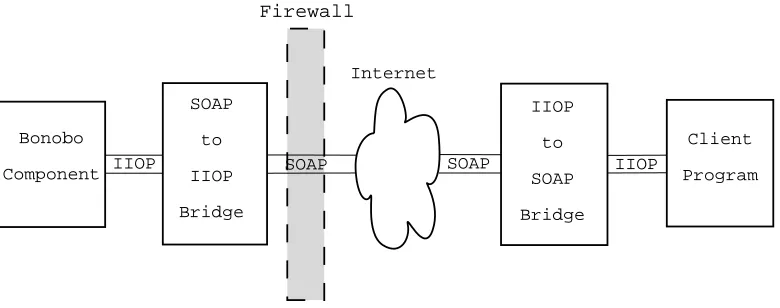
SOAP to IIOP Bridge Firewall SOAP IIOP IIOP to SOAP Bridge SOAP Internet Client Program IIOP Bonobo Component
Figure 1.1: Basic principle of the bridge
The existing Internet security infrastructure has embraced HTTP to
the point that trying to communicate across organizations using
any-thing other than HTTP requires an excessive amount of organizational
and engineering resources. [3]
This thesis is about addressing the issues mentioned above by building an IIOP
to SOAP bridge. Since it is possible to communicate with Bonobo components
using IIOP, building an IIOP to SOAP bridge will make it possible to communicate
with them using SOAP. Figure 1.1 shows how to bridge Bonobo components.
1.3
Roadmap
Here is the outline of the thesis:
The state of the art chapter starts with a general introduction to CORBA,
GNOME, Bonobo, SOAP and ORBit. Then it covers some CORBA details
related to the project, before giving an idea about the bridge.
The Bonobo chapter presents some details about the Bonobo technology.
chapter aim to provide a good basis for understanding Bonobo. The Bonobo
chapter is used in the implementation chapter but not in the design one.
In the design chapter, we examine the different issues relating to building
an IIOP to SOAP bridge and justify the decisions that have been taken.
The implementation chapter is about implementing and testing the bridge.
A Bonobo application and three CORBA clients will be used for the test
exactly as shown in figure 1.1.
In the conclusion chapter, we will discuss the work achieved, the difficulties
Chapter 2
State of the Art
2.1
CORBA
2.1.1
Distributed objects
Distributed object technologies allow objects to interact on different platforms
across the network. The OMG has played a major role into building the most
important distributed objects infrastructure namely CORBA. Other important
in-frastructures for developing distributed objects include:
Distributed Component Object Model (DCOM).
Enterprise Java Beans (EJBs).
Remote Method Invocation (RMI).
The OMG states that it is:
An open membership, not-for-profit consortium that produces and
maintains computer industry specifications for interoperable
ORB 1
NetworkORB 2
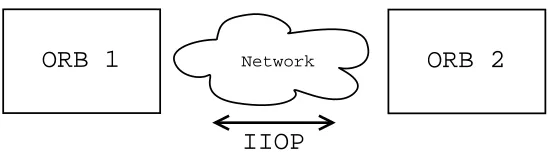
[image:16.612.160.435.75.151.2]IIOP
Figure 2.1: ORB interoperability
The OMG has about 800 memberships. They include virtually every large
com-pany in the computer industry, and hundreds of smaller ones [Obj]. The OMG
debates and publishes CORBA specifications, it does not implement them.
CORBA allows programs to communicate regardless of their programming
language, the platforms and machines they are running on. The communication
between heterogeneous programs is guaranteed due to the IIOP protocol. IIOP is
a TCP/IP1 based protocol specified by the OMG consortium.
In CORBA, an object is an instance of a class, which is defined by a set of
operations, attributes and exceptions. Every object provides well defined services
through its interface, and every object has a reference by which it is identified in
a distributed environment.
2.1.2
Object Request Brokers
An Object Request Broker (ORB) is an implementation of the CORBA
specifi-cations. Many ORBs are available. They differ in many ways. Some of them are
free, others are not. Figure 2.1 shows that different ORBs spread over the network
are able to interoperate via IIOP.
An ORB encapsulates the inherently heterogeneous aspects of the networks
and operating systems. Thus, an ORB is a middleware because:
Client
ORB
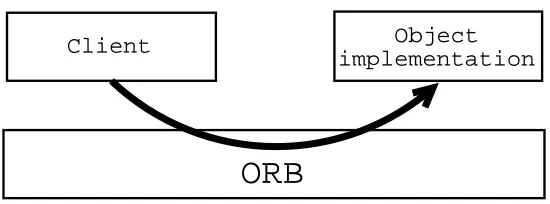
[image:17.612.160.435.74.176.2]Object implementation
Figure 2.2: An ORB communicating a request to a target object implementation
Middleware hides the underlying details from the application. It does
this by providing a common set of services across all the platforms on
which it lives. [Pop98]
An ORB can also be considered as a layer above the network and the operating
system.
Technically speaking, an ORB allows a client to transparently invoke an
oper-ation on a server object (Figure 2.2). The object can be either on the same machine
or across the network. Furthermore, the client need not to know the details of the
object, namely its programming language, its operating system, or any other
as-pect that is not reflected in its interface. Briefly, an ORB makes the communication
between a client and a server easier.
An ORB should accept requests, transport them to the appropriate object and
possibly return results. In others words, it is responsible for the transport,
marshal-ing and unmarshalmarshal-ing of messages. Marshalmarshal-ing consists of encodmarshal-ing messages and
putting them on the wire, while unmarshaling consists of decoding them from the
wire and placing them in an address space.
As was mentioned earlier, there are many differences between ORBs. Among
these differences are the performance in terms of speed and memory usage, the
language bindings provided and the CORBA services available.
Free ORBs: Red Hat’s ORBit, Sun’s Java IDL, Xerox’s ILU and MICO.
Vendor ORBs: IONA’s Orbix, IONA’s OrbixWeb2, OOC’s ORBacus3, and
Inprise’s VisiBroker4.
2.2
GNOME
Bonobo is the component model that derived from the GNOME project. GNOME
is a free desktop environment as well as a suite of powerful applications like the
spreadsheet Gnumeric, the word processor AbiWord or the file manager Nautilus.
GNOME is part of the GNU project which aims to provide free software for
Unix-like operating systems. As mentioned in the GNU website, free software
means that the user is free to run, copy, distribute, study, change and improve the
software5. The most important motivation for the GNOME project is freedom of
software:
GNOME arose from the need for a 100 percent free, open-source
desktop and application programming environment. [She00]
Not surprisingly, GNOME licensing terms are of utmost importance:
The keystone in GNOME’s declaration of freedom is the GNU Public
License, a clever software license from the Free Software Foundation
that mandates that the source code for all GPL6 software be freely
available. [She00]
2Free for Universities. 3Free for non-commercial use.
4Inprise was formerly known as Borland.
5Seehttp://www.gnu.org/philosophy/free-sw.htmlfor more information on the
mean-ing of free software.
KDE is also a desktop environment for Unix workstations. However, KDE is
based on a set of libraries called Qt which had a non-free license. Now, Qt’s license
is also GPL for the Linux and Unix platforms [Gwy00]. KDE can be considered
as GNOME’s competitor. Nevertheless, it is possible to run some KDE programs
from within GNOME and vice versa.
GNOME is distributed by several companies like Ximian, Red Hat, SuSe,
MandrakeSoft and Sun Microsystems. Theoretically, GNOME can run on any
UNIX-like platform supporting the X Windows System. Here are some of the
platforms that were successfully tested: Linux (any recent distribution), Solaris,
FreeBSD and NetBSD. Even though GNOME is based on the X Windows
Sys-tem, it is not tied to a specific window manager.
From the developer’s point of view, GNOME presents a powerful framework
for software development. Indeed, GNOME makes use of cutting edge
technolo-gies. Among the modules that make up the GNOME architecture are:
GTK+7: The toolkit for creating user interfaces.
ORBit: A thin and fast implementation of CORBA.
Bonobo: The architecture for creating reusable software components and
compound documents.
OAF8: A framework for activating CORBA servers.
7GTK+ stands for the GIMP toolkit, and GIMP stands for the GNU Image Manipulation
Pro-gram
2.3
Bonobo
Bonobo is the component model used in the GNOME project. It is largely
in-spired from Microsoft’s Object Linking and Embedding 2 (OLE2). However,
Bonobo relies on CORBA for its communication layer whereas OLE2 relies on
COM/DCOM.
Large GNOME applications like the spreadsheet Gnumeric, the file manager
Nautilus or the mail client and calendar Evolution make heavy use of Bonobo.
Other GNOME applications like the postscript viewer, the PDF viewer or the SVG
viewer also use Bonobo but in a smaller degree. Obviously, components built for
these applications may well be used in future applications.
Let’s suppose that a developer wants to write a mail client program that is
capable of dealing with attached files. The program should then be able to view
images, run videos, render HTML documents, etc. In this case, the use of
com-ponents should be considered. For example, there is no need for the program to
know how to plot images. This functionality should be provided by a component
like the image viewer Eye Of GNOME (EOG).
Bonobo is the framework that allows GNOME developers to create:
Components which are reusable pieces of software. Components help re-ducing the complexity of applications by rere-ducing the amount of
informa-tion a programmer needs to know about the system [dI99]. They also allow
the programmer to tackle a single problem in order to provide a specific
functionality. More importantly, they are easy to reuse and debug.
Furthermore, components present well defined interfaces and interactions:
The magic behind component programming is in the ”interfaces”
that a component export to the world. Each one of these
can plug into. [dI99]
In Bonobo, interfaces are described in IDL and interactions rely on CORBA.
CORBA can be considered as the glue between the cooperating
compo-nents.
Embeddable documents which are documents that can be inserted or em-bedded into other documents.
Controls which are graphical components. They are embedded in applica-tions called containers. Controls are studied in section 3.3.1.
Scripts which allow to manipulate an application through its Bonobo com-ponents. This is possible since components export their CORBA interfaces.
An example of scripting would be to manipulate a Gnumeric spreadsheet.
Technically speaking, Bonobo is a set of CORBA interfaces and their default
implementation in C. Bonobo uses the ORBit implementation of CORBA
dis-cussed in section 2.5. It also uses the GTK+ object and type systems examined in
section 3.1.
2.4
SOAP
SOAP provides a simple and lightweight mechanism for exchanging structured
and typed information between peers in a decentralized, distributed environment
using XML. SOAP does not itself define any application semantics such as a
pro-gramming model or implementation specific semantics. [BEK
00]
Even though the SOAP specification is not tied to a specific transport
making an RPC over HTTP. The method name and the types and values of the
pa-rameters are described in XML, and the message is transported by HTTP. The use
of XML encoding allow SOAP messages to be decoded easily on any platform.
Some experts believe that SOAP has a promising future because it allows to
build distributed applications based on open Internet standards. They also believe
that SOAP will succeed where other distributed technologies like CORBA and
DCOM have failed. The problem with CORBA is that even though ORBs from
different vendors do interoperate due to the IIOP protocol, this interoperability
does not apply for higher level services such as security and transaction
man-agement. Moreover, CORBA uses the Common Data Representation (CDR) for
encoding its messages which is not as widely used as XML. Finally, major
com-puter companies are backing SOAP and are trying to ensure the interoperability
between their implementations.9
SOAP is intended to solve the following problem:
Any time you read about a company porting an application to a
Web-based interface, you can conclude that they will be throwing millions
of dollars out the window in lost employee productivity.
Jakob Nielsen, Principal, Nielsen Norman Group
Actually, the major feature of SOAP is that:
It’s simpler and easier to implement than any existing alternative, and
makes better use of the pervasive Web infrastructure. The effect is that
you can pull a system together using SOAP in weeks not quarters.
Tim Bray, CEO, Antarcti.Ca
9For more information, see the article “Web services architect, Part 3: Is Web services the
2.5
ORBit
ORBit is the CORBA implementation that was written for the GNOME project.
All the Bonobo IDL interfaces are implemented using the ORBit ORB. GNOME
developers had considered the use of two ORBs before Elliot Lee and Dick Porter
decided to write a new one. They considered Xerox’s ILU but they couldn’t get
Xerox to modify its licensing terms. Then, they adopted MICO for a while but its
performance was quite poor. [LZM]
ORBit is a CORBA 2.2 compliant ORB. It was designed to have a high
per-formance, which means low memory usage and high speed. ORBit is written in
C and runs over multiple platforms. It has many language bindings including C,
Perl and C++. [1]
Most of the time Bonobo components will be running on the same process.
However they will be using ORBit for communicating. This seems a little bit
awkward since CORBA is primarily used for distributed objects in a networked
environment. Sending IIOP messages from the stub to the skeleton in order to
ac-cess a local object does not help performance. Actually, ORBit treats the case of a
local object separately. The shortcut is indeed included in the stub of every object.
Here is the shortcut used when calling the just hello method on the HelloWorld
object.
if (_obj->servant && _obj->vepv && HelloWorld__classid) {
((POA_HelloWorld__epv *) _obj->
vepv[HelloWorld__classid])->
just_hello(_obj->servant, ev);
return;
}
case, the client calls directly the method on the object without any marshaling or
unmarshaling.
For security reasons, the communication over the network is disabled by
de-fault. It is possible to enable this option by creating a .orbitrc file in the user’s home directory and having “ORBIIOPIPv4=1” in it. When this option is disabled,
ORBit uses UNIX domain sockets or shared memory for interprocess
communi-cation instead of TCP ports. In this case, the object references used are not
inter-operable since TCP ports are not used. Therefore, these object references can not
be used from another machine to access the corresponding CORBA objects. Such
object references can not be interpreted by IOR parsers10.
2.6
Invoking an operation on a CORBA object
A CORBA client is intended to access a CORBA object by invoking operations
on it. The client needs to know exactly two elements:
The object reference11 that contains information of how to connect to the
object.
The object’s interface, which allows the client to know about the operations
it can invoke on the object.
2.6.1
Interface Definition Language
The Interface Definition Language (IDL) is also a specification of the OMG
con-sortium. It is a neutral language that allows to define interfaces for CORBA
ob-jects. An interface describes the operations that a CORBA client may invoke.
10IOR parsers will be discussed in section 2.6.2.
11Here, we mean the language-dependent object reference which is ORB dependent. The ORB
Every operation should have a name and a set of parameters. IDL also allows type
definition, which means that it is possible to define new types based on known
ones.
An IDL interface represents the contract between a client and a server. The
server should implement this interface12, and the client may invoke any operation
defined in it. The client need not to know any further information about the object
server, apart from its reference. The behaviour of the operations depends on the
object’s implementation.
An interface example
Here is a simple example of an IDL file:
interface BankAccount {
attribute long balance;
void deposit (in unsigned long amount);
void withdraw (in unsigned long amount);
};
The keywordattributeis just a short way for declaring get and set operations. The
deposit andwithdrawoperations look a lot like Java methods. The keywordin is a parameter passing mode. It shows the direction of information. There are two
other parameter passing modes:outandinout. If we are interested in knowing the balance at withdraw or deposit time, we should have this interface instead:
interface BankAccount {
attribute long balance;
void deposit (in unsigned long amount, out long balance);
void withdraw (in unsigned long amount,
out long balance);
};
IDL mappings
Even though IDL is language neutral, it maps to many programming languages
such as Java, C, C++, Python and Smalltalk. This mapping defines a set of rules
for translating IDL elements to language specific data types. Here is a table that
shows the C mapping of some IDL types:
IDL Type C mapping
char signed char
octet unsigned char
boolean unsigned char
enum enum
any typedef struct any
TypeCode type;
void * value;
any;
An IDLanyis a data type that can represent any IDL type. Its C mapping is theany
structure which contains two elements: a data value, and a type code describing
the type of the data value.
IDL compilers
An IDL compiler translates or maps from IDL to a particular language. For
exam-ple, the IDL compiler can take an IDL file as an input and produce some source
code in a specific language like Java, C or C++.
An IDL compiler generates many useful source code files. Two of which are
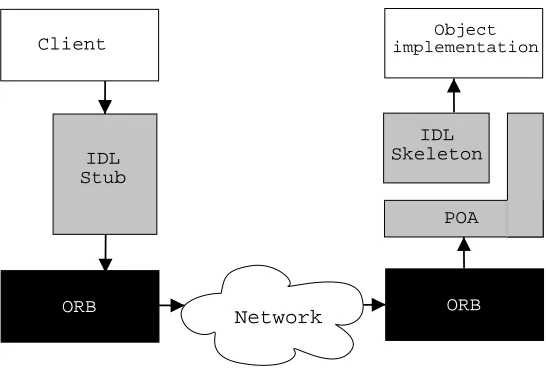
Network
IDL Stub
POA IDL Skeleton
ORB ORB
Client
[image:27.612.161.434.75.261.2]Object implementation
Figure 2.3: The stub and skeleton interactions
skeleton on the server side. The stub and the skeleton insulate the client and the
server from networking details. The stub is a local object through which all
re-quests to a remote object are made. It knows how to locate the skeleton and
mar-shal messages. The skeleton takes care of all networking details and knows how
to forward requests to the real object (Figure 2.3).
Different ORBs come with different IDL compilers. As an example, ORBit
comes with orbit-idl which maps into C and Java IDL comes with idlj which maps into Java.
2.6.2
Interoperable Object References
An object reference allows an ORB to identify a particular object. According to
the OMG specifications [Obj], it should identify the same object each time the
ref-erence is used in a request. However, there may be many distinct object refref-erences
for the same object.
operation on the ORB object. The format of this string is predefined by IIOP.
Therefore, when an ORB generates such a string, another ORB can convert it
back into an object reference using the string to object operation13.
Here is the code used in Java IDL:
String sor = orb.object_to_string(objectReference1);
objectReference2 = orb.string_to_object(sor);
The Interoperable Object Reference (IOR) is an object reference that is
trans-parent to different ORBs. Clients using IORs do not need to distinguish between
object references produced by a local ORB and those produced by a remote one.
Here is what a string representation of an IOR looks like:
IOR:010000001700000049444c3a426f6e6f626f2f436f6e74726f6c3a312e3
0000002000000caaedfba54000000010100002c0000002f746d702f6f726269
742d737175616c6c69612f6f72622d323134313832323438313535383733383
63939000000000018000000000000001240786d1df885b805000000aebff122
7e7b6388000000003c00000001010000160000006e6f777368616b2e6473672
e63732e7463642e696500168218000000000000001240786d1df885b8050000
00aebff1227e7b6388
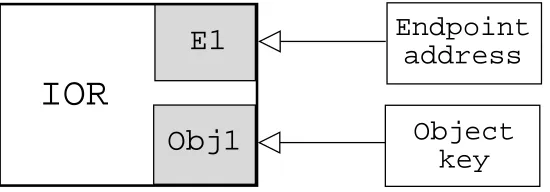
An IOR contains at least three elements:
The version number of the transport protocol (IIOP) the server supports.
The endpoint address, namely the IP address and the TCP port number of
the server.
An opaque object called an object key used by the server to identify a
par-ticular object.
13This works only if the string representation of the object reference has been produced by the
Obj1
E1
IOR
Endpoint
address
[image:29.612.162.437.78.174.2]Object
key
Figure 2.4: Essential elements of an IOR
The IOR in figure 2.4 points to objectObj1 in a server whose endpoint address is
E1.
An IOR parser allows us to extract useful information from the string
repre-sentation of an IOR, including the three elements mentioned above. Many ORB
vendors provide an IOR parser. For example, Orbacus ORB comes with the ior-dump.exe parser. There are also web based parsers like the ILU parser14.
Using the Orbacus parser, here is the information extracted from the previous
string representation of the IOR:
IOR #1:
byteorder: little endian
type_id: IDL:Bonobo/Control:1.0
Unknown profile tag: 3135221450
IIOP profile #1:
iiop_version: 1.0
host: nowshak.dsg.cs.tcd.ie
port: 33302
object_key: (24)
0 0 0 0 18 64 120 109 "...@xm"
29 248 133 184 5 0 0 0 "..."
174 191 241 34 126 123 99 136 "+."˜{c"
The three IOR elements mentioned above are shown in the output results. The
type id and the byte order are also included in the string representation of an IOR. The type id represents the interface type or the repository ID, which is a
unique identifier for an interface.
The byte order is very important as it will allow parsers to know exactly what
the bytes represent. For example, four bytes representing an integer will be read
differently depending on the byte order. The byte order information is placed in the
beginning of the string representation of an IOR. In “IOR: 01000000 17000000”,
the first eight digits show that the byte order is little endian. It is then possible to
understand the meaning of the second eight digits; they represent an integer whose
value is 2315. When using a big endian byte order, the same information would be
represented as follows: “IOR: 00000000 00000017”.
2.7
IIOP to SOAP Bridge
OMG defines the IIOP protocol in order to guarantee the interoperability between
different ORBs. Therefore, a CORBA client and a CORBA server use IIOP for
communicating. More precisely, IIOP is used between the stub and the skeleton.
The stub and the skeleton may be generated by different ORBs, and they will still
be able to communicate (see figure 2.3).
Generally, corporate firewalls do not allow IIOP messages in and out of their
network. Thus, the communication between a CORBA server and a CORBA client
is impossible. However, all the corporate firewalls allow HTTP communication for
Internet access.
SOAP is a protocol that provides a mechanism for exchanging structured and
Firewall
CORBA
Server
CORBA
Client
Bridge
Bridge
IIOP
Blocked IIOP message
IIOP
[image:31.612.100.493.77.353.2]SOAP
Figure 2.5: Getting through the firewall via the bridge
typed information in a distributed environment using XML. What it is interesting
about SOAP is that it uses HTTP as its transport protocol. As a consequence, the
firewall does not prevent a SOAP client and SOAP server from communicating.
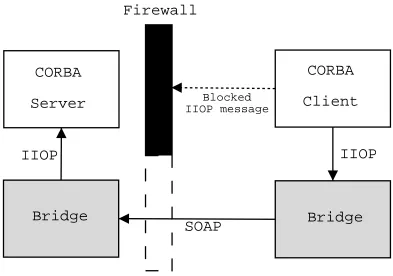
Let’s suppose that a CORBA client wants to communicate with a CORBA
server that is behind a firewall (Figure 2.5). The CORBA client, and more
specifi-cally the stub, will make an IIOP message and try to send it to the CORBA server
using a TCP/IP connection. As mentioned earlier, this IIOP message won’t get
through the firewall.
The role of an IIOP to SOAP bridge is to intercept IIOP messages, to convert
them to SOAP messages and to send them over the network to a SOAP server. On
the server side, the bridge must convert each received SOAP message to an IIOP
Chapter 3
Bonobo
3.1
GTK+
The Bonobo distribution consists of a collection of CORBA IDL interfaces and
their default implementation. The implementation is in C and is based on the
GTK+ library. More specifically, it uses the GTK+ object system which allows
writing C programs with an object oriented programming approach.
GTK+ stands for the GIMP1 Toolkit. Originally, it was developed for the
GIMP, but now it is being used in many applications and constitutes the basis
for GNOME’s user interface [2].
GTK+ is essentially a library for creating graphical user interfaces. It is built
on top of the GLib2 library which enhances programs portability. GTK+ is
com-pletely written in C, but many language bindings are available including C++,
Perl and Python. GTK+ was written with an object oriented approach based on
the GTK+ object system.
GTK+ was adopted by GNOME mainly because of its flexible and convenient
programming interface, but also because of its licensing terms. Besides,
program-mers who are familiar with GTK+ will find it easy to learn Bonobo.
3.1.1
The GLib library
The GLib3 library is written in C and contains some convenient functions and
definitions. For instance, the GLib library defines basic types, memory allocation
routines and useful macros like those dealing with type conversion and byte order.
It also provides useful data structures like arrays, hash tables and linked lists, and
includes utility functions like those related to strings.
GLib replaces many standard and common C language constructs. These
re-placement functions and definitions make applications easier to write and insulate
them from the details of different operating systems. In other words, the
advan-tages of using the GLib library are to increase the portability of applications and
libraries, and to provide some utility functions.
Here are examples of data types defined by GLib4:
gint8, gint16 provide respectively 8-bit and 16-bit integers independently of
the platform. guint8 and guint16 provide unsigned integers with guaranteed
size. These new definitions allow to enhance the programs portability.
gboolean is defined for making code more readable.
gpointer is simply a pointer to void (void *).
And here are examples of some GLib functions:
gpointer g malloc(gulong size);
3See http://www.gtk.org/tutorial/ch-glib.html and http://developer.gnome.
org/doc/GGAD/cha-glib.htmlFor more information about the GLib library.
void g free(gpointer mem);
g new0(type, count);
gint g snprintf(gchar* buf, gulong n, const gchar* format, ...);
3.1.2
The GTK+ object system
GtkObjectforms the basis of the GTK+ object system. It plays a similar role as the
Object class in Java. Every GtkObject is made up of two structures, one structure that represents an object, and another that represents a class.
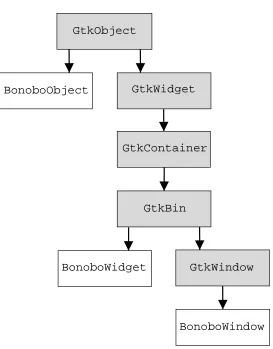
A Gtk object is an object that inherits from GtkObject. Sometimes, when
there is no confusion, a Gtk object will simply be called an object. We will explain
the inheritance mechanism further in this section. BonoboObject, GtkWidget and
GtkButton are all examples of Gtk objects. Figure 3.1 shows a hierarchical tree
of some Gtk objects, starting from the first object which is GtkObject. The white
rectangles represent some Gtk objects used in the Bonobo distribution.
The two structures representing a GtkWidget are5:
typedef struct _GtkWidget GtkWidget;
typedef struct _GtkWidgetClass GtkWidgetClass;
struct _GtkWidget
{
GtkObject object;
guint16 private_flags;
guint8 state;
5Usually the object and class structures are defined in a header file. Exceptionally, the first line
BonoboObject
GtkObject
GtkWidget
GtkContainer
GtkBin
BonoboWidget GtkWindow
[image:36.612.163.436.171.520.2]BonoboWindow
/* Other members that are not shown in this example */
GtkWidget *parent;
};
struct _GtkWidgetClass
{
GtkObjectClass parent_class;
guint activate_signal;
guint set_scroll_adjustments_signal;
void (* show) (GtkWidget *widget);
void (* realize) (GtkWidget *widget);
/* Other members that are not shown in this example */
}
This example shows that the GtkWidget class inherits from the GtkObject class. In
the GTK+ object system, inheritance is accomplished by using nested structures.
The GtkObject structure needs to be the first element in the GtkWidget structure
in order for the object mechanism to work correctly. This allows a GtkWidget
pointer to be cast to a GtkObject pointer. The same applies for GtkWidgetClass
and GtkObjectClass. In fact, the mechanism works well because the C language
guarantees that a pointer to a structure is also a pointer to the first member of that
structure.
In general, the object structure contains object members and the class structure
contains class methods represented by function pointers. The class structure may
also contain class members.
The GTK+ object system makes it possible for subclasses to override class
static void
gtk_button_class_init (GtkButtonClass *klass)
{
GtkObjectClass *object_class;
GtkWidgetClass *widget_class;
object_class = (GtkObjectClass*) klass;
widget_class = (GtkWidgetClass*) klass;
object_class->set_arg = gtk_button_set_arg;
widget_class->activate_signal = button_signals[CLICKED];
widget_class->realize = gtk_button_realize;
/* Only part of the function implementation is shown */
}
In the example above, the GtkButton6class overrides class methods inherited from
GtkObject and GtkWidget. This is possible after casting the GtkButtonClass into
GtkObjectClass and GtkWidgetClass.
3.1.3
The GTK+ type system
GTK+ has also a type system that is used by the object system to check the validity
of casts. Every Gtk object has a type, and every type is associated with a unique
identifier represented by an unsigned integer. The identifier is assigned by the type
system when thegtk type unique function is called.
The gtk type unique function registers the new type with the type system. It takes the type of the parent object as its first argument. This allows the type
system to make a hierarchy of types which can be used to check the validity of
casts. The validity test is done by calling the gtk type is a function which takes two identifiers as arguments and verifies that one identifier is the other’s ancestor.
When writing a Gtk object, it is common to have a function that registers
the Gtk object with the system. The registration is made on the first call of the
function. On subsequent calls, the function simply returns the type’s identifier of
the Gtk object. Here is what this function looks like for BonoboObject:7
GtkType
bonobo_object_get_type (void)
{
static GtkType type = 0;
if (!type) {
GtkTypeInfo info = {
"BonoboObject",
sizeof (BonoboObject),
sizeof (BonoboObjectClass),
(GtkClassInitFunc) bonobo_object_class_init,
(GtkObjectInitFunc) bonobo_object_instance_init,
NULL, /* reserved 1 */
NULL, /* reserved 2 */
(GtkClassInitFunc) NULL
};
type = gtk_type_unique (gtk_object_get_type (), &info);
}
return type;
}
Note that theinfostructure that is passed to thegtk type uniquefunction contains
two function in its members. These functions allow the initialization of the object
and class structures.
The Gtk objects that inherit from BonoboXObject define theirget type func-tion by using the BONOBO X TYPE FUNC FULL macro, which is defined in thebonobo xobject.h file.
Having defined theget type function, the creation of a BonoboObject instance is very simple:
BonoboObject *object;
object = gtk_type_new (bonobo_object_get_type ());
In the object’s header file, it is common to have five macros, four of which
check the validity of casts. Here are the macros defined in BonoboObject:
#define BONOBO_OBJECT_TYPE (bonobo_object_get_type ())
#define BONOBO_OBJECT(o)
(GTK_CHECK_CAST ((o), BONOBO_OBJECT_TYPE, BonoboObject))
#define BONOBO_OBJECT_CLASS(k)
(GTK_CHECK_CLASS_CAST((k), BONOBO_OBJECT_TYPE,
BonoboObjectClass))
#define BONOBO_IS_OBJECT(o)
(GTK_CHECK_TYPE ((o), BONOBO_OBJECT_TYPE))
#define BONOBO_IS_OBJECT_CLASS(k)
(GTK_CHECK_CLASS_TYPE ((k), BONOBO_OBJECT_TYPE))
The second and third macros check the cast validity for objects and classes
respec-tively. The fourth and fifth are used in preconditions to check whether an object is
of a certain type. These macros are often used when writing Gtk or Bonobo based
3.2
Basis of Bonobo
3.2.1
The Bonobo Unknown interface
The Bonobo distribution includes a set of IDL interfaces that we will call Bonobo
interfaces. The Bonobo interfaces constitute the basis of Bonobo.
TheBonobo Unknown interface is the base interface from which all the other Bonobo interfaces inherit. The Bonobo Unknown interface is made up of three
methods.ref andunref deal with lifetime management of objects, and queryInter-face finds out whether or not an object supports an interface and possibly returns a reference to this interface.
Here is the complete Bonobo Unknown interface:
module Bonobo {
interface Unknown {
void ref ();
void unref ();
Unknown queryInterface (in string repoid);
};
};
The Bonobo Unknown interface is inspired from the IUnknown interface of
Microsoft’s OLE2. Indeed, all OLE interfaces are derived from IUnknown.
Here is a simplified version of IUnknown:
class IUnknown
{
public:
virtual HRESULT QueryInterface(REFIID iid,
virtual ULONG AddRef() = 0;
virtual ULONG Release() = 0;
};
TheAddRef andRelease methods in the IUnknown interface correspond respec-tively to theref andunref methods in the Bonobo Unknown interface. The three methods have a similar role in both interfaces.
Objects lifetime management
Bonobo keeps track of objects by using a system of reference counting. Every time
a program starts using an object, the object reference count is incremented by one.
When a program finishes using an object, it should release a reference by calling
the unref method. This causes the object reference count to be decremented by one. When the reference count of an object reaches zero, which means that the
object is not being used, the object is simply destroyed.
The queryInterface method
ThequeryInterface method allows to get a different interface on an object that im-plements the Bonobo Unknown interface. In other words, queryInterface allows a dynamic discovery of the interfaces supported by an object.
As an example, we suppose that we have a reference to a graphical
com-ponent, which in fact is a reference to a Bonobo Control object. queryInterface
can be used on that object to know whether the graphical component supports
the Bonobo Zoomable interface. The returned value is either a reference to a
Bonobo Zoomable object or CORBA OBJECT NIL. If it is a reference to a
Bo-nobo Zoomable object, it means that the graphical component supports the
Bono-bo Zoombable interface8.
incre-Here is an interesting use of thequeryInterface method9:
Bonobo_Unknown bu1, bu2;
control = bonobo_widget_new_control
("file:/home/squallia/Photo.jpg", BONOBO_OBJREF (uic));
bu1 = bonobo_widget_get_objref(BONOBO_WIDGET (control));
bu2 = Bonobo_Unknown_queryInterface
(bu1, "IDL:Bonobo/Zoomable:1.0", &ev);
Bonobo_Zoomable_setLevel(bu2, .25, &ev);
In this example, an image is converted to a graphical component, also called a
control, and is zoomed to 1/4 of its original size.
The queryInterface has to be an equivalence relation, which means that it should be reflexive, symmetric and transitive10.
Let’s A, B and C be three Bonobo CORBA objects, and IA, IB, IC the
inter-faces they implement. The queryInterface implementation should guarantee the
following properties.
Reflexive: Querying object A about interface IA should succeed.
Symmetric: If querying object A about interface IB succeeds, then querying
object B about interface IA should succeed.
Transitive: If querying object A about interface IB succeeds and querying
object B about interface IC succeeds, then querying object A about interface
IC should succeed.
mented. When the program finishes using the object, it should explicitly release a reference by calling theunrefmethod.
9To know more about controls see chapter 3.3.1 on page 39.
3.2.2
BonoboObject
Bonobo defines a base Gtk+ object called BonoboObject. BonoboObject allows the wrapping of CORBA servers as Gtk+ objects. It also implements the
Bono-bo Unknown interface. Therefore, it contains the implementation of theref,unref
andqueryInterface methods.
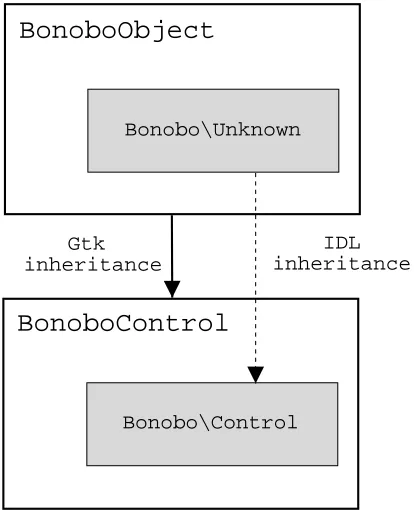
BonoboObject inherits directly from GtkObject (Figure 3.3), which is the base
object for the Gtk+ object. It also wraps a Bonobo Unknown CORBA object. To
make this clear, here is the BonoboObject structure:
typedef struct {
GtkObject base;
Bonobo_Unknown corba_objref;
gpointer servant;
BonoboObjectPrivate *priv;
} BonoboObject;
Figure 3.2 shows that a BonoboObject wraps a Bonobo Unknown CORBA
object. Obviously this remains true for every object inherited from BonoboObject.
In particular, a BonoboControl object wraps a Bonobo Unknown CORBA object.
More precisely, it wraps a Bonobo Control CORBA object.
An object that inherits from BonoboObject will be called a Bonobo object.
Therefore, a Bonobo object wraps at least a Bonobo Unknown CORBA object.
All the Bonobo interfaces are implemented as Bonobo objects11.
11Note that some of the Bonobo objects do not implement any Bonobo interface, and that some
Bonobo\Unknown
BonoboObject
Bonobo\Control
BonoboControl
Gtk inheritance
[image:45.612.193.400.222.477.2]IDL inheritance
Useful functions defined by BonoboObject
BonoboObject provides an important programming interface which is available to
all the Bonobo objects12. We will examine two functions bonobo object corba-objref andbonobo object add interface.
The bonobo object corba objref function takes a BonoboObject as an argu-ment and returns a reference to the wrapped CORBA object. Here is a use of that
method:
BonoboListener *listener;
Bonobo_Listener corba_listener;
listener = bonobo_listener_new (a_callback_function, NULL);
corba_listener = bonobo_object_corba_objref
((BONOBO_OBJECT)listener);
In the example above, we created a BonoboListener object, cast it into a
Bono-boObject by using the BONOBO OBJECT macro and got a reference to the CORBA object it wraps. The BONONO OBJREF macro is usually used instead of the last line of code:
corba_listener = BONOBO_OBJREF (listener);
Thebonobo object add interfacefunction provides a way to associate objects together. Therefore, having a reference to one object makes it possible to get a
ref-erence to all its associated objects. The prototype ofbonobo object add interface
is as follows:
void bonobo_object_add_interface (BonoboObject *object,
BonoboObject *newobj);
Actually, this function adds the list of interfaces supported by newobj to the list of interfaces supported byobject. Here is a sample code that shows a use of this function13:
/* EogControl inherits from BonoboControl,
so it supports the Bonobo_Control interface */
EogControl *control;
/* BonoboZoomable supports the Bonobo_Zoomable interface */
BonoboZoomable *zoomable;
/* The type of the variables are shown above */
bonobo_object_add_interface
(BONOBO_OBJECT (control),
BONOBO_OBJECT (control->priv->zoomable));
The control object is now an aggregate object because it combines two Bono-boObjects into a single one. This means that an aggregate object wraps at least two
CORBA servers. Thecontrol object will support not only the Bonobo Control in-terface but also the Bonobo Zoomable inin-terface. Therefore, having a reference to
thecontrol object makes it possible to obtain a reference to a Bonobo Zoomable object. As a result, the zoom of the object can be changed.
Bonobo_Zoomable zoomable;
zoomable = bonobo_object_query_interface
(BONOBO_OBJECT (control), ‘‘IDL:Bonobo/Zoomable:1.0’’);
3.3
Bonobo objects
In this section, we will investigate some Bonobo objects that will be used in the
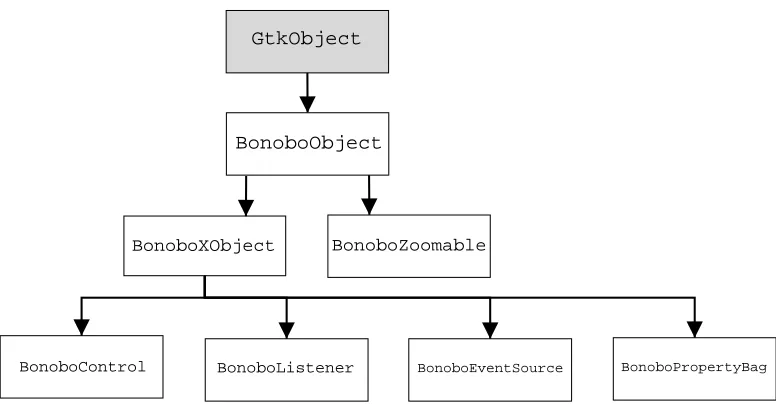
implementation chapter. Figure 3.3 shows the hierarchy of some Bonobo objects.
GtkObject
BonoboObject
BonoboXObject BonoboZoomable
[image:48.612.103.491.74.279.2]BonoboControl BonoboListener BonoboEventSource BonoboPropertyBag
Figure 3.3: A hierarchical tree of some Bonobo objects
It is also useful to have a look at figure 3.1 on page 27, which shows the hierarchy
of some Gtk objects.
3.3.1
Controls
Controls are graphical components that are used by container applications. They
are created from Gtk widgets, which are user interface elements like buttons.
How-ever, unlike the use of Gtk widgets, the use of controls does not require source
code nor header files. Controls are used dynamically and allow a dynamic
discov-ery of their properties.
Creating a control
Creating a control from a widget is very simple. Here is the code that allows to
create a clock control:
GtkWidget *clock;
clock = gtk_clock_new (GTK_CLOCK_INCREASING);
gtk_widget_show (clock);
control = bonobo_control_new (clock);
Basically, there are three steps for creating a control:
Creating a widget.
Calling thegtk widget showfunction14.
Passing the widget to thebonobo control new function.
Accessing a control through a CORBA client
A BonoboControl object wraps a CORBA object that implements the
Bonobo-Control interface. Since thebonobo control new function returns a pointer to a BonoboControl object, it is possible to obtain a reference to a Bonobo Control
CORBA object with the following code lines:
Bonobo_Unknown *objRef;
objRef = BONOBO_OBJREF (control);
Getting the object reference from the control makes it accessible via the
net-work. As a CORBA object, a control can be invoked from a CORBA client
gram. The program can be run in any operating system and written in any
pro-gramming language15. This is possible since CORBA is the communication layer
of Bonobo.
14It is important to call this function here in the control implementation. Otherwise the control
won’t show up when embedded in the container even if the container calls thegtk widget show all
function.
3.3.2
Property bags
A property bag allows a control to expose its functionalities. Consequently, it is a
means for a control to communicate with its container. Most of the controls would
not be useful without property bags. Another way for accessing a control is to
make it support another interface, and then communicate with the CORBA object
implementing this interface.
The PropertyBag class provides an implementation of the Bonobo
Property-Bag interface. Therefore, a PropertyProperty-Bag object wraps a Bonobo PropertyProperty-Bag
CO-RBA object. Using this COCO-RBA object it is possible to access a PropertyBag
object through a CORBA client.
Creating a property bag
As its name suggests, a property bag contains a list of properties. These properties
can be accessed through a get and set callback functions. At the creation of a
PropertyBag object the callback functions and a user data object should be passed
as parameters. Every time the callback functions are called, the user data object
will be passed to them.
The following code shows how to create a property bag:
BonoboPropertyBag *pb;
pb = bonobo_property_bag_new (get_prop, set_prop, clock);
In this example,get prop andset proprepresent the callback functions and clock represents the user data object. Every time the callback functions are called the
Adding properties
After creating a property bag, we should add some properties to it. The bono-bo property bag add function allows to do that. For example, we can add a prop-erty called ”running” whose argument id is 0 and whose type is boolean:
bonobo_property_bag_add (pb, "running", 0,
BONOBO_ARG_BOOLEAN, NULL, "whether
or not the clock is running", 0);
The third argument is the argument id. It is common to use an enumeration to
represent all the argument ids. It makes the code easier to read and allows the
use of switch statements in the implementation of the callback functions. The
fifth argument represents the default value of the property, the following one is a
documentation string, and the last one represents flags that determine the access
rights of the property.
Connecting the control
Now that we have a property bag, we need to connect it to a control:
bonobo_control_set_properties (control, pb);
Callback functions
To complete the example, we need to write the callback functions. The prototype
of theget prop function is as follows16:
get_prop (BonoboPropertyBag *bag, BonoboArg *arg,
guint arg_id, CORBA_Environment *ev,
gpointer user_data)
At this stage, there is an important feature of property bags that should be
mentioned. A property bag does not hold the data of the properties, it is only a
model for the properties. This means that the property bag pointer passed to the
get prop function is not sufficient to get the property value, because the property
bag does not hold the value. A property value may for example represent a data
member of a Gtk widget. This data member would be accessed by calling some
function on the widget.
Here is a sample implementation of theget propfunction17:
GtkObject *clock = user_data; /* Casting the user data */
switch (arg_id) {
case 0:
{
/* The data (whether the clock is running) is held by
the clock not the bag */
gboolean running = gtk_clock_is_running (clock);
/* Setting the out argument arg. */
BONOBO_ARG_SET_BOOLEAN (arg, running);
break;
}
}
When a property value is requested, the get callback function supplied at the
prop-erty bag creation time is called.
The set callback function is very similar to the get one. Only two points are
worth mentioning:
17The is running function used in this example is not in the clock’s API. To have the same result
The BonoboArg pointer that is passed to theset prop function does not get changed, because the argument is a const. The BonoboArg points to the value we want to set.
The BONOBO ARG GET BOOLEAN macro is used in the set callback implementation instead of theBONOBO ARG SET BOOLEAN macro.
3.3.3
Containers
A container embeds controls and may interact with them. A container represents
the client side of an application.
Embedding controls
BonoboWidget makes embedding controls very easy. The Gtk widget
correspond-ing to the control can be created in one line of code:
GtkWidget *control;
control = bonobo_widget_new_control
( "OAFIID:Bonobo_Clock", BONOBO_OBJREF (uic) );
control can then be used as a normal GtkWidget exactly like a GtkButton or a GtkWindow. The previous code deserves some explanations:
The real type ofcontrol is a BonoboWidget, not a GtkWidget. In fact, con-trol was cast to a GtkWidget before being returned by thebonobo widget-new control. The cast is valid because BonoboWidget inherits GtkWid-get18:
18The tree hierarchy is as follows: GtkObject, GtkWidget, GtkContainer, GtkBin,
The first argument passed to the bonobo widget new control function is a string representation of a moniker object. It is sufficient to know that this
string allows the activation of the clock control.
uic is a BonoboUIContainer object. This object should be created and as-sociated with a BonoboWindow object before calling the bonobo
widget-new control function:
BonoboUIContainer *uic;
uic = bonobo_ui_container_new ();
bonobo_ui_container_set_engine (uic, bonobo_window);
Accessing a property
A BonoboWidget also simplifies the access to the control’s property bag. Getting
the value of therunning property is easy:
CORBA_boolean state;
bonobo_widget_get_property (BONOBO_WIDGET (control),
"running", &state, NULL);
Since a property data type might change on the server, it is better for the client
to use another method to access a property. First, we get the control frame
asso-ciated with the bonobo widget, and then we get the property bag from the control
frame19. Here is how to get the value of therunning property using the approach described above:
Bonobo_PropertyBag pb;
BonoboControlFrame *cf;
19When creating a BonoboWidget object, the control (which is linked to the property bag) was
CORBA_boolean state;
cf = bonobo_widget_get_control_frame
(BONOBO_WIDGET (control));
pb = bonobo_control_frame_get_control_property_bag
(cf, NULL);
state = bonobo_property_bag_client_get_value_gboolean
(pb, "running", NULL);
Both ways of accessing properties cause one of the property bag callback
func-tions to be called on the server.
3.3.4
Event Sources and Listeners
Sometimes clients would like to be notified when something happens in the server
so that they can perform some action. For example, a container application might
want to react when one or more properties of a control have changed. The
mech-anism that allows this relies on event sources and listeners.
Clients that wish to be notified when an event occurs have to create a listener
and register it with an event source. Obviously, it is possible that many listeners
register with the same event source.
Let’s suppose that there are two containers embedding the same control, and
that these containers are both registered with the event source of the control’s
property bag. Here is what happens when a property changes. The event source
is immediately notified of the change. It notifies all the listeners attached to it.
As a result, every attached listener emits an event-notify signal. Therefore, the callback function corresponding to the signal is called. This means that the clients
have finally been notified of the property change.
It is possible to attach a listener to an event source so that it listens to all the
Client 1
Client 2Listener 1
Listener 2
Listener 3
Property Bag
Event source
Event 1
Event 2
[image:56.612.104.492.77.226.2]Event 3
Figure 3.4: Registering listeners with an event source
can be notified when one or more property values have changed. Figure 3.4 shows
listeners from two clients registering with some events of the event source. When
an event occurs, the attached listeners are notified.
Next, we will see an example that shows the use of event sources and listeners.
Event sources
Typically, the server creates event source objects. These objects can be accessed
through CORBA clients. The creation of an event source objects is
straightfor-ward:
BonoboEventSource *es = bonobo_event_source_new();
When creating a property bag, an event source object is created automatically
and associated with the property bag. Thus, once a client gets a reference to a
property bag, it can get a reference to the event source object associated with it:
Bonobo_Unknown es; /*event source*/
/* pb is a Bonobo_PropertyBag CORBA object and ev
is an initialized CORBA environment */
Another way to get the same reference is to use the queryInterface function of the
Bonobo Unknown interface:
es = Bonobo_Unknown_queryInterface
(pb, "IDL:Bonobo/EventSource:1.0", &ev);
An event source is responsible for notifying all the listeners attached to it when
an event occurs. For example, when a property value changes by a set callback
function20, the bonobo property bag notify listeners function is called and calls in its turn the bonobo event source notify listeners function. Consequently, all the registered listeners will be notified. However, when a property value changes
by another method, the bonobo property bag notify listeners function should be called explicitly. Otherwise, the property bag will not be notified of the change of
the property value21.
Listeners
In order for the notification mechanism to work, the client needs to create one or
more listeners and register them with the event source:
BonoboListener *listener;
Bonobo_Listener corba_listener;
/* prop_change_cb is a callback function and clist is the
the user data that will be passed to it */
listener = bonobo_listener_new (prop_changed_cb, clist);
/* Requesting the CORBA object
of the ’listener’ Bonobo object */
20See section 3.3.3, page 45 on accessing properties.
21Remember that a property bag is just a model for the properties. It does not hold the data
corba_listener = BONOBO_OBJREF (listener);
Bonobo_EventSource_addListenerWithMask
(es, corba_listener,
"Bonobo/Property:change:running", &ev);
As in the example above, a listener should always be bound to a callback
func-tion, so that the listener is able to call the callback function whenever it is notified
of an event (by the event source). Here is the prototype of a listener callback
func-tion:
void prop_changed_cb (BonoboListener *listener,
char *event_name,
CORBA_any *any,
CORBA_Environment *ev,
gpointer user_data);
whereany is the value that is passed by the event source, andevent name is the event name that has been emitted by the event source.
TheaddListenerWithMask function specifies that the listener wants to be no-tified of certain events only. In the example above, the listener wants to be nono-tified
when therunning property changes. The string in the third argument is called the event mask. It is a comma-separated list of event names the listener is interested
in receiving.
Event names are generally made up of three parts. The first part consists of the
interface that triggered the event. Its purpose is to create a unique namespace. The
second part indicates what happened, and the third part is used to make events
more specific.
Here is the code that allows a listener to be notified when one of therunning
Bonobo_EventSource_addListenerWithMask
(es, corba_listener,
"Bonobo/Property:change:running,
Bonobo/Property:change:test", &ev);
The addListener function should be used in order to notify a listener of all the events emitted by the event source:
Chapter 4
Design
In this chapter, we will examine the design issues of the IIOP to SOAP bridge. We
will discuss the different possibilities of building such a bridge and will justify the
decisions being taken.
4.1
Requirements and assumptions
The bridge should be designed so that a CORBA client and a CORBA server
would communicate seamlessly over HTTP. Particularly, no modifications are
al-lowed in the CORBA client or server in order for the communication to take place.
We will ignore the bootstrapping problem which consists of getting the IOR
of the naming service1, and we will assume that the CORBA client has access to
the IOR of the object it wants to invoke operations on2.
4.2
Intercepting an IIOP message
Once a CORBA client has the IOR of an object and knows the IDL interface
of that object, it can invoke operations on it. The client, and more precisely the
stub, will use the information encapsulated in the IOR in order to create a TCP
connection to the object server. It will then create an IIOP message and send it
over this connection.
On the client side, the purpose of the bridge is to intercept the IIOP message,
convert it to a SOAP message and send it over HTTP. There are two ways to
intercept the outgoing IIOP message:
Changing the stub so that it establishes a TCP connection with the bridge
instead of the CORBA server. Here, the problem is addressed at the end: the
CORBA client communicates with a modified stub.
Changing the object’s IOR so that it points to another endpoint address3.
A server in the appropriate machine will be listening to the appropriate
port number waiting for IIOP messages. We will call this server the proxy
server, because it acts like a proxy to the clients wishing to contact CORBA servers. Here, the problem is addressed at the beginning: the CORBA client
reads a modified IOR. Figure 4.1 shows that the CORBA client reads IOR’
with endpoint address E2 instead of the IOR generated by the CORBA
server.
Both solutions involve a change to be made:
The first approach presents a big disadvantage, because it changes
some-thing that is ORB specific namely the stub. Indeed, different ORBs generate
different stubs for the same IDL interface. In addition, the stub is language
E1 Obj2 Obj1
CORBA
Server
Proxy
Client
Proxy
Server
IOR’
Obj1 E2CORBA
Client
E2SOAP
Server
SOAP
Client
SOAP message IIOP string + E1 IIOP message IIOP string IIOP message IIOP string IIOP string + E1An IOR pointing to a server
TCP communication
Client uses IOR’
Client does not use IOR
IOR
E1
[image:62.612.103.492.121.461.2]Obj1
dependent: the same ORB will generate different stubs for the same IDL
in-terface depending on the language binding chosen. This means that a parser
should be written for every ORB and for every language binding supported
by that ORB. Furthermore, a slight modificat