Computer Graphical Interfaces, Reflection and the
Teaching and Learning of Music Composition – A
Holistic Study
.Kevin Jennings
A dissertation submitted to the University of Dublin in partial fulfillment
of the requirements for the degree of Ph.D. in Computer Science.
Declaration
I declare that the work described in this dissertation is, except where otherwise stated,
entirely my own work and has not previously been submitted as an exercise for a
degree at this or any other university.
Signed………...
Permission to lend and/or copy
I agree that Trinity College Library may lend or copy this dissertation upon request.
Signed………...
SUMMARY
Technology, Reflection and the Teaching and Learning of Music Composition – A Holistic Study.
This thesis is a holistic study in the area of teaching and learning of music composition for children in
the age range eight to eleven years. It investigates the role of graphical computer technology within the
framework of a reflection-in-action model for teaching, learning and research. Its primary aims are
firstly: to examine if reflection-in-action provides a valid model for description of the behaviour and
interactions of teachers, learners and researchers in a technology-enabled environment, and secondly;
to investigate how technology enables/facilitates this model in the case of each. This is done through
both examination of both childrens and teachers behaviours, processes and strategies as they work
together with graphical music software, and also by analysis of childrens compositional products.
Two pieces of software were developed, one designed solely by the author (DrumSteps), the other in
collaboration with research students at MIT (Hyperscore). Each piece of software was extensively
deployed in a wide range of settings with children in the 9-12 year age range.
Qualitative data were collected by intensive examination of selected teaching and learning situations,
using digital video capture to providing a complete record of all learner and teacher actions. Analysis of
the resulting data indicated that Schon’s reflection-in-action model is applicable to
technology-mediated teaching and learning of music composition. The graphical interfaces were observed to
provide a valuable empowering mechanism for both teachers and learners, facilitating music learning
interactions that would not be possible otherwise. Learner interactions progressed through clear stages
and learners exhibited definable, context-related behaviours.
Both pieces of software were made available to the public via the TCD, MIT and BBC websites and
users were invited to submit examples of their work, yielding over ten thousand pieces, of which two
hundred and fifty were selected for analysis. A marked difference was noted in the nature and quality
of childrens pieces produced in mentored workshops and those collected via the web, indicating that
the presence of a teacher is a necessary component for deeper musical learning and reflection. Effective
technology-mediated teaching strategies were identified. Use of graphical software in tandem with
digital video capture was further demonstrated to be an effective vehicle for researcher reflection,
Acknowledgements
I would like to express my appreciation to the many people who have contributed in ways large and small to my work over the last number of years. Thanks are due to my supervisor, Brendan Tangney for his constant support both personally and professionally. Thanks also to Tod Machover at the MIT Media Lab for taking an interest in my work from an early stage, inviting me to participate in the Toy Symphony project and for facilitating collaboration with his research group. Thanks to all my colleagues at CRITE and to all at Hyperinstruments, especially Dr Mary Farbood. I am also grateful to Jeanne Bamberger at MIT for many useful and interesting conversations and for help in unraveling meanings hidden in videotapes. Finally thanks to John Threadgold and the children at Newtown National School and Helena Murphy and the children of Lucan Educate Together National School for their enthusiastic participation in the composing workshops.
The teacher who is indeed wise does not bid you to enter the house of his wisdom but
rather leads you to the threshold of your mind.
Kahlil Gibran, The Prophet
“Would you tell me, please, which way I ought to go from here?”said Alice.
“That depends a good deal on where you want to get to” said the Cat.
“I don’t much care where” said Alice.
“Then it doesn’t matter which way you go” said the Cat.
“As long as I get somewhere,” Alice added as an explanation.
“Oh, you’re sure to do that,” said the Cat, “if you only walk long enough.
Lewis Carroll, Alice in Wonderland
“It would seem that you have no useful skill or talent whatsoever”
he said. "
Have you
thought of going into teaching?"
For Clair, Daire, Oisin and Kelan, and for my parents.
“You are the bows from which your children as living arrows are sent forth.”
CONTENTS
CHAPTER ONE. INTRODUCTION 1
1.1 Background and Context 1
1.2 Why the Current Study is Needed 2
1.3 Context for the Development of Specific Research Questions 3
1.4 The Research Questions to be Addressed 3
1.5 The Structure of the Thesis 4
1.5.1 Overview 4
1.5.2 Review of Relevant Literature 5
1.5.3 Reflection-in-Action, Affordance and Notation 5
1.5.4 Research Methodology 6
1.5.5 Software 6
1.5.6 Case Studies 6
1.5.7 Online Data 7
1.5.8 Discussion and Analysis 8
1.5.9 Conclusions and Future Work 9
CHAPTER TWO. LITERATURE REVIEW 11
2.1 Introduction 11
2.2 Technology in Education 11
2.2.1 Introduction 11
2.2.2 Microworlds 12
2.2.3 The ‘Design Space’ 12
2.2.4 Mindtools 13
2.2.5 Discussion 13
2.3 The Structure of the Music Domain 15
2.3.1 Introduction 15
2.3.2 The Elements of Music 15
2.3.3 Rhythm 15
2.3.4 Melody 16
2.3.5 Harmony 16
2.3.6 Sound 17
2.3.7 Summary 17
2.4 Music Perception and Cognition 18
2.4.1 Introduction 18
2.4.2 The Relationship between Music Theory and Perception/Cognition 18
2.4.3 Perception of Rhythm, Melody and Harmony 19
2.4.4 Accent, Grouping, Patterns and Perception of Boundaries 19
2.4.5 Discussion 20
2.5 Music Composition 21
2.5.1 Introduction 21
2.5.2 Composers on Composing 22
2.5.3 Composers on Teaching Composition 24
2.5.4 Some Problems with Teaching Composition 25
2.5.5 Discussion 26
2.6 Educators on Music Composition 27
2.6.1 Introduction 27
2.6.2 The Swanwick Model 27
2.6.3 The Paynter model 27
2.6.4 The Composing Process 28
2.6.5 Composing as Creativity 29
2.6.6 Approaches to Teaching Composition 31
2.6.7 Discussion 32
2.7 Studies in Children Composing 33
2.7.1 Non Technology-based Studies 33
2.8.1 Introduction 41
2.8.2 Formal Measures of Musical Creativity 41
2.8.3 Consensual Assessment 41
2.8.4 Criteria for Teacher Product-Based assessments 42
2.8.5 Qualitative and Case based Assessment 43
2.8.6 Assessment in the Current Study 44
2.8.7 Discussion 44
CHAPTER THREE. THEORETICAL PERSPECTIVES 47
3.1 Reflection-in-Action 47
3.1.1 Introduction 47
3.1.2 Distinction Between Reflection-in-Action and Technical Rationality 48
3.1.3 Reflection-In-Action and Reflection-on-Action 48
3.1.4 Characteristics of Reflection-in-Action 47
3.1.5 Teaching and learning through Reflection-in-Action 50
3.1.6 The Role of the Teacher 51
3.1.6.1 Telling and Listening 51
3.1.6.2 Demonstrating and Imitating 51
3.1.7 The Ladder of Reflection 52
3.1.8 Teaching as Inquiry 52
3.1.9 The Role of the Medium 52
3.2 Affordance 54
3.3 Music Notation Systems 56
3.3.1 Introduction 56
3.3.2 The Function of Notation 57
3.3.3 Notation as a Cognitive Tool 57
3.3.4 The Limits of Notation Systems 57
3.3.5 Solutions to the Notation Problem 58
3.4 Discussion 59
CHAPTER FOUR. RESEARCH METHODOLOGY 63
4.1 Introduction. 63
4.2 Grounded Theory 63
4.3 Quantitative Research Methodology 64
4.4 Qualitative Research Methodologies 66
4.4.1 Naturalistic and Ethnographic research 66
4.4.2 Action Research 67
4.4.3 Case Studies 70
4.5 Ex post facto research 71
4.6 Data Analysis 73
4.7 Validity and Reliability 75
4.7.1 Trustworthiness 75
4.8 Summary 77
CHAPTER FIVE. SOFTWARE DESCRIPTIONS 79
5.1 Introduction 79
5.2 Hyperscore 79
5.2.1 The Motive Window 80
5.2.2 The Sketch Window 80
5.2.3 Contour 81
5.2.4 Harmony 82
5.3 Drumsteps 84
5.3.1 The Workspace 84
5.3.2 DrumSteps Tools 85
5.4 Interface Affordances 90
5.4.1 Introduction. 90
5.4.2.1 The Hyperscore Interface 91 5.4.2.1.1 Representation in the Motive Window 91 5.4.2.1.2 Representation in the Sketch Window. 93
5.4.2.1.3 Summary 96
5.4.2.2 The DrumSteps Interface 96
5.4.3 Musical Manipulations in Hyperscore and Drumsteps 99
5.4.3.1 Introduction 99
5.4.3.2 Musical Manipulations in Hyperscore 100
5.4.3.2.1 Note-Level manipulations 100
5.4.3.2.2 Higher Level Manipulations 100
5.4.3.3 Musical Manipulations in DrumSteps 101
CHAPTER SIX. CASE STUDIES AND ONLINE DATA 103
6.1 Introduction 103
6.1.1 Conditions For the Case Studies 103
6.1.2 The Researcher 104
6.1.3 The Data 104
6.1.4 Supplementary Data - Online Pieces 105
6.2 Hyperscore Case Studies
6.2.1 Introduction 105
6.2.2 Composing Process 106
6.2.2.1 Task Framing and Reframing 106
6.2.2.2 Convergence 109
6.2.2.3 Composing Process and Visual Affordance 115
6.2.2.4 Composing Process and Kinaesthetic Affordance 117
6.2.2.5 Affordance and Intent 119
6.2.2.6 Move-Testing and Criteria 120
6.2.3 Musical Interaction and Learning 122
6.2.3.1 Musical Concepts 122
6.2.3.2 Form and Structure 125
6.2.3.3 Musical Rudiments 126
6.2.3.4 Musical Perception and Reflection 127
6.2.4 Teaching Intervention and Strategy 131
6.2.4.1 Introduction 131
6.2.4.2 Teaching as Investigation 132
6.2.4.3 Modeling 133
6.2.4.4 Interface Affordance, Problem Finding and Problem Solving 135
6.2.4.5 Task Framing 136
6.2.4.6 Imagination, Perspective and Kinaesthetic Techniques 138 6.2.4.7 Developing Criteria and Learner Autonomy 139 6.2.4.8 The Interface and Reflective Musical Conversation 140
6.2.5 Summary 141
6.3 DrumSteps Case Studies 143
6.3.1 Introduction 143
6.3.2 Composing Process 143
6.3.2.1 Task Framing and Bricolage 143
6.3.2.2 Developing Criteria 146
6.3.2.3 Reflection-on-Action 148
6.3.2.4 Affordance, Problem Finding and Problem Solving 149 6.3.2.5 Convergence and Meta-Awareness of Process 150 6.3.2.6 Non-Musical Affordances and Compositional Process 151
6.3.3 Musical Interaction and Learning 155
6.3.3.1 Attending to Musical Parameters 157
6.3.3.2 Perception of Grouping and Boundaries 157
6.3.3.3 Affordance and Relationships Between Things 160
6.3.3.4 Musical Concepts and Rudiments 161
6.3.4.2 Task Framing 165
6.3.4.3 Modeling 166
6.3.4.4 Kinaesthetic Teaching, Fluidity and the Interface 168
6.3.4.5 Other Strategies 170
6.3.4.6 Summary 172
6.4 Online Compositions 173
6.4.1 Introduction 173
6.4.2 Analysis of Pieces 173
6.4.3 Criteria for Categorization of Online Pieces 174
6.4.4 Results 175
CHAPTER SEVEN. DISCUSSION 177
7.1 Introduction 177
7.2 Musical Interaction and learning. 177
7.2.1 Musical Rudiments 178
7.2.2 Musical Concepts 179
7.2.3 Musical Manipulations 178
7.2.4 Compositional Process 183
7.2.5 Discussion 184
7.3. The Role of the Interface 186
7.3.1 Introduction. 186
7.3.2 Interface Affordences and Musical Learning. 186
7.3.3 Non-Musical Affordences 187
7.3.4 Musical and Non-Musical Interactions in Unmentored Users 189
7.3.4.1 Introduction 189
7.3.4.2 Analysis of Users Pieces 189
7.3.4.3 Discussion 192
7.4 Teaching with Non-Standard Graphical Interfaces. 194
7.4.1 Introduction 194
7.4.2 Teacher Interventions 194
7.4.2.1 Intervention Types 195
7.4.2.2 Teaching Strategies 201
7.4.3 Discussion 204
7.5 Musical Reflection-in-Action: The Computer as Mediator. 206
7.5.1 Introduction 206
7.5.2 Reflection-in-Action and Music Composition. 206
7.5.3 The Case Studies – Children’s Musical Reflection-in-Action 208
7.5.4 The Case Studies – Teacher Reflection-in-action 212
7.5.5 Interface Affordances and Reflection-in-Action 217
7.5.6 Reflection-in-Action and the Research Approach 218
7.6 Summary 219
CHAPTER EIGHT. CONCLUSIONS AND FUTURE WORK 221
8.1 Introduction 221
8.2 Conclusions 221
8.2.1 Subsidiary Conclusions 221
8.2.2 Primary Conclusion 222
REFERENCES 224
APPENDIX A Contents of the accompanying DCROM APPENDIX B Hyperscore Case Studies
CHAPTER ONE. INTRODUCTION.
1.1 Background and Context
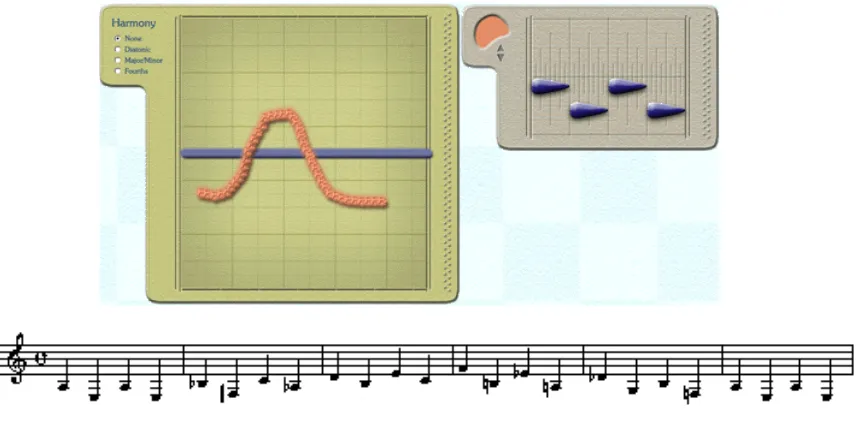
The current dissertation arises out of a research project carried out in collaboration between the Centre for Research in IT in Education, Trinity College Dublin, and Professor Tod Machovers’s Hyperinstruments/Opera of the Future research group, based in the MIT Media Lab, Cambridge, Massachussetts, USA, over the period 1999 to 2004. During the course of the project, a variety of music interfaces, both physical and screen-based were developed and tested with children in both Ireland and the US. These interfaces then formed the core technologies for a public performance project called Toy Symphony1, which involved children, music technology and professional performers and composers which took place in locations in Ireland, the United Kingdom, Europe and the United States in 2001 and 2002.
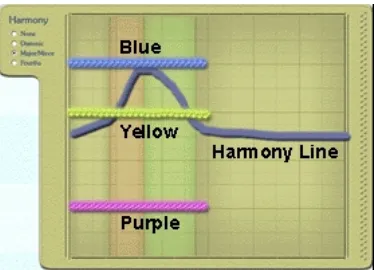
During the course of the Toy Symphony project, the author acted as director for a series of workshops in each location, where children used the various technologies as composers and performers, each workshop series culminating in a public performance with a local professional orchestra. Composing activities were carried out primarily through the medium of the Hyperscore software, which was designed by Mary Farbood and Egon Pazstor at the MIT Media Lab, with some design input from the author.
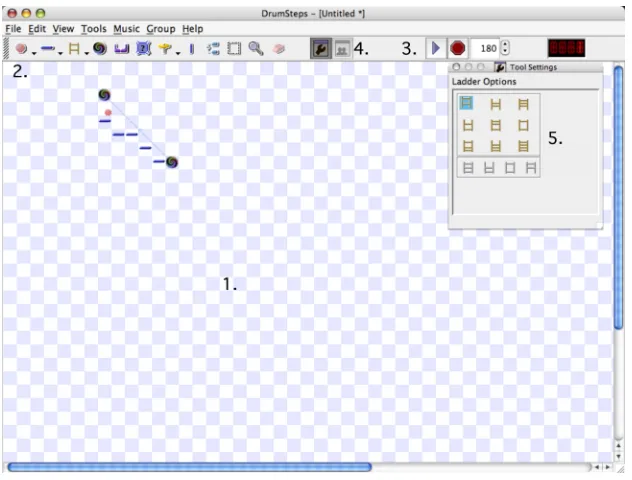
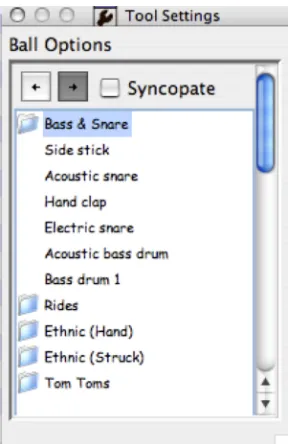
In parallel with these activities, the author designed a second piece of graphical music software called DrumSteps, which was subsequently implemented by James Bligh and Conor McCarthy at CRITE, Trinity College. This software was also subject to initial informal observation and testing with children in Ireland and the UK, and a version of the software was developed for the BBC music website2. While
Drumsteps and Hyperscore are very different pieces of software, they may be characterised principally by the manner in which they seek to facilitate music composition by the use of non-standard representational systems.
During this initial testing and observation process, the author variously informally observed and actively taught more than two hundred children composing with one or other software application. Most of the children involved were between the ages of eight and twelve years old and many had little or no prior formal music education. Almost none had ever composed a piece of music before, yet it seemed that in a relatively short space of time, most of them could not only master the complexities of the software interfaces in question, but use them to produce a musical outcome.
Arising out of these initial informal observations, a number of questions seemed to arise. Firstly, while the children clearly enjoyed working with the software, and there were musical outcomes, it was not
always entirely clear to what extend these outcomes were a function of the childrens musical intent. This was especially true in the Hyperscore interface, which provides the user with a significant degree of automated help. Secondly, while it seemed that children were engaged in some sort of learning process, it was not immediately apparent exactly what was being learned or to what extent this learning was a function of either the interface or the teaching approach. Thirdly, while the author is a practising musician and music teacher, with considerable experience in teaching music in a wide variety of contexts, it was not clear either before or during the workshops what might constitute an appropriate and effective methodological approach in teaching with these software interfaces.
While there were in many cases positive outcomes, and these outcomes were clearly linked to some aspects of the software and the teaching, the nature of the workshop situation made it impossible to pinpoint the exact nature of the many complex activities and relationships which manifested themselves. The author therefore set about carrying out a more formal investigation of the nature of the teaching and learning which seemed to occur in contexts facilitated by the two software applications in question, one of the outcomes of which is the current document.
1.2 Why the Current Study is Needed
There is a considerable lack of knowledge about the role of technology in the teaching and learning of music generally and specifically about its function in enabling music composition activities. Most studies in the field have concentrated on existing technologies that for the most part have been designed for professional rather than educational use and make use of conventional representations of musical information. Many of these have been concerned with constrained compositional tasks rather than composing in the holistic sense. With the exception of Jeanne Bamberger, the author is aware of no studies available in the music-learning sphere in which the researcher has designed software to enable specific musical interactions and examined these in a learning context, nor where non-standard representations of musical information are used. The author is unaware of any body of literature concerned with the specific effect of graphical computer interfaces on the teaching and learning of music composition.
Furthermore, most available studies attempt to distance the researcher from the subject under examination. While this may represent good research practice, it makes a thorough examination of the nature of technology-mediated teaching almost impossible. The author is again unaware of any studies that examine explicitly the relationship between non-standard graphical music interfaces and childrens musical processes, nor of any studies that look closely at the effect of, and relationship between these interfaces and teaching methodology and approach.
address questions relating to the efficacy of the tools themselves, the children’s compositional processes and learning with respect to a variety of musical concepts and ideas, and the nature of technology mediated teaching and learning in the area of music composition.
1.3 Context for the Development of Specific Research Questions
Initially two pieces of software were designed, one by the author solely, and one in collaboration with colleagues at MIT. Each piece of software was created specifically to enable musical construction behaviours without the need for prior musical training or music notation skills on the part of the user. Theoretical underpinning on the design side was provided by the work of both Seymour Papert and David Jonasson. Practical aspects of the design were informed by both the structure of the musical domain and the perceived needs of children working within this domain.
Having designed the software, a theoretical model was sought which might explain user behaviour, including both teachers and students as users. While a variety of general models exist to explain aspects of teaching and learning, the Schon reflection-in-action model was chosen as the underlying theoretical base for the study. This model was seen to provide a holistic and multi-layered description of teacher, learner and researcher actions and interactions and seemed to encompass a variety of other models proposed in the areas of both general learning theory and music composition. Close examination of this model yielded the notion that in order to be applicable in a learning context, a mutually well-understood medium of interaction was a requirement. The current study proposes that in the context of music composition, the graphical computer interfaces under examination might provide such a mediating tool by affording clear and intuitive representations of musical objects, structures and relationships, and by enabling the user (learner and teacher) to reflect on and manipulate these objects.
These propositions then yielded a broad research question and a number of sub-questions that the current study proposed to address.
1.4 The Research Questions to be Addressed
The over-arching research question addressed in the current study is:
Do graphical music software tools support learner and teacher reflection-in-action and reflection-on-action while engaged in the process of learning and teaching music composition?
Concomitant with this is the question:
A related question considers the function of these tools as facilitators of a research approach. As the Schon model proposes the teacher-as-researcher, the role of the technology in facilitating this approach is addressed.
Does the combination of graphical computer technology and digital video facilitate teacher as researcher reflection in- and on- action?
Arising out of these broad questions, a number of sub-questions arise:
Are there definable categories of behaviours apparent in children while engaged in the learning of music composition facilitated by graphical interfaces?
Are there definable teacher interventions and strategies that are effective in this context?
Can the combined-technology research approach yield particular insight into childrens compositional processes and strategies and aspects of their musical perception and cognition?
1.5 The Structure of the Thesis.
1.5.1 Overview
1.5.2 Review of Relevant Literature
As the thesis inhabits a variety of separate but related domains, a range of sources is considered. General perspectives on the design and deployment of technology-enabled learning tools are provided by the work of both Papert and Jonassen. Sources outlining the structure of the music domain are presented. Literature in the area of music perception and cognition indicates points of contact between music domain structures and how these structures are represented in the mind, while also revealing gaps in current understanding, especially in respect of children’s music cognition.
As the thesis is concerned primarily with the learning and teaching of music composition, a number of related bodies of literature are considered. Composers own writings provide descriptions of composing in terms of musical forms and structures, the compositional process itself and the teaching of composition. Music educators provide viewpoints on the teaching and learning of composition, while studies of children actually engaged in music composition yield insight into how children engage with music in this manner. This latter group of studies is further divided into those studies where children compose using traditional media and those where computers and technology-mediated methods are employed. Gaps in current knowledge are identified, most importantly relating to both the effect of graphical interfaces on children’s perception and processes and the nature of effective teaching and pedagogy in technology enabled music composition.
1.5.3 Reflection-in-Action, Affordance and Notation
While a variety of standpoints on learning and teaching are available that might explain observations made during the course of the work, Schon’s theory of reflection-in-action was chosen for a number of reasons. Firstly, the theory itself presents a broad view of learning, and as such may be viewed as containing, or at the very least not conflicting with, a variety of other perspectives, from general education perspectives such as Kolb’s experiential learning model or the Constructivist and Constructionist schools, to specific models for composing such as that presented by Webster. Secondly, Schon’s work offers compelling descriptions of a pedagogic approach and specifically the role of the teacher across a range of subject domains, making it especially applicable to a holistic study such as this. Thirdly, Schon links the notion of reflection-in-action to the availability of a supporting medium. In the current study, it is suggested that computer-based graphical interfaces may provide such a medium for music composition. Finally, reflection-in-action proposes a view of the teacher-as-researcher, which not only informs the approach to teaching and learning contained herein, but also seamlessly links this teaching approach to the underlying research methodology.
learner experience and the manner in which teachers work in technology enabled contexts. This effect, in part, is a function of the manner in which graphical interfaces may act as music notation systems. Therefore, an overview of the role of music notation systems in music learning and in particular in music composition is presented and the suggestion made that computer-based notation systems may have a role in both enabling and exploring children’s music compositional processes.
1.5.4 Research Methodology
The current study is a broad-based inquiry into the nature of music composition teaching and learning as mediated by computer graphical interfaces. The methodological approach draws on elements of naturalistic inquiry and action research as well as Schon’s theory of reflection-in-action, in order to craft a research approach appropriate to the pertinent issues. The specific mode of inquiry used was the participant multiple-case study. Data collection was primarily by the use of digital video. Case study data was supported by a large body of children’s work submitted via the internet. Theoretical relevance specific to the context of the inquiry was induced from qualitative data in a manner informed by grounded theory and supported by ex post facto analysis of the larger submitted data set. Chapter four outlines in some detail the methodological approach taken. The suggestion is made that this broadly qualitative approach is particularly suitable to the nature of the study.
1.5.5 Software
Both pieces of software under examination were designed with the intention of enabling users to engage in music construction and composition, without the need for prior musical training, ability to play an instrument or read standard music notation. DrumSteps is concerned exclusively with rhythm and percussion while Hyperscore enables pitched composition, although only two instrumental timbres are supported. While the two software applications are very different in their design and functionality, there are some common characteristics, in that each of provides a non-standard representation of musical information, allied to the facility to manipulate this information in various ways.
While technical aspects of the implementation of the software are not of interest in the current context, chapter five provides a full description of functional aspects of the software, and details the manipulations and affordances which each provides the user in respect of music composition.
1.5.6 Case Studies
Hyperscore workshops were conducted twice a week over a five week period and involved ten children, in sessions of between fifty minutes and an hour. DrumSteps workshops were everyday over a single week, in sessions of between fifty minutes and an hour involving six children.
During the workshops, the author acted as both researcher and teacher. No a priori pedagogic approach was adopted. Rather, the workshops were allowed to unfold as naturally as possible with a view to capturing and identifying key aspects of the teaching and learning process and the relationship between these and the software.
Each session was videotaped in its entirety using digital video cameras trained on the computer screen. This yielded over one hundred hours of digital video, providing a complete record of children’s work for later analysis. After initial analysis of this complete video record, three students from each workshop group (Hyperscore and DrumSteps) were chosen as exemplars of specific identifiable behavioural types. Complete transcripts were prepared of each of the six case studies which were then analysed in detail and further condensed in two iterations so as to provide rich case study descriptions which form the core of the data set presented in chapter six.
Complete descriptions of the cases are presented in Appendices B and C, while excerpts which illuminate aspects of the argument are presented directly in the text. Discussion in chapter six procedes on two levels. Specific issues are addressed including compositional process, musical interaction and learning and teaching interventions and strategies. A range of interface-related behaviours are identified and broadly characterised as musical, visual/graphical, kinaesthetic and proceedural. In tandem with this discussion, case excerpts are also considered from the perspectives of interface affordance and reflection-in-action, which comprise the key themes of the study.
1.5.7 Online data
Both pieces of software under examination were also made generally available over the internet and received publicity in the media. In the case of Hyperscore, the software was made available via the Toy Symphony website. The software was publicized via the American Public Broadcast television show, “Scientific American Frontiers”, presented by Alan Alda, premiered April 8, 20033 and repeated a number of times over the following two months. The launch of the software was also accompanied by a full-page leader article in the New York Times arts section. Following this publicity, the software was downloaded in excess of twenty-five thousand times. Users were invited to submit scores to a gallery on the Toy Symphony website. Of these pieces, one hundred and five were randomly selected for analysis.
In the case of DrumSteps, the software was made publicly available in collaboration with the BBC. A Shockwave version of the software was built and placed on the BBC website4. The software was
publicised on the BBC Radio 3 programmes ‘Making Tracks”, a music show aimed at children in the eight to fourteen year age range and “The Big Toe Radio Show”, a general magazine show aimed at children in the same age range. A follow up competition was held in conjunction with the CBBC ‘Xchange’ television programme. Children were invited to submit pieces they had made to the competition and for display in an online gallery. Over five thousand users submitted pieces to the BBC website. A random selection of one hundred and fifty-six pieces was made available by the BBC for analysis.
Chapter six also presents a brief account of these selected pieces. Based on particular characteristic gestural features and musical organizing factors, pieces are assigned to those categories developed during the case studies and the prevalence of each behavioural type in this wider data set is assessed. Examples of work in each category and a fuller description and discussion are presented in appendix D,
1.5.8 Discussion and Analysis
Chapter seven is concerned with discussion and analysis of data presented in the previous chapters. Initial discussion focusses on musical interaction and learning, considered from the perspective of the structure of the musical domain. Students are shown to have engaged with a variety of both basic musical rudiments and higher-order musical concepts. Links are made between the nature of this engagement and various acts of manipulation of the musical materials. Key elements of the childrens musical composing processes are identified.
Having established that musical engagement and learning did, in fact, occur, key factors impinging on the learning process are considered, in particular the nature of the affordances provided by the mediating interfaces, and the role of the teacher. Clear links are made between interface affordances and the observed categories of learner behaviours. Teacher interventions are characterised in terms of type and mode, and these are again associated with particular interface affordences.
Finally, the data set is considered through the lens of Schon’s reflection-in-action model. Children are shown to have engaged in a variety of behaviours characteristic of reflection-in-action, including problem framing, move-testing and reflection-on-action. The teaching intervention types and strategies are also shown to be manifestations of the reflection-in-action model and the suggestion is made that this model not only adequately describes, but provides an especially appropriate theoretical underpinning for technology mediated music composition teaching. The role of the teacher as researcher is considered. In conclusion, it is suggested that the affordances provided by the graphical interface are crucial in mediating the multi-layered reflective cycle that underpins the observedlearning, teaching and research.
1.5.9 Conclusions and Future Work
CHAPTER TWO. LITERATURE REVIEW.
2.1 Introduction
This chapter outlines aspects of various bodies of literature and prior work that are relevant to the
current dissertation. As the dissertation is interdisciplinary in nature and is concerned with a holistic
examination of music teaching and learning using technology, a range of sources is explored in order to
inform the work. These include sources relating to the use of technology in education, the structure of
the music domain itself, music perception and cognition, the role of standard notational forms, the
views of both composers and music educators on composing and learning composition and a variety of
field studies on children composing both with and without technology. As the range of sources is
broad, they are necessarily examined only in sufficient depth as to inform current work. These specific
sub-domains relating to this thesis are prefaced with a brief examination of relevant thinking on the
general application of technology in teaching and learning situations.
2.2 Technology in Education
2.2.1 Introduction
Over the past number of years, increasing emphasis has been placed on the application of computers and technology in education and learning. This emphasis has not always been accompanied by rigorous examination of exactly what the role of this technology should be. A variety of approaches have been suggested and tried in different subject domains and settings, with varying degrees of success. These have included internet and web based learning exercises, multi-media based approaches and the deployment and use of commercial software. At this point there is still surprisingly little evidence to indicate whether these types of approaches are more or less successful than traditional teaching and learning methodologies.
A variety of models have been applied to the design of learning software, including drill-and-practice, tutorial, educational games and simulations (Alessi & Trollip, 2001; Richmond, 2002). Other technology based approaches have included adaptive environments, where the software presents material to the user and, based on user responses, attempts to make decisions about which material to present next (Brusilovsky & Peylo, 2003), networked systems that attempt to have users engage in collaborative learning through a variety of techniques including dissemination, creating and sharing materials via bulletin boards, shared workspaces, and a variety of other distance learning approaches.
arts, where mastery of a body of content is not the primary aim of the process. A variety of other approaches exist which may be more relevant to the area of creative music learning.
2.2.2 Microworlds
An alternative vision of how computers might be deployed in educational settings arises out of the
work of Seymour Papert (Papert, 1993a). Building on earlier work of Piaget, he postulates that one of
the reasons children have difficulty in mastering the concepts of a given domain is that very often these
concepts are based on principles which fall outside the range of their normal ‘real-world’ experience.
He suggests an approach based on the idea of a ‘microworld’.
A microworld is an immersive environment (real or virtual) that enables the child to interact with the
elements of a given domain and carry out operations appropriate to that domain, thereby gaining
intuitive knowledge as to the precepts that govern it. The microworld serves as an intermediate, a
mediating tool between the learner and the domain, facilitating the construction of learning paths from
real world experience and knowledge into that needed for understanding in the abstract world of the
domain.
In Papert’s vision, the most appropriate use of computers has nothing to do with the transmission of information. Rather he sees computers as a tool to enable children to do things that they couldn’t otherwise do. Learners build, make or manipulate objects or artefacts and in so doing are confronted with the results of their actions, learning as they go. The physical or virtual ‘building’ acts as an external manifestation of the internal process of constructing knowledge that takes place in the course of completing the task. The underlying philosophy is commonly referred to as ‘constructionism’, the external manifestation of constructivism.
2.2.3 The ‘Design Space’
A similar approach underlies the work of Rafael Granados (Granados, 2001) in the domain of
mathematics education. Much traditional learning takes place in what he calls a ‘problem space’. This
is a conceptual space which consists of a well defined problem statement for which there is a clearly
defined set of actions leading to a correct answer.
The idea of a ‘design space’ stems from problems of a different nature. In a design problem, there is no
clearly defined problem statement, action set or answer. Rather, learners are required to build their own
criteria for deciding on the most useful approach to an open ended problem for which there is no
clearly defined solution. Solutions are only better or worse in various ways when compared to one and
other. Learners will go through cycles where they continuously refine their understanding in order to
arrive at progressively more satisfying solutions. This concept may have relevance to activities in the
appropriate.
2.2.4 Mindtools
Jonasson (Jonassen, 2000) asserts that computers can enable people to think more productively by ‘offloading’ certain lower level tasks. He uses the term ‘mindtool’ to describe any technology that might be used to enable this process and outlines the key characteristics of these tools. A computer-based mindtool should be readily available and affordable. It should allow for knowledge construction and be generalisable across different subject areas. It must entertain both critical thinking and a degree of transferable learning. The principles of operation of the tool itself should be easily learnable by the beginning student.
What the mindtool approach shares with the others described above is a rejection of the notion of
‘technology as conveyor of information’. Neither microworlds (which Jonassen regards as a mindtool)
nor Jonassen's mindtools themselves are concerned with the delivery of content. Rather, knowledge is
built by the learner during a process of active engagement and construction with the materials. The
computer becomes a tool to learn ‘with’ and not ‘from’ (Kommers, Jonassen & Mayes, 1992). These
mindtools facilitate what Jonassen calls ‘cognitive apprenticeship’ (Jonassen, 1994), a process
involving both tool and teacher which is designed to “…scaffold the all-important processes of
articulation and reflection, which are the foundations of knowledge construction.”
These approaches assume that knowledge is situated in authentic experience. Unlike traditional
approaches, learning is ‘ill-structured’. The role of the technology is to facilitate exploratory
behaviours (Jonassen, Peck, Wilson & Pfeiffer, 1999) and to support, guide and extend the thinking
development of their user (Derry & LaJoie,1990). The emphasis is on learners creating their own their
knowledge, rather than receiving it from the teacher.
In this respect, the role of technology is neither to deliver content, nor to replace the teacher. Derry and
LaJoie (Derry & LaJoie, 1993) argue that “the appropriate role for a computer system is not that of a
teacher/expert, but rather, that of a mind-extension ‘cognitive tool’”. Planning, decision-making, and
self-regulation of learning are the responsibility of the learner, not the computer. However “computer
systems can serve as powerful catalysts for facilitating these skills assuming they are used in ways that
promote reflection, discussion, and problem solving” (Jonassen, 1995).
2.2.5 Discussion
There are a number of common threads running through all these visions of the role of technology.
Most important of all of these is the notion of learner autonomy, so that “the best learning takes place
There is agreement that learning should arise naturally out of a process of exploration, which Papert
terms ‘bricolage’, and that this exploration should take the form of actual manipulation of the elements
of a domain. The path through the learning process may be as a result of a negotiation between learner,
teacher or mentor and the material in hand.
Technology itself becomes an ‘object to think with’ (Papert, 1993a), an extension of the users own
cognitive processes rather than a conveyer of information. The underlying philosophical approach is
constructionist, implying that learning is situated in real concrete experience and involves the learner
making, building, designing or otherwise actively constructing something. The computer acts as a
vehicle for construction activities and thereby provides a vehicle for the outward expression of the
users understanding and cognition (Sugarman, 1992). This notion of the computer as a means to
externalize internal understanding is fundamental to the current study, which in part explores the use of
graphical interfaces as a tool with which a teacher may interrogate the students’ cognitive processes.
The current study is concerned with two pieces of software for music composition. In their design, they
both draw on principles underlying mindtools, microworlds and the notion of a design space. They are
‘content-free’ and facilitate design and construction activities within the musical domain. They are
specifically not designed to engender cross-domain behaviours (although, as will be seen, cross-domain
behaviours do in fact ensue) and in this regard may deviate from Jonasson's definition of a mindtool.
However, they do meet many of his other criteria with respect to facilitating planning,
decision-making, reflection and learning by doing.
In designing the tools, it was envisaged that they would be used in a context that included a competent
mentor. This does not preclude their use in other contexts, but for the purposes of this study, this is the
context that was assumed. As one of the aims of the study was to examine the role of these tools in
facilitating reflection-in-action (see chapter three) in a musical context, a prescriptive approach to
actual teaching methodology was not specified at the outset. Design was informed by both the
perceived needs of the children and the nature and structure of the musical domain itself, which is
discussed in the next section.
Finally, each tool is founded on the notion of construction. Users create, manipulate and aggregate
entities on the screen which represent musical sounds or objects, and by so doing create pieces of
music. The nature of the resulting musical construction and the process by which it comes about will
be a function of a number of factors, including the users’ intuitive musical perceptions and priorities,
the structure of the musical domain, the input of a mentor or teacher and the structure of the software
2.3 The Structure of the Music Domain
2.3.1 Introduction
Both computer interfaces examined were designed to enable users to interact with music through acts
of musical construction and composition. The following section briefly defines terms of reference with
respect to core components of the music domain so as to facilitate later analysis of the teaching and
learning process. As music may be subdivided into any number of sub-domains, it is considered most
relevant to broadly outline those aspects of music that are made accessible through either of the
software artifacts in question. The DrumSteps software is entirely concerned with rhythm and
percussion. Hyperscore, while clearly supporting rhythmic work, adds layers of melody, harmony and
counterpoint. This section will concern itself simply with a brief description of these relevant areas.
2.3.2 The Elements of Music
A large number of treatises adequately cover the basic structures of music. White (White, 1984) is
representative of the approach taken in many of these. He presents a comprehensive hierarchic outline
of the structures of music at various levels of detail. At each level, music is considered under the broad
headings of rhythm, melody, harmony and sound. At the lowest level of granularity (micro-analysis),
musical structures are identified as including: rhythm, including details of rhythm at the motivic level,
harmonic rhythm, density and relationship to text; melody, which is subdivided into intervals, conjunct
vs disjunct motion, tessitura, range, pitch profile, cadential figures, density and relationship to text;
harmony, which is subdivided into details of harmony (chord analysis), consonance and dissonance,
cadences, contrapuntal or polyphonic techniques, relationship to text; and sound, which includes such
elements as orchestration/instrumentation, texture, dynamics, relationship of voices to sound,
relationship of text to sound.
At the next level of analysis, which he calls middle-analysis a further set of factors are considered,
which include metric and rhythmic structure of phrases and other formal units and their
interrelationships, melodic shape in phrases and other formal units and harmonic effects in phrases and
other formal units. At the highest level of analysis more global factors are considered which include
meters, tempii, overall rhythmic style, primary rhythmic motives, durations of sections, general
melodic style, broad pitch profile, use of scales, frequent use of intervals, recurrence of melodic ideas,
unity and contrast of harmonic ideas, broad tonal and harmonic relationships.
2.3.3 Rhythm
The divisions adopted by White are reflected in the writings of many other music theorists who delve
(Cooper & Meyer, 1963) describe a hierarchical structure for rhythmic organization. The rhythmic
structure of music is constructed as an organic whole, where smaller rhythmic units, while possessing
their own internal structure, also serve as integral parts of a larger whole. Three basic modes of
temporal organization in music are pulse, meter and rhythm. A pulse is a series of regularly recurring,
equivalent stimuli. Meter is the measurement of the number of pulses between more or less regularly
recurring accents. Tempo, while modifying these three, is not itself a mode of organization. Accent is a
function of a variety of factors that include duration, intensity, melodic contour and regularity (ibid).
As accent occurs when a note event stands out or is set off from other notes in a series, while at the
same time being similar and near enough to these so as not to be perceived as an isolated not event.
Rhythm is commonly defined in terms of grouping of note events (ibid). Repetition of a simple
rhythmic fragment will tend to identify that fragment as a coherent group (Howell, Cross & West,
1985). Howell et al also identify patterning as an important element in music. Groupings that are
symmetric may be divisible into smaller regular groups. The term meter is used to refer to regular
alternation of accents with one or more weak beats, while rhythm is used to refer to the grouped
organization of relative durations without regard to periodicity (E.F.Clarke, 1985; Kramer, 1988;
Clarke & Krumhansl, 1990).Christopher Hasty acknowledges the interplay between fixed metric order
and internal rhythmic variety, stating that “rhythm means, on the one hand, lawfulness, regularity and
measure and on the other hand, expressive or compelling motion, gesture or shape”(Hasty, 1997).
2.3.4 Melody
Melodies composed of discreet pitch levels are universal throughout all musical cultures. Pitches are
commonly divided into pitch classes or scales repeated through several octaves, founded on tonal
centres. Functional harmony arises in melodies out of the relative stability of a tonal centre, generating
tension through movement away from the centre and resolution through returning to it, such that
“knowing where you are in the tonal structure is part of understanding the piece”. (Dowling, 1991)
There are two broad types of melodic structure; conjunct and disjunct (Meyer, 1973). Conjunct
melodies tend to be linear and to continue to a point of relative stability. Disjunct melodies are those
which either ‘skip over’ notes (gap-fill melodies) usually presenting these missing notes in what
follows, or those which are based on triadic interval patterns (third, fourth or fifth) and may imply
continuation of the pattern until a point of stability is reached. Most melodies will in fact show
characteristics of both types. Relationships between melodic structures are based on repetition,
continuation, contrast of function or symmetry.
2.3.5 Harmony
At its simplest, harmony consists of vertically constructed chords or sets of notes and their relationship
might be considered, for the purposes of this dissertation, harmony will refer to what is commonly
called ‘western tonal harmony’. This is a set of generally agreed systems and structures that underpin
much of western music over the past four hundred years. It is the system most relevant to both the
cultural experience of the children involved in the studies described and to the software with which
they are working.
Static harmony may be described in terms of triads (sets of three notes called root, third and fifth,
drawn from an underlying major or minor scale), inversions of these triads (by placing notes other than
the root in the bass), consonance and dissonance and modulation (shifting the tonic). Key movements
are described in terms of first, second and third level dominant-tonic relationships, gradually moving
from the main key via a circle of fifths (Warburton, 1967; Pratt 1996) .
The frequency and rhythmic quality of chord changes is frequently referred to as harmonic rhythm
(Piston, 1949). Cadences are those harmonic patterns that define, or commonly occur in tandem with,
points of rest or phrase endings. Chords may then be arranged in progressions, which create a sense of
harmonic movement towards or away from points of rest. Within these progressions, chords may have
functional relationships with respect to harmonic movement and direction (Forte, 1974).
2.3.6 Sound
It is self-evident that music consists of sounds, usually ordered in various ways. The ways in which
sounds may be organized are commonly described in terms of rhythmic, melodic and harmonic
parameters. Sounds themselves may be described in terms of broad parameters such as tone-colour,
volume, duration, attack, location and pitch (Self, 1986). As the sounds experienced by the children in
the current study were produced by computer using MIDI technology, the parameters over which they
had direct control were pitch, volume and duration. There was control over tone colour to the extent
that they could choose particular timbres and combinations of timbres, but not to the extent that
expressive manipulation of the sounds themselves was possible.
2.3.7 Summary
There is agreement among music theorists that the basic structure of music is comprised of rhythm,
melody, harmony and global factors including tempo, timbre, texture and instrumentation. Emphasis is
places on how these basic elements are combined to form groups, patterns and structurally meaningful
units. A sense of hierarchical order from basic note groups to large-scale structure is common to many
descriptions. Each of the broad categories described may be broken down in to lower order sets of
elements and relationships, while the categories themselves do not operate independently but rather in a
The current study examines how and at what level children interact with these various elements of
music while engaged in computer-based composition. Of the two pieces of software used, DrumSteps
operates exclusively in the area of rhythm, while Hyperscore facilitates interactions with and through
rhythm, melody and harmony. In each case, appropriate sets of descriptors will be brought to bear
based on the relative aspects of the relevant sub-domains as outlined above.
2.4 Music Perception and Cognition
2.4.1 Introduction
The current thesis is in part concerned with children’s musical engagement and learning in
technology-mediated environments. While the primary focus of the study is not children’s music cognition per se,
sources on music cognition and perception are clearly relevant to the extent that they inform the
examination and analysis of research outcomes with respect to learning.
2.4.2 The Relationship between Music Theory and Perception/Cognition
Music theoreticians are interested in understanding the musical structure and interpretation of actual
music compositions. Cognitive psychologists are generally interested in researching mental theories of
how specific musical events are perceived. Much of this latter body of work is based on the study of
discrete musical parameters rather than a holistic study of the musical experience. The applicability of
findings from work of this nature may be compromised by “the tendency for psychologists to use test
materials that are so musically impoverished that they do not really provide a context for musical
perception at all” (Cook, 1994).
There is evidence that musicians and non-musicians seem to attend differently, or attend to different
things in their listening. Musicians may attend to structural features of rhythm, melody and harmony,
while non-musicians may attend to more superficial features such as timbre or melodic contour
(Wolpert, 1990, 2000). Theories of musical structure may tell us about what composers did, but not
necessarily about what people hear. Cook argues that there needs to be a clear distinction between
abstract music theory and the study of music perception, and a careful translation of concepts from one
discipline into the other
This points to the difficulty in teaching naïve musicians in the absence of a clear understanding of what
they are attending to, and no shared formal language of description that may be used to guide their
attention. The current study seeks to demonstrate that graphical interfaces as mediators of musical
2.4.3 Perception of Rhythm, Melody and Harmony
Conventional music notation may offers clues as to what relationships are actually perceived in
listening to music. Specifically with respect to rhythm, beat, meter and bar are of central importance
(Longuet-Higgins & Lee, 1982). Rhythmic repetition and tempo are important in determining
perception of rhythmic grouping (Drake, 1998; London, 2002). Perception of rhythmic features is
closely allied to melodic perception (Steedman, 1977). Features that may be used to describe a melody
include contour, interval pattern, pitch set and key (Dowling, 1994). Listeners will generally recognize
melodies which share the same contour, despite differences in the precise intervallic structure (Dowling
& Fujitani, 1971; Dowling, 1978). Contour does not function independently of other melodic attributes.
Rather it is integrated with both tonal and rhythmic context (Dowling, 1994; Bartlett & Dowling,
1980). Perception of contour may also be a function of melodic length (Edworthy, 1985). Rhythmic
factors may also be important, especially for naïve musicians, who will attend to rhythm as the primary
factor in identifying similarity between melodies (Halpern, Bartlett & Dowling, 1998). Melodic
perception may be influenced by a variety of other factors, including harmony (Povel & Jansen, 2002).
The interrelated nature of those musical parameters which of necessity are often separated out for
individual study is particularly apparent with respect to harmony and perception of tonality. Listeners
extract a sense of key from successive chords perceived in relation to one and other. Key changes are
perceived relative to both the distance between the two keys and the relative directness of the
modulation path, while the sense of the prevailing key is stronger than that of the last heard chord in
isolation (Krumhansl & Kessler, 1982). Perception of hierarchies of pitch with respect to a tonal centre
is also dependent in part on rhythmic pattern (Hershman, 1995). Perception of harmony and harmonic
movement may also depend on the time span over which these events occur, with tonal closure only
affecting listeners when the piece is significantly less than a minute in length (despite the fact that the
notion of tonal closure underpins most models of tonal music) (Cook, 1994). Non-musicians exhibit
little sensitivity to tonal factors in forming segments when engaged in a holistic listening, instead
focusing on surface factors in the music such as change in registration, density, temporal discontinuity
or repetition in choosing points of reference within the piece (Deliege, Melen, Stammers & Cross,
1996).
2.4.4 Accent, Grouping, Patterns and Perception of Boundaries
Many listeners use accents as musical landmarks in the construction of understanding of time structure
of music. Complexity in structure arises from perception of accents at varying degrees of hierarchical
importance (Pfordresher, 2003). Listeners have a tendency to impose pattern-based organization on
musical information, so that “people appear to have strong propensities, whether innate or learned, to
Patterns may exist along dimensions of rhythm, melody, harmony and form or may arise as a result of
the interaction between these. Patterns are identified as involving periodicity, that is to say repetition at
periodic intervals. Listeners abstract pattern information from music with reference to rhythmic,
melodic and harmonic cues such as accent, note duration and orderly progression. In forming patterns,
grouping of elements is important, predicated on a number of principles including temporal proximity,
proximity along the pitch dimension, loudness, timbre and spatial location Other factors which may
influence grouping include continuance, contour and repetition of pitch contours while grouping with
respect to temporal placement has been found to outweigh tonal structure (Deutsch & Fereo 1981).
Studies of children clapping and notating simple rhythms and of children re-constructing known
melodies using Montessori bells show that children attend to grouping of note events into figures based
on position and function rather than on formal definition of each note event by property (Bamberger
1991, 1994). Children constructing melodies using Montessori bells pass through a number of stages
identified as figural, transitional and formal (Bamberger, 1991). The figural stage is characterized by a
reliance on enactive or kinaesthetic techniques – the physical orientation of the bells, the actual pitch
structure of the tune and the child’s “felt path’ over the bells in playing the tune are intertwined. In the
transitional phase, the ‘felt-path’ through the tune is decoupled from the physical orientation of the
bells (the ‘bell-path’). Finally in a fully formal description of the tune, the configuration of the bells is
fixed and invariant and the tune constructed by an ‘action-path’ over the bells which produced the
desired pitch sequence. This formal representation is one in which the note events are formally
classified, in this case according to their position in a scale.
2.4.5 Discussion
There are a number of characteristics that imbue much of the literature on music perception and
cognition. With the exception of Bamberger, many of the studies quoted were carried out in artificial
circumstances, for example using probe tone or other non-contextualised stimuli. Many tests involved
subjects listening to stimuli of various types and responding in various ways. In general the subjects
were not actively engaged in musical activity other than listening. Most of the studies were carried out
using adult subjects rather than children. There is a clear need for further work which addresses
children’s music cognition as they engage actively in real musically-meaningful tasks.
While this study is not directly concerned with an examination of children’s music cognition and
perception, it is clear that those factors outlined above have a bearing on the current work. As the study
is concerned with use of music software for music teaching and learning, what the children attend to
and the extent to which the software both facilitates and directs their attention are of considerable
importance. Furthermore, the extent to which the software makes aspects of their process available for
description and examination is of relevance to an evaluation of both the teaching approach adopted and
software itself as a teaching and research tool. So, while the dissertation will not explicitly analyse
learning interactions and will also seek to demonstrate the value of these interfaces as research tools in
the area of children’s music cognition.
2.5 Music Composition
2.5.1 Introduction
Historically the teaching of composition has been largely concerned with rules based method. In other
words, music is governed by sets of rules and so in order to compose properly, these rules must be
learned. This method is commonly grounded in a sense of musical style. In the renaissance era, certain
basic premises were understood and followed by the vast majority of composers, likewise in the
baroque period, the classical and so on. In modern compositional teaching, most of which happens at
third-level with adult students, it is generally accepted that students will follow a path that involves first
learning to compose in a variety of historical styles, absorbing the conventions of the style and
demonstrating this with pastiche composition before beginning to develop their own voice. At this
point, the student commonly moves to study with a mentor or master composer, who guides him/her in
finding and developing this voice.
Many treatises on composition exist. The emphasis in most of these works is on ‘what to teach” rather than “how to teach”. In the main, they consist of formal descriptions of the structure of music with instructions as to how melodies should be structured, how harmony works, how voices go together contrapuntally in various styles allied to formal exercises, often based on given seed material. The approach is typically domain-centric and rules-based. The student must become familiar with the materials through a series of programmed exercises before engaging in real creative composition.
This approach is clearly neither meaningful or appropriate for children, who are often not specifically
engaged in the formal study of music and who do not have the necessary grounding in music history,
musical analysis and rudiments. The current study seeks to take an alternative approach, by providing
computer-based environments that enable children to construct an understanding of musical
fundamentals while simultaneously engaged in acts of musical construction.
During these acts of musical construction, many kinds of learning may occur. Students may learn
directly the important musical concepts underpinning music composition. They may also learn
something about the compositional process itself, what kinds of strategies and working methods may
be most effective in realizing their musical vision. On another level, they may engage with fundamental
musical principles and rudiments. This study will seek to observe children’s learning on all these
levels, to make connections between these and the structures and affordances of the facilitating