Mechanisms: Normal Phase
R.P. W. Scott, Avon, CT, USA
Copyright^ 2000 Academic Press
Introduction
In normal phase chromatography the dominant inter-actions between the solute and the stationary phase that cause retention and selectivity are polar in na-ture. If dispersive interactions dominate, then the separation system is called ‘reversed phase’ chromatography. To comprehend the retention mechanisms involved in normal phase chromatogra-phy, it is necessary to understand the nature of the different interactive forces that are involved be-tween the solutes and the two phases and how they occur. The retention of a solute is directly propor-tional to the magnitude of its distribution coefR c-ient (K) between the mobile phase and the stationary phase which, in turn, will depend on the relative afRnity of the solute for the two phases, i.e. the interactive forces between the solute molecules and the two phases. Consequently, the stronger the forces between the solute molecule and the molecules of the stationary phase, the larger the distribution coef-Rcient and the more the solute is retained. There are only three basic types of molecular force, all of which are electrical in nature. These three forces are called ‘dispersion forces’, ‘polar forces’ and ‘ionic forces’. Despite there being many different terms used to describe molecular interactions (e.g. hydrophobic forces, } interactions, hydrogen bonding, etc.) all interactions between molecules are the result of com-posites of these three basic molecular forces. Disper-sion forces arise from chargeSuctuations throughout a molecule resulting from random electron/nuclei vi-brations. They are typical of those that occur between hydrocarbons and other substances that have either no permanent dipoles or can have no dipoles induced in them. In biotechnology and biochemistry, disper-sive interactions are often referred to as ‘hydropho-bic’ or ‘lyopho‘hydropho-bic’ interactions, apparently because dispersive substance such as the aliphatic hydrocar-bons do not dissolve readily in water. Polar interac-tions arise from electrical forces between localized charges such as permanent or induced dipoles. Polar forces are always accompanied by dispersive tions and may also be combined with ionic interac-tions. Polar interactions can be very strong and pro-duce molecular associations that approach, in energy, to that of a weak chemical bond (e.g. ‘hydrogen bonding’). Ionic interactions arise from permanent
negative or positive charges on the molecule and thus usually occur between ions. Ionic interactions are exploited in ion exchange chromatography where the counter-ions to the ions being separated are suited in the stationary phase. To achieve the necessary reten-tion and selectivity between the solutes for complete resolution, it is necessary to select a phase system that will provide the optimum balance between dispersive, polar and ionic interactions between the solute mol-ecules and the two phases.
To achieve retention, the forces between the solute molecules and the stationary phase must dominate. If the molecules are largely dispersive in character then dispersive interactions must dominate in the station-ary phase and, by suitable choice of mobile phase, polar interactions are made to dominate in the mobile phase. Conversely, if the substances to be separated are largely polar or polarizable then polar interac-tions must dominate in the stationary phase and, by suitable choice of mobile phase, dispersive interac-tions must be made to dominate in the mobile phase. When polar interactions dominate in the stationary phase, historically, the separation system has been termed ‘normal’ chromatography. When dispersive interactions dominate in the stationary phase, histori-cally, the separation system is said to be ‘reversed phase’ chromatography. Thus in normal chromatog-raphy polar interactions dominate in the stationary phase and dispersive interactions are made to domin-ate in the mobile phase.
Figure 1 Langmuir adsorption isotherms for benzene, butyl chloride and chloroform. chromatography). The strongly polar hydroxyl
groups inducing dipoles in the easily polarizable aro-matic nucleus. A single molecule can possess dif-ferent types of polarity; phenylethanol, for example, will possess both a permanent dipole as a result of the hydroxyl group and also be polarizable due to the aromatic ring. More complex molecules can have many different interactive groups.
The most common, and in fact traditional, normal phase system used in liquid chromatography consists of silica gel as the stationary phase and a mobile phase that is predominantly an alkane or a mixture containing a high proportion of an alkane. This sys-tem will be used to examine the type of interactive mechanisms that can take place in normal phase chromatography. The second solvent(s) can be more dispersive such as methylene chloride or a more polar such as ethyl acetate,n-propanol or even ethanol. To reduce retention, either the interactive character of the stationary phase must be reduced or the interac-tive character of the mobile phase increased or both. Both effects can be achieved by modifying the mobile phase. However, in normal phase chromatog-raphy, when employing mixed mobile phases, the interactions on the silica surface can become quite complex and the mechanism of retention needs some discussion. The mechanisms involved in mobile phase interactions with the solute are quite different to those involved with the stationary phase and thus, they will be considered separately.
The Nature of the Surface of Silica Gel
When the silica surface is in contact with a solvent, the surface is covered with a layer of the solvent
molecules. If the mobile phase consists of a mixture of solvents, the solvents compete for the surface which is partly covered by one solvent and partly by the other. Thus, any solute interacting with the stationary phase may well be presented with two, quite different types of surface with which to interact. The probabil-ity that a solute molecule will interact with one par-ticular type of surface will be statistically controlled by the proportion of the total surface area that is covered by that particular solvent.
Mono-Layer Adsorption
A solvent can be adsorbed from a solvent mixture on the surface of silica gel according to the Langmuir equation for monolayer adsorption. Examples of mono-layer adsorption isotherms obtained for ben-zene, chloroform and butyl chloride are shown in Figure 1. It is seen that the surface becomes com-pletely covered, and its interactive characteristics se-verely modiRed at relatively low concentrations of the second solvent in the mobile phase ('10% v/v). If the second solvent is more polar, a quite different type of adsorption isotherm applies. In this case, bi-layer adsorption can take place as shown by the isotherms inFigure 2. Bi-layer adsorption is not un-common and the bi-layer adsorption isotherm equa-tion can be derived by a simple extension of the procedure used to derive the Langmuir adsorption isotherm. It should be noted that, due to the strong polarity of the hydroxyl groups on the silica, the initial adsorption of the ethyl acetate on the silica surface is extremely rapid.
Figure 2 The individual and combined adsorption isotherms for ethyl acetate on silica gel.
two curves, although similar in form, are quite differ-ent in magnitude. TheRrst layer which is very strong-ly held is complete when the concentration of ethyl acetate is only about 1% w/w. At concentrations in excess of 1% w/w the second layer has only just begun to be formed. The formation of the second layer is much slower and the interactions between the solvent molecules with those already adsorbed on the surface are much weaker. Assuming that the total area covered by theRrst layer will be the same as the area covered by the second layer, then only about one third of the layer is complete at a concentration of about 4% w/v. This is in striking contrast to the formation of theRrst layer which is virtually complete at an ethyl acetate concentration of 1% w/v.
From the point of view of solute interaction with the surface, it is seen that it can now be very complex indeed. In contrast to the less polar or dispersive solvents, the character of the interactive surface will be modiRed dramatically as the concentration of the polar solvent ranges from 0 to 1% w/v. However, above 1% w/v, the surface will be modiRed more subtly, allowing a more controlled adjustment of the interactive nature of the surface.
Multi-layer adsorption is also feasible, for example the second layer of ethyl acetate might have an absorbed layer of the dispersive solventn-heptane on it. However, any subsequent solvent layers that may be generated will be situated further, and further, from the silica surface and are likely to be very weakly held and sparse in nature. Under such circumstances their presence, if, in fact, real, may have little impact on solute retention.
Interactive Mechanisms on the
Surface of Silica Gel in
Normal-Phase Liquid
Chromatography
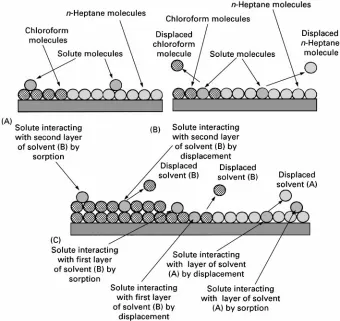
It is clear that the interaction of the solute molecules with the stationary phase surface can be quite complex and also change with the composition of the mobile phase. There are two ways a solute can interact with a stationary phase surface. The solute molecule can interact with the adsorbed solvent layer and rest on the top of it. This is called ‘sorption interaction’ and oc-curs when the molecular forces between the solute and the stationary phase are relatively weak compared with the forces between the solvent molecules and the stationary phase. The second type is where the solute molecules displace the solvent molecules from the sur-face and interact directly with the stationary phase itself. This is called ‘displacement interaction’ and oc-curs when the interactive forces between the solute molecules and the stationary phase surface are much stronger than those between the solvent molecules and the stationary phase surface. An example of sorption interaction is shown inFigure 3(A). Its linear relation-ship is clearly demonstrated and it is seen that the distribution coefRcient (which controls retention) can be adjusted to any selected value by choosing the appropriate mixture of the two solvents.
Reiterating the equation proposed by Purnell, for two solvents (A) and (B) in GC (seeFigure 4):
Figure 3 Different forms of molecular interaction with the silica gel surface.
Figure 4 Graph of corrected retention volume against volume fraction of stationary phase.
The results of Katz et al. can be algebraically ex-pressed in a similar form for LC:
KAB"(KA!KB)#KB [2]
For chromatography purposes the product of the dis-tribution coefRcient and the volume of stationary
phase, or stationary phase surface area, gives the corrected retention volume, i.e.:
VAB"KAB, VA"KA and VB"KB
In the experiments of Katzet al. (seeFigure 5), that validated the relationship given in eqn [4], the distribution coefRcients (K) were referred to the solvent phase (mobile phase) whereas in LC it is the mobile phase composition that is changed and the distribution coefRcients (K) are referred to the stationary phase. Thus:
KAB" 1 KAB
, KA" 1 KA
and KB" 1 KB or:
VAB" 1 VAB
, VA" 1 VA
and VB" 1 VB
[3]
Substituting for the corrected retention volumes in eqn [3] for inverse phase system:
VAB"
1
V1A! 1 VB
#1 VB
Figure 5 Graphs relating distribution coefficient to solute reten-tion forn-pentanol.
Figure 6 Graph of corrected retention volume of the enantio-mers of 4-benzyl-2-oxazolidinone against the reciprocal of the volume fraction of ethanol.
Simplifying:
VAB"
VAVB
(VB!VA)#VA
[5]
Thus, when "0, VAB"VB and when "1, VAB"VA.
In practice a more convenient way of expressing solute retention in terms of solvent concentration for a binary solvent mixture as the mobile phase is to use the inverse of eqn [5], i.e.:
1 VAB
"
1 VA!1 VB
#1 VB
[6]
If the corrected retention volume in the pure strongly eluting solute is very small compared with the reten-tion volume of the solute in the other pure solvent, i.e. VAVBwhich is very often the case in practical LC then eqn [6] simpliRes to the simple reciprocal rela-tionship:
VAB" VA
[7]
Under these conditions the reciprocal relationshipRts experimental data extremely well, particularly at vol-ume fractions below 0.5 of the strongly eluting solute. In addition, under these conditions the inverse will also apply, i.e.
1 VAB
"V A
[8]
Equation [8] has been validated by the results from a number of workers in theReld and an example of the expected correlation is given by the curves in
Figure 6 for the two enantiomers, (S) and (R) 4-benzyl-2-oxazolidinone. The column chosen was 25 cm long 4.6 mm i.d. packed with 5m silica particles bonded with the stationary phase Van-comycin (Chirobiotic V).
This stationary phase is a macrocyclic glycopeptide Vancomycin that has a molecular weight of 1449.22, and an elemental composition of 54.69% carbon, 5.22% hydrogen, 4.89% chlorine, 8.70% nitrogen and 26.50% oxygen. Vancomycin is a strongly polar stationary phase which contains 18 chiral centres surrounding three ‘pockets’ or ‘cavities’ which are bridged byRve aromatic rings and thus can readily offer unique enantiomeric selectivity to a wide range of chiral substances. The column was operated in the normal phase mode using mixtures of n-hexane and ethanol as the mobile phase. Equation [7] is unam-biguously validated by the curves relating the correc-ted retention volume to the reciprocal of the volume fraction of ethanol shown in Figure 6. It is also seen that an excellent linear relationship is obtained with an index of determination very close to unity.
are predominantly dispersive then it is a normal phase system. In practice, normal phase systems are used to separate mixtures of polar substances; they are large-ly ineffective in separating substances that are largely or exclusively dispersive. For reversed phase chromatography, the converse applies.
See also: II/Chromatography: Liquid: Column Techno-logy; Theory of Liquid Chromatography.
Further Reading
Hurtubise RJ, Hussain A and Silver HF (1981)Analytical Chemistry53: 1993.
Katz ED, Ogan K and Scott RPW (1986) The distribution of a solute between two phases.Journal of Chromatog-raphy352: 67.
Laub RJ (1983)Physical Methods in Modern Chromato-graphic Analysis, Chapter 4. New York: Academic Press.
Laub RJ and Purnell JH (1975)Journal of Chromatography
112: 71.
McCann M, Purnell JH and Wellington CA (1980) Pro-ceedings of the Faraday Symposium,Chemical Society, 83.
McCann M, Madden S, Purnell JH and Wellington CA (1984)Journal of Chromatography294: 349.
Robbins WK and McElroy SC (1984)Liquid Fuel Techno-logy2: 113.
Scott RPW and Kucera P (1978) Solute}solvent interactions on the surface of silica gel.Journal of Chromatography
149: 93.
Scott RPW and Kucera P (1978) Solute}solvent interactions on the surface of silica gel II.Journal of Chromatogra-phy149: 93.
Mechanisms: Reversed Phases
R. P. W. Scott, Avon, CT, USA
Copyright^ 2000 Academic Press
Introduction
In the early days of liquid chromatography (LC), the most commonly used stationary phase was silica gel, which was usually loaded with water and employed with a hydrocarbon mixture such as petroleum ether as the mobile phase. To change the selectivity of the distribution system, the hydrocarbon was sometimes adsorbed on the silica, and water or an aqueous alcohol mixture was used as the mobile phase. For obvious reasons, the latter was termed a reversed-phase system. Since that time, the reversed reversed-phase has been deRned in a number of different ways: in this article, it is regarded as consisting of hydrocarbon moieties chemically bonded to a silica matrix. Rever-sed phases are considered to exhibit predominantly dispersive interactions with any solute or solvent with which they are in contact.
TheRrst reversed phase was synthesized by HaHlasz and Sebastian in 1969 by reSuxing silica with a suit-able alcohol (e.g.n-octanol) to form the silyl ester, the hydrocarbon chain being linked to the silica by car-bon}oxygen}silicon bonds. This bonding proved to be labile, as the hydrocarbon moiety was easily re-moved by hydrolysis, but was sufRciently stable to allow the potential of such phases to be established. The next year Kirkland and DeStefano used chloro-silane reagents to attach the hydrocarbon chain to the
silica by a silicon}oxygen}silicon bond which proved to be far more stable, at least between pH 4 and pH 8.
Subsequently, other silyl reagents, such as the silyl esters, were also shown to react with silica. Some of these reagents are now commonly used in the produc-tion of reversed phases.
Brush Phases
There are three basic types of bonded phases which are produced by the use of the mono-, di- and tri-substituted silanes: brush phases, oligomeric phases and bulk phases. For example, the monochlorsilanes (e.g. octyldimethylchlorsilane) react with the hy-droxyl groups on the silica surface to produce dimethyloctylsilyl chains attached to the silica. The alkyl chains are thought to stand out from the surface like the bristles of a brush, hence the term brush phase. After reaction, the material is usually treated with trimethylchlorsilane or hexamethyldisilazane to eliminate any remaining unreacted hydroxyl groups. This procedure is called capping the bonded phase.