Transreal Calculus
Tiago S. dos Reis and James A.D.W. Anderson,
Member, IAENG,
Abstract—Transreal arithmetic totalises real arithmetic by defining division by zero in terms of three definite, non-finite numbers: positive infinity, negative infinity and nullity. We describe the transreal tangent function and extend continuity and limits from the real domain to the transreal domain. With this preparation, we extend the real derivative to the transreal derivative and extend proper integration from the real domain to the transreal domain. Further, we extend improper integration of absolutely convergent functions from the real domain to the transreal domain. This demonstrates that transreal calculus contains real calculus and operates at singularities where real calculus fails.
Index Terms—transreal arithmetic, transreal tangent, tran-sreal continuity, trantran-sreal limit, trantran-sreal derivative, trantran-sreal integral, transreal calculus.
I. INTRODUCTION
T
RANSREAL [6] and transcomplex [3][7] arithmetic are developments of Computer Science that are now being normalised in Mathematics [9]. They define division in terms of operations on the lexical reciprocal. This lexical definition contains the usual definition of division, as multiplication by the multiplicative inverse, but also defines division by zero. Consequently transreal and transcomplex arithmetic are supersets of, respectively, real and complex arithmetic. There is a machine proof [6] and a human proof [7] that tran-sreal arithmetic is consistent if real arithmetic is. The hand proof also demonstrates that transreal arithmetic contains real arithmetic and establishes a similar relationship between transcomplex arithmetic and complex arithmetic.Transreal arithmetic uses a subset of the algorithms of real arithmetic so the general reader will be able to follow any computation in transreal arithmetic but will have little chance of deriving a valid, non-finite, computation until the axioms [6] or algorithms [3] of transreal arithmetic have been properly learned. The reader is further cautioned that the relational operators of transreal arithmetic, less-than (<), equal-to (=), greater-than (>), together with their negations, form a total, irredundant set of independent operations, unlike their real counterparts. These relational operators are described in [4] but there are some typographical errors in that paper. These are corrected in Appendix B below. In order to assist the reader, we explain the special properties of transreal arithmetic where they are first used in a proof.
We begin by describing the transreal tangent [5] so that non-finite tangents are well defined when we use them in the development of the transreal, differential calculus. The trigonometric, tangent function is geometrically defined
Manuscript received January 19, 2015. Revised February 10, 2015. Tiago S. dos Reis is with the Federal Institute of Education, Science and Technology of Rio de Janeiro, Brazil, 27215-350 and simultane-ously with the Program of History of Science, Technique, and Episte-mology, Federal University of Rio de Janeiro, Brazil, 21941-916 e-mail: [email protected]
J.A.D.W. Anderson is with the School of Systems Engineering, Reading University, England, RG6 6AY e-mail: [email protected]
everywhere but it is undefined, in real arithmetic, when it takes on an “infinite” value at multiples of the angleπ/2. In the next section we describe the transreal tangent which is defined everywhere. We then develop transreal limits [5] as a generalisation of real limits. The main results are: wherever infinities occur as symbols in extended-real limits, they occur identically in transreal limits but as definite numbers; wherever the transreal number nullity occurs in transreal limits, the corresponding real limit is undefined. We then develop the transreal derivative [8] so that it contains the real derivative and operates at singularities where the real derivative is undefined. We extend the proper integral of real functions to the transintegral of transreal functions and the improper integral of absolutely convergent, real functions, to the transintegral of absolutely convergent, transreal functions. Thus the transintegral contains all of these real integrals and extends them to operate at singularities. However, this is a rather restricted set of functions. Since the preparation of this integral, a much wider extension of the real integral to the transreal integral has been developed. That material has been submitted for publication elsewhere.
All of the proofs given here are developed in terms of topology, however in Appendix A we appeal to Urysohn’s theorem to show that there are metrics on the set of transreal numbers that are compatible with their topology. Further-more, we construct one such metric.
II. TRANSREALTANGENT
x
y
p
θ
0
±�
+�/2
-3�/2
[image:1.595.355.525.500.704.2]-�/2
+3�/2
Fig. 1. Geometrical Construction of the Tangent
Figure 1 shows the well known geometrical construction of the tangent, in which a point, p, lies on a circle, with a unit radius forming the hypotenuse of a right triangle,
IAENG International Journal of Applied Mathematics, 45:1, IJAM_45_1_06
whose internal angle isθ. When the sides of the triangle are measured in Cartesian co-ordinates, the tangent is defined as
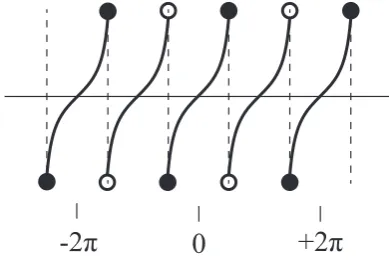
tanθ =y/x. Part of the graph of this function, for real θ, is shown in Figure 2, where the discs, •, show where the tangent arrives exactly at a signed infinity and the annuli,◦, show where the tangent asymptotes to a signed infinity, that is where it approaches the infinity but does not arrive at it.
0
+2π
[image:2.595.73.268.166.305.2]-2π
Fig. 2. Graph of the Transreal Tangent
The reader should examine Figure 2. The abscissa shows the angle in radians; the ordinate shows the value of the tangent function. At zero radians the value of the tangent is
tan = y/x = 0/1 = 0. As the angle increases: the value increases until it passes exactly through positive infinity at
tan(π/2) = 1/0 =∞; the value then jumps discontinuously so that it passes through all negative, real numbers, each of which is finite, until it arrives at tanπ = 0/1 = 0; the value continues to increase, asymptoting to positive infinity at3π/(2−)for small, positive, then jumps discontinuously to negative infinity at tan(3π/2) =−1/0 =−∞; the value of the tangent then increases to zero at tan2π = 0/1 = 0. Notice that the graph has a least, that is principal, period of 2π, not π as is commonly understood. The results for negative angles are similar. For integral k the value of the tangent is positive infinity at θ = 2kπ+π/2 and negative infinity at θ= 2kπ−π/2. The usual graph for the tangent, computed as the limit of a power series, is similar to Figure 2 but with the difference that the tangent is undefined at
2kπ ±π/2 for all integral k. Thus the finite values of the geometrical tangent have periodπbut the extended-real values have period 2π.
As we lack a geometrical construction for the non-finite, transreal angles, we define that the value of the transreal tangent, at non-finite angles, is the limit of the usual power series, evaluated in transreal arithmetic, so thattan(−∞) = tan∞= tanΦ = Φ. This is justified by Observation 16 in Section III-BTransreal Sequencesbelow.
We then take the arctangent as usual, for finite values of the tangent, and augment this with arctan(−∞) =−π/2,
arctan∞= π/2,arctanΦ = Φ. This defines the principal range of the arctangent for all transreal angles.
III. TRANSREALLIMIT ANDCONTINUITY
In this section we augment the topology of transreal space, derived transarithmetically from -neighbourhoods [2], with
the usual topology of measure theory and integration theory. Amongst other results, we show that transreal space is a compact, separable, Hausdorff space. We then develop transreal sequences and establish the transreal infimum and supremum. We present fundamental results on the limits and continuity of transreal functions. Taken together this implies that transreal calculus contains real calculus.
A. Transreal Topology
Transreal arithmetic implies a topology [2], Figure 3, that gives a definite, numerical value to the result of dividing any real number by zero. Infinity,∞, is the unique number that results when a positive number is divided by zero; negative infinity, −∞, is the unique number that results when a negative number is divided by zero; nullity,Φ, is the unique number that results when zero is divided by zero. Nullity is not ordered, all other transreal numbers are ordered. Infinity is the largest number and negative infinity is the smallest number. Any particular real number is finite; ∞ and −∞
are infinite; Φ is non-finite. The infinite numbers are also non-finite. The real numbers, R, together with the infinite numbers,−∞and ∞, make up the extended-real numbers,
RE; the real numbers, together with the non-finite numbers, −∞,∞andΦ, make up the transreal numbers,RT.
In summary the arithmetic and order relation defined in
RT is such that, for each x, y∈RT, it follows that [6]:
i) −Φ = Φ,−(∞) =−∞and−(−∞) =∞, ii) 0−1=∞,Φ−1= Φ,∞−1= 0and(−∞)−1= 0,
iii) Φ +x= Φ,∞+x=
Φ , ifx∈ {−∞,Φ} ∞ , otherwise and
−∞+x=
Φ , if x∈ {∞,Φ} −∞ , otherwise ,
iv) Φ×x= Φ, ∞ ×x=
Φ , ifx∈ {0,Φ} −∞ , ifx <0 ∞ , ifx >0
and
−∞ ×x=−(∞ ×x), v) x−y=x+ (−y) and vi) x÷y=x×y−1.
vii) Ifx∈Rthen−∞< x <∞.
[image:2.595.310.552.380.537.2]viii) The following does not holdx <Φor Φ< x.
Fig. 3. Transreal Number-Line
We now define a topology for the whole of RT = R∪ {−∞,∞,Φ} which contains the usual topology on RE={−∞} ∪R∪ {∞} that is used in measure theory and
integration theory. Specifically we note that{−∞},{∞}and
{Φ} are singleton sets that are not finitely path connected to any other numbers. This retains compatibility with an older view of the topology of the transreal numbers, based
IAENG International Journal of Applied Mathematics, 45:1, IJAM_45_1_06
on computing -neighbourhoods using transreal arithmetic [2]. In our new topology we have that {−∞}and{∞} are closed and not open, while {Φ} is both closed and open. We impose neighbourhoods on {−∞} and {∞} so that the usual topology of measure theory and integration holds, with the possibility that real and extended-real functions have limits of −∞ and ∞. The number Φ is then left as the unique, isolated point, reflecting its status as the unique, unordered number, Φ, in transreal arithmetic. We then rehearse various theorems of sequences, limits and continuity, all of which show that wherever −∞ and ∞
occur as limits in transreal calculus they occur identically in (extended) real-calculus, with the difference that −∞
and∞are abstract symbols in (extended) real calculus and are numbers in transreal arithmetic and transreal calculus. Furthermore0/0is undefined in (extended) real calculus but in transreal arithmeticΦ = 0/0 is a definite number and, in transreal calculus, it is the limit, for example, of constant, transreal functions of the formf(x) = Φ. Thus real calculus is extended to transreal calculus.
Definition 1: Let A ⊂ RT. We say that x ∈ RT is a transinterior point related to A if and only if one of the following conditions holds:
1) x∈ R and there is a positive ε ∈ R such that (x− ε, x+ε)⊂A,
2) x=−∞and there isb∈Rsuch that[−∞, b)⊂A,
3) x=∞and there isa∈Rsuch that (a,∞]⊂A or
4) x= Φand{Φ} ⊂A.
We denote the set of all transinterior points related to A as transintA. We say that a setA⊂RT istransopen if and
only ifA=transintA.
Notice that for every A ⊂ RT it is the case that
transintA⊂A.
Theorem 2: The class of all transopen sets in RT is a
topology on RT. That is to say:
1) ∅,RT are transopen,
2) Any union of transopen sets is a transopen set and 3) A finite intersection of transopen sets is a transopen
set.
Proof:
1) Notice that transint∅=∅ andRT ⊂transintRT follow
directly from the definition of a transopen set. 2) Let I be any set and A = [
α∈I
Aα, where Aα is
transopen for allα∈I. Ifx∈Athenx∈Aαfor some
α∈I, whencex∈transintAα. We have several cases:
x ∈ R, whence there is a positive ε ∈ R such that (x−ε, x+ε)⊂Aα⊂A; orx=−∞, whence there
is b ∈ R such that [−∞, b) ⊂Aα ⊂ A; or x =∞,
whence there isa∈Rsuch that(a,∞]⊂Aα⊂A; or
x= Φ, whence {Φ} ⊂Aα ⊂ A. In every case, x∈
transintA, whenceA⊂transintA.
3) Let A1, A2 ⊂RT be transopen sets. If x∈A1∩A2 then x ∈ A1 and x ∈ A2, whence x ∈ transintA1 andx∈ transintA2. If x∈R then there are positive ε1, ε2 ∈ R such that (x−ε1, x+ε1) ⊂ A1 and
(x−ε2, x+ε2)⊂ A2. Taking ε= min{ε1, ε2}, we have (x−ε, x+ε) ⊂ A1∩A2. If x = −∞ then there are b1, b2 ∈ R such that [∞, b1) ⊂ A1 and
[−∞, b1) ⊂ A1. Taking b = min{b1, b2}, we have
[−∞, b)⊂A1∩A2. Ifx=∞then there area1, a2∈
Rsuch that (a1,∞]⊂A1 and (a2,∞]⊂A1. Taking
a= max{a1, a2}, we have(a∞]⊂A1∩A2. Finally if x = Φ then {Φ} ⊂ A1 and {Φ} ⊂ A2, whence
{Φ} ⊂ A1∩A2. In any case x∈ transint(A1∩A2), whenceA1∩A2⊂transint(A1∩A2).
Reverting now to ordinary terminology, we call a tran-sopen set an open set, we call a transinterior point an interior point, and we denote transintAby int-A.
Observation 3: Notice that the class of sets of the form
(a, b),[−∞, b),(a,∞] and{Φ} make a basis1 for the
topol-ogy ofRT.
We recall that a subset of topological space is closed if and only if its complement is open.
Example 4: The sets {Φ}, (−∞, x), (x,∞), [−∞, x),
(x,∞],(−∞,∞) =R,[−∞,∞],[−∞,∞),(−∞,∞] and (x, y)are open onRT wherex, y∈Randx < y.
Example 5: The sets{−∞},{∞},{x},[−∞, x],[x,∞],
(−∞, x],[x,∞),(x, y],[x, y)and[x, y]are not open onRT
wherex, y∈Randx < y.
Example 6: The sets {Φ},{−∞},{∞},{x},[−∞,∞],
[−∞, x],[x,∞]and[x, y]are closed onRT wherex, y∈R
andx < y. In fact,RT \ {Φ} = [−∞,∞], RT \ {−∞}= R∪(1,∞]∪ {Φ},RT \ {∞}=R∪[−∞,1)∪ {Φ},RT \ {x} = [−∞, x)∪(x,∞]∪ {Φ}, RT \ [−∞,∞] = {Φ}, RT\[−∞, x] = (x,∞]∪ {Φ},RT\[x,∞] = [−∞, x)∪ {Φ}
andRT \[x, y] = [−∞, x)∪(y,∞]∪ {Φ}are open.
Example 7: The sets (−∞, x), (x,∞), [−∞, x), (x,∞],
(−∞,∞) = R, [−∞,∞), (−∞,∞], (−∞, x], [x,∞),
(x, y),(x, y]and[x, y)are not closed onRT wherex, y∈
R
andx < y.
Proposition 8: RT is a Hausdorff2 space.
Proof: Let there be distinctx, y∈RT. If xor y is Φ,
say x = Φ, then it is enough to take A = {Φ}, with B a neighbourhood3 of y, such that Φ ∈/ B. If one of them is equal to −∞ and the other is equal ∞, say x = −∞
andy =∞, it is enough to take a, b∈Rsuch that a < b, A= [−∞, a)andB= (b,∞]. If one of them is equal to−∞
and the other is a real number, sayx=−∞andy∈R, it is enough to take a positiveε∈R,b∈Rsuch thatb < y−ε, A = [−∞, b) and B = (y−ε, y+ε). If one of them is equal to ∞and the other is a real number, sayx=∞ and y∈R, it is enough to take a positiveε∈R,a∈Rsuch that y+ε < a,A= (a,∞]andB= (y−ε, y+ε). Ifx, y∈R,
it is enough to take a positiveε∈Rsuch that2ε <|x−y|, A= (x−ε, x+ε)and B = (y−ε, y+ε). In every case, Ais a neighbourhood of x,B is a neighbourhood of y and A∩B=∅.
Proposition 9: The topology onR, induced by the
topol-ogy ofRT, is the usual topology of R. That is ifA⊂RT
is open onRT then A∩Ris open (in the usual sense) on Rand ifA⊂Ris open (in the usual sense) onRthenAis
open onRT.
1A basis for a topological spaceX is a classB of open subsets ofX such that for every open setAofXandx∈Athere is a elementBfrom Bsuch thatx∈BandB⊂A.
2A topological space,X, is a Haussdorf space if and only if for any distinctx, y∈X, there are open setsU, V⊂X such thatx∈U,y∈V
andU∩V =∅. See [10].
3A subsetU, of a topological space, is a neighbourhood ofxif and only ifx∈UandUis open.
IAENG International Journal of Applied Mathematics, 45:1, IJAM_45_1_06
Proof: Let A ⊂ RT be an open set on
RT. If x ∈ A∩R then x ∈ intA because x ∈ A. This fact, together withx∈R, implies that there is a positive ε∈Rsuch that
(x−ε, x+ε)⊂A, whence(x−ε, x+ε)⊂A∩R. Thusx∈
int(A∩R), where int(A∩R)denotes the interior ofA∩R
in the usual topology on R.
Now let A⊂R be open (in usual sense) onR. Ifx∈A then there is a positiveε∈Rsuch that(x−ε, x+ε)⊂A.
Thusx∈intA.
Corollary 10: IfA⊂RT is closed on
RT thenA∩Ris
closed (in the usual sense) onR.
Proposition 11: RT is disconnected4.
Proof: In fact RT = [−∞,∞]∪ {Φ} and the sets [−∞,∞]and{Φ} are open.
Notice that Φis the unique isolated point5 of RT.
Proposition 12: RT is a separable6 space.
Proof: Q∪ {Φ} is dense inRT.
Proposition 13: RT is compact7.
Proof: Let I be any set and{Aα; α∈I} be an open
covering of RT. We have that Φ,−∞,∞ ∈ [
α∈I
Aα. Thus
there are α1, α2, α3 ∈ I such that Φ ∈ Aα1, −∞ ∈ Aα2
and ∞ ∈ Aα3. So {Φ} ⊂ Aα1 and there are a, b ∈ R
with a < b such that [−∞, a) ⊂ Aα2 and (b,∞] ⊂ Aα3.
Furthermore [a, b]⊂ [
α∈I
Aα, whence [a, b]⊂
[
α∈I
Aα
!
∩
R= [
α∈I
(Aα∩R). So{Aα∩R; α∈I}is an open covering
of[a, b]onR. As[a, b]is compact onR, there aren∈Nand
α4, . . . , αn such that[a, b]⊂ n
[
i=4
(Aαi∩R) =
n
[
i=4
Aαi !
∩
R⊂
n
[
i=4
Aαi. ThusR
T = ([−∞, a)∪[a, b]∪(b,∞]∪{Φ})⊂
n
[
i=1
Aαi.
Corollary 14: LetA⊂RT. It follows thatA is compact
if and only if Ais closed.
Proof: Let A ⊂ RT. If A is compact, since
RT is
Hausdorff space, A is closed. See [10], Theorem 26.3. If A is closed, since RT is compact, A is compact. See [10],
Theorem 26.2.
B. Transreal Sequences
We use the usual definition for the convergence of a se-quence in a topological space. That is a sese-quence,(xn)n∈N⊂
4A topological space,X, is disconnected if and only if there are non-empty, open setsU, V ⊂X such thatU∪V =XandU∩V =∅. See [10].
5An element,x, of a topological space,X, is said to be an isolated point if and only if there is a neighbourhoodU⊂X ofxsuch thatU∩V =∅ for all openV ⊂X withV 6=U.
6A topological space,X, is said to be separable if and only if it has a dense, countable subset. A subsetD, of a topological space,X, is dense in
X if and only if all element ofXare elements or limit points ofD. See [10].
7A topological space,X, is said to be compact if and only if, for all classes of open subsets ofX,{Uα; α∈I}(whereIis an arbitrary set)
such thatX ⊂ [
α∈I
Uα, there is a finite subset{Uαk; 1≤k≤n}(for
somen∈N) of{Uα, α∈I}such thatX⊂ n
[
k=1
Uαk. See [10].
RT, converges tox∈RT if and only if for each
neighbour-hood,V ⊂RT ofx, there is n
V ∈Nsuch thatxn∈V for
alln≥nV.
Notice that sinceRT is a Hausdorff space, the limit of a
sequence, when it exists, is unique.
Observation 15: Let(xn)n∈N⊂Rand letL∈R. Notice
that lim
n→∞xn = L in R
T if and only if lim
n→∞xn = L in
the usual sense inR. Furthermore,(xn)n∈Ndiverges, in the
usual sense, to negative infinity if and only if lim
n→∞xn=−∞
in RT. Similarly (x
n)n∈N diverges, in the usual sense, to
infinity if and only if lim
n→∞xn=∞inR T.
Observation 16: Let (xn)n∈N ⊂ R
T. Notice that
lim
n→∞xn= Φif and only if there isk∈Nsuch thatxn= Φ
for alln≥k.
Proposition 17: Every monotone sequence of transreal numbers is convergent.
Proof:Suppose(xn)n∈N⊂R
T is increasing. The case
for decreasing, transreal(xn)n∈N⊂R
T is similar. Ifx k= Φ,
for some k ∈ N, then xn = Φ, for all n ∈ N, because xi≤Φ≤xj for alli≤kandj≥k, whence lim
n→∞xn= Φ.
Ifxn=−∞, for alln∈N, then lim
n→∞xn=−∞. Ifxn6= Φ,
for all n∈N, and xk 6=−∞, for some k∈N, then xn >
−∞for all n≥k, whence there is s = sup{xn; n ∈N}
and s ∈ R∪ {∞}. If s =∞ then, for each a ∈ R, there
is na ∈ N such that xna > a. Since xn ≤ xn+1 for all n∈N,xn ∈(a,∞]for all n≥na, whence lim
n→∞xn =∞.
Ifs∈Rthen(xk+n)n∈Nis a monotone, bounded sequence
of real numbers, thus it is convergent. Hence (xn)n∈N is
convergent.
Theorem 18: Every sequence of transreal numbers has a convergent subsequence.
Proof: Let(xn)n∈N⊂R
T. If {n; x
n 6= Φ} is a finite
set then clearly lim
n→∞xn= Φ. If{n; xn 6= Φ} is an infinite
set then denote, by(yk)k∈N, the subsequence of(xn)n∈Nof
all elements of(xn)n∈N that are distinct from Φ. LetJ = {k; yk > ymfor all m > k}. IfJ is a infinite set, we write
J ={k1, k2, . . .}, withk1< k2<· · ·. Since for eachi∈N, ki∈J, we have that yki > ykj for alli < j. Thus(yki)i∈N
is a decreasing subsequence of(xn)n∈N. IfJ is finite, letk1 be greater than all of the elements ofJ. Sincek16∈J, there is k2 > k1 such that yk2 ≥yk1. Since k2 > k1, it follows
that k2 6∈ J. So there is k3 > k2 such that yk3 ≥yk2. By
induction we build an increasing subsequence (yki)i∈N of (xn)n∈N. In both cases, in agreement with Proposition 17, (yki)i∈Nis convergent.
Proposition 19: Let x, y ∈ RT and let (xn)n∈N,(yn)n∈N ⊂ R
T such that lim
n→∞xn = x and
lim
n→∞yn=y. It follows that:
1) If x, y ∈ {−∞,∞} and x+y = Φ do not occur simultaneously then lim
n→∞(xn+yn) =x+y;
2) If x, y ∈ {0,∞,−∞} and xy = Φ do not occur simultaneously then lim
n→∞(xnyn) =xy;
3) Ify6= 0 then lim
n→∞(y −1
n ) =y−
1 and
4) If y = 0 and there is k ∈ N such that yn < 0 for
all n ≥ k then lim
n→∞(y −1
n ) = −(y−
1)
. If y = 0 and there is k∈N, such that yn >0 for all n≥k, then
lim
n→∞(y −1
n ) =y −1.
IAENG International Journal of Applied Mathematics, 45:1, IJAM_45_1_06
Theorem 20 (Sandwiches): Let L ∈ RT and let
(xn)n∈N,(yn)n∈N,(zn)n∈N ⊂ R
T such that lim
n→∞xn = L
and lim
n→∞zn =L. If there isN ∈N, such thatxn ≤yn≤zn
for alln≥N, then lim
n→∞yn=L.
Proof: Let L ∈ RT, let (x
n)n∈N,(yn)n∈N,(zn)n∈N ⊂
RT and let N ∈ N such that lim
n→∞xn = L, n→∞lim zn = L
andxn≤yn≤zn for alln≥N.
IfL= Φ, the result follows immediately from Observation 16.
If L∈R, let there be an arbitrary, positive ε∈R. Since lim
n→∞xn = limn→∞zn = L, there are N1, N2 ∈ N such that
L−ε < xn for alln≥N1 andzn< L+εfor alln≥N2. TakingN3= max{N, N1, N2}, we have thatL−ε < xn≤
yn≤zn< L+εfor alln≥N3.
If L = −∞, let there be an arbitrary b ∈ R. Since lim
n→∞zn = L, there is N1 ∈ N such that zn ∈ [−∞, b)
for all n ≥ N1. Taking N2 = max{N, N1}, we have that
yn ≤zn < b for alln≥N2, whenceyn ∈[−∞, b) for all
n≥N2.
IfL=∞, the result follows similarly to the previous case.
If x, y∈RT, we write x6< y, if and only if x < y does
not hold and we write x 6> y, if and only if x > y does not hold. Notice that6<is not equivalent to≥. For example
Φ6<0 butΦ≥0 does not hold. See [4] and Appendix B. Definition 21: Let there be a set A ⊂ RT. We say that
u∈RT is thesupremum of A and we write u= supA if
and only if one of the following conditions occurs: i) A={u}or
ii) u6< x for allx∈Aand for each positive ε∈Rthere isx∈A such thatu−ε < x.
And we say thatv∈RT is theinfimum of Aand we write v = infA if and only if one of the following conditions occurs:
iii) A={v} or
iv)x6< v for allx∈Aand for each positive ε∈Rthere
isx∈A such thatx < v+ε. Definition 22: Let(xn)n∈N⊂R
T. Letv
n = inf{xk, k≥
n}and letun= sup{xk, k≥n}. We define and denote the
lower limitand theupper limit of(xn)n∈N, respectively, by
lim inf
n→∞ xn:= limn→∞vn and lim supn→∞ xn:= limn→∞un.
Notice that vn 6> vn+1 and un 6< un+1 for all n ∈ N,
whence lim
n→∞vn = supn∈N{vn} and n→∞lim un = infn∈N {un}.
Therefore the notations sup
n∈N inf
k≥n{xk} andn∈infN sup
k≥n
{xk}
de-note, respectively, the lower limit and the upper limit. Proposition 23: Let(xn)n∈N⊂R
T. It follows that there
is a limit lim
n→∞xn if and only iflim infn→∞ xn= lim supn→∞ xn. In
this case, lim
n→∞xn= lim infn→∞ xn = lim supn→∞ xn.
C. Limit and Continuity of Transreal Functions
We remember that if X is a topological space then x0 ∈A⊂X is a limit point of A if and only if for every neighbourhood V of x0 it follows that V ∩(A\ {x0}) =∅. The set of all limit points ofA is denoted asA0.
We use the usual definition of the limit of functions in a topological space. That is, ifA is a subset ofRT,f :A→
RT is a function,x0is a limit point ofAandLis a transreal number, we say that lim
x→x0
f(x) =Lif and only if, for each
neighbourhood V of L, there is a neighbourhoodU of x0 such thatf(A∩U\ {x0})⊂V.
Observation 24: Notice that given x0, L ∈ R, the
tran-sreal limit lim
x→x0
f(x) =LinRT exists if and only if the real
limit lim
x→x0
f(x) =Lexists in the usual sense inR. The same
can be said about lim
x→x0
f(x) = −∞, lim
x→x0
f(x) = ∞,
lim
x→−∞f(x) =L, x→−∞lim f(x) =−∞, x→−∞lim f(x) =∞,
lim
x→∞f(x) =L, x→∞lim f(x) =−∞ and x→∞lim f(x) =∞.
Observation 25: Letx0∈RT, notice that lim
x→x0
f(x) = Φ
if and only if there is a neighbourhood U of x0 such that
f(x) = Φfor allx∈U \ {x0}.
Proposition 26: Let A⊂RT,f :A→RT, x0∈A0 and
L∈RT. The following two statements are equivalent:
1) lim
x→x0
f(x) =L,
2) lim
n→∞f(xn) =Lfor all(xn)n∈N⊂A\ {x0}such that
lim
n→∞xn =x0.
Proof:LetA⊂RT,f :A→RT,x0∈A0andL∈RT.
Suppose that lim
x→x0
f(x) =L. Let(xn)n∈N⊂A\ {x0}such
that lim
n→∞xn=x0. LetV be an arbitrary neighbourhood of
L. Then there is a neighbourhood,U, ofx0such thatf(A∩
U\{x0})⊂V. Since lim
n→∞xn=x0there is annU such that
xn ∈U for alln≥nU. Thusf(xn)∈f(A∩U\ {x0})⊂V for alln≥nU.
Now suppose lim
x→x0
f(x) 6= L. Then there is a
neigh-bourhood, V, of L such that, for each n ∈ N, there is
xn ∈ A such that 0 < |xn −x0| <
1
n (if x0 ∈ R) or xn ∈(−∞,−n)(ifx0=−∞) orxn∈(n,∞)(ifx0=∞), andf(xn)∈/ V. Hence(xn)n∈N⊂A\ {x0}, lim
n→∞xn=x0
and lim
n→∞f(xn)6=L.
Proposition 27: LetL, M ∈RT,A⊂
RT, with functions f, g:A→RT, and x
0 ∈A0 such that lim
x→x0
f(x) =L and
lim
x→x0
g(x) =M. It follows that:
1) If L, M ∈ {−∞,∞} and L+M = Φ do not occur simultaneously then lim
x→x0
(f+g)(x) =L+M;
2) If L, M ∈ {0,∞,−∞} and LM = Φ do not occur simultaneously then lim
x→x0
(f g)(x) =LM;
3) IfM 6= 0then lim
x→x0
1
f
(x) = 1
M and
4) If M = 0 and there is a neighbourhood, U, of x0, such that g(x) < 0 for all x ∈ U \ {x0}, then
lim
x→x0
1
g
(x) = −(M−1). If M = 0 and there is
a neighbourhood,U, ofx0, such thatg(x)>0 for all
x∈U\ {x0}, then lim
x→x0
1
g
(x) =M−1.
We use the usual definition of continuity in a topological space. That is if A ⊂RT, f : A → RT is a function and x0∈A, we say that f is continuous inx0if and only if, for each neighbourhood V of f(x0), there is a neighbourhood
U ofx0 such thatf(A∩U)⊂V.
Observation 28: Notice that given x0 ∈R, f is
continu-ous inx0 inRT if and only iff is continuous in x0 in the usual sense inR.
IAENG International Journal of Applied Mathematics, 45:1, IJAM_45_1_06
Observation 29: Notice that if Φ ∈ Dm(f) (Dm(f) de-note the domain off) thenf is continuous inΦ.
Proposition 30: LetA⊂RT, f : A→
RT andx0 ∈A. The following two statements are equivalent:
1) f is continuous inx0, 2) lim
n→∞f(xn) = f(x0) for all (xn)n∈N ⊂ A and
lim
n→∞xn=x0.
Proposition 31: LetA⊂RT;f, g:A→RT andx0∈A such thatf andg are continuous inx0. It follows:
1) If f(x0), g(x0)∈ {−∞,∞} and(f+g)(x0) = Φdo not occur simultaneously thenf +g is continuous in x0;
2) If f(x0), g(x0)∈ {0,∞,−∞} and (f g)(x0) = Φ do not occur simultaneously thenf gis continuous inx0;
3) If g(x0)6= 0 then
1
g is continuous inx0 and
4) If g(x0) = 0 and a neighbourhood, U, of x0, has
g(x)≥0 for allx∈U, then 1
g is continuous inx0. Notice that if g(x0) = 0 and there is no neighbourhood,
U, of x0, such that g(x)≥0 for all x∈U, then
1
g is not continuous in x0.
Proposition 32: Let A, B ⊂ RT, f : A → RT and g : B→RT such thatf(A)⊂B. Iff is continuous inx0 and
g is continuous inf(x0)theng◦f is continuous inx0. Proposition 33: LetA be an open set such thatA⊂RT
and letf :A→RT. It follows thatf is continuous inA if
and only iff−1(B)is open, for all openB ⊂RT.
IV. TRANSREALDERIVATIVE ANDINTEGRAL
In this section we extend the concepts of derivative and integral from the domain of real numbers,R, to the domain
of transreal numbers, RT, largely replacing earlier work on
this topic [1]. We draw heavily on the results in [4][5][8].
A. Transreal Derivative
Definition 34: Let A ⊂RT, f : A → RT and x0 ∈ A. HereA0 denotes the set of limit points ofA.
i) If x0 ∈ R∩A0, we say f is differentiable at x0
onRT if and only if f is differentiable at x0 in the usual sense. And in this case, f0(x0) is called
the derivative offatx0onRT and it is denoted as f0
RT(x0).
ii) If x0 ∈ {−∞,∞} ∩D0 (where D denotes the set of points in A at which f is differentiable in the usual sense), we sayf isdifferentiable atx0onRT
if and only if the following limit exists
lim
x→x0
f0(x).
And if this limit exists then it is called thederivative off atx0onRT and it is denoted asfR0T(x0). iii) If x0 ∈/ A0 we define the derivative off atx0 on
RT asfR0T(x0) := Φ.
Note that we choose an intuitive way of defining the derivative on RT as the slope of the tangent line. So the
derivative, on RT, at a real number is the usual derivative
at that number. And we have the intuitive view that if the limit of slopes of the tangent lines at x, when x tends to
∞ (or −∞), isL ∈ RT then the slope of the tangent line
at ∞ (or −∞) is L. Because of this we choose to define
f0
RT(∞) = limx→∞f 0(x)
f0
RT(−∞) =x→−∞lim f 0(x)
.
Observe that it is not possible to define the derivative at x0 ∈/ A0 by way of a limit because, as is known, if we try to apply the limit definition atx0∈/ A0, anyL∈RT could
be the limit lim
x→x0
f(x). In fact, since x0 ∈/ A0, there is a
neighbourhoodU ofx0 such thatA∩U =∅, hence for any neighbourhoodV ofL,f(x)∈V for allx∈A∩U. Because, vacuously, there is nox∈A∩U such thatf(x)∈/V. Rather than accept the indeterminacy of the derivative at x0 ∈/ A0, we choose to definef0
RT(x0) = Φ. This will presently lead
us to the position where the exponential is identically its own derivative withe0(x) =e(x)so that the usual properties of this important function hold when extended toRT.
Example 35: Letf(x) =ex. It follows from Definition 34
that f0
RT(x) =e
x for allx∈
RT. Particularly,fR0T(−∞) = 0, f0
RT(∞) =∞ and f 0
RT(Φ) = Φ.
Observation 36: Note that differentiability on RT does
not imply continuity. For example letf :RT →RT, where
f(x) =
ex , if x6=∞ 1 , if x=∞ .
Clearly f is not continuous at ∞ but lim
x→∞f
0(x) = ∞,
whencef is differentiable at∞onRT. For the definition of exin
RT see [1].
The usual derivative is generally defined as a rate of change of a function. That is, if x0 ∈ R then f0(x0) =
lim
x→x0
f(x)−f(x0)
x−x0
. Our definition may not show it
explic-itly, but the derivative, onRT, at∞or−∞, is also a rate of
change of a function. This is shown in propositions 38 and 39. First we need the following definition.
Definition 37: Let A⊂RT, f : A×A→ RT,x0 ∈A0 andL∈RT. We say that
lim x→x0 y→x0
f(x, y) =L
if and only if, given an arbitrary neighbourhoodV ofLthere is a neighbourhoodU ofx0such thatf(x, y)∈V whenever
x6=y andx, y∈A∩U\ {x0}. Note that lim
x→x0
y→x0
f(x, y) 6= lim
(x,y)→(x0,x0)
f(x, y), where
lim
(x,y)→(x0,x0)
f(x, y)denotes the limit, in the usual sense, of a
function of two variables. In other words, these are different limiting processes.
Proposition 38: Leta∈Randf : (a,∞]→RT such that fis differentiable in(a,∞). It follows thatf is differentiable
at∞ if and only if there exists x→∞lim y→∞
f(x)−f(y)
x−y . And in this case,
f0
RT(∞) = limx→∞ y→∞
f(x)−f(y)
x−y .
Proof: Let a ∈ R and f : (a,∞] → RT such that f
is differentiable in(a,∞). Observe that f is continuous in
(a,∞).
First let us suppose that f0
RT(∞) = L ∈ R
T, that is
lim
z→∞f 0
RT(z) =L. LetV be an arbitrary neighbourhood of
L. Then there is M > a such that f0
RT(z) ∈ V for all
z ∈ (M,∞). Let x, y ∈ (M,∞) such that x 6= y. Say
IAENG International Journal of Applied Mathematics, 45:1, IJAM_45_1_06
x < y. Since f is continuous in[x, y] and differentiable in
(x, y), by the Mean Value Theorem, there isz∈(x, y)such
that f(x)−f(y) x−y =f
0
RT(z). Sincez∈(x, y)⊂(M,∞)we
have
f(x)−f(y)
x−y =f
0
RT(z)∈V.
Thus lim x→∞ y→∞
f(x)−f(y)
x−y =L.
Now suppose that lim x→∞ y→∞
f(x)−f(y)
x−y =L. Note that L6=
Φfor f0
RT(z)∈Rfor allz∈(a,∞). IfL∈R, let there be
an arbitraryε∈R+. Then there is M ≥a such that−ε 2 <
f(x)−f(y)
x−y −L < ε
2 wheneverx, y∈(M,∞)andx6=y.
For eachx∈(M,∞), taking the limit in the inequality with
y tending to x, we obtain −ε <−ε 2 ≤y→xlim
f(y)−f(x)
y−x −
L ≤ ε
2 < ε, whence −ε < f
0
RT(x)−L < ε, therefore lim
x→∞f 0
RT(x) =L. If L=∞, let there be an arbitrary N ∈
R+. Then there is M ≥ a such that 2N < f(x)−f(y) x−y whenever x, y∈(M,∞)andx6=y. For each x∈(M,∞), taking the limit in the inequality with y tending to x, we
obtain N < 2N ≤ lim
y→x
f(y)−f(x)
y−x , whence N < f
0(x),
therefore lim
x→∞f 0
RT(x) =∞. If L=−∞the result follows
similarly.
Proposition 39: Leta∈R and[−∞, a)→RT such that f is differentiable in[−∞, a). It follows that f is
differen-tiable at−∞if and only if there exists lim x→−∞ y→−∞
f(x)−f(y)
x−y . And in this case,
fR0T(−∞) = lim x→−∞ y→−∞
f(x)−f(y)
x−y .
Proof: The proof is similar to the proof of Proposition 38.
What about the limit lim x→x0
y→x0
f(x)−f(y)
x−y for x0 ∈ R? Propositions 40 and 42 show that it is still the case that
f0
RT(x0) = limx→x0 y→x0
f(x)−f(y)
x−y but additional conditions must be satisfied.
Proposition 40: Let A ⊂ R, f : A → R and x0 ∈
A∩A0. If f is continuous atx0 and there exists the limit
lim x→x0 y→x0
f(x)−f(y)
x−y thenf is differentiable atx0 and
f0
RT(x0) = limx→x0
y→x0
f(x)−f(y)
x−y .
Proof:Letf be continuous atx0such that there exists a limit lim
x→x0 y→x0
f(x)−f(y)
x−y , say x→xlim0 y→x0
f(x)−f(y)
x−y =a. Since f is continuous at x0, lim
y→x0
f(y) =f(x0). Let there be an
arbitrary ε∈R+. Then there is a δ∈R+ such that for each x∈A∩(x0−δ, x0+δ)\ {x0}, it follows that
−ε 2 <
f(x)−f(y)
x−y −a < ε
2
for ally∈A∩(x0−δ, x0+δ)\ {x0}.
Taking the limit in the above inequality withy tending to
x0, we obtain−
ε
2 ≤
f(x)−f(x0)
x−x0
−a≤ ε 2.Thus
−ε <−ε 2 ≤
f(x)−f(x0)
x−x0
−a≤ ε 2 < ε
for allx∈A∩(x0−δ, x0+δ)\ {x0}, whencefR0T(x0) =
lim
x→x0
f(x)−f(x0)
x−x0
=a.
Observation 41: Notice that in Proposition 40, the hy-pothesis of the continuity off is, in fact, needed. For instance letf :R→R, where
f(x) =
x , ifx6= 0 1 , ifx= 0 .
Clearlyf is not differentiable at0, but lim x→0
y→0
f(x)−f(y)
x−y =
1.
Proposition 42: LetA⊂R,f :A→Randx0∈A∩A0. Iff is continuously differentiable inx0 (which means f is differentiable inx0andfR0T is continuous inx0), then there
exists lim x→0
y→0
f(x)−f(y)
x−y and
lim x→x0 y→x0
f(x)−f(y)
x−y =f
0 RT(x0).
Proof: LetA⊂R,f :A →R andx0∈A∩A0 such thatf is continuously differentiable inx0. Let us denote, as
a, the derivative off at x0, that is,fR0T(x0) =a. Let there be an arbitraryε∈R+. SincefR0T is continuous atx0, there is aδ∈R+ such thatfR0T(z)∈(a−ε, a+ε)whenever z∈ A∩(x0−δ, x0+δ). Now letx, y∈A∩(x0−δ, x0+δ)\{x0} such thatx6=y. Sayx < y. Sincef is continuous in[x, y]
and differentiable in (x, y), by the Mean Value Theorem,
there isz ∈(x, y)such that f(x)−f(y)
x−y =f
0
RT(z). Since
z∈(x, y)⊂A∩(x0−δ, x0+δ), we have
f(x)−f(y)
x−y =f
0
RT(z)∈(a−ε, a+ε).
Thus lim x→x0
y→x0
f(x)−f(y)
x−y =a.
Observation 43: Notice that in Proposition 42, the hy-pothesis of the continuity of f0
RT is, in fact, needed. Let
f :R→R, where
f(x) =
x2sin
1
x
, ifx6= 0
0 , ifx= 0
.
Note thatf0
RT(0) = 0but x→xlim0 y→x0
f(x)−f(y)
x−y does not exist. Indeed given an arbitrary δ ∈ R+, let us take a positive,
even integer, n, that is sufficiently large that 1
nπ ∈(−δ, δ). Denotingx= 1
nπ,y=
1
nπ+π2 andz=
1
(n+ 1)π+π2, we
have x, y, z ∈(−δ, δ) and f(x)−f(y)
x−y = −
4n
2nπ+π and f(x)−f(z)
x−z =
4n
6nπ+ 9π.
IAENG International Journal of Applied Mathematics, 45:1, IJAM_45_1_06
If we make some changes to the definition of
lim x→x0 y→x0
f(x)−f(y)
x−y then, under suitable conditions, we can withdraw the hypothesis of the continuity of f0
RT in
Propo-sition 42. This is explained in the following propoPropo-sition. Proposition 44: Let A ⊂R, f :A → R and x0 ∈ A∩
A0−∩A0+. Iff is differentiable atx0then, given an arbitrary neighbourhood V of f0
RT(x0), there is a neighbourhood U
of x0 such that
f(x)−f(y)
x−y ∈V, wheneverx, y ∈A∩U andx < x0< y.
Proof: LetA⊂R,f :A→Randx0∈A∩A0−∩A0+ such that f is differentiable at x0. Let us denote as a the derivative of f atx0, that isfR0T(x0) =a.
Let V = (a − ε, a+ ε) for some ε ∈ R+. Then
there is a δ ∈ R+ such that
f(x)−f(x0)
x−x0
−a < ε 3
whenever x∈ A∩(x0−δ, x0)and
f(y)−f(x0)
y−x0
−a < ε
3 whenever y ∈ A ∩ (x0, x0 + δ). Now let x, y ∈
A ∩(x0 −δ, x0 +δ) such that x < x0 < y. Observe
that f(x)−f(y)
x−y −a =
y−x0
y−x
f(y)−f(x0)
y−x0
−a
−
y−x0
y−x
f(x)−f(x0)
x−x0
−a
+
f(x)−f(x0)
x−x0
−a and that
y−x0
y−x
<1. Hence
f(x)−f(y)
x−y −a ≤
y−x0
y−x
f(y)−f(x0)
y−x0
−a +
y−x0
y−x
f(x)−f(x0)
x−x0
−a +
f(x)−f(x0)
x−x0
−a < ε 3+ ε 3+ ε
3 =ε. Thus
f(x)−f(y)
x−y ∈
V.
Observation 45: Notice that the converse of Proposition 44 is false. Indeed, letf be the function in Observation 41. For all neighbourhood V of 1, there is a neighbourhoodU
of0such that f(x)−f(y)
x−y ∈V, wheneverx, y∈A∩U and x <0< y, butf is not differentiable at 0. This means that,
even with the change to the definition of lim x→x0 y→x0
f(x)−f(y)
x−y , the hypothesis of the continuity offin Proposition 40 cannot be withdrawn.
B. Transreal Integral
Definition 46: Leta, b∈RT. We define:
a)(a, b) :={x∈RT; a < x < b}, (a, b] := (a, b)∪ {b}, [a, b) :={a} ∪(a, b)and[a, b] :={a} ∪(a, b)∪ {b}. We say that A, withA⊂RT, is an interval if and only ifA is one
of these four types of sets.
Notice that we could define [a, b] ={x∈RT; a≤x≤ b}, but, in this way, we would have [a,Φ] = ∅. However, from our definition, we have that[a,Φ] ={a,Φ}. Note also that (a,Φ) =∅= (Φ, a), (a,Φ] ={Φ}= [Φ, a), [a,Φ) = {a}= (Φ, a]and[Φ, a] ={Φ, a}for alla∈RT.
b) IfI∈ {(a, b),(a, b],[a, b),[a, b]}, we define thelength
of I as
|I|:=
0 , ifI=∅
k−k , ifI={k}for some k∈RT
b−a , otherwise
.
Notice that we could define, simply, |I| = b−a. But
|I|would not be well defined. Because we would have, for a ∈ R, |[a,Φ)| = Φ−a = Φ and |[a, a)| = a−a = 0, but [a,Φ) = {a} = [a, a). And, thus, we would have the absurdityΦ =|[a,Φ)|=|[a, a)|= 0.
c) Let A ⊂ RT. We say that XA is the characteristic
functionofA if and only if
XA(x) =
1 , if x∈A
0 , if x /∈A .
d) Let[a, b]be an interval. A setP is said to be apartition
of [a, b] if and only if there are n∈N,x0, . . . , xn ∈[a, b]
such that P = (x0, . . . , xn) where x0 = a, xn = b and,
furthermore, if n = 2, x0 ≤x1 and if n >2, x0 < x1 <
· · ·< xn−1< xn.
Notice that we could require, simply, a = x0 ≤ x1 ≤
· · · ≤xn−1≤xn=bbut then the interval[a,Φ], fora∈R
would not have any partitions becausea≤Φdoes not hold. Note also that, in the casen= 2, we requirex0≤x1in order forP= (a, a,Φ)to be a partitions of[a,Φ]. This allows us to define step functions on[a,Φ],ϕ=ϕ(a)X(a,a]+ϕ(Φ)X(a,Φ]. e) We say that ϕ: [a, b]→RT is astep function on[a, b]
if and only if there is a partitionP = (x0, . . . , xn)of [a, b]
andc1, . . . , cn ∈RT such that
ϕ=
n
X
j=1
cjXIj,
whereIj = (xj−1, xj]for allj∈ {1, . . . , n}.
We denote asS([a, b]) the set of step functions on [a, b]
and note that the description of a step function is not unique.
Definition 47: Leta, b∈RT andϕ=
n
X
j=1
cjXIj be a step
function on[a, b]. We define theintegral inRT ofϕon[a, b]
as
Z b
a RT
ϕ(x)dx:=
n
X
j=1
j;cj6=0
cj|Ij|.
Notice that the integral of a step function is independent of the particular description used.
Definition 48: Let a, b∈ RT and let there be a function f : [a, b]→RT. We say thatf isintegrable in
RT on[a, b]
if and only if
inf Z b a RT
ϕ(x)dx; ϕ∈ S([a, b]) andϕ6< f = sup Z b a RT
σ(x)dx; σ∈ S([a, b])andf 6< σ
.
And in this case theintegral offinRT on[a, b]is defined as
Z b
a RT
f(x)dx:=
inf Z b a RT
ϕ(x)dx; ϕ∈ S([a, b])andϕ6< f
.
See Definition 21 to recallsupandinf.
IAENG International Journal of Applied Mathematics, 45:1, IJAM_45_1_06
Notice that ifϕis a step function on[a, b]then definitions 47 and 48 give the same result.
Proposition 49: a) Leta, b∈Rand let there be a bounded function f : [a, b] → R. It follows that f is Riemann integrable in R if and only if f is integrable in RT. And
in this case,
Z b
a
f(x)dx= Z b
a RT
f(x)dx.
b) Let a ∈ R and let f : [a,∞] → R be a function that is Riemann integrable on every closed subinterval of
[a,∞). The improper Riemann integral
Z ∞
a
|f|(x)dxexists
if and only if f is integrable in RT. And in this case, Z ∞
a
f(x)dx= Z ∞
a RT
f(x)dx.
c) Let b ∈ R and let f : [−∞, b] → R be a function
that is Riemann integrable on every closed subinterval of
(−∞, b]. The improper Riemann integral
Z b
−∞
|f|(x) dx
exists if and only iff is integrable inRT. And in this case, Z b
−∞
f(x)dx= Z b
−∞ RT
f(x)dx.
d) Let f : [−∞,∞] →R be a function that is Riemann
integrable on every closed subinterval of (−∞,∞). The
improper Riemann integral
Z ∞
−∞
|f|(x)dxexists if and only
if f is integrable in RT. And in this case, Z ∞
−∞
f(x)dx=
Z ∞
−∞ RT
f(x)dx.
e) Leta, b∈Rand letf : [a, b]→RT be a function such
that f((a, b])⊂R,f(a) =∞and f is Riemann integrable
on any subinterval in(a, b]. The improper Riemann integral
Z b
a
|f|(x)dxexists if and only iff is integrable inRT. And
in this case
Z b
a
f(x)dx= Z b
a RT
f(x)dx.
f) Leta, b∈Rand letf : [a, b]→RT be a function such
that f([a, b))⊂R, f(b) =∞ andf is Riemann integrable on any subinterval in[a, b). The improper Riemann integral
Z b
a
|f|(x)dxexists if and only iff is integrable inRT. And
in this case
Z b
a
f(x)dx= Z b
a RT
f(x)dx.
Proof:a) It is sufficient to observe that, since[a, b]⊂R
and f : [a, b] →R, the integral Z b
a RT
f(x) dx is precisely
the Darboux integral, which is known to be equivalent to the Riemann integral.
b), c), d), e) and f) It is sufficient to note that if
[a, b] ⊂ [−∞,∞] and f : [a, b] → [−∞,∞] is a non-negative function that is Lebesgue integrable then the integral
Z b
a RT
f(x)dxis equal the Lebesgue integral off on(a, b).
See [12], Section 2.1 and use the Theorems 37, 38, 45 and 46 in [11].
Example 50: Let f : RT → RT and let there be an
aribtrarya∈RT. It follows that:
a) If a ∈ R and f(a) ∈ R then
Z a
a RT
f(x) dx = 0.
Because
Z a
a RT
f(x)dx=f(a)|(a, a]|=f(a)×0 = 0;
b) Ifa∈ {−∞,∞,Φ} then
Z a
a RT
f(x)dx= Φ. Because
Z a
a RT
f(x)dx=f(a)|(a, a]|=f(a)×Φ = Φ;
c)
Z Φ
a RT
f(x) dx = Z a
Φ
RT
f(x) dx = Φ. In order to
see this, let ϕ ∈ S([a,Φ]). Whence
Z Φ
a RT
ϕ(x) dx =
ϕ(a)|(a, a]| + ϕ(Φ)|(a,Φ]| = ϕ(a)|(a, a]| + ϕ(Φ)Φ =
ϕ(a)|(a, a]|+ Φ = Φ. Thus
Z Φ
a RT
f(x)dx= Φ.
The reader will appreciate that it would be possible to define the integral inRT in a more general way, for example
by defining it in a manner analogous to the Lebesgue integral, if we replace step functions with single functions. However, in this paper, we had the more modest aim of giving the first, detailed definition of the integral in RT. We choose a
definition that extends the concept of the integral toRT in a
simple way. We then found that it is totally coincident with the Riemann integral when the domain and codomain of a function are subsets of the real numbers: Dm(f)⊂ R and CDm(f)⊂R.
V. DISCUSSION
The transintegral, as described above, is the first mathe-matical structure that has been defined for which the trans version is less general than the usual one. (We now know that there is a more general definition of the transintegral that contains the real integral. A paper on that subject has been submitted for publication elsewhere but we press on, here, with a notational device that admits all of the results of real calculus to transreal calculus. We mention it because this notational approach may be of more widespread use.)
One possibility for defining the transintegral, so that it contains the usual integral, is that we should define the transintegral asymptotically toward the infinities, as usual, and then observe that the the infinities are singleton points which make no additional contribution to the transintegral. The resulting transintegral differing from the usual one only in that it is defined over functions of transnumbers.
While a difference in integrals remains, we may handle the difference notationally. Consider the symbols for the usual integral: Rb
af(x) dx. We describe a notation to indicate
whether a limit of integration, say a, is exact, x = a, or asymptotic,x→a, for transreala, x. We specify the reading of an isolated symbol,a, so thatais a shorthand forx=a when a ∈R∪ {Φ} anda is a shorthand for x→ a when a∈ {−∞,∞}. When the shorthand does not apply we write the limit explicitly. For example the fragmentR0∞ indicates the integral from exactly zero, asymptotically toward infinity,
IAENG International Journal of Applied Mathematics, 45:1, IJAM_45_1_06
as usual, and the new fragmentRx→x=∞0 indicates the integral asymptotically from zero, exactly to infinity. This notation preserves the whole of the usual notation for integrals, preserves all of the results of real integration and introduces new, non-finite results.
We believe it is important to examine many possible definitions of the transintegral and their uses before coming to a judgement on what the standard definition should be. This is entirely normal in a new area of mathematics, as re-capitulated in the various revisions of the transmathematical structures developed to date.
The transreal derivative is and, in future, the transreal inte-gral will be, supersets of their real counterparts. They differ from their real counterparts only in being more powerful: they give solutions at singularities where real calculus fails. Hence software that implements transreal calculus is more competent than software that implements real calculus.
However, both kinds of calculus and software are partial. There are occasions when both a real limit and a transreal limit fail to exist, say where the function oscillates, unbound-edly, toward both positive and negative infinity. In these cases a solution can be had mathematically by operating on solution sets. Where the limit, derivative, integral, or whatever does not exist the solution is the empty set. In general it is impractical for a computer to operate on arbitrary sets but it may be feasible simply to return a flag to say that the limit, etc. does not exist.
It is already known that the methods just developed are sufficient to extend Newtonian Physics to a Trans-Newtonian Physics that operates at singularities. We hope the present series of paper will build confidence in transmathematics to the point where such results are accepted for publication.
VI. CONCLUSION
We add the usual topology of measure theory and inte-gration theory to the space of transreal numbers and prove that this space is a compact, separable, Hausdorff space. Using these results we extend the limit and continuity of real functions to transreal functions. We extend real derivatives and integrals so that they hold over functions of transreal numbers. This gives us a transmathematics which operates at mathematical singularities.
In the following Appendix A we also prove that the space of transreal numbers is metrisable and we derive a real-numbered metric for the transreal numbers. Hence the transreal numbers are a metric space.
Separately we show that the usual geometrical construction of the tangent is defined for infinite values of the func-tion when it is calculated using transreal arithmetic. We describe the transreal tangent and transreal arctangent as total functions of transreal numbers. We show that while the finite values of the transreal tangent have a primitive period of π, the function has a primitive period of 2π when the infinite values are considered because the transreal tangent alternately asymptotes to and arrives at an infinity on alternate periods ofπ.
APPENDIXA METRICS
All of the proofs, given above, are developed in terms of topology but the Urysohn Metrisation Theorem[13]8 shows
that metrics exist for the set of transreal numbers which are compatible with their topology. Indeed the set of transreal numbers is compact (Proposition 13), hence regular9. Fur-thermore the class of sets of the form(a, b),[−∞, b),(a,∞]
and{Φ}, wherea, b∈Q, make a countable basis
(Observa-tion 3) forRT, hence, by the Urysohn Metrisation Theorem,
it is metrisable.
In addition to the existential assurance given by the Urysohn Metrisation Theorem, we can explicitly construct a metric inRT. This construction follows below. We note,
in passing, the earlier definition of a transmetric which gives the distance between any two transreal numbers in terms of a transreal number [2].
Letϕ: [−∞,∞]→[−1,1]be defined as
ϕ(x) =
−1 , ifx=−∞
x
1 +|x| , ifx∈R
1 , ifx=∞
.
Notice thatϕis a increasing function andϕis a homeomor-phism10. Now letd:
RT×RT →RT be defined as
d(x, y) =
0, ifx=y
2, ifx= Φor elsey= Φ.
|ϕ(x)−ϕ(y)|, otherwise
Proposition 51: RT is metrisable. More specifically,d, as
defined above, is a metric onRT which induces the topology
ofRT.
Proof: Let us see that d is, in fact, a metric on RT.
Clearly, for allx, y∈RT,d(x, y) = 0if and only ifx=y, d(x, y) = d(y, x) and d(x, y) ≥ 0. If x, y, z ∈ [−∞,∞]
then d(x, z) = |ϕ(x)−ϕ(z)| = |ϕ(x)−ϕ(y) +ϕ(y)−
ϕ(z)| ≤ |ϕ(x)−ϕ(y)|+|ϕ(y)−ϕ(z)|=d(x, y) +d(y, z). The reader can verify that triangular inequality is also true whenx, y, z∈[−∞,∞] does not hold.
Now let us see that the topology induced by d and the transreal topology are the same. Recall that, in metric spaces, B(x, r) denotes the ball of centre x and radius r, that is, B(x, r) = {y ∈ RT; d(y, x) < r}. Let us see that every
open set in the transreal topology is also open in the topology induced byd. LetU be an arbitrary open set in the transreal topology and x ∈ U. If x = Φ then we take B(x,1) and soB(x,1) ={Φ} ⊂U. Ifx6= Φ, sinceϕ−1 is continuous, there isδ ∈R with 0 < δ <2 such thaty ∈U whenever |ϕ(y)−ϕ(x)|< δ. SoB(x, δ)⊂U.
Now let us see that every ball on metricdis an open set in the transreal topology. Letxbe an arbitrary transreal number, x ∈ RT, and let r be an aribitrary, positive, real number,
8Urysohn Metrisation Theorem: Every regular spaceX with a countable basis is metrisable ([10], Theorem 34.1).
A topological space is regular if and only if all singleton sets are closed and, for each pair consisting of a pointxand a closed setBdisjoint from {x}, there exist disjoint open sets containingxandB, respectively.
A topological space is metrisable if and only if it possesses a metric which is compatible with their topology.
9Every compact space is regular ([10], Theorem 32.3).
10A homeomorphism is a continuous bijective function whose inverse is continuous.
IAENG International Journal of Applied Mathematics, 45:1, IJAM_45_1_06
r ∈ R. If x = Φ, we take the neighbourhood U = {Φ}
of Φ, hence U ⊂B(x, r). If x6= Φ, since ϕis continuous, there is a neighbourhoodU ofxsuch that|ϕ(y)−ϕ(x)|< r whenever y∈U. SoU ⊂B(x, r).
AsRT is metrical, all results on metric spaces hold.
Corollary 52: RT is a complete, metric space.
Proof:Every compact, metric space is complete andRT
is compact and metric.
AsRT is complete, all results on complete, metric spaces
hold.
APPENDIXB
TRANSREALRELATIONALOPERATORS
This appendix corrects typographical errors in [4]. As the transreal relational operators are used throughout the present paper so it is essential that they are given correctly. The heading rows of tables now correctly show r2; in the not-equal table and the not-less-or-equal table the last row correctly shows T, T, T, F; in the not-less-or-greater table the last row correctly shows F, F, F, F.
There are three basic, transreal, relational operators: less than(<),equal to(=),grater than, (>). These operators are mutually exclusive so they can be combined in23= 8ways. All 8 combinations are distinct and meaningful, including the empty operator with no occurrences of the basic operators. All 8 combinations can be combined with the logical nega-tion operator (!). This yields 2×23 = 24 = 16 distinct and meaningful operators. The multiplication table for each operator is given here.
The relational operators can be formalised as production rules of the form a• b → c, where • is the operator. Hence “a•b” is replaced by “c”. The empty operator is indicated by epsilon () so “ab” is identical to “ab” whence the empty operator implements the identity concatenation ab → ab. This is shown in the first multiplication table, entitledEpsilon.This operator occurs, trivially, in all written languages, including computer languages. Combining the empty operator with the logical negation operator yields “a!b” which is identical to “a!b” and, following custom, we take the operator “!” as a unary, right associative operator, so that, for example, “X!T” is replaced by “XF” where T stands for True, F stands for False and X stands for an arbitrary symbol. This is shown in the second multiplication table, entitledNot Epsilon.This operator, with a possibly different glyph, occurs in most high-level, computer languages. The remaining multiplication tables are truth tables. The labels on the rows and columns indicate the arguments: negative infinity (−∞), an arbitrary real number (ri), positive infinity
(∞), nullity (Φ). As usual T stands for True and F stands for False. In a departure from the usual notation, an asterisk (*) stands for a conditional truth value. For example, in the third table, entitled Less, the asterisk in the row labeledr1 and column labeledr2is to be replaced by the truth value of
r1 < r2, and similarly in the other tables. This recruitment of the real relation, less than, to define the corresponding transreal relation, is a context-sensitive reading of the sym-bol <. Computer scientists are generally comfortable with context-sensitive readings but many mathematicians regard them as an abuse of notation; even so, such notations are very common and are easily understood.
It can be seen, by inspection, that the multiplication tables are distinct. The labour of inspecting the tables can be reduced by exploiting symmetries. It is sufficient to notice that the first two elements, respectively FT, TF, FF of the first row of the tables Less, Equal, Greaterare distinct and, similarly, TT, FT, TF of Less or Equal, Less or Greater, Greater or Equalare distinct.
Epsilon
b
a ab
Not Epsilon
! F T
a aT aF
Less
< −∞ r2 ∞ Φ
−∞ F T T F
r1 F * T F
∞ F F F F
Φ F F F F
Equal
= −∞ r2 ∞ Φ
−∞ T F F F
r1 F * F F
∞ F F T F
Φ F F F T
Greater
> −∞ r2 ∞ Φ
−∞ F F F F
r1 T * F F
∞ T T F F
Φ F F F F
Less or Equal
<= −∞ r2 ∞ Φ
−∞ T T T F
r1 F * T F
∞ F F T F
Φ F F F T
Less or Greater
<> −∞ r2 ∞ Φ
−∞ F T T F
r1 T * T F
∞ T T F F
Φ F F F F
IAENG International Journal of Applied Mathematics, 45:1, IJAM_45_1_06
Greater or Equal
>= −∞ r2 ∞ Φ
−∞ T F F F
r1 T * F F
∞ T T T F
Φ F F F T
Less or Equal or Greater
<=> −∞ r2 ∞ Φ
−∞ T T T F
r1 T T T F
∞ T T T F
Φ F F F T
Not Less
!< −∞ r2 ∞ Φ
−∞ T F F T
r1 T * F T
∞ T T T T
Φ T T T T
Not Equal
! = −∞ r2 ∞ Φ
−∞ F T T T
r1 T * T T
∞ T T F T
Φ T T T F
Not Greater
!> −∞ r2 ∞ Φ
−∞ T T T T
r1 F * T T
∞ F F T T
Φ T T T T
Not Less or Equal
!<= −∞ r2 ∞ Φ
−∞ F F F T
r1 T * F T
∞ T T F T
Φ T T T F
Not Less or Greater
!<> −∞ r2 ∞ Φ
−∞ T F F T
r1 F * F T
∞ F F T T
Φ T T T T
Not Greater or Equal
!>= −∞ r2 ∞ Φ
−∞ F T T T
r1 F * T T
∞ F F F T
Φ T T T F
Not Less or Equal or Greater
!<=> −∞ r2 ∞ Φ
−∞ F F F T
r1 F F F T
∞ F F F T
Φ T T T F
ACKNOWLEDGMENT
The authors would like to thank the members of Trans-mathematica for many helpful discussions.
The first author’s research was financially supported, in part, by the Federal Institute of Education, Science and Tech-nology of Rio de Janeiro, campus Volta Redonda and by the Program of History of Science, Technique and Epistemology, Federal University of Rio de Janeiro.
The second author’s research was financially supported, in part, by the School of Systems Engineering at the University of Reading and by a Research Travel Grant from the Univer-sity of Reading Research Endowment Trust Fund (RETF).
REFERENCES
[1] J. A. D. W. Anderson. Perspex machine ix: Transreal analysis. In Longin Jan Lateki, David M. Mount, and Angela Y. Wu, editors,Vision Geometry XV, volume 6499 ofProceedings of SPIE, pages J1–J12, 2007.
[2] J. A. D. W. Anderson. Perspex machine xi: Topology of the transreal numbers. In S.I. Ao, Oscar Castillo, Craig Douglas, David Dagan Feng, and Jeong-A Lee, editors,IMECS 2008, pages 330–33, March 2008.
[3] J. A. D. W. Anderson. Evolutionary and revolutionary effects of transcomputation. In2nd IMA Conference on Mathematics in Defence. Institute of Mathematics and its Applications, Oct. 2011.
[4] J. A. D. W. Anderson. Trans-floating-point arithmetic removes nine quadrillion redundancies from 64-bit ieee 754 floating-point arithmetic. InLecture Notes in Engineering and Computer Science: Proceedings of The World Congress on Engineering and Computer Science 2014, WCECS 2014, 22-24 October, 2014, San Francisco, USA., volume 1, pages 80–85, 2014.
[5] J. A. D. W. Anderson and T. S. dos Reis. Transreal limits expose cat-egory errors in ieee 754 floating-point arithmetic and in mathematics. InLecture Notes in Engineering and Computer Science: Proceedings of The World Congress on Engineering and Computer Science 2014, WCECS 2014, 22-24 October, 2014, San Francisco, USA., volume 1, pages 86–91, 2014.
IAENG International Journal of Applied Mathematics, 45:1, IJAM_45_1_06
[6] J. A. D. W. Anderson, N. V¨olker, and A. A. Adams. Perspex machine viii: Axioms of transreal arithmetic. In Longin Jan Lateki, David M. Mount, and Angela Y. Wu, editors,Vision Geometry XV, volume 6499 ofProceedings of SPIE, pages 2.1–2.12, 2007.
[7] T. S. dos Reis and J. A. D. W. Anderson. Construction of the transcomplex numbers from the complex numbers. InLecture Notes in Engineering and Computer Science: Proceedings of The World Congress on Engineering and Computer Science 2014, WCECS 2014, 22-24 October, 2014, San Francisco, USA., volume 1, pages 97–102, 2014.
[8] T. S. dos Reis and J. A. D. W. Anderson. Transdifferential and transintegral calculus. InLecture Notes in Engineering and Computer Science: Proceedings of The World Congress on Engineering and Computer Science 2014, WCECS 2014, 22-24 October, 2014, San Francisco, USA., volume 1, pages 92–96, 2014.
[9] W. Gomide and T. S. dos Reis. N´umeros transreais: Sobre a noc¸˜ao de distˆancia.Synesis - Universidade Cat´olica de Petr´opolis, 5(2):153– 166, 2013.
[10] J. R. Munkres.Topology. Prentice Hall, 2000.
[11] T. B. Ng. Mathematical analysis - an introduction. Url http://tinyurl.com/prunxnc, National University of Singapore, Depart-ment of Mathematics, Block S17, 10 Lower Kent Ridge Road, Singapore 119076, July 2012.
[12] E. M. Stein and R. Shakarchi. Real Analysis. Princeton University Press, 2005.
[13] P. Urysohn. Zum metrisationsproblem. Mathematische Annalen, 94:309–315, 1925.