Abstract—The decision-making is a challenge to the experts
in solving problems in different areas of society and more when it is required to analyze large amounts of information, which has led us to seek, develop and implement tools that allow us to solve these problems more quickly and efficiently. The Rapid Evaluation of Sources of Environmental Contamination (ERFCA, by its acronym in Spanish), is a methodologic tool designed by the World Health Organization (WHO) with the purpose of identify the principals pollution sources using data of sector public. Therefore, this paper presents the rapid prototype of an expert system based on ERFCA using programming advanced techniques how data mining, artificial intelligent, web tools whit the purpose of reducing errors, facilitating the handling of large amounts of information and offer real solutions for environmental contingency. The methodological process composed by information collection and analysis to ERFCA technique and Expert Systems, the analysis and design of web tool how expert system and the development of rapid prototype of the system. Within the main results, the requirements determination and analysis to system architecture, design and development of a fast prototype of the expert system to environmental pollution quality estimation. In conclusion, the development of compact and portable systems is very important to facilitate the work of experts to use in real cases, thus offering solutions to make decisions on environmental pollution.
Index Terms— Environmental Informatics, Environmental
Impact, Expert Systems, Web Engineering.
Manuscript received March 5, 2018; revised March 21, 2018.
Elvira Rolón-Aguilar PhD in Architecture and Management of Information and Knowledge of Systems in Network by the University of Castilla-La Mancha, in Spain. Professor Full Time Researcher of the Autonomous University of Tamaulipas. Member of the Consolidated Academic Body UAT-CA-29 Environment and Sustainable Development. Desirable profile of PRODEP (phone: +52 1 833 312-4349; e-mail: [email protected]).
Juan Rios-Gerardo is a graduate student of the Master's Program in Computer Science at the Studies Postgraduate and Research Division, Engineering Faculty, Autonomous University of Tamaulipas (e-mail: [email protected]).
Rene Cabrera-Cruz PhD in Chemistry from the Autonomous University of the State of Hidalgo. Professor Full Time Researcher of the Autonomous University of Tamaulipas. Member of the Consolidated Academic Body UAT-CA-29 Environment and Sustainable Development. Desirable profile of PRODEP. Member of the National System of Researchers Level 1. (e-mail: [email protected]).
Martha Torres-Martinez is a graduate student of the Master's Program in Computer Science at the Studies Postgraduate and Research Division, Engineering Faculty, Autonomous University of Tamaulipas (e-mail: [email protected]).
Julio Rolón-Aguilar Ph.D. in Environmental Education and Research in the Ibero-American Context from the University of Seville, in Spain. Professor Full Time Researcher of the Autonomous University of Tamaulipas. Leader of the Consolidated Academic Body UAT-CA-29 Environment and Sustainable Development. Desirable profile of PRODEP. (e-mail: [email protected]).
I. INTRODUCTION
HE information and communications technologies (ICT) are nowadays fundamentals and in the area of environmental care is no exception. Currently the environmental issue has been a reason of study not only for specialists in the field, but also divers groups of experts in the computer area have been interested in provide tools (software or applications) the analysis for optimization, evaluation and improvement of the environment. The decision-making is a challenge in solving problems in different areas of society and more when it is required to analyze large amounts of information, which has led us to seek, develop and implement tools that allow us to solve these problems more quickly and efficiently.
The expert systems has been included in Artificial Intelligent since 1970s reaching popularity in the 1980s, and early 1990s, where the areas principal of application was accounting, human resources, management, marketing, operations and production [1]. Someone of the applications of ICT to environmental care are air quality management, water pollution control, air pollution (DISPER), electromagnetic pollution (RADIA), marine pollution (DESCAR). The web applications are nowadays an essential element in the software development area, thanks to its ease of sharing and accessing information.
The ERFCA technique aims to identify the main sources of pollution using data available from the public sector, In addition allows carrying out pollutants sources inventory using environmental quality indicators and thus offering real solutions for the environmental contingency [2]. The pollutants sources inventories are tools to experts using in making decisions and offer real solutions to the environmental pollution problematic.
The main aim is develop an expert system based in ERFCA technique using computation advanced techniques such as data mining, artificial intelligent, web tools, etc., and in this way create a tool capable of generating information that allows the of decisions on environmental pollution. There exist software applications to environmental quality evaluation, but do not exist a software application validated by environmental experts in real cases.
Therefore, it is considered of utmost importance develop an expert system that improves the ERFCA technique by reducing errors and facilitating the handling of large amounts of information. The methodologic process is compost by the analysis and collect of information about
Rapid Prototype of the Expert System to
Environmental Quality Indicators Estimation
Elvira Rolón-Aguilar, Juan Ríos-Gerardo, Rene Cabrera-Cruz, Martha Torres-Martínez, Julio Rolón-Aguilar
ERFCA technique, analysis of the stages to develop an expert system, design and development of expert system to environmental quality indicators estimation. Among the main results obtained are the design of the system architecture, the design and determination of functional modules, and the development of the rapid prototype according to the stages of development of an expert system. In conclusion, the development of the rapid prototype of the expert system using advanced computer tools allows us to have a clear perspective of the needs and perspectives of the project, advancing according to the stages of development of an expert system to offer a fast and reliable tool for the decision making on environmental pollution.
II. METHODOLOGY
The present project will be carried out in the Division of Postgraduate Studies and Research of the Engineering Faculty "Arturo Narro Siller" located in the Tampico-Madero University Center of the Autonomous University of Tamaulipas. Within the methodology for the development of the Computational Model for the Evaluation of Environmental Indicators, the methodological process of the ERFCA technique was considered since the system is based on the principles of this technique. Likewise, the development stages of an expert system proposed by Giarratano and Riley [3] were considered.
A. Expert Systems
Expert Systems (ES) as a field of study within Artificial Intelligence (AI) have been around for several decades. Since its inception in the 1960s and its rise to popularity in the 1980s and 1990s, many case studies have been published with a wealth of knowledge about what worked and what did not work for that particular application [1]. Expert systems are a branch of AI that makes extensive use of specialized knowledge to solve problems as a human specialist [3].
The advantages of expert systems are greater availability, reduced cost, reduced danger, multiple experience, greater reliability, rapid response, solid and complete answers, intelligent tutoring and intelligent database [3]. An expert system consists of a human expert, the knowledge base, knowledge engineer, knowledge acquisition, coherence control and inference engine [4].
The knowledge base of an expert system has two types of knowledge: knowledge based on facts and heuristic knowledge [5]. The knowledge base contains the knowledge that allows the inference mechanism to draw conclusions; these are the answers of the expert system to the specialized consultation of the user.
An expert system consists of the following components: User interface which is the mechanism that allows communication between the user and the expert system; means of explanation that explains to the user the reasoning of the system; active memory which is the global database of the facts used by the rules; Inference mechanism makes inferences in deciding which rules satisfy the facts, gives priority to the satisfied rules and executes the rule with the highest priority; schedule the list of priorities assigned to the rules created by the inference mechanism; Medium for the
[image:2.595.307.548.107.191.2]acquisition of knowledge, automatic way for the user to introduce knowledge in the system [3]. In the Fig. 1 shows the basic concept of a knowledge-based expert system.
Fig 1. Basic concept of a knowledge-based expert system.
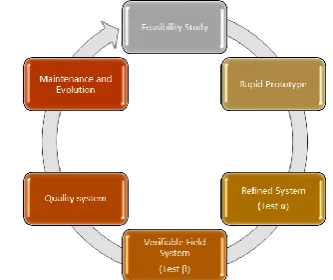
Fig. 2 shows the general stages of development of an expert system. The feasibility study is an article or comparative study to demonstrate that the project is feasible; The rapid prototype is an expert system quickly armed to demonstrate ideas, arouse enthusiasm and print top-level administration; The refined system (Test α) is the internal verification of the system carried out by knowledge engineers and specialists; The verifiable field system is system verification performed by selected users, not specialists or knowledge engineers; The quality system stage is when the system is validated and approved by expert users in real cases, at this stage requires user documentation, training and rapid support to users; The stage of maintenance and evolution of the system is when considering the increase in capacity and the correction of errors.
Fig 2. General stages of development of an expert system.
B. ERFCA
The ERFCA technique describes the procedure for making a rapid general assessment of the amount of air, water and soil contaminants that are produced in a region or country. A good environmental assessment study requires: easy access to all sources of information and the ability to analyze and extract necessary and useful information from a large amount of data. Once the necessary information is gathered, it is entered into the appropriate work tables so that the amounts of contaminants and waste for each source are calculated [2].
[image:2.595.339.506.431.571.2]six main stages of the ERFCA technique.
Fig. 3 Methodological Process of the ERFCA Technique
The ERFCA technique is an indirect environmental quality estimation technique designed by the WHO, although it is a very consistent methodological instrument developed for countries with a lack of economic resources and the absence of reliable databases, it needs to be systematized to facilitate the management of large amounts of information that has served as a basis for the development of other indirect techniques.
C. Methodology for the Project Development
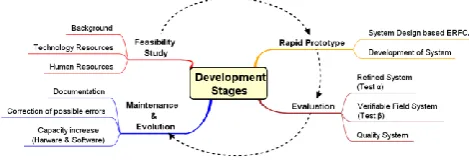
To carry out this project, the methodology was classified into four main stages, taking into account the stages for the evaluation of the environmental quality of the ERFCA technique and the stages of development of an expert system. Fig. 4 shows the main stages for the development of the computational model, which are the feasibility study, rapid prototype, evaluation, maintenance and evolution of the model.
Fig 4. Stages for the development of the Expert System for the Environmental Quality Estimation
[image:3.595.54.281.71.215.2]Fig. 5 shows the activities to be carried out within the feasibility study stage, which consist of the analysis of background, analysis and determination of requirements of technological resources, and analysis and determination of human resources. Within the stage of the feasibility study, the background analysis is derived, necessary to sustain the approach, relevance and requirements of the project based on previous research. In the analysis and determination of technological resources to determine the technological tools of both hardware and software that can be used for the development of the system.
Fig 5 Feasibility Study
III. FEASIBILITY STUDY
To determine the architecture of the Environmental Indicator Estimation System, the information and variables handled by the ERFCA technique were considered, in order to streamline the process of operating the technique, and systematize it to facilitate the handling of large amounts of information obtained from large study areas.
For the development of the System, factors that directly or indirectly influence to reach the main objective are involved. Such as the analysis and determination of the appropriate development platform for the purposes of the computational model, identification of the necessary hardware for its development and implementation, as well as the specialized software necessary for its development. In this phase the specifications of requirements such as use cases, interactions, restrictions, hardware and software of the computational model are analyzed, in order to define the characteristics of the system's environment.
According to the analysis of the functional requirements of the computational model, the modules that make up the system were established. In the Fig 6 the general diagram of the computational model is shown.
Fig 6. General Diagram of the System Modules for the Estimation of Environmental Quality
[image:3.595.49.284.481.561.2] [image:3.595.309.548.545.699.2]always looking for the necessary tools to be stable in long-term projects [6].
The systems developed in a web environment is a server that is responsible for performing the functionality using a user interface through a web browser, which allows us to use the system on any device that has a web browser. Another advantage of web systems is that if it is necessary to carry out an update it will only be done on the server and all the users will have the update at the moment and being on the web it can be applied automatically multiplatform since it allows its execution in any operating system that has a web browser. The platforms for the development of web applications as facilitating tools for the developer, provide a solid base for the construction of the same. The so-called frameworks for PHP, are a scheme (a skeleton, a pattern) for the development and / or implementation of an application. They are a set of files, in this case PHP, that come prepared with all the necessary structure to develop several types of projects [7].
The system will be developed through open license software, therefore an Apache web server, a MySQL database management system, and PHP and JavaScript programming languages will be used. The Table I shows the programming languages that were used during the development of the system.
TABLE I
SOFTWARE USED FOR SYSTEM DEVELOPMENT
Programming language Description
PHP Hypertext
Preprocessor
It is an open source language suitable for web development and that can be embedded in HTML
HTML5 Hyper-Text Markup
Language, version 5
It defines a basic structure and a code (called HTML code) for the definition of content of a web page, such as text, images, videos, games, among others.
JS Java Script
It is an interpreted programming language, implemented as part of a web browser allows improvements in the user interface and dynamic web pages
Ajax
Asynchronous JavaScript And XML
Ajax is an asynchronous technology, in the sense that additional data is requested from the server and loaded in the background without interfering with the display or behavior of the page.
jQuery JQuery
It is a fast, small and characteristic JavaScript library. It is used for event management, animation.
CSS Cascading Style
Sheets
Describe how the HTML elements are displayed on the screen. It is one of the core languages of the Open Web.
MySQL MySQL
It is a relational database management system and is considered the most popular open source database in the world and one of the most popular in general in web development environments.
For the development of the system it is necessary a computer station with specific characteristics for the use of Apache web server, the MySQL database manager, PHP, libraries, among other specialized software for the
management of the system. The necessary connections for the use of the Apache server, MySQL, PHP and a DNS, will be made by configuring them.
Likewise, there is a laptop for system coding and data collection, a server for data storage and web services, where the computer system is housed, two load backup centers for protection of voltage variation, one printer for printing reports and two hard drives for system backups. Table II shows in detail the specifications and justification of the hardware used for the development of the computational model.
TABLE II
SPECIFICATIONS AND JUSTIFICATION OF THE HARDWARE
Description Justification
1
HP LAPTOP 45405 CI5 15.6 500G SYST 4GB DVDRW 1-1-0 1GB W7/8 PRO64 2CE3441SGT N/S: 2CE3441SGT
Mobile workstation for data collection.
1
HP Z620, INTEL XEON E5-1620v2 3.7 10M 1866 4C CPU, RAM 16GB DDR3-1866(4x4gb) DISCO DURO 2TB, 16X SUPERMULTI DVDRW SATA 1ST ODD, WIN8 PRO 64 DG TO WIN7 PRO 64 LTNA GRAFICOS NVIDIA QUADRO K200 2GB, GARANTIA 3-3-3
Server of Databases and Web Server. ArcGIS server and modeling software..
1 MONITOR, HP. Z231I N.S. 3CQ3322BF
Server Monitor described above .
1
NO BREAK SOLA BASUC NKKS DE 1000VA RESPALDO A CARGA TIPICA 30 MINUTS
Protection against voltage variations and faults in the supply of electric power.
1 GARMIN GPS 72HGP
Georeferencing sources of contamination
1
Printer HP LASEERJET M451DN PRO COLOR, 21PPM, 600X600 DP, N/S:
CNDF331757 Report Printing
2 ADSSDX900- 256G:DISCO DURO SOLIDO ADATA SSD SATA III XPG SX900/256GB System backups
IV. RAPID PROTOTYPE DEVELOPMENT
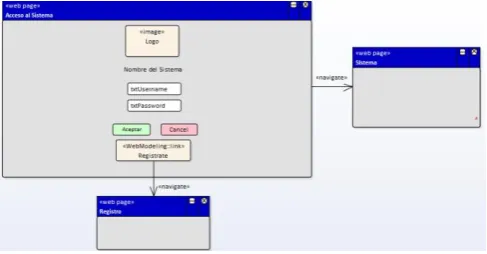
The design of the user interface facilitates the solid and detailed understanding of the behavior of the system without having to use code. This provides an excellent means to establish the precise behavior of the system from the user's perspective, and together with the use case model, defines exactly how a user does a job.
Fig. 7 User Interface Diagram of the System Access Module
In the system access module, a form is displayed in which the user enters a user name and password and press the accept button to validate the data and access the system. If the invalid data the system asks to verify that the data entered is correct, or change the password. In order for the user to have access to the system, it is necessary to be registered in the system, so a link to the registration page is enabled below the access form.
Fig 8 shows the design of the user interface of the system's home page. The main screen shows a bar of drop-down menus such as a start menu, tools, help and user in which the corresponding options of the sub-menus are displayed. The main page contains a workspace where the projects will be loaded.
[image:5.595.301.550.62.190.2]
Fig 8 System start interface
In the home screen, a main dialog window is displayed in which the option to create a new project or the option to open an existing project is displayed.
Fig 9 shows the login screen where the user enters their access data to be authenticated in the user database and can access the system.
Fig 9 System start interface
Fig 10 shows the start screen once the user is authenticated, showing two options: create a new project or open an existing project in which the user has participation as owner of the project or participant.
Fig 9 Module of Open or Create Project
In the development of the rapid prototype, the methodological stages of the ERFCA technique were considered as fundamental part, giving greater importance to the calculus module, which is one of the stages of this technique in which being a manual technique is more likely to have mistakes.
[image:5.595.308.548.357.486.2]Fig 10 shows the calculation module in which the worktables are shown to determine the contaminant contribution per source. The work tables are divided according to the type of medium that is affected in this case air, water and soil.
Fig 10. Work tables for the calculation of environmental indicators
V. RESULTS AND DISCUSSION
According to the characteristics and needs of the computational model, it was thought that it would be developed as a web system. The computational model is a web-based system that uses PHP as the base language and enriched with a set of client and server development technologies to achieve a product, always looking for the necessary tools to be stable in long-term projects [6].
As a computational model based on the web, the structure consists of the modules of Logon, Open Project, Create Project and the modules based on the ERFCA technique for the evaluation of the environmental quality that are composed of the selection of the area of study, formation of a work group, data collection, calculations, presentation of results and evaluation of environmental quality [2].
[image:5.595.46.292.379.513.2]For users, a software product more and more often corresponds to a black box that must effectively support their processes. As a consequence of this natural approach, needs become a driving force in the development of quality software products [8]. The quality of the software products has acquired a great importance generating the necessity to realize an evaluation [9]. Software quality evaluation during development is a tool that helps software engineers to direct the software development process to a quality product.
The system was evaluated internally according to software quality metrics of the SQuaRE family (ISO 25000) [10]. Were evaluated nine modules of the computational model of which a qualification of 0.91 was obtained, being this a satisfactory qualification according to the established criteria [11]. Within the obtained results three of the evaluated modules did not reach high classification the quality, however, according to the weighting given to the modules according to the degree of importance of the computational model, they do not influence significantly so the fast prototype was generally classified as high quality.
Within the recommendations, it is mentioned that exist three modules that did not reach the high quality level, whereby it is recommended the analysis of the functions that did not obtain an acceptable result and its correction. Another recommendation is to continue the development to obtain a satisfactory qualification in each one of the modules that did not obtain the classification of high quality.
VI. CONCLUSION
The development of a computational model for the evaluation of environmental quality indicators is an interdisciplinary project which requires the collaboration of specialists in environmental quality and computer specialists in order to create a quality tool that allows environmental experts to obtain solutions alternates to environmental contingencies and in this way generate its own criteria and propose solutions in terms of environmental quality.
Within the stages of development of an expert system is to make a rapid prototype, which allows both the developer and the specialist who will be the end user of the system, thus allowing communication between both parties to continue development until reaching a stable and complete version.
In this research work was carried out a feasibility study which allowed us to define the most viable platform for development and the necessary tools both software and hardware to carry out the development of the computational model. According to the comparative analysis between the development platforms, the characteristics and needs of the model, we opted for an architecture in web environment using free software tools.
In conclusion the development of this rapid prototype gives us a broad panorama of what is expected to be obtained with the computational model for the evaluation of environmental indicators, in addition to arousing interest and strengthening the communication between the specialist and the programmer to offer a tool that Contributes to specialists in the generation of knowledge and application of solutions in the field of environmental pollution.
As future work, is to continue advancing in the stages of software development by applying software quality metrics as well as functional validation by external users until reaching the stage of commercial quality that can be applied in real cases. In addition, it is proposed to evaluate the energetic consumption of the system to optimize its performance and arrive at the approach of the model as a green software [12].
REFERENCES
[1] W. P. Wagner, «Trends in expert system development: A longitudinal content analysis of over thirty years of expert system case studies,»
Expert Systems With Applications, vol. 76, pp. 85-96, 2017.
[2] H. Weitzenfeld, Evaluacion Rapida de Fuentes de Contaminación Ambiental (Aire, Agua y Suelo), H. Weitzenfeld, Ed., Metepec, México: TRADUCCION Y ADAPTACION DE WHO OFFSET PUBLICATION No. 62, ECO-SEDUE, 1989, p. 75.
[3] J. Giarratano y G. Riley, Sistemas Expertos Principios y Programacion ISBN 9789706860590, Tercera ed., México: International Thompson Editores, S. A. de C. V., 2001.
[4] E. Castillo, J. M. Gutierrez and A. S. Hadi, Expert Systems and Probabilistic Network Models ISBN: 1461222702, 9781461222705, S. S. &. B. Media, Ed., Springer Science & Business Media, 2012.
[5] H. K. Jabbar y R. Z. Khan, «Development of Expert Systems Methodologies and Applications,» International Journal of Information Technology & Management Information System (IJITMIS), vol. 6, nº 2, pp. 49-59, 2015.
[6] R. B. E. Cabrera Cruz, E. Alarcón Ruiz, J. C. Rolón Aguilar y E. M. Otazo Sanchez, «Modelo Computacional para la evaluación de Calidad Ambiental,» de Congreso Internacional AIDIS, Monterrey, Nuevo León, México, 2014.
[7] F. Sierra, J. Acosta, J. Ariza and M. Salas, "Estudio y análisis de los framework en php basados en el modelo vista controlador para el desarrollo de software orientado a la web," Revista Investigación y Desarrollo en TIC, pp. 1-13, 2017.
[8] W. Suryn, P. Bourque, A. Abran y C. Laporte, «Software Product Quality Practices: Quality Measurement and Evaluation using TL9000 and ISO/IEC 9126,» Software Technology and Engineering Practice (STEP), 2002.
[9] A. Blanco Carrillo, P. Reales Mateo y M. Rodriguez Monje, «Metrics to evaluate functional quality; A sistematic review,» de 7th Iberian Conference on Information Systems and Technologies (CISTI 2012), 2012.
[10] ISO. (01 de 03 de 2011). ISO/IEC 25040 Systems and software engineering- Systems and software Quality Requirements and Evaluation (SQuaRE)- Evaluation process.
[11] M. E. Torres-Martinez, E. Rolón-Aguilar, R. B. E. Cabrera-Cruz, R. Tobías-Jaramillo y J. C. Rolón-García, «Evaluación de calidad al prototipo rápido del Modelo Computacional para la Evaluación de Indicadores de Calidad Ambiental,» de INVESTIGACIONES ACTUALES EN MEDIOAMBIENTE VOL. III., Tampico, Tamaulipas: Pearson Educación de México S.A. de C.V., 2018, p. 200.