Abstract— Deregulations in electricity market of Turkey are expanding. However, electricity market is driven by exogenous risk factors. To hedge their risks market participants use derivatives, mostly forward contracts. Due to bear extreme volatility even forwards can cause high financial losses. We propose financial options usage to minimize risks. We have first developed a sophisticated spot price forecast model than priced plain–vanilla options and exotic options. Using real time historical data, we compared performance of forward contracts with option contracts.
Index Terms— Electricity market, forecast, financial options, option pricing, Black-Scholes
I. INTRODUCTION
upply and demand are two main entities of electricity system which has no stable course, creating risks and uncertainty. The very best way to cope is market deregulation. During last decades, countries passed far beyond form their monopolistic markets. Starting from US and EU electricity markets, deregulation diffused nearly all over the world. Physical electricity trade, derived from matching of demand and supply, is now possible in spot markets. Despite on-going deregulation process, such as most financial markets, electricity market is also volatile and bringing on more need to hedge risks.
Turkish electricity power market law passed into law having objective to build a strong, transparent and competitive electricity market formed on bilateral contracts [1]. After the balancing and settlement system had launched, a spot market with day ahead price mechanism, market-clearing price (MCP) took into account.
Many financial derivatives are utilized in electricity trading however in Turkish power trading market, future contracts are the most commonly used ones. Forward prices are very speculative and open to risks. In this study, a sophisticated price-forecasting model will be proposed. The model will be formed by commodity costs and other
Manuscript received Mar 20, 2018; revised April 04, 2018. This work was supported by the Galatasaray University Scientific Funds.
K.O. Ocakoglu . is with Galatasaray University, Istanbul, 34943 Turkey. He is now with the Department of Industrial Engineering, Galatasaray University (phone: +905363432736; e-mail: [email protected]) A.C. Tolga is with Galatasaray University, Istanbul, 34943 Turkey. He is now with the Department of Industrial Engineering, Galatasaray University as associate professor (phone: +902122274480-683; e-mail: [email protected]).
volatility drivers. An alternative to these derivatives is offered to the market participants by selling and buying electricity options. An option is a financial settlement that provides the option holder the right (option) to buy or sell specified amount until an expiration date [2]. Option holder pays a specified fee to option writer. On the other hand, a forward contract is costless but has no flexibility.
In this study market prices will be estimated and to minimize volatility and have better financial performance, financial options will be studied. Firstly, development of the Turkish electricity market will be briefly presented. Then the existing spot market and price forecast model will be shown. The following section will discuss the best suitable financial options methods to the Turkish electricity market. Finally, Black-Scholes option valuation method will be explained and utilized with a numerical example.
Our contribution to the existing literature consists in evaluating of future contracts and financial options, especially in the risky environment of Turkish electricity market
II. TURKISH ELECTRICITY MARKET
In this section Turkish electricity market, spot market mechanism and price forecast models are presented.
A. Market Evolution
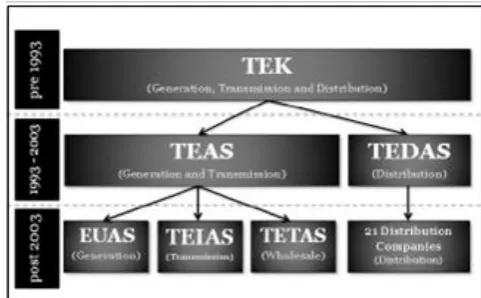
Before 2001, all electricity operations were regulated by Turkish Electricity Corporation (TEK). In line with the law TEK divided into two, Turkish Electricity Generation and Transmission Corporation (TEAS) and Turkish Electricity Distribution Corporation (TEDAS). There were 3 companies under TEAS, which are Turkish Electricity Trading and Contracting Company (TETAS), Energy Generation Company (EUAS) and Turkish Electricity Transmission Company (TEIAS). All these four companies are regulated by an autonomous board Energy Market Regulatory Authority (EMRA). In 2005, Market Financial Settlement Center (PMUM) was established under TEIAS. PMUM was having the role of system operator, balancing the electricity in the system. In 2009 a spot market started to operate. In 2013 new Electricity Market Law of Turkey was substantively enacted by repealing EML of 2001. The law also dictates the establishment of the Energy Market Operation Company (EPIAS) as the market operator. EPIAS is charged of establishing energy exchange conjointly with the exchange operator Borsa ˙Istanbul A.S. to furnish market participants with new financial products.
K.O. Ocakoglu, A.C. Tolga
Effective Trading in Turkish Electricity Market:
Hedging with Options
Fig 1: Changes in the structure of TEK
Installed power generation capacity of Turkey was 85.200 MW at the end of 2017 while annual generation was 300 TWh. Electricity can be generated by EUAS, its partners, private producers, and build, operate and transfer (BOT), build operate (BO) and transferring of operating rights (TOOR) contract holders. Generated electricity can be sold to private or owned suppliers. Customers of state-owned suppliers are identified by the law. Also all private suppliers are obliged to state their commercial operations (bilateral contracts, eligible consumers in their portfolio) to EPIAS.
Private suppliers can procure electricity for their operations by their private generation, by bilateral contracts and by the spot market.
In this study we will focus on spot day ahead market prices, which are previously mentioned MCP. In the day-ahead market prices are determined by a uniform price auction mechanism. Market participants’ bids and offers are collected and the price at the intersection is called MCP. Electricity generators who proposed an offer under or equal to MCP are paid by MCP and all buyers who proposed a bid equal or above to MCP, pay MCP for their demand.
In Turkish electricity trading market, MCP is considered as the reference price. Accurate MCP forecasting is vital for decision-making and strategy development of energy companies. Based on demand evolution and supply capacity’s cost structure they estimate MCP. To hedge the risks of their trading portfolio, traders commonly use derivatives.
Energy markets are known to support extreme price volatility by their very nature. Electricity storage is very rare and expensive. In literature many denoted that electricity is non storable [3]. This non-storability makes the electricity market different from other financial markets. Also considering physical delivery, there is no chance for arbitrage.
Electricity spot prices can dramatically change even in case of fluctuation in power generation or load. There exist four main characteristics of electricity, which are seasonality, volatility, mean reversion, spikes [4]. Also electricity market is up to many internal and external risks. Such as breakdowns, maintenances, fossil fuel supply reliability, commodity prices, weather conditions, water inflow, currency risk, credit risk and political etc.
According to state officials and sector experts, foreign-dependency is the most important risk factor of Turkish power market. Natural gas and imported coal powered
plants constitute more than half (%50.5) of the installed capacity. There are studies as outlook to Turkish power sector and supply structure, especially during gas shortages in winter [5]. Turkey has long term purchasing contracts relied on foreign currency and commodity stock prices. Moreover, the other half is composed by hydroelectric power plants and wind farms, which are unreliable resources due to weather conditions. Also local coal supply is insufficient to meet ever-growing demand.
In Turkey 50% of annual market volume consists of bilateral contracts, 39% consists of Day Ahead Market, 10% consists of Balancing Power Market and 1,2% consists of Intraday Market transactions. Market Clearing Price (MCP) derived from day-a-head market is determined by merit order mechanism and it is called as the spot market price. There are several studies on Turkish spot market that focused on the dynamics of the day ahead electricity prices by using parametric methodologies in the framework of strategic bidding and persistence of exogenous risks [6]. Also portfolio optimization of Turkish day-ahead electricity market by using mean-variance, downside and semi-variance techniques for electricity prices are studied [7], [8].
B. Spot Market Price Models
Intersection of demand and supply determine spot prices. Market participants notify their bids and offers to EPIAS system for day ahead mechanism. However, in Turkish electricity spot market, before implementing a model, it is compulsory to sort out the demand and supply capacity, which affects the price.
There are two types of customers in the electricity system; eligible and non-eligible customers. Non-eligible customers’ consumption, system leaks, agricultural irrigation and electrical enlightenment are provided by electricity distribution companies. The needed amount is provided by bilateral contracts from TETAS. This amount doesn’t take role in price mechanism.
Eligible customers’ electricity, if not provided from suppliers’ private generation units, is traded in spot market.
Regarding historical data spot prices are modeled by production cost models, equilibrium models, statistical models and with quantitative models. Briefly productions cost models are based on marginal costs of electricity generators.
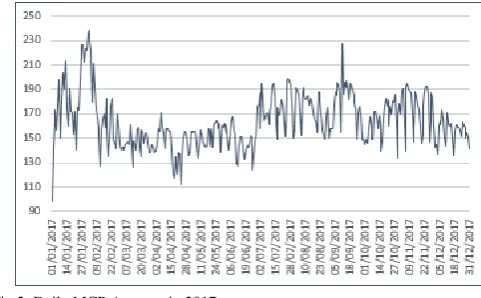
These models take essential that at command supply capacity effectuate prices. For example, from MCP historical data it is possible to see that in springs due to eminent hydroelectric power plant production prices are lower. In contrast in winters due to high consumption, renewable resources cannot cover the demand and fossil fuel based production scales up the prices. Turkey has no natural gas reserves and procure natural gas from other countries by long term take or pay contracts. They are related with commodity prices and currency rates. As its’ shown in Fig2, caused to high consumption and severe winter conditions, in February 2017 a serious gas crisis took part and caused spikes in MCP. However, production cost based models are vulnerable to strategic bidding.
Quantitative models use historical data, using statistical properties of historical prices as price derivatives.
[image:3.595.51.292.136.285.2]In this study a fundamental model will be proposed, by using evolution of production costs and other parameters such as weather conditions, water inflow, currency futures and commodity futures at supply side. Also seasonality, fluctuations in demand will take part.
Fig 2: Daily MCP Average in 2017
C. MCP Forecasting
Many risk factors are present in Turkish electricity market, which makes it even more difficult to make MCP forecasts. In other markets price forecasting is also one of the most important work done by analysts, traders, investors. In literature it is possible to find various studies on MCP forecasts in other markets, however it is very difficult to find studies on Turkish MCP forecast.
Boravkova and Schmeck focused on price modeling using EEX (European Energy Exchange) data with stochastic time change. They proposed a technique, which allows consolidating the characteristic features of electricity prices such as seasonal volatility, mean reversion and seasonally occurring price spikes into the model [9]. Others studied with Nord-Pool data on nonlinear empirical pricing in electricity markets using fundamental weather factors [10], [11]. Ortiz worked on price forecasting in the Spanish electricity market using forecasts as input data [12].
Oum, Oren and Deng focused hedging portfolio risks in competitive whole electricity market. They addressed quantity risk in the electricity market and the paper also points on risk hedging problem of a distribution company, which provides electricity to its customers at a regulated price having price and quantity risks [3].
III. FINANCIAL OPTIONS
A. Financial Options
An alternative to spot market trade and to forward contracts is offered to the market participants by selling or buying through financial options. A call option is a contract that gives the buyer the right to buy. A sell option is a contract that gives right to sell specified amount of electricity energy until an expiration date at a fixed price. Buyer pays a fee that called option price to for the rights. Other derivatives such as forwards are costless. According to market conditions option holder decides whether exercise the option or not. On the other hand, the option seller doesn’t have a flexibility. Seller is obligated to follow buyers’ decision.
In plain-vanilla options there are two types, American
options and European options. A European option is an option that can only be exercised at the end of its life, at its maturity. European options tend to sometimes trade at a discount to their comparable American option because American options allow investors more opportunities to exercise the contract.
Having many risk factors in the uncertain environment, options hedge risks, and aid strategic management of companies. As a result of the development of financial options market, investors started have more information about the power market parameters which followed more sophisticated requests demanding better service. Investors demand created for an alternative option type. Exotic options are nonstandard options with complex features also being traded in over-the counter markets. Exotic options carry with them conditions, providing dynamic flexibility and for the needs of investors. In finance markets, exotic options have many types such as; swing options, rainbow options, barrier options, look back options, Asian type options, and compound options, etc.
. In literature many studied financial options in energy markets. Aid, Campi and Langrene focused on pricing and hedging electricity derivatives [13]. To price and hedge derivatives a risk minimization approach is followed. Others focused on electricity futures, using a four dimensional value at risk model, to analyze fundamental and behavioral aspects of price formation of forward premium [14], [15]. Ghosh and Ramesh created an options model for electric power markets, investigating the development of derivatives market in a market setup using a tool called Optimal Power Flow (OPF) [16]. Sanchez created a framework for trading portfolio. Theoretical framework was compared with real data from the Colombian power system. They resulted with their data that offering two put and three call options on a monthly basis an enhancement in market participants’ risk hedging goals might be achieved [17]. It is possible to have many studies with exotic options especially swing options. Kovacevic and Pflug used swing option pricing by stochastic bi-level optimization [18]. Others studied on hedging swing options in complete markets, the option’s no arbitrage price interval is determined by hedging with forwards, both from the perspective of the holder and the writer of the option [19].
B. Evaluation of Options : Black Scholes Methodology
There are many option valuation models such as Black-Scholes equation, binomial/trinomial tree and Monte-Carlo simulation. Electricity contracts have always an interest risk due to time value of money. Also in Turkish electricity market until expiration date, price is very dynamic and volatile. So that in this study we decided to use Black-Scholes methodology.
The same principle constitutes the substructure of almost all option pricing formulas used today in financial markets.
(1)
(2)
(3)
(4)
Where: = spot price = exercise price = risk free interest rate
= time to expiration date (years) = volatility
, = normal distribution
= call option price = put option price
In literature it is possible to find electricity market cases derived from Black-Scholes. Ghaffari and Venkatesh proposed a new optimization model to trade in reserves to overcome uncertainty, which is for reserve options trade through an intraday secondary market [21]. Vehvilainen studied both financial options types and different option valuation models are presented such as Black-Scholes and Brownian method exercised in Scandinavian electricity market [22].
IV. APPLICATION
In this study for the second half of the year 2017 (H2‘17). A fundamental price forecast model is going to be proposed. First taking into account the ever-growing demand for eligible customers in the Turkish grid is to be estimated. Than the at-demand supply capacity is going to be formulated and production costs will be implemented. Due to risk factors and changing parameters forward prices will be found.
Secondly with Black-Scholes option pricing methodology using plain-vanilla American put options, the cost of the derivative contract will be calculated. Finally, forward and put option contract performance to be compared according real time prices.
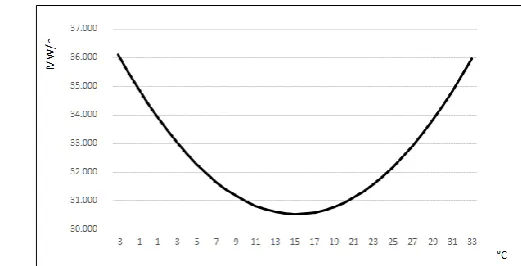
[image:4.595.297.558.60.193.2]Turkish electricity consumption depends on temperature, population, industrial production, country gross domestic product (GDP), technological advance etc. In literature it is easy to find studies modeled by artificial neural network algorithms, autoregressive moving average and regression models etc. In this study for electricity consumption forecast multiple regression method is used. Industrial production index and GDP are directly proportional with electricity consumption. However weather temperature has a quite different regime, lowest electricity consumption occurs when temperature is between 15-20 °C. Also it reaches yearly maximum at temperatures lower than 5°C and higher than 25 °C.
Fig 3: Electricity demand and temperature change
Hence using multiple regression formula:
(5) Where:
= industrial production index = daily average weather temperature = GDP growth
Estimated average electricity consumption for H2’17 is found 34.245 MW/h.
Secondly, to find eligible customers’ net consumption, we have to take out transmission and distribution losses, which are covered by state owned production capacity. An electricity loss is about 9% in Turkey and continuing to decrease after privatization of distribution companies. Also it is required to take out agricultural irrigation and illumination consumption. The remaining 29.644 MW/h is called as consumption under-supply obligation, which is covered by private owned and state owned production. State owned production is traded by TETAS, which has a separate tariff that changes on a quarterly basis. TETAS collects weekly consumption forecasts from in charge distribution companies and manages the production portfolio of EUAS, BO, BOT and TOOR plants and local coal incentive portfolio. The rest is eligible customers’ net consumption, which is covered by private production companies’ portfolio. Eligible customers’ net consumption is about 55% percent of consumption under supply obligation, which can be considered as 16.304 MW/h.
Private production companies’ gives offers to spot market regarding their marginal cost. For a production company generates electricity from renewable resources, marginal cost is just about operational expenses and very low. On the other hand for a production company generates from fossil fuel: Fuel cost, currency rate, supply storage, operational expenses affect marginal costs. Average production cost depends on consumption and supply structure. If there is high water income and/or it is windy and/or demand is too low, average production cost is lower. The changes at commodity costs, currency rates are also other factors.
fuel companies. Dark spread coal production has a very stable regime, they generate 80% of their installed capacity so that we find 7850 MW/h will be produced by natural gas power plants which has the highest marginal cost. Taking account natural gas price in try and average efficiency coefficient we estimate the average for H2’17 161 TL/MWh.
In over-the-counter (OTC) market as of 30.06.2017 it is possible to sell a future contract to 165 TL/MWh. According our fundamental forecast model there is margin of 4 TL/MWh. In the OTC market, the other type of derivative that allows possibility to sell is an American put option. According to Black-Scholes option-pricing formula the option price, for a strike price at 165 TL/MWh is 0,45 TL/MWh.
In case of H2’17 a severe drought occurred in Turkey and fossil fuel production increased about %5 percent to cover the consumption. By the end of the last delivery date average hourly MCP is concluded at 170,18 TL/MWh. If the producer had sold a future contract to 165 TL/MWh aiming 4 TL/MWh profit at the end there would 5,18 TL/MWh loss. However, by using an option contract the market participant could minimize the loss to 0,45 TL/MWh.
As the methodology a fundamental forecast model is developed. Models’ performance could be measured by its’ deviation from spot market price. However, in financial markets there are sophisticated derivatives called financial options which can boost the trading performance. In this application for the specified period, using real time data and real market parameters we found a significant better performing financial derivative.
V. CONCLUSION
Forward contracts are the most commonly used derivatives in Turkish electricity market. Market participants work on accurate forecasts to have financial gain in their operations. However forward contracts based fundamental forecast models are open to both exogenous and strategic bidding risks. Also in financial markets, option contracts are mostly useful instruments to hedge risks.
In this study to increase efficiency, we focused on financial options. Firstly, we presented the supply structure and the elementary components of Turkish power system. Then market mechanism is introduced and a fundamental spot market forecast model is proposed. We found an estimated price for the significant period and we compared its’ performance with an option contract whose option value is determined by the Black-Scholes methodology. We obtained a compelling better result with using American put option contract.
There are certain aspects which should be developed further more. In future studies, applications with exotic options and other option valuation methods will follow. Long-term data with multiple products will be used to assess performance for an effective trading portfolio.
ACKNOWLEDGMENT
O.K.O. thanks his advisor for his guidance so far and for what he will need through the research process in their future work.
REFERENCES
[1] A. Kurucak, “Estimating the value of an energy exchange for Turkey,” M.S. thesis, Dept. Energy and Mineral Eng., The Pennsylvania State Univ, Pennsylvania, U.S., 2013.
[2] S. Pineda and A.J. Conejo, “Managing the financial risks of electricity producers using options,” Energy Economics, vol. 34, pp. 2216-2227, Apr.2012.
[3] Y. Oum, S. Oren, S. Deng, “Hedging quantity risks with standard power options in a competitive wholesale electricity market,” Naval Research Logistics, vol. 53/7, pp. 697-712,Oct.2006.
[4] M. Bierbrauer, S. Truck, R Weron, “Modelling electricity prices with regime switching models,” in Lecture Notes in International
Conference on Computational Science ICCS 2004, pp.859-867.
[5] S. Dastan, O. Selcuk, “Review of the security of supply in Turkish energy markets: Lessons from the winter shortages,” Renewable and
Sustainable Energy Reviews, vol. 59, pp. 958-971, Jun. 2016.
[6] E.A. Surucu, A.K. Aydogan, D. Akgul, “Bidding structure, market efficiency and persistence in a multi-time tariff setting,” Journal of
Energy Economics, vol. 54, pp. 77-87, Feb. 2016.
[7] F. Gokgoz and M.E. Atmaca, “Financial optimization in the Turkish electricity market: Markowitz’s mean-variance approach,” Renewable
and Sustainable Energy Reviews, vol. 16, pp. 357-368, Feb. 2012.
[8] F. Gokgoz and M.E. Atmaca, “Portfolio optimization under lower partial moments in emerging electricity markets: Evidence from Turkey,” Renewable and Sustainable Energy Reviews, vol.67, pp. 437-449, Feb. 2016.
[9] S. Borovkava and M.D. Schmeck, “Electricity price modelling with stochastic time change,” Journal of Energy Economics, vol.63, pp. 51-65, Mar. 2017.
[10] S.M. Lopez, J.M. Uribe, and D.G. Manotas, “Nonlinear empirical pricing in electricity markets using fundamental weather factors,”
Energy, vol.139, pp. 594-605, Nov. 2017.
[11] S. Torbaghan, “Data Driven Medium Term Electricity Price Forecasting in Ontario Electricity Market and Nord Pool,” M.S thesis, Dept. Energy and Environment, Chalmers University of Technology, Goteborg, Sweden. 2010.
[12] M. Oritz, O. Ukar, and A. Mugica, “Price forecasting and validation in the Spanish electricity market using forecasts as input data,”
Electrical Power and Energy Systems, vol.77, pp. 123-127, Jan. 2016.
[13] R. Aid, L. Campi, and M. Langrene, “A structural risk neutral model for pricing and hedging power derivatives,” Mathematical Finance, vol.23/3, pp. 387-438, Oct. 2010.
[14] D. Bunn and D. Chen, “The forward premium in electricity futures,”
Journal of Empirical Finance, vol.23, pp. 173-186, Sep. 2013.
[15] S. Stoft, T. Belden, C. Goldman and S. Pickle, Primer on electricity
futures and other derivatives (Book style), Berkeley.CA, 1998 pp.
38-45.
[16] K. Ghosh and V.C. Ramesh, “An options model for electric power markets,” Electrical Power and Energy Systems, vol.19/2, pp. 75-85, 1997.
[17] G.A. Sanchez, J.M. Alzate, A. Cadena and J.M. Benavides, “Setting Up Standard Power Options to Hedge Price-Quantity Risk in a Competitive Electricity Market: The Colombian Case,” IEEE
Transactions on Power Systems, vol. 26/3,pp. 1493-1500, Aug. 2011.
[18] R.M. Kovacevic and G.C. Pflug, “Electricity swing option pricing by stochastic bilevel optimization: A survey and new approaches,”
European Journal of Operational Research, vol. 237, pp. 389-403,
Sep. 2014.
[19] P. Vayanos, W. Wiesemann and D. Khun, “Hedging electricity swing options in incomplete markets (Published Conference Proceedings style),” in Proc. 18th World Congress The International Federation of
Automatic Control, Milano, 2011, pp. 846-853.
[20] F. Black and M. Scholes, “The pricing of options and corporate liabilities,” The Journal of Political Economy, vol. 81/3, pp. 637-654, Jun. 1973.
[21] R. Ghaffari and B. Venkatesh, “Energy Reserve Trade Optimization for Wind Generators Using Black and Scholes Options in Small-Size Power Systems,” Canadian Journal of Electrical and Computer Engineering, vol. 38/2,pp. 66-76, Apr. 2015.