S DOS
APPLICATION PROGRAMMERS' GUIDE
TABLE OF CONTENTS
INTRODUCTION
SECTION I: DEVICE-DEPENDENT I/O DEVICE-INDEPENDENT I/O . SECTION II: DEVICE DRIVERS
DEVICE DRIVER CHARACTERISTICS DISK FILE DRIVER . • • . DISK DEVICE DRIVER . • . VIRTUAL TERMINAL DRIVER
OPEN & CREATE . CLOSE • • . . . RENAME & DELETE READA & WRITEA READB . . . VTCONTROL . . . .
CC: POSITION . . CC:DUMPBUFFERS CC:ECHO . CC:NOECHO CC:W'U\P • CC:NOWRAP CC:IDLES CC:TABS . CC:SETACTBLOCK CC:CLRINPUT . • CC:CLROUTPUT CC:SETREADTIMEOUT CC:SETPROFILE . • CC:ALTERPROFILE . CC:WRITEEDITLINE CC:SETFIELDSIZE CC:SETPARAMS CC:ACTIVATIONCK CC:SETBAUDRATE CC:COLORING . CC:BACKGROUND CC:KILLPROOF CC:KILLENABLE CC:SETEXCEPTIONS CC:SETOUTPUTTIMEOUT VTSTATUS • .
SC:GETPOS
SC:GETFREECOUNT . . SC:GETDA'rACOUNT . . SC:GETOUTPUTTIMEOUT SC:GETBAUDRATE SC:GETTABS SC: GETIDLES . • SC:GETWRAP SC:GETCOLORING SC:GETBACKGROUND SC:GETACTCOL SC:ATTENTIONCK SC: STATUSCK . . CONTROL CHARACTERS SWITCHES . . • . . SDOS/MT SUPPORT
MULTI-USER CONTROL FUNCTIONS MULTI-USER STATUS FUNCTIONS THE CLOCK: DEVICE DRIVER SECTION III: SYSCALLS
CONCEPTS SYSCALL FORMAT
SECTION IV: ERROR HANDLING
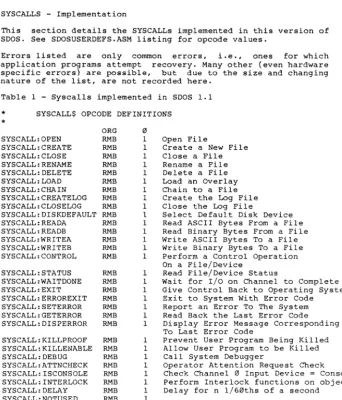
SECTION V: SYSCALLS - IMPLEMENTATION IMPLEMENTATION
SYSCALL:OPEN . SYSCALL:CREATE SYSCALL:CLOSE SYSCALL:RENAME SYSCALL:DELETE SYSCALL:LOAD . SYSCALL:CHAIN SYSCALL:CREATELOG SYSCALL:CLOSELOG . SYSCALL:DISKDEFAULT SYSCALL:READA SYSCALL:READB SYSCALL:WRITEA SYSCALL:WRITEB SYSCALL:CONTROL
CC:POSITION . CC:DUMPBUFFERS SYSCALL:STATUS . SYSCALL:WAITDONE . SYSCALL:EXIT . . . SYSCALL:ERROREXIT SYSCALL:SETERROR . SYSCALL:GETERROR . SYSCALL:DISPERROR SYSCALL:KILLPROOF SYSCALL:KILLENABLE SYSCALL:DEBUG
COPYRIGHT (C) 1978
28 28 28 28 28 28 28 28 28 29 29 29 30 35 36 36 37 38 39 39 40 43 46 46 47 48 49 50 51 52 54 55 57 58 59 61 63 64 65 66 67 68 70 71 72 74 75 76 77 78 79
SYSCALL:ATTNCHECK SYSCALL:ISCONSOLE SYSCALL:INTERLOCK SYSCALL:DELAY
SYSCALL:GETSERIALNUMBER
SECTION VI: SDOS CONSTRUCTION/FUNCTIONS
WRITING AND DEBUGGING USER ASSEMBLY PROGRAMS MEMORY MAP . . . .
SDOS LOADER FORMATS . . . SDOS LOAD RECORD FORMATS ENCRYPTED OBJECT FILES SDOS DISK FILE STRUCTURE LOGICAL SECTOR NUMBERS (LSN) CLUSTERS (LCN)
DISK FILE STRUCTURE . . SDOS FILE STRUCTURE . . DIRECTORY.SYS STRUCTURE THE BOOT.SYS FILE SERIALNUMBER.SYS SDOS.SYS . . . • DISKMAP.SYS . . . ERRORMSGS.SYS FORMAT
BUILDING A TURN-KEY APPLICATION SYSTEM
NOTICE
This manual describes Software Oynamics Operating System (SOOS) Version 1.1. Software Oynamics has carefully checked the information given in this manual, and it is believed to be entirely reliable. However, no responsibility is assumed for inaccuracies.
So reserves the right to change the specifications without notice.
**********************************************************************
** This manual describes software which is a proprietary product **
**
of Software Dynamics (SO). SO software is licensed for use on a single copy per computer basis, and is covered by U.S copyright laws. Unless a written exception is obtained from SO, the soft-**
ware must be used only on the single computer whose unique,SD-**
** **
**
** **
** assigned serial number matches that for which the software was purchased. Copying the software for any purpose other than **
** ** ** archival storage, or use of the software on other than the as- **
** signed serial numbered CPU is strictly prohibited. SD assumes **
** no liability regarding the use of the software.
**
Certain software programs and data files are delivered for use in an encrypted format. The content of such programs and data are considered to be a trade secret of SD. Attempts or suc-cess at breaking the encryption, publication of the results of such attempts or successes, or copying, storage or use of such a file in clear text form will be treated as theft of a tradesec-**
** **
**
****
ret, and prosecuted as such.** POSSESSION OR USE OF THIS MANUAL OR THE SOFTWARE IT DESCRIBES ** CONSTITUTES AGREEMEN'1' BY THE USER TO THESE TERMS.
**
**
** ** **
**
**
** **
**
**********************************************************************
This manual and the software it describes are the copyrighted property of Software Dynamics.
SDOS APPLICATION PROGRAMMERS' GUIDE
INTRODUCTION
This manual gives detailed information needed by programmers building programs to operate under SDOS 1.1. The reader should be familiar with SDOS concepts; the SDOS User's Guide provides the appropriate background.
This document presumes some familiarity on the part of the reader with assembly language coding for M6800, M6801 and M6809 microprocessors. This knowledge is needed to understand fully the implications of the SDOS System Call (SYSCALL) interface and the rules about error propagation. Practical use of SDOS does not generally require assembly assembly language programming, as most programming is done in SD BASIC, which provides statements for performing SDOS System Calls.
This document covers three main areas:
SDOS SYSCALL structure and assembly language interface Device Independent I/O
descriptions
SDOS File System Structure
SDOS APPLICATION PROGRAMMERS' GUIDE SECTION I: DEVICE-INDEPENDENT I/O
DEVICE-INDEPENDENT I/O
SDOS allows user programs to view all disk files and I/O devices as being fundamentally the same, i.e., if one can perform an operation on a device of type x (say, LPT:), one can generally perform that same operation on a different device of type y. Since disk files and devices are treated essentially identical, we will use file sometimes to mean device.
In this section, a conceptual model of how files/devices should act is presented (later sections describe in detail the system calls used to implement this model). SDOS is designed in such a way that disk files conform to this model very closely; exceptions will be noted later. Real devices such as line printers, CRT's, Digital-to-Analog converters, etc., are made to emulate this model as closely as possible via a device driver routine in the I/O package; the degree of closeness depends entirely on this driver. In many cases, it is not practical or appropriate for a device to match the desired model; this means that there are device-dependent (actually, driver-dependent) limitations on this device independence.
SDOS implements files for the purpose of storing and retrieving data. A file is assumed to consist of a sequential set of 8 bit data bytes, with the first byte being numbered zero, the second being number 1, the nth being numbered n-l. Each file has a size, which is equal to the number of bytes of data stored in the file. The data in a file can be read or written sequentially in variable-size blocks. If new data needs to be added to the end of a file, the file can be automatically extended. Commands exist to allow a file to be positioned to a specified byte position in preparation for a later read or write operation, thus providing random access. Data can be read or written in pure binary, or in ASCII (text) format.
A device is (usually) a physical piece of hardware capable of retrieving and storing data, converting data to/from printed form, etc. (some devices, such as the CLOCK:, are almost purely software). In many cases a device is treated as a file by SDOS. Some devices can actually store many separate data files (such as a disk device).
User programs communicate with files via mechanisms called "I/O channels". A channel remembers which file is being manipulated, and where in the file that the next data transfer should take place. Each user can have several I/O channels; typical SDOS systems allow eight I/O channels per user. I/O channels for a user are given numbers 3 to 255 maximum.
Virtually all operations on a file must be performed in conjunction with an I/O channel. An initial connection is established between a user-program specified I/O channel and a particular file by use of a SYSCALL:OPEN (or SYSCALL:CREATE).
SDOS APPLICATION PROGRAMMERS' GUIDE SECTION I: DEVICE-INDEPENDENT I/O
All further operations on that file must specify the operation desired, and the I/O channel number associated with a file. Note that a particular file may be open on several I/O channels, thus causing interactions between what appear to be independent operations. The association between a channel and a file is broken with a SYSCALL:CLOSE operation~ a channel on which this operation is the most recently executed valid operation is said to be CLOSED. No operations except OPEN or CREATE are valid on a closed I/O channel.
The I/O channel has associated with it several pieces of information: whether that channel is open or closed~ the particular device driver which is responsible for that file~
information selecting which file on that device is to be used~ data selecting a position within that file; and a column count (next print position on a real or simulated printing device). When a file is first opened, the position is reset to zero
(beginning of the file). Each read or write operation on an I/O channel advances the position for that channel by the amount of data read/written. An End Of File condition is said to have occurred whenever the file position on a particular channel is equal or larger than the file size (in bytes). Note that two I/O channels open to the same file are not necessarily positioned to the same place within that file.
A column count is maintained for the purpose of "tabbing" (a text concept). This column count is zeroed whenever binary data (non-text) is read or written to a file, and adjusted to reflect the position along an imaginary typewriter line whenever textual data is copied to or from a file.
Operations prformed on files are done via SDOS System (SYSCALLs). SYSCALLs specify an operation, a Write (containing data going to a file or to SDOS) , a Reply (where data or status from SDOS is returned), a channel and/or operation subcode, and a reply length (RPLEN).
SDOS APPLICATION PROGRAMMERS' GUIDE SECTION I: DEVICE-INDEPENDENT I/O
Operations defined on files include, but are not limited to: OPEN, CREATE, CLOSE, DELETE, RENAME, READA, READB, WRITEA, WRITEB, CONTROL, STATUS, POSITION, GETEOF, GETCOLCNT
Other operations are device-driver specific.
OPEN is intended to associate an I/O channel with a file (device) that already exists, for the purpose of reading (or updating) data in that file. Data-input only devices such as paper tape readers must be OPENed in order to read data. All devices can be OPENed so that the device type is easily read without knowing the kind of device being OPENed.
CREATE is intended to associate a file or device with an I/O channel which is to be used whenever an entirely new stream of data is to be written or stored. In particular, when a new disk file is needed, or data sent to an output-only device (such as a line printer) a CREATE should be performed. Some devices, like CRT's, which are both input and output, can be either OPENed or CREATEd.
CLOSE is used to break the association between a file and an I/O channel, and to cause the driver for the device on which that file resides to finish any operations on that file. DELETE is used to delete (disk)
multiple named files. Devices file is deleted, i t cannot be permanently lost.
files from devices that store cannot be deleted. Once a OPENed and its contents are
RENAME is used to change the name of a disk file, and is illegal when directed specifically at a device.
READA and WRITEA are used to read and write ASCII (textual) data. This is used to read data from consoles, print
printers, etc. If a file has no more room for written, then the file is automatically expanded. number must be given to select the desired file.
on line new data A channel
READB and WRITEB are used to read and write binary data to and from devices (data stored in a form convenient for the computer). An I/O channel number is required to select the desired file. Some devices, like Digital to Analog converters, can only perform Write Binary.
CONTROL operations are used to cause device-specific operations that do not fit into the above types of operations. Typical control operations are GETTYP (get device type), POSITION, DUMP BUFFERS, etc.
STATUS operations are used to read device or file specific data. Typical status data is DEVICE TYPE, FILESIZE, EOF flag and COLCNT.
SDOS APPLICATION PROGRAMMERS' GUIDE SECTION I: DEVICE-INDEPENDENT I/O
POSITION is used to change the place in the file that the next read or write will start transferring data to or from. POSITION affects an I/O channel, not the file itself, so several I/O channels may be positioned to different points in the same file. A file can be positioned anywhere past the last data byte; this is used to expand a file. Although POSITION operations can be performed independently of read or write operations, i t is generally more efficient to perform both in the same step; t.o allow this, an "implied position" operation can be added to read and write operations.
GETEOF is used to determine if the position of a particular file is at or past the file size (i.e., there is no more data to read) .
GETCOLCNT is used to read back of an ASCII text file (or a line printer, etc.). display is desired. Like I/O channel dependent.
SDOS APPLICATION PROGRAMMERS' GUIDE SECTION II: DEVICE DRIVERS
DEVICE DRIVER CHARACTERISTICS
This section describes the actual characteristics of the device drivers, and how operations on these drivers differ from an "ideal" device (as described under DEVICE-INDEPENDENT I/O). These characteristics are observable directly by the assembly language programmer via "Syscalls". Many features of the device drivers may be masked by a high level language such as BASIC; to use these features, an escape to assembly language may be required.
SDOS APPLICATION PROGRAMMERS' GUIDE SECTION II: DEVICE DRIVERS
DISK File Driver
Disk files under SDOS implement virtually all aspects file handling as described under Device-Independent section details exactly the operations implemented by Disk File Driver.
of general I/O. This the SDOS
An SDOS disk file can physically contain as few as zero data bytes, and as many as the remaining free space after an SDOSDISKINIT. SDOS keeps track of disk file sizes accurate to the byte. Apparent file size may be much larger than the actually allocated disk space; such a file is said to be
I'sparse'l.
Disk files may be allocated "dense"ly or "sparse"ly. A dense file is one in which data clusters are allocated for each data byte whose position is less than the file size. A sparse file may have a position (with a smaller value than the file size) for which no data cluster is allocated (data read from this area of the file appears as zeroes).
An OPEN is used to open a disk file (that must already exist) for reading and/or update. If the file does not exist, an error will occur. A CREATE will CREATE a new disk file which will supersede the old version of the file when the new file is closed. The new file will contain zero data bytes after creation. A new file cannot be created if the old file is write protected, or a new file by that name is being created.
Any OPEN or CREATE that specifies a filename that does not contain an explicit device identifier will be automatically assumed to be a disk file on the default disk (DISK:). Also, any filename that is prefixed by a disk device name, and does not consist solely of the device name is assumed to be the name of a disk file on the specified disk.
SDOS APPLICATION PROGRAMMERS' GUIDE SECTION II: DEVICE DRIVERS
CREATE #l,"X" CREATE #2,~X"
will result in an error). Otherwise, the new file is created, and the channel is opened. As long as the newly created file is still open on the channel on which it was created, that new file is in the state of "being CREATEd". If an old file with the same name does exist, an OPEN SYSCALL executed after the CREATE, looking for the same file, will open the old file. If the system crashes before the new file is closed, the old file will be unaffected in any way. Even after the new file is closed, channels still open to the old file will not notice any difference. When the last channel OPEN to the old file is closed, the space for the old file is returned to free disk space. Example:
TIME I 2 3 4 5 6
OPERATION OPEN #1, "ABC" CREATE #2, "ABC" OPEN #3, "ABC" CLOSE #2, "ABC" OPEN #4, "ABC" CLOSE in, #3
ACTION Opens o'ld ABC
CREATEs a replacement Opens old ABC
Marks old verson of ABC as deleted
Opens file generated at time 2
Deletes old ABC
CLOSEing a disk file causes changes to the file size, protection, and other characteristics to be updated on the disk. IF THE SYSTEM CRASHES WHILE THE FILE IS OPEN, THESE CHANGES ARE LOST (NOT RECORDED IN THE DIRECTORY). If the disk file is newly created, and is not replacing another by the same name, closing will make its name appear in the directory. If the file is newly created, and it is a replacement for a file that already exists (i.e., one by the same name), then the new file will replace the old in the directory, and the disk space allocated to the old file will be returned to free space as soon as no other I/O channels remain open to the ol(~ version of the file. Disk space allocated to a file beyond the file size will be returned to the free disk space pool when a file is closed.
RENAME is used to change the name of a disk file. RENAMEing a disk file to its own name is legal, and can speed up later OPENs of that file since a rename causes the file name to be re-hashed into the directory. Refer to hash-lookup description of files. A disk file cannot be renamed if it is write protected, or a file by that name already exists, or a new file by that name is being created.
SDOS APPLICATION PROGRAMMERS' GUIDE SECTION II: DEVICE DRIVERS
DELETE is used to free the space being used by a disk file and remove the filename from the directory. A file cannot be deleted if i t is delete or write protected, or if a new version of the file is being created.
READA performs exactly as specified by SYSCALL:READA. READAing through a large, sparse portion of a file may take an excessive amount of time due to the automatic suppression of all the zero bytes found in the sparse area. WRITEA, WRITEB, and READB match the SYSCALLs exactly. If an error occurs during a read or write, the file position may not be advanced properly.
CONTROL operations available on disk files are the following: CC:POSITION
Used to set file position before a read or write operation. See also SYSCALL:WRITEx and SYSCALL:READx.
CC:DUMPBUFFERS
Forces all data related to the file back to the disk media, so i t is recorded permanently in case of a later crash. CC:SETFILEDATE
Sets the creation/update date of the file. The date supplied must be in the same format as returned by a SYSCALL:READB to the CLOCK: device. Note that the file date is automatically updated whenever a WRITE or CC:SETFILESIZE operation is applied to a file.
CC:SETFILEPROT
Sets the file protection byte to the byte supplied. See DIRECTORY.SYS for structure of file protection byte. If the BACKUP protection bit is set, i t will be cleared if any RENAME, CC:SETFILESIZE, or WRITE operation occurs. If the DELETE protection bit is set, the operations RENAME, DELETE, WRITE and CC:SETFILESIZE will not be allowed.
CC:SETFILESIZE
SDOS APPLICATION PROGRAMMERS' GUIDE SECTION II: DEVICE DRIVERS
STATUSes obtainable from a disk file are: SC:GETPOS
Read position of file. SC:GETCOL
Get file column number. This value is zeroed by a CC:POSITION or READB/WRITEB and adjusted as data bytes are read or written in ASCII mode. The disk file driver advances the column count by one for any visible character read/written; decrements by one if ASCII:BS is encountered; zeros the column count if ASCII:CR is encountered; advances the column count to the next multiple of 8 if ASCII:HT is found; and leaves the column count alone for all other codes. The value of the column count at a particular point in a file thus depends on the last operation of a file; i t is intended only for use with sequential ASCII reads and writes.
SC:GETEOF
Returns EOF hit file size. EOF overwritten, or positioned with SC:GETTYFE
flag. EOF is set if positioned at or past also set when last byte of file is read or file is extended. EOF is reset when file is a positioning value less than the file size.
Returns device type of DVTYF.FILE. See SDOSUSERDEFS.ASM. All devices (drivers) are able to return a device type. SC:GETFILESIZE
Returns the position of the file, plus 1. If file has zero.
SC:GETPARAMS
last data byte written to the no data written in it, returns
Returns data about the file, such as sector size in bytes, and the cluster size.
SC:GETFILEDATE
Returns the creation/update date of the file in the standard system date format (same format as a SYSCALL:READB would return from the CLOCK:). device.
SC:GETFILEPROT
Returns the protection byte currently associated with the file. See DIRECTORY.SYS description for format of protection byte.
SDOS APPLICATION PRuGRAMMERS' GUIDE SECTION II: DEVICE DRIVERS
No other status is obtainable from a disk file.
SDOS will allocate data clusters to a file automatically whenever a write request to a non-allocated part of a file occurs (it does not allocate from the current end of file up to the point of the write; i t simply leaves that part of the file sparse). A cluster allocated in a formerly sparse part of a file is automatically zeroed to preserve the "zero" property of the part not modified. SDOS attempts to allocate data clusters contiguously (with respect to Logical Cluster Numbers) to minimize scattering of the file over a disk and to minimize sequential processing time. If absolutely contiguous allocation is not possible, SDOS allocates the closest free LCN that starts a contiguous block of BOOT:MIDALLOC free clusters.
The SDOS disk file driver keeps track of OPENed (CREATEd) files via File Control Blocks. FCBs are in one-to-one correspondence with open files (not channels), and contain what amounts to a DIRECTORY.SYS entry. In particular, the FCB holds the amount of disk space allocated to a file and its apparent size. If a file is extended on one channel, the extension will be apparent immediately on a different channel on which that file is also open because of the shared FCB.
Disk sectors are kept in a pool of sectors to minimize disk reads of fr~quently accessed data. Data written into a file will be immediately available through another I/O channel on which that file is open because the (modified) disk sector in the pool is shared. Modified sectors in the pool are written back to the disk as space is required to bring in another disk sector according to a Least Recently Used discipline. The oldest sector on the queue will be written back if its disk is free.
These side effects of the FCBs and the disk sector buffer pool are subtle but desirable because it is appropriate that different programs be able to share a file and its contents exactly as it is in any instant in time. Many disk operating systems do not provide this exact sharing capability, and consequently make i t hard to build a set of programs that interact through a common data base.
SDOS APPLICATION PROGRAMMERS' GUIDE SECTION II: DEVICE DRIVERS
DISK Device Driver
The SDOS disk device driver allows access to the entire cont~nts
of a disk as though i t were a single, large file. This facility is generally only used by utility programs to initialize, check out, and repair the file structure on a disk, but it may also be used to squeeze out the last ounce of available disk space, to cut down access time to a large file, or to read/write disks compatible with the drive but intended for other disk operating systems.
Disk device drivers may also be used to perform operations on the device itself, such as to dismount a disk.
A disk device driver whose name consists are illegal until this protects the programs since they
is OPENed when SDOS is asked to OPEN a file only of a disk name. (Writes to the device a CC:UNLOCKDISK call is made to enable this; file structure against damage from casual typically don't issue this call.)
A disk device which has been DISMOUNTed recently will have a Map Algorithm of :0001. If the disk device is already mounted (i.e., has been used for disk file operations), then the map algorithm will be that given by the BOOT.SYS file on the disk.
The disk device driver treats CREATE calls exactly like an OPEN. CLOSEing a disk device simply disassociates the I/O channel number, and otherwise does nothing.
RENAME and DELETE operations directed to a disk device will cause an error.
READA and READB act as described under SYSCALLs; the contents of the disk are treated as a single, large stream of bytes. WRITEA and WRITEB act as described (once enabled by CC:UNLOCKDISK), however, a disk device cannot be "extended" when more space is needed, so writing off the "end" of the disk device will cause an End of File error, and the written data will be lost.
Access to sectors may be obtained by positioning a disk device to a byte position which is a multiple of the sector size for that disk.
SDOS APPLICATION PROGRAMMERS' GUIDE SECTION II: DEVICE DRIVERS
Disk device drivers support the following CONTROL operations: CC:POSITION
To position for later reads/writes. CC:DUMPBUFFERS
This control operation will cause all modified sectors belonging to the disk to be written back to it. It will also cause information changed in FCBs of files open on that disk to be written back. Information in FCBs for newly created but not yet closed files is NOT written ba~k to the disk. This is not a substitute for a DISMOUNT control operation. No parameters are needed.
CC,UNLOCKDISK
This enables WRITEA and WRITEB to work properly on a disk device. If CC,UNLOCKDISK is not issued after OPENing a disk, and prior to a write, a "disk is software write protected" error will occur. Requiring this control operation to write on the disk device prevents accidental writing to a disk device. CLOSEing the disk device re-enables the write protection. No parameters are needed. CC:DISMOUNTDISK
This operation is used to make SDOS let go of a disk entirely so it may be removed from the drive. An implied DUMPBUFFERS occurs. If there are any (new or old) disk files OPEN on that disk, an error will occur and the dismount operation will not take place (one should repeatedly issue dismounts until no errors are detected; a disk I/O fault on a dismount will probably require SDOSDISKVALIDATE to repair the disk). The disk I/O driver will be called so that i t may physically eject the disk or perform other needed cleanup. A successful dismount also turns off the FORMAT mode switch in the disk sector I/O driver. The map algorithm is set to :0001 if the dismount succeeds.
CC:SETMAPALGORITHM
SDOS APPLICATION PROGRAMMERS' GUIDE SECTION II: DEVICE DRIVERS
Any other CONTROL code is simply passed by the SDOS Disk Device Driver to the Disk Sector I/O driver for its use.
STATUS information following:
obtainable from a disk device is the
SC:GETPOS
As described under SYSCALLs SC:GETCOL
As described under SYSCALLs SC:GETEOF
As described under SYSCALLs SC:GETPARAMS
Returns NBPS (number of bytes per sector), NSPT (number of sectors per track), NTPC (number of tracks per cylinder), and NCYL (number of cylinders) each as 2 byte values. See SDOSUSERDEFS.ASM for details on format of result.
SC:GETFILESIZE
Returns the size of the disk in bytes; equal to NBPS*NSPT*NTPC*NCYL (the product of the sector size in bytes, and the number of sectors on the disk).
SC:GETTYPE
Returns DVTYP.DISK SC:GETLASTBADLSN
Returns the Logical Sector Number of the disk sector which last caused a Seek, Read or Write error. The LSN is returned as 3 bytes; an LSN of :FFFFFF means "no bad LSN". Executing SC:GETLASTBADLSN, CC:DISMOUNT, or CC:SETMAPALGORITHM causes the value to be reset "to no bad LSN". This STATUS is intended primarily for use by SDOSDISKVALIDATE.
SC:GETERRORSTATS
Returns error statistics collected by the disk driver selected. Such error statistics record counts and disk controller status after each failed attempt by the driver to perform a seek, read or write operation, and the the LSN of the sector involved when the failed attempt last occurred. Since the disk drivers retry failed attempts, nonzero error statistics can occur and yet the system will still function without error; such errors are known as "soft" errors and are only an indication that some difficulty may be present. Executing SC:GETERRORSTATS, CC:DISMOUNT or CC:SETMAPALGORITHM causes the value to be reset "to no bad LSN". This STATUS is intended primarily meant for display by the DISMOUNT command.
SDOS APPLICATION PROGRAMMERS' GUIDE SECTION II: DEVICE DRIVERS
VIRTUAL TERMINAL DRIVER
(CONSOLE:, LPT: and Other ASCII-Oriented Serial Devices)
This section describes SDVTIlC, known as the "Virtual Terminal
Driver". The Virtual Terminal driver is intended to allow an applications program to operate with the majority of display-oriented display units (terminals), without knowing physical terminal characteristics. Inasmuch as printer devices and terminals have a great deal in common., with respect to output, the secondary intent of the VT driver is to give the application the same uniform view of printer devices.
This is accomplished by defining a set of display-oriented operations for an imaginary (virtual) terminal. The application controls the terminal with this set of operations, giving no regard to the type of physical terminal which may be ultimately used. At time of program execution, the operations commanded by the application are mapped into equivalent operations which the physical terminal can perform.
In the event that an applications programmer desires to explicitly reference a feature peculiar to a particular terminal, he may use installation-dependent CONTROL or STATUS calls, or the binary operations READB and WRITEB to bypass the general nature of the VT driver. In so doing, however, that program becomes tied to a particular terminal and is no longer portable to all terminals serviced by the VT driver.
The VT driver provides keyboard entry, line input editing, and text display functions. For CRTs, the VT driver also provides a standard method of dealing with cursor positioning, data entry via fields, and various screen attributes (denoted as "Coloring" in this document) thus making display-oriented applications portable over a wide variety of terminals.
SDOS APPLICATION PROGRAMMERS' GUIDE SECTION II: DEVICE DRIVERS
or CC:ACTIVATIONCK control call), the parity bit is stripped from all characters; certain control characters are assigned special meaning (see Control Characters in this section) and are not stored in the type-ahead buffer. Editing of the input line is performed at the time of character transfer from the type-ahead buffer to the input line buffer: if a READA or a CC:ACTIVATIONCK control call initiated the transfer, then the input line buffer is filled in ASCII mode and line editing is performed; otherwise, the data is transparently copied through the input line buffer to the RDBUF specified by the request. When ASCII mode keystrokes are being stored in the type-ahead buffer, switch requests, such as ~A, ~C, ~S, and ~P (to name a few), are serviced immediately, and are not retained in the type-ahead buffer.
Associated with each virtual terminal device is a "Device Profile Block". The DPB customizes the terminal to operate with specific manufacturers' devices so that standard SDOS operations are converted to equivalent device-specific operations. This allows application programs to position cursors, "color" the screen or screen regions, or update and erase the screen without kL~wing the specific device type. A system command, SDOSSET, can be used to change which device profile is in use; some profiles are "malleable"; i.e., changeable, so even devices with properties not handled by standard DPBs in a system can be accommodated. There are also special control calls to allow an application to select or modify particular profiles.
A terminal may be OPENed or CREATEd, using the device name I'CONSOLE:", "PORTl:", "PORT2: " , etc.; a printer to "LPT: " , "LINEPRINTER:", etc. Doing an OPEN or CREATE sets the ASCII activation set to <CR> only, sets the tabs to 8, 16, 24 .•.. up to 132, performs CC:ECHO and CC:KILLENABLE control calls, and sets the background color to "black" (see CC:BACKGROUND). CREATEs to non-ready devices are aborted with a "Device Not Ready" or "Printer Not Ready", depending on whether the device was a console or printer, respectively; this prevents applications from outputting data to un-ready devices in a way which is convenient to test. A terminal/printer may be open on several channels provided that all channels belong to the same task; output display by the terminal is exactly what would be seen if the I/O requests had been all directed to one channel in the same order. CLOSE disassociates the I/O channel from the driver. For printers, if part of a line has been printed, the VT driver will complete the line by effectively WRITEAing ASCII:CR; if a partial page has been printed, i t will finish the page by effectively WRITEAing ASCII:FF, thus assuring that each use of a printer leaves the paper aligned at top of form for the next use. CLOSE finally does an implied CC:DUMPBUFFERS, and gives an error if the device times out.
RENAME and DELETE operations are illegal.
SDOS APPLICATION PROGRAMNERS' GUIDE SECTION II: DEVICE DRIVERS
SDOS APPLICATION PROGRAMMERS' GUIDE SECTION II: DEVICE DRIVERS
WRITEA causes text to be output to the terminal. All characters are first stripped of the "parity" bit (bit 7), and then inspected to determine their interpretation. Printing characters are sent to the device. Tab characters are expanded according to the tab table assigned to each terminal. ASCII:CR characters cause an ASCII:LF and a variable number of idle characters to be output after them. ASCII:FF (form) characters cause CRT screens to be cleared, and cause printers to move to top-of-next-page. Other control characters are generally printed as AC , where c is
the keystroke used with the control key. See Table of Control Characters for a complete list of the control characters, and their actions, upon both input and output.
WRITEB causes the bytes to be sent to the terminal exactly as specified in the write buffer, including the "parity" bit. No linefeeds or idles are inserted. The logical column count is zeroed, and the VT driver assumes i t no longer knows the location of the cursor (the application must issue a CC:POSITION or perform an implied positioning call before the VT will know where the cursor is again).
SDOS APPLICATION PROGRAMMERS' GUIDE SECTION II: DEVICE DRIVERS
The VT driver supports the following control operations: CC:POSITION
The positioning information is treated as a cursor position of the form R*256+C, where R is the desired row (0 is the top row), and C is the desired column (0 is the leftmost column). Any value which would cause the cursor to position off the display, will result in an Illegal Device Operation error, and the cursor will not be moved. Positioning the cursor of a hardcopy terminal (display depth is zero) or a printer is not permitted, and will result in an Illegal Device Operation error. Note that SYSCALL:READA, SYSCALL:READB, SYSCALL:WRITEA and SYSCALL:WRITEB all allow implied positions in SCBLK: EXT ENS ION, so that a single call can both position the cursor and do I/O.
CC:DUMPBUFFERS
This is generally a no-op, since the driver dumps characters to the device as fast as i t can; i t does check for a device timeout. No parameters are needed.
CC:ECHO
This enables echo on READA. No parameters are needed. CC:NOECHO
This shuts off echo on READA. No parameters are needed. CC:WRAP
This enables line wrapping when a line exceeds the display width.
CC:NOWRAP
This disables line wrapping when a line exceeds the display width: the line is truncated, and the cursor is left on the same line, following the last character displayed.
CC:IDLES
This sets the number of idles to be transmitted after a <CR> or <LF>. The first byte in WRBUF is the idle count (0 is
SDOS APPLICATION PROGRAMMERS' GUIDE SECTION II: DEVICE DRIVERS
CC:TABS
This sets tab stops for tab simulation. The WRBUF must hold a string of bytes, each byte specifying the next tab stop. Each successive byte must contain a column number larger than the previous one. When the terminal is first opened, tab columns are set at every eighth column, up to 132 columns (0 is the first column). Up to 16 tab stops may be set; if too many are supplied, an "Illegal Device Operation" error will result. If the order of the tab stops is incorrect (not monotonically increasing), an "Illegal Device Operation" error will be returned, and the old tab settings will be undisturbed. Since CONSOLE: devices tend to stay open for long periods of time, CONSOLE: tab settings have a tendency to remain in effect long after needed.
CC:SETACTBLOCK
This specifies a non-standard set of activation characters. The non-standard set is specified with a vector of 128 bits (arranged in WRBUF as 16 bytes), corresponding to the ASCII character set. The least significant bit in the first byte corresponds to character code 00, and the most significant bit of the 16th byte corresponds to character code :7F. When a bit is set, the corresponding character is
interpreted as a non-standard activation character; when the bit is reset, the standard interpretation applies (see the chart of Control Characters, below). The activation set is restored to the standard interpretation (all bits reset) by OPEN and CREATE. When marked as activation characters, control characters and ASCII:RUBOUT are never echoed, while printing characters echo only if echo is enabled. Note that <CR> is always an activation character -- marking i t as a non-standard activation character only changes its echoing characteristics (as a standard activation character, i t echoes if echo is enabled; as not-standard, i t does not echo) .
CC:CLRINPUT
This clears the input useful when input, required.
line and type-ahead buffers. This is following an abnormal condition, is
CC:CLROUTPUT
This clears the output buffer. It when the output buffer for a device device is very slow; otherwise, quickly anyway.
COPYRIGHT (C) 1978 19
is generally useful only is very big, or the the buffer will empty
SDOS APPLICATION PROGRAMMERS' GUIDE SECTION II: DEVICE DRIVERS
CC:SETREADTIMEOUT
This sets a timeout on a subsequent READA or CC:ACTIVATIONCK control call. The timed period begins when the subseql1ent input operation is issued. When the timed period has expired, the input operation is terminated with a "Timed Input Expired" error, and the data input thus far is returned in the RDBUF supplied by the input operation. The length of the period is expressed in 60ths of a second, as a 16-bit value. Note that the period allowed is only approximately what is specified, but is guaranteed to be longer than the value given. The value is found in WRBUF, and WRLEN must be 2.
CC:SETPROFILE
This selects a new device profile, which includes a function mapping VT operations to physical terminal operations. Selection of a profile sets default device width, depth and output timeouts; i t specifies how the device will position the cursor, clear the screen, erase to end of line, and go to new lines; i t controls how "coloring" is to be displayed, etc. Such a profile generally represents a particular model of CRT/printer. The new profile replaces the old profile, and is retained until changed or the system is re-booted. Some profiles are malleable and may be somewhat altered to accomodate devices for which there is no specific profile (see below). As the malleable profile is a 'template, any alterations are retained with the device, rather than with the profile. Selection of a new profile will cause previous alterations to be lost. WRBUF contains one number, which is the profile "name". Specification of a profile not sysgenned into the I/O package will result in a "No such Profile" error. Wru,EN must be 1. This call is normally only used by the SDOSSET program. For a list of profile names, see the documentation for SDOSSET or the file IOVTDPBS.ASM.
SDOS APPLICATION PROGRAMMERS' GUIDE SECTION II: DEVICE DRIVERS
CC:ALTERPROFILE
This alters the currently selected profile (see above), if i t is malleable; if i t is not, a "Profile Not Malleable" error is returned. The alterations are confined to defining a cursor-positioning sequence, an erase to end of line (EEOL) sequence, and a home and clear screen (CLEAR) sequence. An "Illegal Device Operation" will be given if the parameter supplied are unreasonable. Note that the cursor positioning sequence contains, in place of the row and column numbers, the offsets to be added to the row and column numbers supplied by the application; thus, the cursor positioning sequence could be used, by itself, to position to location (0,0). More extensive alteration must be accomplished by defining a new profile and incorporating it into a newly-generated system.
WRBUF must contain the following data: ALTERPROFILE:CPLEN
ALTERPROFILE:CPSEQ
ALTERPROFILE:CPIDLES
ALTERPROFILE:ROWDISP
ALTERPROFILE:COLDISP
ALTERPROFILE:CLLEN
ALTERPROFILE:CLSEQ
COPYRIGHT (C) 1978
significant length of cursor positioning sequence following; 1 byte in range 3 to 4. If this length is < 3, then the VT driver will output '@@' instead of a cursor position.
cursor position sequence, which includes the row and column offsets; 4 bytes
number of idles to follow cursor positioning sequence; 1 byte
displacement into cursor positioning sequence of row number; 1 byte
displacement into positioning sequence of number; 1 byte
cursor column
significant length of CLEAR sequence following; 1 byte in range
o
to 4. If 0, a CLEAR sequence will be simulated by generating enough ASCII:LFs to move to the top of a page if a printer device (page depth can be changed by CC:SETPARAMS). This is a useful device if a system has different size paper forms, and no forms control tape.CLEAR sequence; 4 bytes
SDOS APPLICATION PROGRAMMERS' GUIDE SECTION II: DEVICE DRIVERS
ALTERPROFILE:CLIDLES ALTERPROFILE:EEOLLEN
ALTERPROFILE:EEOLSEQ
number of idles to follow CLEAR sequence; 1 byte
significant length of EEOL sequence following; 1 byte in range 0 to 4. If 0, the sequence will be simulated.
EEOL sequence; 4 bytes
ALTERPROFILE:EEOLIDLES number of idles to follow EEOL sequence; 1 byte.
CC:WRITEEDITLINE
This appends the contents of WRBUF to the end of the input line buffer as if the typist had entered that data. A subsequent READA or CC:ACTIVATIONCK control call will cause the data to be displayed, in the usual fashion, and the typist may edit the data until an activation character is entered. Note that using the CC:NOECHO control call, prior to invoking CC:WRITEEDITLINE, will inhibit that data from being displayed at the time of the READA or CC:ACTIVATIONCK control call. An activation character may be present in WRBUF, but will prevent the typist from editing characters prior to the activation character: activation will occur immediately. If WRLEN is greater than the space available in the input line buffer, or data follows an activation character in WRBUF, an Illegal Device Operation error is returned and no data is transferred to the input line buffer.
If present, the syscall block extension contains a cursor position at which the cursor should be left, after the data has been echoed by the input operation; otherwise, the cursor will be left at the end of the data supplied in WRBUF.
SDOS APPLICATION PROGRAMMERS' GUIDE SECTION II: DEVICE DRIVERS
CC:SETFIELDSIZE
This defines an input field for a subsequent READA or CC:ACTIVATIONCK control call. WRBUF contains the field width. The field width must be at least 1 and no greater than the width of the display. If the field width is 0, or exceeds the limits of the display, a "Bad Field Width" error will be returned, and the field definition will not be made. Unless any of the cursor control keys for moving left, right, up, and down have been designated activation characters, they may be used to position within the defined field. When an attempt is made to position the cursor beyond the boundary of the field, that character is treated as an activation character and the operation is terminated; the terminating cursor control character is appended as the activation character, and the cursor is not moved. An SC:GETACTCOL status call may be issued to determine the exact column of exit. If any of the cursor control characters is designated an activation character, then that character cannot cause a field exit condition, and will activate immediately upon use.
The field definition terminates upon field exit, or entry of an activation character. If the field, at the time of the input operation, is not contained completely within the display width, that input operation will terminate with an "Bad Field Width" erx-or and the field input mode will be cancelled. 'CAC will cancel any outstanding field definition.
CC: SETPARfu'lS
Sets the width (1 byte) and the depth (1 byte) of the display; this overrides the default from the device profile chosen. Zero depth means that the terminal is not a paging device and will print AL when given a form feed character.
SDOS APPLICATION PROGRAMMERS' GUIDE SECTION II: DEVICE DRIVERS
CC:ACTIVATIONCK
This is used to enable keyboard input without causing the program to suspend operation. CC:ACTIVATIONCK returns an "Activation Received" error if an activation character is in either the input line buffer or the type-ahead buffer. If no activation character is present in either buffer, the input line buffer is filled from the type-ahead buffer, unless this has already been done by a previous call of CC:ACTIVATIONCK. A READA issued following an "Activation Received" error will always return immediately with the data requested and/or an error appropriate to a READA (If ~C~C has been seen while the SDOS/MT and KILLPROOF flags are set, a "Program Killed" error will be returned; otherwise, ~C~C will result in the program being killed.) *Once the CC:ACTIVATIONCK control call has been issued, subsequent I/O requests (with the exception of CC:ACTIVATIONCK, status requests, and SYSCALL:READA) will result in an "I/O In Progress" error. This state is exited by issuing a READA upon receipt of an "Activation Received" error. A CC:SETREADTIMEOUT control call issued prior to the initial CC:ACTIVATIONCK can be used to limit the time spent in this state. When the timed period expires, the next CC:ACTIVATIONCK will return an "Activation Received" error, and the subsequent READA will return the expected "Timed Input Expired" error, along with any data received prior to the expiration.
* See the section on SDOS/MT support for a caveat that applies to this note.
CC:SETBAUDRATE
SDOS APPLICATION PROGRAMMERS' GUIDE SECTION II: DEVICE DRIVERS
CC:COLORING
For the purposes of this control call, a "color" is that which change~ the appearance of text without changing its meaning or s~ze. This call supports the myriad available features dealing with display appearance: these include, but are not limited to: color, intensity, underscoring, and blinking. It explicitly does NOT handle characters whose size is non-standard (i.e., double-width or double-height) for the device. l6 bits of data, found in WRBUF, specify the desired display mode for subsequent output: all display characteristics must be specified by the same control call at one time.
The mode change is made immediately, and the mode is saved for later use by the position control call. All characters output via WRITEA are "colored" according to the last color selected by this call. When a position control call is made, the "zero" coloring is selected (see CC:BACKGROUND, below), the positioning is performed, and the coloring selected by CC:COLORING is re-instated.
CC:COLORING does not cause the cursor to move (some terminals violate this, due to their design deficiencies). Two bytes in WRBUF are used to specify the display modes. The first byte i.s divided as follows: 2 bits for intensity, 1 bit for blink, 1 bit for underscore, 1 bit for reverse video, 3 bits for (inverted) color (1 bit each for "not red", "not green", and "not blue"). The second byte contains 3 bits for selecting alternate Roman character sets; the remaining bits are undefined and must be zero. The default color of "zero" (both bytes zero) selects the standard Roman character set, standard intensity, no reverse video, no underscore, no blink, and the color white (i.e., the display mode obtained for virtually all "dumb" CRTs). The "zero" color is automatically selected by OPEN.
Although this control call is recognized by all systems, its actual implementation will vary according to the particular terminals being supported; in the simplest of cases, i t will be implemented as a NOP.
SDOS APPLICATION PROGRAMMERS' GUIDE SECTION II: DEVICE DRIVERS
CC:BACKGROUND
A "background" color is the color displayed in all screen locations which do not contain a character.
CC:BACKGROUND selects the default coloring to be used when the display is cleared, or when cursor positioning is to be done (see CC:COLORING, above). The required byte of data is found in WRBUF and is of the same format as for the first byte of CC:COLORING, above. A black background (hex :07) is automatically selected by OPEN.
Although this control call is recognized by all systems, its actual implementation will vary according to the particular terminals being supported; in the simplest of cases, i t will be implemented as a NOP.
CC:KILLPROOF
This is used to KILLPROOF a specific VT input device. What that means is that ·C·C and 'D will be rejected with a beep when they are entered. ·C while killproof clears the type-ahead buffer.
CC:KILLENABLE
This is used to cancel the effect of a CC:KILLPROOF control call directed at the same VT input device. Note that 'WSCALL:KILLPROOF is not overridden by this control call. CC:SETEXCEPTION
This call is used to specify exceptions processing. At this time, the only exception SEDIT; and specifies that fields also ASCII,RUBOUT at left end of field, and on
·u
end of field.CC:SETOUTPUTTIMEOUT
to VT driver defined is for activate on or 'L at right
SDOS APPLICATION PROGRAMMERS' GUIDE SECTION II: DEVICE DRIVERS
STATUS OBTAINABLE FROM THE VT DRIVER
Many of the statuses available from the VT driver are simply images of data specified by Control calls to the driver. This is for convenience of the SDOSSET program, and allows i t to show the operator the "current" settings of things before modification. SC:GETPOS
Reads the cursor position in the same form as CC:POSITION. SC:GETCOL
If the input line buffer is empty, this returns the output column number; otherwise, this returns the column number corresponding to the first byte to satisfy the next read. The column number is the same as used in CC:POSITION. A REA DB zeroes the column number. Returning the column number corresponding to the next input character when there is a partially-read input line makes it possible to distinguish between "TERSE" command lines and "VERBOSE" command lines; if the column count is zero when a program gets control, there must be nothing in the line buffer and so VERBOSE mode is desired; otherwise, something is in the line buffer and so TERSE mode is desired (see COMMAND INTERPRETER).
SC:GETEOF
This returns a non-zero byte if ~Z was seen while in READA mode, and the input line buffer is empty; otherwise, this returns a zero byte. End of File status is never set while in READB mode to a VT device. Note that the only way to reset this status is to CLOSE and reOPEN the channel.
SC:GETTYPE
Returns DVTYP.CONSOLE or DVTYP.PRINTER, as appropriate. SC:GETPARAMS
Returns the width (1 byte) and the depth (1 byte) of the display. Zero depth means that the terminal is a hardcopy device with continuous paper. Printers return paper width and depth.
SC:GETPROFILE
Returns the current profile "name" (a one byte number); suitable for use by the CC:SETPROFILE control call.
SC:GETPROFILENAME
Returns a one to 16 character ASCII text string corresponding to the numeric profile "name" (1 byte) specified in WRBUF. This call does NOT change the profile currently selected on the device. Return a "No Such Profile" error if the profile name specified in WRBUF is not sysgenned into the I/O package. This call is used to all SDOSSET produce a human-readable list of DPBs configured into a system.
SDOS APPLICATION PROGRAMMERS' GUIDE SECTION II: DEVICE DRIVERS
SC:GETPROFILEALTERATION
Returns the current profile alterations in exactly the format given to CC:ALTERPROFILE. Gives a "Profile Not Malleable" error if the profile currently selected is not malleable (and therefore has no alterations).
SC:GETFREECOUNT
Returns a 16 bit integer specifying how much currently available in the output buffer for (memory-mapped video displays always return "1"). SC:GETDATACOUNT
room is a device
Returns a 16 bit integer specifying how much data is currently available in the input ring buffer for this device. Can be used to prevent hanging the system when doing READB.
SC,GETOUTPUTTIMEOUT
Returns the current value of the Output Timeout for this device, in a form suitable for use with CC:SETOUTPUTTIMEOUT. SC:GETBAUDRATE
Returns the current baud rate for this device, in exactly the form required for CC:SETBAUDRATE. Devices which cannot change baud rates usually return "0".
SC:GETTABS
Returns the current tab settings for this device, in exactly the form required for CC:TABS.
SC:GETIDLES
Returns the count of idles to follow a Newline sequence, and the Idle trigger character, in exactly the form required for CC:IDLES.
SC:GETWRAP
Returns a non-zero byte if Wrapping (see SC:WRAP) is enabled, else return a zero byte (wrapping is disabled). SC:GETCOLORING
Returns 2 bytes of Coloring information in exactly the form required by CC:COLORING.
SDOS APPLICATION PROGRAMMERS' GUIDE SECTION II: DEVICE DRIVERS
SC:GETACTCOL
Returns both the column position and the line buffer displacement at which the last activation character was entered (the activation character, itself, is placed at the end of the input line and is obtained via READA or READB). Note that if echoing is disabled, the returned column position value will be meaningless.
SC:ATTENTIONCK
This checks for "Operator Requested Attention" status. If found, the status is cleared and an "Operator Requested Attention" error is returned.
SC;STATUSCK
This returns a "Status has Changed" error if the VT device has had an interesting change of status, which include receipt of an activation character, receipt of ACA C, a "Timed Input Expired" error, a "Device Timed Out" error, etc.
SDOS APPLICATION PROGRAMMERS' GUIDE SECTION II: DEVICE DRIVERS
CONTROL CHARACTERS
This table describes how control characters are treated if they are NOT marked as activation characters (see CC:SETACTIVATION).
:00 NUL
:01
:02
:03 AC
:04
:05
input: ignored output: discarded
input: toggles the CAPS LOCK switch, echoes immediately at the end of the line
output: prints AA
input: requests BASIC breakpoint, does not echo output: prints AB
input: clears the input and output buffers, resets the FREEZE OUTPUT and DISCARD OUTPUT switches (see AS, AO) , resets the PAGE MODE switch (see Ap ) , echoes immediately at the end of the line, aborts the program i f two AC'S are received in successioni ACAC will be rejected with a beep i f KILLPROOF is set. output: prints AC
input: invokes the debugger immediately, does not echo; a beep is echoed if no debugger is
available (CNPG:VTDEBUG=0). Illegal under SDOS/M'l'.
output: prints AD
input: causes all input at, and to the right of, the cursor to be erased from the display and deleted from the input buffer.
SDOS APPLICATION PROGRAMMERS' GUIDE SECTION II: DEVICE DRIVERS
:07
:08
:09 -I
:0B
: 0C
:0D -M
:0E -N
:0F
COPYRIGHT (C) 1978
input: causes BASIC to resume execution from the current breakpoint, does not echo
output: beeps
input: implements the backspace function, does not echo
output: implements the backspace function. edge of screen is not
input:
output:
input: output:
Backspace across allowed.
positions the cursor column, when read positions the cursor column
rejected with beep; see discarded
at the next tab
at the next tab
CC:SETFIELDSIZE
input: rejected with beep; see CC:SETFIELDSIZE output: prints -K
input: implements the forespace function, does not echo
output: causes a PAGE BREAK if the PAGE MODE switch is set (see -P), homes the cursor, selects the background color, and clears the display if depth is not zero, prints -L if the the depth is zero; for a printer device, moves paper to the top of form, such that the next character will be printed in the first position of the line. input: echoes <CR><LF>, causes program activation output: prints <CR> <LF >
input: passed to the application, echoed when read
output: prints -N
input: toggles the DISCARD OUTPUT switch (see -Q, -C), echoes immediately; not functional while a READA or CC:ACTIVATIONCK control call is being satisfied
output: prints -0
SDOS APPLICATION PROGRAMMERS' GUIDE SECTION II: DEVICE DRIVERS
:10
:11
:12 "R
:13 "S
:14 "T
: 15 "U
:16
: 17
input: toggles the PAGE MODE switch (see "0, "C), echoes immediately at the end of the line output: prints .p
input:
output: input:
output: input:
output: input:
output: input:
resumes output suspended due to BREAK (see "P), resets the DISCARD switch (see "o), resets the FREEZE switch (see AS), does not echo prints "0
if CRT, positions cursor to Right a PAGE
OUTPUT OUTPUT
end of current input field; for hardcopy devices echoes "R<CR><LF> followed by all data entered since the last activation
prints "R
sets the FREEZE OUTPUT switch (see "0, ·c), echoes immediately
prints "S
toggles the BASIC line trace switch, does not echo
prints "T
deletes the character at the current cursor location, deletes the corresponding character from the input buffer, does not echo
output: prints ·U
input: toggles the BASIC single step switch, does not echo
output: prints ·V
SDOS APPLICATION PROGRAMMERS' GUIDE SECTION II: DEVICE DRIVERS
:18
:19
:lA
:lB ESC
: lC '\
olD A]
olE
COPYRIGHT (cl 1978
input: clears the input buffer; for hardcopy, echoes ·X<CR><LF> and positions to the column at which input began; fOe a terminal, erases, from the display, the data entered since the last activation character, and positions the cursor at the location where input began; for a terminal with fields defined, erases the displayed field contents, and positions the cursor at the first location of the field
output: prints ·X
input: passed to the application, echoed when read
output: prints ·Y
input: causes END OF FILE status to causes program activation with an FILE error, echoes i~ediately at of the line
output: prints ·Z
be set, END OF the end
input: causes cursor to be placed at right end of current input field, OPERATOR REQUESTED ATTENTION status to be set, and returns "Operator Requested Attention" error. output: prints .[
input: passed to the application, echoed when read
output: prints . \
input: passed to the application, echoed when read
output: prints .]
input: passed to the application, echoed when read
output: prints
SDOS APPLICATION PROGRAMMERS' GUIDE SECTION II: DEVICE DRIVERS
:IF
:7F RUB
input: passed to the application, echoed when read
output: prints ~
input: deletes the character preceeding current cursor location, deletes corresponding character from the buffer, does not echo
output: discarded
the the input
SDOS APPLICATION PROGRAMMERS' GUIDE SECTION II: DEVICE DRIVERS
SOFTWARE SWITCHES AFFECTED BY CONTROL CHARACTERS CAPS LOCK
When set, READA will interpret the lowercase letters a-z as uppercase letters. 'A toggles the switch. If a terminal is stuck in upper case, and the alpha lock key isn't the problem, someone probably typed 'A by accident.
FREEZE OUTPUT
When set, further output will be suspended until the switch is reset. On CRTs,
's
will be displayed to remind the typist that the switch has been set.'s
sets the switch, 'Q and'c
reset the switch.DISCARD OUTPUT
When set, all output will be discarded until either the switch is reset or a READA/READB is issued. '0 will be displayed to remind the typist that the switch has been set. A READA will reset the switch and overwrite the "'0" with "7 A READB will simply reset the switch. '0 toggles the switch, 'Q and
'c
reset the switch.PAGE MODE & PAGE BREAK
When set, subsequent WRITEA lines will be counted, and when <display depth> lines have been output, a Clear screen request is output, or cursor positioning is attempted, then a PAGE BREAK will occur, and no more output will occur until the typist has acknowledged the page break. This gives the typist a chance to read what is displayed before more output occurs. On a CRT, a page break will be signalled by 'p being displayed in the lower right-hand corner of the screen; on hardcopy devices, output will simply cease. The acknowledgement can be 'P (which prevents further page breaks), 'Q (which allows output until the next page break), or ·C (which prevents further page breaks). On CRTs, a Clear screen requests causes a page break BEFORE the screen is cleared, so the text may be read before i t disappears; on hardcopy terminals, the page break occurs AFTER the FORM character moves the paper to top-of-page, so individual sheets of paper may be conveniently printed. All lines output while in page mode will be truncated to fit within the current display width, thus ensuring that line wrapping does not occur so that all lines between page breaks will be captured on the display.
NOTE: All reminders are displayed in the lower, right corner of the display. Reminders will overwrite any characters alread