In addition to solvent-free sample extraction, SPME is also a solvent-free sample introduction tech-nique which facilitates design of a simple, low volume injection system. The net result is rapid desorption and good chromatographic separation, especially when Sash-heated injectors are used. Figure 7 illus-trates 2.5 min extraction and separation of 28 Envir-onmental Protection Agency volatile priority pollu-tants, which is over an order of magnitude faster than the standard purge and trap technique. This approach is particularly useful in combination with online SPME extraction. As eqn [6] indicates, it is possible to integrate sampling with a sample preparation step. This not only results in elimination of analyte losses to container walls and degradation during the trans-port, but also saves time and transport costs. This is particularly true when online SPME extraction is combined withReld portable GCs.
Another interesting feature of SPME which is cur-rently being explored includes speciation of analytes in complex matrices. The small amount of extracting phase does not disturb the equilibrium existing in the natural system and therefore allows quantitation of individual species or the determination of distribution
constants in a multiphase system. In addition, theRbre can be made very speciRc, so separation using chromatographic systems may not be necessary. Therefore development of coupling between SPME with other analytical instrumentation, such as mass spectrometry and inductively coupled plasma}mass spectrometry will facilitate high sensitivity and a large throughput.
See also: II/Extraction: Solid-Phase Extraction; Solvent Based Separation. III/Environmental Applications: Solid-Phase Microextraction; Solid-Solid-Phase Microextraction: Overview.
Further Reading
Kolb B and Ettre LS (1997)Static Headspace Gas
Chromato-graphy.Theory and Practice. New York: Wiley-VCH.
Pawliszyn J (1997)Solid Phase Microextraction. Theory
and Practice. New York, NY: Wiley-VCH.
Schwarzenbach R, Gschwend P and Imboden D (1993)
Environmental Organic Chemistry. New York, NY: John Wiley.
Young AD (1989)Boundary Layers. Oxford: BSP
Profes-sional Books.
Solvent Based Separation
R. G., P. M. Harper and Martin Hostrup,
CAPEC, Technical University of Denmark, Lyngby, Denmark
Copyright^ 2000 Academic Press
Introduction
Separation involves removal of one or more of the constituent parts from a mixture. A solvent is that constituent of a solution that is liquid in the pure state, is usually present in the larger amount, and has dissolved the other constituent (a solute) of the solu-tion. The solute may be a solid, a liquid or a gas. The solvent may be a single compound or a mixture of compounds. Solvent-based separation techniques become necessary when separation or removal of a solute(s) from a mixture become difRcult or in-feasible by conventional separation techniques such as distillation. If the addition of a solvent causes a totally miscible liquid to split into two liquid phases and produce the necessary property difference, the solvent-based separation technique is commonly known as liquid}liquid extraction. If the addition of a solvent causes the coexisting vapour and liquid phases to have different properties, the solvent-based
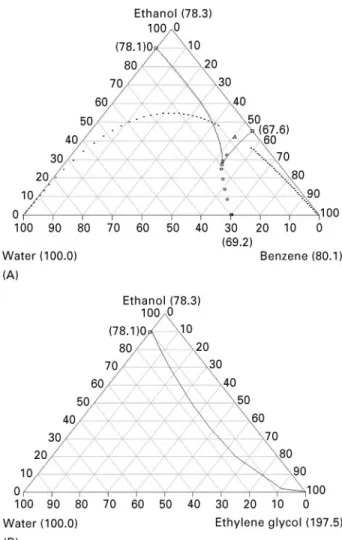
separation technique is called extractive distillation. Figure 1A and 1B highlight the change of the mixture properties as a result of the addition of a solvent. In Figure 1A, the difference between the properties of the liquid and vapour for the binary azeotropic mixture of ethanol}water with and with-out the addition of solvents is highlighted. It is clear from Figure 1A that addition of a solvent removes the barrier of the azeotropic condition. Figure 1B high-lights through a ternary diagram that addition of the solvent causes the totally miscible binary liquid mix-ture (components 1 and 2) to split into two liquid phases, a solvent-rich phase and a solute-rich (1 or 2) phase.
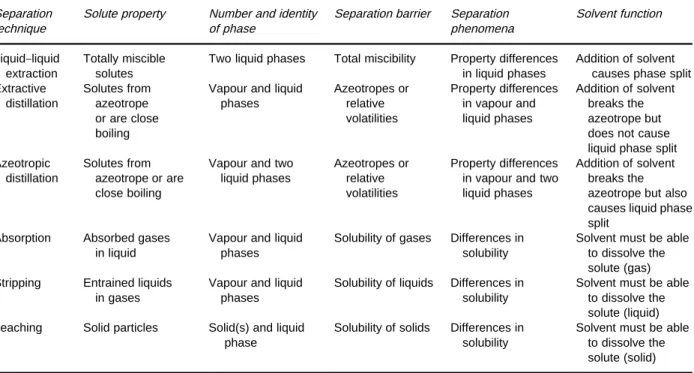
Table 1 Classification of important solvent-based separation techniques
Separation technique
Solute property Number and identity of phase
Separation barrier Separation phenomena
Solvent function
Liquid}liquid extraction
Totally miscible solutes
Two liquid phases Total miscibility Property differences in liquid phases
Addition of solvent causes phase split Extractive
distillation
Solutes from azeotrope or are close boiling
Vapour and liquid phases
Azeotropes or relative volatilities
Property differences in vapour and liquid phases
Addition of solvent breaks the azeotrope but does not cause liquid phase split Azeotropic
distillation
Solutes from azeotrope or are close boiling
Vapour and two liquid phases
Azeotropes or relative volatilities
Property differences in vapour and two liquid phases
Addition of solvent breaks the azeotrope but also causes liquid phase split
Absorption Absorbed gases
in liquid
Vapour and liquid phases
Solubility of gases Differences in solubility
Solvent must be able to dissolve the solute (gas) Stripping Entrained liquids
in gases
Vapour and liquid phases
Solubility of liquids Differences in solubility
Solvent must be able to dissolve the solute (liquid)
Leaching Solid particles Solid(s) and liquid
phase
Solubility of solids Differences in solubility
Solvent must be able to dissolve the solute (solid)
or removal of a chemical species (undesirable by-product or raw material) from a wastewater stream through solvent-based separation are typical exam-ples of industrial application. Figure 1C illustrates the removal of phenol from water through solvent based liquid}liquid extraction. An important feature in this and most other vapour}liquid and/or liquid}liquid solvent-based separation techniques is that the solvent is recovered and recycled back to the solvent-based separation unit.
A logical criterion for classiRcation of solvent-based separation techniques is the number and identi-ties of the coexisting phases and the function of the solvent. Table 1 gives a list of some of the well-known solvent-based separation techniques,
classi-Red in terms of the number and identities of the coexisting phases and function of the solvent. It can be noted from Table 1 that the selected solvent is directly related to the separation task and the separ-ation technique and indirectly related to factors such as cost of operation, the efRciency of separation and the environmental impact. Therefore, solvent selec-tion plays an important role in solvent-based separ-ation. While solvents and solvent-based separation techniques have been known for a very long time, use of efRcient search techniques, such as computer-aided molecular design (CAMD) and computer-aided database search, are fairly new. This article highlights the computer-aided methods and tools related to sol-vent selection.
Solvent Selection:
Problem Formulation
Problem formulation is an important Rrst step in solvent selection as it is necessaryRrst to deRne the functions of the solvent before attempting to Rnd suitable candidates. Each problem, characterized in terms of solvent and solute properties, needs to ad-dress a set of issues related to separation task, perfor-mance, environmental impact and problem-speciRc (special) considerations. The solvent selection prob-lem is formulated in terms of a set of properties (target properties) and their values (target values). A two-step procedure, consisting of a problem
identi-Rcation step (identiRes the solvent functions and issues that need to be addressed) and a criteria for evaluation step (selects target properties and their target) is recommended.
Properties
Figure 2 (A) Ternary VLLE diagram for ethanol}water} ben-zene (solvent). (B) Ternary homogeneous VLE diagram for ethanol}water}ethylene glycol (solvent). Key:2, heterogeneous liquid boiling surface;*, vapour line;䉭, critical point;䊐, azeo-tropes. All temperatures in3C.
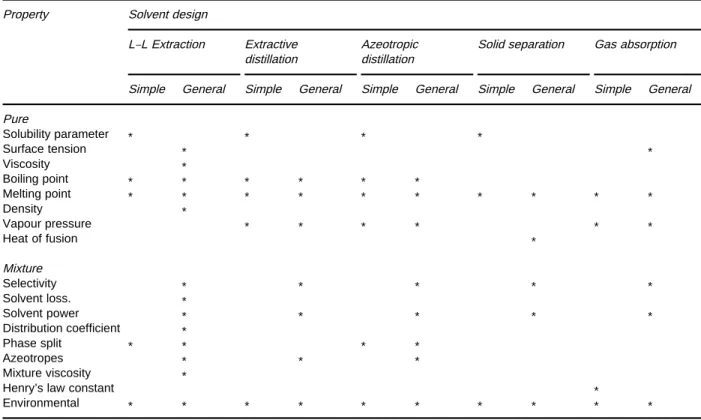
separation technique is called extractive distillation because ethanol}water}ethylene glycol forms a ho-mogeneous azeotropic system, as shown in Figure 2B. Table 2 gives a list of different types of solvent properties that may be considered in the selec-tion/design of a solvent. These properties are
classi-Red in terms of pure component, mixture and envir-onmental.Table 3expands on the nature of the en-vironmental properties. While the pure component and environmental properties are usually available for a large number of chemical species, the mixture properties usually need to be estimated through suit-able property prediction methods.
Problem Identi\cation
Solvents are well known for their different applica-tions and, therefore, funcapplica-tions. They may be em-ployed as cleaning agents, as paint additives, as
separ-ating agents and many more. Each application of the solvent is related to different sets of desirable func-tions and undesirable effects (or funcfunc-tions). The main question that needs to be asked here is what functions will the selected solvent perform? The answer de-pends, to a large extent, on the properties of the solute and/or the mixture to be separated. Properties, for pure compounds and mixtures, provide a frame-work for classifying the different solvent functions and their undesirable effects in a systematic and struc-tured way.
Criteria for Evaluation
Since in solvent selection problems, one is looking for alternatives that match approximately the desirable solvent functions but not the undesirable solvent ef-fects, numerical values of properties can be used to evaluate candidate solvents. Based on the identiRed separation task, the question of which properties (tar-get properties) should be considered in deRning the solvent functions and what should be the property values (target values) is addressed in this step. The exact target values for the target properties are ob-tained by trial and error. However, if a known sol-vent is being substituted, then the target values are obtained from the solvent that needs to be sub-stituted. In Table 2, two types of criteria for evalu-ation are shown}simple and general. As simple, the minimum number of properties that may deRne the desired solvent properties for each solvent based sep-aration is highlighted, while as general, a compre-hensive list of properties is highlighted.
Example
Consider the process from Figure 1C } the efSuent water stream from an industrial process contains 7% w/w of phenol, which needs to be removed through liquid}liquid extraction. The desired solvent, when added to the phenol}water system, must cause a phase split such that the solvent-rich phase will contain signiRcantly more phenol than water while the water-rich phase will contain very little phenol or solvent. It should be possible to separate easily the solvent from phenol. That is, the solvent must not form azeotrope, it must have a reasonable difference in boiling point and vapour pressure from phenol, and it must have a density lower than that of water in order to have free convectionSow in the extraction column. If the solvent has a high environmental im-pact, the loss of the solvent through the water-rich phase will have to be reduced. If the solvent is unable to remove enough phenol, more solvent may need to be used. It should pose a low risk of explosion (the
Table 2 Solvent selection problem formulation with properties
Property Solvent design
L}L Extraction Extractive distillation
Azeotropic distillation
Solid separation Gas absorption
Simple General Simple General Simple General Simple General Simple General
Pure
Solubility parameter * * * *
Surface tension * *
Viscosity *
Boiling point * * * * * *
Melting point * * * * * * * * * *
Density *
Vapour pressure * * * * * *
Heat of fusion *
Mixture
Selectivity * * * * *
Solvent loss. *
Solvent power * * * * *
Distribution coefficient *
Phase split * * * *
Azeotropes * * *
Mixture viscosity *
Henry’s law constant *
Environmental * * * * * * * * * *
Table 3 Specific environmental concerns
Environmental property
Health concern
Safety concern
Environmental concern
Implicit
Toxicity * *
Biological persistence *
Chemical stability *
Reactivity * *
Explicit
Biodegradability *
Vapour pressure * * *
Henry’s law constant in water
*
logP * *
Water solubility *
Flash point *
Biological oxygen demand
*
Vapour density * *
Evaporation rate * *
LD50 * *
Ozone depletion potential
*
Table 4 Problem formulation for separation of phenol from wastewater
Target property Target value
Partition coefficient (logP) '1.5
Solvent loss (0.0015
Liquid density at 298 K (0.95
Normal boiling point (450 K
Vapour pressure at 360 K '0.03 bar
Flash temperature '300 K
Selectivity '8
Capacity '2
Separation factor '80
Other properties Must not form azeotrope
with phenol
Acceptable environmental properties
To ensure a minimal loss of the solvent to the water stream, the solvent should have very low miscibility in water and a high octanol}water partition coefR c-ient. It should be possible to separate the solvent easily from phenol (must not form azeotrope, must
have a reasonable difference in boiling point and vapour pressure from phenol, and must have a den-sity lower than that of water in order to have free convection Sow in the extraction column). For the process in Figure 1C, the target properties and their target values are given inTable 4.
Solvent Selection: Methods and Tools
Methods
Figure 3 Multilevel approach to solvent selection.
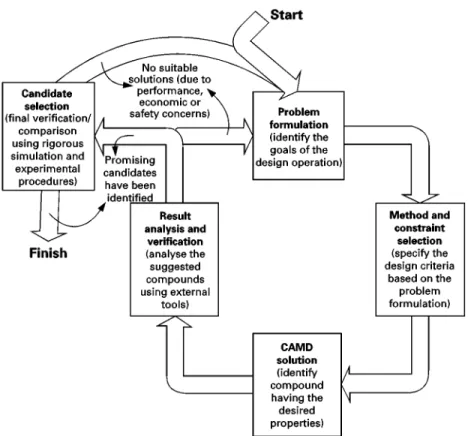
After problem formulation, a list of feasible solvent alternatives is determined and ordered according to a speciRed criterion. The best feasible candidates are then analysed in terms of separation task, perfor-mance, environmental impact and special consider-ations in order to determine the most appropriate solvent(s). If none are found, it is necessary to go back to the problem formulation stage and relax some target property values or go back to the stage for determination of alternatives and use another search space. Thus, solvent selection is also a design problem requiring a trial-and-error solution approach.
List of solvent alternatives Determination of the list of solvent alternatives is based on the ‘generate and test’ paradigm. That is,Rrst generate a list of solvent candidates and then analyse (test) the candidates to determine those that match the speciRed target prop-erty values. The methods available can be classiRed into three types: database search, CAMD and hybrid. The database search approach involves a search in one or more databases for compounds that match the speciRed target property values. For this approach, an efRcient search engine (or computer-aided technique) is needed. For solvent selection problems involving only pure component target properties, efRcient search engines based on so-called pattern matching are avail-able. DifRculties are encountered, however, when
mix-ture properties are also included in the target properties and when the databases do not contain all the target properties for all the compounds. In such cases, an efRcient and comprehensive search is almost impossible and reliable property estimation methods are needed.
uses this information as initial estimate and employs CAMD to solve the solvent selection problem for the pure component and mixture properties that it can estimate with acceptable accuracy. At the end of level 2, a larger list of alternatives than level 1 is obtained. In level 3, those molecules that can be found in the database are identiRed and their target properties are veriRed, resulting in an updated list of alternatives. This list is now used for checking the remaining target properties (such as environmental properties and special properties that are found in special databases). Screening out the molecules that do not satisfy the target properties based on these databases produces a further reRnement of the list of alternatives. Finally, in level 4, selected molecules from level 3 are investi-gated in terms of atomic structure, bond length, bond angle, energies, etc., through links to molecular mod-elling programs.
Final selection Since the list of alternatives contains more than one solvent, all of which match the
speci-Red target property values, it is necessary to deter-mine the most appropriate solvent from this list. Therefore, it is necessary to deRne a selection cri-terion, for example, an objective function (F) that is either minimized or maximized. This objective func-tion may be an explicit funcfunc-tion of the target proper-ties (see eqn [1]) or an implicit function of the target properties (see eqn [2]):
F"(SP,SS) [1]
F"f(DS(SP,SS),T(SP,SS),P(SP,SS)) [2] In the above equations, SP is solvent power, SS is selectivity, DSis a vector of speciRed products,T is a vector of operating temperatures andPis a vector of operating pressures. Since the target properties of eqn [1] are known for the solvents in a generated and tested list of alternatives, use of eqn [1] simply means ordering the molecules in ascending order and select-ing the optimal for further analysis (for example, pilot plant study). In this case, the solvent with the maximum value of Fis regarded as the optimal sol-vent. In eqn [2], the evaluation of F needs other calculations (such as process simulation) in order to determine the values ofDS,TandPcorresponding to an optimal F. Two solution approaches are com-monly applied}an enumeration approach and a si-multaneous solution approach. In the enumeration approach, the optimal value forFin eqn [2] is deter-mined for each solvent through process simula-tion/optimization, generating a set of values forF,DS,
TandPcorresponding to each solvent in the gener-ated list of alternatives. The optimal solvent then corresponds to the minimum (or maximum)Fin the
generated set. In the simultaneous solution approach, the solvent identity is an integer variable and adding it as an optimization variable in the process optimiza-tion problem gives a mixed integer nonlinear pro-gramming (MINLP) problem formulation, which de-termines the optimal solvent and the optimalF simul-taneously.
Tools
From the above section, it is clear that the tools that are needed for solution of the solvent selection prob-lem are databases, search engines, property estima-tion methods, process simulators and numerical methods (such as a MINLP-solver). It should be noted that all the tools might not be necessary for all solvent selection problems. Also, different sets of tools are needed depending on the chosen method of solution. In this article, only the use of search engines with the hybrid approach, which includes database search, CAMD and property prediction, is highlighted. Table 5gives a list of various tools that may be used in solving solvent selection problems.
Search engine The hybrid generate-and-test ap-proach (search engine}CAMD algorithm) has four levels. Each level has its own generate-and-test algo-rithms. Higher levels use additional molecular struc-tural information compared with lower levels. Levels 1}2 are group contribution based (thereby employing macroscopic representation of the molecule), while levels 3}4 are based on atomic (microscopic) rep-resentation of the molecule. Switch from level 1}2 to 3}4 needs a conversion of macroscopic representa-tion to microscopic representarepresenta-tion.
Level 1 This level generates sets of building blocks
(fragments) by combining Rrst-order functional
groups. These sets are capable of forming at least one feasible molecular structure. Simultaneous calcu-lation of related properties (that are dependent only onRrst-order groups) and screening of the generated structures is performed to control the problem size and execution time. The algorithm here is based on a modiRed set of rules. Building blocks are classiRed according to type. Feasibility rules are based on the number of groups from a speciRc class a compound may contain. Valency rules are used to determine the number of groups with one, two, three and four connections that are to be used in molecule structure generation. The main steps of the level 1 algorithm are illustrated inFigure 4.
Level 2 This level generates molecular structures by
Table 5 List of tools for solvent selection problems
Tool Type Contact information
ProCAMD CAMD CAPEC
Synapse CAMD Molecular Knowledge Systems, Inc.
EFDB Electronic database (environmental fate) Syracuse Research Corporation
ChemBankNRTECS Electronic database (health, safety,
physical properties, environmental data)
SilverPlatter Information Inc.
Dortmund Data Bank Electronic database (mixture and
physical properties)
DDBST GmbH
PHYSPROP Electronic database (physical properties) Syracuse Research Corporation
SOLVDB Electronic database (solvents) Syracuse Research Corporation
NIST WebBook Online database (physical properties) NIST
CS Chemfinder Online database (physical properties,
links to other sources)
Cambridge Soft Inc.
SMSWIN Phase behaviour calculations AstraZeneca
Process Design Studio Phase behaviour calculations CAPEC
ChemDraw 5.0 Ultra Property prediction Cambridge Soft Inc.
ACD/Labs Physico-Chemical Laboratory Property prediction Advanced Chemistry Development inc.
Cranium Property prediction Molecular Knowledge Systems, Inc.
ProPred 2.5 Property prediction CAPEC
Figure 4 Hybrid CAMD search engine.
from level 1 to form molecular structures. First- and second-order groups are considered. The main fea-ture of this algorithm is that it is pseudorecursive, all allowed combinations are considered, and efRciency is maintained by continuous removal of duplicate structures. Also, the combination rules satisfy condi-tions of chemical feasibility. Use of second-order groups allows the estimation method to differentiate between some isomers.
Level 3 In this level, the selected candidates from
level 2 are given an atomic representation. Note that
the atomic representation also deRnes the connect-ivity of the molecules. Therefore, property prediction methods based on connectivity indices can be employed to predict properties that could not be predicted earlier (due to unavailable group contri-butions) or to verify previously estimated values.
Level 4 In this level, generation and testing enters
Figure 5 Computed SLE phase diagram for aniline}phenol.
molecular model) is created by applying a set of standard or default bond lengths and angles for the various types of connections. As a result the true molecular model of a compound, which can be fur-ther analysed in terms of conformers, stability, prop-erties, etc., is obtained.
Application Examples
Problems
Solutions of solvent selection problems with the database search approach and the hybrid approach are illustrated. Tools listed in Table 5 have been used for solution of these problems, which involve solvent-based vapour}liquid, liquid}liquid and solid}liquid separations. For the removal of morphine, all the solution steps for solvent selection with the hybrid approach are highlighted. For the other examples, only the problem formulation in terms of target properties and the Rnal results are presented. Also, for solution with the database search approach, only pure compon-ent target properties have been considered.
Database Search Approach
For the seperation of phenol from water by liquid}liquid extraction, solution of the problem (as deRned in Table 4)Rnds, among others, butyl acetate and toulene as solvents that match the pure compon-ent target properties.
For the puriRcation of ethanol from a binary mixture of ethanol}water, solvents for extractive or azeotropic distillation are sought. The pure component target properties are: normal boiling point (Tb)(473 K; melting point (Tm)'270 K;Sash point (FT)'320 K; solubility paramater () between 15 and 20 MPa1/2 for azeotropic distillation or 28 and 35 MPa1/2 for extractive distillation. Note that of ethanol is around 26 MPa1/2 and that of water is around 47.8 MPa1/2. A value offar from water and closer to ethanol will be selective to ethanol and will likely cause a phase split. Benzene, toluene and cyclohexane satisfy the target property values for azeotropic distil-lation. Ethylene glycol satisRes the requirements for extractive distillation. Figure 2A and 2B also conRrm this result.
For the separation (removal) of phenol present as a solid, a solvent is needed to dissolve it. The solvent target properties may be deRned with Tm'270 K,
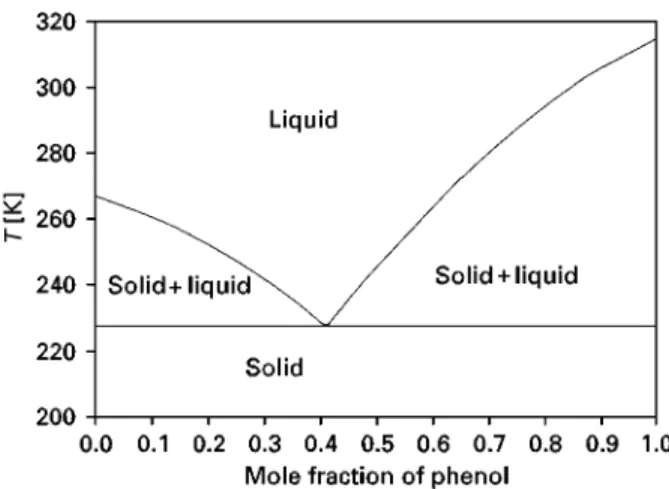
Tb(473 K and 23.5((25.5 MPa1/2. A search of the database gives furfuryl alcohol, aniline, N,N -dimethylformamide and furfural. The solvent function of aniline related to dissolving solid phenol is validated through the computed solid}liquid phase diagram for the phenol}aniline mixture (seeFigure 5).
Hybrid Approach
The solvent selection problem for the removal of phenol from wastewater has been solved with the ProCAMD (see Table 5). The summarized results from ProCAMD are shown in Figure 6. Compared with butyl acetate and toluene, this solvent has been found to have a higher F (eqn [1]) and is environ-mentally acceptable.
IdentiVcation of a solvent for morphine
Problem formulation In the production of
mor-phine a solvent is needed for dissolving the solid. Known solvents for morphine include cyclohexane, tetrachloromethane, toluene and benzene. It is de-sired toRnd alternative solvents capable of dissolving morphine. Furthermore, in order not to contaminate the product with toxic substances, in case of solvent inclusions after crystallization, the compound should be nonaromatic and have a low toxicity.
Constraint selection Solubility is a mixture
Figure 6 Results for phenol}wastewater separation (screenshot from ProCAMD).
Figure 7 Molecular structure of morphine.
Design speciTcations
E Compound typeacyclic alkanes, ethers, esters,
al-dehydes, ketones, alchohols; E Tb'350 K;Tm(273 K;
E 22((30 (exclusion of the lowest ranking can-didates);
E performance measure26.3!should be as low
as possible.
Generation of alternatives The ProCAMD package
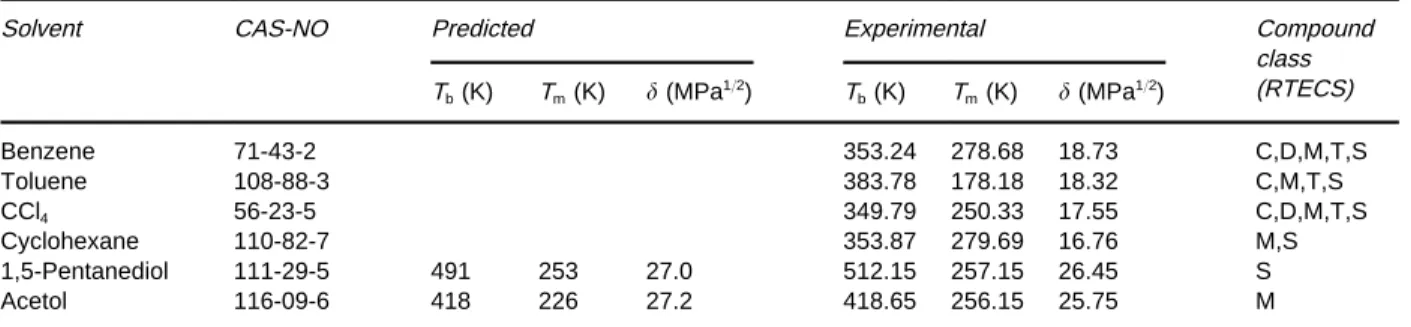
(see Table 5) was used, generating 348 candidates fulRlling the requirements. After performing a struc-ture search to identify substances with known CAS registry numbers two candidates, 1,5-pentanediol and acetol, were selected based on having a solubility parameter close to that of morphine.
Analysis and veriTcation To verify the predicted
values of the properties used as design speciRcations a search in available databases was carried out and the experimental values compared to the predicted. Furthermore the RTECS database (see Table 5) was consulted in order to investigate the health and envi-ronment properties of the selected compounds. The result of the investigations and the predicted proper-ties are shown inTable 6.
Candidate selection From the data listed in Table 6
it is clear to see that among the known and generated solvents 1,5-pentanediol is the most promising candi-date and should be selected for further testing in an experimental setting.
Future Developments
Table 6 List of solvents for separation of morphine
Solvent CAS-NO Predicted Experimental Compound
class (RTECS) Tb(K) Tm(K) (MPa1/2) Tb(K) Tm(K) (MPa1/2)
Benzene 71-43-2 353.24 278.68 18.73 C,D,M,T,S
Toluene 108-88-3 383.78 178.18 18.32 C,M,T,S
CCl4 56-23-5 349.79 250.33 17.55 C,D,M,T,S
Cyclohexane 110-82-7 353.87 279.69 16.76 M,S
1,5-Pentanediol 111-29-5 491 253 27.0 512.15 257.15 26.45 S
Acetol 116-09-6 418 226 27.2 418.65 256.15 25.75 M
D, drug; S, primary irritant; T, reproductive-effector; M, mutagen; C, tumorigen.
however, need to integrate aspects of molecular mod-elling and computational chemistry before acceptable solutions to problems involving complex solutes and tight environmental regulations can be obtained. Finally, it should be noted that having a good so-lvent means easier design/operation of the solvent-based separation technique. Therefore, it is important to formulate correctly the solvent selection problem and to Rnd reliable results in the form of optimal solvents.
Further Reading
Barton AFM (1985) CRC Handbook of Solubility
Para-meters and Other Cohesion ParaPara-meters. Boca Raton, FL: CRC Press.
Fredenslund AA, Gmehling J and Rasmussen P (1972)
Vapour}Liquid Equilibrium Using UNIFAC. Amster-dam: Elsevier.
Harper P, Gani R, Kolar P and Ishikawa T (1999) Com-puter aided molecular design with combined molecular
modelling and group contribution.Fluid Phase
Equilib-ria337: 158}160.
Horvath AL (1992) Molecular Design. Amsterdam:
Elsevier
Lo TC, Baird MHI and Hancon C (1987)Handbook of
Solvent Extraction. New York: John Wiley.
Marcus Y (1998)The Properties of Solvents. New York:
John Wiley.
Mavriounioutis M (ed.) (1998) Special issue on design of
chemical compounds.Computers and Chemical
Engin-eering Journal22: 713.
Seader JD and Henley E (1998)Separation Process
Prin-ciples. New York: John Wiley.
Steam Distillation
L.Ramos, Free University, Amsterdam, The Netherlands
Copyright^ 2000 Academic Press
Sample preparation is nowadays the limiting step in the trace analysis of organic pollutants in environ-mental and biological samples. Looking forward to the laboratory of the future, versatile and universal sample enrichment techniques are required, which can produce fast and valid data, with low costs in terms of solvent consumption and operator involve-ment. A selectivity higher than that of the classical exhaustive extraction methods or the simultaneous elimination of the interference material could be an additional requirement, as it would reduce the amount of solvents and adsorbents used by reducing or eliminating the subsequent clean-up step. Possible additional beneRts deriving from a low manual ma-nipulation of the samples would be a reduction in the
risk of contamination and loss of the analytes, as well as an easier automation of the process.
Steam distillation extraction}solvent extraction (SDE) has been presented as such a universal sample enrichment technique. SDE allows the simultaneous extraction, clean-up and concentration of the target compounds in a closed system, with short analysis times (1}8 h) and by using small amounts of organic solvents (a few mL). This paper reviews this assumption for the case of the analysis of less volatile organic pollutants in environmental samples. The SDE advantages and short-comings for such an analysis have been discussed.