Memorandum No.16
Correcting for Seasonality: I The Regression Method, with an Application to Irish Data
R.C. Geary
Let the data be observed for T consecutive years with k(= 12 for months~ = 4 for quarters) length of seasons. The observations are Yt’ t = kt~ + s, tT = 1,2,...,T, s = 1,2,...,k. Set up the regression
t’
(i) Yt=blXtl +b2xt2 +o..+bpXtp+clztl +c2zt2 +...+ckztk +ut,
where Yt "-: Yt - ~" The xti are the trend (regarded as
orthogonal) and the ztj are the seasonality variables,
ut the random residual. The ztj elements are all zeros or u nities~ Their Tk x k matrix Z is
I
where I is the unit k x k matrix and these are T such matrices. Since the xti are orthogonal,
z
t xti Xti’ (i~-i’) = O o
Similarly for the ztj.
(4) ~’
t ztj ztj’ (j~j’) = 0
The regression solution of (i) in the b and
i
c, is found from J
(i) %1t XtiYt = biZxt2i + X.C EtXtiZt
J j’
(5)
(ii)
Et ztjYt = Z.b Z± i tztjxti + T cj, j = 1,8, ..~,k
-2-system is very easily set up and solved. be shown from (i) that
(6)
k
~, e. =0,j=l 1
It can readilF
which is a desirable property in the seasonality components and is a check on the solution of (5).
To solve (5) the only sum-product computations required are
S:t = ZtxtiYt = Z~xtiYt, i = 1,2, .... , p
All the other terms in (5) are summations the ztj are zeros or unities. The method of solution involves substitution for the c. from (5) (ii) into (5) (i),
]
solving for the b. and substituting back into (5) (ii)
i
.. The method will be illustrated by to obtain the c
application to the data in Table i.
[image:2.576.45.475.211.890.2]Application to Raw Data
Table i. Quarterly Output of Blectricity in Five Years 1959-1963
¯ ~WHm, Quarter
Year I II III IV To t al
1959 572 437 417 593 2,019
1960 646 470 464 658 2,238
1961 668 507 491 698 2,364
1962 754 565 538 756 2,611
1963 852 617 578 813 2,860
Su m 3~492 2,594 2,488 3, 518
I~,092
Z1 Z2 Z3 Z4
L.
Source: ITJSB.
It is proposed to use the first 2(=p) orthogonal polynomials for trend. Also k = 4, T = ~5, kT = 20,
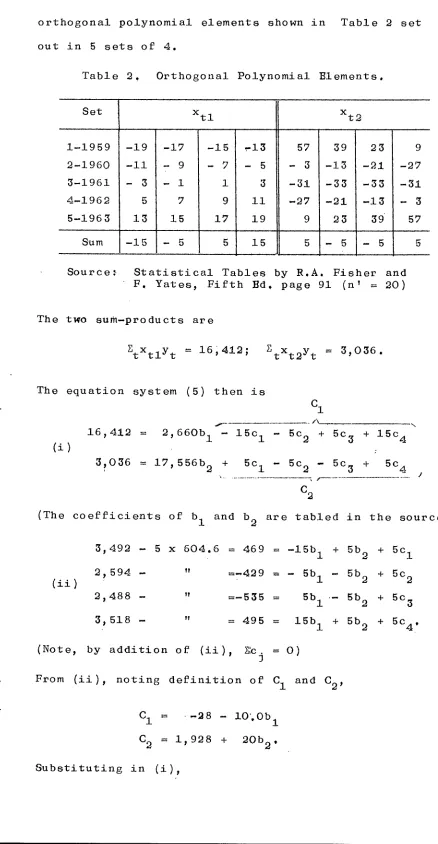
orthogonal polynomial elements shown in Table 2 set out in 5 sets of 4.
Table 2, Orthogonal Polynomial Blements.
Set Xtl xt2
1-1959 -19 -17 -15 -13 57 39 23 9 2-1960 -ii - 9 - 7 - 5 - 3 -13 -9.1 -27 3-1961 - 3 - 1 1 3 -31 -33 -33 -31 4-1962 5 7 9 ii -27 -91 -13 - 3
5-1963 13 15 17 19 9 25 39 57
Sum -15 - 5 5 15 5 - 5 - 5 5
Source: Statistical Tables by R.A. Fisher and F, Yates, Fifth Ed. page 91 (n’ = 20)
The two sum-products are
ZtxtlYt = 16,412; Ztxt2Yt = 3,036.
The equation system (5) then is
C1
16,412 = 2,660bI -15cI - 5c2 + 5c
(i)
3 + 15c43 + 5c4 3?036 = 17,556b2 + 5cI - 5c2 - 5c
... -~ F J C~
(The coefficients of bI and b2 are tabled in the source)
(ii)
3,492 - 5 x 604.6 = 469 = -15bI + 5b2 + 5c1 2)594 - " =-429 = - 5bI - 5b2 + 5c2 2,488 - "
=-535 = 5bI - 5b2 + 5c3 5,518 - " = 495 = 15bI + 5b2 + 5c40
(Note, by addition of (ii), ~. = O) 3
From (ii), noting definition of C1 and C2,
C1 = --28 - lO’.Ob1 C2 = 1,928 + 20b2,
16,412 = 2,660 bI -28-i00bI or bI=16,440/2,560=6,421875 3,036 = 17,556 b2+1,928+ 20b2 or b2= i,i08/17, 576 =0 .06 Z041
Finally, on substituting these values for bI and b2 in (ii) we have
5cI = 565.019; 5c2 =-396.575; 5c \
with check that the sum is zero.
3 = -566.794; 5c4 = 398.357 For computational
purposes it will be convenient to set down the values of c + Y. These are
3
cI + Y = 717,6 c + Y = 525dZ
9
C~ + Y = 491.2 c4 + Y = 684. $
Having determined the coefficients bl, b2, Cl, c2, c3~ c4, the value of R9" can be found~ This is ,9800 which might be regarded as satisfactorily large. But is it the best we can do?
Appliqation to Logarithmic Data
The answer is no. The implication of this arithmetical approach is that the actual production in any quarter in any year is to be found by adding the
correction (i.e. the appropriate cj) to the tre~d,; this correction is the same for all years. This assumption is somewhat unreal in a rapidly increasing phase of expansion. As a rough test from Table i it will be observed that the ranges (all between quarters III and IV) in the successive five years were 176, 194, 207, 218~ 235, or 8,7, 8.7, 8.8, 8.3, 8.2 of annual production. While there may be some slight tendency towards a declining amplitude there can be no doubt
We accordingly repeat the foregoing
calculations but now using log Yt instead of Yt" The
results are as follows (using primed letters for
corresponding symbols used in the foregoing arithmetical
cI c2 c
3 c6 J
case).
Y’ = 2.7726
bI’ = .024609375 b2t = .0433910 ’ + Y’ = 2.8536
+ Y’ = 2.7162 + Y’ = 2.6896
w
’ + Y’ = 2.8310
The regression yields the satisfactorily high value of .9913 for R2. There can be little doubt that the logarithmic approach is to be preferred. The results are compared in Table 3. The "calculated" values are
those using formula (I) with ut = O. For the
logarithmic regression the antilogs are, of course~ shown. These resulted in a slight discrepancy in the five-year output of 12,099 in givin~ a figure of 12,088: the 4 units were distributed 8o as to give the correct total.
s Table 3.
J
Actual and Calculated Values of Output of Electricity, Quarterly 1959-1963
KWHm.
Calculated Deviation (absolute value), frgm ,actual
Qu art er Actual Difference,
cols. 5-6 (i) Original (ii) Logar- (i) Original (ii)
Logar-data ithmic data ithmic
1 2 3 4 5 6 7
1959 I 572 599 587 27 15 +12
I! 437 419 436 18 I +17
III 417 396 418 21 i +20
IV 593 501 592 8 i + 7
1960 I 646 647 636 1 i0 - 9
II 470 466 472 4 2 + 2
Ill 464 445 454 19 i0 + 9
IV 658 651 641 7 17 -i0
1961 i 668 696 690 28 22 + 6
II 507 517 514 i0 7 + 3
III 491 495 493 4 2 + 2
IV 698 702 698 0 +
1962 I 754 748 751 6 3 + 3
IX 563 569 559 6 4 + 2
IIi 538 548 538 i0 0 +i0
IV 755 755 761 /.- 1 5 - 4
196 3 I 852 802 820 50 32 +i 8
II 617 623 611 6 6 +0
III 578 603 588 25 i0 +i 5
IV 813 810 833 3 i0 -17
To t al 12,092 12,092 12,092 258 168 9O
[image:6.921.135.795.87.523.2]Testing for Relative Efficiency
Are the deviations in columns 5 and 6
significantly different? The two entries for each
of the twenty units may be regarded as "treatments".
The nul-hypothesis is that these are not significantly
different. It will be noted from column 7 that in
only 4 cases out of 20 are the column 5 deviations
less than those in column 6. On the nul-hypothesis
the number of - or + signs would have a probability
distribution of
+
when the probability of 4 or fewer - or + signs being
found is ~Oll8, so small that the nul-hypothesis is
rejected.
Procedure
The seasonality factors Cl, c2, c3, c4
based on the original data or some transform of these
(e.g. the logarithm) would be calculated for the
latest five calendar years and applied to correct the
four quarters of the following year. As soon as the
data for the four quarters of the current year become
available the same procedure is adopted. The actual
data displayed in the example worked out above will
be used for different series and different sets of
years. Only the following data are specific to
each series: Zl, Z2~ Z3~ Z4 (see Table i)~
Sl = Et xtl Yt’ $2 = Ext2 Yt" The actual formulae
for the c could be written down as linear expressions J
in these symbols and the "constant" symbols. The
solution in arithmetical terms is so simple that there
As to the actual procedure as applied to the data for 1964 we have
log seasonality
Antilog Actual factors 1959-63
(i) (2) (3) (4)
cI’ = 0:0810 ioe050 885
D
c2 ~ = T, 94~6 0. 8782 676 c3T = T. 9170 0.8260
c4’ = 0.0584 1.1440
Output
Corrected
(s)
734 770
The product of the factors in column (3) is unity°
Between the first and second quarter of 1964 seasonally corrected output increased by 86 KWHm. or by 4.9%.
Short term Forecasting
The logarithmic regression fit is so
remarkably good that confidence might be reposed in
using formula (i) (without ut) for forecasting the quarterly output in the short term from I 1954. this the formulae for Xtl and xt2 are required°
are as
follow~’-FO r
Th ey
Xtl ~ 2t + 1
t2 + t - 33 xt2 =_
The serial number for I 1964 is i0~ for these polynomi~l terms and the ztj
shown in Table 4.
I 1964 Ii 1964 III 1964 IV 1964 I 1965 Co ef fi ci ent s
i0 ii 12 13 14 (log arit hmi c )
Xtl 21 23 25 27 29 0.024609375
xt2 77 99 123 149 177 -O.04~3910
Ztl 1 0 0 0 1 2.8536~
Zt2 0 1 0 0 0 2.7162~
zt3 0 0 1 O O 2.6896~
zt4 0 0 0 1 O 2. 8310~
Calculated
Log Yt 2. 9478 2 o8189 2. 8007 2.9504 2.981Z
Y 887 659 892
t 632 95 8 KWHm.
Actual Y 885 676 T!
t
l !
-I0-The entries at log Yt are the sum products of the
last co!u:~n by the other columns. The correspondence is excellent in i 1964, actually better than is to be expected normally, as reference to column 6 of
Table 3 will show. The mean deviation for that colun~j is 8°4 and the standard deviation 9.’7 so that the
deviation of 17 KWHm for II !964 while somewhat large~:’ than might usually be found is not yet to be regarded as a change in the 1959-196~ trend.
Comparison of Seasonality Correction Divisors
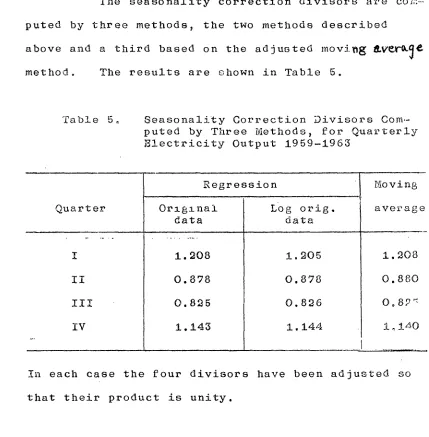
The seasonality correction divisors are co~n .... puted by three methods, the two methods described
[image:10.576.51.480.351.788.2]above and a third based on the adjusted movin~ ~V~ method. The results are Ghown in Table 5.
Table 50 Seasonality Correction Divisors Com.-puted by Three Methods, for Quarterly ~!ectricity Output 1959-1963
Quarter I II IIi IV Regression Orlglnal data 1. o.08 0.878 0.8~5 1.143 Log orig. data io 205 0.878 0.826 I. 144 Moving average I. 208 0.880 Oo 87’: i o 140
In each case the four divisors have been adjusted so
that their product is unity.
the actual moving average results are corrected for the well-known aberrations at high and low points on the moving average curve, to determine trend, using a method described in Memorandum No. 17 : estimates of divisors for each quarter are the five" year geometric means of the quotient of original data by trend.
Concluding Remarks
It is not to be expected that the method
described here will yield quite so satisfactory results when used with other major series: for example, in the Third French Plan the percentage increases (to the unit place) forecast were identical with the actual increases in each case in electricity, gas and petro-¯ leum production . Quite a large amount of
experi-. mental work has been completed in the Institute on seasonality correction using the moving average
method corrected for change in trend - to be described in another BRI Memorandum - and this work shows that
(1) major irish time data fluctuate seasonally with large amplitude;
at the quarterly level these fluctuatie~o exhibit marked regularity;
(3)
accordingly, any good method forseason-ality correction, applied at the quarterly level is likely to yield reliable
results.
-12-The prospects of being able to appraise the trend of the Irish economy at quarterly intervals are distinctly promising.
II III IV 1959
I II III IV I II III IV 1 II III IV
1961 I~2