FM 5-25
D E P A R T M E N T O F T H E A R M Y F I E L D M A N U A L
EXPLOSIVES
AND
DEMOLITIONS
HEADOUARTERS. O E P A R T M E N V
M A Y
TACU 7Ie.A
T OF THE
1
c- 6.
i4cetion I. II. APPlmDII A. B. C.
D. E.
F.
SAFE HANDLING, TRANSPORTATION, AND STORAGE OF EXPLOSIVES
General Mfety precautions _________ ..____ _____ 186-140 Tranrportation. storage. and disposal _.___. __._ _ 141-145 REFERENCES ___________.._________---..___-_- _______ METRIC CHARGE CALCULATIONS .___ __... _..__-_ USE OF LAND MINES, AERIAL
BOMBS, AND SHELLS AS
DEMOLITION CHARGES __________________ _______ SUMMARY OF EXPLOSIVE
CALCULATION FORMULAS _______________ _______ POWER REQUIREMENTS FOR
SERIES FIRING CIRCUIT _________________ _______ SPECIAL DEMOLITION MATERIALS
AND TECHNIQUES _________________.._-_- _____._ 149 166 168 164
167 160
CHAPTER 1
DEMOLITION MATERIALS
Section 1. INTRODUCTION
1. Pupse and Scope
a. This manual is a guide in the use of explo- sives in the destruction of military obstacles, and in certain construction projects. The ma- terial includes information on-
(1) Types, characteristics, and uses of ex-
(2)
(3) (4)
(5) (6)
plosives and auxiliary equipment. Preparation, placement, and firing of charges.
Charge calculation formulas. Deliberate and hasty demolition methods for use in the forward zone. Safety precautions.
Handling, transportation, and storage of explosives.
h. The contents of this manual are applicable to nuclear and nonnuclear warfare.
2. Comments
Users of this manual are encouraged to sub- mit comments or recommendations for im- provement. Commends should be referenced to the specific page, paragraph, and line of text. The reasons should be given for each to insure proper understanding and evaluation. Com- ments should be forwarded directly to the Com- mandant, U. S. Army Engineer School, Fort Belvoir, Virginia, 22060.
3. Military Demolitions
Military demolitions are the destruction by fire, water, explosive, and mechanical or other means of areas, structures, facilities, or ma- terials to accomplish a military objective. They have offensive and defensive uses: for example, the removal of enemy barriers to facilitate the advance and the construction of friendly barriers to delay or restrict enemy movement.
Section II. MILITARY EXPLOSIVES AND SPECIAL CHARGES
4. Definitions
a. Ezylosiues. Explosives are substances that, through chemical reaction, violently change and release pressure and heat equally in all directions. Explosives are classified as low or higb according to the detonzztirrg velocity or speed (in feet per second) at which this change takes place and other pertinent characteristics.
b. Low Explosives. Low explosives de- flagrate or change from a solid to a gaseous state relatively slowly over a sustained period (up to 400 meters or 1312 feet per second). This characteristic makes low explosives ideal where pushing or shoving effect is required. Examples are smokeless and black powders.
e. High Exploaizvs. The change in this type
explosive to a gaseous state-detonation-oc- curs almost instantaneously (from 1,000 meters per second (3,280 feet) to 8,500 meters per second (27,888 feet), producing a shatter- ing effect upon the target. High explosives are used where this shattering effect is re- quired-in certain demolition charges and in charges in mines, shells, and bombs.
d. Relative Effectiveness Factor. Explosives vary not only in detonating rate or velocity (feet per second), but also in other character- istics, such as density and heat production, that determine their effectiveness. They vary so much that the amount of explosive used is com- puted according to a relative effectiveness fac- tor, based on the effectiveness of all high explo-
sives in relation to that of TNT. For example, TNT, with a detonating velocity of 23,000 feet per second, has a relative effectiveness factor of 1, while tetrytol, with the same velocity, has a higher relative effectiveness factor of 1.20 (table VIII).
5.
Characteristics of Military Explosives Explosives used in military operations have certain properties or characteristics essential to their function. These are-a. Relative insensitivity to shock or friction. b. Detonating velocity, adequate for the pur- pose.
c. High power per unit of weight. d. High density (weight per unit of volume).
e. Stability adequate to retain usefulness for
a reasonable time when stored in any climate at temperatures between -30’ F and +166 F.Cardboard with metal ends; threaded cap well.
CMor ‘k lb-OD
?4 ILyellow or
i
OD 1 l&OD
f. Positive detonation by easily prepared primers.
g. Suitability for use under water. h. Convenient size and shape for packaging, storage, distribution, and handling by troops. i. Capability of functioning over a wide range of temperatures.
6. Selection of Explosives
The explosives for a particular purpose gen- erally are selected on the basis of velocity of detonation. For example, an explosive having a high detonating velocity generally is used for cutting and breaching; that of a lower velocity, for cratering, ditching, and quarrying. The types of explosives commonly used are de- scribed below.
7. TNT (Trinitrotoluene) a. Characteristics (fig. 1).
water
rPsIstI”ce P*ck.ghs
Excellent (does not Less sensitive to ahoek. %A lb-200 blocks in wooden box; H lb-100 readily absorb blocks in wooden box; 1 lb-50 or 56 block8
water). in wooden box.
b. Use. TNT is used in cutting and breach- ing and as a main or booster charge for general demolition purposes in combat areas. To form a charge to fit special targets, it is removed from the package and melted in a double boiler. Then it must be immediately cast in the shape needed, because TNT, when melted, becomes fluid and hardens quickly.
TNT should attempt this.
If allowed to boil or crystallize, it becomes supersensitive and detonates at a small amount of shock or exposure to flame.
c. Detonation. TNT may be detonated by military electric and nonelectric blasting caps.
8. Tetrytol
Caution: Only these who are well-informed a. Ml Chain Demolition Block. on the characteristics and reaction of molten (1)
cfial-aeteristics
(fig.
2).2 FT BLOCK WEIGHT
\ 2+ LB
Figure 3. M2 demolition block.
2 Fi HAVERSACK PACKAGE
CONTAINING 8 BLOCKS
Figure L. MI chain demolition block.
(2) Use. The Ml chain demolition block may be used as an alternate to TNT. The complete chain, or any part of the
chain, may be laid out in a line,
wrapped around a target, or used in
the haversack as it is packed. The
entire chain will detonate, even though the blocks may not be in contact with each other. If less than eight blocks
are needed, the required number is
cut
from the chain. Tetrytol is nowcase (b,or
Asphalt-impregnated paper wrapper. Has OD threaded cap well.
being eliminated. When present stocks
are exhausted, no more will be pro-
cured.
(3) Detonation. Tetrytol is detonated by
neans of the military electric or non-
electric blasting cap. The explosive
end of the cap should extend toward the charge.
b. M.2 Demolition Block.
(1) Charactetitics (fig. 3).
sirr WwzhL “~lO”O”;~~;
11xZx2in. 2% lb. 23,000 fps
water realnfanee
Excellent (only slightly soluble).
Low tem,lPlrture effecta
Slight decrease in strength and less sensitive to shock. Requires 6 turns of detonating cord for positive detonation; will explode or ignite under 50.calibre incendiary machine gun fire at subzero temperatures.
hck~inl
Eight blocks packed in a haversack, weighing approxi- mately 22 lb, and two haversacks in P wooden box.
(2)
(3)
Use. The M2 demolition block is used in the same manner as the Ml block. Tetrytol, however, is now being elimi- nated. No more will bs issued after present stocks are exhausted.
Detonation. The Me demolition block may be detonated by the military elec- tric or nonelectric blasting cap.
9. Compositbn C3 (M3 QI MS Demoliiion *k)
Fi,,ure 4. MS and MS demolition blockr.
came cab,
“‘s.?
Sk?KS-Cardboard wrapper perforated for MLOD M5--clear plastic Yellow odorous.
easy opening; Y5-plastic container MB-11 I 2 x 2 in
with threrrded cap well. MS-12 x 2 I 2 in
M&2?& lb Y&Z% lb. 1 25,018 fps 1 1.34 1 Good, but must be in container to prevent erosion.
Low tnnpc,aturc ercets When chilled, color changes to red;
below -20°F becomes stiff and brittle; plasticity restored by heat- ing. Velocity reduced at -2O’F but still of high order.
PdM.nina Rem~rlu
M3-8 blocks packed in haver- More sensitive than TNT to sack and two haversacks in initiation by impact; and wooden box. ML-1 charge odorous.
in polyethylene bag, 24 bags in wooden box.
b. Use. Because of its plasticity and high e. Detonation. Composition C3 may be deto-
detonation velocity, composition C3 is ideally nated by the military electric or nonelectric
suited to cutting steel structural members. It blasting cap.
may be easily molded in close contact to irreg-
ularly shaped objects and is an excellent un- 10. Composition C4
derwater charge if enclosed in a container to a. M5Al Demolition Block.
prevent erosion. (1)
Characteristics
(fig. 5).
Water mistancc
Excellent, if enclosed in original or improvised co”- tainer to prevent erosion by stream currents.
low *mDer*tu* cfkct.
Bemains like putty at -70’ to +l’lO’F. Below -7O’, it becomes hard and brittle.
Puk*lli”* Rcmrr*.
One charge packed in polyethy- C4 ia more powerful than lene bag and 24 bags in TNT, without the odor of wooden box. C3. It ia now classified standard B, to be re- placed by the Ml12 demolition charge.
(2)
(3)
Use. Because of ita high detonation velocity and ita plasticity, Composi- tion C4 icl well suited for cutting steel and timber and breaching concrete.
Detuna.tion. Composition C4 may be detonated by a military electric or nonelectric blasting cap.
b. Ml12 Demolition Charge.
(1) Chamcteristice (fig. 5).
W.tn rehlmc. Low tcrnMlrlUrc .tlccin Pac**ainn Excellent if inclosed in I&ai”a like putty at 30 blocks per box 14 x
original or impro+ed -7O’F to +170-F. Be- ll % x 6 19/32 in: total container to prevent low .-70” beames hard weight 48 lb. erosion by stream cur- and brittle.
Pe”t#.
(2) Use. Because of its high detonating velocity and plasticity, the Ml12 demo- lition charge (C4) is used for cutting ateel and timber and breaching con- crete. It has an adhesive compound on one face for attachment to target.
(3) Detonation. The Ml12 demolition charge may be detonated by a mili- tary electric or nonelectric blasting cap
aem.rtT.
11. Ml 18 Demolition Charge a. Chamcteristics (fig. 5).
Caac cdur
Mylar container White
“X~v&y Sk Wlim Lkton*tinp(
v*,mity Dark green Block: 12?4 x 3% x 1% Block: 2 lb 23,616 fpa
in Sheet: 12 I 3 x U in. Sheet:
W
lb Re,*ti*e cffcct,ucnea. W.teI raintma Low teInlKlat”rC. Pl?rctr Pae*a.i”n The relative effectiveness Unaffected by Retains flexibility at Four sheets per packagefactor has not yet been submersion. -65°F; does not craze and 20 packages per box, established. For can- or melt at +160-F. with B volume of 1.1 eu
puting test shots, ft. Total weight 62 lb.
“se 1.00.
Remarks. May be cut with a knife and placed in an open fire where it will burn but not explode. Will withstand impact of .30 eal. bullets fired from a distance of 40 ft. Each sheet has an adhesive compound on one face.
b. Use. After the protective cover-strip is pulled off, the sheet of explosive may be quickly pressed against any dry surface at a tempers- ture higher than 32’F. A supplementary ad- hesive has been developed for colder, wet, or underwater targets. The explosive may be used in bulk or cut to accurate width and uni- form thickness. It is particularly suitable for cutting steel and breaching.
e. Detonation. The Ml18 sheet explosive may be detonated by a military electric or non- electric blasting cap.
12. Composition g
This is a high explosive made of RDX and TNT with a relative effectiveness factor higher than that of TNT (1.35)) but is more sensitive. Because of its shattering power and high rate of detonation, Composition B is used as the main charge in certain models of bangalore torpedoes and shaped charges. For further information see table VIII.
13. PETN (Pentaerythritetronitrate) PETN, the explosive used in detonating cord, is one of the most powerful military explosives, almost equal in force to nitroglycerine and RDX. When used in detonating cord, PETN has a detonation velocity of 24,000 feet per second and is relatively insensitive to friction and shock. For further information see table VIII.
14. Amatol
Amatol is a mixture of ammonium nitrate and TNT with a relative effectiveness of 1.17. Amatol (80/20) may be found in the bangalore torpedo (table VIII).
15. RDX (Cyclonite)
RDX is the base charge in the M6 and MI electric and nonelectric blasting caps. It is Aoa 1250A
Figwe 5. M5.41, M111, and Ml18 demolition blocks. highly sensitive and brisant (great shattering effect) and the most powerful military ex- plosive.
16. Pentoiite
Pentolite is a combination of PETN and TNT used in the M2A3 shaped charge. Like Compo- sition B it has a high rate of detonation and great shattering power.
17. Ednatol
This is a mixture of halite, or explosive H, and TNT. It has no tendency to combine with metals in the absence of moisture, and has no toxic effects. It is used in shaped charges and high explosive shells.
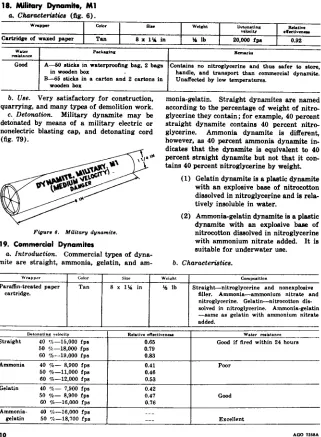
18. Miliiry Dynamite, Ml (I%?. 6).
b. Use. Very satisfactory for construction, quarrying, and many types of demolition work.
e. Detonation. Military dynamite may be
detonated by means of a military electric or
nonelectric blasting cap, and detonating cord
(fig. 79).
Figure 8. Military dynamits.
19. Commercial Dynamites
a. Zntrodwtimz. Commercial types of dyna-
mite are straight, ammonia, gelatin, and am-
monia-gelatin. Straight dynamites are named
according to the percentage of weight of nitro- glycerine they contain; for example, 40 percent
straight dynamite contains 40 percent nitro-
glycerine. Ammonia dynamite is different,
however, as 40 percent ammonia dynamite in-
dicates that the dynamite is equivalent to 40 percent straight dynamite but not that it con- tains 40 percent nitroglycerine by weight.
(1) Gelatin dynamite is a plastic dynamite with an explosive base of nitrocotton dissolved in nitroglycerine and is rela- tively insoluble in water.
(2) Ammonia-gelatin dynamite is a plastic
dynamite with an explosive base of
nitrocotton dissolved in nitroglycerine
with ammonium nitrate added. It is
suitable for underwater use.
b. Characteristics. Wr~LT..-r
Paraffin-treated paper
cartridge.
com~itlan
Straighenitroglycerine and nonexplosive filler. Ammonia--ammonium nitrate and nitroglycerine. Gelatin-nitrocottan dia- solved in nitroglycerine. Ammonia-gelatin -same as gelatin with ammonium nitrate added.
DetonatinP “elrxitl Straight 40 %--15,000 fpa
50 4-13.000 fps 60 70-19.000 fps
Ammonia 40 %- 3,900 fpa 50 %-11,000 fps 60 %-12,000 fpa
Gelatin 40 %- 7,900 fps 50 %- 3,900 fps 60 %-16,000 fps Ammonia- 40 %--16,000 fps gelatin 50 %-13,100 fps
Rcl.fi”. eI?eCtivcnea 0.65 0.79 0.33
0.41 0.46 0.53
0.42 0.47 0.76
Water re&tanec Good if fired within 24 hours
Poor
Good
Excellent
[image:11.367.15.336.31.468.2]Remarks
Require8 careful handling, as flames, sparks, friction, and sharp blows may cause detonation, and special are
in storage, as it deteriorates rapidly. It ia thus undesirable for military use.
c. Uses. Being sensitive to shock and fric-
tion, commercial dynamite is not generally
used in forward areas; but it is acceptable in
emergencies when other more suitable ex-
plosives are lacking. Sixty percent straight
dynamite, of leas strength than TNT, has a
variety of uses; gelatin dynamite is applicable
to underwater demolitions and to land clearing,
cratering, and quarrying. A gelatin dynamite
of low heaving force and a high rate of detona-
tion is used for blasting hard rock.
d. Detonation. Commercial dynamites may
be exploded when primed with a commercial
No. 6 or larger, blasting cap, a military electric
or nonelectric blasting cap, or detonating cord
(fig. 79).
8. Low Temperature Eflects. The sensi-
tivity of dynamite decreases at diminishing
temperatures until the dynamite freezes, after
which it becomes extremely sensitive. Gelatin
dynamite does not freeze as easily as straight
dynamite. When straight dynamite is stored,
the nitroglycerine tends to settle out of the
sticks; accordingly, straight dynamite cases
should be frequently and regularly turned until
freezing sets in. Frozen dynamite may be
thawed in a kettle as described in g, below.
f. Old Dynamite. Old dynamite may be rec-
ognized by the oily substance collected on the
casing or by stains appearing on the wooden
packing case. These arc caused by the separa-
tion of the nitroglycerine from the porous base.
Dynamite in this state, being extremely sensi-
tive, must not be used but destroyed immedi-
ately by burning (TM 9-1300-206).
9. Frozen Dynamite. Frozen dynamite is
recognized by its hardness and by the appear-
ance of crystals (which are extremely sensitive)
in the contents of the stick. Its use is not
recommended. It may be destroyed by burning
in the same manner as old dynamite. Frozen
dynamite, may be used, however, if thawed as
follows
:
(1) Use a commercial thawing kettle. If
this is not available, a 6- and a lo-
AGO 7218A
gallon container may be combined to
make a good substitute. (a) (b) (c) Cd) (8) (f)
(9)
(2)Heat water in a separate container
to a temperature as high as can bs
tolerated by the hand.
Pour the heated water into the
water compartment of the thawing
kettle (10 gallon can).
Lay the frozen dynamite in the in-
ner compartment (S-gallon con-
tainer) in a horizontal position,
with the bottom sticks supported on
strips of wood or other material, so
that the air can circulate readily
around the sticks.
Place the kettle in a barrel or box
insulated by hay or some other sat-
isfactory material.
Thaw no more than 50 pounds of
frozen dynamite in a single lot.
Never place the frozen dynamite in
the thawing compartment of the
kettle before the hot water is poured
into the water compartment.
Never set the kettle over heat after
the dynamite has been placed in it.
Frozen dynamite is completely thawed
when it has returned to its original
consistency. This can be determined
by squeezing the sticks lightly with
thumb and forefinger. If no hard
spots remain and when unwrapped no
crystals are seen, it is thawed and
ready for use.
20. Foreign Explosives
a. Types. Explosives used by foreign coun-
tries include TNT, picric acid, and guncotton.
Picric acid has characteristics like TNT except
that it corrodes metals and thus forms ex-
tremely sensitive compounds. A picric acid
explosive in a rusted or corroded container must
not bc used
: in fact, it should not be handled
inany way, except to move it very carefully to a
safe disposal area or location for destruction
(app C).
b. Uses. Explosives of allied nations and those captured from the enemy may be used to
supplement standard supplies. Such explosives,
however, should be used only by experienced soldiers and then only according to instructions
and directives issued by theater commanders.
Captured bombs, propellants, and other devices may be used with U. S. military explosives for larger demolition projects, such as pier, bridge, tunnel, and airfield destruction (app C). Most foreign explosive blocks have cap wells large enough to receive U. S. military blasting caps.
These blasting caps, when used to detonate
foreign explosives, should be test fired to de- termine their adequacy before extensive use.
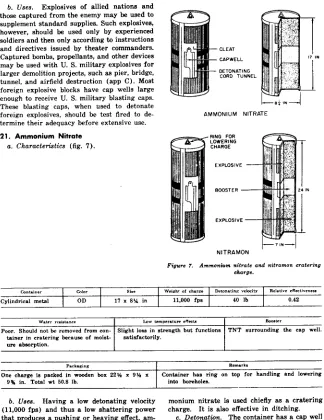
21. Ammonium Nitrate
a. Characteristics (fig. 7).
L-stw-4
NITRATE
1
24 IN [image:13.367.16.340.35.455.2]1
NITRAMON ’Figure 7. Ammonium nitrate and nitramon mate+ing charge.
cont.incr color Cylindrical metal OD
size 11 x 8% in
wridw Of rhare Drton.finE vebcitr Rrl?.ti”c cffcetivcnea*
11,000 fps 40 lb 0.42
W.ter rc.iatanee law te”!xr*1”re enecefs Bcmarr
Poor. Should not be removed from con- Slight loss in strength but functions TNT surrounding the cap well. tainer in cratering because of moiat- satisfactorily.
ure absorption.
PmctaSmg
I
aallar!aOne charge ia padred in awden box 22% Y 9?4 x Container has ring on top for handling and lowering 9?4 in. Total art 50.8 lb. into boreholes.
b. Uses. Having a low detonating velocity monium nitrate is used chiefly as a cratering (11.000 fps) and thus a low shattering power charge. It is also effective in ditching.
that produces a pushing or heaving effect, am- c. Detonation. The container has a cap well
and a detonating cord tunnel for priming. A cleat is placed above and to the side of the cap
well for attaching electric and nonelectric pri-
mers. Frequently a primed one-pound block of
TNT is placed on the charge to insure detona-
tion.
22. Nitramon Cratering Charge a. Chasacteristics (fig. 7).
c”,“?nl”Pr calm sw.e
Cylindrical metal. 24 x 7 in
Wewht of eharse amnat,nl. “Pi0CiO Relative rRrcli”rnPss ~~._~
functmns satisfactorily.
BoaLpr Paekasing
TNT surrounding One metal container in wooden the cap well. box 27% x 8% x 9% in.
Total weight 52 lb.
h.
use.
Because of the low detonatingvelocity (11,000 fps) and low shattering power
that produces a heaving effect, this charge is
very effective in cratering and ditching. The
container has a ring on top for general handling
and lowering into boreholes.
e. Detonation. The container is fitted with
a cap well and a tunnel for priming and a cleat
to attach electric and nonelectric primers. A
primed l-pound block of TNT is placed on the
charge for positive detonation.
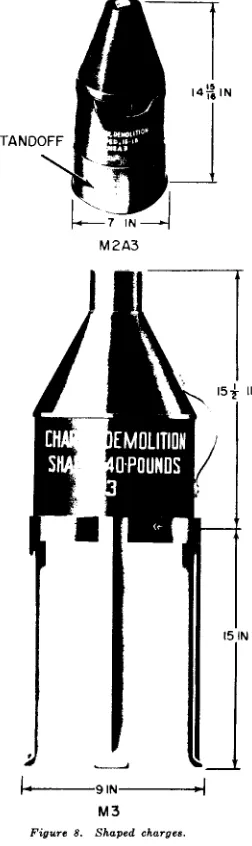
STAND
k7IN-4 M2A3
[image:14.366.199.325.36.459.2]M3
Figure 8. Shaped charges.
23. Shaped Charges
A shaped charge is an explosive charge with ita detonating action directed to increase its effectiveness in penetrating steel, armor, and concrete and other masonry (fig. 8). Charges, as issued, are usually cylindrical in shape hut may be linear like the charges included in the Ml57 demolition kit (para 2’7~). Cylindrical shaped charges have a conical top, a cynical
recess, and a metal or glass liner in the base, The threaded cap well in the top is for priming with military electric or nonelectric blasting cap*. Shaped charges, generally, are made from such explosives as Composition B, pento- lite, and ednatol.
a. MBA3 and M.?A4 Shaped Charges.
(1) Characteristics (fig. 8).
Cur Color
Water resistant fiber OD
Weight Of eh.rw sire EX”I”.i”P scaste.
12 lb 14 15116 x 7 in SO/60 pentolite M2A3: 50150 pento- or composi- lite with camp B tion B. explosive.
M2A4: Comp A3, n- aistant to small *rm* Are.
Liner
Glass
Low tlm”“Pt”re e.Tects Packi”p: senmrks
Satisfactory in arctic Three charges packed in wooden Both models have a cardboard cy- climates. box 33% x 10% x 9% in. Total lindrical standoff fitted to the case.
weight 66 lb.
(2) Use. Shaped charges are used pri- marily to bore holes in earth, m&al, masonry, concrete, and paved and un- paved roads. Their effectiveness de- pends largely on their shape and the material of which they are made, the explosive, and proper placement. The penetrating capabilities in various ma- terials and proper standoff distances are given in table XII.
Detonation. The M2A3 and M2A4
shaued charges contain a threaded caD
weli for detonation by electric anh nonelectric blasting caps. Dual prim- ing, however, is extremely difficult be- cause of the configuration of the case and the need for priming at the exact rear-center. They are not effective under water because of the obstruc- tion to the jet.
(3)
b. MS Shaped Charge.
(1) Characteristics (fig. 8).
C.” Metal
wcidlt of ehrge sire EIplo.i”e
I
B”OStm30 lb EW x 9 in (less SO/50 pentolite or 50/60 pent&& with standoff). composition B. camp B charge.
liner Lor w”m”yturo PPEteDinp Remarks
Steel “1 copper Satisfactory in One each in wmden box 20% x Provided with metal tripod standoff arctic climates. 13% x 11% in. Total weight 65 lb. 15 in high.
(2) _Use. Shaped charges, primarily, are of the obstruction to the jet. used to bore holes in earth, metal,
masonry, pavement and the like. Ef- c. Special Precautions. In order to achieve fectiveness dewnds considerably on the maximum effectiveness of shaped chargea- ,.
,
the shape and- material in the -cone,the explosive used, and proper place- ment. The penetrating effects of shaped charges in various materials and relative standoff distances are given in table XII.
\I,
(21
(31
Center the charge over the target point.
(3) DetoxaMon. The M3 shaped charge is provided with a threaded cap well for detonation by electric and nonelectric blasting caps. Dual priming is very difficult because of the slope of the case and the need for exact rear-cen- ter priming. The M3 shaped charge is not effective under water because
(41
(51
24. MlAl and MlA2 Bangalore Torpedo Kits a. Chwacte&tic8 (fig. 9).
Set the axis of the charge in line with the direction of the hole.
Use the pedestal provided to obtaln the proper standoff distance. Be certain that there is no obstruction in the cavity liner or between the charge and the target.
Be certain that soldiers using shaped charges in the open are at least 900 feet away in defilade under cover, or at least 300 feet away if in a missile- proof shelter, before firing.
10 loading assemblies or Approx 12 lb 6 ft x 2 % in MlAl~approx 9 lb amat
-~/~~/~/
rhauine
I
RemukaOne kit packed in wooden box 64U x 13% x 1% in. Four inches of length at both ends of each section mn-
Total weight 1’76 lb. tains * booster.
b. Assembly
for Use.
All sections have a threaded cap well at each end so that they may be assembled in anv order. The connectino sleeves make rigid joints. A nose sleeve iiplaced on the front of the torpedo to assist in \ CYPOSITI pushing it through entanglements and across
the ground. It is also desirable to attach an improvised loading section without explosive
on the end to forestall premature detonation by TWRL4oEo CAP WI a mine when the torpedo is shoved into place.
In the assembly of two or more tubes, the nose sleeve is pressed onto one end of one tube, and the other end is connected to a second tube by a
connecting sleeve. A bangalore torpedo or CONNECTING SLEEVE
torpedo section may be improvised by the use of a 2-inch diameter pipe with a 24-gage wall
thickness with approximately 2 pounds of ex- L ”
LOADING ASSEMBLY 1
plosive per foot of length. Successive pipe
lengths, however, must be closely connected. Figurs 9. MIA1 bangalwa torpedo.
c. Use. The bangalore torpedo clears a path
10 to 15 feet wide through barbed wire en-
tanglements. In minefield breaching, it will
explode all antipersonnel mines and most of the antitank mines in a narrow foot path. Many of the mines at the sides however may be shocked into a sensitive state, which makes extreme
care necessary in any further mineclearing.
Bangalore torpedoes also may be used in
bundles as substitute explosive charges in the
M3Al antitank mineclearing projected charge
demolition kit (fig. 13).
d. Detonation. The military electric or non- electric blasting caps will detonate the banga- lore torpedo. In obstacle clearance, the banga- lore torpedo should be primed after it has been placed. The cap well at the end should be pro- tected with tape or a wooden plug while the
torpedo is being pushed into place. Priming
is generally done either by means of priming adapter and a military electric or nonelectric blasting cap and time fuse. or by detonating cord with six turns around the I-inch booster portion of the torpedo.
25. M37 Demolition Charge Assembly
The M37 charge assembly (fig. 10) consists of eight M5Al demolition blocks, eight demo-
lition block hook assemblies, and two Ml5
priming assemblies. The demolition blocks are
packed in two bags, four blocks per bag, and the assembly placed in an M85 carrying case.
The Ml5 priming assembly is a g-foot length
of detonating cord with two plastic adapters
and two RDX boosters attached. The adapters
are threaded to fit the standard cap well in
the demolition block. The priming assembly
has two detonating cord clips for fixing the M37
charge assembly to the main line. The hook
assemblies are hooks and pieces of rope for
attaching charges to the target.
a. Use. This assembly is applicable to the use of assault demolition teams in the reduc- tion of obstacles. It is very effective against small dragon’s teeth approximately 3 feet high and 3 feet wide at the base.
b. Detov~otion. The M37 demolition charge
is detonated by means of the Ml5 priming as- sembly and an electric or nonelectric blasting
16
Figure IO. MS7 demolilioa charge assmbla,
cap or by a ring main attached by means of the
detonating cord clips provided.
c. Packaging. One assembly is packed in an
MS5 carrying case, and two are packed in a
wooden box 171/a x 11% x 1292 inches. The
gross package weight is 67 pounds.
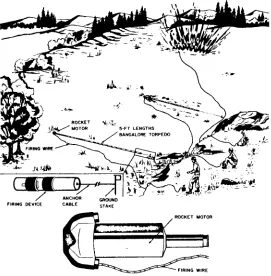
26. Rocket-Propelled Train Bangalore
Torpedo (Barney Google)
The device consists of 20 sections of banga-
lore torpedo fitted together by special con-
necting sleeves to form a loo-foot train (fig. 11). A kit contains the rocket motor, tail as-
semblies, and couplings for 20 sections. The
motor is fitted to the front of the train to pro- vide propulsion. Detonation occurs at the tail
assembly by means of a nonelectric blasting
cap, pull fuze, and a reel of cable.
Figure II. Rocket-propelled ban&ore torpedo (Barney Googds).
a. Uses. The rocket-propelled bangalore tor- ‘pedo is used against barbed wire entangle- ments, antipersonnel mines, and similar small obstacles. The rocket propulsion enables deeper penetration of small obstacles with less ex- posure of friendly soldiers to enemy observa- tion and fire.
b. Detonation. The assembled torpedo is placed at a spot within range of the target. The 400-foot reel of cable is shortened to the proper length and its free end is anchored firmly. After the safety has been unscrewgd from the tail assembly and all soldiers have
boo 12-A
taken cover, the rocket motor is fired elec- trically. After the torpedo has traveled a dis- tance equal to the length of the anchored cable, the pull fuze is actuated and the assembly detonated.
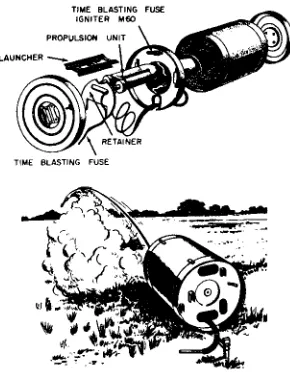
27. Projectld Charge Demolition Kits a. MI and MfEl. These are identical in all respects except for the delay detonators and the time blasting fuze igniters issued with them. The MlEl has the M60 weatherproof blasting fuse igniter and the 15-second delay MlA2 per- cussion detonator, while the Ml has the M2
weatherproof blasting fuse igniter and the 16 second delay Ml or MlAl friction detonator
(fig. 12).
(1)
(2)
(3)
(4)
C~mpouents. These are a nylon-cov- ered detonating cable, propulsion unit, launcher, fuse lighter, delay detonator,
anchor stake, and carrying case. The explosive item, or detonating cable, is
1 inch in diameter and approximately
170 feet (52 meters) long; it weighs 63 pounds, 46 pounds of which is oil-
soaked PETN. The detonating cable
is composed of 19 strands of special
detonating cord, each containing 100 grains of PETN per foot. This differs from the regular (reinforced) deto- nating cord, which contains bnly 60 to 60 grains of PETN per foot. Regular detonating cord cannot be used as a substitute in the kit.
Use. This kit is emplaced to project and detonate a cable across a pres- sure-actuated antipersonnel minefield. Grass, leaves, other light vegetation, and some soil are blown aside in a lane about 8 feet wide. More soil is blasted aside when the ground is moist and soft than when it is dry and hard. Camouflaged antipersonnel mines and those near the surface in the 8 foot lane are usually exposed.
Detonation. One soldier fires the com- plete assembly. First the kit is em- placed; then the fuse lighter on the jet propulsion unit is pulled. The 16-
second delay in the propulsion fuse allows the soldier to move the S-foot distance from the launcher to the an- chor stake and pull the fuse lighter safety pin and pull ring on the deto- nating cable (which also has a 15-seer ond delay) and then take cover at least 100 feet behind the assembly. Packaging. The complete assembly is issued in a OD-colored waterproof aluminum carrying case. Each case is packed in a wooden box 2S$$ x 13% x 19% inches. The gross weight of the kit and box is 142 pounds. b. Antitank ,WneClearing Kits. Theae kits,
IO
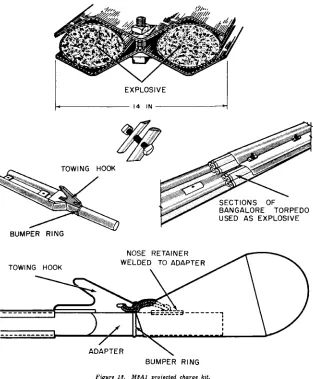
Figure II. MlEl projected charge kit.
[image:19.365.192.337.41.233.2]ment as a separate expedient charge. In most meters (330 feet) long, 6 meters (16 fee!$) soils, these charges form a crater about 100 wide, and 2 meters (7 feet) deep.
TOWING HOOK
BUMPER RING
TOWING HOOK
ADAPTER \
[image:20.365.19.332.70.449.2]BUMPER RING
Figure 1.3. MSAl projected charge kit.
Tabb I. Cmnpa&m of M2, MzAI. MS. and bf2Al P+oiscted Ckarge Dmwlitim Kita
radar in erosa in cram section.
e on towing yoke rained cable on towing yoke raised
winch on perkcope fit- by winch on periscope fit-
TWO IMPACT
c. M-157.
(1) Description. T.da kit (fig. 14) meas-
(2)
urea about 12 inches in width, ‘7 inches in height, and 400 feat (121.9 meters) in length. It consists of 79 sections -1 nose section, 13 body sections, 62 center-loading sections, 2 impact fuse sections, and 1 tail section. Only 64 of the 79 sections contain exploaivcs- the 62 canter loading Sections and the 2 impact fuss sections. The kit weighs 11,000 pounds including ap- proxima+ely 5.200 pounds of explosive. The explosive is a linear shaped charge, 12 inches wide, 7 inches high, and 5 feet long, containing approxi- mately 45 pounds of Composition B and 6 pounds of Composition C-4. As the insert tubes are welded to the walls of the center loading sections, the explosive elements cannot be used as separate charges or replaced by any substitute item in the field. The linear shaped charge insures a wider, clearer path throughout minefields than many other explosive clearing devices. In most soils this charge forms a crater about 100 meters (330 feet) long, 4 to 5 meters (12 to 16 feet) wide, and 1 to lib meters (3 to 6 feet) deep. Use. Projected demolition charges are used chiefly in the deliberate breaching of minefields. They are also effective against bands of log posts, steel rail posts, antitank ditches, and small concrete obstacles. These charges are adequate to break down the sides of an antitank ditch. They will also clear a path through the ditch adequate for tank traffic, if it is un- rev&ted and 5 feet deep or less and if the charges project beyond the far side of the ditch. They are effective in ditches from 5 to 8 feet deep if the soil is very favorable. The explosive elements of the M3 and M3Al pro- jected charges may be used as expedi- ent individual charges in the M-167 kit.
(3) Detonation. The charges are generally detonated from a tank by means of ADO ,%M
bullet impact fuse, which has a target plate that bears on the firing pin and is held in place by a shear pin and a safety fork that must be removed before the fuse can be actuated. The fuse is detonated by fire from the main tank armament or from any 37mm or larger high explosive shell with a super-quick fuse. Two fuses are pro- vided to insure that one is visible to the tank gunner at all times.
28. Improvised Charges
Demolition teams operating in the field fre- quently find targets to which standard methods and charges may not apply and improvisations are required. Frequently the success of the mission depends upon the ingenuity or the team. The package and pole charges are such improvisations. By skillful modifications they may be applied successfully in many situations.
a. Package Chavges. Charges prepared in convenient packages of appropriate size and shape are always more readily put in place than other types. Explosives may be packaged in sandbags to make elongated cylindrical charges for boreholes. Blocks of TNT or other ex- plosives may bs stacked together and bound with tape or twine or wrapped in canvas, other cloth, or paper. A satchel charge may bc im- provised by tying or taping explosive blocks to a board with a handle attached. Large charges may consist of an entire case of explosives; Here at least one block or one cartridge is re- moved from the case, primed, and replaced. A still larger charge may be made by lashing several cases of explosive together. The deto- nation of a single primer will dre the entire charge. Dual priming systems, however, should be used if possible.
6. Pole Ckargeu. Pole charges are con- venient for placement against pill boxes, hard- to-reach bridge stringers, underwater bridge supports, and other locations not easily accessi- ble. Pole charges are usually an assembly of an explosive charge; detonating cord; fuse lighter, time fuse, nonelectric blasting cap; and a pole for placing or propping them in position. Pole charges are usually prepared in the same manner as package charges. Dual priming should be used, if possible.
Section III. DEMOLITION ACCESSORIES
29. Time Blasting Fuse
Time blasting fuse transmits a flame from a match or igniter to a nonelectric blasting cap or other explosive charge, providing a time delay wherein blasters may retire to a safe distance prior to the explosion. There are two types: safety fuse and time fuse M700. These may be used interchangeably.
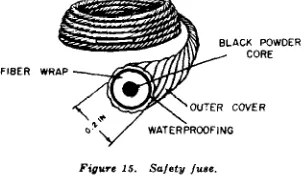
a. Safety Fuw. Safety fuse is limited stand- ard. It is used in general demolitions. It con- sists of black powder tightly wrapped with several layers of fiber and waterproofing ma- terial and may be any color, orange being the most common (fig. 15). As the burning rate may vary for the same or different rolls from 30 to 45 seconds per foot under different atmos- pheric and climatic conditions (exposure for over 12 hours to the elements, extreme changes in temperature, and the like), each roll must be tested prior to using in the area where the charge is to be placed. Particular precautions must be taken if used under water, as the rate of burning is increased significantly. Accord- ingly, each roll should be tested under water prior to preparation of the charge. In arctic temperatures, the outside covering becomes brittle and cracks easily.
ACK POWDER
CORE
FlWR WRAP
OUTER COYER
WATERiRCOFING
b. Time Fuse M700. This fuse (fig. 16) is similar to safety fuse and may be used inter- changeably with it. The fuse is a dark green cord 0.2 inches in diameter with a plastic cover, either smooth or with single painted bands
around the outside at l-foot or la-inch intervals and double painted bands at S-foot or go-inch intervals, depending on the time of manufac- ture. These bands are provided for easy measuring purposes. The burning rate is ap- proximately 40 seconds per foot, which permits the soldier firing the charge to reach a place of safety. The burning rate, however, must al- ways be tested in the same manner as that of safety fuse, above. At arctic temperatures, the outside covering becomes brittle and cracks easily.
DARK GREEN WATER SMOOTH PLASTIC
WITH YELLOW S
Figure 16. Time jwa M700.
e. Packaging.
(1) Safety fuse.
(a)
(b)
Cc)
SO-foot coil, 2 coils per package, and 30 packages (3000 feet) in a wooden box 243/a x 153/a x 12% inches. The total package weight is 71.8 pounds. 50-foot coil, 2 coils per package, 6 packages sealed in a metal can, and 8 cans (4000 feet) per wooden box 30 x 14s/8 x 145/8 inches. The total package weight is 93.6 pounds. SO-foot coil, 2 coils per package, and 60 packages (6000 feet) per wood- en box 29 x 22 x 17 inches. The total package weight is 162 pounds.
[image:23.372.23.175.324.413.2](2) Time fuse WOO. This is packed in Ml-foot coils, 2 coils per package, 6 packages per sealed container, and 8 containers (4000 feet) per wooden box 304/s x 16Ys x 141/8 inches. The total package weight is 94 pounds. 30. Detonating Cord
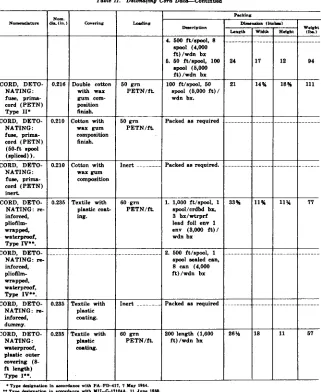
a. Characteristics. Detonating cord consists of a core of PETN in a textile tubs coated with a layer of asphalt. On top of this is an outer textile cover finished with a wax gum composition or plastic coating (fig. 17). It will transmit a detonating wave from one point to another at a rate of at least 5900 meters per second or about 19400 feet. Parti$Iy sub- merged water-soaked detonating car will de- tonatc if initiated from a dry end. Although it does not lose its explosive properties by ex- posure to low temperatures, the covering, be- coming stiff, cracks when bent. Thus great care is required in using detonating cord prim- ers in arctic conditions. Data on the types available is shown in table II.
/ASPHALT LAYER /’ : )
L RAYON ’ SEAMLESS
LAYER COTTON TUBE
Table II. Dstonatin~ Cord Data
CORD, DETO- NATING: fuse. prima- cord (PETN) Type 1..
0.210
Lo.dinc
50 gm PETN/ft
1. 1,066 ft./spool, 1 apool (1,999 ft)/wdn bx 1. 100 ftlspml,
95 spool (2.569 ft)/wdn bx 3. 596 ft/spool, 1
spool/sealed can, 8 can (4,609 ft)/wdn bx
y&
Table Il. D&ma&~g Co+d Data-Continued
0.210
0.236
0.235
94
I
LalM_ _ _ _ _ _ .
24
21 17
14% 4. 606 ft/spool, 8
spool (4.600 ft)/adn bx 6. 50 ft/spool, 1M
spool (6,000 fO/wdn bx CORD, DETO-
NATING: fuse, prinla- cord (PETN) Type II* CORD, DETO-
NATING: fuse. prinla- cord (PETN) (So-it spool (spliced) ).
Double cotton with wax gum earn- position finiah. :otton with
wax gum wmposition finish.
so gm PETN/ft.
100 ft/apool. 50 spool (6,000 ft), wdn bx.
50 gr” PETNlft.
Packed as required
CORD, DETO- NATING: fuse, prima- cord (PETN) inert. CORD, DETO-
NATING: re. inforced, pliodlm- VnPpd,
Inert _._.--. Peeked as required.
%tnn
with w=gum compositionTextile with plastic coat ing.
60
gm
PETN/ft.1. 1,000 ft/spool. I spool/erdbd bx, 3 br/wtrprf lead foil e”v 1 en” (3,ooo it)/ wdn bx
33% 11% 11% 71
CORD, DETO- NATING: re. inforced, pliolllm- wappea. waterproof, Type IV**. CORD. DETO-
NATING: I.+ inioread, dummy. CORD, DETO-
NATING : rrterproof, Plastic outer
&erl”g
(3. it 1e”gth) Type I’*.2. 506 ft/apool, 1 spool waled can, 8 can (4,600 ft)/wdn bx
26?4 LB 11 Packed as required
Pextile with plsatic coating. Pextile with
PkStiC Coehg.
60 gr” PETN/ft.
260 length (1,600 ft)/wdn bx
_
[image:25.366.18.339.41.433.2]b. Precautions in Use. The ends of detonat-
ing cord should be sealed with a waterproof sealing compound to keep out moisture when used to detonate underwater charges, or charges left in place several hours before fir- ing. A B-inch free end will also protect the remainder of a line from moisture for 24 hours. In priming, kinks or short bends, which may change the direction of detonation and thus cause misfires, should be avoided.
31. Blasting Caps
Blasting caps are used for initiating high ex- plosives. They are designed for insertion in cap wells, and are also the detonating element in certain land mine firing devices. Special military blasting caps are designed to detonate the less sensitive explosives like TNT, military dynamite, and tetrytol. Commercial caps may be used to detonate more sensitive explosives like tetryl and commercial dynamite, in an emerg- ency. Two commercial caps are required to detonate military explosives
; however, there is
also a priming problem as two caps willnot
fit
into the standard threaded recess. Both military and commercial blasting caps, being extremely sensitive, may explode unless handled carefully. They must be protected from shock and extreme heat and not tampered with. Blasting caps must never be stored with other explosives, nor should they be carried in the same truck except in an emergency (para141b(3)). Two types, electric and nonelactric, are used in military operations.
a. Electric Blasting Caps. These are used when a source of electricity, such as a blasting machine or a battery, is available. Two types are in use, military and commercial (fig. 18). Military caps are instantaneous, and the com- mercial, instantaneous and delay. Instantaneous caps include the M6, the special or military, and the commercial No. 6 and No. 8. No. 8 commer- cial delay caps (fig. 18) are issued from the first to the fourth delay ranging from 1:OO second to 1:53 seconds. When two or more of the special instantaneous caps are used, they should be of the same manufacture except for the M6 caps, which regardless of manufacturer, may be used interchangeably as they are all made to a single specification. All issue electric
caps have lead wires of various lengths for connection in a circuit. The most commonly used are 12 feet long. Most all have a short circuiting shunt or tab, to prevent accidental firing, which must be removed before connec- tion in a firing circuit. If the cap is issued without a shunt, which is sometimes the case with the M6, the bare ends of the lead wires must be twisted together to provide the shunt- ing action. Data on electric blasting caps is shown in table III.
b. Nonelecttic Blasting Caps. Nonelectric blasting caps (fig. 19) may be initiated by time blasting fuse, firing devices, and detonating cord. Because they are extremely difficult to waterproof, they should not be used with time blasting fuse to prime charges placed under water or in wet boreholes. If such be neces- sary, however, they should be moistureproofed with waterproof sealing compound. Those in use include the commercial No. 6 and No. 8 and the special or military types I (J-l (PETN or RDX) and M’7 (fig. 19). Special caps will detonate military explosives, and the commer- cial caps the more sensitive types. The latter, however, will detonate military explosives if used in pairs
: but this presents a priming prob-
lem, as two caps willnot fit into the standard
threaded cap well. The M7 special caps are flared at the open end for easy insertion of the time fuse. Data on nonelectric caps is shown in table IV.32. Priming Adapter MlA4
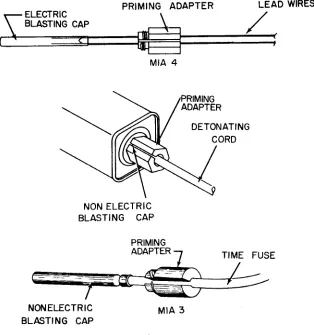
This is a plastic hexagonal-shaped device threaded to fit threaded cap wells and the Ml0 universal destructor. A shoulder inside the threaded end is large enough to accapt blase ing fuse and detonating cord but too small to permit passage of a blasting cap. The adapter is slotted longitudinally to permit easy and quick insertion of the electric blasting cap lead wires (fig. 20). The MlA4 replaces the MlA2 and MIA3 models, which have cylindrical bodies. The hexagonal MlA4 is more readily handled by men wearing arctic mittens. 33. Adhesive Paste, Ml
This is a sticky, putty-like substances for attaching charges to vertical or overhead flat surfaces. It is useful in holding charges while
SHORT - TAB REMOVE CONNEC
SPECIAL (MILITARY) iii FIRI
DELAY (COMMERCIAL 1
IRCUITING IUST BE BEFORE ING CAPS : CIRCUIT
/
/ / M6 SPECIAL \ IGNITION CHARGEINTERMEDIATE (LEAD STYPHNATE \
AND BARIUM LEAD WIRES
LEAD AZIDE CHROMATE)
M6 SPECIAL (ON CARDBOARD SPOOL)
PL”0‘ ASSEMBLY ( RUBBER 1
trie ,No. 8, 4th delay (approx. 1.53 see)
CAP, BLASTING: elee- Lead 6 ft long, copper 1. 50/ctn _._~~~..~._ 9 4% 3 2.3 trie, high strength tinned 2. IOletn . . . __ 14% 7% 3% 6.0
CAP, BLASTING: elec- Lead 9 ft long, capper so/ctn _~_._.______ 7’6 4% 3% 4.0 trie, high strength tinned
CAP, BLASTING: elec- Lead 6 ft long, copper 50/&n .~~~~~~.~_~__~ 6% 6 2% 2.0 trie, low strength tinned
CAP, BLASTING: elec- Various long lead As require6 ~~~ ~~~~~.... . ..____~~~~~~.~_~_~~~~~~~~~~
tric, inert wires
CAP, BLASTING: Lead 12 ft long .__.__. 1. l/chipbd pkg. 50 23% 15?4 11% 16.5
special, electric pkg/fbrbd bx, 10
bx (500 cap) lwdn 17% 12% 11 5l.d bx
2. Aa required .______._______.____---.__ . . . __
Table III. Electric Blasting Cap Clurroctsristie*-Conti”“~d
~~
AbbmeahoN:
bl
b.E,d
eh*.bd chr.board
etn
carton,,,
I,
fmt,kl,
bi
bc.X~,>
ernbdc.rdboarrl
ft.&d. fiberboard lb..
.po”nd,Bl
INTERMEDIATE CHARGE
ALUMINUM ALUMINUM ( LEAD AZIDE)
ALLOY CUP
t 0.260 IN
MAX t
BASE CHARGE
- 2.350 IN MAX ,I
0
cl
SPECIAL M7 MILLITARY
BASE CHARGE COPPER OR ALUMINUM
SHELL
PRIMING CHARGE FLASH CHARGE
Table IV. Nonelectric Bla-stin~ Cap Characftitics
/fbrbd bx. 1 bxl bag. 6 bag (6,000 cap)/
or RDX). n/crdbd bx, 10 bx
in sawdust/outer
electric, Yl.
AbbWWWdN:
bi bo*,s, cm.. c*Ilnn Ib Do”“d
.rdM urdbolrd f3,hrk.d hberbxrd mu meal
tying them in place or, under some conditions, for holding without tying. It will not adhere satisfactorily to dirty, dusty, wet or oily sur- faces; becomes stiff and hard and loses its ad- hesiveness at subzero temperatures; is softened by water
; and becomes useless if wet.
34. Waterproof Sealing Compound This is used to waterproof the connection between the time blasting fuse and a nonelec- tric blasting cap and to moistureproof primed dynamite. It does not make a permanent waterproof seal and must not bs submerged in water unless the charge is to be fired immedi- ately.
35. Cap Crimper
The Fd2 cap crimper (fig. 21) is used to squeeze the shell of a nonelectric blasting cap around time fuse, a standard base, or detonat- ing cord securely enough to keep it from being pulled off but not tightly enough to interfere with the burning of the powder train in the
doe 1S8A
.kB ..8ck8m,*, udn vmden ..rbd . p.DerbMrd wtrprt . v.tclPmo*
fuse or the detonation of the detonating cord. The M2 crimper forms a water resistant groove completely around the blasting cap; however, sealing compound should be applied to the crimped end of the blasting cap for use under water. The rear portion of the jaws is shapsd and sharpened for cutting fuse and detonating cord. One leg of the handle is pointed for use in punching fuse wells in explosive materials for the easy insertion of blasting caps. The other leg has a screwdriver end. Cap crimpers being made of a soft nonsparking metal (but they will conduct electricity), must not bs used as pliers for any purpose, as this damages the crimping surface. Also the cutting jaws must be. kept clean and beused only for cutting fuss and detonating cord.
36. Galvanometar
The galvanometer is an instrument used in testing the electric firing system to check the continuity of the circuit (the blasting cap, Ar- ing wire, wire connections, and splices) in
BLASTING CAP
PRIMING
ADAPTER
LEAD WIRES
J,
9
MIA 4
DETONATING
NON ELECTRIC
BLASTING
CAP
PRIMING
ADAPTER 1
TIME FUSE
NONELECTRIC
BLASTING
CAP
[image:31.366.26.340.45.380.2]MIA 3
Figure 20. Priming adapters.
order to reduce the possibility of misfires (fig. of the needle deflection depends on the amount 22). Its components include an electromagnet, of resistance in the closed circuit and on the a small special silver-chloride dry cell battery, strength of the battery. The galvanometer a scale, and an indicator needle. When the two must be handled carefully and kept dry. It external terminals are connected in a closed should be tested before using by holding a piece circuit, the flow of current from the dry cell of metal across its two terminals. If this does mowa the needle across the scale. The extent not cause a wide deflection of the needle (23 to
CUTTING JAWS Figure PI. Me Cap crimper.
26 units) the battery is weak and should be re-
placed. Being delicate, the instrument must
not bs opened except to replace a weak cell. When used in a cold climate, the galvanometer should be protected from freezing by keeping it under the clothing near the body, as dry cell batteries tend to cease functioning at tempera- tures below 0°F.
CAUTION: Only the special silver-chloride dry ccli battery BA 245/U, which produces only 0.9 volts, is to be used in the galvanometer, aa other batteries may produce sufficient voltage to detonate electric blasting cape. Becauee of the tendency to corrode, the battery should be removed from the gaIvinometu when
it im
not to be wed for extended perioda37. Blasting Machine
a. Ten-Cap Blasting Machine. This is a small electric impulse-type generator that pro- duces adequate current (46 volts) to initiate 10 elsctric caps connected in series if the handle is rotated to the end of its travel. It weighs
approximately 5 pounds (fig. 23). The opera-
tion is as follows
:
(1)
Try the machine to see whether oror not it works properly. Operate it several times until it works smooth- ly before attaching the ilring wires. (2) Fasten the firing wires tightly to the
terminals. (3) Insert the handle.
(4) Insert the left hand through the strap
ADO ,xIA
(6)
Fipurs 2% Gdvanometsr.
and grasp the bottom of the machine. Grasp the handle with the right hand and turn it vigorously clockwiee ae far ae possible.
b. Thirty-Cap LHaeting Machine. This de- vice fires 30 electric caps connected in series. It weighs about 20 pounds. To operate:
(1) Raise the handle to the top of the stroke.
(2) Push the handle down quickly as far as it will go.
c. Fifty-Cap and One-Hundred Cap Blasting Machines.
(1) The SO-cap machine fires SO electric caps connected in series (fig. 23). It
weighs about 20 pounds. Operation
is as follows:
(a) Raise the handle to the top of its streak.
(b) Push the handle down quickly as
far as it will go.
(2) The NO-cap machine is similar to the
[image:32.366.144.324.35.472.2]CARRYING \
&, TERMINALS
HAND GRIP
I/ pp FIFTY - CAP BLA!STlNG MACHINE
INALS
[image:33.366.62.306.53.375.2]TEN -CAP BLASTING MACHINE
Figure 25. Blasting machines.
50-cap machine except for size and is the two-conductor, No. 18 AWG plastic- weight and is operated in the same
manner. Both are adequate for firing covered or rubber-covered type. It is carried their rated capacity of electric blast- on the reel unit RL39A. described below. ing caps connected in series. Single-conductor No. 20 AWG annunciator wire in 200-foot coils is issued for making connec- 38. Firing Wire and Reel tions between blasting caps and firing wire. a. Types of Firing Wire. Wire for firing WD-l/TT communication wire may also be electric charges is issued in 500-foot coils. It used. However, it has a resistance of about
40 ohms per 1000 feet, which increases the power requirement (table XXI, app E).
b. Reels.
(1) RUgA. This consists of a spool that accommodates 500 feet of wire, a handle assembly, a crank, an axle, and two carrying straps (fig. 24). The fixed end of the wire is extended from the spool through a hole in the side of the drum and fastened to two brass thumbnut terminals. The carrying
(2)
handles are made of two U-shaped steel rods. A loop at each end en- circles a bearing assembly, which is a brass housing with a steel center to accommodate the axle. The crank is riveted to one end of the axle and a c