A Collaborative Reinforcement Learning Approach to Urban Traffic Control
Optimization
As’ad Salkham, Raymond Cunningham, Anurag Garg, and Vinny Cahill
Distributed Systems Group
School of Computer Science and Statistics
Trinity College Dublin, Ireland
{salkhama, raymond.cunningham, anurag.garg, vinny.cahill}@cs.tcd.ie
Abstract
The high growth rate of vehicles per capita now poses a real challenge to efficient Urban Traffic Control (UTC). An efficient solution to UTC must be adaptive in order to deal with the highly-dynamic nature of urban traffic. In the near future, global positioning systems and vehicle-to-vehicle/infrastructure communication may provide a more detailed local view of the traffic situation that could be em-ployed for better global UTC optimization. In this paper we describe the design of a next-generation UTC system that exploits such local knowledge about a junction’s traf-fic in order to optimize traftraf-fic control. Global UTC opti-mization is achieved using a local Adaptive Round Robin (ARR) phase switching model optimized using Collabora-tive Reinforcement Learning (CRL). The design employs an ARR-CRL-based agent controller for each signalized junc-tion that collaborates with neighbouring agents in order to learn appropriate phase timing based on the traffic pattern. We compare our approach to non-adaptive fixed-time UTC system and to a saturation balancing algorithm in a large-scale simulation of traffic in Dublin’s inner city centre. We show that the ARR-CRL approach can provide significant improvement resulting in up to ~57% lower average wait-ing time per vehicle compared to the saturation balancwait-ing algorithm.
1. Introduction
Managing traffic in urban areas is a continuously evolv-ing problem. Increasevolv-ing population size requires more ef-ficient transportation systems and hence better traffic con-trol. Even developed countries are suffering high costs be-cause of increasing road congestion levels. In the European Union (EU) alone, congestion costs 0.5% of the member countries’ Gross Domestic Product (GDP), and this is
ex-pected to increase to roughly 1% of the EU’s GDP by 2010 if the problem is not dealt with properly [13]. In 2002, the number of vehicles per thousand persons had reached 460 which is nearly double the number in 1975. In addition, ve-hicles are now travelling triple the overall distance that they travelled 30 years ago [14]. Congestion and non-optimal driving in the EU accounts for up to 50% of fuel consump-tion on road networks resulting in toxic emissions that could otherwise be diminished [14]. Urban transport contributes 40% of carbon dioxide emissions from road traffic in the EU thus resulting in serious health and safety problems [13]. In order to avoid the high costs predicted by such threats, next-generation UTC has to provide efficient solu-tions to the problem of traffic management. Fortunately, the increasing adoption of global positioning and vehicle-to-vehicle/infrastructure communication systems may provide more detailed local view of the traffic situation that could be exploited to achieve efficient global UTC optimization.
Minimizing vehicle travel time, reducing traffic delay, increasing vehicle velocity, and prioritising emergency traf-fic are goals that an eftraf-ficient UTC system may realize. Designing and implementing such a UTC system is not straightforward. Issues like the unpredictability of traffic flow, the heterogeneity of vehicles and the communication and fusion of traffic data, must all be taken into consid-eration. In order to provide a scheme that deals with all these challenges, an adaptive UTC solution must be de-ployed [12, 26]. Reinforcement Learning (RL) [36] is con-sidered to be one of the approaches that provides adaptive optimization solutions to control problems. Classical RL is a centralized approach while a number of collaborative and decentralized RL methods [11, 3, 37] have been proposed for solving decentralized optimization problems.
We aim to use Collaborative Reinforcement Learning (CRL) to provide adaptive and efficient UTC by exploit-ing vehicle location data. Each signalized junction, (i.e., a junction controlled by a traffic signal) runs a CRL-based
2008 IEEE/WIC/ACM International Conference on Web Intelligence and Intelligent Agent Technology
2008 IEEE/WIC/ACM International Conference on Web Intelligence and Intelligent Agent Technology
traffic controller/agent that follows an adaptive phase cycle, i.e., Adaptive Round Robin (ARR), and observes the local traffic pattern from local vehicle location data. Adaptive-ness is provided through a set of actions that provide dif-ferent service times per phase. In this paper we describe a large-scale UTC, (i.e., Dublin’s inner city centre) opti-mization scheme using CRL-based ARR controllers (ARR-CRL). We also experiment with a decentralized ARR-RL design in order to assess the effect of collaboration on UTC optimization. We show that both the RL and ARR-CRL schemes outperform the non-adaptive fixed-time UTC and the saturation balancing algorithm baselines. Moreover, we show that collaboration can significantly improve per-formance in terms of average vehicle waiting time. Our ARR-CRL and ARR-RL schemes were developed using our generic CRL framework that provides the necessary compo-nents for agent-based application development
The urban traffic simulator we use is microscopic and models individual vehicles’ behaviour in a detailed map of a real city. In addition, we rely on vehicle location data to provide the information needed by each agent, (e.g., vehi-cle count on a certain approach). In effect, UTC solutions or policies achieved through a given optimization scheme are near-optimal given the challenging, complex and dynamic problem nature. This is in contrary to the static chess prob-lem, for example, where the possible system states are finite and each action’s effect is predictable.
The remainder of the paper is organized as follows. Section 2 presents related work. Section 3 describes our generic CRL framework. Section 4 presents the decentral-ized ARR-RL-based and the ARR-CRL-based UTC simu-lation of Dublin’s inner city centre traffic network and pro-vides experimental results. In Section 5 we discuss future work and conclude in Section 6.
2. Related Work
Traffic control has been a widely-known problem for a long time. Many systems and methodologies to address it have been proposed over the past four decades. Most exist-ing UTC systems are based on complex mathematical mod-els to optimize specific settings of a traffic controller for each phase, namely, the time between signalling adjacent traffic controllers (offset), the green time on each approach (split), and the time given to all approaches on a specific junction (cycle time). The well-known SCATS [22] and SCOOT [18] systems follow such a methodology. These systems have improved traffic conditions in many countries [19] but the question remains open when it comes to their absolute success, due for instance, to the overhead of com-plex personnel training and their acceptability [19]. These systems are generally centralized and mainly suffer from inefficient handling of saturated traffic conditions due to
in-adequate real-time adaptiveness. They also need a complex software implementation that impairs their portability and incurs high maintenance cost [26, 33, 5]. In addition, unde-sirable human intervention in many unexpected situations such as accidents is almost inevitable. Other approaches like OPAC [16], PRODYN [15], and RHODES [24] calcu-late switching times by solving dynamic optimization prob-lems in a real-time manner. Such systems suffer exponen-tial complexities [10] that diminish their chances of being deployed on a large scale [26]. Another dimension be-ing pursued in UTC is based on store-and-forward mod-elling as in TUC [9]. TUC models the traffic network as a connected graph of junctions and regulates a set of con-trol rules (involving green time) while the system is online. The approach has low complexity and promising simulation and empirical results. Other methods are single intersec-tion centric and use several forms of Dynamic Programming (DP) [36] as the means to minimise total delay time, for in-stance, COP [33], ADPAS [20], and ALLONS-D [29]. Nev-ertheless, problem formulation for such UTC methods is not considered a straightforward issue [20]. In [6] a heuris-tic/fuzzy model for a cooperative and a non-cooperative traffic simulation based on a variation of the Green Light District (GLD) [40] simulator is presented. Nevertheless, there is no significant improvement for the average junction waiting time using their cooperative approach against the non-cooperative one. Bazzan A. [4] proposes an evolution-ary game theory based approach where agents try to balance between their local and global goals. However, the evalu-ation was based on a macroscopic simulevalu-ation of a single arterial street controlled by multiple intersection agents.
(Multi)-Agent Systems (MAS) [25], RL and numerous decentralized RL methods are being customized for UTC. This is a new way of achieving highly-adaptive and respon-sive near-optimal solutions for the UTC problem. Abdulhai
decision making. Steingröveret al. [35] provide a simi-lar approach in addition to taking into account congestion levels at a given junction. A simple pair of connected traf-fic light junctions each running a Q-Learning-based agent is presented in [7] where they model and control the small traf-fic network using a stochastic game scheme. Their results showed that Q-Learning outperformed random and best-effort policies. Moreover, the average number of waiting vehicles was reduced by ~30% when both agents were us-ing Q-learnus-ing as opposed to it beus-ing used by one agent at a time. Pendrith [27] proposed a distributed Q-Learning scheme in which optimization is aimed at controlling vehi-cle speed. The basic model used is a3×3grid of mobile ve-hicles where the learning agent (vehicle) is positioned in the middle. Vehicles are presumed to be equipped with radar sensors that enable a given vehicle to determine the states of the surrounding vehicles if any. More complex RL tech-niques were used by Richteret al.[32]. They exploited the Natural Actor-Critic (NAC) [28] algorithm that is based on 4 different RL methods, i.e., policy gradient, natural gra-dient, temporal difference and least-square temporal differ-ence. In their simplified simulation they had 5 scenarios and every junction on the grid had 4 phases. NAC managed to outperform a SCATS inspired technique (namely, SAT) in a 10×10junction grid simulation while optimizing for vehi-cle average travel time. Furthermore, Caoet al. have used a form of RL classifier system to build a distributed learn-ing control scheme for traffic light junctions [8]. In order to provide (intelligent) cooperation schemes among RL-based traffic control agents, RL has been coupled with different genetic algorithms in several cases [23, 34].
It is very rare to find a large-scale urban traffic simulation based on real city maps. Moreover, the optimization prob-lem in many proposed systems was occasionally not clearly defined, i.e., non-specific reward model or a vague environ-ment representation (state-action space) and agent collabo-ration specifics. The lack of a generic design framework for RL and CRL applications has also limited the experimen-tation with different design choices, (e.g., different reward models, state-action spaces, learning strategies and action selection techniques). In addition, the use of a model-based RL approach as in [40, 39] adds unnecessary complexities compared to using model-free Q-Learning as argued by Ab-dulhaiet al.[2, 1]. We argue as well that it is more realistic to assume the future pervasiveness of relatively cheap and well-understood sensor technologies, e.g., global position-ing devices, rather than relyposition-ing on expensive and inaccurate infrastructure, e.g., radar or camera sensors.
3. The CRL Framework
Suttonet al.[36] introduce RL as“learning how to map situations to actions so as to maximise a numerical reward
signal”. Any RL solution is based on two basic elements, namely, a reward function and a value function. Optionally, some RL solutions rely on a model of the environment to predict the reward and next state after taking an action in a given state. The reward function is meant to provide an immediate goodness measure for a certain action in a given state. The value function tries to indicate what is best in the future by accumulating the relevant immediate rewards throughout a (finite) horizon. Interaction with the environ-ment eventually provides the RL-based agent with a policy that defines what is the best action to take in any state at any given time. Moreover, action selection can occur us-ing exploratory strategies, (e.g., (ǫ-)greedy or Boltzmann) or non-exploratory strategies, (e.g., random or greedy). If a form of direct collaboration is required among originally RL-based agents, they are then expanded to be CRL-based agents.
Q-Learning is a well-established model-free RL tech-nique based on the concept of discounted expected rewards. An RL-based agent that uses Q-Learning usually learns with a specific rate0 ≤α <1and a certain discount fac-tor0 ≤γ < 1through a Markov Decision Process (MDP) representation of the environment.
We have designed a generic framework to support the implementation of both RL and CRL applications. The use of a framework enables us to experiment with different application designs in a more structured and flexible man-ner. The CRL framework is a C++ library that provides the programmer with all the components needed to build an RL application, e.g., agents, learning strategies, action se-lection strategies, states, actions, MDP representation, and model. By model in the CRL framework we mean the struc-ture where the learnt values are stored and indexed by some key, for instance, a key can be in the form of (state_ID, ac-tion_ID) if we are using Q-Learning. The framework also supports CRL application development by providing, in ad-dition to the common RL application needs, a feedback or an advertisement strategy, neighbourhood management and caching. In that case, the model has caching support for the information communicated from neighbouring agents. Figure 1 represents the CRL framework class diagram.
Furthermore, each CRL agent manages its view of its neighbours using a class that provides an interface for com-munication. A certain advertisement strategy followed by every CRL agent determines how the latter should update its knowledge from its neighbours and how to decide on what information is to be communicated to them.
4. Decentralized RL-based and
ARR-CRL-based UTC Simulation of Dublin
Figure 1. CRL framework class diagram
The latter commonly models traffic flow based on concepts inspired by fluid dynamics. It deals with vehicles collec-tively and on a homogeneous basis. On the other hand, the microscopic approach models the details of individual ve-hicle/driver behaviour, for instance, lane switching, vehicle following, and speed control. In addition, it differentiates between various types of vehicles, which is closer to real life. The UTC simulator [30] we use is based on the micro-scopic approach. Its input is a set of XML files describing the road network to be simulated and the valid phases for each signalized junction. This includes, the number of lanes per road, the maximum allowed speed on a given road, and the distances between connected junctions. Moreover, traf-fic can be generated between specitraf-fic junctions or among user-defined zones where the source/destination junctions are selected randomly within the source/destination zones.
4.1. Traffic Light Controller Design
We focus on experimenting with ARR-RL-based and ARR-CRL-based traffic light control scenarios that provide near-optimal policies for the UTC problem. In the ARR-RL controller, a given signalized junction’s state-action space is modelled based on every available phase and its status, (i.e., busy/not busy). A given phase’s status depends on all the in-coming approaches of that phase. A pair of a phase and its status is considered a state in the model, see Figure 2.
A given phase’s status is determined by comparing the total number of vehicles within range on its incoming ap-proaches against a specific threshold value. The ARR-RL controller specifies a number of actions, (i.e., candidate phase durations including a zero-second duration action) that could possibly be chosen in a given state. Given that we follow a round-robin style overnphases, after any action we take in any state of phasePi, the next action will be in
a state of phaseP(i+1)mod ndepending on local traffic
con-ditions. The availability of a zero-second duration action
Busy
Not Busy
Busy
Not Busy
Busy
Not Busy
Phase 0
Phase 1
Phase 2 = l a s t
[image:4.612.327.548.71.199.2]Edges: actions [0, x, y...] seconds duration for the originating phase
Figure 2. State-Action space for an ARR-(C)RL traffic controller
allows the ARR-RL controller to skip unnecessary phases while exploring for the near-optimal policy. Furthermore, an ARR-CRL controller uses the same state-action space model as in the ARR-RL controller but allows for knowl-edge exchange among collaborating ARR-CRL controllers. The collaboration is governed by a specific advertisement strategy. This strategy defines the frequency of communi-cation, the nature of communicated data, and the groups of ARR-CRL agents every controller is allowed to send to and receive from, (i.e., agents to collaborate with).
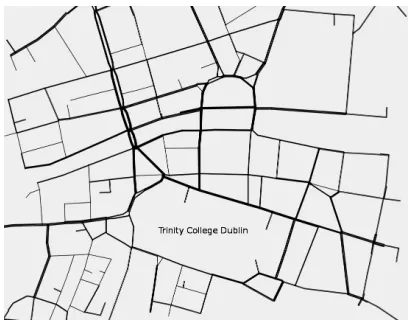
The map of Dublin’s inner city centre is presented in Fig-ure 3. The pattern of traffic we experiment with is based on 4032 vehicles uniformly inserted over ~133 minutes dura-tion. Those vehicles are of the same type and travel in both directions between the map’s opposing edges. The map comprises 64 signalized junctions which makes it a chal-lenging UTC optimization task given the aforementioned pattern.
Figure 3. Dublin’s inner city centre map
[image:4.612.334.538.506.667.2]al-gorithm that roughly emulates SCATS’ behaviour of sat-uration balancing in addition to a Fixed Time Traf-fic Controller (FT-TC) scenario where a FT-TC is
as-signed to each signalized junction. The FT-TC cycles
through a given junction’s phases giving a fixed phase
time to each. We chose to experiment with 20- and
40-second phase times assuming that 20-second is a
rea-sonable average phase time. The SAT-like algorithm
tries to achieve a 90% saturation level and uses a 20-second minimum phase time and a maximum cycle length of [min_phase_time × f actor × number of phases] where the factor in this case is set to 2 while the number of phases depends on the junction. Essentially, we exper-iment with two different scenarios, a decentralized ARR-RL scenario and an ARR-CARR-RL scenario that share the basic design choices. Each signalized junction in the ARR-RL and ARR-CRL scenarios is assigned an ARR-RL agent or an ARR-CRL agent respectively. In both scenarios agents are designed with a set of {0, 20, 40} second actions avail-able within their state-action space. These agents learn us-ing Q-Learnus-ing and chose their actions based on a Boltz-mann action selection technique. In the ARR-CRL sce-nario, agents employ a common advertisement strategy that allows a given ARR-CRL agent to exchange its rewards col-lected during 240 seconds. These exchanged rewards are discounted based on age using a Net Present Value (NPV) [21] inspired formula (1). The d_rate in the NPV for-mula is the discount rate used to diminish the significance of older rewards. Anrtis the reward obtained at indext
in the exchanged reward vector. The most recent reward has the highest t value while the first has t = 0, hence, 0≤t < rv_sizeandrv_sizeis the reward vector size. We set thed_rateto 0.1.
N P V(rt) =
rt
(1 +d_rate)(rv_size−(t+1)) (1)
We design a reward model for the ARR-RL scenario based on the number of vehicles that manage to clear the junction (v_cleared) during the selected action (phase set) duration and on the number of vehicles that are still waiting (v_waiting) after the action execution. The reward is cal-culated locally using rlocal = (v_cleared−v_waiting).
An ARR-CRL agent uses the same local reward model as in the ARR-RL agent to calculate the rewards that are to be exchanged with its identified neighbours. The actual reward model used by any ARR-CRL agent to update its learnt policy is hence a composite of its local reward value and the normalized discounted rewards received from its neigh-bours, see formula (2). In the CRL scenario, an ARR-CRL agent’s send/receive neighbours are the first signalized junctions positioned up and down stream.
exch_rewards= X n∈neighbours
Pt=rv_sizen−1
t=0 N P V(rnt)
rv_sizen
rARR−CRL=rlocal+
exch_rewards
number of neighbours (2)
4.2. Experimental Results
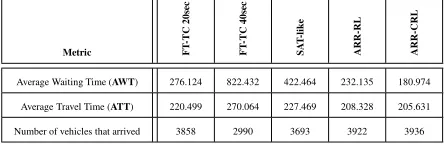
We run the simulation for 140 minutes in order to give the most recently inserted vehicles the possibility to reach their destinations. In case of the RL and the ARR-CRL scenarios the agents are bootstrapped with initial Q-values (warm models) based on explored models resulting from the simulation of three similar traffic traces (training traces) following the same traffic pattern. We conduct a number of experiments using different Q-Learning discount factorsγand learning ratesα. The Boltzmann temperature is set initially to 10000 and cools down uniformly as time advances throughout the training simulation, until it reaches 1 half-way through the experiment where the warm models are extracted. The results we present in Table 1 are based on the best performing settings ofγandαfor the correspond-ing ARR-RL and ARR-CRL bootstrapped simulations us-ing a different traffic trace from the trainus-ing traces but fol-lowing the same traffic pattern. The Boltzmann tempera-ture is fixed to 1, (i.e., exploitation) during the bootstrapped simulation. The metrics used to evaluate our results are the Average Waiting Time (AWT) and the Average Travelling Time (ATT) per arrived vehicle. The travelling time is de-fined as the time the vehicle spends with its speed>0while the waiting time is the time spent still at signalized junc-tions.
Metric FT
-T
C
2
0
se
c
F
T
-T
C
4
0
se
c
S
A
T
-l
ik
e
A
R
R
-R
L
A
R
R
-C
R
L
Average Waiting Time (AWT) 276.124 822.432 422.464 232.135 180.974
Average Travel Time (ATT) 220.499 270.064 227.469 208.328 205.631
[image:5.612.326.548.445.520.2]Number of vehicles that arrived 3858 2990 3693 3922 3936
Table 1. Average waiting and travel time per arrived vehicle in seconds and the number of vehicles that managed to arrive to their des-tinations
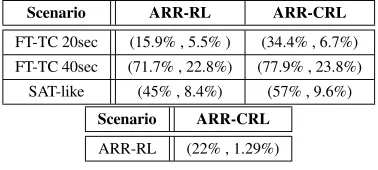
the ARR-RL and ARR-CRL experimental results. Concern-ing the ATT metric, the ARR-RL scenario reduces travel time by ~5.5%, ~22.8% and ~8.4% in contrast to the FT-TC 20sec, the FT-TC 40sec and the SAT-like scenarios respec-tively. Moreover, ARR-CRL showed a small difference of ~1.29% better ATT performance compared to the ARR-RL scenario.
Scenario ARR-RL ARR-CRL
FT-TC 20sec (15.9% , 5.5% ) (34.4% , 6.7%)
FT-TC 40sec (71.7% , 22.8%) (77.9% , 23.8%) SAT-like (45% , 8.4%) (57% , 9.6%)
Scenario ARR-CRL
ARR-RL (22% , 1.29%)
*Percentages are presented in the following format:
[image:6.612.84.273.168.253.2](~Average Waiting time (AWT)% , ~Average Travel Time (AWT)%)
Table 2. Relative performance improvement of the different scenarios
In Figure 4 we present the accumulated waiting time throughout the simulation for all the vehicles in the map. The simulation’s granularity is quite fine where the plotted accumulation occurs every 250 milliseconds hence the large numbers on the y-axis.
0 50000 100000 150000 200000 250000
0 1e+06 2e+06 3e+06 4e+06 5e+06 6e+06 7e+06 8e+06 9e+06
Accumulated waiting time (hours) for all vehicles in the map
Simulation time in milliseconds Dublin’s Inner City Centre Experiments
SAT-Like FT-TC 20sec FT-TC 40sec ARR-RL ARR-CRL
Figure 4. Accumulated waiting time
In effect, the graph reaffirms the results presented in Ta-ble 1. It is also noticeaTa-ble that the FT-TC 40sec and the SAT-like accumulated waiting times for all vehicles grows out of scale. Both ARR-RL and ARR-CRL scenarios out-perform the FT-TC 20sec scenario while ARR-CRL main-tains lowest measures starting half way through the simula-tion. We believe the ability of both ARR-RL and ARR-CRL designs to skip unnecessary phases and to provide suitable timing per phase are key to their good performance.
5. Future Work
The work presented in this paper intended to establish a platform for future experiments involving uncertainty in such large-scale dynamic environments. We would like to provide an uncertainty model that could possibly deal with noisy sensor data during the exploration for better optimiza-tion. We are also exploring different collaboration tech-niques among intelligent agents and potentially better en-vironmental representations. The CRL framework allows us to experiment with different action selection techniques such asǫ-greedy which could be an interesting future com-parison against Boltzmann action selection.
6. Conclusion
In this work we showed that RL and CRL are promising approaches to providing optimization solutions to dynamic environments especially the UTC problem. Moreover, we noticed that improvements are possible when collaboration is used among agents in such environments. The reduction in average waiting time per arrived vehicle achieved by both the ARR-RL and the ARR-CRL scenarios is quite signifi-cant despite the steady/uniform nature of the pattern we ex-perimented with. One would expect that the FT-TC scenar-ios, given its uniform phase cycling, to perform very well with such a pattern but regardless the RL and ARR-CRL scenarios proved to be more suitable in terms of per-formance. The SAT-like scenario maintained better results than the FT-TC 40sec only where that was still insufficient.
Acknowledgements
The work described in this paper was partly supported by Science Foundation Ireland (as Investigator award 02/IN1/I250) and by the Irish Higher Education Authority Programme for Research in Third Level Institutions (as the Networked Embedded Systems Centre). The authors would like to thank Vinny Reynolds for his work on the UTC sim-ulator and Mikhail Volkov for implementing the SAT-like algorithm.
References
[1] B. Abdulhai and P. Pringle. Autonomous multiagent rein-forcement learning - 5gc urban traffic control. InAnnual Transportation Research Board Meeting, 2003.
[2] B. Abdulhai, P. Pringle, and G. Karakoulas. Reinforcement learning for true adaptive traffic signal control. InASCE Journal of Transportation Engineering, volume 129(3), pages 278–284, 2003.
[image:6.612.62.297.409.575.2][4] A. L. C. Bazzan. A distributed approach for coordination of traffic signal agents.AAMAS, 10(1):131–164, 2004. [5] C. Bielefeldt, C. Diakaki, and M. Papageorgiou. TUC and
the SMART NETS project. In Proceedings of the IEEE ITS’01, pages 55–60, 2001.
[6] E. Bitting and A. A. Ghorbani. Cooperative multiagent sys-tems for the optimization of urban traffic. InProceedings of IAT’04, pages 176–182, Washington, DC, USA, 2004. IEEE Computer Society.
[7] E. Camponogara and W. K. Jr. Distributed learning agents in urban traffic control. In F. Moura-Pires and S. Abreu, editors,EPIA, volume 2902 ofLecture Notes in Computer Science, pages 324–335. Springer, 2003.
[8] Y. J. Cao, N. Ireson, L. Bull, and R. Miles. Design of a traffic junction controller using classifier systems and fuzzy logic. InProceedings of the 6th International Conference on Computational Intelligence, Theory and Applications, pages 342–353, London, UK, 1999. Springer-Verlag.
[9] C. Diakaki, M. Papagerogiou, and K. Aboudolas. A mul-tivariable regulator approach to traffic-responsive network-wide signal control.Control Engineering Practice, 10:183– 195, February 2002.
[10] V. Dinopoulou, C. Diakaki, and M. Papageorgiou. Appli-cations of the urban traffic control strategy tuc. European Journal of Operational Research, 175(3):1652–1665, 2006. [11] J. Dowling, R. Cunningham, E. Curran, and V. Cahill. Build-ing autonomic systems usBuild-ing collaborative reinforcement learning.Knowl. Eng. Rev., 21(3):231–238, 2006.
[12] K. Dresner and P. Stone. Multiagent traffic management: Opportunities for multiagent learning. In K. T. et al., editor,
LAMAS 2005, volume 3898 ofLecture Notes In AI. Springer Verlag, Berlin, 2006.
[13] European-Commission. European transport policy for 2010 : time to decide. Brussels, Belgium, 2001.
[14] EuropeanCommission. On the intelligent car initiative -raising awareness of ICT for smarter, safer and cleaner ve-hicles. Brussels, Belgium, 2006.
[15] J. Farges, J. Henry, and J. Tuffal. The PRODYN real-time traffic algorithm. InProceedings of the IEE Interna-tional Conference on Road Traffic Signalling, pages 307– 312, 1983.
[16] N. Gartner. OPAC: A demand-responsive strategy for traf-fic signal control. U.S. Dept. Transportation, Transp. Res. Record 906, 1983.
[17] S. P. Hoogendoorn and P. H. L. Bovy. State-of-the-art of vehicular traffic flow modelling. volume 215, pages 283– 303(21), 19 August 2001.
[18] P. B. Hunt, D. I. Robertson, and R. D. Bretherton. The SCOOT on-line traffic signal optimization technique.Traffic Eng. Control, 23:190–192, 1982.
[19] P. K.Fehon. Adaptive traffic signals are we missing the boat? InITE District 6 Annual Meeting. DKS Associates, 2004. [20] C. O. Kim, Y. Park, and J.-G. Baek. Optimal signal control
using adaptive dynamic programming. In O. G. et al., edi-tor,ICCSA (4), volume 3483 ofLecture Notes in Computer Science, pages 148–160. Springer, 2005.
[21] G. C. I. Lin and S. V. Nagalingam. CIM justification and optimisation. Taylor & Francis, London, UK, 2000.
[22] P. Lowrie. SCATS: The sydney co-ordinated adaptive traf-fic system-principles, methodology, algorithms. In Proceed-ings of the IEE International Conference on Road Traffic Signalling, pages 67–70, 1982.
[23] S. Mikami and Y. Kakazu. Genetic reinforcement learning for cooperative traffic signal control. InICEC, pages 223– 228, 1994.
[24] P. Mirchandani and L. Head. A real-time traffic signal con-trol system: architecture, algorithms, and analysis. Trans-portation Research Part C: Emerging Technologies, 9:415– 432(18), December 2001.
[25] L. Panait and S. Luke. Cooperative multi-agent learning: The state of the art.AAMAS, 11(3):387–434, 2005. [26] M. Papageorgiou, C. Diakaki, V. Dinopoulou, A. Kotsialosa,
and Y. Wang. Review of road traffic control strategies. In
Proceedings of the IEEE, volume 91, pages 2043–2067, De-cember 2003.
[27] M. D. Pendrith. Distributed reinforcement learning for a traffic engineering application. InAGENTS’00, pages 404– 411, New York, NY, USA, 2000. ACM Press.
[28] J. Peters, S. Vijayakumar, and S. Schaal. Natural actor-critic. InECML, pages 280–291, 2005.
[29] I. Porche and S. Lafortune. Dynamic traffic control: De-centralized and coordinated methods. InProceedings of the IEEE Conference on ITS, 1997.
[30] V. Reynolds, V. Cahill, and A. Senart. Requirements for an ubiquitous computing simulation and emulation environ-ment. InInterSense’06, page 1, New York, NY, USA, 2006. ACM.
[31] S. Richter. Learning traffic control - towards practical traf-fic control using policy gradients - Diplomarbeit. Albert-Ludwigs-Universität Freiburg, 2006.
[32] S. Richter, D. Aberdeen, and J. Yu. Natural actor-critic for road traffic optimisation. InAdvances in Neural Information Processing Systems, volume 19. The MIT Press, Cambridge, MA, 2007.
[33] S. Sen and L. K. Head. Controlled optimization of phases at an intersection.Transportation Science, 31(1):5–17, 1997. [34] Z. sheng Yang, X. Chen, Y. shan Tang, and J. ping Sun.
In-telligent cooperation control of urban traffic networks. In
Proceedings of 2005 ICMLC, volume 3, pages 1482–1486, 2005.
[35] M. Steingröver, R. Schouten, S. Peelen, E. Nijhuis, and B. Bakker. Reinforcement learning of traffic light controllers adapting to traffic congestion. InBNAIC, pages 216–223, 2005.
[36] R. Sutton and A. Barto. Reinforcement Learning: An Intro-duction. MIT Press, Cambridge, MA, 1998.
[37] M. Tan. Multi-agent reinforcement learning: independent vs. cooperative agents. InReadings in agents, pages 487– 494, San Francisco, CA, USA, 1998. Morgan Kaufmann Publishers Inc.
[38] C. J. C. H. Watkins and P. Dayan. Q-learning. Machine Learning, 8(3-4):279–292, 1992.
[39] M. Wiering. Multi-agent reinforcement learning for traffic light control. InProceedings of the 17th ICML, pages 1151– 1158. Morgan Kaufmann, San Francisco, CA, 2000. [40] M. Wiering, J. Veenen, J. Vreeken, and A. Koopman.