Well test analysis on pressure of viscoelastic polymer
solution with variable rheological parameters
*
Hongjun Yin#, Weili Yang, Siyuan Meng, Ming Cai
Key Laboratory of Enhanced Oil and Gas Recovery Ministry of Education; Northeast Petroleum University; Daqing, China;
#Corresponding Author: [email protected]
Received 27 September 2010; revised 28 October 2010; accepted 2 November 2010.
ABSTRACT
According to the behavior that the polymer so-lution has both the characteristics of viscosity and elastic properties, the transient flow mathe- matical model considered the viscoelasticity of the polymer solution has been established. The model, in which the variation of the rheological parameters during the seepage flow has been also taken into consideration, has been solved using finite-difference method. The type curves have been plotted. The influence of some prop-erties of polymer solution including the viscoc-ity, the elastic properties and the rheological parameters has been analyzed. Compared with the curves of the power-law fluid, it is shown that the pressure derivative curve considering the elasticity of the polymer solution upwarps less at the radial flow regime. Besides, it will come down as the variation of the rheological parameters, which is quite different from the case regarding them as constants. Therefore, in well test analysis on pressure of polymer solu-tion, it’s necessary to consider the elasticity and the variation of the rheological parameters. Keywords:Polymer Solution; Viscoelastic; Relaxation Time; Rheological Parameters
1. INTRODUCTION
The polymer solution used in the oil field is a typical kind of non-Newtonian fluid and its rheological property in the porous media is very complicated because of the effect of shear degradation, deconcentration, adsorption and entrapment.
Many domestic and foreign scholars have studied its rheological property and established several rheological model. The initial researches on the flow behavior of the non-Newtonian fluid are mainly focus on the power-law fluid. In most well test analysis on pressure of polymer solution, it is also assumed that the polymer solution is pure viscous fluid, only the shear viscosity is considered and the rheological parameters are always treated as constants.
But a large number of experiments have demonstrated that polymer solution has viscoelastic behavior and the rheological parameters changes in the seepage flow process. The viscosity of the polymer solution will de-cline as the raising of the shear rate at a relatively lower Darcy velocity. In the flow event, the viscosity is the dominant influential factor and the elastic property can be neglected. In addition, the rheological property of polymer solution can be expressed by using pseudo-plastic power-law model. However, once the Darcy velocity exceeds the critical value,the viscosity will raise with the increasing of the shear rate, the elastic effect will enhance gradually and its influence will be too signifi-cant to be ignored.
Reference [1] has declared that the effective viscosity of polymer solution is composed of the individual con-tributions of shear and strain viscosity. The elasticity behavior and rheological property of polymer solution in porous media under the conditions of reservoir flow rate has been studied in [2]. A power-law fluid viscoelastic semi-empirical model which could describe the viscoe-lastic effect of polymer solution in porous media has been developed in [3]. The researches on the viscoelas-ticity have promoted the development of percolation theory. Reference [4] has conducted numerical simula-tion study for improvement of polymer flooding by vis-coelastic effect. Reference [5] has studied the flow be-havior of viscoelastic fluid, power law fluid and Newto-nian fluid in pore throat by numerical method. Differ-ence mathematical models of viscous-elastic polymer solution have been established in [6] and [7] from
dif-*Project supported by the National Science Foundation of China (Grant
w
ferent angles. The influence of different factors on the pressure of the formation near the injection well is ana-lyzed too. But the variation of rheological behavior was seldom taken into consideration and the consistency co-efficient and the power-law index were always treated as constants. Besides, the researches on the well test of viscoelastic polymer solution were seldom.
Therefore, in this paper, the relationship between elas-tic viscosity and shear viscosity has been insisted in this paper. In addition, the variation of the rheological pa-rameters in the flow event has been taken into considera-tion. What’s more, the expression of the apparent viscos-ity of polymer solution which considered the viscoelas-ticity and the changing parameters of polymer solution has been developed. Then the non-dimensional radial instable flow mathematical model has been established and solved using finite-difference methods. The pressure of different formation points near the bottom of the well at different time has been calculated. Then the well test analysis curves have been plotted. In the end, the influ-ence of different factors on the curves has been ana-lyzed.
2. APPARENT VISCOCITY OF POLYMER
SOLUTION
2.1. The Shear Viscosity
The viscosity of the power-law fluid can be described as:
1 vn r H r r
(1) where r is the radius away from the wellbore, m; γ is the shear rate, s-1; H (r) is the consistency coefficient, mPa·sn; n (r) is the power-law index of polymer solution, dimensionless.
Reference [8] has studied the variation of rheological behavior through experiments and developed the basic models about the variation of rheological parameters along the seepage flow direction. In this paper it means that the consistency coefficient and the power-law index are changing along the radial direction.
For the well where the polymer solution is injected into, the variation of rheological parameters can be ex-pressed as:
ww
r r
H r H r e (2)
w
n r n r r r (3)
where rwis the radius of the wellbore, m; α is the varia-tion factor of the consistency coefficient, dimensionless;
β is the variation factor of the power-law index, dimen-sionless.
According to the researches in [9], the relationship between the shearing rate and the seeping rate is as fol-lows:
3 1 2 1 2 '
n v
γ
n C K
(4)
where v is the flow velocity through porous medium, m/s;
K is the permeability of the formation, μm2; c’ is the factor related to the tortuosity of capillary, 2.08~2.50;
Φ is the porosity of the formation, dimensionless. The flow velocity through porous medium can be ap-proximately expressed by using the following linear re-lation:
2
q v
rh
(5)
where q is the injection rate of the polymer solution, m3/d; h is the reservoir thickness,m.
Then the expression of shearing rate considering the variation of rheological parameters can be derived.
13 1 1
2 1 2 ' 2π
n r q
r
n r C K h
(6)
The power-law index changes with the radius. How-ever, the resulting changes of the shear rate make little sense to the viscosity of the fluid at the same point. As a result, the variation of the power-law index can be ig-nored when calculating the shearing rate. Then the shearing rate can turn to the expression as follows:
ww 13 1 1
2 1 2 ' 2π
n r q
r
n r C K h
(7)
where n(rw) is the power-law index of polymer solution in the bottom hole, dimensionless.
Letting
ws
w
3 1 1
2 1 2 ' 2π
n r q
F
n r C K h
(8)
The shearing rate can be eventually simplified as:
1 s F r
(9) And the final expression of the shear viscosity of the polymer solution considering the variation of theological parameters can be reached.
2.2. The Elastic Viscosity
The relationship between elastic viscosity and shear viscosity has been obtained in [10].
e 2 f v
2.3. The Apparent Viscosity
There are both the shearing deformation and the elas-tic deformation when the polymer solution seeping in the porous medium because of the continuous contraction and spreading of the runner. As a result, the apparent viscosity is composed of the shear viscosity (μv) and the elastic viscosity (μe).
a e v 1 2 f v
(11) According to the expressions of the shear rate and the shear viscosity, the final expression of the apparent vis-cosity can be obtained.
w
w w w w
1
a f s w
1 1 s
1 2 r r
n r r r n r r r
F r H r e
F r (12)
3. MATHETICAL MODEL AND ITS
SOLUTION
The mathematical model for transient flow of viscoe-lastic polymer solution is derived with the following equations.
The partial differential equation for transient flow of viscoelastic polymer solution:
L
a
1 r p C p
r r μ r K
t (13)
Initial condition:
i 0
t
p p (14)
Inner boundary condition:
w
a r r 2πw
K p
μ r r
q
h (15)
Outer boundary condition:
e 0 r r p r
(16)
Define the dimensionless variable as follows: Dimensionless radius D w r r r
(17)
Dimensionless pressure
D *
2πKh
p p
q B
pi
(18)Dimensionless time
D * 2
t w
Kt t
C r
(19)
Where μ* is the characteristic viscosity, that is the ap-parent viscosity of the polymer solution at the bottom of the wellbore.
w
w
1 *
a w w
n r n r
r r Ar Cr
w (20)
where
w 1w s
n r
A H r F (21)
wf w s
2 n r
C H r F (22) According to the dimensionless variable above, the seeping model of the polymer solution considering the variation of the rheological parameters was established:
D D D De * D D D
D D a D D
D 0 * D D 1 a D D D 1 0 1 0 t r r r p p r
r r r t
p p r r p r (23)
The difference equation at the point (i, j) can be estab-lished by using Implicit Difference Method.
1 1 1
1 1 1, 2, , 1
j j j
i i i i i i i
a p b p c p d i N
0 0, 1, 2, , 1
i
p i N
1 0, 0
i i
p p d i
1 1
1 0,
j j
i i
p p i N
where
D Di
2 2 2
Di 2Di
i i
r a
r x r x
Di 2 2 Di 2 1 i j b t r x D D
2 2 2
D D ' 2 i r c
r x r x
D 1 j i i d p t
w w w w 1 1 ( )w w 0 1 w w 1 1 A C 1 A C w w
n r n r
x x
n r n r
w w
n r n r
e e
r r
n r n r
d r r
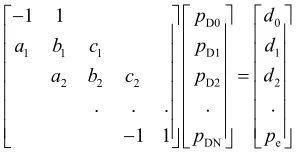
Then the tridiagonal coefficient matrix equation of the dimensionless mathematical model was built up as:
D0 0
D1 1
1 1 1
D2 2
2 2 2
DN e
1 1
. .
. . .
1 1
p d
p d
a b c
p d
a b c
p p
The equation has been solved. The pressure and its derivative value at the bottom of the wellbore at different time have been calculated.
4. TYPE CURFE OF VISCOELASTIC
POLYMER SOLUTION
According to the solution of the mathematical model, the type curve has been drawn, as may be seen in Figure 1.
As shown in Figure 1, when considering the variation of the rheological parameters and the elasticity of the polymer solution, the characteristic of the type curve is as follows:
The pressure curve and the pressure derivative curve both change along the straight line with the slope of 1 at the pure wellbore storage phase.
In transition section, the pressure curve flattens and the pressure derivative curve appears to be a transporta-tion hump.
The pressure derivative curve goes up after the transi-tion regime. This variatransi-tion is a comprehensive actransi-tion of adsorption, shear, and elastic deformation.
The pressure derivative curve goes down once the in-fluence of the changing rheological parameters become obviously.
When the effects of the closed outer boundary play a role, the pressure curve and the pressure derivative curve both go up.
5. ANALYSIS OF INFLUENTIAL
FACTORS
Some parameters which could influence the charac-teristics of the type curve have been analyzed. These parameters include the relaxation time, the variation factor of the consistency coefficient and the variation factor of the power-law index, as well as the consistency coefficient and the power-law index of the viscoelastic polymer solutions.
The influence of relaxation time is analyzed on the basis of Figure 2. As the relaxation time increases, the pressure and pressure derivative values increase after the pure wellbore storage phase, the “hump” of the pressure derivative curve in transition section increases and the
0 1 2 3
2 3 4 5 6 7 8 9
lg(tD)
lg
(
pD
),
lg
(
pD
'·
tD
)
10 lg(pD)
[image:4.595.312.535.82.183.2]lg(pD'·tD)
Figure 1. The type curve of viscoelastic polymer solution.
0 1 2 3
2 3 4 5 6 7 8 9
lg(tD)
lg
(
pD
),
lg
(
pD
'·
tD
)
10 θf=0.010s
[image:4.595.97.247.107.183.2]θf=0.005s θf=0s
Figure 2. The influence of the relaxation time.
pressure derivative curve upwarps less at the radial flow regime. What’s more, compared with the curves simply considered the polymer solution as power-law fluid, it is shown that the pressure derivative curve upturns less at the radial flow regime considering the elasticity of the polymer solution. The larger the relaxation time is, the elastic property of the polymer solution is stronger and the greater the energy is required, then the larger the bottom hole pressure is and the faster it changes. There-fore, it’s necessary to consider the elasticity in well test analysis on pressure of viscoelastic polymer solution.
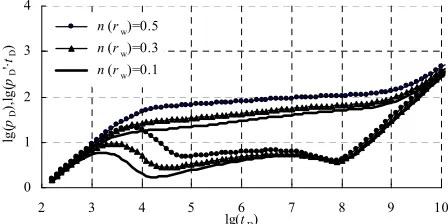
The influence of the consistency coefficient at the wellbore is analyzed on the basis of Figure 3. It is shown that the consistency coefficient of the polymer solution at the wellbore has no significant effect on the go-up of the pressure derivative curve. However, as the consis-tency coefficient at the wellbore increase, the apparent viscosity of the polymer at the wellbore will increase, the pressure and its derivative value of the radial flow regime will increase.
[image:4.595.312.535.220.320.2]0 1 2 3 4
2 3 4 5 6 7 8 9
lg(tD)
lg
(
pD
),
lg
(
pD
'·
tD
)
10
[image:5.595.310.537.81.182.2]H(rw)=0.06Pa·sn H(rw)=0.04Pa·sn H(rw)=0.02Pa·sn
Figure 3. The influence of consistency coefficient at the well-bore.
0 1 2 3 4
2 3 4 5 6 7 8 9
lg(tD)
lg
(
pD
),
lg
(
pD
'·
tD
)
10
n(rw)=0.5 n(rw)=0.3 n(rw)=0.1
Figure 4. The influence of power-law index at the wellbore.
The influence of variation factor of the consistency coefficient is analyzed on the basis of Figure 5. As the variation factor of the consistency coefficient increases, the radial flow regime disappear earlier, the pressure derivative curve goes down earlier and deeper instead of going on turning up. It is mainly for the following rea-sons: The smaller the variation factor of the consistency coefficient is, the faster the consistency coefficient changes and the faster the apparent viscosity of polymer solution decreases. In the same period of flowing time, the smaller the apparent viscosity of the polymer solu-tion is, the smaller the flow resistance is. As a result, the pressure derivative curve goes down earlier, the recessed part is wider and the radial flow period stopped earlier.
The influence of variation factor of the power-law in-dex is analyzed on the basis of Figure 6. As the variation factor of the power-law index increases, pressure and pressure derivative values are smaller in the same period of flowing time, the pressure derivative curve upwarps less obviously at the radial flow regime and the radial flow period become shorter. What’s more, the Concave appears earlier and deeper. It is mainly for the following reasons. The greater the variation factor of the power-law index is, the faster the power-law index changes, the sooner the apparent viscosity of polymer solution decreases, then the smaller the apparent viscos-ity is and the lower the flow resistance is. It is the reasons
0 1 2 3
2 3 4 5 6 7 8 9
lg(tD)
lg
(
pD
),
lg
(
pD
'·
tD
)
10
α=-0.002
α=-0.006
[image:5.595.58.282.81.203.2]α=-0.010
Figure 5. The influence of the variation factor of consistency coefficient.
-1 0 1 2 3 4
2 3 4 5 6 7 8 9 10 11 1
lg(tD)
lg
(
pD
),
lg
(
pD
'·
tD
)
2
β=0.0005
β=0.0010
[image:5.595.312.537.232.351.2]β=0.0015
Figure 6. The influence of variation factor of the power-law index.
above make the pressure derivative curve falls earlier.
6. CONCLUSIONS
According to the behavior that the polymer solution has viscoelasticity and its rheological parameters are not constants along the seepage flow direction, the transient flow mathematical model has been established. It has been found that the type curve is different from the curves without considering the viscoelasticity and the rheological parameters’ variation.
Compared with the curves simply considered the polymer solution as power-law fluid, the pressure curve of viscoelastic polymer solution is higher and the pres-sure derivative curve upturns less in the radial flow re-gime.
The greater the relaxation time is, the greater the elas-tic viscosity of polymer solution is and then the greater the seepage resistance the fluid encountered is. It means that the energy required in the seepage flow is higher. So the injection pressure required is higher and the pressure at the other point of the formation is higher.
[image:5.595.58.282.253.365.2]ly and make the pressure derivative curve upturns more at the radial flow regime. The consistency coefficient of polymer solution in the bottom hole has no significant influence on the upturned degree of the pressure deriva-tive curve. It mainly has impact on the value of the pressure and the pressure derivative. The larger the con-sistency coefficient of polymer solution in the bottom hole is, the larger the value of the pressure and the pres-sure derivative is.
Because of the variation of the rheological parameters, the apparent viscosity of polymer solution reduces con-tinuously in the flow process, which makes the pressure derivative curve declines after the upturned section in the radial flow and make a concave section appears be-fore the upturned section caused by the closed outer boundary. The more seriously the rheological parameters changes, the more obviously the concave will be.
REFERENCES
[1] Ranjbar, M., Rupp, J., Pusch, G. and Meyn, R. (1992) Quantification and optimization of viscoelastic effects of polymer solutions for enhanced oil recovery. Society of Plastics Engineers, 24154, 521-531.
[2] Wang, W.Y. (1994) Viscoelasticity and rheological prop-erty of polymer solution in porous media. Journal of Ji-anghan Petroleum Institute, 16, 54-57 (in Chinese). [3] Zhang, Y.L., Li, C.H., Wang, X.M. and Hu, J.B. (1994)
The viscoelastic effects of polymer solutions in porous media. Journal of Daqing Petroleum Institute, 18, 139- 143 (in Chinese).
[4] Li, H., Cheng L.S. and Zhang S.Y. (2002) Numerical simulation study for improvement of polymer flooding by viscoelastic effect. Petroleum Exploration and De-velopment, 29, 91-93 (in Chinese).
[5] Zhang, L.J., Yue, X.A., Liu, Z.C. and Hou, J.R. (2005) Percolation mechanism of polymer solution through po-rous media. Journal of University Petroleum (Natural Science Edition), 29, 51-55 (in Chinese).
[6] Yin, H.J., Fu, C.Q. and Lv, Y.P. (2004) An unsteady seepage flow model of viscoelastic polymer solution.
Journal of Hydrodynamics, 16, 209-215 (in English) [7] Cao, R.Y., Cheng, L.S., Hao B.Y., Gao, H.H. and Yao,
D.W. (2007) Mathematical model of viscous-elastic polymer solution seepage. Journal of Xi’an Shiyou Uni-versity (Natural Science Edition), 22, 107-109 (in Chi-nese).
[8] Xia, H.F., Yue, X.A., Cao, G.S. and Zhang, S.F. (2000) Rheological behavior of polymer solution in the course of seepage flow. Journal of Daqing Petroleum Institute, 24, 26-29 (in Chinese).
[9] Wang, X.H. and Zhao, G.P. (1998) Shear rate of power- law fluid through porous media. Xinjiang Petroleum Ge-ology, 19, 312-314 (in Chinese).