models
Maria Jo˜ao Janeiro
1,2,*, David W. Coltman
3, Marco Festa-Bianchet
4, Fanie Pelletier
4, and
Michael B. Morrissey
11
School of Biology, University of St Andrews, St Andrews, Fife, United Kingdom
2CESAM, Department of Biology, University of Aveiro, Aveiro, Portugal
3
D´epartement de biologie, Facult´e des Sciences, Universit´e de Sherbrooke, Sherbrooke,
Qu´ebec, Canada
4
Department of Biological Sciences, University of Alberta, Edmonton, Alberta, Canada
*corresponding author, email: [email protected]
Abstract 1
Integral projection models (IPMs) are extremely flexible tools for ecological and evolutionary infer-2
ence. IPMs track the distribution of phenotype in populations through time, using functions describing 3
phenotype-dependent development, inheritance, survival and fecundity. For evolutionary inference, two 4
important features of any model are the ability to (i) characterize relationships among traits (including 5
values of the same traits across ages) within individuals, and (ii) characterize similarity between indi-6
viduals and their descendants. In IPM analyses, the former depends on regressions of observed trait 7
values at each age on values at the previous age (development functions), and the latter on regressions 8
of o↵spring values at birth on parent values as adults (inheritance functions). We show analytically that 9
development functions, characterized this way, will typically underestimate covariances of trait values 10
across ages, due to compounding of regression to the mean across projection steps. Similarly, we show 11
that inheritance, characterized this way, is inconsistent with a modern understanding of inheritance, and 12
underestimates the degree to which relatives are phenotypically similar. Additionally, we show that the 13
use of a constant biometric inheritance function, particularly with a constant intercept, is incompati-14
ble with evolution. Consequently, current implementations of IPMs will predict little or no phenotypic 15
evolution, purely as artifacts of their construction. We present alternative approaches to constructing 16
development and inheritance functions, based on a quantitative genetic approach, and show analytically 17
and through an empirical example on a population of bighorn sheep how they can potentially recover 18
patterns that are critical to evolutionary inference. 19
20
Keywords: integral projection models, regression to the mean, inheritance, development, body size, 21
Introduction
23
Evolutionary and ecological dynamics converge at the scale of generation-to-generation change in popula-24
tions (Pelletier et al., 2009; Coulson et al., 2010). When traits cause fitness variation, the distributions of 25
those traits, weighted by fitness, necessarily changes within generations (Godfrey-Smith, 2007). If di↵erences 26
among individuals have a genetic basis, then genetic changes will be concomitant with phenotypic changes. 27
Such genetic changes are the basis for the transmission of within-generation change due to selection, to ge-28
netic change between populations, i.e. evolution (Lewontin, 1970; Endler, 1986). The fundamental nature of 29
this relationship between phenotypic change due to selection, and associated genetic and thus evolutionary 30
change, has motivated the development of various expressions relating selection to genetic variation and 31
evolution in quantitative terms (Lush, 1937; Robertson, 1966, 1968; Lande, 1979; Lande & Arnold, 1983; 32
Morrissey, 2014, 2015). Important recent advances in population demography, particularly the introduction 33
(Easterling et al., 2000) and popularization (e.g. Childs et al., 2003; Ellner & Rees, 2006; Coulson et al., 2010; 34
Ozgul et al., 2010; Coulson, 2012; Merow et al., 2014) of integral projection models (IPMs), can potentially 35
allow the construction of very flexible models of changes in phenotype, and of its associated demographic 36
implications (Coulson et al., 2010). 37
38
IPMs are structured population models used to study the dynamic of populations when individuals’ vital 39
rates (e.g. survival, growth, reproduction) depend on one or more continuous state variables (e.g. mass). 40
In principle, these model structures track the distribution of individual values of the state variables through 41
time. To achieve this, IPMs make population projections from regression models that define the underlying 42
vital rates as a function of the state variables. Four core sets of functions for vital rates have been defined, 43
termed fundamental functions or fundamental processes (Coulson et al., 2010): (i) survival, (ii) fertility, (iii) 44
ontogenetic development of focal trait conditional on surviving (development functions), and (iv) distribu-45
tion of o↵spring trait as a function of parental trait (inheritance functions). In principle, the inheritance 46
functions allow IPMs to be used to make evolutionary inference, i.e. inference of evolutionary trajectories 47
and parameters relevant to evolutionary processes, such as selection and genetic variation, particularly in-48
cluding the estimation of biometric heritabilities (Coulson et al., 2010; Schindler et al., 2013; Traill et al., 49
2014; Bassar et al., 2016). As discussed by Coulson et al. (2010), these four processes underlie the high flex-50
ibility of IPMs and their ability to link di↵erent aspects of population ecology, evolutionary biology and life 51
history. The fundamental processes are combined to compute a function called the kernel, which represents 52
all possible transitions between state values through time (e.g. the probability density of transitions from 53
t 1 is integrated over all possible sizes to obtain the number of individuals of sizex2 at timet. In general, 55
the numerical implementation of IPMs involves the construction of an iteration matrix to solve the integral. 56
Empirical examples include the study of monocarpic plant species (Childs et al., 2003; Rees et al., 2006; 57
Ellner & Rees, 2006), Soay (Ovis aries, Ozgul et al. 2009; Childs et al. 2011) and bighorn (Ovis canadensis, 58
Traill et al. 2014) sheep, yellow-bellied marmots (Marmota flaviventris, Ozgul et al. 2010), and Trinidadian 59
guppies (Poecilia reticulata, Bassar et al. 2016). 60
61
A key aspect of the distribution of phenotypes is how traits covary at the level of individuals. Genetic and 62
phenotypic covariances among traits are key determinants of evolution (Lande, 1979). In the context of 63
IPMs, which often consider single traits (e.g. mass), age-specific values of a given trait can be thought of as 64
separate, age-specific traits, the covariances among which are key determinants of evolutionary processes. In 65
fact, in these models, when selection acts only on juveniles, evolution can only occur if there is covariance 66
between trait values at juvenile ages and some aspect (genetic or phenotypic) of the state of individuals 67
at the stage when they reproduce. Such mechanics di↵er from the classic quantitative genetic approach, 68
where a change in phenotype is transmitted to future generations if there is a change in breeding values. 69
In most IPMs as parameterized to date (e.g. Childs et al., 2003; Ellner & Rees, 2006; Coulson et al., 2010; 70
Ozgul et al., 2010), recovering covariance across ages depends on correctly estimating regressions of observed 71
trait values at each age on trait values at the previous age. In practice, as it is well known, such regres-72
sions will typically be underestimated due to regression to the mean (Campbell & Kenny, 1999; Barnett 73
et al., 2005; Kelly & Price, 2005). This statistical phenomenon - unusually extreme measurements being 74
followed by measurements that are closer to the mean - is a manifestation of measurement error. Regression 75
to the mean therefore occurs if phenotypic measurements of predictor variables imperfectly reflect relevant 76
biological quantities. This problem has begun to be investigated in the context of IPMs (Chevin, 2015), 77
and it is likely to be very general. The development functions used so far in IPMs estimate size at any 78
age as an accumulation of growth from birth until that age, which implies that size at age a is estimated 79
through a series of regressions in which an increasing measurement error in the predictor is not accounted 80
for. We note that IPMs do not imply the occurrence of regression to the mean. The issues that we dis-81
cuss in this article are related to the statistical models that are typically - but not necessarily - used in IPMs. 82
83
In age-size-structured IPMs, size-dependent transition functions of the fundamental demographic processes 84
are used to project size distribution from one age to the next, and across generations. The inheritance 85
function has been defined as an association between the phenotype of the o↵spring as newborns or juveniles 86
Traill et al., 2014; Bassar et al., 2016). Essentially, it is a cross-age parent-o↵spring regression, which is a 88
peculiar measure of resemblance due to inheritance. Outside of the IPM framework, the concept of biometric 89
heritability - the slope of the o↵spring trait regressed on the midparent’s value (Jacquard, 1983) - is defined 90
by comparing parent and o↵spring at the same age (e.g. Galton, 1886). In fact, no theory exists for the 91
concept of cross-age heritability as used in IPMs. Body size, commonly the focal trait in IPMs, is typically 92
a dynamic trait (a trait that varies over the development) and therefore its value at a certain age is the 93
result of the accumulation of growth until that age, causing di↵erences among individuals to accumulate 94
over the ontogeny due to environmental and genetic variation in size trajectories (Chevin, 2015). As genes, 95
not phenotypes resulting from development, are inherited, parental phenotype as an adult is an imperfect 96
predictor of the parental genetic contribution to the o↵spring phenotype. As a consequence of phenotype 97
being used as a predictor, regression to the mean occurs and results in the underestimation of resemblance 98
between parents and their o↵spring, and therefore of the genetic contribution to phenotypic change (Chevin, 99
2015). 100
101
Here we construct simple but realistic theoretical models of development and inheritance of a quantitative 102
phenotypic trait. For both development and inheritance, we also construct corresponding models to the 103
functions normally implemented in IPMs. By comparing these two sets of models, we investigate how the 104
development and inheritance functions adopted to date in IPMs use data on size-at-age of relatives, and 105
how well they recover across-age and across-generation population structure in continuous traits. Aspects 106
of the distribution of traits through time, other than over single iteration steps, in size-dependent devel-107
opment and inheritance functions, are normally not used to parameterize IPMs. Also, IPMs are typically 108
iterated so that once the population structure at timet+ 1 is generated, the state of the population at time 109
t is discarded. Consequently, while IPMs’ most important feature is tracking the distribution of phenotype 110
through time, they do not output aspects of population structure (e.g. correlations in size within individuals 111
across ages) that allow their performance to be checked. This is a critical point because whenever aspects 112
of the distribution of traits across time are of interest for any inference, particularly evolutionary inference, 113
correlations of individual trait values across ages, and of trait values of relatives across generations, must 114
be adequately reflected. Path analysis (McArdle & McDonald, 1984) can be very useful in studying such 115
correlations. In fact, the structure of both the development functions with their autoregressive structure -116
and of the biometric inheritance - with associations both among di↵erent generations and among di↵erent 117
ages - can be conveniently illustrated by a path diagram representing the causal relationships amongst a set 118
of variables. Also, the path (or tracing) rules are easily applied to obtain the correlations among variables 119
to generate analytical expressions that isolate growth and inheritance, providing insight into the degree to 121
which models of these processes typically used to date recover the structure of populations. 122
123
We demonstrate that current parameterizations of IPMs generally recover only a small fraction of the true 124
underlying similarity within individuals across ages (sectionDevelopment), and a small fraction of the true 125
underlying similarity between relatives (sectionInheritance). These shortcomings have severe consequences 126
for evolutionary inference with IPMs. We then provide an empirical example of a quantitative genetic anal-127
ysis of developmental trajectories in a pedigreed wild population of bighorn sheep using a random regression 128
animal model of body mass. We compare the random regression analysis, which not only should be robust to 129
regression to the mean, but also uses a model of inheritance based on established principles of how biometric 130
relationships among kin arise from genetic variation (Fisher, 1918; Wright, 1921), to the inheritance function 131
based on the cross-age parent-o↵spring regression and standard regression methods for growth functions 132
normally implemented into IPMs. We show a large di↵erence between the two parameterizations in the 133
ability to capture similarity within individuals across ages, which results in standard regression methods 134
normally used in IPMs not capturing the across-age structure in growth. Similar conclusions are reached 135
across generations, where IPMs miss most similarity among relatives, corresponding to a failure of the typical 136
IPM inheritance function to predict evolution. We conclude by discussing the results from the theoretical 137
and empirical sections and potential solutions that may prove useful in fully realizing the potential of IPMs. 138
139
Development
140
Regression to the mean is particularly relevant to IPMs due to how size-dependent growth coefficients are 141
typically - although not necessarily - estimated. Transition rates between size classes for surviving individuals 142
are modelled by regressing observed size at agea+ 1 on observed size at agea, observed size being therefore 143
a predictor. Either linear models (e.g. Childs et al., 2003; Coulson et al., 2010), or extensions of such models, 144
including generalized linear or additive (mixed) models and nonlinear models (e.g. Ozgul et al., 2010; Rees 145
et al., 2014; Traill et al., 2014) have been used for this purpose. All these methods assume that predictors 146
are measured without error. When this assumption is violated, downwardly biased estimates are obtained 147
(for a review on problems and proposed models to deal with measurement error see Thompson & Carter, 148
2007). Measurements of most traits, including size, will virtually always be made with non-trivial error, for 149
two reasons. First, limitations in the measurement process caused by di↵erent measuring conditions (e.g. 150
measurement, tend to occur. Second, size, like most other variables of ecological interest, is an abstract 152
concept and therefore is not directly measurable. As such, proxy variables that do not perfectly represent 153
size are measured instead, such as mass or some skeletal measure. The complexity ofsize is such that the 154
covariation between any proxy at timetandt+ 1 is also determined by the other components of size, which 155
are highly correlated with each other. Importantly, the mechanics underlying IPMs neither imply measure-156
ment error nor regression to the mean. Rather, the application of standard regression methods that do not 157
account for measurement error within an autoregressive structure on size (subsequent sizes being used as 158
predictors) promotes the occurence of regression to the mean due to measurement error. 159
160
Since the measurement error that causes regression to the mean is random rather than systematic, this 161
problem can be modelled by thinking of true size, the trait we want to measure, as a latent variable,z, that 162
cannot be measured (e.g. McArdle, 2009; Little, 2013, p. 43). In such a scenario, instead of the true values 163
z, a proxy, the trait we actually measure,x, is recorded, which di↵ers fromz by a measurement error, 2
✏,
164
and is related to it by a repeatability, r2. x can, therefore, be written as x = z+ 2
✏. In figure 1A, we
165
illustrate such model of the ontogenetic development of size, which we namedlatent true size model, using 166
a path diagram. In this diagram, true size at age 1, z1, determines true size at age 2, z2. z2 is then a 167
predictor of true size at age 3, z3, and so on until size at age n, zn, is predicted. In contrast, the kinds 168
of regression analyses implemented to date in IPMs (e.g. Childs et al., 2003; Coulson et al., 2010; Ozgul 169
et al., 2010; Rees et al., 2014; Traill et al., 2014) assume that true sizez is being measured when in fact the 170
measured variable isx. This model, which we termedobserved size model, is illustrated in figure 1B. The 171
autoregressive structure in this model is very similar to that in figure 1A, but is built on observed sizes rather 172
than true ones. We use the theoretical models in figure 1 to illustrate the consequences of this conceptual 173
mismatch and to inspect how regression to the mean a↵ects inference about development. We show that the 174
correlations, and therefore the regression coefficients, estimated using IPMs do not correspond to the true 175
latent ones. We then derive a generic analytical expression for how much correlation an IPM can recover 176
given a certain repeatability and number of projection steps (number of IPM iterations). 177
178
If we consider linear size-dependent growth functions, we can express the true biometric relationships (i.e. 179
true theoretical expressions) among traitsz(e.g. size at di↵erent ages), as well as the relationships captured 180
by standard regression methods typically used in IPMs to describe development, using the principles of 181
path analysis (McArdle & McDonald, 1984). Developed by Wright (1921, 1934) for estimating causal path 182
coefficients, path analysis mathematically decomposes correlations (or covariances) among the variables in 183
dardized (mean centered and variance of 1). In such circumstances, the expected correlation between two 185
variables is the product of the standardized path coefficients that link them. Some notational details are 186
worth summarizing: denotes several aspects of true covariation (covariance in growth among ages), whereas 187
2 represents true variances. Variances estimated by IPMs are denoted bys2. Since the models in figure 1
188
are antedependence models (or autoregressive, as the response variable depends on itself at a previous time), 189
2
g in figure 1A ands2g in in figure 1B correspond to variances in growth associated with the regressions of 190
true size on true size at a previous time and observed size on observed size at a previous time, respectively. 191
Finally, the path coefficientsbcorrespond to regressions of size on size andr2to the square of the regression
192
coefficient of observed size at agea, xa, on true size at the same age, za. Following the principles of path 193
analysis, we used a variance-covariance matrix with the variances in growth, 2
ga, and errors associated
194
with observed sizes, 2
✏a, for each agea, and a matrix with path coefficients (bz a and ra) matching figure
195
1A to obtain a variance-covariance matrix for sizes at di↵erent ages (Appendix A1). From this matrix, we 196
then extracted the covariances among ages for both true and observed sizes (Table B.1 in appendix B). As 197
an example, according to the path rules, the correlation and covariance in true size between ages 1 and 198
3 are given by bz1·bz2 and 2g1·bz1·bz2, respectively. Analogous quantities were obtained similarly for
199
IPMs (Table B.2 in appendix B). Since regressions of observed size on observed size,bxa, are estimated from
200
the data (rather than implied), these quantities are necessarily recovered correctly, and therefore the bxa
201
estimated in IPMs (figure 1B) are equivalent to the analogous quantities in figure 1A. In contrast, variances 202
in growth estimated with observed sizes,s2
ga, do not correspond to variances in growth estimated with true
203
latent sizes, 2
g a, nor to the measurement error associated with observed sizes, ✏2a. Consequently, since these 204
quantities are crucial to estimate covariances in size among ages, the across-age distribution of phenotype 205
that occurs in a typically-constructed IPM does not generally recover the across-age distribution of either a 206
measured aspect of phenotype (e.g. correlations in thexvariable across ages) or of an underlying quantity 207
(e.g. correlations in the z variable across ages). An across-age distribution of phenotype, which includes 208
correlations among ages, is not typically tracked by an IPM (e.g. Childs et al., 2003; Ellner & Rees, 2006; 209
Coulson et al., 2010; Ozgul et al., 2010). Yet, an IPM’s utility for any ecological and evolutionary inference 210
depends on its ability to track this distribution through time. In a typical implementation, the distribution 211
of phenotype at agea 1 is discarded once the distribution at ageais generated, so such correlations cannot 212
easily be outputted and checked against data. As such, we use path analysis to mimic basic IPM mechanics 213
and to extract the across-age dynamics that are not otherwise easily tracked. In contrast, an IPM can easily 214
be interrogated for the distribution of phenotype at any given time. These distributions generally closely 215
match data (Ozgul et al., 2010; Childs et al., 2011, also see fig3(a) in Chevin, 2015 for a simulation example). 216
For tractability, we demonstrate that IPMs do not in general recover the across-age structure of phenotype 218
using a simplified case of the path diagram in figure 1A as the true model. Specifically, we focus on a 219
static trait, as it renders the basic principles more clearly without loss of generality. We assume that all 220
size-dependent growth coefficients are one (bza= 1,8a), that the variance in true growth at age one - which
221
also corresponds to the variance in true size at age one - is one ( 2
g1= 1) and that the subsequent variances
222
are zero ( 2
ga = 0,8a > 1). Finally, all repeatabilities, ra, and measurement errors, 2
✏a, take the same
223
value, r and 1 r2, respectively. Applying the path rules and these assumptions results in the particular
224
case of all true phenotypic variances and covariances being 1 and variances and covariances for phenotypic 225
observed size being 1 and r2, respectively (see appendix A.1.2 for details). Standard regression methods
226
typically used in IPMs underestimate regressions for true growth in any instance where r <1, by a factor 227
of r2. Whenever true and observed sizes di↵er, which is true for virtually every attempt to measure size,
228
instead of 1 (value set for allbza),bxatake the valuer
2for any consecutive pair of ages (both in figure 1A and
229
1B). As mentioned before, covariances in size across ages are in general not reported when building an IPM. 230
However, the implied covariances can be calculated using path analysis (see appendix A.1.1 for the general 231
case and appendix A.1.2 for this simplified example). Since according to the path rules of standardized 232
variables correlations between two variables correspond to the product of the path coefficients linking them, 233
in this example correlations in size among two ages will be r2 to a power equivalent to the number of links
234
between them. As such, sincer <1, these correlations will be underestimated. As for the covariances, these 235
are obtained by multiplying the correlations by the variance in growth at age 1, which corresponds to the 236
variance in growth at age one,sg1. Variances in size are well recovered in IPMs because these quantities are
237
directly estimated from the data. Therefore, in this example,sg1, which also corresponds to variance in size
238
at age one, corresponds to one, resulting in covariances in size implied by the growth functions normally 239
implemented in IPMs being given by 240
covIP M(xi, xj) = r2 t, (1)
where
t
is the number of projection steps (or path coefficients) connecting agesiandj (j i). 241242
The standardized conditions set in this simplified example illuminate how much correlation between sizes at 243
di↵erent ages the standard IPM formulation will miss. As true correlations (or covariances) in size across 244
ages were set to one, subtracting the correlation in equation (1) to that theoretical value corresponds to the 245
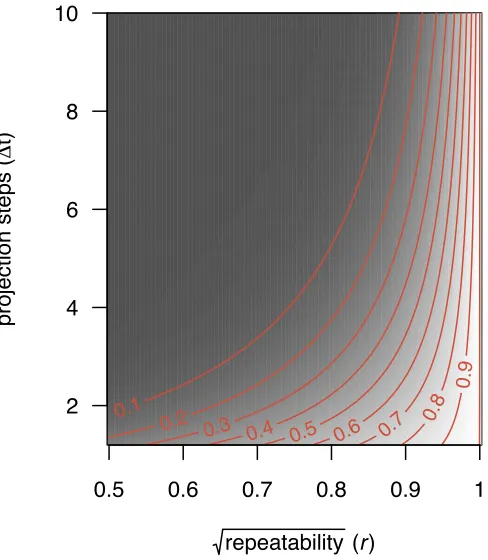
missed correlation = 1 r2 t . (2)
The theoretical result of equation (2) shown in figure 2 demonstrates that this quantity is far from negligible, 247
increasing rapidly with the number of projection steps and decreasing values of r. Many IPM analyses to 248
date have focused on long-lived organisms. In these systems, age di↵erences (projection steps) of 5 to 10 249
years may correspond to the gap between juvenile stages, which are often subject to the strongest viability 250
selection, and ages of greatest fecundity. Even for traits with high repeatabilities (e.g. r= 0.9), correlations 251
over such age di↵erences will be underestimated by more than 60% (Figure 2). Ultimately, size is estimated 252
as an accumulation of growth through an autoregressive process that discards the distribution of size at 253
time t 1 at each iteration (when the distribution att is obtained). This results in measurement error at 254
each iteration not being accounted for in the next, and therefore the e↵ect of regression to the mean rising 255
with the number of IPM projection steps. Serious consequences can be expected both for evolutionary and 256
ecology studies, whenever di↵erences in individual growth are of interest. Curiously, all else being equal, 257
IPMs with narrower projection intervals (e.g. monthly, rather than yearly) will su↵er more from regression 258
to the mean than models constructed with wider projection intervals. Finally, it is important to note that 259
asserting that the observed quantities, rather than underlying variables, are the target of interest in any 260
given IPM application does not solve the fundamental problem. In any scenario where the covariance of 261
observed values through time is caused (in part or in whole) by quantities other than the observed values 262
themselves (figure 1A) a model of sequential regressions of observed values on one another (figure 1B) will 263
not recover the resulting covariance structure. 264
265
Inheritance
266
The modern understanding of how genes contribute to similarity among relatives (Fisher, 1918, 1930; Wright, 267
1922, 1931) has a very di↵erent structure from the inheritance function typically included in IPMs (e.g. 268
Coulson et al., 2010; Traill et al., 2014; Bassar et al., 2016). Fisher and Wright showed how Mendelian 269
inheritance at many loci influencing a trait generates the observed biometric relationships among relatives, 270
including the relationships of a quantitative character between parents and o↵spring. Here, we use the basic 271
mechanics of inheritance of a polygenic trait, which have well-known relationships to selection and evolution 272
(Walsh & Lynch, forthcoming), and use it as simple background to see if IPM mechanics are generalizations 273
theory of the inheritance of quantitative traits, and has its roots in Fisher’s (1918) and Bulmer’s (1980) 275
infinitesimal model (see Falconer, 1981; Walsh & Lynch, forthcoming, Chapter 15). Each parent passes half 276
of its genes and therefore half of its breeding value on to the o↵spring. As such, the expected breeding value 277
of o↵springi,E[BVi], corresponds to half the sum of parental breeding values, as follows 278
E[BVi] = (BVmi+BVfi)
2 , (3)
whereBVmi andBVfi are the maternal and paternal breeding values, respectively. The true breeding value,
279
BVi, follows a normal distribution, 280
BVi⇠N(E[BVi],
2
a
2 ), (4)
with its expected value as mean and 22
a
as variance, corresponding to the variance in breeding values in 281the absence of inbreeding, conditional on mid-parent breeding values, resulting from segregation (Bulmer, 282
1980). The variance in the breeding values divided by the phenotypic variance is defined as heritability,h2,
283
a measure of evolutionary potential. The degree of resemblance between relatives provides the means for 284
distinguishing the di↵erent sources of phenotypic variation and therefore for estimating heritabilities and 285
other quantitative genetic parameters (Falconer, 1981). The simplest way of doing so is by using correlations 286
of close kin, for example, of parents and their o↵spring, as h2 corresponds to the slope of the o↵spring
287
trait regressed on the midparent’s (Lynch & Walsh, 1998, Chapter 7). In fact, Jacquard (1983) defines the 288
heritability estimated with a parent-o↵spring regression as a biometric heritability, as opposed to broad- and 289
narrow-sense heritabilities, for which the genetic and additive genetic variances are, respectively, explicitly 290
estimated. Any genetic architecture, i.e. broad- and narrow-sense heritability, determines the biometric 291
relationships among kin (Lynch & Walsh, 1998, Table 7.2). In IPMs, heritabilities have been estimated 292
using parent-o↵spring regressions. Specifically, inheritance has been defined as a regression of the phenotype 293
of the o↵spring as newborns or juveniles on that of the parents at the time the o↵spring was produced 294
(Coulson et al., 2010; Schindler et al., 2013; Traill et al., 2014; Bassar et al., 2016). In this section, we 295
investigate whether this cross-age biometric notion of inheritance is compatible with what is known about 296
trait transmission across generations. 297
298
Inheritance across generations
299
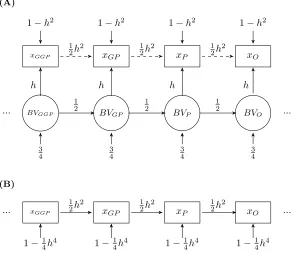
We start by addressing consequences of regression to the mean related to the biometric concept of inheritance 300
tions of the same age, according to Fisher’s and Wright’s understanding of trait transmission (Figure 3A), 302
and a comparable model reflecting the biometric concept of inheritance typically used in IPMs (Figure 3B). 303
As for the development models, we used path diagrams and path analysis to compare the correlations implied 304
by both models. In figure 3A, breeding values, the underlying units that are inherited, are passed on across 305
generations: from great-grandparents to grandparents, from grandparents to parents, and from these to the 306
o↵spring. Since each parent passes on half its breeding value to the next generation, the regression coefficient 307
linking generations is 1
2. The variance associated with the breeding values is 3
4, which corresponds to 1 2 from
308
the other parent and 14 from segregation. h corresponds to correlation between the breeding values and 309
phenotypic values (Wright, 1921; Falconer, 1981) and, in a standardized path analysis, to the corresponding 310
regression coefficient as well. If observed size is standardized (variance of 1), then according to the path rules 311
its exogenous variance corresponds to 1 h2. Finally, if any regression was to be made between the observed
312
sizes,x, the coefficient would be half the heritability. There is a close analogy with the path diagrams in figure 313
3A and figure 1A. Not only do they share the same structure (sizes at di↵erent generations instead of sizes 314
at di↵erent ages), but other analogies can be taken. For example, as the regression coefficient of phenotype 315
on breeding values, the square root of the heritability expresses the reliability of the phenotype to represent 316
the underlying genetics, which in figure 1A was represented by the square root of the repeatability. In figure 317
3B we show a series of parent-o↵spring regressions based on phenotype, rather than genetics. The slope 318
of the parent-o↵spring regression for a single parent is known to be 12h2 and in a standardized path
analy-319
sis, the associated variance is 1 14h4. Similarly, the path diagram in figure 3B relates to the one in figure 1B.
320 321
With this single age set up, we can isolate the regression to the mean that occurs as a result of a purely 322
biometric approach to the inheritance function. As for the true regressions, parent-, grandparent-, great-323
grandparent-o↵spring regressions are given by 1 2h
2, 1 4h
2, 1 8h
2, respectively (Lynch & Walsh, 1998). The
324
extension for arbitrary ancestral regressions is given by 325
g = 1 2 gh
2, (5)
where
g
is number of generations between two relatives. We used path analysis to obtain the analogous 326regressions that are implied when applying a biometric inheritance function repeatedly within an autore-327
gressive process (Figure 3B). The structure of the path diagrams in figures 1B and 3B are equivalent and 328
therefore the reasoning for obtaining covariances and regressions for size presented in appendix A.1 also 329
applies in this case. As such, according to the path rules, IPMs, as usually parameterized, will estimate 330
gIP M = ✓
1 2h
2
◆ g
, (6)
which does not correspond to equation (5). As an example, tracing the regression of grando↵spring size 332
(xO) on grandparent size (xGP) in this standardized path diagram involves two paths with coefficient 12h2, 333
resulting in 1 4(h
2)2 instead of the true regression 1 4h
2. Equation (6) implies that trait transmission between
334
same-age relatives is not fully recovered when the gap between generations (
g
) is greater than one. For 335ancestral regressions other than of o↵spring on parent to be correctly recovered the heritability of this trait 336
would have to be one, which tends not to happen in nature for most ecologically interesting traits. The 337
proportion of the true regressions recovered by the biometric inheritance function is given byh2( g 1), as
338
illustrated in figure 4. For example, if a trait has a heritability of 25%, the grandparent-grando↵spring 339
regression will be estimated as 14h4 = 1
64 rather than its true value of 1 4h2 =
1
16, which corresponds to only
340
recovering 25% of the regression. This proportion drops to 6.25% for great-grandparents and their o↵spring. 341
342
Across-age inheritance functions
343
There is a second mechanism by which regression to the mean a↵ects inference with the inheritance function, 344
particularly resulting from its cross-age structure. It is important to note that although an individual’s 345
genetic constitution is constant throughout life, the genetic variants relevant at one life stage need not a↵ect 346
other life stages. Genetic variants acting late in life may be latent early in development. Such variants may be 347
inherited and contribute to similarity among relatives, even if they contribute neither to covariance of traits 348
within individuals, through time, nor to covariance of parents, as adults, with their o↵spring, at young, or 349
arbitrary, life stages. Consequently, there is potential for the concept of inheritance applied to date in IPMs 350
to neglect a major fraction of how genetic variation can generate similarity among relatives (Hedrick et al., 351
2014; Chevin, 2015). Chevin (2015) illustrated this issue with numerical demonstrations. Here we formalize 352
his findings analytically to explore the generality and the magnitude of his conclusions. We examine what 353
would happen to two cohorts (parents and o↵spring) with two ontogenetic stages (juvenile, J, and adult, 354
A, Figure 5). We choose a simple model with only two ontogenetic stages, since extending it to include 355
more age classes would correspond exactly to what was described for development in the previous section. 356
We explore two di↵erent perspectives of trait transmission - first using basic quantitative genetic principles 357
and then a cross-age biometric approach typical of IPMs. The first path diagram (Figure 5A) reflects the 358
former, with phenotype being a result of the breeding values, BV, and the environment,
e
2. To account359
symbols for breeding values in the juvenile and adult stages. In this path diagram, parent phenotype as a 361
juvenile determines parent phenotype as an adult through the regression coefficient b. We also represent 362
segregation and mating, through which the o↵spring receives paternal breeding values that, together with 363
the environment, define o↵spring phenotype as juveniles, OJ. Finally, o↵spring phenotype as juvenile also 364
determines its phenotype as an adult,OA. We use the subscriptsz,
a
ande
to distinguish between phenotypic 365variance, 2, and covariance, , and their additive genetic and environmental components, respectively. The
366
diagram in figure 5B illustrates a cross-age phenotypic transmission between parents and o↵spring normally 367
used in IPMs (e.g. Coulson et al., 2010; Traill et al., 2014; Bassar et al., 2016). In this diagram, parent 368
phenotype as a juvenile determines parent phenotype as an adult (through the regression coefficient for 369
development, bdev), which determines o↵spring phenotype as a juvenile (through the regression coefficient 370
for inheritance,binh). Finally, growth also occurs in the o↵spring, resulting in its adult stage. As before, we 371
consider linear size-dependent growth functions, and additive genetic e↵ects on juvenile size and subsequent 372
growth, so that path analysis can be used to obtain the biometric relationships among traits (true theoretical 373
expressions), as well as the relationships captured by the cross-age inheritance function implemented in 374
IPMs (see appendix A.2 for details). First, we defined true hypothetical additive genetic and environmental 375
variance-covariance matrices for growth at each age, as well as true path coefficients that match the path 376
diagram in figure 5A. Subsequently, we used path analysis to obtain the true phenotypic variance-covariance 377
matrix for size, a matrix that quantifies both direct and indirect e↵ects of size at each age. Finally, the slopes 378
of the regressions of o↵spring size on parent size were obtained analytically from the model, corresponding 379
to the true parent-o↵spring regressions for both juveniles, 380
OJ,PJ =
1 2
2
a
J2
z J = 1
2h
2
J, (7)
and adults, 381
OA,PA=
1 2
2
a
Jb2+ 2a
J,Ab+a
2A2
z Jb2+ 2 zJ,Ab+ 2
z A = 1
2h
2
A. (8)
Note that the numerator and denominator in equation (8) are simply reconstructions of the additive genetic 382
and phenotypic variances in size, respectively, given the additive genetic and phenotypic variances in juvenile 383
size, growth to adult size, and the covariance between them. Two other expressions are required, as they 384
are used in constructing IPMs, namely for the regression of adult o↵spring size on juvenile o↵spring size, or 385
OA,OJ = PA,PJ = A,J = 2
z Jb+ zJ,A 2
z J
, (9)
which models the ontogenetic development of size, and for the regression of juvenile o↵spring size on adult 387
parent size, 388
OJ,PA=
1 2
2
a
Jb+a
J,A2
z Jb2+ 2 z J,Ab+ z A2
, (10)
which corresponds to the cross-age inheritance function. 389
390
As shown in figure 5B, typical IPMs adopt OJ,PA (binh) as the inheritance function. We use the path
391
rules to obtain the covariances among same-age parent and o↵spring that are implied by this quantity, and 392
therefore to obtain expressions for the same-age parent-o↵spring slopes. In practice, we then compare the 393
theoretical results presented above, in particular the true parent-o↵spring regressions in equations (7) and 394
(8), to those that occur with the cross-age inheritance function, allowing us to derive the conditions under 395
which IPMs recover the population structure of continuous traits between parents and o↵spring. According 396
to the path rules, IPM-based inference for parent-o↵spring regression at both juvenile and adult stages, 397
OJ,PJ and OA,PA, respectively, corresponds to the product of J,A (Equation 9) and OJ,PA (Equation 10,
398
see appendix A.2 for details), as follows 399
1 2h
2
(IP M)= OJ,PJ(IP M)= OA,PA(IP M) =
1 2
2
z Jb+ zJ,A 2
z J
2
a
Jb+a
J,A 2z Jb2+ 2 zJ,Ab+ 2z A
. (11)
As a result, in a two-stage case, an IPM as typically built implies the same value of the parent-o↵spring 400
regression for both stages, which is not the case for the true values (Equations 7 and 8). Also, and even more 401
importantly, the IPM-based inference corresponding to the expression in equation (11) does not correspond 402
to the true values for either age (Equations 7 and 8). Thus, IPMs do not, in general, recover parent-o↵spring 403
regressions. 404
405
The comparison between IPM-based inference and true values becomes more straightforward in the simplified 406
case of no covariances of growth across ontogenetic stages (additive genetic,
a
J,A, and more generally,407
phenotypic, zJ,A). In such circumstances, the IPM implies a parent-o↵spring regression, for both juveniles
408
and adults, of 409
1 2h
2
(IP M)= OJ,PJ(IP M) = OA,PA(IP M) =
1 2
2
a
Jb22
z Jb2+ z A2
which is always less than the corresponding true values. This is a best-case scenario for IPMs, as covariances 410
of growth across ages are in general not modelled when estimating size transitions in such models. Even in 411
such unrealistic conditions, a standard IPM can only recover the true parent-o↵spring regressions under very 412
specific conditions. According to equation (12), for parent-o↵spring regression in juveniles to be fully recov-413
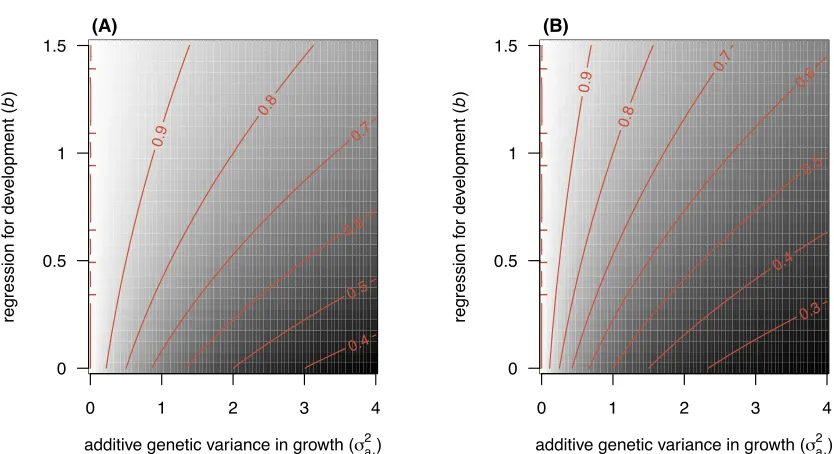
ered by a model using a cross-age biometric inheritance function, the phenotypic variance in growth, 2
z A, 414
must be zero. When that is not the case, the proportion of regression recovered decreases with decreasing 415
size-dependent size regression,b(Equation 7, Figure 6A). The same condition holds for the parent-o↵spring 416
regression in adults (Equation 8, Figure 6B). These quite narrow conditions are unlikely to occur in nature. 417
We obtained similar results for the case where covariance in growth exists (Appendix B). Indeed, although 418
IPMs were developed to model dynamic traits, the conditions for which they are guaranteed to recover 419
parent-o↵spring regression, particularly the absence of variance in growth, essentially constrain a dynamic 420
trait to be static. 421
422
Parent-o
↵
spring regression with a constant intercept
423
The preceding analysis shows that regression to the mean prevents the inheritance function from capturing 424
most aspects of covariance between individuals and their descendants. In language typically used to describe 425
properties of IPMs, a cross-age biometric inheritance function does not fully capture the most important 426
ways in which inheritance influences the dynamics of a population through time. Importantly, however, as 427
shown above, the biometric inheritance notion does capture the correct covariance of parents and o↵spring, 428
at least of a static trait (or a model with a single age class). In itself, this may imply that a purely bio-429
metric notion of inheritance can be used, at least in simple cases, to track some important features of a 430
population. Nonetheless, the use of the concept of biometric inheritance that is extensively recommended 431
for IPMs (Coulson et al., 2010; Coulson, 2012; Rees et al., 2014) does not correctly employ the concept. This 432
recommendation is based on two misconceptions about biometric inheritance, both of which lead to failures 433
to characterize even the simplest aspects of phenotype (e.g. the dynamic of mean phenotype). The first mis-434
conception, shown above, is the assumption that theory underlying the biometric relations among kin can be 435
applied to a non-static trait when parents and o↵spring are of di↵erent ages. This includes the assumption 436
that iteration of the purely phenotypic relations of parents and o↵spring across multiple generations can 437
recover biometric relationships among more distant kin, e.g. arbitrary ancestral regressions. The second 438
misconception is that the biometric inheritance concept, and its known relationships to quantitative genetic 439
genetic basis (e.g. an assumption thath2 is constant over a period of time) to a trait is commonly assumed
441
in quantitative genetic studies, and implies that the slope of the parent-o↵spring regression is constant. 442
However, should a trait evolve, changing the mean phenotype, then the intercept of the parent-o↵spring 443
regression necessarily changes. If the intercept is assumed to not change, or a model is constructed where 444
the intercept cannot change, then the dynamic of mean phenotype will be highly restricted. Therefore, even 445
the simplest possible IPM constructed with a typical inheritance function, which has not only a constant 446
slope, but also a constant intercept, will necessarily fail in describing the evolution of mean phenotype. 447
448
As an example, consider a non-age structured population, with no class structure other than that associated 449
with some focal trait, z. We denote the mean trait value in generation
g
by ¯zg and its heritability as h2.450
Without loss of generality, we assume that during a period of equilibriumz is measured such that its mean 451
is 10. We also assumed thatz is heritable (h2= 0.5) but, since there is no selection, no phenotypic change
452
is observed (Figure 7A). Suppose that the equilibrium is then disrupted and that both sexes experience 453
the same selection, which represents a change in mean phenotype for the first generation ( ¯z0
1) of 1 unit
454
(Figure 7B). The o↵spring on mid-parent regression is thenE[z2] = ↵+h2z1m+z1f
2 , where↵ is the
inter-455
cept and z1m and z1f denote maternal and paternal phenotypes, respectively. An IPM constructed using 456
this regression (appropriately handling the two sexes) yields a mean phenotype in the next generation of 457
¯
z2=R↵+h2
·z·p1(z)dz=↵+h2(¯z1+ ¯z0
1). The first expression corresponds to the integral that would be
458
solved (typically numerically) by an IPM corresponding to this example, andp1(z) is the probability density 459
function of phenotype after selection but before reproduction in generation 1. The second expression is the 460
analytical solution for this integral, made possible by assuming a linear function. Under the conditions set 461
for this example, this expression would be ¯z2= 5 + 0.5·(10 + 1) = 10.5. This change satisfies the breeder’s 462
equation for the change in mean phenotype across generations ¯zi+1 z¯i=h2 z¯0. The problem arises in the 463
next generation. 464
465
Let us suppose that selection is now relaxed, such that the within-generation change in phenotype due to 466
selection, z¯0
2, is zero. In the absence of selection, drift, immigration and mutation, we expect no change
467
in allele frequencies (Wright, 1937) and therefore no evolution. Consequently, we expect no change in mean 468
phenotype (Figure 7C). In a very simple non-age structured IPM, we would use the current distribution 469
of trait values (
g
= 2) and the same inheritance function to obtain the mean phenotype in generation 3, 470and that would correspond to ¯z3 =R↵+h2·z·p2(z)dz=↵+h2(¯z2), which in this case would be 10.25 471
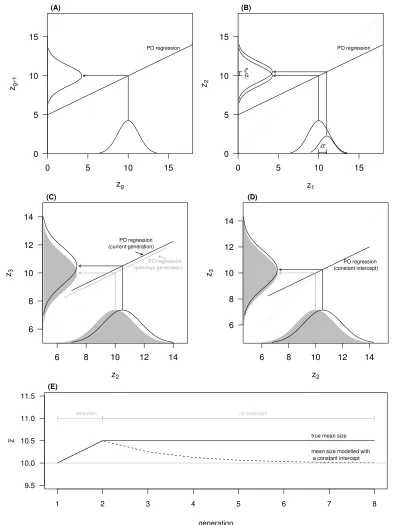
(Figure 7D). In this example, an IPM would predict the trait moving back 0.25 phenotype units, which 472
static biometric inheritance function results in changes in mean phenotype in the absence of selection, drift, 474
mutation and migration. Continuing the analytical iteration of the mean phenotype in this simple IPM, we 475
show that with each subsequent generation (iteration step, in this simple argument), the mean phenotype 476
regresses further toward a value determined by the nature of the static biometric inheritance function (Fig-477
ure 7E). If selection is sustained, then the dynamic of the mean phenotype even in this very simple IPM 478
will be wrong, representing a component associated with the response to selection, and a spurious change 479
due to the misconception of biometric inheritance associated with a parent-o↵spring regression with a fixed 480
intercept. A biometric inheritance function with a constant slope and intercept is inconsistent with evolution. 481
482
Study case: bighorn sheep
483
We used a pedigreed population of bighorn sheep from Ram Mountain, Alberta, Canada (52 N, 115 W) 484
to assess the performance of the development and inheritance functions as implemented in standard IPMs. 485
Both quantitative genetic (e.g. Coltman et al., 2003; Wilson et al., 2005) and IPM analyses (Traill et al., 486
2014) have been conducted for this study system. This isolated population has been the subject of intensive 487
individual-level monitoring since 1971. Sheep are captured and weighed multiple times per year between 488
late May and late September. For detailed information on the study system see Jorgenson et al. (1993), 489
Festa-Bianchet et al. (1996) and Coltman et al. (2003). We analyzed individual age-specific masses adjusted 490
to September 15 (see Martin & Pelletier, 2011; Traill et al., 2014) for 461 ewes captured from 1975 to 2011 491
and aged up to 10 years (2002 ewe-years). We built two statistical models, one reflecting how the ontogenetic 492
development of size and inheritance have been typically modelled in IPMs, and the other corresponding to 493
a possible alternative to estimating these two key functions, a random regression animal model of body size 494
(Kirkpatrick et al., 1990, 1994; Meyer & Hill, 1997; Meyer, 1998; Wilson et al., 2005). We chose random 495
regression because it is widely used to study the genetics of developmental trajectories and it satisfies a 496
number of criteria, namely: (i) it accommodates across-age covariance, over and above that attributable to 497
measured values of focal traits, (ii) it incorporates the known fundamentals of quantitative genetics, (iii) it 498
is economical in terms of the number of parameters that need to be estimated, and (iv) its basic structure is 499
compatible with IPMs. Criteria (i) and (ii) result in random regression analysis providing an approach for 500
characterizing development and inheritance that should be robust to regression to the mean, as imperfectly 501
measured quantities are not used as predictor variables, and as it uses a modern notion of inheritance of 502
quantitative traits. Nonetheless, other options can also avoid regression to the mean, including a formulation 503
though the random regression approach, and potentially other models using quantitative genetic approaches 505
characterizing variation in phenotype and its inheritance, could profitably be integrated into the broader 506
IPM framework, for simplicity we refer to the former approach as “IPM” and to the latter as “RRM”. Both 507
models were fitted in a Bayesian framework, using MCMCglmm (Hadfield, 2010), and di↵use inverse gamma 508
priors for all (co)variance components. 509
510
Standard IPM approach
511
We used a linear model to estimate the development and inheritance functions used in typical IPMs. We 512
modelled observed ewe mass at each age as a function of mass at the previous age, with separate intercepts 513
and slopes for each age. For lambs, we estimated a regression of lamb mass on the mass of their mother two 514
months before conception (previous September). Formally, the model is described as 515
xi,a⇠N(ua+bdeva⇥Iadulti⇥xi,a 1+binh⇥Ilambi⇥mothermassi, ei,a), (13)
where xi,a is the observed mass of individual i at age a, ua age-specific intercepts, bdeva age-specific size
516
slopes andbinhis the inheritance function coefficient. IlambandIadult are indicator variables for lambs and 517
older individuals, respectively. Finally, ea are heterogeneous residuals per age. The estimated fixed e↵ects 518
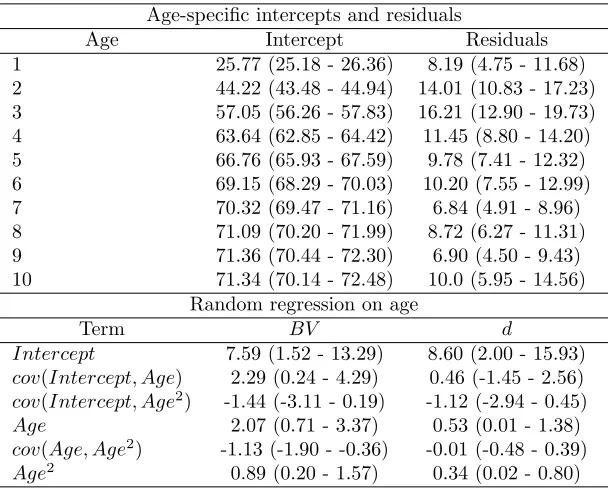
and variance parameters are presented in table 1. 519
520
Random regression of size
521
To model the family of size-at-age functions in bighorn sheep ewes, its genetic basis, and associated pheno-522
typic and genetic covariances of size across age, we fitted a random regression animal model (Kirkpatrick 523
et al., 1990, 1994; Meyer & Hill, 1997; Meyer, 1998; Wilson et al., 2005) of the form 524
xi,a⇠N(µa+f1(di, n1, a) +f2(BVi, n2, a), ei,a), (14)
where xi,a is the mass of individual i at age a and µa are age specific intercepts. f1 and f2 are random 525
regression functions on natural polynomials of order n, for permanent environment e↵ects and additive 526
genetic values, respectively. The permanent environment e↵ect refers to all consistent individual e↵ects other 527
than the additive genetic e↵ect (see Kruuk & Hadfield, 2007). In bothf1 andf2, nwas set to 2, allowing 528
standard deviation-scaled ages to improve convergence. Finally, heterogeneous residuals across ages were 530
estimated (ei,a). d and BV, vectors with individual and pedigree values, respectively, were assumed to 531
follow normal distributions,d⇠N(000, DDD) andBV ⇠N(0, GGG⌦AAA). BothDDD=III 2i, where 2i is the permanent 532
environment e↵ect of individuali, and the additive genetic variance-covariance matrix,GGG, are 3⇥3 matrices, 533
AAA is the pedigree-derived additive genetic relatedness matrix, and ⌦ denotes a Kronecker product. More 534
information on partitioning phenotypic variance into di↵erent components of variation using pedigrees and 535
the animal model is provided by Lynch & Walsh (1998), Kruuk (2004) and Wilson et al. (2010). To obtain 536
the genetic variance-covariance matrix for the 10 ages, the following equation is used 537
G10 G10
G10= GGG T, (15)
whereG10G10G10is the resulting 10⇥10 genetic matrix,GGGis the 3⇥3 genetic matrix estimated by the model and 538
is a 10⇥3 matrix with the polynomials evaluated at each age (Kirkpatrick et al., 1990; Meyer, 1998). 539
A 10⇥10 matrix,D10D10D10, for individual e↵ects at the 10 ages can be obtained similarly. The estimated fixed 540
e↵ects and variance parameters are presented in table 2. 541
542
Recovering resemblance within and across-generations
543
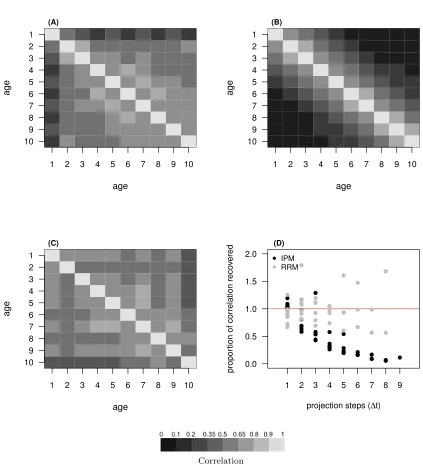
We compare the correlations in mass among ages implied by the development functions typically adopted 544
in IPMs and those derived from a RRM, to the observed phenotypic correlations (Figure 8A-C). We used 545
the path rules, as described for the theoretical models, to obtain the correlation matrix for size at di↵erent 546
ages implied by the IPM approach. There was no need to do the same for the RRM, as these correlations 547
were recovered with equation (15). We also analyze the proportion of correlation recovered for di↵erent gaps 548
between ages (projection steps,
t
) by both models (Figure 8D). The RRM estimates a phenotypic correla-549tion matrix (Figure 8C) that is much more similar to that observed (Figure 8A) than the correlation matrix 550
implied by the IPM approach (Figure 8B). Across-age correlations are better recovered by the RRM than 551
by the IPM approach (Figure 8D). The proportion of correlation in size among ages recovered by an IPM 552
follows the pattern predicted in figure 2, with high recoveries for a single projection step, and then rapidly 553
decaying to near zero (Figure 8D). As predicted by our theory, typical parameterizations of the development 554
functions severely underestimate similarity of trait values within individuals across ages. 555
556
Second, we show the parent-o↵spring regressions recovered by the RRM and the IPM, and use the “ob-557
on maternal mass for all matching ages, also including random intercepts for mother ID by age, year and 559
cohort, as well as heterogeneous residuals by age. The cross-age biometric inheritance function implemented 560
in IPMs recovers parent-o↵spring regression for lambs (age 1), but for older ages most similarity between 561
parents and o↵spring is missed (Figure 9). In contrast, the patterns of parent-o↵spring similarity recovered 562
by the RRM are of the observed order of magnitude throughout most of the life cycle (Figure 9). 563
564
Discussion
565
We have shown analytically that IPMs, as typically implemented, will generally, and often severely, under-566
estimate quantities that are critical to evolutionary inference. Both our theoretical results and our empirical 567
example show that phenotypic covariances within and across individuals can be e↵ectively zero in these mod-568
els, due purely to artifacts of their construction. Additionally, the static nature of the inheritance function 569
(parent-o↵spring regressions with fixed intercept) artificially reverses any response to selection. Consequen-570
tially, IPMs, as typically constructed, will inevitably suggest that evolution is not an important aspect of 571
the dynamics of traits over time. We suggest, and demonstrate empirically, alternative approaches that 572
could be used to characterize some key functions in IPMs. IPMs in principle are extremely useful and highly 573
flexible, and their original conceptualization (Easterling et al., 2000; Ellner & Rees, 2006) should be broadly 574
compatible with a variety of alternative ways of characterizing variation in growth and inheritance. 575
576
The main reason why development functions in IPMs fail to recover within-generation covariances of traits is 577
regression to the mean. This problem is well-understood in evolutionary and ecological studies (e.g. Kelly & 578
Price, 2005). In IPMs, this problem is particularly severe because the multiple age-specific projection steps 579
compound the e↵ect of measurement error to reduce covariance among predictor and response variables. Con-580
sequently, covariance between non-adjacent ages, which can be substantial (Figure 8A, Wilson et al., 2005), 581
is severely underestimated (Figure 8B), even when measurement error is relatively small (Equations 1 and 2). 582
583
The failure of biometric inheritance functions to predict phenotypic similarity among relatives is partially 584
also a direct manifestation of regression to the mean. Indeed, it is the canonical manifestation of regression 585
to the mean – coined in exactly this context by Galton (1886). What we now understand is that Mendelian 586
factors are inherited, and that, in terms of statistical mechanics of quantitative genetics, environmental 587
variation can be regarded as measurement error obscuring the influence of breeding values. Any model of 588
in quantitative traits (Fisher, 1918, 1930; Wright, 1922, 1931) cannot be expected to suffice for even the 590
most basic evolutionary predictions. Another issue arises from assuming that the biometric inheritance 591
function is constant. Whenever the mean phenotype changes, the intercept of the parent-o↵spring regression 592
necessarily changes as well. To presume that the intercept of the parent-o↵spring regression is constant 593
across generations constrains the mean phenotype to be able to respond only transiently to selection, as we 594
show by analytically iterating the mean phenotype in a simple IPM model structure (Figure 7D). We reit-595
erate that our criticism of a constant inheritance function is not a criticism of models assuming a constant 596
heritability, whether that heritability is modelled using a genetical (i.e. using constant 2
a
and 2z) or a 597
biometric approach (i.e. using a parent-o↵spring regression with a constant slope). Rather, the key point 598
is that the mean phenotype cannot evolve in a model where a parent-o↵spring regression has a fixed intercept. 599
600
In our theoretical models, we use simple but general development and inheritance functions that are specif-601
ically designed to isolate these two fundamental processes from each other. In practice, however, the un-602
desirable behaviours that we have modelled separately will interact. Importantly, in iteroparous organisms, 603
where multiple episodes of reproduction occur over the lifetime, regression to the mean in development 604
functions will further obscure relationships between parents and o↵spring, with increasing e↵ects as parents 605
age (Chevin, 2015). Additionally, biased estimates of covariance of parents and o↵spring are compounded 606
across multiple generations. The underestimation of similarity between parents and o↵spring will be com-607
pounded at each generation, leading to increasingly severe undervaluation of the relevance of relationships 608
among more distant relatives to the evolutionary process. This interaction is very evident in the empirical 609
example we present. Parent-o↵spring regressions recovered with the development and inheritance functions 610
generally used in IPMs (Figure 9) could not be predicted by the two-age theoretical model presented here, 611
and specifically by equation (11). 612
613
IPMs with typical cross-age biometric inheritance functions have been recommended for studying evolution-614
ary responses to selection (Coulson et al., 2010; Coulson, 2012; Rees et al., 2014). Some studies applying this 615
approach have concluded that non-evolutionary changes in trait distributions are the major contributors to 616
temporal changes in phenotype (Ozgul et al., 2010; Traill et al., 2014). Our theoretical findings do not indi-617
cate that these conclusions are wrong. Rather, we demonstrate that these are the conclusions that this kind 618
of model must inevitably generate when applied to any system, regardless of whether evolutionary change 619
is important or not. Since typical parameterizations of IPMs neglect the vast majority of similarity between 620
parents and o↵spring, they cannot attribute phenotypic change to evolution. Concern about how IPMs model 621
& Langangen, 2015; van Benthem et al., 2016). Particularly, Chevin (2015) identified some issues addressed 623
in this paper, presenting insightful numerical examples that illuminate the main concern with the cross-age 624
structure of the inheritance function. Besides our analytical demonstrations, and the numerical examples 625
made available by Chevin (2015), we also provide an empirical example, using random regression analysis 626
to address the issues presented here. The random regression model provided substantial improvement in 627
recovering both correlations across ages within a generation (Figure 8D), and parent-o↵spring regressions 628
reflecting how breeding values are transmitted over generations (Figure 9). 629
630
Vindenes & Langangen (2015) discuss joint models of static traits (constant through life) and dynamic traits 631
(such as those typically handled in IPMs) in the general IPM framework. They suggest that incorporation 632
of static traits could solve some of the problems that had begun to be acknowledged about evolutionary 633
inference with IPMs (Hedrick et al., 2014; Chevin, 2015). The authors propose that the static trait, birth 634
mass in their example, could be modelled as influencing mass at all other ages and demographic rates, which 635
would allow covariances among birth mass and older ages to be well recovered. In a sense, using random 636
regression animal models as we suggest treats breeding values (as opposed to some realized phenotypic value) 637
as a static trait, but critically also models the inheritance of breeding values, not as some observed function, 638
but according to the principles of quantitative genetics. It is noteworthy to mention that a genetic notion 639
of trait transmission has already been implemented into an IPM for a single Mendelian locus (Coulson 640
et al., 2011). The authors constructed an IPM that describes the dynamics of body mass and a biallelic gene 641
determining coat color in wolves (Canis lupus). In contrast to biometric IPMs of quantitative traits, Coulson 642
et al. (2011) conclude that the genetic variance within the study population is enough for natural selection 643
to cause evolution. In fact, it is in principle relatively straightforward to implement an IPM that uses the 644
basic principles of inheritance of polygenic quantitative traits to define inheritance functions of breeding 645
values; such exercises have indeed begun for a single trait (Childs et al., 2016). It is easy to conceive of 646
multivariate extensions of such inheritance functions (based on multivariate versions of equations 3 and 647
4), whereby one could treat age-specific sizes as di↵erent characters, and estimate genetic variances and 648
covariances from data. Nonetheless, a great deal of work is still required. For long-lived organisms, genetic 649
covariance matrices of age-specific traits would be very challenging to estimate with useful precision (Wilson 650
et al., 2010). Furthermore, the dimensionality of resulting phenotypes would overwhelm typical strategies 651
for implementing IPMs (Coulson et al., 2010; Rees et al., 2014; Merow et al., 2014). In practice, a key 652
challenge, but a surmountable one, will be to develop sufficiently flexible, low-dimensional characterizations 653
of the genetic basis of development for practical estimation and subsequent modelling. The function-valued 654
possibility. Other approaches could possibly be even more useful; for example, uses of various autocorrelation 656
functions (Pletcher & Geyer, 1999; Hadfield et al., 2013), or factor-analytic mixed model (de los Campos & 657
Gianola, 2007; Meyer, 2009; Walling et al., 2014). 658
Summary
659
We have shown analytically and using and empirical example that standard implementations of integral 660
projection models will generally severely underestimate the likelihood of evolutionary change. IPMs to date 661
have been constructed using characterizations of development and inheritance that would not stand up to 662
scrutiny in studies focusing on development and inheritance. It is not surprising that more complex models 663
built on such functions behave poorly. In fact, insofar as the ability of IPMs to track the full joint distribution 664
of phenotype has been suggested as their main quality for ecological inference, the problems that preclude 665
their typical use for evolutionary inference should be of equal concern to ecologists. Importantly, we have 666
suggested ways in which more nuanced models of development, and a modern understanding of inheritance, 667
can be incorporated into the general IPM approach. A great deal more work is required before IPMs based 668
on adequate models of development and inheritance will be field-ready. As a next step, careful studies of the 669
performance of di↵erent approaches for characterizing the genetic basis of developmental trajectories, with 670
particular focus on approaches that could be incorporated into an IPM framework, are needed. 671
Acknowledgments
672
We thank Jarrod Hadfield, Loeske Kruuk, Luis-Miguel Chevin, Josephine Pemberton, Graeme Ruxton, Jean-673
Michel Gaillard, Sandra Hamel, and two anonymous reviewers for valuable comments and discussions. We 674
are also very grateful to all those who worked on the bighorn program over decades. The bighorn research 675
is supported by the Government of Alberta, the Universit´e de Sherbrooke and an Alberta Conservation 676
Association Challenge Grant in Biodiversity, NSERC Discovery Grants to D. Coltman, M. Festa-Bianchet 677
and F. Pelletier and the Canada Research Chair in Evolutionary Demography and Conservation. M. B. 678
Morrissey is supported by a University Research Fellowship from the Royal Society (London). M. J. Janeiro 679
is supported by a PhD scholarship (SFRH/BD/96078/2013) funded by the Funda¸c˜ao para a Ciˆencia e 680