http://www.scirp.org/journal/fns ISSN Online: 2157-9458
ISSN Print: 2157-944X
DOI: 10.4236/fns.2019.108066 Aug. 13, 2019 923 Food and Nutrition Sciences
Effect of
Monascus
Fermentation on Aroma
Patterns of Semi-Dried Grass Carp
Kang Wu, Jinghui Xie, Qianqian Wang, Meijing Ling, Jianzhong Wu
*Department of Food Science and Engineering, Jinan University, Guangzhou, China
Abstract
The aim of the present study is to investigate the effects of Monascus fermen-tation on the aroma pattern of semi-dried grass carp. Semi-dried fish was fermented using Monascus purpureus GDMCC3.439. The volatile flavor sub-stances present in fresh fish, semi-dry fish and Monascus fermented semi-dried fish were compared by simultaneous distillation and extraction combined with gas chromatograph-mass spectrometer (GC-MS). The results showed that alcohols, aldehydes and ketones were the main components of the flavor of the unfermented and fermented semi-dried grass crap. Monas-cus fermentation could significantly affect the volatile flavor substances of semi-dried grass carp. Moreover, the processing of semi-dried fish fermented by Monascus could not only effectively improve the fishy smell of fresh fish, but also make up for the defect of thepickled flavor of semi-dried fish. Eigh-teen of the main volatile components in semi-dried fish fermented by Mo-nascus were identified by relative odor activity value (ROAV), as follows: 1-octene-3-ol, phenylethanol, hexanal, heptanal, nonanal, (E)-2-octenal, 3- Methyl-1-butanal, benzaldehyde, (E)-2-nonenal, (E,E)-2,4-heptadienal, (E)-2- Decenal, phenylacetaldehyde, (E,E)-2.4-decadienal, tetradecanal, 2,3-butanone, 2,3-octanedione, alpha-pinene, 2-pentane furan.
Keywords
Monascus, Fermentation, Semi-Dried Grass Carp, ROAV, Flavor
1. Introduction
Grass carp (Ctenopharyngodon idellus), one of the four largest freshwater fish in China, is very popular among consumers because of its rapid growth, high yield, and low price [1]. Grass carp is mainly freshly sold due to the high cost of sto-rage [2]. Moreover, the production of fresh fish is greatly influenced by seasonal How to cite this paper: Wu, K., Xie, J.-H.,
Wang, Q.-Q., Ling, M.-J. and Wu J.-Z. (2019) Effect of Monascus Fermentation on Aroma Patterns of Semi-Dried Grass Carp. Food and Nutrition Sciences, 10, 923-936. https://doi.org/10.4236/fns.2019.108066
Received: July 7, 2019 Accepted: August 10, 2019 Published: August 13, 2019
Copyright © 2019 by author(s) and Scientific Research Publishing Inc. This work is licensed under the Creative Commons Attribution International License (CC BY 4.0).
DOI: 10.4236/fns.2019.108066 924 Food and Nutrition Sciences and regional weather conditions. To prevent fresh fish from deterioration, it is commonplace for the fish to be processed into salted fish. However, the tradi-tional salted fish has high salt content and poor taste, which does not meet the dietary habits of modern people.
In recent years, a kind of low salt semi-dried fish has come into the markets. It has been welcomed by many people because of low salt content and good taste [3]. The grass carp processed into the low salt semi-dried fish has the broad market prospect. However, it suffers from having fewer flavor substances than traditional salted fish as a result of lower salt content, shorter drying time and the lack of natural inoculation and fermentation process. This problem paves the need for improvement in the flavor of fish meat. For instance, You gang et al. [4] inoculated compounded Lactobacillus on ornate threadfin bream. The results showed that a lot of carbonyl and alcohol compounds present in the flavor sub-stances of fermented fish, which added the unique flavor of fermented fish on the basis of traditional salted fish flavor. Furthermore, Wu haiyan et al. [5] made use of Lactic acid bacteria and Staphylococcus to ferment the white cloud mountain minnows. Compared with the salted fish marinated by traditional techniques, the content of small molecules in the fermented fish meat was sig-nificantly increased, and the flavor of the final fermentation product was im-proved. To add on, Udomsil et al. [6] utilized Staphylococcus isolated from the traditional fish sauce as a starter culture to prepare fish sauce, which induced sauce black chocolate aroma and improved the flavor of fish sauce.
Monascus belongs to Eurotiales, Euascomycetes, Ascomycota, and Eumyco-phyta. It is one of the traditional fermentation moulds used by human beings and is mainly used in fermented food in some Asian countries. Monascus has been used for more than 1000 years in the production of wine, vinegar, and soy sauce in China. GDMCC3.439 Monascus purpureus is a kind of Monascus. It can produce Monascus red pigment in large quantities and has strong inhibition effect on alcohol, salinity and bacteriostasis [7].
In order to further enhance the flavor of semi-dried fish, Monascus was in-oculated to ferment the semi-dried fish. The aroma-producing effect of Monas-cus fermentation on low salt semi-dried grass carp was analyzed. The present study attempted to provide some new ideas for the traditional salted fish tech-nology.
2. Materials and Methods
2.1. Materials and Reagents
Grass carp was purchased from China Resources Vanguard Supermarket. Mo-nascus purpureus GDMCC3.439 was purchased from Guangdong Culture Col-lectioncenter of Microbiology. C7-C30 normal paraffins were purchased from the
DOI: 10.4236/fns.2019.108066 925 Food and Nutrition Sciences chemicals and solvents used in the study were of analytical grade.
2.2. Main Instruments
7890A-5975C Gas Chromatography-Mass Spectrometer was purchased from Agilent Company. Chromatographic column was HP-INNOWAX (60 m × 0.25 mm × 0.25 um). Simultaneous distillation and extraction (SDE) was obtained from Guangzhou Dongju Experimental Instrument Co., Ltd. Vigreux column was purchased from Guangzhou Congyuan Experimental Instrument Co., Ltd.
2.3. Processing Craft
2.3.1. Preparation of Starter Cultures
The activated Monascus were inoculated into the slope composed of PDA me-dium in a test tube and cultured at 30˚C for 7 - 10 days. Then 5 mL of sterile water was pumped into the tube, shaken for 15 minutes, and the red-brown spores were washed into the Monascus culture medium with the 6 g of rice powder as a carbon source, 2.5 g of soybean protein as nitrogen source, and 0.05 g of MgSO4 and 0.1 g KH2PO4 as the mineral elements to incubate Monascus in
the shaker for 5 days under 35˚C, shaking at 150 r/min. after which Monascus
starter cultures were prepared. The concentration of Monascus was 109 CFU/mL
[7].
2.3.2. Craft of Low Salt Semi-Dried Fish
The Scale, head, tail, fin and viscera of grass carp were removed and cut into small pieces. They were marinated at 4˚C for 2 hours after 3% of salt (W/W) was added to them, then put into a heat pump drier, and dried at 27˚C and 20% hu-midity until the moisture content of the fish was about 50%. Finally, after va-cuum packaging, they were unfermented group samples.
2.3.3. Craft of Low Salt Semi-Dried Fish Fermented by Monascus
The Scale, head, tail, fin and viscera of grass carp were removed and cut into small pieces. They were marinated at 4˚C for 2 hours after 3% (W/W) of salt was added to them. Monascus starter cultures were evenly applied to ferment them, and the inoculation amount was 5 mL/100g. Then, they were fermented at 30˚C for 18 hours, and transferred to a heat pump dryer. Next,they were dried at
27˚C and 20% humidity until the moisture content of the fish was about 50%. Finally, after vacuum packaging, they were fermented group samples.
2.4. Collection of Volatile Compounds
DOI: 10.4236/fns.2019.108066 926 Food and Nutrition Sciences 55˚C. The extraction was continued for 3 h, the extracts were collected and re-frigerated overnight with 10 g of anhydrous sodium sulfate. The volume of the extract was then concentrated to 3 mL with a Vigreux column. 600 uL of sample concentrates were accurately absorbed into a 1.5 mL of sample bottle with 300 uL of butanol (the concentration was 400 ug/mL) as the internal standard. The sample bottle was frozen in the refrigerator for GC-MS analysis.
2.5. GC-MS Analysis Condition
Chromatographic columns used HP-INNOWAX (60 mm × 0.25 mm × 0.25 um). Helium was used as the carrier gas, the gas at a flow rate of 1.0 mL/min. The column temperature was maintained at 50˚C for 2 min, programmed at 5˚C/min to 220˚C and maintained for 5 min. The mass spectrometer was oper-ated in electron impact (EI) ionization mode with electron energy of 70 eV and temperature at 230˚C. The four-stage bar temperature was 150˚C. Scan range was 30 - 550 m/z.
2.6. Qualitative Analysis
Unknown compounds were matched with the NIST08 library. Only compounds with mass greater than 75 were reported. Using the same heating program and taking saturated alkanes from C7 to C30 as the standard, the Retention Index (RI)
of the corresponding compounds was calculated and qualitatively analyzed with the database retrieval results [8].
1
RI 100 100 x n
n n
t t n
t + t −
= + ×
−
(1)
tx: the retention time of the volatiles to be tested (min).
tn, tn+1: the retention time of saturated alkanes containing n and n + 1 carbon
atoms (min)
2.7. Quantitative Analysis
Butanol was used as an internal standard, and the peak area of each test sub-stance and internal standard were compared. The concentration of the volatile substance in the sample was calculated.
133.3 ug mL 3 mL 1.5 3 kg
S
C= × × × (2)
S: the ratio of peak area of volatile matter measured to that of internal stan-dard butanol.
C: the concentration of the volatile substance (μg/kg).
DOI: 10.4236/fns.2019.108066 927 Food and Nutrition Sciences formula:
ROAVi i stan 100
stan i
C T
C T
≈ × × (3)
ROAVi: the relative odor activity value of a volatile component.
Ci: the concentration of a volatile component (ug/kg).
Ti: the sensory threshold of a volatile component (ug/kg).
Cstan: the concentration of the component with maximum contribution to
odors (ug/kg).
Tstan: the sensory threshold of the component with maximum contribution to
odors. (ug/kg)
3. Results and Analysis
3.1. Detection Results of SDE-GC-MS
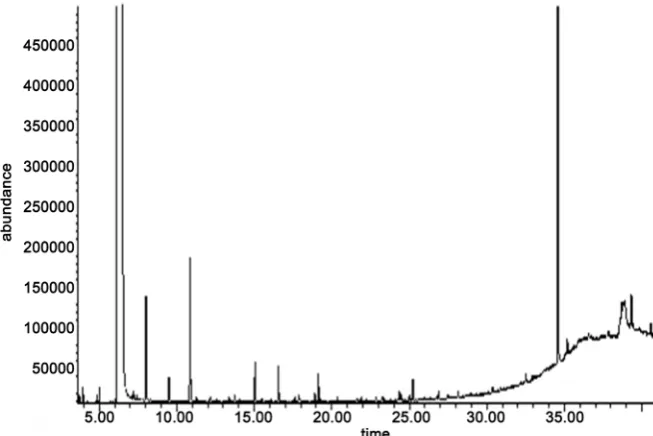
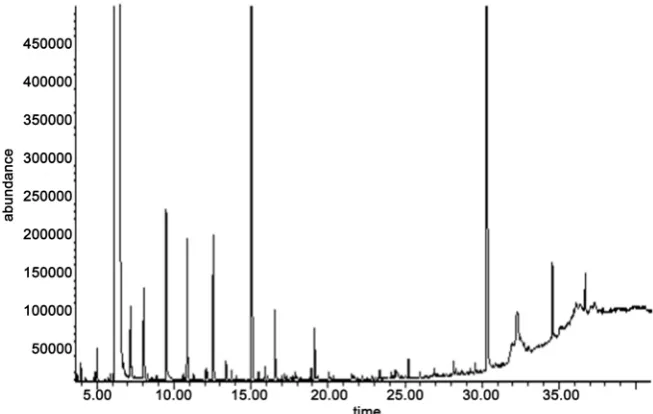
The total ion chromatograms of the fresh fish group, unfermented semi-dried fish group and the fermented semi-dried fish group were determined by SDE-GC-MS, respectively, as shown in Figure 1, Figure 2 and Figure 3.
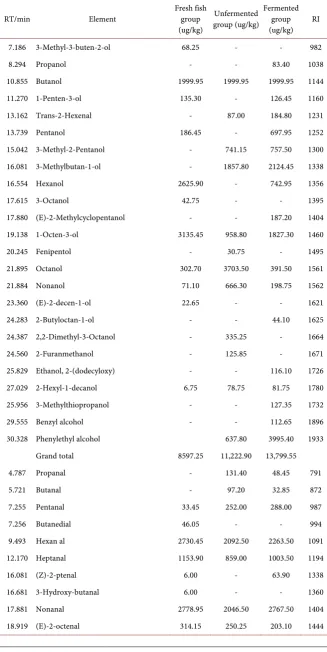
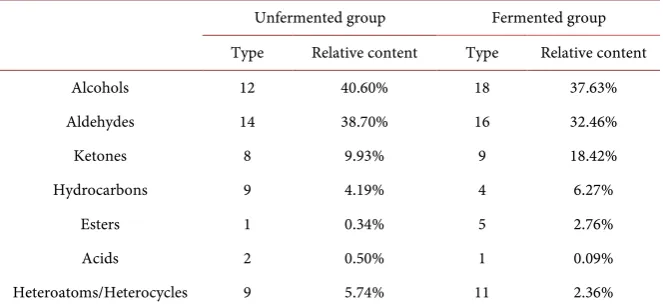
Specific substances were identified by searching the NIST08 spectral library and the retention index was calculated according to Equation (1). Compared with the concentration and peak area of the internal standard, the concentration of other substances was calculated by Equation (2), as shown in Table 1. The types and relative contents of volatile substances in fish meat under different processing methods were further studied, as shown in Table 2.
[image:5.595.208.535.488.706.2]From Table 1, compared with the fresh fish group, the contents of hexanal, Heptanal, nonanal, (E)-2-octenal, (E)-2-nonenal, (E)-2-decenal, (E,E)-2,4-decadienal, (E,E)-2,4-heptadienal, 1-pentene-3-ol and 1-octen-3-ol significantly decreased in the fermentation group. Based on the literature analysis, these low molecular
DOI: 10.4236/fns.2019.108066 928 Food and Nutrition Sciences
Figure 2. The total ion count (TIC) chromatogram of unfermented semi-dried fish sample.
Figure 3. The total ion count (TIC) chromatogram of semi-dried fish sample fermented
by Monascus.
weight aldehydes and alcohols, especially hexanal, heptaldehyde, nonanal, (E,E)- 2,4-decadienal, (E,E)-2,4-heptadienal were typical fishy odor-causing com-pounds [11] [12] [13] [14] [15]. Moreover, 1-octene-3-alcohol had mushroom aroma and earthy odor [16]. The results showed that the processing of semi-dry grass carpcould effectively improve the fishy smell.
[image:6.595.207.534.309.516.2]DOI: 10.4236/fns.2019.108066 929 Food and Nutrition Sciences
Table 1. Volatile components and contents of fish meat processed in different ways.
RT/min Element Fresh fish group (ug/kg)
Unfermented group (ug/kg)
Fermented group (ug/kg) RI
7.186 3-Methyl-3-buten-2-ol 68.25 - - 982
8.294 Propanol - - 83.40 1038
10.855 Butanol 1999.95 1999.95 1999.95 1144
11.270 1-Penten-3-ol 135.30 - 126.45 1160
13.162 Trans-2-Hexenal - 87.00 184.80 1231
13.739 Pentanol 186.45 - 697.95 1252
15.042 3-Methyl-2-Pentanol - 741.15 757.50 1300
16.081 3-Methylbutan-1-ol - 1857.80 2124.45 1338
16.554 Hexanol 2625.90 - 742.95 1356
17.615 3-Octanol 42.75 - - 1395
17.880 (E)-2-Methylcyclopentanol - - 187.20 1404
19.138 1-Octen-3-ol 3135.45 958.80 1827.30 1460
20.245 Fenipentol - 30.75 - 1495
21.895 Octanol 302.70 3703.50 391.50 1561
21.884 Nonanol 71.10 666.30 198.75 1562
23.360 (E)-2-decen-1-ol 22.65 - - 1621
24.283 2-Butyloctan-1-ol - - 44.10 1625
24.387 2,2-Dimethyl-3-Octanol - 335.25 - 1664
24.560 2-Furanmethanol - 125.85 - 1671
25.829 Ethanol, 2-(dodecyloxy) - - 116.10 1726
27.029 2-Hexyl-1-decanol 6.75 78.75 81.75 1780
25.956 3-Methylthiopropanol - - 127.35 1732
29.555 Benzyl alcohol - - 112.65 1896
30.328 Phenylethyl alcohol 637.80 3995.40 1933
Grand total 8597.25 11,222.90 13,799.55
4.787 Propanal - 131.40 48.45 791
5.721 Butanal - 97.20 32.85 872
7.255 Pentanal 33.45 252.00 288.00 987
7.256 Butanedial 46.05 - - 994
9.493 Hexan al 2730.45 2092.50 2263.50 1091
12.170 Heptanal 1153.90 859.00 1003.50 1194
16.081 (Z)-2-ptenal 6.00 - 63.90 1338
16.681 3-Hydroxy-butanal 6.00 - - 1360
17.881 Nonanal 2778.95 2046.50 2767.50 1404
DOI: 10.4236/fns.2019.108066 930 Food and Nutrition Sciences
Continued
20.372 3-Methy-1-butanal - 502.00 666.00 1500
20.465 2-Methylundecanal - 91.800 - 1504
21.549 Benzaldehyde 78.45 64.50 117.00 1547
21.641 (E)-2-nonenal 114.15 - 63.00 1551
20.649 (E,E)-2,4-heptadienal 327.15 126.00 288.00 1511
24.272 (E)-2-decenal 46.65 - 36.00 1659
24.491 Phenylacetaldehyde - 58.50 945.00 1668
28.159 (E,E)- 2,4-decadienal 354.15 369.00 117.00 1824
34.574 Tetradecanal 3999.45 3754.95 3000.00 2148
grand total 11,988.95 10,695.60 11,902.80
5.017 Acetone 187.20 241.65 - 814
5.813 4-Hydroxy-2-butanone - - 101.70 879
6.067 2-Butanone - - 130.50 900
7.186 2,3-Butanedione 90.15 243.60 886.05 980
10.647 (E)-3-penten-2-One - - 93.75 1136
12.078 2-Heptanone 81.30 330.60 167.25 1191
14.904 6-Methylheptan-2-One - 80.10 - 1235
15.054 3-Hydroxy-2-Butanone 261.30 - 3905.85 1300
15.331 Cyclohexanone - 226.35 - 1310
15.504 1-Hydroxy-2-Propanone - 132.45 - 1317
15.919 2,3-Octanedione 1205.40 1233.00 1363.95 1332 24.756 3,6-Dimethyl-4-octanone - 256.65 53.85 1680
27.306 1-Hepten-3-one - - 53.10 1792
Grand total 1825.35 2744.40 6756.00
3.956 3-Methyl-1-butene 133.35 151.35 166.20 600
4.244 Heptane - 113.55 - 702
4.798 2,4-Dimethyl-heptane 91.50 - - 792
4.821 Octane 85.05 384.00 82.95 796
5.444 (Z)-3-octene - 91.20 - 849
5.629 (Z)-2-octene - 33.60 - 863
8.051 Alpha-Pinene - - 1799.40 1027
8.559 Toluene - 126.15 - 1050
17.292 1-Ethyl-2,4-dimethylbenzene - 59.85 - 1383
17.765 2,3,3-Trimethyloctane - 73.80 - 1400
25.229 Heptadecane 289.05 124.80 250.65 1699
DOI: 10.4236/fns.2019.108066 931 Food and Nutrition Sciences
Continued
Grand total 648.60 1158.30 2299.20
5.848 Ethyl acetate - - 74.70 801
6.044 Formic acid, ethenyl ester 37.50 - - 898
17.304 N’-Ethyl-hydrazinecarboxylic acid methyl ester - - 69.00 1383
22.472 Methoxyacetic acid, tridecyl ester - - 129.60 1584 23.291 Oxalic acid, cyclobutyl heptadecyl ester - 94.65 - 1618
24.375 1-Methyltridecyl cyclobutanecarboxylate - - 143.85 1664
36.708 Hexadecanoic acid, ethyl ester - - 593.25 2260
Grand total 37.50 94.65 1010.40
22.253 2-Hexynoic acid 3.00 37.20 33.90 1575
29.844 Nonahexacontanoic acid - 99.75 - 1910
Grand total 3.00 136.95 33.90
21.641 Ethanedial, dioxime - - 100.80 1551
26.890 2,4-Dimethyl-benzenamine 125.10 - - 1773
27.017 3-butenamide - - 56.10 1779
27.306 (Z)-2-butenediamide - 30.00 - 1792
27.929 1-octadecanamine - 13.20 - 1820
7.336 N-carboxal-4-carboxychloropi-peridine 6.15 4.65 6.00 992
13.381 2-Pentyl-furan 72.30 932.10 263.10 1239
18.469 (Z)-aconitic anhydride 3.30 3.30 9.15 1427
19.276 2-methylpiperazine 34.65 - - 1458
19.357 1-(aminoacetyl)-Piperazine - - 66.00 1461
19.876 3-Furan-2-yl-1-methyl-propyla-mine - 18.00 - 1481
20.165 1-Fluoro-dodecane 11.85 - 151.20 1492
21.480 2-N-octylfuran - 39.45 - 1543
22.068 N-methyl-1,3-Propanediamine - - 10.05 1568 22.253 5-Methyl-2-furancarboxaldehyde - - 48.75 1575
24.122 4-Methylthiazole - 247.20 - 1653
24.756 Pentanoic acid, 2-methyl-, anhydride - 298.95 - 1680
28.713 1-Sec-butyldiaziridine - - 83.40 1857
32.358 1,54-Dibromotetrapentacontane - - 71.85 2033 253.35 1586.85 866.40
DOI: 10.4236/fns.2019.108066 932 Food and Nutrition Sciences
Table 2. Species and relative contents of volatile substances in fish meat under different
processing methods.
Unfermented group Fermented group Type Relative content Type Relative content
Alcohols 12 40.60% 18 37.63%
Aldehydes 14 38.70% 16 32.46%
Ketones 8 9.93% 9 18.42%
Hydrocarbons 9 4.19% 4 6.27%
Esters 1 0.34% 5 2.76%
Acids 2 0.50% 1 0.09%
Heteroatoms/Heterocycles 9 5.74% 11 2.36%
aroma of salted fish and make up for the shortage of pickled flavor of semi-dried fish.
According to Table 1 and Table 2, 55 and 64 of volatile compounds were de-tected in fresh fish, non-fermented fish and fermented fish, most of which were alcohols, aldehydes and ketones, accounting for 89.23% and 88.51% respectively. As a result, alcohols and carbonyl compounds were the main volatile compo-nents of grass carp fish flavor. The total contents of alcohols and aldehydes in semi-dried grass carp after fermentation were 9.21% lower than those in non-fermented fish. Moreover the contents of ketones, hydrocarbons and esters were significantly increased, indicating that the fermentation of Monascus had a significant effect on the flavor of the semi-dried grass carp.
3.2. Identification of Key Aroma Substances
Why did fresh fish, unfermented fish and fermented fish have similar flavor components while the overall flavor was significantly different? Some data showed that the flavor contribution of volatile flavor substances was determined by their concentration and flavor threshold. The flavor characteristics of fer-mented fish could not be accurately described by the content of flavor substances alone [21] [22] [23].
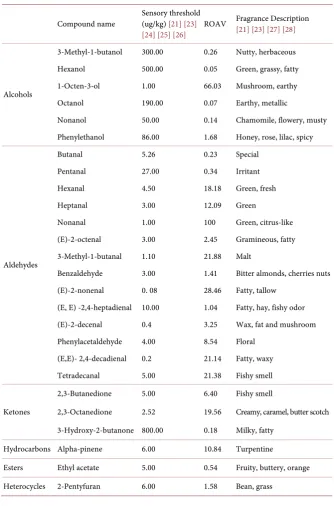
DOI: 10.4236/fns.2019.108066 933 Food and Nutrition Sciences Table 3 showed that the main flavor substances (ROAV > 1) of Monascus
[image:11.595.205.540.229.736.2]fermented semi-dried grass carp were as follows: 1-octene-3-ol, phenylethanol, hexanal, heptanal, nonanal, (E)-2-octenal, 3-Methyl-1-butanal, benzaldehyde, (E)-2-nonenal, (E,E)-2,4-heptadienal, (E)-2-Decenal, phenylacetaldehyde, (E,E)-2.4- decadienal, tetradecanal, 2,3-butanone, 2,3-octanedione, alpha-pinene, 2-pentane furan. The content of saturated straight-chain alcohols in alcohols was higher, which contributed little to the flavor of fermented fish meat because of their high sensory threshold. However, some unsaturated alcohols had low threshold, such
Table 3. Aroma characteristics, threshold and relative activity value of volatile
compo-nents in semi-dried fish fermented by Monascus.
Compound name Sensory threshold (ug/kg) [21] [23]
[24] [25] [26] ROAV Fragrance Description [21] [23] [27] [28]
Alcohols
3-Methyl-1-butanol 300.00 0.26 Nutty, herbaceous Hexanol 500.00 0.05 Green, grassy, fatty 1-Octen-3-ol 1.00 66.03 Mushroom, earthy Octanol 190.00 0.07 Earthy, metallic
Nonanol 50.00 0.14 Chamomile, flowery, musty Phenylethanol 86.00 1.68 Honey, rose, lilac, spicy
Aldehydes
Butanal 5.26 0.23 Special
Pentanal 27.00 0.34 Irritant
Hexanal 4.50 18.18 Green, fresh
Heptanal 3.00 12.09 Green
Nonanal 1.00 100 Green, citrus-like
(E)-2-octenal 3.00 2.45 Gramineous, fatty 3-Methyl-1-butanal 1.10 21.88 Malt
Benzaldehyde 3.00 1.41 Bitter almonds, cherries nuts (E)-2-nonenal 0. 08 28.46 Fatty, tallow
(E, E) -2,4-heptadienal 10.00 1.04 Fatty, hay, fishy odor (E)-2-decenal 0.4 3.25 Wax, fat and mushroom Phenylacetaldehyde 4.00 8.54 Floral
(E,E)- 2,4-decadienal 0.2 21.14 Fatty, waxy Tetradecanal 5.00 21.38 Fishy smell
Ketones
2,3-Butanedione 5.00 6.40 Fishy smell
2,3-Octanedione 2.52 19.56 Creamy, caramel, butter scotch 3-Hydroxy-2-butanone 800.00 0.18 Milky, fatty
Hydrocarbons Alpha-pinene 6.00 10.84 Turpentine
DOI: 10.4236/fns.2019.108066 934 Food and Nutrition Sciences as 1-octene-3-alcohol and phenylethanol, which gave fermented fish meat mu-shroom and rose fragrance. Aldehydes, due to their low sensory threshold, ac-counted for the largest proportion of the main flavor substances in fermented fish meat, giving fish a variety of flavors. Ketones gave fermented fish fragrance, creamy fragrance and ester fragrance. Alpha-pinene and 2-pentylfuran gave the fermented fish oil and bean fragrance.
4. Conclusion
The volatile components of fresh fish, semi-dried fish and semi-dried fish fer-mented by Monascus were analyzed by SDE combined with GC-MS, and 43, 56 and 64 of volatile substances were detected respectively. The results showed that alcohols, aldehydes and ketones were the main components of the flavor of grass crap. The semi-dried fish fermented by Monascus could significantly affect the flavor of semi-dried grass carp. Furthermore, the processing could not only ef-fectively improve the fishy smell of fresh fish, but also enhance the aroma of salted fish, and make up for the shortcomings of the pickled flavor of semi-dried fish. 18 of the main flavor components of semi-dried fish fermented by Monas-cus were identified by relative odor activity value (ROAV). They were as follows: 1-octene-3-ol, phenylethanol, hexanal, heptanal, nonanal, (E)-2-octenal, 3-Methyl- 1-butanal, benzaldehyde, (E)-2-nonenal, (E,E)-2,4-heptadienal, (E)-2-decenal, phenylacetaldehyde, (E,E)-2.4-decadienal, tetradecanoaldehyde, 2,3-butanone, 2,3-octanedione, a-pinene, 2-pentane furan. The main aroma characteristics were mushroom, rose, gramineous, citrus taste, Vegetable-flavored, malt, bitter almond-flavored, cherry and nut-flavored, the fragrance of a flower, cream-flavored, fruit-flavored and wine-flavored.
References
[1] Zhang, L., Li, X., Lu, W., Shen, H.-X. and Luo, Y.-K. (2011) Quality Predictive Models of Gress Carp (Ctenopharyngodon idella) at Different Temperatures during Storage. Food Control, 22, 1197-1202.
https://doi.org/10.1016/j.foodcont.2011.01.017
[2] Kang, C.-C., Shi, W.-Z., Fang, L. and Wang, X.-C. (2018) Effects of Different Freez-ing Methods on the Volatile Components of Grass Carp Meat. Food Science, 39, 229-235.
[3] Jin, J., Wu, L.-F., Wang, Q.-D., Wu, J.-Z. and Zeng, S.-D. (2011) Effects of Fermen-tation by Lactic Acid Bacteria on the Volatile Components of Damp-Dry Tilapia.
Journal of Jinan University (Natural Science & Medicine Edition),32, 473-479. [4] You, G. and Niu, G.-G. (2016) Study on the Volatile Flavor Compounds of
Nemip-terus virgatus Inoculated with Complex Lactic Acid Bacteria. Food and Fermenta-tion Industries, 42, 167-173.
[5] Wu, H.-Y., Yang, L., Li, S.-D., Wang, G. and Yang, X.-H. (2010) Effects of Mixed Starter Cultures on the Quality of Fermented Cured Fish. Guangzhou Chemical Industry, 38, 73-77.
DOI: 10.4236/fns.2019.108066 935 Food and Nutrition Sciences
https://doi.org/10.1111/1750-3841.12986
[7] Zhang, C., Song, Z.-L., Li, F.-E. and Wu, J.-Z. (2017) Influence of Monascus Fer-mentation on Storage Characteristics of Semidry Salted Tilapia. Journal of Aquatic Food Product Technology, 10, 1122-1133.
https://doi.org/10.1080/10498850.2014.914116
[8] Moradi, P., Ford-Lloyd, B. and Pritchard, J. (2017) Metabolomic Approach Reveals the Biochemical Mechanisms Underlying Drought Stress Tolerance in Thyme.
Analytical Biochemistry, 527, 49-62. https://doi.org/10.1016/j.ab.2017.02.006
[9] Niu, D.-Y., Zhou, G.-H. and Xu, X.-L. (2008) “ROAV” Method: A New Method for Determining Key Odor Compounds of Rugao Ham. Food Science,29,370-374.
[10] Frauendorfer, F. and Schieberle, P. (2006) Identification of the Key Aroma Com-pounds in Cocoa Powder Based on Molecular Sensory Correlations. Journal of Agricultural and Food Chemistry, 54, 5521-5529. https://doi.org/10.1021/jf060728k
[11] Maurizio, B., Gianluca, G., Gandini, G., Caccialanza, G., Finzi, P.V., Vidaric, G., et al. (2007) Determination of the Threshold Odor Concentration of Main Odorants in Essential Oils Using Gas Chromatography-Olfactometry Incremental Dilution Technique. Journal of Chromatography A, 1150, 131-135.
https://doi.org/10.1016/j.chroma.2007.02.031
[12] Wu, J.-Z., Wang, Q.-Q., Liao, S., Wu, K. and Zhang, M.-M. (2019) Causes Analysis of Deodorization of Saury Soup by Angel Yeast Fermentation. Food and Fermenta-tion Industries,45, 213-220.
[13] Zhou, Y.-Q. and Wang, Z.-J. (2006) Extraction and Analysis on Fishy Odor-Causing Compounds in the Different Part of Carp. Chinese Journal of Analytical Chemistry, 34, 165-167.
[14] Wang, X., Huang, J., Hou, Y.-D. and Wang, Q.-J. (2012) Analysis of Volatile Com-ponents in Yellowfin Tuna by Electronic Nose and GC-MS. Food Science, 33, 268-272.
[15] Qian, P., Ma, X.-T., Xu, G., Xue, J., Jin, R.-Y. and Dai, Z.-Y. (2016) Study on Vola-tile Components and Deodorization of Silver Carp. Journal of Chinese Institute of Food Science and Technology, 16, 169-173.
[16] Huang, Z.-B., Ming, T.-H. and Dong, L.-S. (2019) Studies on the Deodorization during Fermentation of Tuna’s Milt by Lactobacillus plantarum. Journal of Chinese Institute of Food Science and Technology, 19, 147-154.
[17] Wu, H.-Y., Xie, W.-C., Yang, X.-H., Yang, L., Li, S.-L. and Zhang, C.-H. (2009) SPME-GC-MS Analysis of Volatile Components in Cured Golden Thread ( Nemip-terus virgatus) Meat. Food Science, 30, 278-281.
[18] Li, L.-H., Ding, L.-L., Wu, Y.-Y., Yang, X.-Q., Deng, J.-Z. and Liu, F.-J. (2012) Analysis of the Volatile Flavor Compounds in Salted-Dried Fish. Journal of Fishe-ries of China, 36, 979-988. https://doi.org/10.3724/SP.J.1231.2012.27682
[19] Wu, Y.-Y., Li, L.-H., Yang, X.-Q., Niu, F.-J., Diao, S.-Q. and Deng, J.-C. (2011) Changes of Volatile Flavor Compounds during Salted Hairtail (Trichiurus haumela) Processing. Food Science, 32, 208-212.
[20] Wang, Y., Wang, R.-D., Xue, Y., Zhao, Y.-N. and Xue, C.-H. (2018) Analysis of Vo-latile Flavor Compounds Changes during Traditional Processing of Salted Spanish Mackerel. Modern Food Science and Technology, 34, 268-276.
[21] Cai, R.-K., Wu, J.-J., Zhu, J.-L., Qian, P. and Dai Z.-Y. (2017) Analysis of Volatile Compounds and Odor-Active Compounds in Fermented Large Yellow Croaker.
DOI: 10.4236/fns.2019.108066 936 Food and Nutrition Sciences
[22] Gao, J.-C., Ye, P. and Huan, Y.-J. (2019) Effects of Single Bacteria and Compounded Bacteria Fermentation on Volatile Compounds of Pork Jerky. Food and Fermenta-tion Industries, 1, 128-136.
[23] Lu, C.-X., Wong, L,-P., Wang, H.-H., Yang, R.-H., Wang, X.-F. and Dai, Z.-Y. (2010) Investigation on the Key Odor Compounds of Three Cage-Farming Fishes.
Food and Fermentation Industries, 36, 163-169.
[24] Pino, J.A. and Mesa, J. (2006) Contribution of Volatile Compounds to Mango (Mangifera indica L.) Aroma. Flavour and Fragrance Journal, 21, 207-213.
https://doi.org/10.1002/ffj.1703
[25] Zhu, L.-L., Yang, F., Gao, P., Jiang, Q.-X., Xu, Y.-S. and Yu, P.-P. (2018) Effect of Fermentation Conditions on Flavor of Yeast-Fermented and Wine-Aroma Sturgeon (Acipenser dabryanus). Food and Fermentation Industries, 44, 110-117.
[26] Selli, S. and Gayhan, G.C. (2009) Analysis of Volatile Compounds of Wild Gilthead Sea Bream (Sparus aurata) by Simultaneous Distillation-Extraction (SDE) and GC-MS. Microchemical Journal, 93, 232-235.
https://doi.org/10.1016/j.microc.2009.07.010
[27] Anupam, G., Kazufumi, O., Akira, O. and Toshiaki, O. (2010) Olfactometric Cha-racterization of Aroma Active Compounds in Fermented Fish Paste in Comparison with Fish Sauce, Fermented Soy Paste and Sauce Products. Food Research Interna-tional, 43, 1027-1040. https://doi.org/10.1016/j.foodres.2010.01.012