ISSN Online: 2168-1570 ISSN Print: 2168-1562
DOI: 10.4236/cweee.2019.84006 Sep. 16, 2019 91 Computational Water, Energy, and Environmental Engineering
Performance Study of Silicon-Based
Multi-Junction Solar Cell
Kamrunnahar Kali
1, Mohammad Ashraful Islam
2, Must. Asma Yasmin
3, Sangita Das
1,
Komol Kanta Sharker
41Department of Physics, Comilla University, Cumilla, Bangladesh
2Department of Physics, University of Chittagong, Chattogram, Bangladesh
3Department of Computer Science and Engineering, Bangladesh Army University of Engineering and Technology,
Natore, Bangladesh
4Department of General Educational Development, Daffodil International University, Dhaka, Bangladesh
Abstract
This paper presents a performance study of silicon-based multi-junction (MJ) solar cell which is produced by Spectrolab is the most efficient solar cell in the world, with a record efficiency of over 40%. The I-V characteristics of solar cells were investigated for different environmental conditions (both at indoor and outdoor). Photovoltaic (PV) parameters like short circuit current (ISC),
open circuit voltage (VOC), fill factor (FF) and efficiency (ŋ) were evaluated
for the fabricated cell. The fabricated cell provides I-V characteristics curve which shows that the maximum efficiency of the cell is obtained when the cell temperature is lower. It was also observed that, efficiencies of the cells are about 17% to 24% at indoor and 7% to 20% at outdoor and fill factors are 0.40 to 0.71. From the result, it can also be found that fill factor is directly affected by the values of the cells series and shunt resistance.
Keywords
Multijunction (MJ) Solar Cell, Photovoltaic Performance, Efficiency Enhancement
1. Introduction
Energy plays a crucial role in human activities and has gradually become the foundation of modern economy all over the world. Due to prevalently utilizing fossil fuels, global warming and energy crisis are getting increasingly serious, resulting in an urgent research and development of solar energy [1]. The energy
How to cite this paper: Kali, K., Islam, M.A., Yasmin, M.A., Das, S. and Sharker, K.K. (2019) Performance Study of Sili-con-Based Multi-Junction Solar Cell. Com-putational Water, Energy, and Environmen-tal Engineering, 8, 91-98.
https://doi.org/10.4236/cweee.2019.84006
Received: June 30, 2019 Accepted: September 13, 2019 Published: September 16, 2019
Copyright © 2019 by author(s) and Scientific Research Publishing Inc. This work is licensed under the Creative Commons Attribution International License (CC BY 4.0).
DOI: 10.4236/cweee.2019.84006 92 Computational Water, Energy, and Environmental Engineering
However, the conversion efficiency of solar cell is very poor, that is, mainly caused by carrier recombination loss as well lower and higher energy photons absorption losses [7]. Photovoltaic technologies have become increasing attrac-tive and competiattrac-tive in recent years as a renewable alternaattrac-tive to traditional fos-sil fuel energy sources. Among the many currently available PV technologies, multi-junction PV solar cells produce the highest energy conversion efficiencies exceeding the Shockley-Queisser limit [2] [8]. MJ solar cells split up the solar spectrum by vertically stacking subcells comprised of different energy bandgaps in order to more efficiently convert energy from the solar spectrum. The MJ so-lar cells structure is composed of number of cells in which the bandgaps of the subcells are divided by tuning the composition. For efficient absorption of whole solar energies, the higher bandgapsub cell is fabricated at the top and others are below the top subcell [9]. The silicon solar cell’s technological improvements resulted in the achievement of the 25% record efficiency on lab scale and of 22% in production [2], very close to the theoretical maximum efficiency for a single junction PV device of 31%. Several solar cell approaches have been proposed like MJ solar cell, concentrator solar cell, intermediate bandgap solar cell, quantum well and quantum dot solar cells etc. Among these, the MJ approach is very much attractive to resolve the main issues associated with efficiency degradation
[10]. The Single junction cell has the limitation that it cannot absorb low energy photons and as such has relatively low efficiency. To overcome this limitation, MJ solar cells, such as double and triple junction solar cells, based on the spectral splitting principle have been devised.
2. Experimental Method
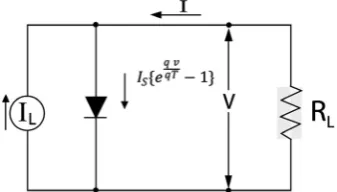
In this work, a digital pyranometer has been used to measure the solar radiation. The resulting equivalent circuit of a solar cell is shown in Figure 1.
The I-V characteristics of such a device are given by,
exp 1
s qV L
I I I
KT
= − −
(1)
where, IL is photo generated current (amperes), q is elementary charge, 19
1.6 10 Coulombs,× − k is Boltzmann’s constant, 1.38 10× −23J K , T is the cell temperature in Kelvin. At 25˚C, kT/q ≈ 0.0259 volts.
Fill factor is the ratio of the maximum power point divided by the open circuit voltage (Voc) and the short circuit current (Isc):
m c
oc sc oc sc
P A E
FF
V I V I
η × ×
= =
DOI: 10.4236/cweee.2019.84006 93 Computational Water, Energy, and Environmental Engineering
Figure 1. The equivalent circuit of a solar cell.
where, ŋ is the solar cell conversion efficiency, Ac is the surface area of the solar
cell, E is the input light irradiance.
FF can also be interpreted graphically as the ratio of the rectangular areas de-picted in Figure 2.
MAX m m
T sc c
I V P
FF
P I V
= = (3)
Efficiency is the ratio of the electrical power output Pout compared to the solar
power input, Pin, into the PV cell. Pout can be taken to be PMAX since the solar cell
can be operated up to its maximum power output to get the maximum efficiency
out MAX MAX in in , P P P P
η= η = (4)
Pin is taken as the product of the irradiance of the incident light, measured in
W/m2, with the surface area of the solar cell which is measured in m2.
STC specifies a temperature of 25˚C and an irradiance of 1000 W/m2 with an
air mass 1.5 (AMI 1.5) spectrum.
3. Results and Discussion
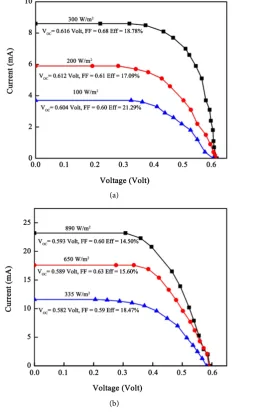
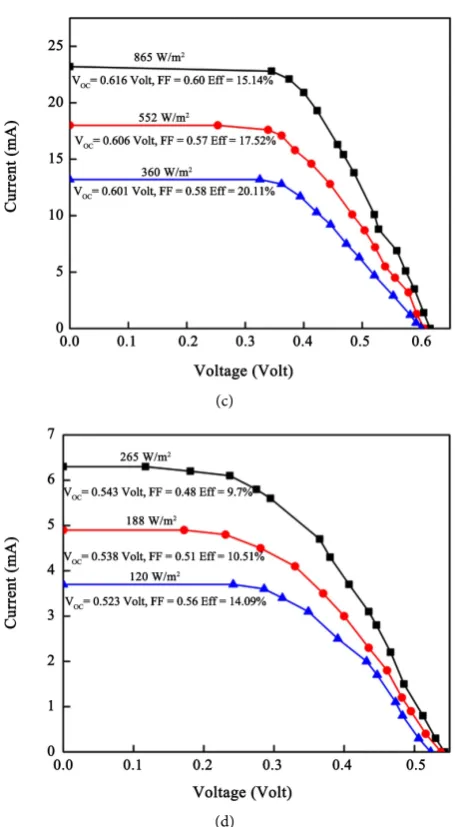
The current-voltage characteristics of the solar cell are measured at different in-door and outin-door conditions. The solar cell has been characterized by using the experimental set and also characterized both in the indoor and outdoor condi-tions. Figures 3(a)-(d) shows the variation of current with voltage when the cell is illuminated with the light source and the sun. The shapes of the curves are shown in Figures 3(a)-(d). In the I-V characteristics curve, it was observed that the current remains constant at the beginning and there is small variation of current with voltage in short time. At the end of the graph, it shows that current changes rapidly with small change in voltage. Figures 3(a)-(d) shows the cur-rent-voltage characteristics curves of solar cell at different light intensities. The
Voc and Isc can be directly determined from graph, the maximum voltage Vm and
current Im at the maximum power point can be determined by computing the IV
product at the turning points on the curve and selecting the points where the product is maximum. Thus the maximum power and fill-factor can be obtained from the relations Pm = ImVm and FF = ImVm/VocIsc, respectively. The efficiency
DOI: 10.4236/cweee.2019.84006 94 Computational Water, Energy, and Environmental Engineering
Figure 2. Getting the Fill Factor from the I-V curve.
(a)
DOI: 10.4236/cweee.2019.84006 95 Computational Water, Energy, and Environmental Engineering (c)
[image:5.595.260.488.64.478.2](d)
Figure 3. Voltage-Current characteristics of solar cell at different light intensities (a) 300
W, 200 W, 100 W bulb as a constant light source, (b) When the sky was clear (sunny day), (c) Sun as a light source when the sky was windy, (d) When the sky was cloudy.
Figure 4 shows that if we compare the maximum point in the P-V curve and the maximum power point in the I-V curve, it results that they are situated at the same vertical line.
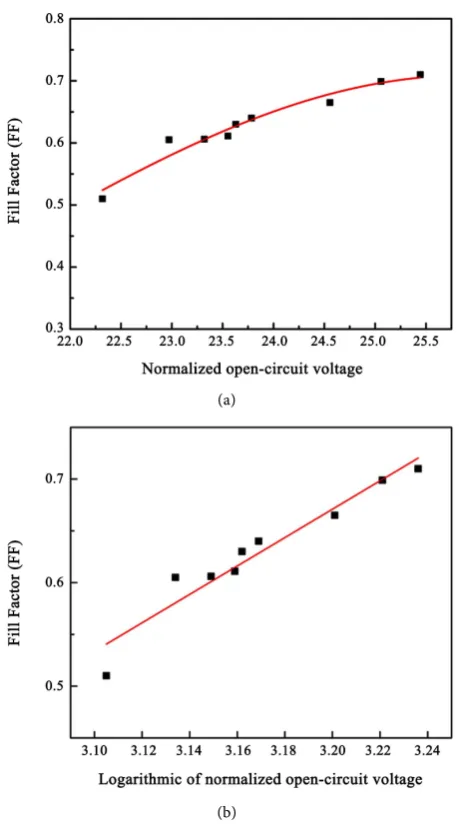
The ideal characteristics of solar cells is obtained by plotting corresponding fill factor (FF) of normalized open-circuit voltage [Voc/(KT/q)] and its loga-rithmic are shown in Figure 5(a) and Figure 5(b), respectively, where the first one shows a non-linear behavior bowing upward and the second one exhibits li-near relationship.
DOI: 10.4236/cweee.2019.84006 96 Computational Water, Energy, and Environmental Engineering
Figure 4. Current and Power as a function of Voltage.
(a)
(b)
Figure 5. (a) Value of the fill factor as a function the open-circuit voltage
[image:6.595.259.489.266.679.2]DOI: 10.4236/cweee.2019.84006 97 Computational Water, Energy, and Environmental Engineering
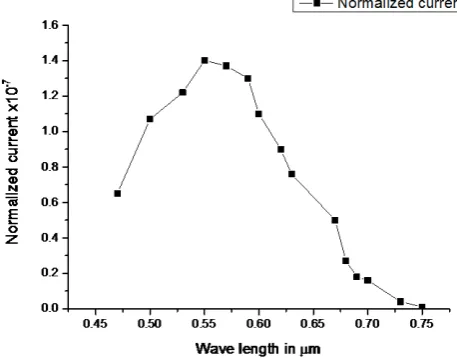
Figure 6. Spectral response of a multijunction solar cell.
4. Conclusion
In this work, the efficiency of MJSC is evaluated at different light intensities on various times of the day. At the more insulation, more current and more voltage are produced. Variation of efficiency, open circuit voltage (Voc), short circuit
current (Jsc) and fill factor (FF) with the variation of different light intensity have
been investigated. When the cell temperature becomes high, its efficiency de-creases. Due to wind effect, cell temperature becomes low and more efficiency is obtained. As the temperature increases, the diffusion length increase, because the diffusion constant stays the same or increase with temperature, and the mi-nority life time increase with temperature. The increase in mimi-nority-carrier dif-fusion length causes an increase in JL (photo-generated current density). This
ef-fect causes a reduction of efficiency as the temperature increases. The main im-pact of series resistance is to reduce the fill factor, although excessively high val-ues may also reduce the short -circuit current. A large fill factor is desirable and corresponds to an I-V sweep that is more square-like. Typical fill factors range from 0.5 to 0.82. The fill factor is directly affected by the values of the cells series and shunt resistance. Increasing the shunt resistance (Rsh) and decreasing the
se-ries resistance (Rs) will lead to higher fill factor, thus resulting in greater
effi-ciency, and pushing the cells output power closer towards its theoretical maxi-mum.
Acknowledgements
Authors thank Dr. Md. Nurul Islam, Dept. of Physics, University of Chittagong for helpful discussions.
Conflicts of Interest
DOI: 10.4236/cweee.2019.84006 98 Computational Water, Energy, and Environmental Engineering
[3] Green, M.A. (2003) Crystalline and Thin-Film Silicon Solar Cells: State of the Art and Future Potential. Solar Energy, 74, 181-192.
https://doi.org/10.1016/S0038-092X(03)00187-7
[4] Blakers, A.W. and Green, M.A. (1986) 20% Efficient Silicon Solar Cell. Applied Physics Letters, 48, 215-217.https://doi.org/10.1063/1.96799
[5] Green, M.A. (2009) The Path to 25% Silicon Solar Cell Efficiency: History of Silicon Cell Evolution. Progress in Photovoltaics, 17, 183-189.
https://doi.org/10.1002/pip.892
[6] Zhao, J., Wang, A. and Green, M.A. (2001) 24.5% Efficiency PERT Silicon Solar Cells on SHE MCZ Substrates and Cell Performance on Other SHE CZ and FZ Sub-strates. Solar Energy Materials & Solar Cells, 66, 27-36.
https://doi.org/10.1016/S0927-0248(00)00155-0
[7] Green, M.A. (2002) Limiting Photovoltaics Light Conversion Efficiency. Progress in Phtovoltaic, 9, 257-261.https://doi.org/10.1002/pip.375
[8] King, R.R., Law, D.C., Edmondson, K.M., Fetzer, C.M., Kinsey, G.S., Yoon, H., She-rif, R.A. and Karam, N.H. (2007) 40% Efficient Metamorphic GaInP/GaInAs/Ge Multijunction Solar Cells. Applied Physics Letters, 90, Article ID: 183516.
https://doi.org/10.1063/1.2734507
[9] Islam, M.R., Hasan, M.T., Bhuiyan, A.G., Islam, M.R. and Yamamoto, A. (2008) Design and Performance of InxGa1−xN-Based MJ Solar Cells. IETECH Journal of
Electrical Analysis, 2, 237-243.
[10] Islam, M.R., Hasan, M.T., Rayhan, M.A. and Bhuiyan, A.G. (2012) High Efficiency InxGa1−xN-Based Multi-Junction Solar Cells with Concentrator. Journal of Electrical