J Anim Ecol. 2019;1–17. wileyonlinelibrary.com/journal/jane
|
1 Received: 28 June 2018|
Accepted: 21 November 2018DOI: 10.1111/1365-2656.12948
R E S E A R C H A R T I C L E
Seasonal differences in baseline innate immune function are
better explained by environment than annual cycle stage in a
year- round breeding tropical songbird
Chima J. Nwaogu
1,2,3|
Will Cresswell
2,3|
Maaike A. Versteegh
1|
B. Irene Tieleman
1This is an open access article under the terms of the Creative Commons Attribution License, which permits use, distribution and reproduction in any medium, provided the original work is properly cited.
© 2019 The Authors. Journal of Animal Ecology published by John Wiley & Sons Ltd on behalf of British Ecological Society 1Groningen Institute for Evolutionary
Life Sciences, University of Groningen, Groningen, The Netherlands
2School of Biology, University of St Andrews, St Andrews Fife, UK
3A.P. Leventis Ornithological Research Institute, Jos, Nigeria
Correspondence Chima J. Nwaogu Email: [email protected]
Funding information
Leventis Conservation Foundation through the University of St. Andrews UK; Ubbo Emmius grant of the University of Groningen, The Netherlands.; Netherlands Organisation for Scientific Research, Grant/ Award Number: NWO-Vidi 864.10.012
Handling Editor: Daniel Ardia
Abstract
1. Seasonal variation in innate immunity is often attributed to either temporal envi
-ronmental variation or to life-history trade-offs that arise from specific annual cycle stages but decoupling them is difficult in natural populations.
2. Here, we effectively decouple seasonal environmental variation from annual cycle stage effects by exploiting cross-seasonal breeding and moult in the tropical Common Bulbul Pycnonotus barbatus. We test how annual cycle stage interacts with a key seasonal environmental variable, rainfall, to determine immunity at population and individual level. If immune challenge varies with precipitation, we might expect immune function to be higher in the wet season due to increased environmental productivity. If breeding or moult imposes resource constraints on birds, depending on or independent of precipitation, we might expect lower im
-mune indices during breeding or moult.
3. We sampled blood from 818 birds in four annual cycle stage categories: breeding, moult, simultaneous breeding and moulting, or neither. We quantified indices of innate immunity (haptoglobin, nitric oxide (NOx) and ovotransferrin concentra
-tions, and haemagglutination and haemolysis titres) over two annual cycles of wet
and dry seasons.
4. Environment (but not annual cycle stage or interactions between both) explained variation in all immune indices, except NOx. NOx concentration differed between
annual cycle stages but not between seasons. However, within the wet season, haptoglobin, NOx, ovotransferrin and haemolysis differed significantly between
breeding and non-breeding females. Aside from some recorded inconsistencies, population level results were largely similar to results within individuals that were measured repeatedly. Unexpectedly, most immune indices were higher in the dry season and during breeding.
5. Higher immune indices may be explained if fewer or poorer quality resources force birds to increase social contact, thereby exposing individuals to novel anti
1
|
INTRODUCTION
Immune function varies seasonally (Dopico et al., 2015; Nelson &
Demas, 1996), and this is often attributed to either variation in en
-vironment (Horrocks, Matson, & Tieleman, 2011; Tieleman, 2018)
or to life- history trade- offs that are associated with resource allo
-cation to competing annual cycle stages (Knowles, Nakagawa, &
Sheldon, 2009; Sheldon & Verhulst, 1996). However, because an
-nual cycle stages often covary with environmental factors, seasonal differences in immune function may reflect response to seasonal environmental variation, annual cycle stage or both. The difficulty in decoupling environmental effects (food, diet, vectors or antigenic properties) from life- history- related effects (resource cost of annual cycle stages or associated effects) sets limitations to interpreting immune variation on the basis of life- history trade- offs in natural populations (Pedersen & Babayan, 2011; Ricklefs & Wikelski, 2002; Schmid- Hempel, 2003).
Interpreting immune variation on the basis of life- history vari
-ation at the popul-ation level only (Hegemann, Matson, Both, & Tieleman, 2012; Tieleman, Williams, Ricklefs, & Klasing, 2005) may
be problematic if individuals vary consistently in response to envi
-ronment and/or life- history challenges (Ardia, 2005b) due to differ
-ences in personality or quality (Araya- Ajoy et al., 2018). Individuals may vary in exposure or tolerance to infection (Bansal, Grenfell, & Meyers, 2007; Lloyd- Smith, Schreiber, Kopp, & Getz, 2005; Loehle, 1995) and in resource acquisition and allocation to immunity and other competing traits (van Noordwijk & de Jong, 1986; van de Pol & Wright, 2009). These differences may cause relationships between immune function and competing life- history traits within individuals to be obscured at the population level by among- individual variation (Merrill et al., 2015; Williams, Christians, Aiken, & Evanson, 1999). Therefore, understanding variation in immunity on the basis of life- history trade- offs requires an ecological context (Tieleman, 2018)
where variation in both environment and individual animals is con
-sidered using carefully selected immune indices (Norris & Evans, 2000).
Seasonally arid tropical environments where resident birds breed and moult across different seasons are suitable for decoupling the effect of seasonal environmental variation from that of annual cycle stages on immune function. In Nigeria, there is a single wet and
dry season annually, and environmental factors differ between and
within these seasons. Food is usually more abundant in the wet sea
-son (Ngozi Molokwu, Ols-son, Nils-son, & Ottos-son, 2008; Nwaogu,
Dietz, Tieleman, & Cresswell, 2017), but pathogens and disease vec
-tors should also be more abundant in the wet season due to high en
-vironmental productivity (Pascual, Bouma, & Dobson, 2002; Young, Garvin, & McDonald, 1993). However, social contact may increase
with less food and water during the dry season because animals clus
-ter around fewer resources, and this may facilitate disease transmis
-sion (VanderWaal, Gilbertson, Okanga, Allan, & Craft, 2017), even if pathogen abundance is low. Furthermore, the effect of rainfall on
environmental productivity may vary between seasons. For exam
-ple, while the onset of the wet season is rapid, and the effects of precipitation are quickly felt, the rains do not end as abruptly, and
hence, the commencement of the dry season, and associated dry
-ing out of the environment, is much more prolonged. Thus, con
-ditions within the wet season should be less variable than the dry
season. Nonetheless, the resident Common Bulbul Pycnonotus
bar-batus is capable of breeding year- round (Cox et al., 2013; Nwaogu, Tieleman, & Cresswell, 2018) and its individuals are long- lived (Stevens, Ottosson, McGregor, Brandt, & Cresswell, 2013) in central Nigeria. These characteristics make them ideal for decoupling the effects of environment and annual cycle stage on immune function. Some individuals moult into the dry season or overlap moult with breeding (Nwaogu et al., 2018), and this allows the effect of moult
on immune function to be considered between seasons and breed
-ing states. Residency allows repeat sampl-ing of individuals between seasons and annual cycle stages. Consequently, temporal elevation of resource demands due to the occurrence of breeding and moult
(Murphy, 1996; Sanz, Moreno, Merino, & Tomás, 2004) becomes ef
-fectively decoupled from seasonal environmental variation, allowing
life- history and environment effects to be decoupled at both popu
-lation and individual levels.
Nonetheless, despite the large body of literature in ecological
immunology, interpreting variation in immune indices is still ambigu
-ous (Buehler, Versteegh, Matson, & Tieleman, 2011; Matson, Cohen, Klasing, Ricklefs, & Scheuerlein, 2006; Versteegh, Schwabl, Jaquier, & Tieleman, 2012). Depending on the immune index (Boughton, Joop, & Armitage, 2011; Demas, Zysling, Beechler, Muehlenbein, & French, 2011), high values may indicate a well- protected animal capable of
infected females omit breeding. We conclude that seasonal environmental varia
-tion impacts immunity more directly in natural animal popula-tions than via re
-source trade-offs. In addition, immune indices were more often variable within than among individuals, but some indices are characteristic of individuals, and so may offer selective advantages if heritable.
K E Y W O R D S
destroying invading agents, or a prior poorly protected and now highly challenged animal. From an “operative protection” point of view, high
levels of immune indices should indicate increased investment pro
-portionate to current or perceived infection (Horrocks, Matson et al.,
2011), or trade- offs due to increased investment in competing pro
-cesses within the immune system (Martin, Weil, Kuhlman, & Nelson,
2006; McDade, Georgiev, & Kuzawa, 2016). Indices such as haemo
-lytic or bacteria killing capacity of blood or plasma reflect ability to destroy foreign cells (Matson, Ricklefs, & Klasing, 2005; Tieleman et al., 2005) and thus a relative measure of an individual's ability to clear infection. But biomarkers of inflammatory response may have relative interpretations: haptoglobin is a positive acute phase protein which normally circulates in low concentration but increases with inflammation (Jain, Gautam, & Naseem, 2011; Matson, Horrocks, Versteegh, & Tieleman, 2012; van de Crommenacker et al., 2010; but see Hegemann, Matson, Versteegh, Villegas, & Tieleman, 2013). Ovotransferrin on the other hand is a negative acute phase protein.
Both ovotransferrin and haptoglobin increase with inflammation be
-cause they bind to and remove haem from circulation during infec
-tion, so that haem is unavailable as nutrient to pathogens (Horrocks,
Irene Tieleman, & Matson, 2011). But concentrations of ovotrans
-ferrin may decrease with increased inflammation because temporar
-ily high free hormones may bind to ovotransferrin, and other acute phase proteins may be produced at the expense of ovotransferrin by the liver (Giansanti, Leboffe, Pitari, Ippoliti, & Antonini, 2012; Gruys,
Toussaint, Niewold, & Koopmans, 2005; Jain et al., 2011). NOx modu
-lates inflammatory processes but also participates in the direct killing of parasites and tumour cells (Sild & Hõrak, 2009). Overall, combining measures of haemolytic and natural antibody activity with multiple
biomarkers of inflammatory response should give a robust assess
-ment of constitutive immune function (Adamo, 2004).
In this study, we test the main and interactive explanatory power of seasonal environmental variation (i.e. occurrence of rainfall) and annual cycle stage on seasonal immune variation. We separate male and female bulbuls into annual cycle stages on the basis of breeding
and moult occurrence and test differences in baseline innate immu
-nity between the wet and dry season and within the wet season at population and individual levels. Specifically, we test: (a) the effects
of seasonal environmental variation and annual cycle stage on vari
-ation in immune function of females and males at the popul-ation level; (b) the main and interactive effects of breeding and moult on immune function of females in the wet season (see justification for excluding males and dry season records in method section (below));
and (c) within individuals, the effect of seasonal environmental vari
-ation on immune function of non- breeding and non- moulting birds, and the separate effects of breeding and moult on immune function within the wet season. We expect immune indices to be higher in the
wet season compared to the dry season due to higher environmen
-tal productivity, but we expect the occurrence of breeding and/or moult to lower immune function. However, differences between the wet and the dry season should remain consistent for different annual cycle stages in both sexes, if seasonal environmental variation is a more crucial determinant of seasonal variation in immune function.
Otherwise, differences between annual cycle stages should be con
-sistent between the wet and dry season at both population and in
-dividual levels. But, if both factors are important, we might expect interactions between them. Under such interaction scenarios, we predict that: (a) immune indices should be lowest for breeding or moulting birds in the dry season and highest for non- breeding or
non- moulting birds in the wet season; (b) Breeding and moulting fe
-males should have lower immune indices compared to non- breeders and non- moulters, especially when breeding and moult overlap; and (c) Patterns within individuals should be similar to patterns at the population level and repeatability should be low, if the effect of seasonal environmental variation and/or annual cycle stage leads to larger variations within than among individuals.
2
|
MATERIALS AND METHODS
2.1
|
Birds, blood sampling and determination of
variables
Field work was carried out at the Amurum Forest Reserve (09°52′N, 08°58′E) which is located at the A.P. Leventis Ornithological Research Institute (APLORI) on the Jos Plateau in north central Nigeria (see Supporting Information for more details on field site). All field work was approved by the APLORI scientific committee. We
collected 818 blood samples from 530 individuals over 256 days be
-tween 29 January 2014 and 5 February 2016 (mean = 3.2, SD = 2.8,
min = 1, max = 16 bulbuls/day, Supporting Information Figure S2). All
birds were caught using mist nets between 6:00 and 11:00 hr. On av
-erage, birds were bled 7.9 ± 4.3 min after capture (Range 2–15 min).
Samples were stored on ice in the field until processing in the labora
-tory to separate plasma from cellular fractions. Plasma was separated and stored frozen at −20°C until immune assays were carried out.
For each bird, we assessed breeding status on the basis of brood patch occurrence (Redfern, 2010), and moult status on the basis of feather quality and occurrence of moulting primary wing feathers.
Only females incubate eggs; therefore, only females could be classi
-fied as breeding or not. Since bulbuls are sexually monomorphic, we sexed all birds using gel electrophoresis. DNA extractions followed methods described by Richardson, Jury, Blaakmeer, Komdeur, and Burke (2001) and amplification was done using the P2/P8 primers (Griffiths, Daan, & Dijkstra, 1996).
2.2
|
Immune assays
2.2.1
|
Haptoglobin concentration
We quantified plasma haptoglobin concentration using a functional colorimetric assay which quantifies the haem- binding capacity of plasma. We followed instructions for the “manual method” provided with a commercially available assay kit (Cat. No.: TP801; Tridelta
Development Ltd, Maynooth, Co. Kildare, Ireland). We used 7.5 μl of
plasma and standard curves in respective wells. A five- step serial di
standard was used as the standard curve concentrations. We ran
-domised samples before assays. We calculated within- assay variabil
-ity (n = 20 plates, maximum CV = 0.88, minimum CV = 0.31, mean
CV = 0.49) and among- assay variability (n = 807 samples, CV = 0.58)
to verify consistency.
2.2.2
|
Nitric oxide concentration
We measured nitric oxide concentration by a colorimetric assay de
-scribed by Sild and Hõrak (2009). This estimates the concentration of nitrate and nitrite in plasma after reducing all nitrate to nitrite
using copper- coated cadmium granules. A measurable colour devel
-opment proportionate to nitric oxide concentration follows reaction
with Griess reagent. We used 10 μl of plasma for the nitrate reduc
-tion step. A five- step serial dilu-tion (100, 50, 25, 12.5, 6.25, 3.13
and 1.6 μM) of nitrate standard was used as the standard curve con
-centrations. We randomised samples before assays. We calculated
within- assay variability (n = 17 plates, maximum CV = 0.94, minimum
CV = 0.48, mean CV = 0.70) and among- assay variability (n = 667
samples, CV = 0.73) to verify consistency.
2.2.3
|
Ovotransferrin concentration
Ovotransferrin was quantified by estimating the maximum amount of iron required to saturate all ovotransferrin in a sample. We used
methods described by Horrocks, Irene Tieleman et al. (2011), follow
-ing a three- step process involv-ing: saturation of ovotransferrin with ferric iron under alkaline conditions, reduction of excess unbound
iron by ascorbic acid, then dissociation of ovotransferrin- iron com
-plex under acidic conditions, leading to colour development whose
absorbance is measured by colorimetry. We used 10 μl of plasma and
standard conalbumin concentrations (20, 16, 10, 4, 2 and 1 mg/ml) for test and standard curves, respectively. We randomised and analysed
each sample in duplicate. We further calculated within- assay vari
-ability (n = 48 plates, maximum CV = 1.18, minimum CV = 0.21, mean
CV = 0.70) and among- assay variability (n = 652 samples, CV = 0.53)
to verify consistency.
All colorimetric assays (a–c above) were carried out using the Versamax plate reader (Molecular Devices, Sunnyvale, CA).
2.2.4
|
Haemagglutination/haemolysis titres
We assessed natural antibody- mediated haemagglutination and complement- mediated haemolysis titres of plasma samples against 1% rabbit red blood cells (Envigo RMS (UK) Ltd.) in phosphate- buffered saline as described by Matson et al. (2005). Twenty- five
microlitre of plasma was used as the starting concentration, and sub
-sequent concentrations were obtained by a further 10- step serial di
-lution of 25 μl plasma in 25 μl of phosphate- buffered saline. 25 μl of
1% rabbit red blood cells was incubated in each well. Both haemag
-glutination and haemolysis titres were recorded as the number of se
-rial dilution steps in which each function was still observable (i.e. 1:2 is 2 while 1:1,024 is 11; Matson et al., 2005). We randomised samples
before assays. We calculated within- assay variability (n = 255 plates,
haemagglutination: maximum CV = 1.41, minimum CV = 0, mean CV = 0.43; haemolysis: maximum CV = 2.23, minimum CV = 0, mean
CV = 1.48) and among- assay variability (n = 801 samples, haemag
-glutination: CV = 0.51; haemolysis: CV = 2.38) to ensure consistency.
2.3
|
Statistics
We analysed each index separately because immune indices were uncorrelated or at most weakly correlated with each other (All
r2 < 5%), and a principal component analysis did not substantially
reduce the number of variables (i.e. the five measured indices clus
-tered into three principal components: PC1 (24%)—NOx and
hae-molysis; PC2 (25%)—ovotransferrin and haemagglutination; and PC3 (21%)—haptoglobin, NOx, ovotransferrin and haemagglutination).
First, we tested the effects of environment and annual cycle stage on baseline innate immune function at the population level. We built
general linear models for haptoglobin, NOx, ovotransferrin and haem
-agglutination, and a generalised linear model for haemolysis. We in
-cluded season and annual cycle stage, and their interaction as predictor variables. We ran separate analyses for the two sexes because breeding status was only reliably determined for females. We grouped females
into breeding (B), moulting (M) and neither (N) and excluded individu
-als that were breeding and moulting simultaneously (BM) because only three records were obtained for this group in the dry season (against 38 in the wet season). We grouped males into non- moulting (NM) and moulting (M). For population level analyses, we used the first capture
of an individual if it was caught more than once, to prevent pseudorep
-lication. Capture date—assigned as number of days from the first day of
each season was included in each model to account for seasonal varia
-tion within the wet and dry seasons. 1 April was assigned the first day of the wet season while 1 November was assigned the first day of the dry season annually. Body mass was included in all models to account for the possible effect of individual body condition on immune indices. Haemolysis titre was modelled as a binary outcome throughout the study (0 or 1) because this was mostly zero or relatively low for most birds. Because samples were analysed in two batches (one for each
year), we included “batch” as a fixed factor in all models. Significant ef
-fects of batch may result from natural differences between years and/ or differences between the analyses (e.g. reagents, kits).
Secondly, we tested the effects of breeding and moult, and their interaction, on immune function within the wet season for females only. Again, we excluded repeat captures and included capture date
and body mass in all models. We built general linear models for hap
-toglobin, NOx, ovotransferrin and haemagglutination, and a gener
-alised linear model for haemolysis.
Finally, we tested whether the population level results occurred
in the same way within individual birds, using individuals with multi
-ple sampling records only. We built general linear mixed models for
haptoglobin, NOx, ovotransferrin and haemagglutination, and a gen
-eralised linear mixed model for haemolysis, including individual iden
depending on availability, testing differences between seasons, breeding and moult states, keeping analyses separate for the sexes. To test differences between seasons, we only considered females that were neither breeding nor moulting, and males that were not moulting. To test differences between breeding and non- breeding
state and moulting and non- moulting state, we considered individu
-als caught between these annual cycle stages within the wet season
only. Further, we estimated individual repeatability using the pack
-age “rptr” (Stoffel, Nakagawa, & Schielzeth, 2017), including batch, season, breeding and moult as covariates in each model.
All models were reduced by a stepwise backward elimination, ex
-cept for the repeatability models in which we retained season, annual cycle stage and batch even if they were not significant. However, we included the non- significant outputs of all eliminated variables in our
summary tables to show their performance in each model. We per
-formed post hoc tests implemented by the package “lsmeans” (Lenth, 2016) to determine between group differences where interaction between predictor variables was significant. All statistical analyses
were performed in r 3.4.4.
3
|
RESULTS
Overall, seasonal differences in immune function were more often explained by season than annual cycle stage (ACS) for all indices,
except NOx concentration. The effect of annual cycle stages were
largely only visible within the wet season. Aside some inconsist
-encies, results at the population level were largely similar to those within individuals that were sampled repeatedly.
3.1
|
Population level differences in
immune function
3.1.1
|
Between breeding and moult states in the
wet and dry seasons
In female bulbuls, ovotransferrin concentration, and haemolysis titre differed significantly between seasons (Figure 1). The effect of season on haptoglobin concentration was influenced by date (Table 1): haptoglobin concentration was always higher in the dry than the wet season (Figure 1a, post hoc test on dry season–wet
season while controlling for date t = 4.0, p < 0.01), but increased
with date through the dry season and remained low through the wet season (Supporting Information Figure S4). The haemagglutination titre did not differ significantly between seasons (Figure 1d, Table 1).
Haptoglobin and ovotransferrin concentration and haemagglutina
-tion and haemolysis titre did not differ between annual cycle stages
(Table 1). In contrast, variation in NOx concentration was explained
by an interaction between season and annual cycle stage (Table 1,
Figure 1b)—NOx concentration was only significantly higher for
breeding females in the wet season (post hoc test: B–M (t = 3.2,
p < 0.01), B–N (t = 2.0, p = 0.1), M–N (t = −2.1, p = 0.08)), but did not
differ between annual cycle stages in the dry season (post hoc tests:
all p > 0.94). Body mass did not explain variation in immune indices
(Table 1).
Male bulbuls had significantly higher haemagglutination and
haemolysis titres in the dry season, and like females, these indi
-ces did not differ between annual cycle stages (Figure 2, Table 1).
Similar to females, the effect of season on haptoglobin concen
-tration was influenced by date (Table 1): haptoglobin concentra
-tion was higher in the dry season than the wet season (Figure 2a,
post hoc test on dry–wet season while controlling for date t = 4.0,
p < 0.01), but increased significantly through the dry season and
remained low throughout the wet season (Supporting Information
Figure S5). Similarly, the effect of season on NOx concentration was
influenced by date: the difference between seasons was only sig
-nificant after controlling for date (post hoc test: dry season – wet
season t = 2.7, p < 0.01). NOx increased during the dry season, but
decreased during the wet season (Supporting Information Figure
S5). Unlike in females, NOx was significantly higher for non- moulting
compared to moulting males independent of season (Figure 2b, Table 1). Ovotransferrin concentration did not differ significantly between seasons and annual cycle stage in male bulbuls (Figure 2c, Table 1). Unlike females, haemagglutination increased significantly
through the wet and dry season. Body mass did not explain varia
-tion in immune indices (Table 1).
3.1.2
|
Between breeding and moult states in
females within the wet season
Within the wet season, haptoglobin concentration (Figure 3a) was significantly lower, while ovotransferrin concentration (Figure 3c)
and haemolysis titre (Figure 3e) were significantly higher in breed
-ing compared to non- breed-ing females. The moult state of female birds did not influence these immune indices (Table 2). The only
exception was NOx concentration (Figure 3b), where the interac
-tion between breeding and moult was significant (Table 2). NOx
concentration was only significantly higher for breeding females
in non- moulting state (Figure 3b, post hoc (NM): NB – B (t = −2.5,
p < 0.01))—during moult, breeding and non- breeding females did
not differ in NOx concentration (Figure 3b, post hoc (M): NB – B
(t = 0.1, p = 0.89)). Haemagglutination titre did not differ between
breeding and non- breeding females in the wet season (Figure 3d, Table 2). Body mass did not explain variation in immune indices (Table 1).
3.2
|
Intra- individual level differences in
immune function
3.2.1
|
Between seasons in non- breeding and
non- moulting females, and non- moulting males
Within- individual females, haptoglobin concentration and hae
-molysis titre were significantly higher in the dry season, while
NOx concentration and haemagglutination titre did not differ be
level, ovotransferrin concentration did not differ between seasons (Figure 4g, Table 3a).
Within- individual males, haptoglobin concentration was sig
-nificantly higher in the dry season, while NOx and ovotransferrin
concentration did not differ between seasons (Figure 5, Table 3a).
Unlike at the population level, haemolysis titre did not differ be
-tween seasons, but individuals were more likely to have higher haemolysis titre in the dry season than in the wet season (Figure 5i, Table 3a).
3.2.2
|
Between breeding and non- breeding states
in the wet season
Within- individual females, NOx concentration and haemolysis
titre were significantly higher during breeding, while haemagglu
-tination titre did not differ between breeding and non- breeding
states (Figure 4, Table 3a). Unlike at the population level, hap
-toglobin and ovotransferrin concentration did not differ signifi
-cantly between breeding and non- breeding states (Figure 4b,h, Table 3a).
3.2.3
|
Between moulting and non- moulting states
in the wet season
Within- individual females, NOx concentration was significantly
higher during moult, while haptoglobin and ovotransferrin concen
-trations, and haemagglutination and haemolysis titres did not differ between moulting and non- moulting states (Figure 4, Table 3a).
Within- individual males, NOx concentration was significantly
higher during moult, while haptoglobin and ovotransferrin concen
-trations, and haemolysis titres did not differ between moulting and non- moulting states (Figure 5, Table 3a). Unlike at the population
F I G U R E 1 Seasonal differences in (a) haptoglobin, (b) nitric oxide, (c) ovotransferrin, (d) haemagglutination titre and (e) % occurrence of haemolysis between annual cycle stages in female Common Bulbuls, sampled over two annual cycles in Nigeria. Annual cycle stages were determined based on occurrence of brood patch and feather quality: B—breeding; M—moulting and N— non- breeding and non- moulting. Sample sizes are indicated below each box/bar
+DSWRJORELQPJPO
'U\ :HW (a)
1LWU
LFR
[LGH
0
(b)
2Y
RWUDQVI
HUU
LQPJPO
(c)
% 0 1
$QQXDOF\FOHVWDJH
+DHPDJJOXWLQDWLRQWLWUH
(d)
% 0 1
$QQXDOF\FOHVWDJH
RFFXUUHQFHRIKDHPRO\VL
V
level, haemagglutination titre was significantly higher during moult (Figure 5h, Table 3a).
3.2.4
|
Individual repeatability
Individual repeatability in immune indices was low to modest (0.01– 0.23; Table 3b). Nonetheless, the repeatabilities for haptoglobin and
NOx concentrations were significant in females, while those of NOx
concentration and haemagglutination titre were significant in males (Table 3b).
4
|
DISCUSSION
In a system that decouples seasonal environmental variation and annual cycle stage in a tropical songbird, we found that seasonal
differences in immune function were more often explained by envi
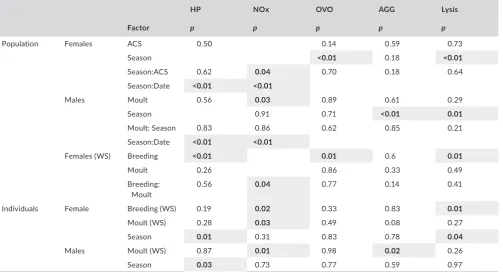
-ronmental variation than annual cycle stage (Table 4). Immune indi
-ces were generally higher in the dry season than in the wet season, independent of annual cycle stage in both female and male birds.
The only exception was NOx concentration, which was higher for
breeding females in the wet season only. We also found that within the wet season, breeding females were more likely to have higher immune indices than non- breeding females, except for haptoglobin
concentration which was significantly higher for non- breeding fe
-males. Moult had no effect on immune function in the wet season. Patterns of immune variation at the population level were largely
similar with patterns within individuals that were sampled repeat
-edly, except for a few inconsistencies, suggesting that population level variation reflects similar within- individual variation and not
simply among- individual variation in immune function due to per
-sonality or quality (see results summarised in Table 4). Overall, our F I G U R E 2 Seasonal differences in (a) haptoglobin, (b) nitric oxide, (c) ovotransferrin, (d) haemagglutination titre and (e) % occurrence of haemolysis between moulting and non- moulting male Common Bulbuls sampled over two annual cycles in Nigeria. Annual cycle stages were determined based on feather quality: NM—non- moulting and M—moulting. Sample sizes are indicated below each box/bar
+DSWRJORELQPJPO
'U\ :HW
(a)
1LWULFR[LGH0
(b)
2YRWUDQVIHUULQPJPO
(c)
10 0
0RXOWVWDWXV
+DHPDJJOXWLQDWLRQWLWUH
(d)
10 0
0RXOWVWDWXV
RFFXUUHQFHRIKDHPRO\VL
V
F I G U R E 3 Differences in (a) haptoglobin, (b) nitric oxide, (c) ovotransferrin, (d) haemagglutination titre and (e) % occurrence of haemolysis between breeding and moult stages within the wet season in female Common Bulbuls sampled over two annual cycles in Nigeria. Annual cycle stages were determined based on occurrence of brood patch and feather quality: NM— non- moulting; M—moulting, B—breeding and NB—non- breeding. Sample sizes are indicated below each box/bar
+DSWRJORELQPJPO
1% %
(a)
1LWU
LFR
[LGH
0
(b)
2Y
RWUDQVI
HUU
LQPJPO
(c)
10 0
0RXOWVWDWXV
+DHPDJJOXWLQDWLRQWLWUH
(d)
10 0
0RXOWVWDWXV
RFFXUUHQFHRIKDHPRO\VL
V
(e)
TA B L E 2 Population level differences in immune indices between breeding and moult states in female Common Bulbuls Pycnonotus barbatus in the wet season. Bulbuls were sampled over two annual cycles in Nigeria. Breeding state was determined based on occurrence of brood patch and moult state based on feather quality. All individuals that were repeat sampled were also excluded
Factor df
HP NOx OVO AGG Lysis
F p F p F p F p LRT p
Batch 1 35.65 <0.01 2.17 0.14 39.63 <0.01 3.54 0.06 1.71 0.19
Body mass 1 0.27 0.60 0.20 0.65 0.01 0.92 0.00 1.00 3.21 0.07
Date 1 0.16 0.69 3.52 0.06 2.50 0.12 3.42 0.07 0.01 0.91
Breeding (B) 1 15.07 <0.01*** a 6.74 0.01* 0.28 0.60 7.36 <0.01**
Moult (M) 1 1.25 0.26 a 0.03 0.86 0.98 0.33 0.48 0.49
B:M 1 0.35 0.56 4.46 0.04* 0.08 0.77 2.25 0.14 0.68 0.41
Note. AGG: haemagglutination and lysis—haemolysis; HP: haptoglobin concentration; NOx: nitric oxide concentration; OVO: ovotransferrin concentration.
Summary statistics with significant p-values are highlighted bold. * indicates level of significance: *p < 0.05; **p < 0.01; ***p < 0.001.
results suggest that innate immunity depends largely on the envi
-ronment because, except for NOx, annual cycle stages were only
significant within the wet season. Immune indices are often more
variable within than among individuals as suggested by low repeat
-ability, although some indices were still repeatable.
Our finding of higher immune indices in the dry season inde
-pendent of annual cycle stage is contrary to expectations based on predictions of lower infection risk with increased aridity (Horrocks et al., 2015; B. I. Tieleman, M. A. Versteegh, K. C. Klasing, & J. B. Williams, unpublished data) and lower investment in immunity under less optimal foraging conditions (French, DeNardo, & Moore, 2007). We found no indication that immune investment in Common
Bulbuls was constrained by the occurrence of annual cycle stages— an explanation given for winter immune enhancement in temperate
animals (Nelson & Demas, 1996). NOx concentration was the only
exception, and it is unlikely that its variation is due to competition for resources, because it was higher for breeding birds and lower for moulting birds. In seasonal environments like central Nigeria, one will predict that natural selection should shape immune function to counter predictable infection risks (Horrocks, Matson et al., 2011), and there are indications that vector- and waterborne diseases are typically high during tropical wet seasons (Altizer et al., 2006; Pascual et al., 2002; Young et al., 1993). But only few studies have investigated variation in immune function in tropical environments
(Lee, Wikelski, Robinson, Robinson, & Klasing, 2008; Ndithia, Bakari, Matson, Muchai, & Tieleman, 2017; Tieleman et al., 2005), and none has done so over the entire annual cycle (Supporting Information Figure S2). Our study is also unique in that it takes place in a clearly seasonally arid environment, representative of the west African
Savanna—a wide spread habitat where multiple factors may vary be
-tween and within seasons (Furley, 2006). Our results suggest that smaller scale local epidemiological factors such as seasonal habitat use, social interaction and diet shifts (Loehle, 1995; Sah, Mann, & Bansal, 2018) may have stronger impact on immune variation and possibly infection risk than factors related to general environmental
productivity, which has been suggested as a proxy for antigen abun
-dance (Horrocks et al., 2015). In support of this idea, incidences of free range poultry diseases in Africa are more prevalent in the dry
season when environmental conditions are presumably harsh, caus
-ing birds to range more widely and cluster around fewer resources (Miguel et al., 2013; Nwanta, Egege, Alli- Balogun, & Ezema, 2008).
This may apply to many free living tropical animal species that clus
-ter around resources in times of scarcity (Altizer et al., 2006), and to
Common Bulbuls in particular, who we observe in large mixed spe
-cies flocks around fruiting plants and water pools retained in gullies during the dry season (Brandt & Cresswell, 2008). Clearly, there is need to assess seasonal differences in infection status in addition to
immune indices and to confirm whether enhancement of specific im
-mune indices are in anticipation of, or response to, higher infection risk in the dry season.
Breeding and moult occurrence did not constrain investment
in immune function as expected (Sheldon & Verhulst, 1996) or al
-ternatively, enhanced immunity did not prevent breeding (Williams et al., 1999). However, the co- occurrence of high haemolysis and
NOx concentrations coupled with lower haptoglobin concentra
-tions in breeding compared with non- breeding females during the wet season (Figure 3a,b,e) suggest that immune function may be organised differently for breeding and non- breeding females. It could also mean that breeding females are more immunocompetent and/or less challenged than non- breeding ones, or that challenged females omit breeding. The latter is likely the case if we interpret
higher haemolysis titre and NOx concentrations as enhanced ca
-pacity to destroy pathogens, and lower haptoglobin concentration
to reflect lower infection. Alternatively, lower haptoglobin concen
-tration in breeding birds may indicate a trade- off between invest
-ing in breed-ing versus immune function (Råberg, Nilsson, Ilmonen,
Stjernman, & Hasselquist, 2000). But lower haptoglobin concentra
-tion cannot be interpreted as an overall down- regula-tion of immune function in breeding birds, because ovotransferrin and nitric oxide concentrations, and haemolysis titre were higher in breeding birds and haemagglutination titre was not affected by breeding state. Note however, that in a diet manipulation experiment on Common Bulbuls, we observed that low haemolysis titre and high haptoglobin concentration are associated with loss of body mass (C. J. Nwaogu, A. Galema, W. Cresswell, M. W. Dietz, & B. I. Tieleman, unpublished
data), and breeding Common Bulbuls are more likely to be in bet
-ter condition (Nwaogu et al., 2017), so high haemolysis titre and low haptoglobin concentration may indicate less challenge. Similarly,
incubating Common Eiders Somateria millissima in better body con
-dition have higher NOx concentration (Bourgeon, Raclot, Le Maho,
Ricquier, & Criscuolo, 2007). Perhaps, the immune system is re- organised depending on annual cycle stage rather than out- rightly down or up- regulated (Buehler, Piersma, Matson, & Tieleman, 2008).
Our observation that moult or its overlap with breeding (Moreno, 2004; Sanz et al., 2004) did not explain variation in all
measured immune indices (except for NOx concentration) is largely
consistent with the finding of Sandström, Prop, van der Jeugd, and Loonen (2014) where baseline immunity was associated more with
date than moult stage in barnacle geese Branta leucopsis. But our
results contrast those of Silverin, Fänge, Viebke, and Westin (1999) and Buehler et al. (2008) who suggested that breaking of feather F I G U R E 5 Within- individual differences in (a, b) haptoglobin,
[image:12.595.49.290.49.441.2]follicles through the skin creates infected wounds that elevate im -mune function during moult. Unlike Sandström et al. (2014), we considered the entire moulting period a fixed annual cycle stage, comparable to breeding, and the absence of breeding and moult (see Figure 1). We do not expect different outcomes from using moult stage as a fixed or continuous variable, because in Common Bulbuls, moult correlates strongly with sampling date (Nwaogu et al., 2018),
but except for haemagglutination in males, none of the measured im
-mune indices correlated with sampling dates within the wet season when moulting largely takes place (Supporting Information Figure S4). Haemagglutination titre increased with sampling dates in males
in both the wet and dry season, so the cause of variation in haemag
-glutination is not obvious. Overall, the occurrence of breeding and moult did not coincide with lower immune indices within the wet season. Nonetheless, we cannot conclude that there are no trade- offs between immune function and the occurrence of breeding or
moult. Rather, we propose that the effect of such trade- offs may de
-pend on environmental conditions (Ardia, 2005a), and this may not always lead to lower immune indices. Unfortunately, we could not statistically test the interactive effect of breeding and moult within
the dry season because we sampled fewer birds breeding and moult
-ing simultaneously. But plots of available data suggest that there are no differences in immune indices between annual cycle stages in the dry season (Supporting Information Figure S3).
Population and individual level patterns were largely consistent, and individual repeatabilities were low to modest. This similarity in
trend between population and individual levels coupled with low individual repeatabilities for most immune indices implies that the impact of seasonal environmental variation and that of annual cycle
stage within the wet season lead to larger variation within individu
-als than among individu-als in the population (Lessells & Boag, 1987). There is no suggestion that population level patterns are resultant of among- individual variation in immune function. However, significant
individual repeatabilities for haptoglobin and NOx concentrations
in females, and NOx concentration and haemagglutination titre in
male Common Bulbuls suggest that these indices are characteristic of individuals (Matson et al., 2012; Sild & Hõrak, 2009; Versteegh, Helm, Kleynhans, Gwinner, & Tieleman, 2014). If in addition to being repeatable, they are also heritable, as with other physiological traits like basal metabolic rate (Tieleman et al., 2009), they should be acted upon by natural selection (Falconer & Mackay, 1996), through the selective advantages they may offer individuals depending on environment.
Individual repeatability in some immune indices may account for
some of the inconsistencies observed between population and indi
-vidual level patterns, because population level analyses were carried out among individuals. Hence, if individuals are repeatable, there is a higher likelihood of finding population level differences even if such differences are not consistent within individuals, and the reverse may be the case if individuals are not repeatable. Nonetheless, some
inconsistencies observed may still not be explained by individual re
-peatability. Patterns of variation in immune function are not always TA B L E 4 Summarised population and individual level results showing cells with significant p values shaded grey
Factor
HP NOx OVO AGG Lysis
p p p p p
Population Females ACS 0.50 0.14 0.59 0.73
Season <0.01 0.18 <0.01
Season:ACS 0.62 0.04 0.70 0.18 0.64
Season:Date <0.01 <0.01
Males Moult 0.56 0.03 0.89 0.61 0.29
Season 0.91 0.71 <0.01 0.01
Moult: Season 0.83 0.86 0.62 0.85 0.21
Season:Date <0.01 <0.01
Females (WS) Breeding <0.01 0.01 0.6 0.01
Moult 0.26 0.86 0.33 0.49
Breeding: Moult
0.56 0.04 0.77 0.14 0.41
Individuals Female Breeding (WS) 0.19 0.02 0.33 0.83 0.01
Moult (WS) 0.28 0.03 0.49 0.08 0.27
Season 0.01 0.31 0.83 0.78 0.04
Males Moult (WS) 0.87 0.01 0.98 0.02 0.26
Season 0.03 0.73 0.77 0.59 0.97
Note. AGG: haemagglutination and lysis—haemolysis; HP: haptoglobin concentration; NOx: nitric oxide concentration; OVO: ovotransferrin concentra -tion; WS: indicates analyses within the wet season only.
[image:13.595.49.553.62.335.2]consistent across levels (Matson et al., 2006), and this may be the
case between population and individuals. Moreover, immune indi
-ces were less variable within the wet season than the dry season (Supporting Information Figures S4 and S5), so wet season values may represent individual baseline. Future studies should therefore carefully select immune indices and sampling design depending on ecological question (Adamo, 2004).
Nitric oxide concentration, varying between annual cycle
stages but not between seasons, deviated from the overall pat
-tern observed for other immune indices. Elsewhere, H. K. Ndithia, M. A. Versteegh, M. Muchai, and B. I. Tieleman (unpublished
data) also found higher NOx concentrations in chick feeding red-
capped Calandrella cinerea and rufous- naped larks Mirafra africana
relative to non- breeding ones in Kenya. Baseline NOx
concen-trations in bulbuls (0–8 μM) were lower than baseline values in
greenfinches Carduelis chloris (29–110 μM; Sild & Hõrak, 2009)
and red- capped larks (2–26 μM), but similar to those of rufous-
naped larks (2–6 μM; H. K. Ndithia, M. A. Versteegh, M. Muchai,
& B. I. Tieleman unpublished data). NOx concentration was also
repeatable in bulbuls (Rpt = 0.17 (females) and 0.23 (males)) as
observed for greenfinches (Rpt = 0.35; Sild & Hõrak, 2009). The
reason why variation in NOx concentration deviated from pattern
observed for other immune indices in our study is not clear. NOx
is multifunctional, varying with physiological condition, health state, stress and work load (Bogdan, Röllinghoff, & Diefenbach,
2000; Bourgeon et al., 2007); hence, its concentration may be al
-tered by other physiological processes related to breeding, moult or their interactions with the wet season.
5
|
CONCLUSIONS
By separating among from within- individual variation in immune
function in a natural study system where annual cycle stage is de
-coupled from seasonal environment, this study connects purely controlled laboratory experiments with population level field studies in ecological immunology (Pedersen & Babayan, 2011). We show that in a natural population seasonal environmental variation offers better explanation for seasonal differences in immune function than the occurrence of annual cycle stages or their associated costs, because breeding and moult were only
significant in explaining immune variation under specific environ
-mental conditions (i.e. within the wet season) and variation within individual was larger than among individuals for most indices. We provide evidence that variation in immune function within a single species in a single environment does not follow simple environmental productivity patterns, and this may also apply to disease risk. However, some inconsistencies between population and individual level patterns entail that caution is required when interpreting variation in immune function. A crucial next step is
decomposing potential environmental effects into smaller meas
-urable components such as diet, aridity, social contact, vectors and pathogen prevalence, using a combination of spatio- temporal
field observations and experiments. We recommend that expla
-nations of seasonal variation in immunity should incorporate epi
-demiologically relevant ecological factors that reflect infection risk to individual animals under specific environments, and not be restricted to the costs of immune function (Hegemann, Matson, Versteegh, & Tieleman, 2012; Hegemann, Matson, Both et al., 2012) or the overall productivity of environments (Horrocks et al., 2015).
ACKNOWLEDGEMENTS
Kwanye Bitrus and numerous other assistants helped with field work in Nigeria. Manu Shiiwua assisted with arranging permits for work in APLORI. Anvou Jambol stored samples at the National Veterinary Research Institute, Vom, Nigeria. M. Versteegh developed and
provided software for processing haemolysis and haemagglutina
-tion scans. Marco van der Velde assisted with molecular sexing. Members of the Tieleman laboratory provided feedback during the initial stages of the manuscript. We thank Nicholas Horrocks and one anonymous reviewer, and the editors for comments that greatly
improved the clarity of our writing. C.J.N. was supported by a stu
-dentship funded by the Leventis Conservation Foundation through the University of St. Andrews UK and an Ubbo Emmius grant of the University of Groningen, the Netherlands. B.I.T. was supported by the Netherlands Organisation for Scientific Research (NWO- Vidi 864.10.012). This is publication number 135 of the APLORI, Nigeria.
AUTHORS’ CONTRIBUTIONS
C.J.N., B.I.T. and W.C. designed and raised funds for the project. C.J.N. was responsible for field data collection while B.I.T. and W.C.
co- supervised. C.J.N., B.I.T., M.A.V. and W.C. analysed data and in
-terpreted results. C.J.N. developed the first draft of the manuscript. All authors read and approved the submission.
DATA ACCESSIBILIT Y
Data for this article are deposited in Dryad Public Repository https:// doi.org/10.5061/dryad.m559kb0 (Nwaogu, Cresswell, Versteegh, & Tieleman, 2018).
ORCID
Chima J. Nwaogu https://orcid.org/0000-0002-4623-2355
REFERENCES
Adamo, S. (2004). How should behavioral ecologists interpret mea -sures of immunity? Animal Behaviour, 68, 1443–1449. https://doi. org/10.1016/j.anbehav.2004.05.005
Araya-Ajoy, Y. G., Bolstad, G. H., Brommer, J., Careau, V., Dingemanse, N. J., & Wright, J. (2018). Demographic measures of an individual's “pace of life”: fecundity rate, lifespan, generation time, or a compos -ite variable? Behavioral Ecology and Sociobiology, 72, 75. https://doi. org/10.1007/s00265-018-2477-7
Ardia, D. R. (2005a). Tree swallows trade off immune function and repro -ductive effort differently across their range. Ecology, 86, 2040–2046. https://doi.org/10.1890/04-1619
Ardia, D. R. (2005b). Individual quality mediates trade- offs be -tween reproductive effort and immune function in tree swal -lows: Individual quality and immune function. Journal of Animal Ecology, 74, 517–524. https://doi.org/10.1111/j.1365-2656.2005. 00950.x
Bansal, S., Grenfell, B. T., & Meyers, L. A. (2007). When individual be -haviour matters: homogeneous and network models in epidemiol -ogy. Journal of the Royal Society, Interface, 4, 879–891. https://doi. org/10.1098/rsif.2007.1100
Bogdan, C., Röllinghoff, M., & Diefenbach, A. (2000). Reactive oxygen and reactive nitrogen intermediates in innate and specific immunity. Current Opinion in Immunology, 12, 64–76. https://doi.org/10.1016/ S0952-7915(99)00052-7
Boughton, R. K., Joop, G., & Armitage, S. A. O. (2011). Outdoor immu -nology: methodological considerations for ecologists. Functional Ecology, 25, 81–100. https://doi.org/10.1111/j.1365-2435.2010. 01817.x
Bourgeon, S., Raclot, T., Le Maho, Y., Ricquier, D., & Criscuolo, F. (2007). Innate immunity, assessed by plasma NO measurements, is not suppressed during the incubation fast in eiders. Developmental and Comparative Immunology, 31, 720–728. https://doi.org/10.1016/j. dci.2006.11.009
Brandt, M. J., & Cresswell, W. (2008). Breeding behaviour, home range and habitat selection in Rock Firefinches Lagonosticta sanguinodor -salis in the wet and dry season in central Nigeria. Ibis, 150, 495–507. https://doi.org/10.1111/j.1474-919X.2008.00811.x
Buehler, D. M., Piersma, T., Matson, K., & Tieleman, B. I. (2008). Seasonal redistribution of immune function in a migrant shorebird: Annual- cycle effects override adjustments to thermal regime. American Naturalist, 172, 783–796. https://doi.org/10.1086/592865
Buehler, D. M., Versteegh, M. A., Matson, K. D., & Tieleman, B. I. (2011). One problem, many solutions: Simple statistical approaches help un -ravel the complexity of the immune system in an ecological context (FR Adler, Ed.). PLoS ONE, 6, e18592. https://doi.org/10.1371/jour -nal.pone.0018592
Cox, D. T. C., Brandt, M. J., McGregor, R., Ottosson, U., Stevens, M. C., & Cresswell, W. (2013). The seasonality of breeding in savannah birds of West Africa assessed from brood patch and juvenile occur -rence. Journal of Ornithology, 154, 671–683. https://doi.org/10.1007/ s10336-013-0930-y
Demas, G. E., Zysling, D. A., Beechler, B. R., Muehlenbein, M. P., & French, S. S. (2011). Beyond phytohaemagglutinin: assessing vertebrate im -mune function across ecological contexts: Assessing vertebrate im -mune function across ecological contexts. Journal of Animal Ecology, 80, 710–730. https://doi.org/10.1111/j.1365-2656.2011.01813.x Dopico, X. C., Evangelou, M., Ferreira, R. C., Guo, H., Pekalski, M. L.,
Smyth, D. J., … Todd, J. A. (2015). Widespread seasonal gene expres -sion reveals annual differences in human immunity and physiology. Nature Communications, 6, 7000.
Falconer, D., & Mackay, T. F. (1996). Introduction to quantitative genetics. Burnt Mill, UK: Longman.
French, S. S., DeNardo, D. F., & Moore, M. C. (2007). Trade- offs be -tween the reproductive and immune systems: Facultative responses to resources or obligate responses to reproduction? The American Naturalist, 170, 79–89.
Furley, P. (2006). Tropical savannas. Progress in Physical Geography, 30, 105–121. https://doi.org/10.1191/0309133306pp474pr
Giansanti, F., Leboffe, L., Pitari, G., Ippoliti, R., & Antonini, G. (2012). Physiological roles of ovotransferrin. Biochimica et Biophysica Acta (BBA) – General Subjects, 1820, 218–225. https://doi.org/10.1016/j. bbagen.2011.08.004
Griffiths, R., Daan, S., & Dijkstra, C. (1996). Sex identification in birds using two CHD genes. Proceedings of the Royal Society B- Biological Sciences, 263, 1251–1256.
Gruys, E., Toussaint, M. J. M., Niewold, T. A., & Koopmans, S. J. (2005). Acute phase reaction and acute phase proteins. Journal of Zhejiang University Science B, 6, 1045–1056. https://doi.org/10.1631/ jzus.2005.B1045
Hegemann, A., Matson, K. D., Both, C., & Tieleman, B. I. (2012). Immune function in a free- living bird varies over the annual cycle, but seasonal patterns differ between years. Oecologia, 170, 605–618. https://doi. org/10.1007/s00442-012-2339-3
Hegemann, A., Matson, K. D., Versteegh, M. A., & Tieleman, B. I. (2012). Wild skylarks seasonally modulate energy budgets but maintain en -ergetically costly inflammatory immune responses throughout the annual cycle. PLoS ONE, 7, e36358. https://doi.org/10.1371/journal. pone.0036358
Hegemann, A., Matson, K. D., Versteegh, M. A., Villegas, A., & Tieleman, B. I. (2013). Immune response to an endotoxin challenge involves mul -tiple immune parameters and is consistent among the annual- cycle stages of a free- living temperate zone bird. Journal of Experimental Biology, 216, 2573–2580. https://doi.org/10.1242/jeb.083147 Horrocks, N. P. C., Hegemann, A., Ostrowski, S., Ndithia, H., Shobrak,
M., Williams, J. B., … Tieleman, B. I. (2015). Environmental proxies of antigen exposure explain variation in immune investment better than indices of pace of life. Oecologia, 177, 281–290. https://doi. org/10.1007/s00442-014-3136-y
Horrocks, N. P. C., Irene Tieleman, B., & Matson, K. D. (2011). A sim -ple assay for measurement of ovotransferrin – a marker of inflam -mation and infection in birds: Ovotransferrin assay for plasma from wild birds. Methods in Ecology and Evolution, 2, 518–526. https://doi. org/10.1111/j.2041-210X.2011.00096.x
Horrocks, N. P. C., Matson, K. D., & Tieleman, B. I. (2011). Pathogen pressure puts immune defense into perspective. Integrative and Comparative Biology, 51, 563–576. https://doi.org/10.1093/icb/ icr011
Jain, S., Gautam, V., & Naseem, S. (2011). Acute- phase proteins: As di -agnostic tool. Journal of Pharmacy and Bioallied Sciences, 3, 118–127. https://doi.org/10.4103/0975-7406.76489
Knowles, S. C. L., Nakagawa, S., & Sheldon, B. C. (2009). Elevated repro -ductive effort increases blood parasitaemia and decreases immune function in birds: a meta- regression approach. Functional Ecology, 23, 405–415. https://doi.org/10.1111/j.1365-2435.2008.01507.x Lee, K. A., Wikelski, M., Robinson, W. D., Robinson, T. R., & Klasing, K.
C. (2008). Constitutive immune defences correlate with life- history variables in tropical birds. Journal of Animal Ecology, 77, 356–363. https://doi.org/10.1111/j.1365-2656.2007.01347.x
Lenth, R. V. (2016). Least- squares means: The R package lsmeans. Journal of Statistical Software, 69, 1–33.
Lessells, C. M., & Boag, P. T. (1987). Unrepeatable repeatabili -ties: A common mistake. The Auk, 104, 116–121. https://doi. org/10.2307/4087240
Lloyd-Smith, J. O., Schreiber, S. J., Kopp, P. E., & Getz, W. M. (2005). Superspreading and the effect of individual variation on dis -ease emergence. Nature, 438, 355–359. https://doi.org/10.1038/ nature04153
Loehle, C. (1995). Social barriers to pathogen transmission in wild animal populations. Ecology, 76, 326–335. https://doi.org/10.2307/1941192 Martin, L. B., Weil, Z. M., Kuhlman, J. R., & Nelson, R. J. (2006). Trade-
Matson, K. D., Cohen, A. A., Klasing, K. C., Ricklefs, R. E., & Scheuerlein, A. (2006). No simple answers for ecological immunology: relation -ships among immune indices at the individual level break down at the species level in waterfowl. Proceedings of the Royal Society B- Biological Sciences, 273, 815–822. https://doi.org/10.1098/rspb.2005.3376 Matson, K. D., Horrocks, N. P. C., Versteegh, M. A., & Tieleman, B. I.
(2012). Baseline haptoglobin concentrations are repeatable and pre -dictive of certain aspects of a subsequent experimentally- induced in -flammatory response. Comparative Biochemistry and Physiology Part A Molecular Integrative Physiology, 162, 7–15. https://doi.org/10.1016/j. cbpa.2012.01.010
Matson, K. D., Ricklefs, R. E., & Klasing, K. C. (2005). A hemolysis–hem -agglutination assay for characterizing constitutive innate humoral immunity in wild and domestic birds. Developmental and Comparative Immunology, 29, 275–286. https://doi.org/10.1016/j.dci.2004.07.006 McDade, T. W., Georgiev, A. V., & Kuzawa, C. W. (2016). Trade- offs between
acquired and innate immune defenses in humans. Evolution, Medicine, and Public Health, 2016, 1–16. https://doi.org/10.1093/emph/eov033 Merrill, L., González-Gómez, P. L., Ellis, V. A., Levin, I. I., Vásquez, R. A.,
& Wingfield, J. C. (2015). A blurring of life- history lines: Immune function, molt and reproduction in a highly stable environment. General and Comparative Endocrinology, 213, 65–73. https://doi. org/10.1016/j.ygcen.2015.02.010
Miguel, E., Grosbois, V., Berthouly-Salazar, C., Caron, A., Cappelle, J., & Roger, F. (2013). A meta- analysis of observational epidemiological studies of Newcastle disease in African agro- systems, 1980–2009. Epidemiology and Infection, 141, 1117–1133. https://doi.org/10.1017/ S0950268812002610
Moreno, J. (2004). Moult- breeding overlap and fecundity limitation in tropical birds: a link with immunity? Ardeola: Revista Ibérica de Ornitología, 51(2), 471–476.
Murphy, M. E. (1996). Energetics and nutrition of molt. In C. Carey (Ed.), Avian energetics and nutritional ecology (pp. 158–198). Boston, MA: Springer. https://doi.org/10.1007/978-1-4613-0425-8
Ndithia, H. K., Bakari, S. N., Matson, K. D., Muchai, M., & Tieleman, B. I. (2017). Geographical and temporal variation in environmental con -ditions affects nestling growth but not immune function in a year- round breeding equatorial lark. Frontiers in Zoology, 14, 28. https:// doi.org/10.1186/s12983-017-0213-1
Nelson, R. J., & Demas, G. E. (1996). Seasonal changes in immune function. The Quarterly Review of Biology, 71, 511–548. https://doi. org/10.1086/419555
Ngozi Molokwu, M., Olsson, O., Nilsson, J. Å., & Ottosson, U. (2008). Seasonal variation in patch use in a tropical African environment. Oikos, 117, 892–898. https://doi.org/10.1111/j.0030-1299.2008.16549.x Norris, K., & Evans, M. R. (2000). Ecological immunology: life history
trade- offs and immune defense in birds. Behavioral Ecology, 11, 19– 26. https://doi.org/10.1093/beheco/11.1.19
Nwanta, J. A., Egege, S. C., Alli-Balogun, J. K., & Ezema, W. (2008). Evaluation of prevalence and seasonality of Newcastle disease in chicken in Kaduna, Nigeria. World's Poultry Science Journal, 64, 416– 423. https://doi.org/10.1017/S0043933908000147
Nwaogu, C. J., Cresswell, W., Versteegh, M. A., & Tieleman, B. I. (2018). Data from: Seasonal differences in baseline innate immune func -tion are better explained by environment than annual cycle stage in a year- round breeding tropical songbird. Dryad Digital Repository, https://doi.org/10.5061/dryad.m559kb0
Nwaogu, C. J., Dietz, M. W., Tieleman, B. I., & Cresswell, W. (2017). Breeding limits foraging time: evidence of interrupted foraging re -sponse from body mass variation in a tropical environment. Journal of Avian Biology, 48, 563–569. https://doi.org/10.1111/jav.01132 Nwaogu, C. J., Tieleman, B. I., & Cresswell, W. (2018). Weak breeding
seasonality of a songbird in a seasonally arid tropical environment arises from individual flexibility and strongly seasonal moult. Ibis. https://doi.org/10.1111/ibi.12661
Pascual, M., Bouma, M. J., & Dobson, A. P. (2002). Cholera and climate: revisiting the quantitative evidence. Microbes and Infection, 4, 237– 245. https://doi.org/10.1016/S1286-4579(01)01533-7
Pedersen, A. B., & Babayan, S. A. (2011). Wild immunology: wild immunology. Molecular Ecology, 20, 872–880. https://doi. org/10.1111/j.1365-294X.2010.04938.x
Råberg, L., Nilsson, J.-Å., Ilmonen, P., Stjernman, M., & Hasselquist, D. (2000). The cost of an immune response: vaccination re -duces parental effort. Ecology Letters, 3, 382–386. https://doi. org/10.1046/j.1461-0248.2000.00154.x
Redfern, C. P. F. (2010). Brood- patch development and female body mass in passerines. Ringing & Migration, 25, 33–41. https://doi.org/10.108 0/03078698.2010.9674412
Richardson, D. S., Jury, F. L., Blaakmeer, K., Komdeur, J., & Burke, T. (2001). Parentage assignment and extra- group paternity in a cooperative breeder: The Seychelles warbler (Acrocephalus sechellensis). Molecular Ecology, 10, 2263–2273. https://doi. org/10.1046/j.0962-1083.2001.01355.x
Ricklefs, R. E., & Wikelski, M. (2002). The physiology/life- history nexus. Trends in Ecology & Evolution, 17, 462–468. https://doi.org/10.1016/ S0169-5347(02)02578-8
Sah, P., Mann, J., & Bansal, S. (2018). Disease implications of an -imal social network structure: A synthesis across social sys -tems. Journal of Animal Ecology, 87, 546–558. https://doi. org/10.1111/1365-2656.12786
Sandström, C. A. M., Prop, J., van der Jeugd, H., & Loonen, M. J. J. E. (2014). Baseline immune activity is associated with date rather than with moult stage in the arctic- breeding barnacle goose (Branta leu-copsis). PLoS ONE, 9, e114812. https://doi.org/10.1371/journal. pone.0114812
Sanz, J. J., Moreno, J., Merino, S., & Tomás, G. (2004). A trade- off between two resource- demanding functions: post- nuptial moult and immunity during reproduction in male pied fly -catchers. Journal of Animal Ecology, 73, 441–447. https://doi. org/10.1111/j.0021-8790.2004.00815.x
Schmid-Hempel, P. (2003). Variation in immune defence as a question of evolutionary ecology. Proceedings of the Royal Society of London. Series B: Biological Sciences, 270, 357–366. https://doi.org/10.1098/ rspb.2002.2265
Sheldon, B. C., & Verhulst, S. (1996). Ecological immunology: costly parasite defences and trade- offs in evolutionary ecol -ogy. Trends in Ecology & Evolution, 11, 317–321. https://doi. org/10.1016/0169-5347(96)10039-2
Sild, E., & Hõrak, P. (2009). Nitric oxide production: an easily measurable condition index for vertebrates. Behavioral Ecology and Sociobiology, 63, 959–966. https://doi.org/10.1007/s00265-009-0710-0 Silverin, B., Fänge, R., Viebke, P.-A., & Westin, J. (1999). Seasonal
changes in mass and histology of the spleen in willow tits Parus montanus. Journal of Avian Biology, 30, 255–262. https://doi. org/10.2307/3677351
Stevens, M. C., Ottosson, U., McGregor, R., Brandt, M., & Cresswell, W. (2013). Survival rates in West African savanna birds. Ostrich, 84, 11– 25. https://doi.org/10.2989/00306525.2013.772544
Stoffel, M., Nakagawa, S., & Schielzeth, H. (2017). rptR: Repeatability Estimation for Gaussian and Non-Gaussian Data.
Tieleman, B. I. (2018). Understanding immune function as a pace of life trait requires environmental context. Behavioral Ecology and Sociobiology, 72, 55. https://doi.org/10.1007/s00265-018-2464-z Tieleman, B. I., Versteegh, M. A., Fries, A., Helm, B., Dingemanse, N. J.,
Gibbs, H. L., & Williams, J. B. (2009). Genetic modulation of energy metabolism in birds through mitochondrial function. Proceedings of the Royal Society of London. Series B: Biological Sciences, 276, 1685– 1693. https://doi.org/10.1098/rspb.2008.1946