ISSN Online: 1947-3826 ISSN Print: 1949-2421
DOI: 10.4236/cn.2019.113006 Aug. 30, 2019 65 Communications and Network
A Mobile Edge Computing Approach for
Vehicle to Everything Communications
Plouton V. Grammatikos , Panayotis G. Cottis
School of Electrical and Computer Engineering, National Technical University of Athens, Athens, Greece
Abstract
This paper explores the exploitation of Mobile/Multi-access Edge Computing (MEC) for Vehicle-to-Everything (V2X) communications. Certain V2X ap-plications that aim at improving road safety require reliable and low latency message delivery. As the number of connected vehicles increases, these re-quirements cannot be satisfied by technologies relying on the IEEE 802.11p standard. Therefore, the exploitation of the 4th generation Long Term Evolu-tion (LTE) mobile networks has been considered. However, despite their widespread use, LTE systems are characterized by high end-to-end latency since the messages have to traverse the core network. MEC addresses this problem by offering computing, storage and network resources at the edge of the network closer to the end-users. This paper aims at investigating the ben-efits MEC may offer toward implementing V2X communications. In this frame-work, simulation scenarios were examined concerning various V2X use cases im-plemented employing either LTE or MEC. The simulation results indicate a clear superiority of MEC over LTE, especially in the case of delivering critical data.
Keywords
V2X, LTE, MEC, Simulation, ns3
1. Introduction
Road accidents cause thousands of fatalities to drivers, passengers and pede-strians every year. Despite efforts of every kind to improve road safety, the re-duction rate in fatalities has been only slowly decreasing during the last years
[1]. Among the various measures targeting at preventing accidents, the vehicles must be 1) aware of their environment and 2) capable of timely informing the drivers about imminent dangers [2]. However, the sensors that modern ve-hicles are equipped with do not fully guarantee the drivers’ safety, since they
How to cite this paper: Grammatikos, P.V. and Cottis, P.G. (2019) A Mobile Edge Computing Approach for Vehicle to Eve-rything Communications. Communications and Network, 11, 65-81.
https://doi.org/10.4236/cn.2019.113006
Received: July 24, 2019 Accepted: August 27, 2019 Published: August 30, 2019
Copyright © 2019 by author(s) and Scientific Research Publishing Inc. This work is licensed under the Creative Commons Attribution International License (CC BY 4.0).
http://creativecommons.org/licenses/by/4.0/
DOI: 10.4236/cn.2019.113006 66 Communications and Network
offer insufficient information about the type of traffic affecting the vehicles. Ve-hicle-to-everything (V2X) communications extend the drivers’ field of view, so that, in cooperation with sensors, they can drastically contribute to avoiding ac-cidents. However, V2X communications do not only aim at improving road safety, but can also improve the quality of experience (QoE) of the drivers by of-fering additional information about the traffic conditions or the presence of points of interest.
The first standards developed to support V2X communications were based on the IEEE 802.11p standard concerning the physical and MAC layers. However, despite the long-term development of C-ITS (Cooperative-Intelligent Transport System) in Europe and of DSRC (Dedicated Short Range Communication) in the US, there are certain factors that delay the prevalence of the first standards in the market.
The main feature of the IEEE 802.11 series affecting its performance is the use of CSMA/CA (Carrier Sense Multiple Access/Collision Avoidance) to control the access to the wireless medium. This algorithm has been proven to signifi-cantly exacerbate the delay and packet delivery ratio (PDR) as the data traffic exchanged by vehicles increases [3]. Therefore, although IEEE 802.11p was de-signed to serve applications transmitting critical data, such as Cooperative Awareness Messages (CAMs) and Decentralized Environmental Notification Messages (DENMs), it may struggle to achieve the Quality of Service (QoS) re-quirements, under high network load. The message delivery is also hampered by the use of the 5.9 GHz band, due to the high propagation loss, especially in non-line-of-sight scenarios.
The belated implementation of IEEE 802.11p is not due solely to its poor per-formance under high load and intense mobility. Providing vehicles with Ve-hicle-to-Infrastructure (V2I) and Vehicle-to-Network (V2N) services necessitates the very costly coverage of large geographical areas with special-purpose Road Side Units (RSUs). On the other hand, though On Board Units (OBUs) that support IEEE 802.11p are relatively inexpensive, the low complexity of the phys-ical layer leads to poor spectral efficiency [4]. Moreover, as the majority of mod-ern devices support standards characterized by significantly higher spectral effi-ciency (e.g. HSPA, LTE), their manufacturing costs have fallen significantly in recent years.
DOI: 10.4236/cn.2019.113006 67 Communications and Network
reasons, the preference for LTE instead of IEEE 802.11p toward supporting V2X communications has been demonstrated by many regulatory organizations, such as the 5 G Automotive Association (5 GAA) [5].
Since LTE was originally destined to provide mobile broadband services, sev-eral issues arise when LTE is used to serve other purposes such as V2X commu-nications. The main limitation of LTE with regard to V2X is that the packets exchanged between two endpoints must traverse the core network of the Mobile Network Operator (MNO). This compulsory data transport hinders the imme-diate transfer of critical data, especially under network congestion.
In many V2X use cases, the data exchanged between the users and the net-work infrastructure is localized in a particular geographical area and does not need to be available to centralized data centers which are remotely dispersed over the Internet. Consequently, the performance of LTE networks when serving specific V2X applications can be significantly improved by using ETSI Mo-bile/Multi-access Edge Computing (MEC). MEC favors the development of de-lay and/or loss-sensitive applications, as it offers computing, storage and net-work resources at the edge of the netnet-work, i.e. closer to the end-users [6]. Appli-cations can offload computing tasks to a MEC server, thus reducing both the message delivery latency and the traffic traversing the core network. In this course, in addition to other smart system applications [7], V2X communications have been identified as one of the most important use cases for MEC.
This paper explores the possible benefits that MEC can offer in implementing V2X services related to road safety and traffic efficiency. In particular, a simula-tion model was created that approximates an LTE system enhanced with basic MEC capabilities, such as packet routing. The model was tested on serving tele-matics and emergency message delivery applications and its performance was evaluated with regard to the packet delivery latency and losses. In addition to vehicle users, pedestrian users were deployed to account for the external tele-communication traffic handled by the access and core networks. As intuitively expected, the simulations performed demonstrate that the delay reduction when utilizing MEC gets higher as the use of the core network gets more intense. As such, MEC is proven to enable the deployment of certain delay-sensitive appli-cations which, otherwise, cannot be served efficiently by current LTE networks. Also, the simulations show additional benefits for other LTE services destined for pedestrian users. These benefits are attributed to the reduction of the total traffic traversing the core network.
DOI: 10.4236/cn.2019.113006 68 Communications and Network
2. Using LTE for V2X Communications
Due to its centralized structure, LTE is appropriate for serving specific V2X use cases and the most suitable option, if not the only, for applications requiring Vehicle-to-Network (V2N) communication [8]. Certain V2X applications re-quire that vehicles exchange periodic messages with a server which is capable 1) of estimating the traffic intensity and the drive times and 2) of providing drivers with the relevant information. Although RSUs using the IEEE 802.11p standard could also be used to serve a particular area, the eNBs of the practically ubiquit-ous LTE systems offer broader coverage without requiring new investments.
Numerous road safety applications can also be supported by existing wireless access technologies. Either ad-hoc or centralized communications are capable of supporting cooperative awareness among vehicles, offering minimum latency or enhanced reliability, respectively. The same applies to communications involv-ing both vehicles and pedestrians, such as applications concerninvolv-ing Vulnerable Road Users (VRUs). However, the LTE option, already supported by all the lat-est smartphone models, outperforms its alternatives, as it does not require the purchase of any special device.
Moreover, though suitable to serve simple V2X applications, LTE may have difficulties in satisfying the strict specifications of mission critical applications, such as those concerning the delivery of emergency messages under high net-work traffic. This necessitates specific enhancements to the LTE architecture. The support for V2X communication has been studied and standardized in the latest 3 GPP releases, including recommendations for various V2X use cases and the relevant architecture enhancements.
The LTE architecture destined to support V2X exploits the Device-to-Device (D2D) mode of communication defined in previous releases. D2D communica-tions allow two UEs (User Equipment) to communicate without involving an eNB. This is achieved employing the newly defined PC5 (or sidelink) interface, avoiding the conventional Uu interface which is used for the communication between a user and an eNB. Employing the sidelink interface, the end-to-end la-tency between two users is minimized due to 1) the elimination of the schedul-ing performed by the eNB and 2) the avoidance of the transport and the core networks. Therefore, the support of many delay sensitive V2X applications be-comes feasible. Moreover, the use of the ad-hoc mode of communications enables service provision outside the coverage area of the eNBs, similarly to IEEE 802.11p, since, to become available to moving vehicles, the UEs have the option to select radio resources from a pre-defined pool.
communica-DOI: 10.4236/cn.2019.113006 69 Communications and Network
tions, collisions may occur, leading to service availability deterioration.
The ad-hoc mode of communications offered by the 3 GPP Release 14 seems capable of serving applications that are based on cooperative awareness, but it cannot support critical V2X applications. For instance, remote driving would not be feasible, as it requires seamless communication between a vehicle and a remote server with extremely low latency and ultra-high reliability in both direc-tions, characteristics that are not achievable by current cellular technologies. Moreover, the uncertainty of message delivery over the PC5 interface renders the deployment of any degree of autonomous driving questionable, as reliable packet delivery is crucial for the safety of the passengers. The recently completed 3 GPP Release 15 and the upcoming Release 16 promise to overcome such issues by minimizing end-to-end latency, at the same time ensuring high reliability for mission critical communications. This can be achieved by utilizing Edge Com-puting and Network Function Virtualization, which enables network scalability, as it separates the network functions from the hardware they are running on.
Although 5 G is expected to dramatically influence many applications related to mobile communications, the deployment of 5 G networks is in the primary stages and it is most likely that the early 5 G deployments will not meet all the requirements defined for next generation cellular networks [9]. In this course, as MEC is an access technology agnostic platform which, by enabling applications to be deployed closer to vehicles and pedestrians, shortens the packet delay, promises to enhance existing V2X communications or enable new ones.
3. Enhancing LTE with MEC Capabilities
MEC deployment in LTE networks may enhance or enable a plethora of V2X applications. A MEC server will allow V2X applications to run closer to RSUs, vehicles and sensors, exchanging data with extremely low latency and high relia-bility. Furthermore, in order to become available to moving vehicles, local in-formation can be transferred between neighboring MEC servers without having to move through the core network. Also, due to the capability offered by MEC hosts of locally processing the information collected by the various entities in-volved in V2X, MEC can significantly reduce the computational load which, otherwise, should be handled by the core network. Furthermore, MEC is also expected to enhance applications that are not hosted in the edge cloud, since, if necessary, only aggregated messages are sent to the centralized cloud. As verified by this paper, users receiving mobile broadband services will experience lower download latency, due to the reduction of the packet queue time as less commu-nication traffic will be handled by the backhaul network.
DOI: 10.4236/cn.2019.113006 70 Communications and Network
systems, as well as the MEC reference architecture, while the following ones deal with specific system features.
One of the primary features of the proposed MEC architecture is transparency to the underlying network. Therefore, a MEC host should be capable of serving nodes that support different radio access technologies, without been perceived as an intermediate entity. Though, initially, MEC was intended for 3 GPP net-works, it has been proven useful for WiFi, as well as for fixed wireless access. For this reason, to more accurately express the extended objectives of the MEC ISG, the term MEC has been changed from “Mobile Edge Computing” to “Mul-ti-access Edge Computing”. In this course, the next version of MEC specifica-tions, which is currently under development, takes into consideration the sup-port for non-3 GPP access technologies.
The proximity to users offered by MEC will significantly improve the perfor-mance of various location-based applications. In particular, V2X applications are expected to better exploit radio network information (RNI) and location-based services, as defined in ETSI GS MEC 012 and 013 respectively. As the majority of V2X applications are related to users located within specific geographical areas, MEC hosts installed at or closely located to the network edges will facilitate the localization of mobile devices and allow for the development of user-based ap-plications. Furthermore, applications running on edge nodes have access to real-time network data, such as the radio channel status and cell utilization, and may use them to offer individualized services. In V2X, the provision of RNI ser-vices could be used for addressing issues related to mobility support and traffic coordination among vehicles [11]. The prediction of the QoS achievable in each cell will lead to solutions improving the selection process of both the serving cell and the MEC server, thus guaranteeing optimum QoE and seamless service cov-erage throughout the vehicle trajectories. QoS prediction can also enhance the performance of certain V2X applications running on a MEC host. For example, in the scenario of assisted overtaking, drivers should be aware in advance that their QoS will deteriorate; in this case, the application informs the driver to postpone the overtaking.
DOI: 10.4236/cn.2019.113006 71 Communications and Network
moving toward fully autonomous vehicles [12].
In addition to improving user experience and network utilization, the dep-loyment of MEC promises many economic benefits for network providers as well as for third-parties. In the case of V2X, possible third-parties are automotive OEMs (Original Equipment Manufacturers), software and hardware vendors, and other automotive related businesses, such as car rentals, taxi fleets and pub-lic transport. Automotive and electronic equipment manufacturers have the op-portunity to collaborate toward delivering services to end users employing MEC enhanced LTE networks. Due to the virtualized characteristics of MEC, content providers will have the capability of quickly developing new applications and deploying them using resources made available by cloud service providers. The development of such applications will be facilitated by the definition of appro-priate open standards, APIs (Application Programming Interfaces) and SDKs (Software Development Kits).
4. Simulation Scenarios
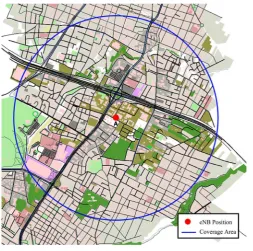
[image:7.595.249.503.459.710.2]To simulate traffic, the SUMO tool (Simulation of Urban Mobility) has been used. In particular, a section of Kifissias Avenue in Athens, Greece, approx-imately 2.5 km long was considered, as shown in Figure 1. Each simulation lasted 700 s and took into account vehicles moving toward both directions, whe-reas the incoming traffic from adjacent roads was ignored. With regard to the average number of connected vehicles (AvNu) and the vehicle density (Vede) in vehicles/km, three levels have been considered to represent traffic, namely low (AvNu = 127, VeDe = 50.8), medium (AvNu = 304, VeDe = 121.6) and high (AvNu = 510, VeDe = 204).
DOI: 10.4236/cn.2019.113006 72 Communications and Network
The traffic data generated by SUMO is introduced to the ns-3.28 tool in order to simulate the communications of vehicles with each other. To simulate how V2X communications are served by LTE systems, the ns3 LENA (LTE EPC Network simulAtor) module has been used, which provides the necessary tools to implement accurate representations of the LTE protocols stack and of the EPC (Evolved Packet Core) functions. In the simulated models, a single eNB node was installed at point A of Figure 1, having coverage of radius equal to 1250 m, and all vehicles were assumed to be equipped with an appropriate UE device. Vehicles entering the coverage area of the eNB node are immediately as-signed to it. Once a vehicle leaves the coverage area, its communication with the eNB is terminated.
As, in addition to providing V2X services, the LTE network provides broad-band services to pedestrian users in the same area, one of the goals of this paper is to examine how pedestrian users affect V2X communications. These broad-band services are characterized by much higher data rates than the ones per-taining to V2X services. To simulate the pedestrian traffic, a certain number of UE nodes were placed on a straight line, at a gradually increasing distance from the eNB, ranging from 100 to 1000 m. Each pedestrian user transmits and rece-ives 512 Byte long UDP packets via the eNB. An on-off model, characterized by random durations for the on and off states, was employed to represent the user uplink (UL) and downlink (DL) traffic. The average data rates assumed in each direction are: RuserUL =100kbps and RuserDL =1Mbps.
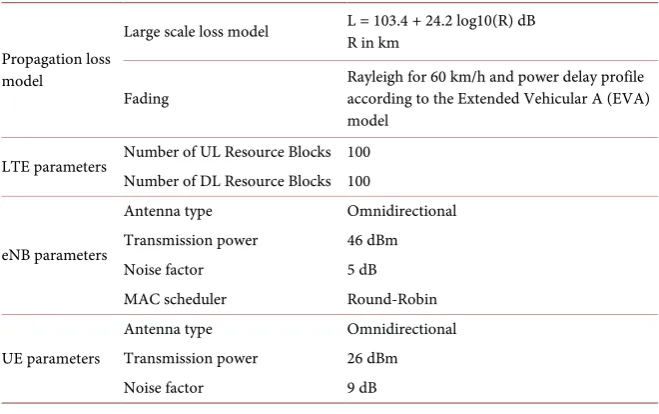
The parameters related to the LTE system considered in the simulation are given in Table 1. Though the fading model used in the simulations may not si-mulate accurately the channel conditions for the pedestrian users due to the high velocity of 60 km/h assumed, it has been adopted since the LENA module re-quires the same fading model for all the network nodes/users. The use of the EVA model led to pessimistic results, that is, higher latency and losses, for both the vehicles and the pedestrians, especially in the UL transmissions, where the transmit power is much lower than in the DL ones. To compensate for the ex-tremely rapidly changing channel conditions adopted in the simulations for the pedestrian users, the transmit power of their UEs was increased so that the si-mulation produces results similar to those that would have resulted employing the Extended Pedestrian A (EPA) model with a velocity of 3km/h. Though sim-plified, the simulation option adopted is adequate for the purposes of this paper because: 1) it is the accuracy of the results concerning the vehicles that matters more, 2) the rapidly changing conditions in the pedestrian channels still yields slightly pessimistic results and 3) the choice of the fading model affects equally the results for the LTE and MEC cases, so the possible benefits of MEC will still be highlighted by the simulations.
4.1. The MEC and LTE Simulation Scenarios
DOI: 10.4236/cn.2019.113006 73 Communications and Network
where the delay and the maximum data rate over the relevant links are also shown. The Serving/Packet-Gateway (S/P-GW) node communicates via point- to-point links with two servers, one to serve the vehicle traffic and one to serve the pedestrian traffic. DropTail queues of 100 packets were used for all links.
(a)
[image:9.595.230.514.149.471.2](b)
Figure 2. Simulation scenarios: (a) The LTE scenario and (b) The MEC scenario.
Table 1. Physical and MAC layer simulation parameters.
Propagation loss model
Large scale loss model L = 103.4 + 24.2 log10(R) dB R in km
Fading Rayleigh for 60 km/h and power delay profile according to the Extended Vehicular A (EVA) model
LTE parameters Number of UL Resource Blocks 100 Number of DL Resource Blocks 100
eNB parameters
Antenna type Omnidirectional Transmission power 46 dBm
Noise factor 5 dB
MAC scheduler Round-Robin
UE parameters
Antenna type Omnidirectional Transmission power 26 dBm
[image:9.595.209.539.521.728.2]DOI: 10.4236/cn.2019.113006 74 Communications and Network
Since, so far, ns-3 simulation tools for MEC systems have not been developed, to simulate the MEC behavior, the scenario, hereafter called MEC scenario, de-picted in Figure 2(b) has been created. In this scenario, a second V2X server was assumed, directly connected to the S/P-GW with a 10 Gbps link of zero delay. The same features were also assumed for the S1-U link. These two hypothetical links can be thought of as virtual interfaces, co-located with the eNB. Routing is controlled by a specific node, which in a practical scenario could be a high-speed SDN switch [13]. Messages originating from/destined for vehicles are exchanged between the eNB and the local V2X server with practically no delay. Moreover, due to the high speed characterizing the links involved, these messages are also not affected by the pedestrian communication traffic.
In contrast to the LTE scenario, in the MEC scenario, the remote V2X server does not communicate directly with the vehicles. Its role is to periodically up-date the information available at the local server, so that the latter becomes aware of the traffic outside the examined area. On the other hand, the local serv-er sends aggregated messages to the core network, so that the remote V2X sserv-ervserv-er can produce more accurate traffic data regarding the service area.
Access to the Internet is provided by a router, which has a role similar to that of the central S/P-GW of the core network. The router is connected to the local S/P-GW via a link causing the same delay as the one caused by the S1-U link of the LTE scenario which is equal to 10 ms. In the simulations, the speed over this link was intentionally reduced, so that the behavior of this link is close to that of S1-U (see Figure 2(b)). Each pedestrian user exchanges 512 Byte packets with the Internet server. Among these 512 Bytes, 28 Bytes are added due to the IP and UDP headers. Moreover, the S1-U interface adds a total of 40 Bytes to each packet (20 IP + 8 UDP + 12 GTP), all of which are removed when the packets are sent to the Internet. Therefore, to keep the pedestrian traffic unaffected un-der the MEC scenario, the rate of the link connecting the S/P-GW to the router should be reduced from 100 Mbps to:
(
) (
)
100Mbps 512 20 8 512 20 8 40 93.1Mbps
R= ⋅ + + + + + = . (1)
Having done the above rate adaptation, the proposed model approximates MEC deployment over the S1-U interface [14]. The rationale behind this adapta-tion is further justified in Secadapta-tion 4.4 where the performance improvement of mobile broadband services is examined.
4.2. General Traffic Information
DOI: 10.4236/cn.2019.113006 75 Communications and Network
Thus, to simulate the exchange of data with the V2X server, two UDP streams were assumed for every connected vehicle. Following the relevant 3 GPP rec-ommendations [15], the DL message payload and the message transmission fre-quency were set equal to 1000 Bytes and to 1 Hz, respectively. The correspond-ing numbers for the UL messages were 300 Bytes and 10 Hz, respectively.
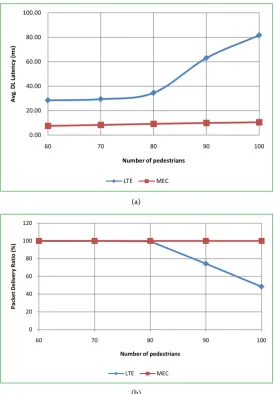
Figure 3(a) depicts the simulation results concerning the average delivery la-tency (AVL) of the periodic messages sent to the vehicles by the V2X server, lo-cal or remote respectively, assuming a low mobility level. The reduction in AVL achieved by the MEC scenario is indeed larger than the fixed latency caused by the transport and the core networks which is equal to 20 ms. Moreover, as the number of nearby pedestrian users involved increases, so does the gap between the curves corresponding to the LTE and MEC scenarios, since the capacity li-mitations of the backhaul link does not affect the packet transfer under the MEC scenario.
(a)
[image:11.595.236.512.292.687.2](b)
Figure 3. Simulation results in the DL with respect to the number of pedestrian users: (a) average message delivery latency and (b) average packet delivery ratio.
0.00 20.00 40.00 60.00 80.00 100.00
60 70 80 90 100
Av
g.
D
L
La
ten
cy
(m
s)
Number of pedestrians
LTE MEC
0 20 40 60 80 100 120
60 70 80 90 100
Pa
ck
et
D
el
iv
er
y
Ra
tio
(%
)
Number of pedestrians
DOI: 10.4236/cn.2019.113006 76 Communications and Network
Due to constraints in the queue size, packet losses also occur in the LTE sys-tem, as shown in Figure 3(b). Though it may seem that the MEC scenario is un-affected by such losses, as in this case packets are subjected to zero queue time, in order to fully evaluate the MEC scenario performance, the traffic moving through the local and the remote V2X servers should also be taken into account. In the MEC scenario, an additional packet flow is active between the two servers to update the local traffic information. The packet size and transmission fre-quency of this flow are identical to those sent to every vehicle. Instead of calcu-lating the packet delivery ratio of this flow, the average local data renewal latency is determined from:
(
) (
)
renew N 1 1
D = t −t N− (2)
where N is the number of received packets and ti (i = 1, N) is the time when the
i-th packet was received. The above quantity is plotted in Figure 4. As expected, as the number of users increases, the local data is renewed at a slower rate. In a practical scenario, however, the local server would be capable of processing the packets received from the vehicles and, consequently, delivering traffic data to them with minimum losses. Hence, the effect of the backhaul link on the appli-cation performance would be moderated.
Though the reduction in latency offered by MEC is significant, the require-ments concerning use cases related to traffic information are not strict (e.g. the tolerable latency is 500 ms). Therefore, the MNOs can provide this type of ser-vices, without having to invest in MEC deployment.
4.3. Emergency Message Delivery
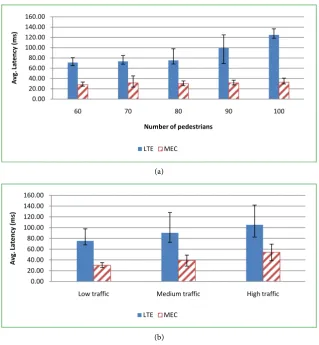
The imperative necessity for using MEC in V2X applications is justified when mission critical use cases, especially those related to road safety, are considered. In this course, in addition to handling traffic information destined for vehicles, the two models under consideration were compared in the framework of deli-vering emergency messages destined for vehicles, say the DENMs. In the simula-tions, a total of 11 simulated events have been considered, where a randomly lo-cated vehicle transmits an 800 Byte emergency message to notify all nearby ve-hicles. As soon as the server responsible for the relevant processing receives this message, it sends an appropriate message to all the vehicles located within a range of 500 m from the vehicle-sender. Figure 5(a) depicts the mean end-to-end deli-very latency of emergency messages as well as the range of values among the 11 events considered. As the maximum tolerable latency in emergency use cases is 100 ms, in contrast to the scenario examined in Section 4.2, the data transfer via the transport and core networks causes a severe QoS deterioration to an intoler-able level. In a more accurate scenario, however, the latency caused by the back-haul and core networks would be a random variable [16], an even greater varia-tion between the LTE and MEC performance is expected.
DOI: 10.4236/cn.2019.113006 77 Communications and Network Figure 4. Average local server data renewal latency with respect to the number of pedestrian users.
(a)
(b)
Figure 5. Mean and range of E2E latency for emergency messages: (a) with respect to the number of pedestrian users and (b) plotted for three levels of traffic density.
affects the delivery of DENMs. In these simulations, the number of pedestrians was set equal to 80, as this is the maximum value that yields acceptable results in the case of low traffic. Though in both models under comparison the mean la-tency and its dispersion get larger when more messages are transmitted, the MEC
0.80 1.20 1.60 2.00
60 70 80 90 100
Ren ew al L at en cy (sec )
Number of pedestrians
0.00 20.00 40.00 60.00 80.00 100.00 120.00 140.00 160.00
60 70 80 90 100
Av g. La te nc y (m s)
Number of pedestrians
LTE MEC 0.00 20.00 40.00 60.00 80.00 100.00 120.00 140.00 160.00
Low traffic Medium traffic High traffic
[image:13.595.213.533.275.621.2]DOI: 10.4236/cn.2019.113006 78 Communications and Network
scenario yields acceptable (i.e. less than 100 ms) end-to-end latency values even under high traffic conditions.
4.4. High-Definition Maps
A message transmission frequency from the V2X server of 1Hz is considered adequate for delivering traffic data via text messages. However, real-time provi-sioning of high-definition local maps may require high data rates, in many cases up to hundreds of kbps per user. Figure 6(a) shows results concerning higher DL message transmission frequencies that require considerably higher data rates. The traffic level assumed is low and the number of pedestrians is set equal to 80. It is evident that the MEC scenario performance is once again unaffected by the increasing network traffic, whereas, to update local maps in real-time, the LTE option may have to struggle to deliver data at acceptable rates.
(a)
[image:14.595.217.532.279.682.2](b)
Figure 6. Simulation results with respect to the message transmission frequency from the V2X server: (a) average DL message delivery latency to vehicles and (b) average DL message delivery latency to pedestrians.
0 20 40 60 80 100
1 2 4 8 16 32
Av
g.
D
L
La
te
nc
y
(m
s)
Message transmission frequency (Hz)
LTE MEC
80 100 120 140 160
1 2 4 8 16 32
Av
g.
D
L
La
te
nc
y
(m
s)
Message transmission frequency (Hz)
DOI: 10.4236/cn.2019.113006 79 Communications and Network
Finally, how a potential deployment of V2X applications would affect the rest of the users of a cellular network was examined. In Figure 6(b), the average downlink latency experienced by pedestrian users is plotted with respect to the message transmission frequency. When the communication traffic created by the vehicles is low, the pedestrian traffic is unaffected by the presence of the MEC server, since the total traffic traversing the backhaul network is low and can be easily handled by the available bandwidth. This result also explains the S1-U rate adaptation performed in Section 4.1. However, as the use of the back-haul network in the LTE scenario increases, the MEC scenario exhibits a clear superiority, even though the applications used by the pedestrian users are not hosted in the MEC server. It should be noted that, due to the simplistic model used for the pedestrian traffic and the limitations of the fading model described earlier in Section 4, the exact latency values depicted in Figure 6(b) do not ac-curately represent an actual mobile broadband scenario. However, the difference between the LTE and the MEC scenario is clearly demonstrated.
5. Conclusions
The simulation results suggest that, although LTE is able to timely deliver traffic data to vehicles, high congestion in the backhaul and core networks might lead to inevitable packet losses, which can be offset by the computing capabilities of a MEC server. However, the true merit of MEC is justified when delivering emer-gency messages. Even in cases of low traffic density, LTE systems may lead to in-efficient delivery of messages to vehicles, especially when the volume of data produced by the pedestrian users becomes high. On the other hand, the use of MEC achieves end-to-end emergency message delivery in less than 100 ms, re-gardless of the number of connected vehicles. Moreover, the MEC scenario ex-amined in this paper proved to effectively mitigate the impact of connected ve-hicles on the experience of existing users.
DOI: 10.4236/cn.2019.113006 80 Communications and Network
Conflicts of Interest
The authors declare no conflicts of interest regarding the publication of this pa-per.
References
[1] An Assessment of LTE-V2X (PC5) and 802.11p Direct Communications Technolo-gies for Improved Road Safety in the EU. 5GAA White Paper, 5-Dec-2017.
http://5gaa.org/wp-content/uploads/2017/12/5GAA-Road-safety-FINAL2017-12-05
[2] V2X White Paper v1.0. NGMN Alliance, 17-June-2018.
https://www.ngmn.org/fileadmin/ngmn/content/downloads/Technical/2018/V2X_
white_paper_v1_0.pdf
[3] Mir, Z.H. and Filali, F. (2014) LTE and IEEE 802.11p for Vehicular Networking: A Performance Evaluation. EURASIP Journal on Wireless Communications and Networking, 2014, Article No. 89. https://doi.org/10.1186/1687-1499-2014-89
[4] 5G Automotive Vision. 5GPPP White Paper, 20-Oct-2015.
https://5g-ppp.eu/wp-content/uploads/2014/02/5G-PPP-White-Paper-on-Automoti
ve-Vertical-Sectors.pdf
[5] The Case for Cellular V2X for Safety and Cooperative Driving. 5GAA White Paper, 23-Nov-2016.
http://5gaa.org/wp-content/uploads/2017/10/5GAA-whitepaper-23-Nov-2016.pdf
[6] Mobile-Edge Computing—Introductory Technical White Paper. Sep-2014.
https://portal.etsi.org/Portals/0/TBpages/MEC/Docs/Mobile-edge_Computing_-_In
troductory_Technical_White_Paper_V1 18-09-14.pdf
[7] Yu, W., Liang, F., He, X., et al. (2018) A Survey on the Edge Computing for the In-ternet of Things. IEEE Access, 6, 6900-6919.
https://doi.org/10.1109/ACCESS.2017.2778504
[8] Boban, M., Kousaridas, A., Manolakis, K., et al. (2018) Connected Roads of the Fu-ture: Use Cases, Requirements, and Design Considerations for Vehicle-to-Everything Communications. IEEE Vehicular Technology Magazine, 13, 110-123.
https://doi.org/10.1109/MVT.2017.2777259
[9] IMT Vision-Framework and Overall Objectives of the Future Development of IMT for 2020 and Beyond. ITU-R Recommendation M.2083-0, Sep-2015.
https://www.itu.int/dms_pubrec/itu-r/rec/m/R-REC-M.2083-0-201509-I!!PDF-E.pdf
[10] ETSI MEC ISG. https://www.etsi.org/technologies/multi-access-edge-computing [11] ETSI GR MEC 022 V2.1.1 (2018) Multi-Access Edge Computing (MEC): Study on
MEC Support for V2X Use Cases.
https://www.etsi.org/deliver/etsi_gr/MEC/001_099/022/02.01.01_60/gr_MEC022v0
20101p.pdf
[12] Giust, F., Sciancalepore, V., Sabella, D., et al. (2018) Multi-Access Edge Computing: The Driver behind the Wheel of 5G-Connected Cars. IEEE Communications Stan-dards Magazine, 2, 66-73. https://doi.org/10.1109/MCOMSTD.2018.1800013
[13] Campolo, C., Molinaro, A. and Iera, A. (2018) A Reference Framework for So-cial-Enhanced Vehicle-to-Everything Communications in 5G Scenarios. Computer Networks, 143, 140-152. https://doi.org/10.1016/j.comnet.2018.07.010
DOI: 10.4236/cn.2019.113006 81 Communications and Network
https://www.etsi.org/images/files/etsiwhitepapers/etsi_wp24_mec_deployment_in_
4g_5g_final.pdf
[15] 3GPP TR 22.885 V14.0.0 (2015) Technical Specification Group Services and System Aspects: Study on LTE Support for Vehicle to Everything (V2X) Services.
https://portal.3gpp.org/desktopmodules/Specifications/SpecificationDetails.aspx?sp
ecificationId=2898
[16] Emara, M., Filippou, M.C. and Sabella, D. (2018) MEC-Assisted End-to-End La-tency Evaluations for C-V2X Communications. European Conference on Networks and Communication, Ljubljana, 18-21 June 2018, 1-9.