DETERMINATION OF RESIDUAL DEFORMATION IN
*
Mammadov Vasif Talib
Azerbaijan State Oil and Industry University ARTICLE INFO ABSTRACT
Solution of the sparital task on tension
considered in the article. Koshi method for variations of the
complex loading in the well has been used. The theory of plastic flow has also been applied, borders of plastic zone at the period of packing deformation have been determined and some variants in the particular case for
are compared with the results of the works carried out by other authors.
Copyright © 2018, Mammadov Vasif Talib and Suleymanova Arzu Javanshir License, which permits unrestricted use, distribution, and
INTRODUCTION
Many cases of plane deformation state of plat are devoted to the study of this problem the solution of spatial task. Let’s consider sealing element subjected to two
forces placed in its plane. We chose beginning of Cartesian system of coordinates in central plane. AxisОХ andОХ2aredirectedtowards the operating efforts, but ОХ
Let’s suppose that
where and – are stresses, applied on the edges; and considered moment of time be disturbed as following
Here 2 – is the thickness of undisturbed condition, and and tangent stresses be for disturbing moment, that is
and at , .
Due to Koshi formulae for variations of deformation tensor components we have 11 22
m
11
22
3 30
cos
1 1cos
2 2x
x
x
x
3
x
0
ij
e
ij
0
i
j
i j
,
1, 2, 3
ISSN: 0975-833X
Article History:
Received 17th June, 2018
Received in revised form 22nd July, 2018
Accepted 06th August, 2018
Published online 30th September, 2018
Citation:Mammadov Vasif Talib and Suleymanova Arzu Javanshir
loading”, International Journal of Current Research, 10, (09),
Key Words:
Well Packer, Residue Deformation, Biaxial Loading, Plastic Flow of Packer, Critical Force.
*Corresponding author
RESEARCH ARTICLE
DETERMINATION OF RESIDUAL DEFORMATION IN SEALING ELEMENTS IN TWO
Mammadov Vasif Talib and Suleymanova Arzu Javanshir
Azerbaijan State Oil and Industry University ABSTRACT
Solution of the sparital task on tension-deformation condition of biaxial loaded well packer is considered in the article. Koshi method for variations of the components of tensor deformations in complex loading in the well has been used. The theory of plastic flow has also been applied, borders of plastic zone at the period of packing deformation have been determined and some variants in the particular case for satisfying stabilly conditions of the sealing have been solved. The obtained results are compared with the results of the works carried out by other authors.
Mammadov Vasif Talib and Suleymanova Arzu Javanshir. This is an open access article distributed under and reproduction in any medium, provided the original work is properly
Many cases of plane deformation state of plat are devoted to the study of this problem [Babanly et al., 2016
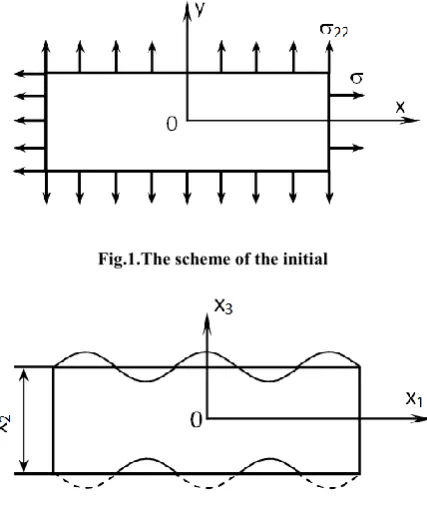
Let’s consider sealing element subjected to two-axial compression on the edges by equally distri forces placed in its plane. We chose beginning of Cartesian system of coordinates in central plane. AxisОХ
aredirectedtowards the operating efforts, but ОХ3 – normally to packing elements plane [Mammadov
stresses, applied on the edges; and – is real positive number. Let surface of sealing element in the considered moment of time be disturbed as following:
is the thickness of undisturbed condition, and – is a small quantity. It is supposed that, there are no displacements for disturbing moment, that is
.
formulae for variations of deformation tensor components we have [Mammadov, 2017
m
International Journal of Current Research
Vol. 10, Issue, 09, pp.73698-73706, September, 2018
DOI: https://doi.org/10.24941/ijcr.32174.09.2018
Mammadov Vasif Talib and Suleymanova Arzu Javanshir, 2018. “Determination of residual deformation in sealing elements in two , 10, (09), 73698-73706.
SEALING ELEMENTS IN TWO: AXIAL LOADING
Suleymanova Arzu Javanshir
deformation condition of biaxial loaded well packer is components of tensor deformations in complex loading in the well has been used. The theory of plastic flow has also been applied, borders of plastic zone at the period of packing deformation have been determined and some variants in the satisfying stabilly conditions of the sealing have been solved. The obtained results are compared with the results of the works carried out by other authors.
under the Creative Commons Attribution properly cited.
Babanly et al., 2016]. The paper concerns axial compression on the edges by equally distributed forces placed in its plane. We chose beginning of Cartesian system of coordinates in central plane. AxisОХ1
Mammadov, 2017].
(1.1) Let surface of sealing element in the
(1.2) is a small quantity. It is supposed that, there are no displacements
(1.3)
, 2017]:
INTERNATIONAL JOURNAL OF CURRENT RESEARCH
(1.4)
where is variation of displacement component. As the material is considered uncompressed, then
(1.5) If to disregard sluggish members and volume forces because of their infinitesimal, then equations of Koshi movement in variations have the form
. (1.6)
On that ground, surface of the plate doesn’t test any loading, boundary conditions at have the form
,where (1.7)
– are guiding normal of cosine to the surface disturbances determined from equation (2). Dependence between stresses and deformations will be removed due to the theory of small elastic-plastic deformations, that is [Mammadov et al., 2015]
, (1.8)
where – is kroneker symbol, – is hydrostatic pressure tension and
, (1.9)
From the experiment on pure tension we have
. (1.10)
Varying(8) on the basis (10), (4), (5) and (6) we get the system of differential equations in quotient devivatives with four unknowns and :
, (1.11) Where
More ever
(1.12)
1
2
ji ji
ij
i j
u
u
e
x
x
ji
u
0
i
j
u
x
0
ij
j
x
3 30
x
x
ij
ij
j
0
33
0
j
2
3
ij
ij ij ij
i
e
e
ij
0
2 11
1
i
m m
02 11
2 1
2
i
m
m
e
e
m
0 1
i
e
i
u
11
ke
ijk
e
ij0
x
2
3
i
i
k
e
0
0
2
2
3
1
3
i
ij
i
d
A
при i
j
de
k
k e
B
при i
j
e
If to take the beginning of the coordinates system in the neck centre (residual deformation), then on the basis of process symmetry relatively to coordinate planes we will have.
(1.13)
Under collection of arguments is implied, more were, signs change every time only before one argument. According to boundary conditions (2) and condition (13) we find particular solution of the system (11) in the form [Nguyen Gang Li, 1978]:
, (1.14) where
, (1.15)
Putting (1.14) into (1.11), integrating the third equation once and considering detail of functions and , we get
,
,
(16)
in
(1.16)
In (1.17) can be changed to , to , and to one, as tangential to disturbed surface forms small angle on the surface . Disregarding infinite small members of the second order and considering them, and also correlation (14), boundary conditions will have the form [Maltsev, 1978]:
(1.17)
in .
It is supposed that in normal to coordinate axis and crosses the following conditions are satisfied:
(1.18)
From (15)-(17) in corresponding values of and , all particular cases are obtained.
i i
i i
i i
u
x
при i
j
u x
u x
при i
j
i
x
1 2 1 1 3
2 1 2 2 1 3
3 1 1 1 2 3 1 3
1 1 1 2 4 1 3
1 2 1 1 3
sin
cos
1
cos
sin
1
cos
cos
1
1
cos
cos
1
sin
cos
1
j i i i
i i i
j
j i i i
u x
m
x
x
x
u
x
m
x
x
x
u x
x
x
x
x
x
x
u x
m
x
x
x
11 2211 22
2
2
1
m
m
m
22 11 11 22
2
2
1
1
m
m
m
2 ''
2 '
1 1 4
1
2
1
1
0
B
m
m
A B
2 ''
2
2
2 2 4
1
2
1
1
0
B
m
m
A B
2
''
2
23 3 4
1
2
A B
B
1
1
0
3 30
x
x
''1 2
1
30
m
m
1
ux31
23
2 u x
31 2
0
x x
1
B
m
1
B
11
3
0
1
2
11
30
B
m
m
3 30
x
x
4
2
A
30
1
x
x
230 30 30
30 30 30
12 3 13 3 23 2
0
x x x
x x x
dx
dx
dx
From the fourth equation of system (16) we determine and put into the first equation of the system, where is determined and put into the second and third equations, we get:
(1.19)
The first equation of system (19) is multiplied to , and the second to , adding it we get [Kokoshvili, 1978]:
(1.20) In all cases when and are so, the expression turns to zero, we get equation in the form
(1.21)
But in other cases, determining from (20) and, putting it into the first equation of the system (19), we get equation in the form
, (1.22)
1.23)
(1.24)
(1.25) In the same way boundary conditions can have the form Inscription
(1.26)
Condition (13), boundary conditions (26), (27), (18) and give make it possible to determine arbitrary constants of inteqration but the condition of stability loss is determined from (1.26)
. (1.27)
Setting , it is possible to find , which gives minimum value of function .
2. Special cases.
а) in and from (1.21) we get equation 1
4
22 2 2
2 2
4 2
2 2 2
3 2 3
3 2
2 2
4 ( ) 2 2 2
3 3 3
1 1 1 4 1
1 1 2 1 0
1 1 2 2
1 1 4 2 1 0.
IV
IV
B m m A B
B A B
B m m A B
B A B B
1
1
2
2
2
4 ( )2 3
2
m
1
1
A B
1
B
1
IV
2
4
2
2
23 3
2
A
2
B
2
1
B
1
m
2 2
1 1 1
m A B
22 4 2
( )
3 2 3 4 3
2
2
2
1
0
1
1
IV
A
B
B
2
3 0 3 1 3 2 3
0
IV
a
a
a
5 6
2 2
0 2 2
4 1 2 3 1 4 4 2 3 1 1 A B a B
62 2 2 4 2 2 4
1 4
2 2
12
1
4
1 2
1
3
1
8
1
1
A
AB
B
a
B
4 2 2 2 61
4
1
1
A
B
a
B
23 2 3
2
3 2 3
1
1
0
1
1
0,
1
н
m
B
B
3
0, 0,
30u
x
1
f m
, , ,
A B
m
f m
, , , A B
0, 5
, (2.1) Corresponding boundary conditions received by the equation have:
in (2.2) In this case stability loss condition was found in the form:
or (2.3)
b) in we get biaxial tension of the packer with equal forces between themselves. For simplicity let’s take . In this
case and . Then, from equation (1.21) we get
, (2.4) where
, (2.5) Boundary conditions for (2.4) will be:
(2.6) in (2.7)
Characteristic equation for (2.4) has roots where
.
Where
, . (2.7)
General solution (2.4) we find in the form (2.8) Where
. (2.8)
By for ceofa detail of the function and , should be taken, as must be the true function. This,
. (2.9)
(2.10)
"
3
2 2
1
3 30
IV
A
B
11
" '
3 3
" 3 3
0
0
B
B
3
30x
x
1
4
A
i0
2 3
A
1
m
0
0,5
m
m
1
21( ) 4
2
3
2
3 30
IV
Pn
n
1
2
n
1
3
1
2
A
P
B
11
3 3
3 3
3
2
0, 5
0
B
B
3
30x
x
i n
i p
iq n
i n
i p iq n
1
2
P
p
1
2
P
q
3 1
sin
2sin
3 4cos
t
c
nt
c
nt
c nt
c
nt
1
1 3
t
x
3
t
c
1
c
2
0
c
3
c
4
3
t
3
cos
cos
t
c
nt
c
nt
cos
cos
0
where,
, .
.
Equation (2.10) will be satisfied always, if we accept:
,
, (2.11)
here, – is unknown arbitrary constant. Consequently,
. (2.12)
In , .
Considering it and (2.14), we find:
. (2.13) After putting (2.12) into (2.6)the latter can be written in the form of:
, (2.14)
Where
Equation (2.14) has 2 valid roots , different from zero, equal between themselves on the value and opposite on sign, while carrying condition , which is brought to equality
(2.15) Comparison (2.15) and (2.3) testifies that critical intensity of tensions for formation of neck in the packers considerably depends on parameters and . c) In we get monobasic compression of packer. For simplicity let’s take . Then, we get plane deformation condition relatively to deformation increments. In this case , and from (1.21) we get equation (2.1) and boundary conditions (2.2). That’s why, the same condition of stability loss is obtained:
or (2.16)
Which his more, than in case , . In all these cases conditions (1.18) are satisfied automatically. By the same way, the cases are solved, when
or
in any , however in these cases new integral constants appear which are easyly determined from the first equation (1.18), among all possible it is possible to choose such value, that in the given critic force will have minimum value. 3. It is known that experiment in a complex loading confirm better only plastic flow, than the theory of small elastic plastic deformations [9].
2
0, 5 1
N
N
0, 5 1
2
1
1 30
h
x
1
2
cos
c
D
nh
1
2
cos
c
D
nh
D
2
2
3
1
cos
cos
1
cos
cos
t
D
nh
nt
nh
nt
t
h
x
1
x
2
0
u
3
2 cos sin
D
lmN nh nh
0
sin 2
2
k
pnh
pqsh qnh
11
0
2 2
B p
k B
0
h
2
k
q
12
2
3
B
A
m
m
0
0
2
m
u
2
0
11
4
A
i0
4
A
0, 5
m
0
A B
B
2
A B
A A B
B
B
m
That’s why it is very interesting to solve the task about the neck with the help of plastic flow theory. Let’s accept theory of plastic flow in a simple form:
(3.1)
where – is elastic module of displacement; – are components of deformation deviator; – are components of tension deviator; but – is second variant of tension deviator. In this task it has the form
(3.2)
as it is supposed,
in .
In the excited condition of the packer in (3.1) value differentials can be changed to their variations. Solving them relatively to the variations of tension deviator components we get
(3.3)
. (3.3) In consequence of incompressibility of the material deformation deviator components are equal to the variations of tensor deformation components, that is
, а (3.4)
For simplicity here the case , is considered. Putting function on the basis of the incompressibility condition
, (3.5)
and excluding the equilibrium equation in variations , we get
(3.6) Corresponding boundary conditions have a form
, (3.7)
in (3.8)
Particular solving (3.6) we find in the form
(3.9)
2 22
ij
ij ij
dS
dЭ
f J
S dJ
G
ij
1, 2, 3
G
Эij Sij2
J
2 2 2
2 11 22 33
1
2
J
S
S
S
0
ij
S
i
j
22
ij ij ij pq pq
S
G Э
P J
S S
Э
i j P q
, , ,
1, 2, 3
22 1 2
2 2
4
1 4
G f J
P J
Gf J
J
ij ij
Э
e
S
ij
ij
ij0, 5
m
0
x x1, 3
1
3
d
u
dx
31
d
u
dx
4 4 4
4 2 4
1 3
2
0
d
d
d
dx
dx dx
dx
11
22 221 3
0
d
d
G
G
dx
dx
21 3
1
d
0
G
dx dx
3 30
x
x
x x
1,
3
sin
1x
1,
x
3
Further process of solution (3.6) with boundary conditions (3.7) and (3.8) is the former one. Consequently, we get the stability loss condition in the form
oder (3.10)
4. For comparison the obtained results in the case , due to the various theories let’s suppose that graph is a cubic parabola and function
(4.1) Then
(4.2) In a pure tension due to the theory of plastic flow we have
(4.3) as
, (4.4)
In order (4.3) to present cubic parabola, the function must be constant, that is
Integrating (4.3), we get
(4.5) Comparing (4.5) with (4.1), we have
(4.6) Then from (2.3), considering (4.2) and (4.6), we find
. (4.7)
From (3.8) and (3.3) we get
Consequently, in the case and the results obtained by various theories coincide.
11
2
G
1
20
3
G
1
0, 5
m
0
0 0
i
e
i
e
i0
i0
0 0
i i
e
0 0
0
1
i i
i
d
d e
de
d
0 2
0 2 0 0
4
9
i
i i i
d
de
f J
d
E
2 2
11 2 0
4
3
4
3
iS
J
3
E
G
2f J
2f J
c
const
0 3
1 0
4
27
i
i
e
c
E
0 21 0
4
27
i
i
c
E
0 2
0
6 3
9
4
i
i
E
cE
0 2
6 3
9 4
i
i
E
c
0, 5
Fig.1.The scheme of the initial
Fig. 2. Seal scheme after loading of the sealant
Conclusion
Koshi method for variations of tensor deformation components is well described in the complex biaxial loading of well sealing elements.
REFERENCES
Aslanov D.N. 2015. Determination of the elastic deformation-deflection of the spring of the sealing assembly of the fountain valves. Actual problems of the humanities and natural sciences. Number: 7-1. Year: Pages: 45-48, Moscow.
Babanly M.B., Mamedov G.A., Mammadov V.T., Aslanov J.N. 2016. Features of the calculationwhile nonstationary dynamic loadings for the downhole packer sealing. Science Innovators. International Conference on European Science and Technology. Materials of the XII International Research and Practice Conference. 42-54. Munich, Germany, Yuly 1st-2nd.
Chertova N.V. 2000. Dynamic field of defects for creep under monotonically changing stress //Theor.Appl.Fracture mech. V.34. №3. P.205-210.
Karnaukhov VG, Kozlov VI, Kucher N.K. Dynamic behavior of elastic and viscoelastic, reinforced, hollow cylinders. Applied Mechanics, vol. 11, No. 8, p.16-25.
Kokoshvili S.M. 1978. Methods of dynamic testing of rigid polymeric materials. Riga, Knowledge, 182p.
Maltsev L.E. 1978. Approximate solution of some dynamical problems of viscoelasticity. Mechanics of polymers, №2, p.210-218.
Mammadov, V.T., Qurbanov, S.R.2015. The impact of the relatively low compression rubber to functions sealing elements of well bore pakers. ICSCCW-2015, Eighth International Conference on Soft Computing, Computing with Words and Perceptions in System Analysis, Decision and Control, Edited by R.A. Aliev, I.B. Turksen, J. Kacprzyk, Dedicated to Professor LutfiZadeh, Antalya, Turkey September 3-4, p.p.397-399.
Mammadov, V.T., Suleymanova, A.J. 2017. Study of dynamic impact of compression by the flow of rubber element in non-linear deformation. Scientific-technical journal “Construction of on-shore and off-shore oil and gas wells. No3. OJSC “VNIIOENG”, March, p.34-37.
Mammadov, V.T., Suleymanova, A.J.2017. Study of the properties of well sealing elements in cross impact. News of Azebaijan Engineering Academy, volume 9, No4, October-December, p.45-49
Nguyen Gang Li. 1978. On a method for solving integro-differential equations occurring in the dynamics of viscoelasticity. Mechanics of Polymers, No. 5, p.818-825.
Yoshida S. 2000. Consideration on fracture of solid-state materials //Phys.Lett.A. V.270. – P.320-325.
Yoshida S. Dynamics of plastic deformation based on mechanisms of energy dissipation restoration under plasticity. // Phys. Mesomech., Vol. 11. - №2. - p.31-38.