SE
P
T
E
M
B
E
R 2
01
6 | V
O
L
. 2
6
, NO
. 9 A PUBLICATION OF THE GEOLOGICAL SOCIETY OF AMERICA®
25–28 Sept. GSA 2016. Share your science, network, and explore Colorado.
SCIENCE
4 Tectonics and crustal evolution
Chris J. Hawkesworth, Peter A. Cawood, and Bruno Dhuime
Cover: Early Earth and present-day Earth and Earth’s Moon. See related article, p. 4–11.
SEPTEMBER 2016 | VOLUME 26, NUMBER 9
Featured Article
GSA TODAY (ISSN 1052-5173 USPS 0456-530) prints news and information for more than 26,000 GSA member readers and subscribing libraries, with 11 monthly issues (March/ April is a combined issue). GSA TODAY is published by The Geological Society of America® Inc. (GSA) with offices at 3300 Penrose Place, Boulder, Colorado, USA, and a mail-ing address of P.O. Box 9140, Boulder, CO 80301-9140, USA. GSA provides this and other forums for the presentation of diverse opinions and positions by scientists worldwide, regardless of race, citizenship, gender, sexual orientation, religion, or political viewpoint. Opinions presented in this publication do not reflect official positions of the Society. © 2016 The Geological Society of America Inc. All rights reserved. Copyright not claimed on content prepared wholly by U.S. government employees within the scope of their employment. Individual scientists are hereby granted permission, without fees or request to GSA, to use a single figure, table, and/or brief paragraph of text in subsequent work and to make/print unlimited copies of items in GSA TODAY for noncommercial use in classrooms to further education and science. In addition, an author has the right to use his or her article or a portion of the article in a thesis or dissertation without requesting permission from GSA, provided the bibliographic citation and the GSA copyright credit line are given on the appropriate pages. For any other use, contact [email protected].
Subscriptions: GSA members: Contact GSA Sales & Service, +1-888-443-4472; +1-303-357-1000 option 3; gsaservice@ geosociety.org for information and/or to place a claim for non-receipt or damaged copies. Nonmembers and institutions: GSA TODAY is US$92/yr; to subscribe, or for claims for non-receipt and damaged copies, contact gsaservice@ geosociety.org. Claims are honored for one year; please allow sufficient delivery time for overseas copies. Peri-odicals postage paid at Boulder, Colorado, USA, and at additional mailing offices. Postmaster: Send address changes to GSA Sales & Service, P.O. Box 9140, Boulder, CO 80301-9140.
GSA TODAY STAFF
Executive Director and Publisher: Vicki S. McConnell Science Editors: Steven Whitmeyer, James Madison University Dept. of Geology & Environmental Science, 800 S. Main Street, MSC 6903, Harrisonburg, VA 22807, USA, [email protected]; Gerald Dickens, Rice University School of Earth Science, MS-126, 6100 Main Street, Houston, Texas 77005, USA, [email protected].
Member Communications Manager: Matt Hudson, [email protected]
Managing Editor: Kristen “Kea” Giles, [email protected], [email protected]
Graphics Production: Margo McGrew
Advertising (classifieds & display): Ann Crawford, +1-800-472-1988 ext. 1053; +1-303-357-1053; Fax: +1-303- 357-1070; [email protected]; acrawford@ geosociety.org
GSA Online: www.geosociety.org GSA TODAY: www.geosociety.org/gsatoday/ Printed in the USA using pure soy inks.
Erratum: The 2016 new GSA Fellows article (July 2016, v. 26, no. 7, p. 17–21) did not include Brandon Schmandt, who advanced to GSA Fellowship as the 2015 GSA Young Scientist (Donath Medal) awardee. GSA regrets this error.
GSA 2016 Annual Meeting & Exposition
14 President’s Welcome
14 GSA Presidential Address: Mission-Driven Geoscience 15 GSA Awards Ceremony
16 Feed Your Brain: Lunchtime Enlightenment 16 GSA 2016 on Social Media
18 Hotel Map
19 Housekeeping
20 Registration
20 Organizing Committee
20 Pardee Keynote Symposia
22 Getting around Denver
23 Denver Activities
24 Student Information and Activities
24 Let’s Celebrate Diversity!
26 GeoCareers
27 Guest Program
27 Local Tours
30 Scientific Field Trips
33 Short Courses
35 5th International EarthCache Event
35 Notice of Council Meetings
36 Exhibitors
38 Thank You Sponsors!
GSA News
12 Tour Colorado with Free GSA Field Guides
12 Special Highlight: October’s Science Article Covers the Geology of Cuba, Ties into Annual Meeting
40 Preliminary Announcement and Call for Papers: 2017 GSA South-Central Section Meeting
42 Why GSA Membership is Important to Me
44 Preliminary Announcement and Call for Papers: 2017 GSA Northeastern and North-Central Joint Section Meeting
48 Geoscience Jobs & Opportunities
53 GSA Foundation Update
4
GS
A T
OD
AY
|
SEP
TE
MB
ER
20
16
GSA Today, v. 26, no. 9, doi: 10.1130/GSATG272A.1.
Chris J. Hawkesworth, Department of Earth Sciences, University of Bristol, Wills Memorial Building, Queens Road, Bristol BS8 1RJ, UK; and Department of Earth Sciences, University of St. Andrews, North Street, St. Andrews KY16 9AL, UK, c.j.hawkesworth@bristol .ac.uk; Peter A. Cawood, Department of Earth Sciences, University of St. Andrews, North Street, St. Andrews KY16 9AL, UK; and Bruno Dhuime, Department of Earth Sciences, University of Bristol, Wills Memorial Building, Queens Road, Bristol BS8 1RJ, UK
ABSTRACT
The continental crust is the archive of Earth’s history. Its rock units record events that are heterogeneous in time with distinctive peaks and troughs of ages for igneous crystallization, metamor-phism, continental margins, and mineralization. This temporal distribution is argued largely to reflect the different preservation potential of rocks generated in different tectonic settings, rather than fundamental pulses of activity, and the peaks of ages are linked to the timing of supercontinent assembly. Isotopic and elemental data from zircons and whole rock crustal compositions suggest that the overall growth of continental crust (crustal addi-tion from the mantle minus recycling of material to the mantle) has been continuous throughout Earth’s history. A decrease in the rate of crustal growth ca. 3.0 Ga is related to increased recycling associated with the onset of plate tectonics.
We recognize five stages of Earth’s evolution: (1) initial accre-tion and differentiaaccre-tion of the core/mantle system within the first few tens of millions of years; (2) generation of crust in a pre-plate tectonic regime in the period prior to 3.0 Ga; (3) early plate tectonics involving hot subduction with shallow slab breakoff over the period from 3.0 to 1.7 Ga; (4) Earth’s middle age from 1.7 to 0.75 Ga, characterized by environmental, evolutionary, and litho-spheric stability; (5) modern cold subduction, which has existed for the past 0.75 b.y. Cycles of supercontinent formation and breakup have operated during the last three stages. This evolving tectonic character has likely been controlled by secular changes in mantle temperature and how that impacts on lithospheric behavior. Crustal volumes, reflecting the interplay of crust generation and recycling, increased until Earth’s middle age, and they may have decreased in the past ~1 b.y.
BACKGROUND
The geological record is incomplete—some rock types are more likely to be preserved than others, and breaks in the rock archive are marked by breaks in the depositional record in the upper crust and deformational and metamorphic events in the deeper crust. The result is an inhomogeneous distribution of ages of rock units, as strikingly seen in the peaks and troughs of U-Pb crystallization ages that appear to be a feature of the geological record (Fig. 1). This distribution of ages is unexpected in a planet whose history is thought to have been dominated by the continuous action of plate tectonics, and there is considerable debate over the causes of the
peaks and troughs of ages. Much of it has focused discussion on the extent to which the generation and evolution of Earth’s crust is driven by deep-seated processes, such as mantle plumes, or is primarily in response to plate tectonic processes that dominate at relatively shallow levels.
The cyclical nature of the geological record has been recog-nized since James Hutton noted in the eighteenth century that even the oldest rocks are made up of “materials furnished from the ruins of former continents” (Hutton, 1785). The history of the continental crust, at least since the end of the Archean, is marked by geological cycles that on different scales include those shaped by individual mountain building events, and by the cyclic development and dispersal of supercontinents in response to plate tectonics (Nance et al., 2014, and references therein). Successive cycles may have different features, reflecting in part the cooling of the earth and the changing nature of the litho-sphere. In this contribution, we explore the extent to which changes in tectonic processes have shaped the geological record and the surface environments through Earth’s history. Where possible these are linked to changing thermal conditions as the earth cooled.
5
GS
A TO
DA
Y | w
ww
.geo
soc
iet
y.or
g/
gs
at
oda
y
1500 1000 500 0 NumberPangeaGondwanaRodinia Nuna
0 1000 2000 3000
4000 Kenor
Zircon record (n = 100,445) 500 1500 Granulite facies UHT metamorphism Eclogite-HP granulite metamorphism HP-UHP metamorphism
change in scale
Passive margins 0 5 10 15 20 40 60 80 Number
Modern passive margins
2000
change in scale
δ 18 O(‰) zircon 8 7 6 5 4
0.5 1.0 1.5 2.0 2.5 3.0 3.5
0 4.0 4.5
-15 -10 -5 0 5 10 15 Mean
εHf (t) in detrital zirco
n Age (Ga) 0% 20% 40% 60% 80% 100% Seawater Oxygen Hf Gradient ( C /G P a) o Normalized Sr/
Sr curve of
87
86
river runo
ff vs. mantle in
fluence
A
B
C
Figure 1. (A) Histogram of more than 100,000 detrital zircon analyses showing several peaks in their U-Pb crystallization ages over the course of Earth’s history (Voice et al., 2011), which are very similar to the ages of supercontinents. Also shown is the apparent thermal gradient versus age of peak metamorphism for the three main types of granulite-facies metamorphic belts (Brown, 2007, 2014). UHT—ultrahigh temperature; HP—high pressure; UHP—ultrahigh pressure. (B) Histogram of the ages of ancient and modern passive margins (Bradley, 2008) and normalized seawater 87Sr/86Sr curve (Shields, 2007).
(C) Running mean of initial �Hf in ~7000 detrital zircons from recent sediments (Cawood et al., 2013) and moving average distilled from compilation of ~3300 �18O analyses of zircon versus U-Pb age (Spencer et al., 2014).
THE GEOLOGICAL RECORD
Earth’s history is one of continuous activity in the generation of igneous, metamorphic, and sedimentary rocks. Yet in terms of stratigraphy, most of geological time is represented by gaps (in unconformities and disconformities) and not by the rocks them-selves. Moreover, the geological record is only what remains— what is preserved. Few rocks from the oceans survive, and preservation is shaped by tectonic setting, the development of mountain belts, and erosion. Thus, while geological activity may be continuous, the distribution of different rock units is heteroge-neous in both space and time; the ages of igheteroge-neous crystallization, metamorphism, continental margins, and mineralization are
distributed about a series of peaks and troughs (Fig. 1; and see also Bradley, 2011). The record is incomplete (e.g., Holmes, 1965; Hutton, 1788; Raup, 1972), and incomplete records tend to result in biases, not least because the preservation of the records of different environments and tectonic settings is highly variable.
[image:5.603.99.500.49.485.2]6
GS
A T
OD
AY
|
SEP
TE
MB
ER
20
16
species are marine (Mora et al., 2011), marine fossils dominate the fossil record. Mineral deposits that form at or near Earth’s surface (e.g., epithermal silver-gold deposits) have a lower long-term pres-ervation potential than deeper deposits (orogenic gold; Wilkinson and Kesler, 2007).
It has similarly been argued that the peaks and troughs of crys-tallization ages that characterize the continental crust (Fig. 1) reflect the better preservation of igneous rocks generated in some tectonic settings compared to others. The peaks of ages are there-fore thought to reflect a biasing of the continental record, appar-ently linked to the development of supercontinents (Cawood et al., 2013; see also Condie et al., 2011; Hawkesworth et al., 2009, 2010). The implication is that they should not be taken as prima facie evidence that in any global context the history of the conti-nental crust is marked by pulses of magmatic activity. Rather, magmatic rocks generated in different tectonic settings have different likelihoods of being preserved over long periods. This is most marked in the contrast between the preservation of igneous rocks generated in continental and oceanic settings. However, these differences in preservation are also a feature of rocks gener-ated in subduction and collision-relgener-ated tectonic environments in the continents.
Along subduction zones, high volumes of magma are generated, but a number of studies have highlighted that the continental crust is destroyed by erosion, subduction, and in some areas delamination, at rates similar to, or greater than, those at which new crust is generated (Clift et al., 2009; Scholl and von Huene, 2007, 2009; Stern, 2011). Island arcs have higher average rates of magma generation than Andean margins, yet island arcs are more readily subducted and so they are even less likely to be preserved than continental margins (Condie and Kröner, 2013). In contrast, the volumes of magma generated in the final stages of convergence
and continental collision decrease, but the chances of the resultant igneous rocks being preserved is high. Thus, ages from late stage subduction- and collision-related magmatic rocks are likely to be better preserved than those generated more generally above subduction zones, and this results in peaks of ages coincident with the ages of supercontinents. One implication is that the supercon-tinent cycle tends to bias the rock record (Cawood et al., 2013; Hawkesworth et al., 2009).
Crustal reworking is accentuated by continental collision, and the degree of crustal reworking has changed with time. The temporal distribution of crystallization ages of zircons with Hf model ages greater than their crystallization ages can be used as a proxy for the degree of crustal reworking, and the periods of increased crustal reworking are those of supercontinent assembly (Dhuime et al., 2012). Similarly, there are peaks and troughs in
�18O values in zircons through time, and the periods of elevated �18O are also those of supercontinent assembly (Fig. 1; Dhuime et
al., 2012; Roberts and Spencer, 2014; Spencer et al., 2014). Elevated
�18O values indicate reworking of sedimentary material, and this
is most readily achieved in sections of thickened crust in response to continental collision. Thus, this is independent evidence that the peaks of U-Pb crystallization ages are associated with periods of crustal thickening, of continental collision, and the develop-ment of supercontinents.
An alternative view is that peaks of ages reflect pulses of magmatic activity, and that as such, they might be associated with mantle plumes (Albarède, 1998; Arndt and Davaille, 2013; Condie, 1998; Parman, 2015; Rino et al., 2004). However, the composition of the continental crust appears to be dominated by minor and trace element features that are characteristic of subduction-related magmas (Rudnick and Gao, 2003), and even for the relatively young age peaks, when the rock record is better
schist gneiss amphibolite granulite mafic granulite mantle granite Granite 10 km 20 km 30 km
40 kmMoho
[image:6.603.55.555.50.306.2]felsic succession amphibolite felsic crust mafic crust granulite seds mantle reworked Hadean amphibolite mafic crust granulite mantle mantle 10 km 20 km 30 km 10 km 20 km
7
GS
A TO
DA
Y | w
ww
.geo
soc
iet
y.or
g/
gs
at
oda
y
preserved, there is little evidence that the ages are concentrated in particular areas that might reflect plume activity. There is, for example, a peak of zircon crystallization ages associated with the Grenville at ca. 1 Ga (Fig. 1), and the Grenville is widely regarded as a collisional event (Gower and Krogh, 2002), rather than a time of unusual volumes of magma generation. We conclude that the tectonic settings in which magmas are generated, and the colli-sional regimes associated with the supercontinent cycle, have shaped aspects of the preserved geological record. Not all collision orogenies are marked by peaks in the ages of zircons; for example, most of the detrital zircons in rivers draining the Appalachian Mountains have ages associated with the Grenville rather than the Paleozoic (Eriksson et al., 2003). The implication is the numbers of zircons of different ages preserved in sediments depend on the depths of erosion of likely source areas, and hence presumably on the amounts of crustal thickening. Alternatively, although colli-sion related magmas contain greater numbers of zircons than convergent plate margin magmas, the volume of such magmas is so small that this cannot explain the co-incidence of the peaks of zircon ages with the times of supercontinent assembly (Cawood et al., 2013; Hawkesworth et al., 2013).
CRUSTAL THICKNESS (AND VOLUME) THROUGH TIME A number of different approaches have concluded that
65%–70% of the present volume of the continental crust had been formed by the late Archean (3.0–2.5 Ga; Belousova et al., 2010; Campbell, 2003; Dhuime et al., 2012; Kramers, 2002). It follows that the rates of continental growth (i.e., the rates of increase in the volume of continental crust with time) were significantly
higher before 3.0 Ga than subsequently. The rates of continental growth reflect the balance between the rates of generation and destruction of continental crust, and the change at ca. 3.0 Ga has been taken to indicate that the dominant processes of crust gener-ation changed at about that time (Dhuime et al., 2012). There is a broad consensus about the composition of the bulk/average conti-nental crust as presently preserved (Rudnick and Gao, 2003) and how that is different for Archean terrains (e.g., Fig. 3; Taylor and McLennan, 1985). The challenge has been to obtain information on the composition of new continental crust, and whether that has changed with time, because that constrains the conditions under which the continental crust was generated.
Much of the geological record is of magmatic rocks derived from preexisting crustal rocks, but Sr, Nd, and Hf isotope data can be used to estimate the Rb/Sr ratios of those crustal source rocks, which we take to represent new continental crust. Crustal differ-entiation processes produce a range of fractionated Rb/Sr ratios, and there is therefore a strong positive correlation between Rb/Sr and the SiO2 contents of crustal rocks and, in recent geological settings, with the thickness of the continental crust (Dhuime et al., 2015).
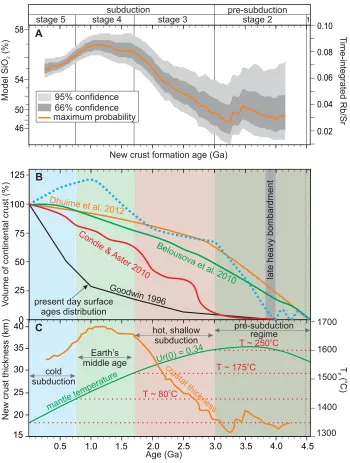
Dhuime et al. (2015) combined crystallization ages, Nd model ages, and initial Sr isotope ratios of igneous rocks to calculate the Rb/Sr ratios of their crustal source rocks in the period between the model ages, taken to reflect the time those crustal source rocks were derived from the mantle, and the time of generation and crystallization of the magmatic rocks analyzed. These time- integrated Rb/Sr ratios are thought to reflect those of new conti-nental crust, because they are calculated from the time of their model Nd ages. The Rb/Sr ratios of new continental crust are highly scattered prior to 3.0 Ga, but the median is ~0.03, and it increased to a maximum value of ~0.08 from 3.0 to 1.7 Ga, before decreasing to values of ~0.065 in the past ~1 b.y. (Fig. 4A). The implication is that the SiO2 contents of new crust increased from ~48% before 3.0 Ga to more intermediate compositions, with SiO2 up to ~57%. This is attributed to a shift from broad-scale mantle melting and diffuse magma injection prior to 3.0 Ga to a subse-quent plate tectonic regime involving subduction-related magma-tism at plate boundaries (e.g., Sizova et al., 2010).
The Rb/Sr ratios of igneous rocks in modern-day Central and South America increase with crustal thickness, and so the temporal increase in the Rb/Sr ratio of new continental crust may also indicate that the thickness of the crust at the sites of crust generation increased from 20 km at 3.0 Ga to almost 40 km at ca. 1.7 Ga. The estimated thickness then decreased to nearer 30 km since ca. 1 Ga (Dhuime et al., 2015). The predominantly mafic character of Earth’s crust before 3.0 Ga (see also Kemp et al., 2010; Tang et al., 2016) means that it would have had a higher density and been less buoyant than modern continental crust, resulting in a greater probability for its recycling into the mantle. Recent geodynamic modeling of Archean crust generated under higher mantle temperatures suggests that it would have been gravitation-ally unstable and susceptible to recycling through delamination (Johnson et al., 2013).
The curves for crustal growth rates from Belousova et al. (2010) and Dhuime et al. (2012) are based on the proportion of juvenile to reworked crust at different times. Such cumulative growth curves cannot decrease with time (Fig. 4B), and so the curve of changing crustal thickness through time offers a different
Pilbara-Yilgarn (8,200 analyses)
40 50 60 70 80
Andes (4,800 analyses)
SiO (%)2
[image:7.603.61.267.47.326.2]600 400 200 0 300 200 100 0
Figure 3. Whole rock SiO2 distributions of plutonic and volcanic rocks from
8
GS
A T
OD
AY
|
SEP
TE
MB
ER
20
16
15 20 25 30 35 40
New crust thickness (km
)
T(
C)
p
o
Ur(0) =0.34 1600
1500
1400
1300 1700
Earth’s middle age
mantle
temperatur
e crustal thicknes
s
T ~ 175 Co
T~ 80oC
T ~250oC
hot, shallow subduction
pre-subduction regime
cold subduction
C
Volume of continental crust (%
)125
present day surface ages distribution
Goodwin 1996
Dhuime et al. 2012
100
75
50
25
0
0.5 1.0 1.5 2.0 2.5 3.0 3.5 4.0 4.5
Age (Ga)
B
Model Si
O
(%2
r
46 50 54
0.02 0.04 0.06 0.08
95% confidence 66% confidence maximum probability
New crust formation age (Ga)
Condi
e &Aster 2010 Belousova et al. 201
0 late heavy bombardment
Figure 4. (A) Variation in the estimated Rb/Sr ratios, and SiO2 contents, of new continental crust from Dhuime
et al. (2015). (B) A preliminary model for the changes in volume of the continental crust (dotted blue curve) compared with the crustal growth curves of Belousova et al. (2010) and Dhuime et al. (2012), the model age distribution of Condie and Aster (2010), and the present-day surface age distribution of Goodwin (1996). The preliminary model is illustrative, and it is not unique. It assumes two types of crust generated before and after 3.0 Ga, and rates of crust generation and destruction for each. It is constrained by the volume of continental crust at the present day and 70% at 3.0 Ga, and by the present-day curve of Condie and Aster (2010). (C) Variation in the thickness of new continental crust through time (orange curve) as estimated from the Rb/Sr ratio of new continental crust (Dhuime et al., 2015), and thermal models for ambient mantle for Urey (Ur) ratio of 0.34 (Korenaga, 2013).
perspective (Fig. 4C; Dhuime et al., 2015). The high crustal growth rates before 3.0 Ga were marked by relatively thin conti-nental crust, and at that time there is no link between estimated crustal thickness and crustal growth rates. However, by 3.0 Ga the estimated volume of crust was at least ~70% of the present-day volume, and the crustal thickness was ~50% of the present-day crustal thickness. It therefore appears that before 3.0 Ga the area of continental crust increased with crustal volume, but that since
then the thickness (and volume) of the crust may have increased with little or no increase in area.
[image:8.603.127.477.45.508.2]9
GS
A TO
DA
Y | w
ww
.geo
soc
iet
y.or
g/
gs
at
oda
y
between Rb/Sr and crustal thickness is observed in subduction settings (Dhuime et al., 2015), it implies that crustal thickness may be a reasonable proxy for crustal volume at least over the past 2.0 b.y.
Figure 4B (dotted blue curve) illustrates such a model for the changes in crustal volumes through time. It is constrained by the present volume of the continental crust, the presence of 70% of that volume at 3.0 Ga, and the present-day distribution of crust with different model ages (Condie and Aster, 2010). It starts at the end of the heavy bombardment ca. 3.9 Ga; it assumes that the rate of crust generation was greater before 3.0 Ga than subsequently, and that the compositions of the crust generated before and after 3.0 Ga were different. Pre–3.0 Ga crust was preferentially recycled from 3.0 to 1.5 Ga following the onset of subduction at 3.0 Ga. Such models are not unique, but they indicate that changing volumes of continental crust can be modeled with two types of crust that are destroyed at different rates. The model outlined here predicts that nearly twice the present volume of the continental crust has been recycled since the end of the heavy bombardment.
The increase in thickness at the sites of crust generation from 3.0 to 1.7 Ga indicates that more of the continental crust was elevated above seawater (Flament et al., 2013), and hence suscep-tible to sub-aerial weathering and erosion. This increase in crustal thickness is accompanied by a steady increase in the Sr isotope ratios of seawater (Fig. 1; Shields and Veizer, 2002), implying increased continental runoff, which would increase the amounts of CO2 draw down due to continental weathering (e.g., Kramers, 2002). Preliminary models indicate that in the mid-Proterozoic the volume of continental crust may have been up to 20% greater than at the present day, and since 1.0 Ga the crust has become thinner, and we infer that the crust decreased in volume (Fig. 4). The rates of crustal growth appear to have decreased as Earth cooled, and “cool” subduction began to dominate, which, on the basis of preserved metamorphic and other rock units, is taken to have commenced around 0.75 Ga (Brown, 2006; Cawood and Hawkesworth, 2014), such that the rates of crustal recycling were greater than the rates at which new crust was generated.
DISCUSSION
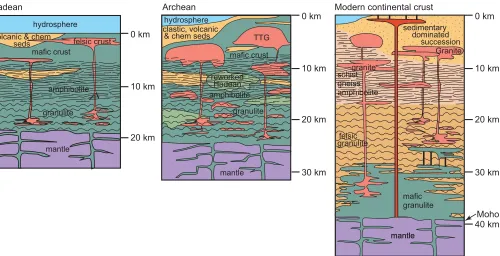
There appears to have been five stages in Earth’s evolution, with the last four being recorded in the geology of the continental crust (Fig. 4). Stage 1 included the initial accretion of the Earth, core/ mantle differentiation, the development of a magma ocean, and of an undifferentiated mafic crust. Most models suggest that a magma ocean may have persisted on Earth for 5–10 m.y., and continuing volcanism, along with deformation, would have progressively thickened the initial mafic crust (Kamber, 2015; Kamber et al., 2005). Once the crust was at least 15–20 km thick, remelting could take place (Fig. 2; Kamber et al., 2005), and the resultant felsic magmas represented the high silica component in the distinctive bimodal silica distribution that characterizes the Archean crust (Fig. 3). This second stage was marked by elevated mantle temperatures compared to the present day (Fig. 4C) that resulted in lithosphere weakened by the emplacement of melts (Gerya, 2014; Sizova et al., 2010). This inhibited subduction, and hence plate tectonics, and magmatism were driven by mantle upwellings that percolated the lithosphere. These might have been associated with deep-seated mantle plumes, but such models
remain difficult to test, and the upwellings may have been more localized and likely originated at shallower levels, perhaps as in a heat-pipe model (Moore and Webb, 2013). In today’s world, such magmatism would be regarded as intraplate; it has no association with subduction, but in a time before plates, such terminology is arguably misleading. Destruction and recycling of early crust occurred through a combination of delamination (Johnson et al., 2013) and meteorite impact, the latter continuing until the end of the late heavy bombardment ca. 3.9 Ga (Gomes et al., 2005; Marchi et al., 2014), and so perhaps we are fortunate to have the few zircon grains that have survived from the Hadean.
The onset of stage 3 is taken to be the stabilization of Archean cratons and the change in crustal growth rates ca. 3.0 Ga. It is envisaged that Earth had cooled sufficiently for “hot” subduction to take place (Sizova et al., 2010) from ca. 3.0 Ga to ca. 1.7 Ga (Fig. 4). The continental crust became thicker and more evolved, plate tectonics resulted in collisional orogenies, supercontinent cycles developed, and there was increased erosion to the oceans due to thickening and subaerial exposure of continental crust resulting in an increase in Sr isotope ratios in seawater (Fig. 1B). Models in which ~70% of the present volume of the continental crust was present at 3.0 Ga also require that large volumes of continental crust have been destroyed, presumably in the late Archean and the Proterozoic (Hawkesworth et al., 2013). However, the net growth of crust requires the rate of crust genera-tion to exceed that of recycling (Fig. 4).
The fourth stage is from 1.7 to 0.75 Ga, referred to as the “boring billion” (Holland, 2006), and more recently as Earth’s middle age (Cawood and Hawkesworth, 2014). It is marked by a paucity of preserved passive margins, an absence of significant anomalies in the paleoseawater Sr isotope record and in Hf isotopes in detrital zircon (Fig. 1), a lack of orogenic gold and volcanic-hosted massive sulfide deposits, and an absence of glacial deposits and iron formations (Cawood and Hawkesworth, 2015). It appears to have been a period of environmental, evolutionary, and lithospheric stability, which has been attributed to a relatively stable continental assemblage that was initiated during assembly of the Nuna supercontinent by ca. 1.7 Ga and continued until breakup of its closely related successor, Rodinia, ca. 0.75 Ga. It is also marked by abundant anorthosites and related rocks perhaps linked with the secular cooling of the mantle. The overlying continental lithosphere was strong enough to be thickened and to support the emplacement of large plutons into the crust, yet the underlying mantle was still warm enough to result in widespread melting of the lower thickened crust and the generation of anor-thositic magmas (Ashwal, 2010).
10
GS
A T
OD
AY
|
SEP
TE
MB
ER
20
16
in the properties of the lithosphere, and hence in tectonics and ultimately in surficial processes. As Earth cooled from the late Archean (Fig. 4C), the continental and oceanic lithospheres strengthened because they contained less melt and were charac-terized by lower temperatures. Subduction and plate tectonics caused profound changes with the onset of significant horizontal tectonics, the development of thickened mountain belts and increased erosion, a change in crustal compositions, and the recy-cling of continental crust back into the mantle. Secular cooling of Earth impacted lithospheric rheology, magmatic activity, and thickness, which in turn influenced surficial processes and features. Secular changes in the rheology of the lithosphere deter-mine how it behaves in terms of global tectonics, the magmas generated, and the differential preservation of rocks generated in different settings that have shaped the geological record.
ACKNOWLEDGMENTS
We thank the Natural Environment Research Council (grants NE/ J021822/1 and NE/K008862/1) for funding, and Mike Brown, Adrian Lenardic, and Brendan Murphy for their detailed and helpful reviews. REFERENCES CITED
Albarède, F., 1998, The growth of continental crust: Tectonophysics, v. 296, no. 1–2, p. 1–14, doi: 10.1016/S0040-1951(98)00133-4.
Arndt, N., and Davaille, A., 2013, Episodic Earth evolution: Tectonophysics, v. 609, p. 661–674, doi: 10.1016/j.tecto.2013.07.002.
Ashwal, L.D., 2010, The Temporality of Anorthosites: Canadian Mineralogist, v. 48, no. 4, p. 711–728, doi: 10.3749/canmin.48.4.711.
Belousova, E.A., Kostitsyn, Y.A., Griffin, W.L., Begg, G.C., O’Reilly, S.Y., and Pearson, N.J., 2010, The growth of the continental crust: Constraints from zircon Hf-isotope data: Lithos, v. 119, no. 3–4, p. 457–466, doi: 10.1016/ j.lithos.2010.07.024.
Bradley, D.C., 2008, Passive margins through earth history: Earth Science Reviews, v. 91, no. 1–4, p. 1–26, doi: 10.1016/j.earscirev.2008.08.001. Bradley, D.C., 2011, Secular trends in the geologic record and the
supercontinent cycle: Earth Science Reviews, v. 108, no. 1–2, p. 16–33, doi: 10.1016/j.earscirev.2011.05.003.
Brown, M., 2006, Duality of thermal regimes is the distinctive characteristic of plate tectonics since the Neoarchean: Geology, v. 34, no. 11, p. 961–964, doi: 10.1130/G22853A.1.
Brown, M., 2007, Metamorphic conditions in orogenic belts: A record of secular change: International Geology Review, v. 49, no. 3, p. 193–234, doi: 10.2747/ 0020-6814.49.3.193.
Brown, M., 2014, The contribution of metamorphic petrology to understanding lithosphere evolution and geodynamics: Geoscience Frontiers, v. 5, no. 4, p. 553–569, doi: 10.1016/j.gsf.2014.02.005.
Campbell, I.H., 2003, Constraints on continental growth models from Nb/U ratios in the 3.5 Ga Barberton and other Archaean basalt-komatiite suites: American Journal of Science, v. 303, no. 4, p. 319–351, doi: 10.2475/ ajs.303.4.319.
Carlson, R.W., Pearson, D.G., and James, D.E., 2005, Physical, chemical, and chronological characteristics of continental mantle: Reviews of Geophysics, v. 43, no. 1, RG1001, doi: 10.1029/2004RG000156.
Cawood, P.A., and Hawkesworth, C.J., 2014, Earth’s middle age: Geology, v. 42, no. 6, p. 503–506, doi: 10.1130/G35402.1.
Cawood, P.A., and Hawkesworth, C.J., 2015, Temporal relations between mineral deposits and global tectonic cycles, in Jenkins, G.R.T., Lusty, P.A.J., McDonald, I., Smith, M.P., Boyce, A.J., and Wilkinson, J.J., eds., Ore Deposits in an Evolving Earth: v. 393, Geological Society, London, Special Publication 393, p. 9–21, doi: 10.1144/SP393.1.
mantle recycling and Phanerozoic evolution of the continental crust: Earth Science Reviews, v. 97, no. 1–4, p. 80–104, doi: 10.1016/j.earscirev .2009.10.003.
Condie, K.C., 1998, Episodic continental growth and supercontinents: A mantle avalanche connection?: Earth and Planetary Science Letters, v. 163, no. 1–4, p. 97–108, doi: 10.1016/S0012-821X(98)00178-2.
Condie, K.C., and Aster, R.C., 2010, Episodic zircon age spectra of orogenic granitoids: The supercontinent connection and continental growth: Precambrian Research, v. 180, no. 3–4, p. 227–236, doi: 10.1016/ j.precamres.2010.03.008.
Condie, K.C., and Kröner, A., 2013, The building blocks of continental crust: Evidence for a major change in the tectonic setting of continental growth at the end of the Archean: Gondwana Research, v. 23, no. 2, p. 394–402, doi: 10.1016/j.gr.2011.09.011.
Condie, K.C., Bickford, M.E., Aster, R.C., Belousova, E., and Scholl, D.W., 2011, Episodic zircon ages, Hf isotopic composition, and the preservation rate of continental crust: GSA Bulletin, v. 123, no. 5–6, p. 951–957, doi: 10.1130/ B30344.1.
Dhuime, B., Hawkesworth, C.J., Cawood, P.A., and Storey, C.D., 2012, A Change in the geodynamics of continental growth 3 billion years ago: Science, v. 335, no. 6074, p. 1334–1336, doi: 10.1126/science.1216066. Dhuime, B., Wuestefeld, A., and Hawkesworth, C.J., 2015, Emergence of
modern continental crust about 3 billion years ago: Nature Geoscience, v. 8, p. 552–555, doi:10.1038/ngeo2466.
Elkins-Tanton, L.T., 2008, Linked magma ocean solidification and atmospheric growth for Earth and Mars: Earth and Planetary Science Letters, v. 271, no. 1–4, p. 181–191, doi: 10.1016/j.epsl.2008.03.062.
Eriksson, K.A., Campbell, I.H., Palin, J.M., and Allen, C.M., 2003,
Predominance of Grenvillian magmatism recorded in detrital zircons from modern Appalachian rivers: The Journal of Geology, v. 111, p. 707–717, doi: 10.1086/378338.
Flament, N., Coltice, N., and Rey, P.F., 2013, The evolution of the 87Sr/86Sr of
marine carbonates does not constrain continental growth: Precambrian Research, v. 229, p. 177–188, doi: 10.1016/j.precamres.2011.10.009. GEOROC, 2016, Geochemistry of Rocks of the Oceans and Continents: Max
Planck Institute for Chemistry, http://georoc.mpch-mainz.gwdg.de/ georoc/ (last accessed 24 June 2016).
Gerya, T., 2014, Precambrian geodynamics: Concepts and models: Gondwana Research, v. 25, no. 2, p. 442–463, doi: 10.1016/j.gr.2012.11.008. Gomes, R., Levison, H.F., Tsiganis, K., and Morbidelli, A., 2005, Origin of the
cataclysmic Late Heavy Bombardment period of the terrestrial planets: Nature, v. 435, 7041, p. 466–469, doi: 10.1038/nature03676.
Goodwin, A.M., 1996, Principles of Precambrian Geology: London, Academic Press, 327 p.
Gower, C.F., and Krogh, T.E., 2002, A U-Pb geochronological review of the Proterozoic history of the eastern Grenville Province: Canadian Journal of Earth Sciences, v. 39, p. 795–829.
Hawkesworth, C.J., and Kemp, A.I.S., 2006, The differentiation and rates of generation of the continental crust: Chemical Geology, v. 226, no. 3–4, p. 134–143, doi: 10.1016/j.chemgeo.2005.09.017.
Hawkesworth, C., Cawood, P., Kemp, T., Storey, C., and Dhuime, B., 2009, A matter of preservation: Science, v. 323, p. 49–50, doi: 10.1126/ science.1168549.
Hawkesworth, C., Dhuime, B., Pietranik, A., Cawood, P., Kemp, T., and Storey, C., 2010, The generation and evolution of the continental crust: Journal of the Geological Society, v. 167, p. 229–248, doi: 10.1144/ 0016-76492009-072.
Hawkesworth, C., Cawood, P., and Dhuime, B., 2013, Continental growth and the crustal record: Tectonophysics, v. 609, p. 651–660, doi: 10.1016/j.tecto .2013.08.013.
11
GS
A TO
DA
Y | w
ww
.geo
soc
iet
y.or
g/
gs
at
oda
y
Holmes, A., 1965, Principles of Physical Geology: London, Nelson, 1288 p. Hutton, J., 1785, Abstract of a dissertation read in the Royal Society of
Edinburgh, upon the seventh of March, and fourth of April,
MDCCLXXXV, Concerning the System of the Earth, Its Duration, and Stability: Edinburgh, 30 p.
Hutton, J., 1788, Theory of the Earth; or an Investigation of the Laws observable in the Composition, Dissolution, and Restoration of Land upon the Globe: Transactions of the Royal Society of Edinburgh, v. 1, p. 209–304, doi: 10.1017/S0080456800029227.
Johnson, T.E., Brown, M., Kaus, B.J.P., and VanTongeren, J.A., 2013, Delamination and recycling of Archaean crust caused by gravitational instabilities: Nature Geoscience, v. 7, no. 1, p. 47–52, doi: 10.1038/ ngeo2019.
Kamber, B.S., 2015, The evolving nature of terrestrial crust from the Hadean, through the Archaean, into the Proterozoic: Precambrian Research, v. 258, p. 48–82, doi: 10.1016/j.precamres.2014.12.007.
Kamber, B.S., Whitehouse, M.J., Bolhar, R., and Moorbath, S., 2005, Volcanic resurfacing and the early terrestrial crust: Zircon U-Pb and REE constraints from the Isua Greenstone Belt, southern West Greenland: Earth and Planetary Science Letters, v. 240, no. 2, p. 276–290, doi: 10.1016/ j.epsl.2005.09.037.
Kemp, A.I.S., Wilde, S.A., Hawkesworth, C.J., Coath, C.D., Nemchin, A., Pidgeon, R.T., Vervoort, J.D., and DuFrane, S.A., 2010, Hadean crustal evolution revisited: New constraints from Pb-Hf isotope systematics of the Jack Hills zircons: Earth and Planetary Science Letters, v. 296, no. 1–2, p. 45–56, doi: 10.1016/j.epsl.2010.04.043.
Korenaga, J., 2013, Initiation and evolution of plate tectonics on Earth: Theories and observations: Annual Review of Earth and Planetary Sciences, v. 41, no. 1, p. 117–151, doi: 10.1146/annurev-earth-050212-124208. Kramers, J.D., 2002, Global modelling of continent formation and destruction
through geological time and implications for CO2 drawdown in the
Archaean eon, in Fowler, C.M.R., Ebinger, C.J., and Hawkesworth, C.J., eds., The Early Earth: Physical, Chemical and Biological Development, Geological Society, London, Special Publication 199, p. 259–274, doi: 10.1144/GSL.SP.2002.199.01.13.
Marchi, S., Bottke, W.F., Elkins-Tanton, L.T., Bierhaus, M., Wuennemann, K., Morbidelli, A., and Kring, D.A., 2014, Widespread mixing and burial of Earth’s Hadean crust by asteroid impacts: Nature, v. 511, 7511, p. 578–582, doi: 10.1038/nature13539.
McKenzie, D., 1984, The generation and compaction of partially molten rock: Journal of Petrology, v. 25, no. 3, p. 713–765, doi: 10.1093/petrology/ 25.3.713.
Moore, W.B., and Webb, A.A.G., 2013, Heat-pipe Earth: Nature, v. 501, no. 7468, p. 501–505, doi: 10.1038/nature12473.
Mora, C., Tittensor, D., Adl, S., Simpson, A., and Worm, B., 2011, How many species are there on Earth and in the ocean?: PLoS Biology, v. 9, no. 8, p. 1–8, doi: 10.1371/journal.pbio.1001127.
Nance, R.D., Murphy, J.B., and Santosh, M., 2014, The supercontinent cycle: A retrospective essay: Gondwana Research, v. 25, no. 1, p. 4–29, doi: 10.1016/ j.gr.2012.12.026.
Nisbet, E.G., Cheadle, M.J., Arndt, N.T., and Bickle, M.J., 1993, Constraining the potential temperature of the Archaean mantle: A review of the evidence from komatiites: Lithos, v. 30, no. 3–4, p. 291–307, doi: 10.1016/ 0024-4937(93)90042-B.
Parman, S.W., 2015, Time-lapse zirconography: Imaging punctuated continental evolution: Geochemical Perspective Letters, v. 1, p. 43–52, doi: 10.7185/geochemlet.1505.
Rapp, R.P., and Watson, E.B., 1995, Dehydration melting of metabasalt at 8–32 kbar: Implications for continental growth and crust-mantle recycling: Journal of Petrology, v. 36, no. 4, p. 891–931, doi: 10.1093/ petrology/36.4.891.
Raup, D.M., 1972, Taxonomic diversity during the Phanerozoic: Science, v. 177, no. 4054, p. 1065–1071, doi: 10.1126/science.177.4054.1065.
Rino, S., Komiya, T., Windley, B.F., Katayama, I., Motoki, A., and Hirata, T., 2004, Major episodic increases of continental crustal growth determined from zircon ages of river sands; implications for mantle overturns in the
Early Precambrian: Physics of the Earth and Planetary Interiors, v. 146, p. 369–394, doi: 10.1016/j.pepi.2003.09.024.
Roberts, N.M.W., and Spencer, C.J., 2014, The zircon archive of continent formation through time: Geological Society, London, Special Publication 389 p., doi: 10.1144/SP1389.1114.
Rudnick, R.L., and Gao, S., 2003, Composition of the continental crust, in Rudnick, R.L., ed., Treatise on Geochemistry, v. 3, The Crust: Amsterdam, Elsevier, p. 64.
Scholl, D.W., and von Huene, R., 2007, Exploring the implications for continental basement tectonics if estimated rates of crustal removal (recycling) at Cenozoic subduction zones are applied to Phanerozoic and Precambrian convergent ocean margins, in Hatcher, R.D., Jr., Carlson, M.P., McBride, J.H., and Catalán, J.M., eds., 4-D Framework of Continental Crust: Geological Society of America Memoir 200, p. 9–32. Scholl, D.W., and von Huene, R., 2009, Implications of estimated magmatic
additions and recycling losses at the subduction zones of accretionary (non-collisional) and collisional (suturing) orogens, in Cawood, P.A., and Kröner, A., eds., Earth Accretionary Systems in Space and Time: Geological Society, London, Special Publication 318, p. 105–125, doi: 10.1144/SP318.4.
Shields, G.A., 2007, A normalised seawater strontium isotope curve: Possible implications for Neoproterozoic-Cambrian weathering rates and the further oxygenation of the Earth: eEarth, v. 2, p. 35–42.
Shields, G., and Veizer, J., 2002, Precambrian marine carbonate isotope database: Version 1.1: Geochemistry Geophysics Geosystems, v. 3, no. 6, p. 1–12, doi: 10.1029/2001GC000266.
Sizova, E., Gerya, T., Brown, M., and Perchuk, L.L., 2010, Subduction styles in the Precambrian: Insight from numerical experiments: Lithos, v. 116, no. 3–4, p. 209–229, doi: 10.1016/j.lithos.2009.05.028.
Sizova, E., Gerya, T., and Brown, M., 2014, Contrasting styles of Phanerozoic and Precambrian continental collision: Gondwana Research, v. 25, no. 2, p. 522–545, doi: 10.1016/j.gr.2012.12.011.
Smith, A.B., and McGowan, A.J., 2007, The shape of the Phanerozoic marine palaeodiversity curve: How much can be predicted from the sedimentary rock record of Western Europe?: Palaeontology, v. 50, no. 4, p. 765–774, doi: 10.1111/j.1475-4983.2007.00693.x.
Spencer, C.J., Cawood, P.A., Hawkesworth, C.J., Raub, T.D., Prave, A.R., and Roberts, N.M.W., 2014, Proterozoic onset of crustal reworking and collisional tectonics: Reappraisal of the zircon oxygen isotope record: Geology, v. 42, no. 5, p. 451–454, doi: 10.1130/G35363.1.
Stern, C.R., 2011, Subduction erosion: Rates, mechanisms, and its role in arc magmatism and the evolution of the continental crust and mantle: Gondwana Research, v. 20, no. 2–3, p. 284–308, doi: 10.1016/j.gr.2011 .03.006.
Stern, R.J., 2005, Evidence from ophiolites, blueschists, and ultrahigh-pressure metamorphic terranes that the modern episode of subduction tectonics began in Neoproterozoic time: Geology, v. 33, no. 7, p. 557–560, doi: 10.1130/G21365.1.
Tang, M., Chen, K., and Rudnick, R.L., 2016, Archean upper crust transition from mafic to felsic marks the onset of plate tectonics: Science, v. 351, p. 372–375, doi: 10.1126/science.aad5513.
Taylor, S.R., and McLennan, S.M., 1985, The Continental Crust: Its Composition and Evolution: Oxford, Blackwell Scientific Publications, 312 p.
Voice, P.J., Kowalewski, M., and Eriksson, K.A., 2011, Quantifying the timing and rate of crustal evolution: Global compilation of radiometrically dated detrital zircon grains: The Journal of Geology, v. 119, no. 2, p. 109–126, doi: 10.1086/658295.
Western Australia Geological Survey, 2016, Geochemistry Database Search: Government of Western Australia Department of Mines and Petroleum, http://geochem.dmp.wa.gov.au/geochem/ (last accessed 24 June 2016). Wilkinson, B.H., and Kesler, S.E., 2007, Tectonism and exhumation in
convergent margin orogens: Insights from ore deposits: The Journal of Geology, v. 115, no. 6, p. 611–627, doi: 10.1086/521606.
12
GS
A T
OD
AY
|
SEP
TE
MB
ER
20
16
From the eastern plains to the western canyons, Colorado offers countless opportunities for geological investigation. To coincide with the 2016 Annual Meeting in Denver, we’re offering free digital access to three popular Colorado field guides that will help you explore the unique geology of the state and make the most of your visit. Available now through the end of September.
Free GSA Field Guides
Get started at
www.gsapubs.org
High Plains to Rio Grande Rift: Late Cenozoic Evolution
of Central Colorado
2002, v. 3, p. 59–93
Critical zone evolution: Climate and exhumation in the
Colorado Front Range
2013, v. 33, p. 1–18
Colorado geology then and now: Following the route of the Colorado Scientific Society’s 1901
trip through central Colorado
2013, v. 33, p. 19–82
SPECIAL HIGHLIGHT
October’s Science Article Covers
the Geology of Cuba, Ties into
Annual Meeting Pardee Symposium
14
GS
A T
OD
AY
|
SEP
TE
MB
ER
20
16
communit y.geosociet y.org /gsa2 016
View of Colorado from Pikes Peak. Photo by Kea Giles.
Join your GSA colleagues for a full, fun, and invigorating Annual Meeting. The early meeting dates allow for an unusually rich slate of geological field trips to locations across the mountain states. Remind yourself why you love geoscience on a field trip to the Belt Basin, the San Juan Mountains, Yellowstone, the Colorado–Green River system, and more. A full technical program will reach broadly across our science, with 230 topical sessions and featured symposia on the geological evolution of Cuba (with special Cuban guests) and the critically important High Plains Aquifer.
Enhance your skills with a short course on LiDAR, environmental geochemistry, teaching controversial issues, 3-D printing, and much more. Check out the Exhibit Hall, and meet with instrument and service vendors, publishers, geoscience organizations, and graduate schools. Opportunities abound for students to network with top profes-sionals and speak with mentors from various employment sectors. The 5th International
EarthCache Event immediately precedes the GSA meeting, and there will be opportunities throughout the meeting to engage in EarthCache activities.
Now that the abstracts are in, we can tell you that you’ll have more than 4,700 talks to choose from, and we expect that nearly 7,500 geoscientists from around the world will come to Denver this year. Don’t miss your opportunity to weigh in on discussions, find project and job opportunities, and have a bit of fun! See you in Denver!
President’s Welcome
GSA Presidential Address:
Mission-Driven Geoscience
Sun., 25 Sept., noon–1:30 p.m. Colorado Convention Center (CCC), Mile High Ballroom 2A/3A
Geoscientists work across the spectrum, from the fundamental research that dominates academic departments to the applied science driving oil and gas exploration, mining, and environmental protection. Within a number of federal agencies, especially the U.S. Department of Energy, geosci-entists mesh fundamental and applied science to focus on mission-driven geoscience. Here the goal is to develop the basic understanding necessary to solve complex problems in support of the nation’s energy and national security, and its environmental health. This address will explore some of the complex challenges being addressed by geoscientists within our national laboratories, from the detection and characterization of clandestine nuclear weapons testing to resolving the longstanding question of what to do with radioactive waste, both legacy and recent. The challenges also encom-pass the efficient and environmentally sustainable development of our many energy resources, and improving our ability to predict the impacts of climate change at global and regional scales. Harnessing scientific understanding to resolve large, complex problems is fundamentally important to a healthy, safe, and prosperous nation and will remain a challenge to future geo-generations.
Claudia I. Mora, GSA President
15
GS
A TO
DA
Y | w
ww
.geo
soc
iet
y.or
g/
gs
at
oda
y
15
GS
A TO
DA
Y | w
ww
.geo
soc
iet
y.or
g/
gs
at
oda
y
GSA2016 ANNUAL MEETING & EXPOSITION
communit y.geosociet y.org /gsa2 016
PENROSE MEDAL
John T. Andrews, University of Colorado
ARTHUR L. DAY MEDAL
Donald B. Dingwell, University of MunichYOUNG SCIENTIST AWARD (DONATH MEDAL)
Whitney M. Behr, The University of Texas at AustinPRESIDENT’S MEDAL
Sarah Andrews, Geologist and AuthorGSA PUBLIC SERVICE AWARD
Rex Buchanan, Kansas Geological SurveyRANDOLPH W. “BILL” AND CECILE T. BROMERY
AWARD FOR MINORITIES
Kathleen R. Johnson, University of California Irvine
GSA DISTINGUISHED SERVICE AWARD
J. Christopher Hepburn, Boston CollegeLori L. Summa, ExxonMobil Upstream Research Company
DORIS M. CURTIS OUTSTANDING
WOMAN IN SCIENCE AWARD
Christine A. Regalla, Boston UniversityGEOLOGIC MAPPING AWARD IN HONOR OF
FLORENCE BASCOM
Marc R. St-Onge, Geological Survey of Canada Please join GSA President Claudia I. Mora and GSA Vice-President/
President-Elect Isabel P. Montanez to honor and greet the 2016 GSA Medals & Awards recipients at the Presidential Address and
Awards Ceremony. You will also have the privilege of hearing Mora give her Presidential Address, “Mission-Driven Geoscience.” Following this address, Vicki S. McConnell, Executive Director of
GSA, will provide a presentation on the state of the Society and
Jack Hess will provide a GSA Foundation update.
PRESIDENT
Claudia I. Mora
VICE PRESIDENT/ PRESIDENT-ELECT
Isabel P. Montanez
Awards & Medals
GSA AWARDS CEREMONY
Sun., 25 Sept., noon–1:30 p.m. CCC, Mile High Ballroom 2A/3A
2016 GSA M
EDAL & AWARD RECIPIENTS
Donald B. Dingwell
Lori L. Summa Whitney M. Behr
Christine A. Regalla
Rex Buchanan
Marc Robert St-Onge John T. Andrews
J. Christopher Hepburn Kathleen R. Johnson
16
GS
A T
OD
AY
|
SEP
TE
MB
ER
20
16
communit y.geosociet y.org /gsa2 016
LUNCHTIME ENLIGHTENMENT
Jen Russel-Houston,
Osum Oil Sands Corp.
GSA 2016 Michel T. Halbouty Distinguished Lecture: Contemporary Oil Sands: Retrospect and Future Potential
Monday, 26 Sept., 12:15–1:15 p.m.
Colorado Convention Center, Mile High Ballroom 2A/3A
The oil sands in Canada are the third largest accumulation of crude oil in the world and are part of the diverse energy mix that meets the world’s growing needs. The bitumen deposits are hosted in siliciclastic sandstones deposited during the Cretaceous in fluvial to marine settings of the foreland basin east of the Rocky Mountains and in underlying Paleozoic carbon-ates. Natural bitumen is a high-density oil that is too viscous to flow at reservoir conditions. About 20% of the bitumen is found in shallow deposits and excavated using surface mining tech-niques. During this talk, Dr. Jen Russel-Houston will focus on the remaining 80% of the bitumen, which is hosted in reservoirs deeper than 75 m and is recovered in situ using wellbores. Typically, steam is injected into the pores of the reservoir to heat the oil and thus reduce the viscosity of the bitumen to enable it to flow to producing wells. Early applications of steam injection to produce oil took place in the 1960s in California, where steam was
GSA’S CONNECTED COMMUNITY
—Connect with your colleagues at community.geosociety.org/gsa2016/attendeeinfo/network/directory.
www.facebook.com/GSA.1888.
YOU TUBE
—Learn more about GSA and careers in the geosciences atwww.youtube.com/user/geosociety.
http://linkd.in/1HsYwni.
BLOG ROLL
—Will you be blogging about the meeting? Get on the Blog Roll atcommunity.geosociety.org/gsa2016/press/news/blogroll.
flooded through the reservoir in a pattern of injection and production wells. This method and others were adapted to the Canadian reservoirs and entirely new technological approaches were advanced, with steam assisted gravity drainage (SAGD) being the most successful. Effective adaptation and application of these technologies is linked directly to understanding and inte-grating geological information with engineering design. This has led to investment of over $200 billion, and growth in production to over 1.3 million barrels per day. This spirit of innovation continues as recovery technologies are being piloted, optimized, and commercialized to further reduce the energy intensity and environmental footprint of future developments.
Jen Russel-Houston, P.Geol., obtained a Ph.D. in geology from Dalhousie University in 2001 and completed a thesis that examined the graptolite taphonomy of a Silurian-aged carbonate ramp in the Arctic of Canada. Prior to joining Osum Oil Sands Corp. in 2008, Russel-Houston worked for Shell on both onshore and offshore proj-ects where she developed expertise in reservoir evaluation, thermal production geology, and leading technical teams. As vice president of geoscience, she oversees Osum’s geoscience evaluations as they relate to current assets and guides the assessment of potential opportuni-ties of interest to Osum. Russel-Houston is Director of the Canadian Society of Petroleum Geologists, Associate Editor of the Canadian Bulletin of Petroleum Geology, and was Vice General Chair of the American Association of Petroleum Geology Annual Convention and Exhibition in June 2016.
GSA 2016 on Social Media
18
GS
A T
OD
AY
|
SEP
TE
MB
ER
20
16
communit y.geosociet y.org /gsa2 016
Hotel Map
Downtown Denver Hotels Distance to Colorado Convention Center Single/Double Rate
1 Hyatt Regency Denver at CCC (HQ Hotel) 50 Steps $223
2 Crowne Plaza Denver Downtown 2 Blocks $179
3 Denver Marriott City Center 3 Blocks $199
4 Grand Hyatt Denver (Co-HQ Hotel) 3 Blocks $205
5 Hampton Inn & Suites Convention Center 1 Block $199
6 Hilton Garden Inn Downtown Denver 1 Block $195
7 Holiday Inn Express Denver Downtown 5 Blocks $161
8 Homewood Suites Denver/Downtown—Convention Center 1 Block $199
9 HYATT house 1 Block $199
10 Hyatt Place 1 Block $199
19
GS
A TO
DA
Y | w
ww
.geo
soc
iet
y.or
g/
gs
at
oda
y
19
GS
A TO
DA
Y | w
ww
.geo
soc
iet
y.or
g/
gs
at
oda
y
GSA2016 ANNUAL MEETING & EXPOSITION
communit y.geosociet y.org /gsa2 016
Housekeeping
Hotels
Orchid Event Solutions/GSA Housing Bureau will continue to assist you with hotel reservations through 15 September. If rooms are not available at the hotels in the GSA block, OES will provide you with a list of hotels in the area that have availability. community.geosociety.org/gsa2016/attendeeinfo/ accommodations/reservations
Critical Dates
15 Sept.: All changes, cancellations, and name substitutions must be finalized through Orchid Event Solutions by this date.
16 Sept.: Beginning on this date, you must contact the hotel directly for all changes, cancellations, and new reservations.
Polarizing Microscopes
MT9920
& MT9930
• Condenser with Swing-Out Top Lens
• Strain-Free Objectives, Infinity Corrected
• Focusable Bertrand Lens
• Rotatable Analyzer
• 1/4 Wave Plate and First Order Red Plate
• Circular Rotating Ceramic-Coated Stage
• Transmitted & Incident Illumination
Polarizing Microscopes
5895 Rue Ferrari San Jose, CA 95138 Toll Free: 1 (800) 832-0060 | Fax: (408) 226-0900 www.MeijiTechno.com Use “GSA2016MEIJI” promo code, when
ordering, to receive 10% off on all Polarizing Microscope
Ends 09/30/2017
BOOTH# 230
•
Condenser with Swing-Out Top Lens
•
Strain-Free Objectives, Infinity Corrected
•
Focusable Bertrand Lens
•
Rotatable Analyzer
• 1
/4 Wave Plate and First Order Red Plate
• Ci
rcular Rotating Ceramic-Coated Stage
•
Transmitted & Incident Illumination
MT9930Before You Arrive in Denver
Review the arrival/departure dates on your hotel acknowl-edgement for accuracy. If you do not show up on the date of your scheduled arrival, the hotel will release your room AND you will be charged for one night’s room and tax. If you have travel delays and cannot arrive on your scheduled arrival date, contact the hotel directly to make them aware of your new arrival date.
Child Care
20
GS
A T
OD
AY
|
SEP
TE
MB
ER
20
16
communit y.geosociet y.org /gsa2 016
Registration
You still have time to register for GSA 2016!
Register online at community.geosociety.org/gsa2016/ registration throughout the meeting, or visit the onsite registration desk in the Colorado Convention Center (CCC). Space is available on some tours, ticketed events, field trips, and short courses.
Badges will be available at the registration desk starting at 7 a.m. on Saturday, 24 Sept. Ribbons are available at the CCC Information Desk during onsite registration hours. Eligible attendees should inquire there.
GSA Section Travel Grants
Recipients of GSA Student Travel Grants will need to check in at the Annual Meeting office (room 210/212), show identi-fication, verify their address, and sign the check-in sheet to receive their check. The checks will be mailed to recipients after the meeting. If you do not check in, you willl not receive your grant.Pardee Keynote Symposia
25
SUNDAY
P1. Mastery of the
Subsurface: The Challenge to Improve Subsurface Energy Systems
1:45–5:30 p.m.
26
MONDAY
P2. When Oil and Water Mix: Understanding the Environmental Impacts of Shale Development
8 a.m.–5:30 p.m.
27
TUESDAY
P5. The High Plains Aquifer: Can It be Managed for Today and the Future?
8 a.m.–noon
P3. Exploring the Third Zone: The Geology of Pluto, Charon, and the Kuiper Belt
1:30–5:30 p.m.
28
WEDNESDAY
P4. Geologic Evolution of Cuba
8 a.m.–noon These Pardee Keynote Symposia will take place Sun.–Wed., 25–28 Sept.,
in Mile High Ballroom 2A/3A at the Colorado Convention Center. Read symposia descriptions and learn more about the featured speakers and cosponsors at
community.geosociety.org/gsa2016/science/sessions/pardee.
GSA 2016 September
Joseph T. Pardee
General Chair: Karen Berry
Technical Program Chair: Paul Baldauf
Technical Program Vice-Chair: Dick Berg
Field Trip Co-Chairs: Steve Keller, Matt Morgan
Education and Outreach Chair: Rick Aster
K–12 Education Chair: Samantha Richards
Student Committee: Hank Matthew Cole, Rachel Glade, Jay Merrill, Annette Patton, Charles Shobe, Sean Smith
Bruker Corporation
Bruker offers the world’s most comprehensive range of scientific
instrumentation available under one brand — a brand synonymous with
excellence, innovation and quality.
Visit us at Booth #500
for an Exciting Announcement!!Can't wait to find out?
Contact us at [email protected] to get more information.
22
GS
A T
OD
AY
|
SEP
TE
MB
ER
20
16
communit y.geosociet y.org /gsa2 016
Getting around Denver
Bus
The Regional Transportation District (RTD) skyRide makes hourly runs to/from Denver International Airport and to/from 18 free park-n-rides around the city. Fares are US$7, US$9, or US$11, depending on location, and drivers assist with luggage. All RTD services, maps, routes, park-n-rides, and fares are detailed on the RTD website at www.rtd-denver.com.
Taxi
Taxis are readily available and provide service to the Denver metro area and surrounding counties. The flat-rate charge (one-way fare, airport access fee already included) for downtown Denver is US$55.57; rides to Boulder are US$88.57. Taxis pick up and drop off from level 5 of the main terminal at DIA.
Rail
Denver’s new airport rail (A line) runs between Denver International Airport (DIA) and downtown Denver for US$9 each way. It has six stops and takes about 37 minutes to get to Union Station. Tickets can be purchased at ticket vending machines on rail line platforms. Catch the train at DIA outside the Westin Denver International Airport Hotel.
Schedule
3:15 a.m.–4:15 a.m.: Every 30 minutes 4:15 a.m.–6:30 p.m.: Every 15 minutes
6:30 p.m.–12:30 a.m. (1 a.m. Fri./Sat.): Every 30 minutes *The last train leaves Denver International Airport at 1:26 a.m. (1:56 a.m. Fri./Sat.)
16th Street Shuttle
This free hybrid bus runs up and down the 16-block tree-lined retail core of downtown Denver. Hop on at any intersection on 16th Street between Civic Center Station at Broadway near the Colorado State Capitol (200 E. Colfax Ave.) and Union Station on the west end.
GSA Meetings Bulletin Board
Find other meeting attendees on GSA’s secure Connected Community at community.geosociety.org/gsa2016/roommatesand talk about whatever you want, whenever you want. Meet new people, coordinate your schedules, share travel and lodging expenses, and plan activities while in Denver. Make sure to include GSA2016 in the subject line.
Everything you need to know about the
meeting, always at your fingertips!
• Search the full technical program;
• Locate the sessions and individual talks you want to hear; • See who is exhibiting and add them as favorites;
• Find speakers and add them as contacts;
• Select events to attend and add them to your calendar; and • View uploaded presentations.
Build Your Own
Schedule
• Install it as a native app on iOS or Android phones and tablets to browse and search the entire meeting without an Internet connection. This app is available in the Apple Store and Play Store —search for GSA 2016.
• Use the Web app, which can run in your favorite web browser, works well on screens of any size.
GSA 2016
Meeting App
Visit
23
GS
A TO
DA
Y | w
ww
.geo
soc
iet
y.or
g/
gs
at
oda
y
23
GS
A TO
DA
Y | w
ww
.geo
soc
iet
y.or
g/
gs
at
oda
y
GSA2016 ANNUAL MEETING & EXPOSITION
communit y.geosociet y.org /gsa2 016
Neighborhood
Spotlight
Denver Activities
The Highlands/Lower Highlands (LoHi)
• Dining: Enjoy rooftop seating, craft beer and cocktails,innova-tive cuisine concepts, and unique flavors!
• Navajo Street Art District: Experience this tucked-away district in LoHi. With amazing galleries, fine dining, great performance art, and ample parking, it’s truly one of the best-kept secrets in town. • REI: Stop in the impressive, three-story flagship store, housed in a building formerly home to Denver’s streetcars and right along the Platte River. Inside you’ll find a rock-climbing wall; outside is a small river for testing out kayaks.
• Craft Beer: Try the Graham Cracker Porter at the Denver Beer Company while you consult the Denver Beer Trail map for more breweries to sample in the neighborhood.
Saturday Icebreaker
Sat., 24 Sept., 5–7 p.m., Colorado Convention Center (CCC),
Mile High Ballroom I
Join thousands of industry professionals, students, academics, GSA Divisions, and GSA Associated Societies to kick off the Annual Meeting with beer and great company.
Coffee
Your Caffeine Fix is complimentary in the mornings (while it lasts!).
Sun, 25 Sept.: 10–10:30 a.m. Exhibit Hall, posters area
Mon.–Wed. 10–10:30 a.m. Exhibit Hall
Coffee will also be available for purchase at the Blue Bear Café and the Little A Café.
Libations and Collaborations
Mon.–Wed., 26–28 Sept., 4:30–6:30 p.m.,
CCC, Exhibit Halls
Be a part of the conversation! Enjoy beer or your choice of non-alcoholic beverages while making time to meet with poster presenters.