ISSN Print: 2161-6817
DOI: 10.4236/ait.2019.93003 Jul. 5, 2019 33 Advances in Internet of Things
Cloud Computing at a Cross Road: Quality and
Risks in Higher Education
Mohammed Ali
Alliance Manchester Business School, Manchester Institute of Innovation Research Innovation Management and Policy Division, University of Manchester, Manchester, UK
Abstract
The key determinants of cloud computing provide a convincing argument for HEIs and its stakeholders to adopt the innovation. These benefits re-flect the essential quality characteristics of the cloud, such as Broad network Access; Measured Service; On-demand Self-Service; Rapid Elasticity; and Re-source Pooling. However, there are also risks associated with the cloud, lead-ing to non-adoption, such as Confidence, Privacy, Security, Surety and Trust. Understanding the impact of these factors can support multiple stakeholders, such as students, lecturers, senior managers and admins in their adoptive de-cision of CC in their respected institutions. Using the Multiview 3 (MV3) methodology, a research model was proposed to explore the key qualities and risks that determine the adoption or non-adoption of CC by UK HEIs from multiple perspectives. An exploratory qualitative study was con-ducted on 32 University stakeholders across 2 UK Universities. The find-ings suggest that security, privacy and trust are the key determinants to non-adoption as participants felt that the cloud cannot fully guarantee the safeguarding of sensitive information. Determinants to cloud adoption in-clude improving relationships between students and teachers via collabo-rative tools, in addition to proposing cloud apps for mobile devices for ac-cessing virtual learning materials and email securely off-campus. In con-clusion, University stakeholders are still at a cross-road when it comes to cloud adoption, but future advances of the cloud may help to steer their decision to adopt this innovative technology given its overwhelming po-tential.
Keywords
Cloud Computing, Higher Education, Innovation, Stakeholders, Quality, Risks
How to cite this paper: Ali, M. (2019) Cloud Computing at a Cross Road: Quality and Risks in Higher Education. Advances in Internet of Things, 9, 33-49.
https://doi.org/10.4236/ait.2019.93003
Received: February 23, 2019 Accepted: July 2, 2019 Published: July 5, 2019
Copyright © 2019 by author(s) and Scientific Research Publishing Inc. This work is licensed under the Creative Commons Attribution International License (CC BY 4.0).
DOI: 10.4236/ait.2019.93003 34 Advances in Internet of Things
1. Introduction
1.1. Background
Recently, cloud computing (CC) has become a major player in education [1]. CC via novel computing paradigms enables students, teachers and admins, among other stakeholders at Universities to access a host of cloud services. These com-puting paradigms are Software as a Service (SaaS), Platform as a Service (PaaS) and Infrastructure as a service (IaaS) (see Sultan [1]).
CC virtualizes resources, for example, software applications, enabling them to be distributed over the Internet as opposed to deploying them on student com-puters or workstations [2]. As such, CC can now allow for e-learning systems, mobile learning and online distance learning [3]-[8].
Higher education institutions (HEIs), including Universities and Colleges, are now starting to implement three types of CC models, namely private clouds, which colleges have used to establish their own CC environment [9], while gov-ernments have invested in shared clouds for Universities [10]. In addition, Uni-versities also purchase CC services from third-party service providers [11].
The problem pertaining to this research is a limited understanding of the quality and risks associated with CC that influences HEIs’, namely Universities’ adoptive decision. Currently, CC is widely accepted among various firms, indus-tries, businesses and even government agencies [12]-[18]. However, there is lim-ited research to support the quality and risks associated with CC, particularly with an emphasis on UK Universities. Therefore, the quality and risks associated with CC have been studied from a user perspective in the context of UK Universities.
In sum, quality in the context of this study is defined as the quality elements or characteristics, which make CC a powerful and viable technology for Univer-sities to adopt (see Literature Review). Whereas, the risks refer to the potential barriers or dangers that may dissuade Universities from adopting CC.
1.2. Purpose
This paper explored the quality and risks of CC adoption in HEIs from multiple perspectives. In particular, the quality was measured through the essential char-acteristics of the cloud, which influences adoption, as well as the risks which in-fluence the non-adoption of the cloud (see literature review). Adoption refers to stakeholders’ acceptance of CC, whereas non-adoption refers to the rejection of CC. Since there is no prior research to the authors’ knowledge on assessing the quality and risks of CC adoption from multiple perspectives, this was a great opportunity to fill the existing literature gap. To answer the research questions, a qualitative study was conducted where multiple HEI stakeholders were inter-viewed (namely students, teachers, senior management and admins) about adopting current and new potential IS solutions, such as CC.
2. Literature Review
DOI: 10.4236/ait.2019.93003 35 Advances in Internet of Things around the world [1] [3] [4] [13] [19] [20] [21] [22] [23]. Several studies have found that governments, in particular, are now backing CC initiatives in HEIs, namely Universities and Colleges who also purchase CC service third-party vendors [10] [11], as well as establish their own CC environments [9].
There is a myriad of research that supports the linkage between CC and HEIs, as well as the adoption and use of the technology at a user level, namely by stu-dents [24]-[29]. By employing TAM3 (Technology Acceptance Model), research-ers have been able to demonstrate the acceptance or adoption of CC by students
[25]. On an organisational level, Behrend [25] found that cost-effectiveness is con-sidered as the key influencing factor toward the acceptance of CC [25]. Although Behrend [25][26] did not study the levels of CC adoption and acceptance by teachers, they did exhibit “clear differences” in terms of their system needs when questioned.
HEIs are now moving to the cloud for a number of reasons [27], especially for economic purposes [30] [31]. In the context of education, Katzan [32] found that CC balances both economies of scale and control, providing a lower total cost of ownership. This is heavily linked to the quality of CC, which influences HEIs’ adoptive decision. This paper has defined quality as the key elements or characteristics, which make CC a powerful and viable technology to adopt, as well as reflecting the efficient and economic nature of the cloud.
Mell and Grance [33] identified five essential quality characteristics of the cloud:
• Broad Network Access: users can access network resources from a range of
devices;
• Measured Service: the cloud can automatically control and enhance resource
use via the introduction of a measured service, which can be altered to suit the needs of the HEI. This is a highly efficient and cost-effective aspect of the cloud as a metering service only allows users to pay for what they use, and thus no money is wasted on downtime;
• On-demand Self-Service: this enables students, teachers and admins, among
other key HEI stakeholders (users) to have anytime, anywhere access to a number of cloud resources, such as email, storage and applications without human interaction with the service vendor;
• Rapid Elasticity: similar to measured service, rapid elasticity is the process of
adjusting cloud system resources to meet user demands;
• Resource Pooling: this refers to the use of cloud resources via a network, and
cloud vendors use shared computing resources to provide cloud services to
their users [33] [34] [35].
DOI: 10.4236/ait.2019.93003 36 Advances in Internet of Things nature of the cloud, ranging from personnel and expertise to licencing.
Quality aspects of the cloud, as well as cost reductions and rapid develop-ments in modern technologies, are clear justifications for CC adoption by HEIs
[1] [27]. Sultan [1] found that the quality cloud improves efficiency, reduces costs, and is an ideal model for the education sector. The customisability of cloud services, as well as the pay-as-you-go metered service, have a significant effect on the financial decisions associated with IT spending. Therefore, CC en-compasses a paradigm shift for various IT developments in HEIs.
Despite these compelling arguments for the adoption of CC via the quality aspects of the technology, there are, however, a number of risks associated with the cloud, which can sway HEIs’ adoptive decision, leading to non-adoption. The risks associated with the cloud leading to non-adoption, include confidence, surety and trust [37] [39] [40] [41] [42].
Confidence refers to users’ willingness and readiness to use and accept a cloud solution; this is a branch of cultural resistance in which users may reject the technology purely based on their unfamiliarity and the unwillingness to adapt to change [11]. Surety refers to the cloud solution delivering its intended purpose, which with new innovations can be uncertain since this is a novel technology, which many users will not be accustomed to. Trust refers to users’ acceptance of the cloud solution based on having full confidence in the technology, but given the many potential risks of novel technologies, users will more than likely not trust the innovation [1].
For example, Reeves, Blum [43] founds that “building an IT organization’s confidence in a solution requires a combination of consistent performance, veri-fiable results, service guarantees, transparency, and plans for contingencies” (p.33). It is clear that the majority of cloud services have a poor track record when it comes to building trust when migrating from existing services to a new solution that is supposed to add quality and benefit, given that it is a relatively new technology with potential uncertainty [41]. The cloud can therefore only flourish with time, experience and reputation. Another issue is that many HEIs are unskilled and lack the required knowledge to manage risk, as well as service performance at a third party service level, all of which requires a degree of con-fidence [37]. For example, a lack of confidence in CC in the commercial sector stems from:
• Poor risk management skills; • Vendor lock-in;
• Management issues; • Market immaturity;
• Inadequate or absent service level agreements (SLA).
DOI: 10.4236/ait.2019.93003 37 Advances in Internet of Things privacy is given the regulatory compliance limiting potential adoption of CC. Potential adopters stressed that they would only be persuaded to move to the cloud if the security and privacy issues surrounding the cloud are addressed.
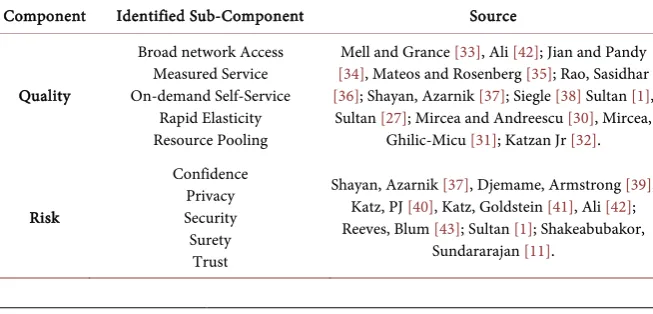
In short, CC is becoming heavily linked to e-learning systems in HEIs. Previ-ously, conventional e-learning systems were only endogenous to HEIs [44]. CC can offer its stakeholders, such as students, teachers and admins, a quality low-cost computing solution, as well as the ability to develop virtual computing environments, especially in areas, such as distance or online learning and science education [3]. However, CC is still a relatively new technology that is vulnerable to risk, but with a long-term commitment, time and experience, potential adopters will begin to realise the true quality of this fascinating and innovative piece of computing technology. Therefore, this leaves potential stakeholders of CC at a cross-road. Please refer to Table 1 for a full summary of the quality and risks of CC.
3. Research Model
The multiview framework, developed by Avison and Wood-Harper and the more recent multi-view 3 (MV3) framework by Bell and Wood-Harper [45] is an approach that support the analysis, design and the development of informa-tion systems (IS), as well as evaluating possible soluinforma-tions to IS related issues from a number of perspectives. Using a soft systems approach, it draws on a number of elements, such as human activity systems, socio-technical systems, data analysis and structured analysis, besides tackling the different perspectives of people using IS. In other words, multiview helps to determine multiple per-spectives through individual perceptions of the IS development process or in the context of this research the quality and risks of adopting a cloud solution in HEIs. Therefore, this research used the MV3 model to explore the quality and risks of CC in higher education. Further, the MV3 model is a novel framework, particularly to the CC and educational areas as to the researcher’s knowledge, no previous studies have applied such a model in this context.
[image:5.595.210.537.584.741.2]Multiview can be used by researchers to explore the quality and risks associated with the adoption of technological innovation from multiple
Table 1. Summary of quality and risks of CC.
Component Identified Sub-Component Source
Quality
Broad network Access Measured Service On-demand Self-Service
Rapid Elasticity Resource Pooling
Mell and Grance [33], Ali [42]; Jian and Pandy
[34], Mateos and Rosenberg [35]; Rao, Sasidhar
[36]; Shayan, Azarnik [37]; Siegle [38] Sultan [1], Sultan [27]; Mircea and Andreescu [30], Mircea,
Ghilic-Micu [31]; Katzan Jr [32].
Risk
Confidence Privacy Security Surety
Trust
Shayan, Azarnik [37], Djemame, Armstrong [39], Katz, PJ [40], Katz, Goldstein [41], Ali [42]; Reeves, Blum [43]; Sultan [1]; Shakeabubakor,
DOI: 10.4236/ait.2019.93003 38 Advances in Internet of Things perspectives [45] [46]. The model comprises of three perspectives: technical, organisational and personal [45]. In the current study, the technical perspective refers to the quality (or characteristics) and risks of the cloud, which influence adoption. The organisational perspective refers to HEIs, namely Universities’ and their decision to adopt the technology based on weighing the pros and cons of the cloud solution. The personal perspective refers to the individuals involved with the system, namely stakeholders, such as students, teachers, senior manage-ment and admins, as well as their needs and expectations from the cloud solution.
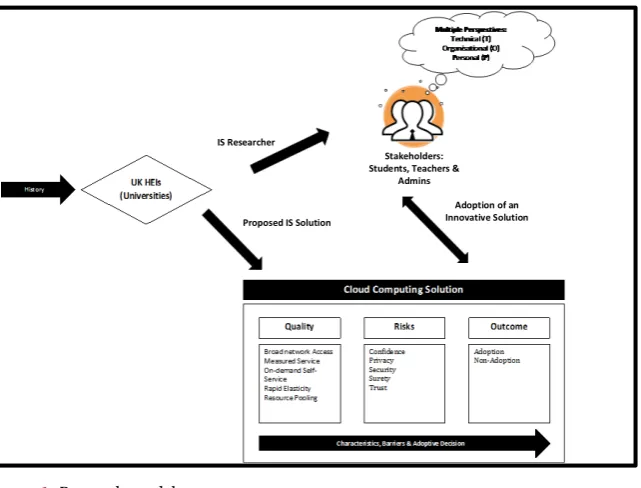
The proposed model has been inspired by the MV3 model by Bell and Wood-Harper [45]. It includes a number of elements, such as key stakeholders involved in the CC adoption process (personal), quality and risks of the cloud system (technical), and the targeted institution, UK Universities (organisa-tional). Figure 1 demonstrates the research model.
The current literature has identified five key quality characteristics of adopting the cloud (Broad network Access; Measured Service; On-demand Self-Service; Rapid Elasticity; and Resource Pooling) [1] [27] [33]-[38]. In addition, five key risks of adopting the cloud (Confidence; Privacy; Security; Surety; and Trust) were also identified [37] [39][40] [41] [43]. The framework was developed, consid-ering these qualities and risks of the cloud, and consists of three key components.
[image:6.595.214.535.473.717.2]The first component of the framework involves the multiple perspectives (TOP—Technical: cloud computing, Organisational: universities, and Personal: users i.e. students, teachers, senior management and admins). The next compo-nent involves the target institution or context (HEIs) and proposes a potential emerging technology to adopt (CC). The third component assesses the quality and risks of the cloud to influence HEI and stakeholder decisions to adopt CC based on user needs and expectations (outcome).
Figure 1. Research model.
Stakeholders: Students, Teachers &
Admins
Adoption of an Innovative Solution Proposed IS Solution
DOI: 10.4236/ait.2019.93003 39 Advances in Internet of Things The following research questions were derived from the review of the current literature on the quality and risks of CC adoption:
RQ1: What quality characteristics of the cloud influence stakeholders’ (
stu-dents, teachers, senior management and admins) acceptance of CC, leading to
adoption?
RQ2: What risks of the cloud influence stakeholders’(students, teachers,
sen-ior management and admins) rejection of CC, leading to non-adoption?
4. Method
4.1. Participants
The participants were made up of various stakeholders situated at two UK Uni-versities situated in North-West England with some prior knowledge and ex-perience of adopting a cloud solution. One University had gone ahead with the adoption process, whereas the other did not. In addition, the stakeholders were made up of students, lecturers, senior management and administrators operating within the University’s business school, all of whom were interviewed accord-ingly.
Given the limited case studies of CC adoption among UK HEIs, this was a great opportunity to assess the effectiveness of CC adoption in UK HEIs from multiple stakeholder perspectives based on the quality and risks of this innova-tion. Moreover, a sample of 32 university stakeholders was interviewed; 16 stakeholders from University A, namely 4 students, 4 lecturers, 4 senior manag-ers and 4 admins, and the same sample was applied to Univmanag-ersity B.
4.2. Data Collection
UK HEIs (Universities) represent the research population and sample. Ross (2010) claims that HEIs are potential consumers of cloud technologies, thus jus-tifying the chosen sample and population. Semi-structured interviews were the main data collection tool, and multiple University stakeholders were interviewed on-campus in a private room. Students, lecturers, senior managers and admins were all volunteers willing to participate in the current study, and were obtained via word of mouth by other students and lecturers who knew them personally. In total, 32 (16 in University A and 16 in University B) interviews were con-ducted (out of an initial sample of 40), thus yielding an 80% response rate. Eight interviewees failed to attend the interview sessions. Therefore, 32 valid responses were analysed.
4.3. Data Analysis
DOI: 10.4236/ait.2019.93003 40 Advances in Internet of Things
5. Findings & Discussion
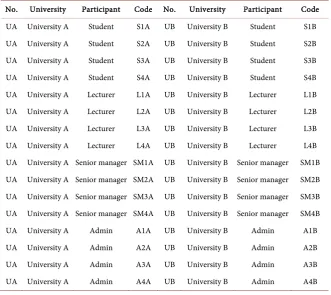
The interview findings of the research are presented in this section. There was a total of 18 University stakeholders who were interviewed, namely University students, lecturers, senior managers and admins, across two UK Universities situated in North-West England in order to determine the quality and risk fac-tors which influence adoption and non-adoption of CC from multiple perspec-tives (technical, organisational and personal). Thematic analysis was used to analyse the data, where a number of themes were deduced from the findings ac-cording to each perspective of the MV3 methodology (see Research Model and Methods chapters). Moreover, Table 2 provides a summary of the research par-ticipants:
5.1. Findings
5.1.1. General Findings
As well as the key findings, some general findings were deduced from the re-search data, mostly pertaining to the stakeholder roles in UK HEIs.
[image:8.595.209.541.433.728.2]Students’ role was self-explanatory as they conduct research for assignments and exams, as well as monitor their course progress through email and the ex-isting Virtual Learning Environment (VLE) employed at the University. Lectur-ers, however, are responsible for teaching students, conducting lecturLectur-ers, grading exams and assignments, as well as other teaching-related duties. Senior manag-ers or heads of department roles are similar to those of lecturmanag-ers as they also engage
Table 2. Research participants.
DOI: 10.4236/ait.2019.93003 41 Advances in Internet of Things on some level of teaching, but also coordinate and manage their staff in their re-spected department. For example, the business school has one head of the department and that department consists of various lecturers who teach a wide range of business-related subjects. Lastly, the admins role involves providing as-sistance to academic staff, besides handling student admissions.
5.1.2. Multi-Perspective Findings
It was found during the analysis that the technical perspective highlights the proposed cloud solution, namely in terms of design issues, access to the tech-nology and the actual use of CC. The organisational perspective highlights the impact of the cloud solution on HIEs, namely in terms of collaboration between the key actors of CC within UK Universities. Finally, the personal perspective highlights the individual interests of CC within UK Universities, namely the stakeholders involved with the technology.
The findings show that technical factors require considerable attention before adopting cloud computing in HEIs. The quality and risks of the cloud from a technical perspective were highlighted as a highly important issue.
For example, lecturers and senior managers perceived quality as a high prior-ity before considering the acceptance of a cloud solution. L1A and L2B indicated that for the cloud to work, the system would have to include some type of on-demand virtual learning environment so that would enable them to grade their students work and even conduct more collaborative lectures with them, thus helping towards the acceptance of CC among University staff.
S3A and S1B further emphasised that they would like a system that enables them to access course material and grades from a range of devices, anytime, anywhere as they pointed out that the existing VLE has compatibility issues with certain devices, such as smart phones. S4B further emphasised that a cloud app, which combines a cloud VLE with existing Google cloud services, such as Gmail and Gdocs would be great and as a result support CC.
A2A and A2B stated that CC would be an ideal technology if it could facilitate the admission process at the University. The participants also highlighted that they currently have outdated database software that has very limited features and that a new system with better accessibility and more features would be necessary to facilitate the admission process.
DOI: 10.4236/ait.2019.93003 42 Advances in Internet of Things that they handle highly sensitive student and staff data on a daily basis, and cannot trust the technology unless both students and their work colleagues in-formation will not be compromised.
Several students (S1A, S2A, S3B and S4B) emphasised that they were uncer-tain about their personal data remaining secure as they would be accessing these cloud services from a wide range of apps, which are potentially vulnerable to hackers, and thus uncertainty of the cloud was highlighted as a huge issue for them. SM2B also reported that having the will to adopt the cloud requires the readiness to not only embrace the technology, but to be prepared for potential cloud hacks or attacks leading to the expose of personal data and student data. Although the participant praises the innovativeness of the cloud, they high-lighted that it is a risky innovation solution. In addition, the admins shared a similar view (A2B and A4B) by stating that no new system is worth the risk of disclosing personal admission data.
5.2. Discussion
This study aimed to determine the quality and risk factors that could potentially influence the adoption or non-adoption of CC in UK HEIs. The findings were interpreted based on the research model. The model proposed HEIs’ adoptive decision of a cloud solution from multiple perspectives, namely technical, organisational and personal perspectives.
It was determined from the findings that each University stakeholder had dif-fering system needs, and thus it was expected that stakeholders would have very different and specific expectations from CC. For example, students’ needs stem from having a cloud solution which enables them to access course materials and emailing systems from a range of devices with anytime anywhere features. This directly relates to the quality of the cloud in terms of on-demand self-service and broad-network access characteristics [1] [27] [33]-[38]. Students also believed that the cloud is a great idea granted that it supports their learning outcomes. Therefore, students demand a cloud solution that delivers efficient and broad access to course materials and other important course data.
Admins, on the other hand, demand a cloud solution that is secure and pri-vate as these were perceived key risks to non-adoption identified [37] [39][40] [41] [43]. Since they are responsible for handling student admissions, this was expected from the admin staff as they work with sensitive data on a daily basis. Security and privacy are crucial when considering CC, and it has the highest priority. The findings suggest that security is perceived differently from each set of participants based on their technical awareness and its usefulness towards UK HEIs.
DOI: 10.4236/ait.2019.93003 43 Advances in Internet of Things that would help to improve student-teacher relationships.
The research has determined that the technical perspective is more related to the quality aspects of the cloud as the essential characteristics were clearly emphasised by the participants. Security was also technical as the technology it-self has a duty to safeguard sensitive information. Therefore, failing to meet these demands would result in non-adoption, as opposed to adoption. The organisational perspective was found to have a direct linkage to improving rela-tionships between the HEI and its students and staff via collaborative tools. Fi-nally, the personal perspective was related to the potential solutions the stake-holders gave to meet their individual needs and expectations from the cloud, leading to adoption. One of the most notable examples was one student’s pro-posed cloud apps for mobile devices in which they can access their virtual learn-ing materials and email securely off-campus.
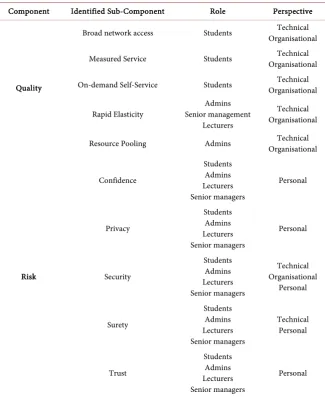
In conclusion, the technical, organisational and personal perspectives are mostly related to the quality aspects of the cloud, particularly among various stakeholders who voiced their concerns about security and accessibility of the cloud, as well as potential solutions. The risks, however, were more personal, since any stakeholders had concerns about how data would be protected by the cloud. Security, however, was found to be related to all aspects as this affects not only the technology and HEIs but also the individuals who use the system. Table 3 provides a summary of the quality and risks of the cloud from multiple per-spectives according to the research findings.
6. Contribution
At a higher theoretical level, this research bridges between technological innova-tion, as well as IS adoption and development. In the field of technological inno-vation, this research applied a multi-perspective theory [45] to demonstrate an emerging technology known as cloud computing (CC). In doing so, this research explored the quality and risks of CC from multiple perspectives as a means to determine whether such an innovative solution would be viable for educational settings, namely UK HEIs or Universities. At a lower theoretical level, this re-search aimed to conceptualise CC adoption and development to determine which quality and risks influence adoption and non-adoption in UK Universi-ties. At the base theoretical level, this research provided a literature review of ex-isting qualities and risks of the cloud to address the current literature gap.
DOI: 10.4236/ait.2019.93003 44 Advances in Internet of Things
Table 3. Quality and risks of the cloud from multiple perspectives.
Component Identified Sub-Component Role Perspective
Quality
Broad network access Students Organisational Technical Measured Service Students Organisational Technical On-demand Self-Service Students Organisational Technical
Rapid Elasticity Senior management Admins Lecturers
Technical Organisational Resource Pooling Admins Organisational Technical
Risk
Confidence
Students Admins Lecturers Senior managers
Personal
Privacy
Students Admins Lecturers Senior managers
Personal
Security
Students Admins Lecturers Senior managers
Technical Organisational
Personal
Surety
Students Admins Lecturers Senior managers
Technical Personal
Trust
Students Admins Lecturers Senior managers
Personal
At a practical level, a CC development framework was proposed based on the MV3 methodology. This framework was used to support the authors during the research process, as well as to determine the key qualities and risks that influence the adoption or non-adoption of CC from multiple perspectives. The key com-ponents include multi-perspective factors, namely technical (CC solution); or-ganisational: (Universities), and personal (users i.e. students, teachers, senior management and admins), as well as an assessment of the quality and risks of the cloud to influence HEI and stakeholder decisions to adopt CC based on user needs and expectations (outcome).
7. Limitations and Future Work
DOI: 10.4236/ait.2019.93003 45 Advances in Internet of Things could have been bigger as 16 participants could have attributed to the narrow perceptions of the quality and risks of CC adoption. Based on this limitation, the research did not fully capture multi-perspective view of CC quality and risks in UK HEIs. It is important for future studies to take on-board these limitations.
Future studies could take the findings of this study and apply them to other countries around the world. A comparative study of the quality and risks of CC in HEIs in developing and developed countries would help to distinguish be-tween different stakeholder needs and expectations of the cloud as a means to facilitate the IS development process. Therefore, this will help future authors to conduct research on multiple case HEIs to obtain broader perceptions of CC in different countries around the world.
8. Conclusions
This study (to the authors’ knowledge) is the first to explore the determinants of CC adoption by HEIs in terms of quality and risk factors from multiple perspec-tives. The key quality factors reflected the essential characteristics of the cloud, such as Broad network Access, Measured Service, On-demand Self-Service, Rapid Elasticity, and Resource Pooling. Whereas, Confidence, Privacy, Security, Surety, and Trust were identified as the risk factors of the cloud. Understanding the impact of these factors can support multiple stakeholders, such as students, lecturers, senior managers and admins in their adoptive decision of CC in their respected institutions.
Security was highlighted as a key determinant to non-adoption as safeguard-ing sensitive information is vital in the cloud and the participants appeared un-convinced about the cloud achieving this. Therefore, trust was another key de-terminant to non-adoption. However, dede-terminants to cloud adoption included the cloud having the potential to improve relationships between students and teachers via collaborative tools. Students even proposed cloud apps for mobile devices for accessing virtual learning materials and email securely off-campus. Meeting these expectations appear to be a convincing argument for cloud adop-tion.
In conclusion, it can be deduced that HEIs are in a position to adopt multiple cloud solutions. For example, e-mail and virtual learning services, as well as online collaboration tools and learning management systems to facilitate the teaching process and to build student-teacher relationships. However, the exist-ing security and privacy factors of the cloud still represent a real concern for stakeholders and will more than likely reject the technology, which in turn leaves them at a cross-road. Future studies may help to steer stakeholders’ decision to adopt the cloud as the technology develops in the coming years.
Acknowledgements
DOI: 10.4236/ait.2019.93003 46 Advances in Internet of Things feedback about the research.
Conflicts of Interest
The authors declare no conflicts of interest regarding the publication of this pa-per.
References
[1] Sultan, N. (2010) Cloud Computing for Education: A New Dawn? International Journal of Information Management, 30, 109-116.
https://doi.org/10.1016/j.ijinfomgt.2009.09.004
[2] Rindos, A., et al. (2010) The Transformation of Education through State Education Clouds. IBM Global Education White Paper.
[3] Al-Zoube, M., El-Seoud, S.A. and Wyne, M.F. (2010) Cloud Computing Based E-Learning System. International Journal of Distance Education Technologies, 8, 58-71. https://doi.org/10.4018/jdet.2010040105
[4] Doelitzscher, F., et al. (2011) Private Cloud for Collaboration and E-Learning Ser-vices: From IaaS to SaaS. Computing, 91, 23-42.
https://doi.org/10.1007/s00607-010-0106-z
[5] Xiao, L. and Wang, Z. (2011) Cloud Computing: A New Business Paradigm for E-Learning. 3rd International Conference on Measuring Technology and Mecha-tronics Automation, Shanghai, 6-7 January 2011, 716-719.
https://doi.org/10.1109/ICMTMA.2011.181
[6] Rao, R.V. and Selvamani, K. (2015) Data Security Challenges and Its Solutions in Cloud Computing. Procedia Computer Science, 48, 204-209.
https://doi.org/10.1016/j.procs.2015.04.171
[7] Round, K. (2011) E-Learning 2.0: Cloud Computing and the Online Learner. Jour-nal of Applied Learning Technology, 1, 24-27.
[8] Vishwakarma, A.K. and Narayanan, A. (2012) E-Learning as a Service: A New Era for Academic Cloud Approach. 1st International Conference on Recent Advances in Information Technology, Dhanbad, 15-17 March 2012, 352-356.
https://doi.org/10.1109/RAIT.2012.6194445
[9] Schaffer, H.E., et al. (2009) NCSU’s Virtual Computing Lab: A Cloud Computing Solution. Computer, 42, 94-97. https://doi.org/10.1109/MC.2009.230
[10] Klug, W.E. (2014) The Determinants of Cloud Computing Adoption by Colleges and Universities. Northcentral University, Scottsdale.
[11] Shakeabubakor, A.A., Sundararajan, E. and Hamdan, A.R. (2015) Cloud Computing Services and Applications to Improve Productivity of University Researchers. In-ternational Journal of Information and Electronics Engineering, 5, 153-157.
https://doi.org/10.7763/IJIEE.2015.V5.521
[12] Chang, V. (2015) Delivery and Adoption of Cloud Computing Services in Contem-porary Organizations. IGI Global, Hershey.
https://doi.org/10.4018/978-1-4666-8210-8
[13] Ammurathavalli, V. and Ramesh, V. (2014) Factors Influencing the Adoption of Cloud Computing by Small and Medium-Sized Enterprises (SMEs). International Journal of Engineering, 6, 119-125.
DOI: 10.4236/ait.2019.93003 47 Advances in Internet of Things
https://doi.org/10.1109/i-Society.2014.7009071
[15] Avram, M.-G. (2014) Advantages and Challenges of Adopting Cloud Computing from an Enterprise Perspective. Procedia Technology, 12, 529-534.
https://doi.org/10.1016/j.protcy.2013.12.525
[16] Hoberg, P., Wollersheim, J. and Krcmar, H. (2012) The Business Perspective on Cloud Computing—A Literature Review of Research on Cloud Computing. Pro-ceedings of the 18th Americas Conference on Information Systems, Seattle, 9-12 August 2012, 5.
[17] Low, C., Chen, Y. and Wu, M. (2011) Understanding the Determinants of Cloud Computing Adoption. Industrial Management & Data Systems, 111, 1006-1023.
https://doi.org/10.1108/02635571111161262
[18] Mohammed Banu, A., Trevor, W.-H. and Mostafa, M. (2018) Benefits and Chal-lenges of Cloud Computing Adoption and Usage in Higher Education: A Systematic Literature Review. International Journal of Enterprise Information Systems, 14, 64-77. https://doi.org/10.4018/IJEIS.2018100105
[19] Blue, E. and Tirotta, R. (2011) The Benefits & Drawbacks of Integrating Cloud Computing and Interactive Whiteboards in Teacher Preparation. TechTrends, 55, 31-39. https://doi.org/10.1007/s11528-011-0495-7
[20] Mouyabi, M. (2015) Higher Education and the Adoption of Cloud Computing Technology in Africa. International Journal on Communications, 4, 1-9.
https://doi.org/10.14355/ijc.2015.04.001
[21] Hegazy, A.F., Khedr, A.E. and Al Geddawy, Y. (2015) An Adaptive Framework for Applying Cloud Computing in Virtual Learning Environment at Education a Case Study of “AASTMT”. Procedia Computer Science, 65, 450-458.
https://doi.org/10.1016/j.procs.2015.09.121
[22] Hussein, A. and Omar, M. (2015) Cloud Computing and Its Effect on Performance Excellence at Higher Education Institutions in Egypt (an Analytical Study). Euro-pean Scientific Journal, 11, 163-176.
[23] Tashkandi, A. and Al-Jabri, I.M. (2015) Cloud Computing Adoption by Higher Education Institutions in Saudi Arabia. International Conference on Cloud Com-puting, Riyadh, 26-29 April 2015, 1527-1537.
https://doi.org/10.1109/CLOUDCOMP.2015.7149634
[24] Aaron, L.S. and Roche, C.M. (2012) Teaching, Learning, and Collaborating in the Cloud: Applications of Cloud Computing for Educators in Post-Secondary Institu-tions. Journal of Educational Technology Systems, 40, 95-111.
https://doi.org/10.2190/ET.40.2.b
[25] Behrend, T.S., et al. (2011) Cloud Computing Adoption and Usage in Community Colleges. Behaviour & Information Technology, 30, 231-240.
https://doi.org/10.1080/0144929X.2010.489118
[26] Calvo, R.A., et al. (2011) Collaborative Writing Support Tools on the Cloud. IEEE Transactions on Learning Technologies, 4, 88-97.
https://doi.org/10.1109/TLT.2010.43
[27] Sultan, N.A. (2011) Reaching for the “Cloud”: How SMEs Can Manage. Interna-tional Journal of Information Management, 31, 272-278.
https://doi.org/10.1016/j.ijinfomgt.2010.08.001
DOI: 10.4236/ait.2019.93003 48 Advances in Internet of Things
https://doi.org/10.5220/0005529701020109
[29] Berger, E. (2014) A Preliminary Summative Assessment of the HigherEd 2.0 Pro-gram—Using Social Media in Engineering Education.
[30] Mircea, M. and Andreescu, A.I. (2011) Using Cloud Computing in Higher Educa-tion: A Strategy to Improve Agility in the Current Financial Crisis. Communica-tions of the IBIMA, 2011, Article ID: 875547. https://doi.org/10.5171/2011.875547
[31] Mircea, M., Ghilic-Micu, B. and Stoica, M. (2011) Combining Business Intelligence with Cloud Computing to Delivery Agility in Actual Economy. Journal of Economic Computation and Economic Cybernetics Studies, 45, 39-54.
[32] Katzan Jr., H. (2010) The Education Value of Cloud Computing. Contemporary Is-sues in Education Research, 3, 37-42. https://doi.org/10.19030/cier.v3i7.219
[33] Mell, P. and Grance, T. (2011) The NIST Definition of Cloud Computing. U.S De-partment of Commerce, National Institute of Standards and Technology, Gaithers-burg. https://doi.org/10.6028/NIST.SP.800-145
[34] Jian, A. and Pandy, U.S. (2013) Role of Cloud Computing in Higher Education. In-ternational Journal of Advanced Research in Computer Science and Software Engi-neering, 3, 966-972.
[35] Mateos, A. and Rosenberg, J. (2011) The Cloud at Your Service. Helion, West Mid-lands.
[36] Rao, N.M., Sasidhar, C. and Kumar, V.S. (2012) Cloud Computing through Mo-bile-Learning. International Journal of Advanced Computer Science and Applica-tions, 1, 42-47.
[37] Shayan, J., et al. (2014) Identifying Benefits and Risks Associated with Utilizing Cloud Computing. International Journal of Soft Computing and Software Engi-neering, 3, 416-421.
[38] Siegle, D. (2010) Cloud Computing: A Free Technology Option to Promote Col-laborative Learning. Gifted Child Today, 33, 41-45.
https://doi.org/10.1177/107621751003300410
[39] Djemame, K., et al. (2016) A Risk Assessment Framework for Cloud Computing.
IEEE Transactions on Cloud Computing, 4, 265-268.
https://doi.org/10.1109/TCC.2014.2344653
[40] Katz, R., Goldstein, P. and Yanosky, R. (2009) Demystifying Cloud Computing for Higher Education. EDUCAUSE Center for Applied Research Bulletin, 19, 1-13. [41] Katz, R., et al. (2010) Cloud Computing in Higher Education.
https://net.educause.edu/section_params/conf/CCW
[42] Ali, M. (2019) The Barriers and Enablers of the Educational Cloud: A Doctoral Stu-dent Perspective. Open Journal of Business and Management, 7, 1-24.
https://doi.org/10.4236/ojbm.2019.71001
[43] Reeves, D., et al. (2009) Cloud Computing: Transforming IT. Burton Group Publi-cation, Utah, 33.
[44] Ketel, M. (2014) E-Learning in a Cloud Computing Environment. IEEE SOUTHEASTCON, Lexington, 13-16 March 2014, 1-2.
https://doi.org/10.1109/SECON.2014.6950728
[45] Bell, S. and Wood-Harper, T. (2014) The Innovation of Multiview 3 for Develop-ment Professionals. The Electronic Journal of Information Systems in Developing Countries, 63, 1-25. https://doi.org/10.1002/j.1681-4835.2014.tb00448.x
DOI: 10.4236/ait.2019.93003 49 Advances in Internet of Things
Multiview: Through the Lens of Soft Systems Methodology. Systemist, 14, 136-145. [47] Miles, M.B., Huberman, A.M. and Saldana, J. (2013) Qualitative Data Analysis: A
Methods Sourcebook. SAGE Publications, Thousand Oaks.