ROLES, RIGHTS, AND RESPONSIBILITIES IN THE
SUSTAINABLE MANAGEMENT OF RED DEER
POPULATIONS IN SCOTLAND
Lorin E. Witta
A Thesis Submitted for the Degree of PhD
at the
University of St Andrews
2018
Full metadata for this thesis is available in
St Andrews Research Repository
at:
http://research-repository.st-andrews.ac.uk/
Please use this identifier to cite or link to this thesis:
http://hdl.handle.net/10023/14571
This item is protected by original copyright
This item is licensed under a
Creative Commons Licence
Roles, Rights, and Responsibilities in the
Sustainable Management of Red Deer
Populations in Scotland
Lorin E Witta
This thesis is submitted in partial fulfilment for the degree of
Doctor of Philosophy (PhD)
at the University of St Andrews
ii Candidate's declaration
I, Lorin Witta, do hereby certify that this thesis, submitted for the degree of PhD, which is
approximately 52,000 words in length, has been written by me, and that it is the record of work carried out by me, or principally by myself in collaboration with others as acknowledged, and that it has not been submitted in any previous application for any degree.
I was admitted as a research student at the University of St Andrews in October 2007.
I confirm that no funding was received for this work.
Date 30 August 2017 Signature of candidate
Supervisor's declaration
I hereby certify that the candidate has fulfilled the conditions of the Resolution and Regulations appropriate for the degree of PhD in the University of St Andrews and that the candidate is qualified to submit this thesis in application for that degree.
Date 30 August 2017 Signature of supervisor
Permission for publication
In submitting this thesis to the University of St Andrews we understand that we are giving permission for it to be made available for use in accordance with the regulations of the University Library for the time being in force, subject to any copyright vested in the work not being affected thereby. We also understand, unless exempt by an award of an embargo as requested below, that the title and the abstract will be published, and that a copy of the work may be made and supplied to any bona fide library or research worker, that this thesis will be electronically accessible for personal or research use and that the library has the right to migrate this thesis into new electronic forms as required to ensure continued access to the thesis.
I, Lorin Witta, confirm that my thesis does not contain any third-party material that requires copyright clearance.
The following is an agreed request by candidate and supervisor regarding the publication of this thesis:
Printed copy
No embargo on print copy.
Electronic copy
No embargo on electronic copy.
Date 30 August 2017 Signature of candidate
iii
Underpinning Research Data or Digital Outputs Candidate's declaration
I, Lorin Witta, understand that by declaring that I have original research data or digital outputs, I should make every effort in meeting the University's and research funders' requirements on the deposit and sharing of research data or research digital outputs.
Date 30 August 2017 Signature of candidate
Permission for publication of underpinning research data or digital outputs
We understand that for any original research data or digital outputs which are deposited, we are giving permission for them to be made available for use in accordance with the requirements of the
University and research funders, for the time being in force.
We also understand that the title and the description will be published, and that the underpinning research data or digital outputs will be electronically accessible for use in accordance with the license specified at the point of deposit, unless exempt by award of an embargo as requested below.
The following is an agreed request by candidate and supervisor regarding the publication of underpinning research data or digital outputs:
Embargo on part (Participant Interviews) of electronic files for a period of 3 years on the following ground(s):
• Publication would be in breach of law or ethics or data protection
Supporting statement for embargo request
The community of red deer management professionals in Scotland is such that if interviews are publicly available, the identities of participants could be established.
Date 30 August 2017 Signature of candidate
iv
Acknowledgments
This project has been one of the most amazing experiences of my life. In the course of the many years it took to complete, many people have supported and helped me along the way. I would like to thank them now.
Professor Verity Brown deserves an extra special thank you. I had many problems during my studies, especially towards the end. If it were not for Professor Brown, I would not have had the opportunity to reach my goal. Furthermore, she provided excellent supervision, tolerated all my endless chatter, and answered every question I could come up with to help me understand, progress, and be successful. Dr. Kate Arnold for assisting with viva preparation, and assisting Professor Brown in helping me to realize the value of my research and my level of knowledge. I would also like to thank everyone else who supported me through this amazing experience, especially in these last few years.
A special thanks to participants, especially those that made the time for our interview – I could not have done it without you! Also, an extremely profound Thank You to all of the gentlemen that allowed me to participate in management activities. My understanding of your lives, this amazing profession, and the red deer industry is far more than I expected or predicted it could be. I hope this project reflects this and provides true and accurate insight/account of red deer in
Scotland.
Finally, my parents – George and Jerrilou Witta. What can I say? You gave me great genes, provided a unique childhood filled with fun, animals, and responsibilities. You’ve seen me at my worst and loved me more for it. You’ve supported my every thought because it was mine, and taught me to learn something new every day. You always taught me to reach for the stars and never to put any limits on my life. When I needed to follow a dream, y’all helped to make it happen. Y’all
are amazing, generous, and loving parents/people – and, best for me, is that you are mine!
v
Abbreviations
DCS Deer Commission for Scotland
DEFRA The Department for the Environment, Food, and Rural Affairs DMGs Deer Management Groups
DSA 1996 The Deer (Scotland) Act 1996 FC Forestry Commission
NT National Trust for England, Wales, and Northern Ireland NTS National Trust for Scotland
RSPB Royal Society for the Protection of Birds SD Sustainable Development
SDM Sustainable Deer Management SSSI Sites of Special Scientific Interest SWT Scottish Wildlife Trust
UN United Nations UK United Kingdom
WANE 2011 The Wildlife and Natural Environment (Scotland) Act 2011
Parts of this thesis contributed to the following articles and conference presentations:
Witta, L. E., Flanagan, S. A., & Hagan, L. P. (2012). Culture: The missing aspect of the sustainability paradigm. The International Journal of Interdisciplinary Social Sciences.
Witta, L. E., Flanagan, S. A., & Hagan, L. P. (2011, July). Culture: The missing aspect
of the sustainability paradigm. Paper presented at the 6th International Conference on
Interdisciplinary Social Science, New Orleans, Louisiana, USA.
Witta, L. E. (2010, January). Towards sustainable red deer management: Initial
Findings. Paper presented at Student Conference: Post-Graduate Day, University of St
Andrews
Witta, L. E. (2009, April). Towards sustainable red deer management: Integrating
cultural and historical aspects. Paper presented at Student Conference: Evidence Base for
Environmental Management and Conservation, Stirling University, UK.
Witta, L.E. & White, R. (2008, September). Historical and cultural understandings of
the red deer in Scotland: Towards a broader sustainability paradigm. Poster presented at
vi
Abstract
The aim of the project was to explore the acquisition and dissemination of knowledge
amongst decision-makers involved in the management of red deer in Scotland. While research exists
on the ecology of red deer habitat, no research exists that focuses on the relationship between the
deer and the people responsible for their management. Therefore, this thesis is primarily qualitative
research which aimed to explore the various aspects of red deer management in Scotland within the
socio-ecological context in which it exists. There are numerous groups with interest in red deer
management, however this research, due to scope and time restrictions, was limited to two primary
groups, the individuals tasked with implementing policy and the practitioners who carry out culling.
During the course of the project, under-researched topics surfaced, highlighting areas of practical
and theoretical divergence between stakeholders. This thesis therefore aims to explore how
differing views and perspectives of two of the key stakeholder groups – the estate-based
practitioners (including stalkers, land-managers, and land-owners) and staff of governmental
agencies – influence the management of red deer in Scotland. This research indicates that people
with different roles hold different relationships with the deer, which affect management decisions
and implementation at local, regional, and/or national level. As with other areas within
conservation and wildlife management, this research indicates there is a disconnect between
blanket governmental policy and site-specific needs, with a lack of inclusion of practitioner
knowledge. Potential future research would include additional qualitative research to follow up
some of the management issues raised by this research and formulate recommendations for
changes to practice, followed by collection of quantitative data assessing the efficacy of
vii
“These are fine beasts. We must take them out for the good of the
herd. But they’ve earned our respect and they deserve a clean death.”
(‘The Gamekeeper’, Downton Abbey Season 3, Episode 9, PBS TV,
viii
Table of Contents
Chapter 1: Introduction to the management of red deer in Scotland... 1
1.1 Environmental management ... 1
1.2 Management or stewardship? ... 2
1.3 Challenges for stewardship ... 3
1.4 Can Sustainable Development offer solutions? ... 4
1.5 Human-Animal interactions and animal welfare ... 8
1.6 Landscapes ... 10
1.6.1 Site Designations... 11
1.7 Red deer management in Scotland... 15
1.7.1 Red Deer Ecology………..……….…….15 1.7.2 Legislation ... 20
1.7.3 “Scotland’s Wild Deer – a National Approach” ... 22
1.7.4 Code of Practice ... 23
1.7.5 Best Practice Guidelines ... 25
1.8 Practitioners of deer management ... 26
1.8.1 Organizations and Red Deer Management ... 27
1.8.2 Landownership, Estates, and Stalking ... 34
1.9 Research into sustainable management or red deer... 40
1.10 New Directions of Research ... 40
1.11 Statement of the aims of the thesis... 42
Chapter 2: Research Methods - people managing red deer in Scotland ... 43
2.1 General methods ... 43
2.2 Field research data collection and analysis... 43
2.2.1 Sampling: Snowball, Convenience, and Theoretical ... 44
2.2.2 Questionnaires...44
2.2.3 Semi-structured Interviews ... 45
2.3 Characteristics of participants ... 46
2.3.1 Questionnaire participant characteristics ... 46
2.3.2 Semi-Structured interview participant characteristics ... 50
2.4 Positionality... 54
Chapter 3: An Icon or a pest? ... 56
3.1 Introduction ... 56
3.1.1 Religious and mystical status of deer ... 56
3.1.2 Red deer in literature... 57
3.1.3 Red deer representation in the visual arts ... 58
3.1.4 Hunting of red deer... 60
3.2 Methods ... 60
3.3 Results ... 61
3.3.1 Cultural Icons ... 61
3.3.2 Personal feelings about the deer ... 61
3.3.3 Deer as a pest ... 62
3.3.4 Conflicted views ... 63
3.4 Discussion... 64
Chapter 4: Knowledge, Information, and Decision Making ... 68
4.1 Introduction ... 68
ix
4.3 Results ... 69
4.3.1 Avenues into red deer management ... 69
4.3.2 Information channels ... 71
4.3.3 Flow of Information ... 74
4.3.4 How are decisions made? ... 75
4.4 Discussion... 76
Chapter 5: Legislation and Implementation - voluntary or not? ... 80
5.1 Introduction ... 80
5.2 Methods ... 85
5.3 Results ... 85
5.3.1 How is Section 7 perceived by government agency participants? ... 85
5.3.2 The view of the estate-based participants ... 87
5.3.3 Perceived success of Section 7 culling ... 88
5.3.4 Political influences ... 91
5.4 Discussion... 92
Chapter 6: Issues of Animal Welfare ... 95
6.1 Introduction ... 95
6.2 Methods ... 97
6.3 Results ... 98
6.3.1 Status and influence of animal welfare guidelines ... 98
6.3.2 How do animal welfare considerations impact practice? ... 99
6.3.3 Which animals are to be culled?... 99
6.3.4 Closed seasons and exemptions for out-of-season culling... 101
6.3.5 Welfare implications of Section 7 agreements... 101
6.4 Discussion...105
Chapter 7: Implications for Sustainable Management...108
7.1 Summary of research findings ...108
7.2 Future Research ... 111
7.2.1 Protecting red deer ... 112
7.2.2 Improving the knowledge base... 113
7.2.3 Protecting the land ... 114
7.2.4 Human impacts ... 114
7.2.5 A new framework for the sustainable management of red deer in Scotland ... 115
Chapter 1: Introduction to the management of red deer in Scotland
The red deer (Cervus elaphus) and the Scottish people have a long association, stretching
back several millennia. The red deer is a native species and one of the most iconic of all Scottish
animal species, named first by around 50% of respondents who expressed a view as ‘important for
Scotland’ (Stewart, 2006). It is therefore unsurprising that red deer are the subject of research (e.g.,
Bradshaw and Bateson, 2000; Warren, 2002; White, 2005; McCauley, 2006) and are widely
represented in the media and popular culture (e.g., BBC programs: Rannoch the Red Deer, 1998;
Rowling, J. K., 1999 book, 2004 movie; Downton Abbey S3E9, PBS TV, 2013). This notwithstanding,
the adult deer have no natural predators other than humans and the population of deer therefore
needs to be managed. The aim of the thesis is to explore the implications of their dual status, being
both a cultural icon and a pest, for the sustainable management of the red deer population of
Scotland.
Similar to other highly populated areas worldwide, natural predators of deer within Scotland
- species such as bear, lynx, and wolves – have been hunted to extinction (Monbiot, 2013). Without
predators, the population of red deer is only naturally regulated by food availability or disease.
Allowing this natural regulation, however, is not consistent with goals for habitat conservation and
restoration, especially for woodland regeneration (Davies and White 2012). In addition, there are
other economic implications from a failure to regulate deer populations, including, for example,
motor vehicle collisions, tick-borne diseases, and agricultural productivity. There are also ethical
implications of relying on population-self-regulation via illness and starvation of an animal
population. The management of red deer is made more complex because of their status as a cultural
icon (Bradshaw and Bateson, 2000).
1.1 Environmental management
The environment - its ecosystems, ecosystem services, and natural resources – is of obvious
value (Begon et al., 2006). It has been argued that the spiritual and aesthetic value of nature
(including tourism and other outdoor pursuits) is sufficient to promote its conservation (e.g.
McCauley, 2006), notwithstanding our practical dependence on the environment for goods and
services (including food production, air to breathe, and water to drink), which makes many of our
current actions seem disturbingly short-sighted (Brown, 2011; Pullin, 2002). Environmental
management is informed by many disciplines, but has especially strong ties with conservation
biology. Barrow (2000, p. 35) explains that “environmental management is a myriad of individual and
collective decisions by persons, groups, and organizations, that together these decisions and
environmental resources of a society or nation.” Ecosystems may share widely applicable functional
principles, but small differences in soil type, altitude or aspect or connection to habitat corridors
cause species and processes to be unique to each site (Daily et al., 1997; Marten, 2001; Opdam et al.,
2002; Begon et al., 2006). Local users and managers need to build up an understanding – albeit one
that will likely be coloured by their particular perspective - of the interactivity of resources within the
same place, because environments are complete systems, so that one resource within a system
affects all other aspects of the local environment.
The term ‘environmental resource’ traditionally implies the potential of a specific supply of
natural product for human exploitation. Nevertheless, this perspective is gradually shifting with
increased emphasis on ecosystem services in regulatory and theoretical outputs. In this thesis,
natural resource management (such as forestry, maintenance of grasslands, conservation of wildlife
populations) and the management of ecosystem services (seeing the interconnectedness of
ecological processes and items, such as carbon or nitrogen management) are considered within the
broader concept environmental management (comprising also additional commercial activities, such
as agriculture and water-catchment management).
Socio-economic processes are primary drivers for changes in land use and land cover, and
therefore these determine the structure, function, and dynamics of most landscapes (Wu and
Hobbs, 2002). The drivers of these processes (e.g., mass production of food, tourism, and so forth)
have consequences, including soil erosion, redirected water ways, climate change, and biodiversity
loss (Barrow, 2000; Begon et al., 2006; Rochstrom et al., 2009). Each of these consequences in turn
results in new environmental challenges (Brown, 2011). For example, local and regional decreases in
biodiversity diminishes ecosystem resilience by increasing vulnerability to disease (Rockstrom et al.,
2009) and reduces available habitat to maintain ecological processes (Begon et al., 2006). Although
most environmental problems have these common characteristics, difference between socio-
ecological systems necessitate individual solutions (Birnbaum and Mickwitz, 2009). Additionally,
while most environmental changes and management usually take place at a local level, there is
difficulty in maintaining an awareness of the ecological status of the region in which they exist
(Marten, 2001; De Groot, 2006; Opdam et al., 2006). We thus have scale challenges both in working
at a sufficiently local level to facilitate effective management, and in linking local levels into regional,
national and global pictures of environmental resource availability and degradation.
1.2 Management or stewardship?
Some professionals suggest that environmental management is changing and should now
be considered an aspect of environmental stewardship, de-emphasing control and giving greater
2000; Marten, 2001). Along with this shift of emphasis towards environmental stewardship, there is
an increasing awareness of how social values and culture influence environmental strategy (Cash et
al., 2003; Milner et al., 2006; Ostrom, 2007). If, as argued above, anthropogenic influences have
caused environmental changes, and these environmental changes greatly impact on humanity, we
need to understand these social values both to be able to influence these changes and to mitigate
effects. Anthropogenic effects on the environment are caused by policy makers through the
development of regulatory approaches; statutory agencies responsible for implementing regulation;
land managers; other land users; and in some instances, individuals comprising the wider public (for
example, in causing carbon emissions). Changing the behaviour of these individuals has proved
complex and challenging. It is now understood that barriers such as disempowerment,
infrastructural constraints and social norms limit the ability of individuals to develop more
sustainable behaviour patterns (Gardner and Stern, 1996). Education certainly forms part of
successful strategies to change behaviour (Myers, 2005), but awareness-raising alone has limited
potential to cause behavioural change, because behaviour is influenced by values (Kasser, 2011) and
facts alone are rarely sufficient to instigate behavioural change (Myers, 2002).
1.3 Challenges for stewardship
Consideration of ecosystems as dynamic and ever-changing, rather than being in equilibrium
(Pullin, 2002), results in challenges for environmental management, not least arising from
inadequate data in the face of increasing appreciation of system complexity (Barrow, 2000; Begon et
al., 2006). It is now accepted that there are large gaps in knowledge of environmental processes,
structure and function, as well as the specifics of how human societies and individuals behave and
the impacts of economic issues across varied spatial scales: local, regional, and global (Opdam et al.,
2002). Additionally, most management models are less than adequate because they are ‘hermetic’–
that is, completely separated from the complexities of human behaviour and the constraints
imposed by the environment (Wilson, 1998). Furthermore, many management interventions have
not been evaluated, which leaves decision-makers without the evidence on which to make evidence-
based decisions (Pullin et al., 2003). Due the variety of these challenges, environmental managers
typically focus on a specific area – an individual ecosystem, sector of activity or resource (Barrow,
2000). The lack of information has left much of environmental and conservation management
practice accused of being based upon anecdote and myth rather than being founded
on evidence or the experience of others who have successfully overcome similar problems
Inconsistencies in aligning ecological scale to political jurisdiction significantly increase the
challenges to environmental and conservation efforts (Birnbaum and Mickwitz, 2009). While some
environmental areas have been left for nature to reclaim, others have been set up as specific sites of
special scientific interest (SSSI), national parks, or other areas with special significance, which are
given some sort of designation on which governmental policies and legislation can act. Environmental
managers and scientists often use these governmental regulations as an opportunity to try to correct
a problem (Jordan, 2008; Hilden, 2009). However, governmental and political actions may appear to
presume or seek, environmental control, which could be considered not only arrogant, but also
ineffective (Pullin, 2002). Additionally, environmental policies often attempt to restore or maintain
an equilibrium and resist change (Wu and Hobbs, 2002; Begon et al., 2006), rarely accounting for
nonlinear changes, threshold changes, and discontinuities which only unfold with the passing of time
(Hilden, 2009).
Evidence-based frameworks (i.e., review and dissemination of efficacy of management and
policy interventions) aim to increase efficacy of decision-making and are increasingly being used
(Pullin and Stewart, 2006). Both public and private sectors have demanded a greater focus on
evaluation of conservation and environmental interventions (Poister, 2003). Environmental
evaluators struggle with addressing four main, methodological challenges: (a) differing and
frequently long-time horizons; (b) disparities in scaling; (c) data quality and credibility; and (d) the
problem of research designs in environmental policies and programs, given that they are formed at
various levels (local, regional, state, national, continental, and global) (Birnbaum and Mickwitz,
2009). Additionally, for environmental policies, time perspectives are particularly important because
policies not only evolve over incremental time, but intervention is path-dependent (Hilden, 2009).
Hoffman-Reim and Wynne (2002) indicate that the greatest challenge for environmental and
conservation management is to acknowledge that an extension of any timeline, either backward or
forward, not only allows for conflicting and contradictory interpretation of policies, but also greatly
increases uncertainties and ‘outright ignorance,’ which is neither acknowledged nor admitted.
1.4 Can Sustainable Development offer solutions?
Human behaviour creates environmental problems (Barrow, 2000) and, globally, human and
natural systems are regarded as ‘dangerously stretched’ (Holling, 2000). Sustainable development
(SD), as an academic discipline, acknowledges the interdependence of social justice and
environmental integrity, while reconciling environmental and economic theory (Dresner, 2002). SD is
a particular kind of development (Graham, 2006) which has various definitions associated with the
concept, although the most popularly accepted definition comes from the Brundtland Commission,
Common Future (1987) in the United Nations (UN) report which detailed the commission’s findings.
Brundtland stated, ‘the environment does not exist as a sphere separate from human actions,
ambitions, and needs’ (Kates et al., 2005, p. 9) which led to his elusive, ideological explanation of SD:
‘meeting the needs of the present without compromising the ability of future generations to meet
their own needs’ (Brundtland, 1987).
As the world has embraced the SD concept, it has grown and developed rapidly. Most SD
takes the view that the challenge of SD is the ‘reconciliation of society’s development goals with the
planet’s environmental limits’ (Clark and Dickson, 2003, p.8059). One conceptual framework which
arose out of SD became focused on three interlocking pillars: economic, social, and environmental
(Figure 1.1). These pillars are usually discussed in terms of benefits – an economic, a social, or an
environmental benefit arising out of a particular management strategy or opportunity. However, just
because something is a benefit does not mean that it will be embraced by a population. Additionally,
this model assumes that the three pillars are interchangeable, with greater economic benefit, for
example, countering environmental deficits. However, earth systems do not necessarily work like
this, because the planet is a finite resource (Rockstrom et al., 2009). Furthermore, if development is
contemplated at an ‘infinite forever’ time frame, then any growth extended indefinitely is
unsustainable (Parris and Kates, 2003). These weaknesses have initiated work which focuses on the
concepts of weak sustainability and strong sustainability. Weak Sustainability is identified by SD
models which use economic growth and production to counteract non-renewable natural resource
loss, while Strong Sustainability is recognized by the understanding that ‘at least a portion of natural
capital’ cannot be substituted by any other form of capital, it must be protected (Dietz and
Neumayer, 2007). The three-pillar approach is considered Weak Sustainability, though this model is
still predominant across many industries.
In 2002, at Johannesburg, South Africa, the World Summit on Sustainable Development met
and reaffirmed the commitment to SD (Kates et al., 2005). In the 21st century, SD has come to focus
on the ‘dynamic interactions between nature and society,’ considering ‘how social change shapes
the environment and how environmental change shapes societies’ (Clark and Dickson, 2003, p.
8059). Additionally, SD indicators which include an Environmental Sustainability Index that has 68
indicators for 148 countries, has been created (Parris and Kates, 2003). Furthermore, global change
research and a new scientific discipline, sustainability science, attempts to understand essential
Earth processes, including human actions (Rockstrom et al., 2009). According to Clark (2007),
sustainability science is centred on ‘use-inspired basic research’ while encompassing theorizing and
‘pragmatic problem solving.’ While sustainability science is interdisciplinary and it recognizes the
need to engage theory with practice, it is still a science, which means it may often lack understanding
Theoretically, and increasingly in practice, people have moved away from the three pillars,
aiming for more synergy and stronger sustainability models (Jordan, 2008). One model includes the
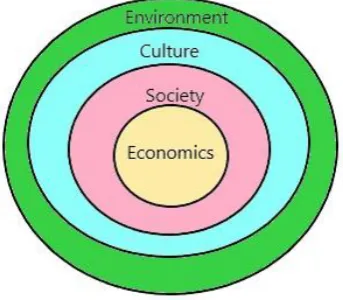
environment, a culture or world view, as well as social and economic aspects (Figure 1.2). This model
is an example of strong sustainability: it suggests that economic aspects are drivers of social changes
which then influence human interactions with the environment. Even with all of these developments
in SD, things have continued to get worse since the Brundtland Commission and the following 1987
UN report (Jordan, 2008), and natural habitat loss and degradation has continued (Blamford et al.,
2002).
Environmental
[image:16.596.314.486.237.387.2]Social Economic
Figure 1-1 The Three Pillars of Sustainable Development (Recreated from
[image:16.596.105.259.253.398.2]http://sustainabilityadvantage.com/2010/07/20/3-sustainability-models/ accessed 3 Jan 2018)
Figure 1-2 Model of Strong Sustainable Development (as described by Rehema White, Lecturer in Sustainable Development, University of St Andrews, 2010)
The question of how to put SD into practice, or even into policy, has been widely debated
(Jordan, 2008). ‘True’ SD requires the participation of all stakeholders, while aiming to reconcile
diverse values and goals toward a new ‘coordination of mutual action’ to achieve goals
simultaneously (Kates et al., 2005). Sustainability governance is required to reach SD goals, if the
‘system of governance’ can be configured in ways to encourage societal dialogue, while also
transforming beliefs and attitudes that actively facilitate SD (Jordan, 2008). Governance does not
mean just government, but rather the influences of government plus other stakeholders. In fact,
“some government policies accelerate resource destruction” (Ostrom, 2009, p. 420). While
hierarchical modes of governance aim to instruct individuals on ‘how’ to achieve something,
network-based models allow the participating actors, including businesses, individuals, and
non-governmental organizations (NGOs), to work out ‘how’ to steer society for themselves, which
provides greater coordination and success (Jordan, 2008). Cash et al. (2003) found that effectiveness
suffers when communication is predominantly one-way and declines dramatically when stakeholder
These socio-ecological concerns have led researchers to investigate social-ecological systems
and knowledge systems. While both social-ecological systems and knowledge systems focus on the
social aspects of sustainability, they also note the extensive use of ‘misguided policy efforts’ to make
human-environment systems sustainable over time (Ostrom, 2007). Socio-ecological systems use
conceptual maps to investigate resource use and resource users (Ostrom, 2009), while knowledge
systems consider mechanisms which ‘facilitate communication, translation, and mediation across
boundaries’ and asks how to better integrate the private sector, which is both a user and a source of
relevant knowledge, into SD. This integration occurs through a recasting of the interactions between
scholar and practitioner, while noting that experts and decision-makers are usually “divided by
different languages, usages, and histories” (Cash et al., 2003, p. 8097). These differences may include
differing knowledge and moral and ethical standards, and will impact any perception and
understanding of a resource, hence actions taken with regard to a resource. Research in socio-
ecological systems and knowledge systems indicates some aspect of cultural cohesion amongst
practitioner groups, including knowledge, histories, and moral and ethical standards, and amongst
individuals who utilize a resource, while also emphasizing the value of the knowledge these
individuals have regarding the natural resource (Ostrom, 2007; Ostrom, 2009; Cash et al., 2003). For
example, local level harvesters, with a long-term interest in the sustainability of a particular resource
or resource system, are not only more likely to invest in social norms and rules relating to timing,
technology, and the quantity and quality of harvesting, but will also generate useful information
regarding the resource, the resource conditions, and better strategies for harvesting (Ostrom, 2007).
Both knowledge systems and socio-ecological systems explore, to some extent, how to link
knowledge to action, yet still lack an effective means for integrating less tangible aspects and
decision-making. For example, values, attitudes, and behaviour are influenced by emotion (Myers,
2005). Ostrom (2007, p. 15183) suggests that the long-term goal for scholars is “recognize which
combination of variables tends to lead to relatively sustainable and productive use of particular
resource systems operating at specific spatial and temporal scales.” But, as Cash et al. (2003, p.
8086) explains, a difficulty will be that “evaluations of scientific advice in general, and environmental
assessments in particular” are only likely to be effective in influencing social responses to “the
extent that the information is perceived by relevant stakeholders” to be credible, salient, and
legitimate.
Although notions regarding the theory and practice of SD are evolving rapidly, one major
aspect that is problematic is that the definition remains ambiguous (e.g. Redclift 2005). Practical SD
objectives should be realistic and based on a workable strategy (Barrow, 2000). Yet while culture and
these have to enhance the SD paradigm. Although humanity has dramatically changed the
environments in which they live, Wilson (1998) states that ‘humans are biologically and
culturally adapted to the natural environment in which we evolved’, such that cultural values and
beliefs passed down from our earliest ancestors are reinforced over time, yet maintained
throughout environmental, human-induced changes relative to specific location (Matsumoto,
2000). Therefore, we, as scientists and individuals, cannot separate ourselves and our
socio-cultural realities from the natural world we inhabit.
1.5 Human-Animal interactions and animal welfare
Animals may be perceived in negative and positive ways, such as both pest and icon,
depending on circumstances (Bateson and Bradshaw, 2000). However, specific animals tend to
evoke certain feelings, for example for many people a rat is just a pest, while a red deer stag –
especially in Scotland – may evoke emotive responses, such as power, strength, or mysticism.
Therefore, human interactions with animals is not simply a discussion on welfare or legislation.
Campbell (1988), cited in Nelson (2008), reveals the hidden and complex world of human-wild
animal interactions, stating:
‘encounters with large wild animals are luminal experiences, bringing us to and sometimes
over, the edge of our normal awareness or consciousness ... we have dropped out of our accustomed
social structure ...we are thrown into all the hero adventure stories we have heard, where the
moment stands large with potential ... time stops ... and we humans get to ask ourselves questions:
‘this a battle of physical strength or wit; what kind of person is the animal; what kind of person will I
prove to be ...’
This quotation suggests that everyone, from hunters to animal rights activists, is affected by
interactions with animals, and this is especially true for individuals who work with these animals
regularly (Zinn et al., 2008). Furthermore, as animals, specifically mammals, are thought to be the
only other sentient beings on Earth, people may perceive animals to have a mental state and
abilities based on their own experiences with animals and other knowledge sources that are
integrated to form specific judgements and beliefs (Spence et al., 2017). Therefore, a concept of an
animal mind by an individual is likely “to have wider relevance than animal welfare, ethical, or
political and policy issues” (ibid).
Although interactions with wildlife are often planned activities, these encounters usually
have an impact on both human and animals (Nelson, 2008). It is how the interactions between
humans and animals take place which affects us and animals either positively or negatively. Hunting
management action, and the perception of how the animals were treated. In the South African
government’s cull of wild elephant herds in the 1980s for “population control and the protection of
habitat;” Pacelle (2011, p. 2) rationalizes “the practice was widely reviled because of the traumatic
emotional effects” on the animals. If these animals had been hunted, with respect to animal welfare
and stress concerns, would people have still reacted in the same way? This is a prime example of
how hunting is not merely a management tool; the act of hunting remains complex, partially due to
culture dependent responses in current societies, especially with respect to the welfare of the
animals being culled: their humane treatment and the emotional impact (stress) on the animals
being hunted. Hence, in Western societies we see a shift from the reasons for hunting for necessity
(food, survival) towards either hunting as sport, hunting as management, or hunting as sport to
support conservation. In addition, there is a wider social context to culling animals which includes
the acceptability of the action to the general human population where the animals are located.
In terms of the legal and regulatory context in which red deer are managed, there are a
number of applicable animal welfare measures. The ‘Universal Declaration on Animal Welfare
(UDAW; issued 2007, revised 2011), arose following animal welfare conferences in Manila (2003) and
Costa Rica (2005) and is supported by the 28 EU member states, including the UK. UDAW (2007) sets
out ‘Five Freedoms’ for animals, which are the same as those adopted by the UK RSPCA (RSPCA,
2013), which are: freedom from hunger, thirst, and malnutrition; freedom from fear and distress;
freedom from physical and thermal discomfort; freedom from pain, injury, and disease; and freedom
to express normal patterns of behaviour. Within the principles of the declaration, there is
acknowledgement that “while there are social, economic, and cultural differences between
societies, each should care for and treat animals in a humane and sustainable manner” and that
appropriate standards of welfare should be developed or elaborated for, but not limited to, “farm
animals, companion animals, animals in scientific research, draught animals, wildlife animals, and
animals in recreation” (UDAW, 2007). The UDAW, through its wording appears to primarily focus
on human behaviour regarding animals under the control of human care. While many wildlife
species, such as red deer, are not under human-care in the same way that domestic species are,
and many of the five freedoms cannot be ensured for wildlife species within their natural
environment, (for example, predators will cause stress on prey, but it is a naturally occurring
phenomenon as is hunger and thirst for wild species), many species, including red deer, are
managed to some degree by humanity. Within this management action, there is the potential for
the principles of the UDAW to be integrated, such as acknowledging and minimizing possible
stress on the animals being manged.
The earliest relevant UK legislation was the Martins Act (1822) the objectives of which
conserving some wildlife; and promoting responsibility. This act reflected the culture of moral
consciousness in the 19th century (Buillet, 2005). Nevertheless, the most relevant legislation still in
force is the Protection of Animals Act (1911) and the Protection of Animals (Scotland) Act (1912).
More recently, the Wild Mammals (Protection) Act (1996) and Protection of Wild Mammals
(Scotland) Act (2002) both should provide stronger legislative protection. However, these Acts
require proof of intention to harm, and furthermore they explicitly exclude red deer. There are a
number of other acts that extend protection for wild species (for example, Nature Conservation
(Scotland) Act (2004) and Conservation of Seals (Scotland) Order (2002)) but while these are
concerned with protection of wild species, they do not necessarily include animal welfare, beyond
the explicit requirement to prevent suffering. In recent years, older acts have been revised, so that
the most relevant now is the Animal Health and Welfare (Scotland) Act (2006) but Harrop (1997)
noted that wildlife has no legislative welfare protection, and this remains the case to date. So how is
animal welfare to be ensured for wildlife species during management operations?
1.6 Landscapes
A nation’s cultural history can provide clues with which to understand current values held by
its society because human histories are played out in-conjunction with complex environmental
histories (Berkes, 1999; Haviland et al., 2007). While political context influences landownership, the
history, myths, legends, and landscapes create and inform culture (Boyd and Richerson, 1992;
Newton, 2000; Haviland et al., 2007), which then, the culture acts on the landscapes through
attitudes, beliefs, perceptions, and therefore, management action. The Scottish context is distinctive
in numerous ways – in landscape, climate, history, culture, law, education, and politics (Warren,
2002). Scotland’s intriguing cultural heritage is rich and ancient, stretching back across nine millennia
or more (McCrone, 1998) and is closely tied with its landscape and its wildlife species, including red
deer.
Scotland’s landscape is unique and complex, with geological striations in its rocks and soil
recording world-changing events and having been shaped and chiselled by recent ice ages, but
ultimately it was transformed by its human population (Ritchie and Ritchie, 1997; Walker and Lowe,
1997). The rising seas led to the British Isles being truly isolated no later than 7,800 years ago and
possibly as early as 10,500 years ago (Yalden, 1999). The Scottish landscape has played a key role in
Scottish history and for Scottish wildlife, including red deer, since the land itself influences many
aspects of society, which then acts upon, and manages, the landscape and the wildlife. For most of
Scottish history, the people of Scotland have been closely associated with the landscape and the
cultural value of the Scottish landscape remains today, being of cultural importance and having
1.6.1 Site Designations
The Scottish landscape in the 21st century is a result of historical changes and influences
from over 2,000 years of human habitation. For example, the loss of the human population in the
highlands during the 18th and 19th centuries due to famine and removal (Fry, 2005) and the
creation of gaming estates (MacLeod, 1997) has led to the highlands being sparsely populated and
in the lowlands, the effects of the Enlightenment Era (later 18th century) are still in existence.
The Scottish landscape, in its various forms, has cultural importance for the Scottish
people. In addition, the many habitats have scientific value for Scotland and much of Europe, as
well as the species that live within them. The result of the landscape having cultural, habitat and
species, and scientific value are site designations.
Designated sites arise out of the distinct character of the Scottish landscape. A book by
Scottish Natural Heritage (SNH) (1995) entitled, Heaths and Moorland: Cultural Landscapes, and
publications: Scottish Office (1996) entitled, Natural Heritage Designations Review and SNH
(2002) Natural Heritage Zones: A National Assessment of Scotland’s Landscapes
(http://www.snh.org.uk/futures/Data/pdfdocs/LANDSCAPES.pdf (accessed 16 August 2017) and
includes maps of the various landscapes discussed below), are invaluable to understanding
Scotland’s unique landscape characteristics and their value in the 21st century. The following
discussion on landscapes and designations are a summary of these publications. Scotland’s
landscape, in the simplest classification, is made up of coastal, highland, island, lowland, and
upland areas, as well as a combination of these which all require individual management. The
landscape of Scotland is continually changing. It includes variations that change from urbanized
townships to wild, rugged mountains, open coastlines as well as landlocked lochs, and also glens
with dramatic mountains, and sweeping moorland contrasting with rolling uplands, all on a
relatively small landmass. The northern landscapes of the highlands are usually viewed as being
relatively natural (Robbins and Fraser, 2003), and where the majority of red deer are found.
Mountains offer a sense of grandeur, with breath-taking panoramas which create an intimate and
mystical landscape. Meanwhile, the lowlands are dominated by farms and farmland (SNH, 2002).
The open landscapes and fertile soils tend to show the greatest seasonal changes of all of
Scotland’s landscapes. Finally, all coastlines are greatly shaped by the seas. The exposure to harsh
weather shapes vegetation, while physical characteristics illustrate the strength of mother-nature
in shaping this landscape.
Scotland’s landscape is physically diverse, comprised of landscape types with distinct
heritage landscapes which have been created by the many people which have inhabited Scotland
throughout its history, which has resulted in a unique landscape. Interestingly, the Scottish Natural
Heritage report (2002) not only identifies the importance of culture on the landscape but also
identifies cultural effects, which include: built heritage, rural character, field patterns and designed
landscapes, cultural monuments, and transitional landscapes. The Scottish Natural Heritage
publication explains these cultural effects in detail. Built heritage sites focus on the larger cities,
which are usually located on estuaries where valuable trading links provided Scotland both incoming
monetary wealth and cultural influences. Rural character is identified by the lack of large settlements
and stone dykes which mark field boundaries. These are often farms or villages which are located on
spring lines or at river crossings. Field patterns were laid during the agricultural revolution and were
set across the fertile lowlands. Designed landscapes are usually associated with castles and large
houses or hunting lodges, which are prominent in the open landscapes of farmland or uplands. The
untamed, wild, often romanticised landscape of the Highlands became highly valuable in the 19th
century (Magnusson, 2000; Fry, 2005; Devine, 2006). This Scottish landscape provokes emotional
responses and aesthetic reactions, which are ingrained in Scottish culture and continually influences
the appreciation and understanding of landscape by the Scottish public (SNH, 2002). The 2002
Scottish Natural Heritage report further explains that cultural monuments may refer to the castles or
great houses with planned grounds, or it may manifest itself where ancient monuments appear to
majestically ascend above the landscape. Natural landmarks such as volcano remnants, hills, and
high waterfalls, which may be emphasized by monuments or structures, are also a part of this
cultural landscape. Finally, transitional landscapes are located between major landscape types, such
as where the land meets the sea and where mountains meet lowlands (SNH, 2002). These
landscapes tend to be not only complex, as they have elements of all surrounding landscapes, but
they are also fragile and liable to change.
Regional landscape characteristic reports indicate there are significant, special landscape
characteristics across Scotland, each of which requires individual management aims. These special
features include: openness, intervisibility, naturalness, natural processes, remoteness, and
infrastructure. Openness refers to exposed coastlines, inland water, and the natural rockiness of the
mountains. Intervisibility areas emphasize a range of colours and tones through layered
compositions which embody distance. It is often associated with the transitional landscapes of
coasts and islands. Perceived naturalness corresponds to remoteness and wildness, which is
emphasized by the roughness of many northern landscapes. Natural processes refer to the areas
where water is still shaping the physical characteristics of the surrounding landscape. Scotland’s
Inaccessible areas and Scotland’s rugged topography accentuates distance and characterises
remoteness.
The infrastructure of Scotland is uniquely associated with the topographical landscape.
Roads along narrow passes reinforce the visibility of Scotland’s natural landscapes. There are many
effects which may change these landscapes. Human affects are most obvious and include changes in
land-use and expanding human populations. Land-use changes include: mechanization, new
technologies: communication and renewables, mixed-farming, crofting, recreational facilities,
creation of upland tracts, and the planting of forests (Robbins and Fraser, 2003). All of these human
interests need to be balanced with the precious natural environment. Scenic areas within the
Scottish landscape are especially beneficial as they contribute to the quality of life for the public
through their aesthetic context, they draw tourism from local and international people, they draw
investment into the local area, and they are often recreational assets (SNH, 2002).
All of these landscape changes and perceptions of value have resulted in site designations,
which aim to protect valuable habitats and natural features (SNH, 2003; Macually Institute website,
2011). Land-use within these areas is greatly influenced and impacted by nature conservation
legislation. National Scenic Areas (NSAs) are just one designation which can be found in Scotland.
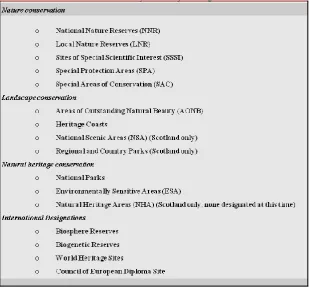
Other designations include: Sites of Special Scientific Interest (SSSIs), National Parks, National
Nature Reserve (NNR), Special Area of Conservation (SAC), and Special Protection Area (SPA).
Some of these designations are created by the Scottish or UK government, while others are
through European directives. Additionally, there are local nature reserves and joint-working
programmes in which several government agencies work together to attain a common goal, or to
enhance these designated sites.
The Joint Nature Conservation Committee (JNCC) as well as Scottish Natural Heritage (SNH)
provide in-depth resources regarding the site designations occurring throughout Scotland. SNH
provides a guidance publication regarding designated sites and maps which is available on their
website. Table 1.1 provides a list of the principle designations (Macually Institute website, 2011). In
1996, the Scottish Office indicated that over 12% of the landscape in Scotland had nature
conservation designations and almost 13% had landscape conservation designations. Each of these
designations may impact or influence the management of the landscape, and all of the flora and
fauna species located on them in various ways, including red deer. Nature conservation designations
focus on the flora and fauna species and do not include the visual landscape as part of their remit.
Landscape conservation designations do include the visual landscape as part of their remit, and
include things like Areas of Outstanding Natural Beauty (AONB) and regional and country parks.
these sites often extend across a wide range of both nature conservation and landscape interests,
which may include cultural aspects such as structures or gardens. International designations arise
from European legislation. They are usually used to designate natural habitats occurring in natural
regions or for preservation of European flora and fauna. These sites may be used for long-term
scientific studies, including environmental change or species diversity. World heritage designations
are awarded to areas of outstanding natural habitats or superior natural features and these sites
often have ‘exceptional natural or cultural value.’ The European Diploma sites are awarded based
upon superior protection and management of area which include recreational or social attributes.
Many parts of the Scottish landscape hold more than one designation and all sites are evaluated and
monitored for site condition. Priority sites, on which governmental organizations will focus attention
and financial resources, are usually in substandard condition, but are believed to have potential to
successfully achieve favourable status. Many of these sites have red deer herds that need to be
managed so that favourable status may be achieved.
According to the Macaulay Institute website (2011), there are other, non-statutory
designations as well. The list includes: Special Landscape; Special Landscape Area; Area of Landscape
Value/Merit/Significance; Great/Particular Landscape Value; Outstanding Landscape Area/Quality;
Local Landscape Area; High Landscape Value; Historic Landscape; Landscape Conservation Area;
Landscape Protection/Merit/Feature/Significance. These designations are created only at the local
level and will vary between individual councils. Red deer may live in any of these areas, such that red
[image:24.596.149.459.490.778.2]deer management of some sort will be required.
This discussion has been primarily based on an objective, scientific viewpoint. However,
landscapes are usually much more; they tend to evoke a strong emotional response in the people
who live (and interact) with them (McCrone, 1998). Though there is not room to thoroughly discuss
the ethnographic nature of human identity, which would include both belonging and territorial
rootedness of individuals with specific landscapes, there is substantial evidence that landscapes have
special meaning relating to human identity (for example, see Ateljevic and Doome, 2002), and evoke
emotions, especially when one is forced to physically leave a location, they rarely do psychologically
(Basu, 2001). McCrone (1998) states, ‘our visions of who we are, our identity and culture, are bound
up with the land,’ and embedded in these notions is ‘an attachment to the land which is Scotland,
such that its iconography is easily recognized and mobilized.’ The clearest evidence for the meaning
of the Scottish landscapes to the people of Scotland can be found in the numerous songs, tales, and
pictures which arose throughout history as well as in other countries, such as the United States of
America and Canada, when people left their homeland for new opportunities, either by force or due
to survival (Kay, 2006). The Scottish Natural Heritage report (2002) suggests that not only do cultural
impacts shape our landscape, they are so important that we want to conserve them, in order to
conserve aspects of previous cultures. Interestingly, some authors have stated that when
conservation agencies present specific visual and ecological order as ‘the natural heritage’ of
Scotland, they forget that ecosystems both arise from and reflect the social systems, or culture, which
give rise to them (MacDonald, 2002; Harvey, 1996).
1.7 Red deer management in Scotland
Red deer management in Scotland comprises a mixture of legislative acts, governmental
organizations, and individual practitioners, who are often associated with sporting estates.
1.7.1 Red Deer (Cervus elaphus) Ecology
The first deer-like animals arose around 30 million years ago, with the forbearers of red deer
colonizing Europe and Asia approximately three million years ago, before spreading to North America
(Clutton-Brock and McIntyre, 2007). The North American red deer (Cervus elaphus canadensis) are
called ‘wapiti’ and often ‘elk’ by the native population, probably due to their large size, similar to the
European Elk/Moose (Alces alces) when colonists first arrived in the Americas (ibid, 2007). Red deer are
a very adaptable species and have been introduced in many other parts of the world, including New
Zealand (Clutton-Brock et. al., 1982). While red deer have a large range, the primary focus of this
section will focus on characteristics specific to Scotland’s red deer populations.
There are few wildlife species which have a history that is intimately intertwined with humanity
from people following animal food resources, specifically game herds and notably, red deer. There is
high probability that a permanent human population existed from at least 9,000 years ago (Ritchie and
Ritchie, 1997). Various stone, bone, ivory, and antler tools have been found, and it was increasingly
evident that these hunter-gatherers were highly dependent on the red deer, not only for sustenance
but also for technological tools and hunting weapons (Magnusson, 1997; Love, 1987). At the end of the
first millennium, the landscape of Scotland would have been settled for at least the past 2,000 years
and the biodiversity was rich with vast woodland and scrub covering the uplands, the dominant species
of trees were Scots pine and oak, and a variety of wildlife species would have existed, including: red
deer, roe deer, capercaillie, red and black grouse, pine martens, wildcat; and probably beavers, wolves,
wild cattle, wild pigs, and lynx and bear (Woolf, 2007). As people settled across Scotland and reduced
forests and woodlands through human use, the woodland-based red deer retreated and adapted to the
more remote and less hospitable areas – the slopes and heather-filled hills of the Scottish Highlands
(Clutton-Brock and McIntyre, 2007). The harsh environment of the highlands results in a reduction red
deer body size of between 20 – 30% of that of woodland, farmed, and European red deer for both
sexes (de Nahlik, 1992).
Red deer have characteristics, life spans, and mortality which differ between the sexes. Male
red deer, called ‘Stags’, have a life span, on average of 9-12 years (Clutton-Brock and McIntyre, 2007),
and vary in weight and height, usually 14 – 18 stone (1 stone = 14 pounds; 95-115kg) and 105-125cm
(42-48 inches) at the shoulder for a Scottish hill stag, where woodland or European stags average 18 –
30 stone (115-190kg) and 115-135 cm (45-54 inches) at the shoulder (de Nahlik, 1992). Although males
also have higher mortality as infants, juveniles, and older stags during the harsh winter conditions as
they use up their reserves due to their larger body size and higher need for food than the females
(Clutton-Brock et al., 1982). Due to the harsher conditions on an open hill, Scottish deer have a smaller
skeletal structure and antlers than their European or woodland counterparts (de Nahlik, 1992). Antler
growth, only occurring in stags, begins in February or March, after shedding the previous year’s antlers,
is completed by late summer (Mitchell, et al., 1977; Clutton-Brock and McIntyre, 2007), and can be up
to 5% of a male’s body weight (de Nahlik, 1992). In late summer, testosterone levels increase
prompting antler cleaning of the velvet, development of mane and neck muscles, and by late
September stag groups have fragmented as the males migrate to their rutting grounds (Clutton-Brock,
et al., 1982; Clutton-Brock and McIntyre, 2007). Female red deer, called ‘hinds’, are approximately 35%
smaller and lighter than stags, and on average, live only a year or two longer than stags (ibid, 2007).
Female size and weight also differs between hill (stands 90 cm/36 inches at the shoulder and weighs
65-90kg/10-14 stone) and woodlands (standing 105-125 cm/42-48 inches at the shoulder and weighing
birth at the age of two, while Scottish hill hinds more often conceive or give birth at the age of three or
even four years old (ibid, 1992).
During the rut, successful stags rarely eat while holding harems of hinds, defending them from
challengers day and night, through roaring, which may play a part in conception, and occasionally
fighting, which can result in serious or temporary injuries (Clutton-Brock and McIntyre, 2007). Older
stags have an advantage in collecting and retaining a harem as there is a ‘large degree of correlation’
between age, antler size, and body weight (de Nahlik, 1992). By late September hinds begin to come
into oestrus, which usually lasts for 6 – 24 hours where the females may lick or mount the stag, with
the majority of conceptions (over 80%) occurring in October (Clutton-Brock and McIntyre, 2007). Hinds
are pregnant throughout the winter months, eventually calving in mid-May through early July after 33
weeks of gestation (ibid, 2007). The highest time of mortality where death peaks for both sexes is from
late February through early April as feed is scarce and animals use the last of their stored reserves, and
can be especially difficult for calves as 20-40% of calves perish (Clutton-Brock, et al., 1982; de Nahlik,
1992; Clutton-Brock and McIntyre, 2007). When females of poor condition fail to conceive or bear a
calf, becoming temporarily barren after rearing a calf successfully, they are called ‘yeld hinds’, and this
condition can affect up to 40% of females in a population depending upon food availability, deer
density, and age as fecundity tends to decline after a female’s 12th year (Clutton-Brock and McIntyre,
2007).
As a hind gets close to birth she will separate herself from the herd for calving (Mitchell, et al.,
1977; de Nahlik, 1992). The birthweight of calves averages around 15 pounds (7kg) for stag calves, with
hind calves being about one pound lighter; however, colder years can result in lighter calves and
warmer springs in heavier calves of both sexes and around 1/5th of all calves will not live past the first
month (Clutton-Brock and McIntyre, 2007). More dominant and larger hinds tend to produce more stag
calves, however due to the cost associated with their development and early development of calves
will impact the animals for life, i.e. smaller animals at birth will remain small throughout life and impact
breeding success (ibid, 2007). Although calves will be on their feet within an hour of its birth, it is most
often concealed within high grasses close to its mother for the first few weeks of life (de Nahlik, 1992),
hiding from predators such as golden eagles (Clutton-Brock, et al., 1982; Clutton-Brock and McIntyre,
2007). Calves will suspend their growth through the winter months only to begin again in the spring;
and will continue to grow until the animal is six or seven years of age for stags and five or six for hinds
(ibid, 2007). Calves are born chestnut with white spots before changing as they age into a summer coat
that can vary from buff/grey to a reddish-brown to a deep brown for the rest of their life, and a winter
Red deer have a social structure that differs between the sexes. Stag calves may stay with the
female and calving herd up to around three years of age when they will be kicked out and will then join
a stag only herd (de Nahlik, 1992). Stag herds are social groups that exists only outside of the rut, in
which a massive change in behaviour occurs where each stag sees another as a rival (ibid, 1992). Stags
within a group are not often closely related, with some 40% travelling more than five miles away from
their calving herd, and thus tend to be evenly dispersed within their group (Clutton-Brock and
McIntyre, 2007). However, the hind herds have a hierarchical social system where each herd has a ‘lead
hind’, usually an older animal, that determines feeding areas and herd movement (de Nahlik, 1992).
Hinds usually stay within a ‘home range’ that is determined by a calving area, is often where the
majority, if not all, of the hinds were born, and they are very territorial (ibid, 1992). Home ranges can
vary from around a half square mile up to two square miles, and since most of the hinds are related,
they will associate with their families (mothers, daughters, siblings, etc) and thus are often more
closely bunched in groupings than stag herds (Clutton-Brock, et al., 1982; Clutton-Brock and McIntyre,
2007). Day to day movements are determined by feeding, shelter, and weather conditions, as well as
by fly and midge activity (de Nahlik, 1992). In larger hind groups, there may be a subordinate, second
‘lead hind’ that guards the rear (ibid, 1992). Disputes within hind herds are decided by ‘boxing’ where
hinds rear up on hind legs and ‘box’ each other with their forelegs (de Nahlik, 1992).
Traditionally, red deer are forest dwellers but they do not do well in coniferous forests, usually
only accessing them for shelter (Mitchell, et al., 1977; de Nahlik, 1992). Red deer are ruminant,
opportunistic feeders and are adaptable (ibid, 1992). Heathers and grasses make up about 90% of their
diet, with heather almost 50% in the autumn and winter; red deer may also consume Bilberry and
seaweed, as well as bones and shed antlers for calcium (Clutton-Brock and McIntyre, 2007). Red deer
are highly selective feeders, consuming only a small portion of vegetation in an area, and usually
consuming a proportion of coarse forage along with more nitrogen-rich, nutritious grasses (ibid, 2007).
However, stags often consume more food of lower quality, which is often less digestible and coarser
while hinds consume more nitrogen-rich foods, which may be due to dietary needs and available food
sources on specific ground (stags use lower ground in winter and higher ground in summer than the
hinds) (Clutton-Brock, et al., 1982; Clutton-Brock and McIntyre, 2007).
Red deer populations have fluxuated through recent history. At the beginning of the 19th
century only six deer ‘forests’ (land tracks devoted to hunting) existed and had sizable populations
(Clutton-Brock and McIntyre, 2007). However, with Queen Victoria’s purchase of Balmoral and the
increased wealth from the Industrial Revolution, interest in hunting deer became popular such that by
the beginning of the 20th century over two million hectares of the Scottish landscape became deer