Munich Personal RePEc Archive
Bayesian Averaging of Classical
Estimates in Asymmetric Vector
Autoregressive (AVAR) Models
Albis, Manuel Leonard F. and Mapa, Dennis S.
School of Statistics, University of the Philippines Diliman
2014
Online at
https://mpra.ub.uni-muenchen.de/55902/
Bayesian Averaging of Classical Estimates in
Asymmetric Vector Autoregressive (AVAR) Models
1Manuel Leonard F. Albis2 and Dennis S. Mapa, PhD.3
School of Statistics, University of the Philippines Diliman, Quezon City
A B S T R A C T
The estimated Vector AutoRegressive (VAR) model is sensitive to model misspecifications, such as omitted variables, incorrect lag-length, and excluded moving average terms, which results in biased and inconsistent parameter estimates. Furthermore, the symmetric VAR model is more likely misspecified due to the assumption that variables in the VAR have the same level of endogeneity. This paper extends the Bayesian Averaging of Classical Estimates, a robustness procedure in cross-section data, to a vector time-series that is estimated using a large number of Asymmetric VAR models, in order to achieve robust results . The combination of the two procedures is deemed to minimize the effects of misspecification errors by extracting and utilizing more information on the interaction of the variables, and cancelling out the effects of omitted variables and omitted MA terms through averaging. The proposed procedure is applied to simulated data from various forms of model misspecifications. The forecasting accuracy of the proposed procedure was compared to an automatically selected equal lag-length VAR. The results of the simulation suggest that, under misspecification problems, particularly if an important variable and MA terms are omitted, the proposed procedure is better in forecasting than the automatically selected equal lag-length VAR model.
Keywords: BACE, AVAR, Robustness Procedures
1
The authors are grateful to the Statistical Research and Training Center (SRTC) for the thesis fellowship grant for the completion of this study, and to the participants of the Colloquium on the Statistical Sciences at the School of Statistics, University of the Philippines, for their valuable comments.
2
Assistant Professor, School of Statistics, University of the Philippines Diliman. Email Address: [email protected]
3
9
1. Introduction
The Vector Autoregressive (VAR) model by Sims (1980) became a popular tool for
forecasting a group of interrelated economic variables because of its ease of use. However,
Braun & Mittnik (1993) showed that the ordinary least squares (OLS) coefficients VAR
estimates are sensitive to misspecification errors due to omitted variables, incorrect
lag-length, and excluded moving average (MA) terms. This results in having biased and
inconsistent estimators and creates problems in forecasting and the estimation of the impulse
response function (IRF) and variance decompositions. If these problems are not considered in
the modeling procedure, then the results of the VAR model may be misleading. A certain
degree of caution must be emphasized for the purpose of policy and decision making under
these circumstances.
The effects of excluded MA terms in the VAR model are alleviated by using a large number
of lags. However, the problem of omitting an important variable in the VAR model is the
hardest to solve. This problem is common in practice partly because of the true model is
usually unknown. .
Furthermore, the VAR model itself is misspecified. It assumes the lags of all variables in the
system are the same or symmetric. This is a problem in applied research since variables tend
to have different degrees of endogeneity. Keating (1993, 1995 & 2000) addressed this
problem by allowing unequal lag length or asymmetry in the VAR model (AVAR).
Another way of dealing with these problems is to use model averaging that is deemed to
produce robust results under problems of model misspecifications. Strachan & van Dijk
(2007) were the first to apply Bayesian Model Averaging (BMA) on VAR. The authors
assumed prior distribution for each parameter in the model. In analyzing cross-section data,
10
likelihood function of the regression model as weights in averaging the OLS estimates, where
the average is taken across all models generated in the context of the Extreme Bounds
Analysis of Leamer (1983). Sala-i-Martin, Doppelhofer & Miller (2004) formulated the
Bayesian Averaging of Classical Estimates (BACE) that uses the posterior model probability
as weights for the OLS estimates that needs only one prior information – the number of
variables in the true model.
The main objective of this paper is to develop a modeling procedure that will yield robust
VAR forecasts by the use of BACE on the forecasts of AVAR models using less assumption,
particularly on the parameter’s prior distributions of popular Bayesian VAR methods. The
combination of the two procedures, the BACE and the AVAR, is expected to minimize the
effects of misspecification errors by extracting and utilizing more information on the
interaction of the variables, and cancelling out the effects of omitted variables and omitted
MA terms through averaging. The paper also aims to determine the forecasting performance
of the BACE-AVAR method by applying it to stationary and deseasonalized vector of
variables simulated from different data characteristics. The Modified Diebold-Mariano test
and the relative MAPE will be used in the forecasting accuracy of the BACE-AVAR
procedure with respect to a model with automatic selection procedure.
2. VAR, AVAR and BACE Procedures
This section will provide a background on VAR and AVAR models, how these models are
specified and estimated, and how to measure their predictive accuracy. The BACE procedure
11
2.1 Vector Autoregressive Moving Average (VARMA) Models
Following Lütkepohl (2004), consider the generalized form of the finite order VARMA( , )
model that is given by:
∗
=
∗ (1)where = , … , , = 1, … , , is stationary, ∗ and ∗ are autoregressive
and moving average coefficient matrices, respectively, and = , … , ′ is a
K-dimensional white noise process, that is ! = " and
! # = $ %&, '( = ℎ
0 + ℎ,-.'/,, (2)
and %& is positive definite.
Due to the difficulties in estimating a VARMA , model, it is a common practice among
researchers to estimate VARMA , 0 model, which is popularly known as the VAR
model. The VAR 4 model is commonly represented by:
=
∗+
(3)where the terms are as defined in Equation (1). The parameters are usually estimated using
ordinary least squares (OLS) for all equations in the system.
4
The VAR operator is stable and the process is stationary if det ∗ 5 ≠ 0, where 5 ∈ ℂ. If this is the case, then the VAR( ) model can also be expressed as = ∑ :; , where : = < , if ∗ = ∗= < , and
12
Another approach in estimating the VAR model parameters is through the Bayesian VAR,
which was introduced by Litterman (1980). This approach was extensively used in modeling
and forecasting economic variables.5 The BVAR procedure involves setting the prior
distributions of the parameters and running MCMC simulations. Sun & Ni (2003; 2004)
indicated that the use of the non-informative Jeffrey’s prior in BVAR is likely to have
over-estimated posterior mean variance. Their study also showed that the results of BVAR across
different priors were different. This indicates that results of the BVAR are sensitive to the
selected prior information.
2.2 Automatic Selection Procedure
In practice, the model builder usually starts with VAR( ∗ model where ∗ is selected using
an automatic selection procedure. This involves the estimation of all VAR( model for
= 1, … , ∗, and selecting the initial model that yields the “best” value of a pre-selected
information criterion. The common information criteria are the Akaike Information Criterion
(1973) that is given by:
CDE = logIJKI + 2- (4)
and the Bayesian Information Criterion by Schwarz (1978) that is of the form:
LDE = logIJKI +- log (5)
where - is the number of estimated parameters, is the number of dependent variables in the
vector, and is the sample size. Hurvich & Tsai (1993) corrected the AIC for small samples
and it has the form:
5
13
CDEM = logIJKI + 2 − -/ .- (6)
Kadilar & Eldemir (2002) analyzed the performance of the popular information criteria by
simulating VAR(1) and VAR(2) models, with and without seasonality. They showed that
performance of the information criteria is better in VAR without seasonality than VAR with
seasonality. They also noted the improvement in the performance of AIC as the number of
variables in the VAR model, without seasonality, increases. However, the result for the AIC
is reversed for VAR with seasonal data. Hence, the authors recommended not to use the AIC
in the presence of seasonality in the VAR data. Overall, they ranked the performance of the
information criteria from highest to lowest as: Schwarz (SIC), Hannan-Quinn (HQ), Akaike
(AIC).
Waele & Broersen (2003) noted that the AIC is an unbiased estimate of the Kullback-Leibler
discrepancy.6 However, for a finite sample size, it tends to over-fit the model by choosing a
high number of lags, as discussed earlier. They also showed that the Kullback-Leibler
discrepancy can be used as an information criterion which they call KIC. Seghouane (2006)
proposed a refinement to the KIC, which the author called KICvc, where vc stands for vector
correction. The KICvc performs better than the KIC in model specification for small sample
sizes.
George, Sun & Ni (2004) developed a Bayesian stochastic search approach in determining
the VAR model that can incorporate restrictions on the VAR coefficients and on the elements
of the error covariance matrix. Korobilis (2010) developed an automatic variable selection
procedure using the Gibbs sampler for linear and nonlinear VARs. Numerical simulations
6
14
indicated that both procedures select a satisfactory model with improved forecasting
performance.
2.3 Asymmetric Vector Autoregressive (AVAR) Models
Hsiao (1981) was the first to suggest the estimation of VAR models with variables having
unequal lag length. However, Keating (1993) argued that Hsiao’s method depends on the
inclusion sequence of the explanatory variables in the model and that Litterman’s Bayesian
(Litterman, 1980) approach gives biased parameter estimates, a minor issue in forecasting
but a potential problem in determining macroeconomic structures. Keating introduced
asymmetries in the lag lengths of the variables in the VAR system and named this as
Asymmetric VAR (AVAR) model. The AVAR( , … Q), can be written as
=
R
∗ ∗+
(7)where ∗ = max { , W, … , Q}; R = diag{1{ Z [}, 1{ Z \}, … , 1{ Z ]}}, a diagonal matrix
having indicator variables as elements such that 1^ Z _` = {1 '( ' ≤ =; 0 + ℎ,-.'/,}; the
rest are as previously described. The Rmatrix restricts some of the parameters to zero and
this matrix introduces the inequalities in the lag-length of the variables.
The AVAR model is a VAR model that permits unequal lag length for the variables in the
equations. However, the lag specification should be the same across all equations in the
system. Because of this, the AVAR gives a parsimonious model with a substantial reduction
in the standard errors compared to the ordinary VAR. This translates to the clarity in the
interpretations from the impulse response function and variance decompositions.
Keating also performed an automatic selection procedure over a set of AVAR models. For a
15
number of lags c, and for each estimated model, the selected information criterion is
computed. The best AVAR model with the best information criterion is selected. There are cQ
number of AVAR models needed to be estimated in the procedure. For convenience, the
values of the AIC, SIC and HQ that are computed using Keating’s procedure will be called
KAIC, KSIC and KHQ respectively.7
Ozcicek & McMillin (1999) studied the performance of the popular information criteria, such
as AIC, SIC, KAIC and KSIC, in determining the lag length of a VAR model. Using a
variety of autoregressive data structure such as either short or long-lagged process, and
symmetric and asymmetric lag lengths, the authors showed that AIC is best for symmetric
data, since the other information criteria under-fits the model. The authors also showed that
KAIC is the best criterion to use for asymmetric data and they proposed this criterion to be
used in modeling since the lag length structure of the data is uncertain and most of the time
asymmetric in theory.
2.4 Predictive Accuracy
Diebold and Mariano (1995) developed a test for predictive accuracy in forecasting that is not
restricted to the quadratic loss function and can handle a wide variety of error characteristics.
For the two forecasts {d }e and {dW }e for the series { }e , let {, }e and {,W }e
be the associated forecast errors. The loss associated with a forecast at time is given by the
loss function f , d and the authors pointed out that the loss function is a direct
function of the forecast errors, that is, f , d = f , . The null hypothesis of the
Diebold-Mariano test is ! g = 0, where g = f , − f ,W is the loss differential. So
7
16
that if we have {g }e , then under the assumption that the loss differential series is
covariance stationary and short memory,
√ ig̅ − kl→ oi0,2p(m m 0 l, (8)
where, g̅ =
e∑ ge and (m 0 =Wq∑;t ;rm s , the spectral density of the loss
differential at frequency zero, having rm s = !{ g − k g t− k} , the sample
autocovariance of the loss differential to lag s, and k is the population mean of the loss
differential.
Harvey, Leybourne and Newbold (HLN) (1997) corrected the Diebold-Mariano (DM) test for
finite samples. The ℎ-step ahead forecasts DM test statistic is given by:
uv = g̅wxyig̅lz W (9)
where xyig̅l is the estimated variance of g̅ that is given by
xyig̅l ≈1|rd + 2 rdQ #
Q
} (10)
and, rdQ is the estimated autocovariance of g̅ that has the form:
rdQ= 1 g − g̅ g Q− g̅ e
Q~ (11)
The ℎ-step ahead forecasts Modified DM test (MDM) is of the form:
vuv = • + 1 − 2ℎ + ℎ ℎ − 1 €Wuv (12)
having a Student’s distribution with − 1 degrees of freedom. The MDM test statistic was
17
forecasting performance of the VAR model that is selected automatically using an
information criterion.
The Mean Absolute Percentage Error (MAPE) is a descriptive measure of predictive accuracy
that is given by:
vC•! = 1 ‚ − d ‚
e
(13)
where |⋅| is the absolute value function. The MAPE was used in the study to measure the
distance between the actual and predicted forecasts. The ratio of two MAPE is called the
relative MAPE and is given by the form
…,†vC•! =vC•!vC•!∗ (14)
where vC•! is from the ' # model and vC•!∗ is from the baseline model. Relative MAPE
of less than 1 implies that the model that is being evaluated is better than the baseline model.
2.5 Bayesian Averaging of Classical Estimates
The BACE by Sala-i-Martin, et. al. (2004) computes the weighted average of the OLS
coefficient estimates weighted by the probability that the model where it is estimated from is
the true model. This approach also has an advantage over BMA, since it only needs the
number of variables in the model as prior information under the assumption of equal prior
inclusion probabilities for each variable, whereas the BMA must be given assumed prior
distributions for all of the parameters.
The procedure involves estimating all regression models of the form
18
where ‰ is the variable of interest, Œ is a vector of fixed variables that appear in all the
regressions, and Ž= ∈ • is a vector of variables taken from the • collection of all other
variables under consideration.
If it is assumed that the prior inclusion probability of each variable in the model are equal, the
prior probability of model ?, denoted as •iv=l, will be:
•iv=l = ‘’“” Q_
‘1 −’“” Q_ (16)
where ’“ is the speculated number of variables in the true model, is the total number of
variables in the dataset, and ’= is the number of variables in the ? # model.
The weights that will be used in the averaging is the posterior probabilities of the v=′/. The
weight is a function of the prior probability and is given by:
•iv=| l = •iv=l•
Q_/W ––!
= —/W
∑ • v •W] Q˜/W ––! —/W (17)
where the ––!= is the sum of squared errors in model ?. Therefore, the posterior mean of Š is
given by:
! Š| = •iv=I lŠK= W™
=
(18)
where ŠK= is the estimated value of the vector of coefficients under OLS; and its
corresponding posterior variance is of the form:
xš- Š| = •iv=I lxš- Š| , v= W]
=
+ •iv=I lwŠK=− ! Š| zW W]
=
19
3. The BACE-AVAR Procedure
In specifying the AVAR model, the procedure of Keating (1995) estimates c AVAR models
given a maximum lag length of c that is set by the researcher. The best specification will be
selected based on the model that gives the best value of an information criterion.
The prior probability •i =l will be assumed to be equal for all the equations in the ? #
estimated VAR model. The formula for the prior probability for the AVAR model = is
given by:
•i =l = ›c†=œ ‘c”†̅ •_
‘1 −c”†̅ ž •_ (20)
where, †= is the total number of AR lag regressors for each of the equations in the ? # model,
and †̅ is the assumed total number of lags of all the variables in the true model. To simplify
the procedure, the value for †̅ can be given by running an automatic selection procedure over
VAR models and setting †̅ based on the recommended number of lags. Alternatively, the
researcher may run BACE-AVAR using a different †̅.
The formula for the posterior probability will be:
•iv= | l = •i =l •_/W ––!=
e/W
∑ •ž™ •˜/W ––! e/W (21)
where ––!= is the sum of squared errors of the AVAR model that is given by ––!= =
∑Q ∑e Q − dQ W .8 This will give a single weight for an estimated AVAR model
depending on the ability of all its equations to fit their corresponding variables.
8
20
3.1 BACE-AVAR on Forecasted Values
The posterior probabilities will also be used in computing for the forecasts of the
BACE-AVAR procedure. The forecasts will be the weighted mean of the forecast series produced by
the AVAR models, with the posterior probabilities as its weights. The + # forecast for
the vector of variables e~ from the BACE-AVAR procedure is given by:
e~
¡¢£¤
=
¥
= =,e~
ž™
=
(22)
where d=,e~ is the forecast at time + of the ? # AVAR model, and ¥= is as discussed
above. The corresponding standard error of ¡¢£¤e~ is the average of the standard errors of the
AVAR forecasts that is given by the formula
/,
¡¢£¤e~=
¥
=w/,i
=,e~lz
ž™= (23)
3.2 Summary of the Procedure
For a ’-dimensional vector of stationary time-series variables in , the procedure of the
Bayesian Averaging of Classical Estimates in Asymmetric Vector Autoregressions
(BACE-AVAR) is as follows:
1. Set c and †̅, the maximum lag length for the AVAR models and the assumed
symmetric lag length of the models. The †̅ can be set by using the automatic selection
procedures for VAR models given a certain information criterion. c may be set as
c = †̅ + 3, as adding a constant 3 to the lag length as specified by an automatic
21
2. Estimate all possible AVAR models given c using OLS. The total number of models
to be estimated is c .
3. For each of these models, compute the prior probability •i =l and the posterior
probability •i =| l that the ? # AVAR model has the correct specification.
4. For each model, obtain the forecasts along with their variances.
5. Compute the weighted forecasts and its corresponding variance at time , e~¡¢£¤ and
/, ¡¢£¤e~ .
3.3 Performance of BACE-AVAR through Simulations
The performance of BACE-AVAR was assessed using simulations. A 3-dimensional vector
time-series dataset9 was generated from a VAR or VARMA; for that particular dataset, all
possible AVAR models were estimated given a maximum number of lags c, as well as their
corresponding posterior probabilities of being the true model; the impulse responses and
variable forecasts were weighted using these posterior model probabilities, and the results
were compared with the true impulse response function and true forecasted values,
respectively. The forecasting performance of the method was compared to the symmetric
VAR that is selected by AIC for the cases with sample size 1000 and AICc for the other
cases. The number of iterations for each case was set to 100.
9
22 3.3.1 Specific Scenarios
The data were generated arbitrarily with the restriction that the time-series is stable and
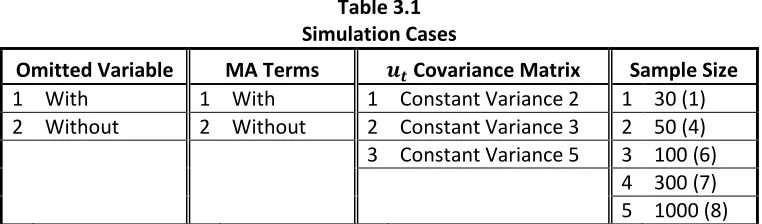
non-stationary. The BACE-AVAR was evaluated using cases summarized in Table 3.1. Overall,
[image:16.595.108.489.303.415.2]sixty scenarios were considered.
Table 3.1 Simulation Cases
Omitted Variable MA Terms § Covariance Matrix Sample Size
1 With 1 With 1 Constant Variance 2 1 30 (1) 2 Without 2 Without 2 Constant Variance 3 2 50 (4) 3 Constant Variance 5 3 100 (6)
4 300 (7)
5 1000 (8)
3.3.1.1 Sample Size
The range for the sample size is from 30 to 1000. The choice of range for the sample size is
mainly due to the periodicity of the data that is being used in practice. A sample size of 30
can be viewed as an annual data; a sample size of 50, as quarterly data; a sample size of 100
as a monthly data; a sample size of 300 can be viewed as weekly data; and 1000 can be
associated to daily data. Though these specifications were a generalization of common
practice, the BACE-AVAR procedure does not limit the sample size with respect to the
periodicity of the data. It is just more likely in practice that the sample size of the data is
directly related to the period of the series, that is, higher sampling rate will have a larger
23
Furthermore, data collected on lower sampling rates have a higher amount of aggregated
information than higher frequency samples. In mimicking this phenomenon, the AR part of
the true model will have a lag order that is directly related to the sample size that will be
obtained. The AR lag orders are enclosed in parenthesis beside the sample sizes in Table 3.1.
3.3.1.2 Covariance Matrix
Three cases will be set for the covariance matrix % of the innovation series =
• , ¨ , ˆ ′, or = • , ¨ , ˆ , ‹ ′, in the case of an omitted variable. These will be
limited to a diagonal matrix with equal elements, which were set to be two, three and five,
that is, Σ = ' ∗ I , ' ∈ {2, 3, 5} and ∈ {3, 4}. These values for the scalar covariance matrix
were chosen to determine the performance of the BACE-AVAR procedure through different
magnitudes of variances, relative to the performance of the automatically selected model.The
starting values of the simulated data and the parameters for each replicate will be the same in
order to have comparable results for the different specification of %.
3.3.1.3 Omitted Moving Average Terms
The case wherein there is an omitted MA term was also considered in the simulations. The
MA term are restricted to lag order of one. The MA terms will be omitted in the modeling
procedure.
3.3.1.4 Omitted Variable
It is likely in practice that some of the important variables in the system were not included in
the modeling. It may be because that the variable is difficult to measure, the variable has not
been measured, or the variable cannot be measured directly. In simulating this phenomenon, a
24
will be used in modeling. The AR and/or MA parameters of this omitted variable will be
generated using the same procedure as the parameter generation of the variables of interest.
4. Results & D i s c u s s i o n
This chapter discusses the performance of the BACE-AVAR procedure in forecasting and in
determining the interaction of the variables given some misspecification errors. The problems
that were encountered in the simulation proper will be discussed first. The discussion of the
results will then follow. In summary, the BACE-AVAR procedure has an advantage in
forecasting over the automatically selected model under the problem of an omitted important
variable and excluded MA term.
4.1 Preliminary Concerns on the Simulation
The formula for the posterior probability of the BACE procedure in cross-section data given
Equation (17) involves the ––! being raised to the power −•/2, where • is the sample size
of the cross-section data. In the BACE-AVAR procedure, the resulting posterior probability
will be zero for a large sample size due to the small size of the ––!. Therefore, the problem
was counteracted by raising the ––! to − 0.1 /2 on this part of the formula that is given in
Equation (21) for the sample sizes = 300 and = 1000 since any power of the ––! that is
less than −100/2 yields undefined posterior probabilities. However, this stands only as a
temporary remedy to the problem. This issue posits that the order in which the ––! converges
in the formula of the posterior probability may be different, in time-series data, from
25
There were cases wherein the steps taken in order to have a simulated data that is stable and
stationary do not work, since the generated parameters were selected at random. In order to
guarantee a model that gives a stable data, a data burning of 10,000 time points were done.
Table 4.1 gives the lag length of the symmetric VAR models in the simulation. The number
of AVAR models for models with lower lag length is small because c = †̅ + 3. This may
affect the results of the averaging and may decrease the performance of the BACE-AVAR on
smaller samples. Therefore, the performance for small samples of the BACE-AVAR
procedure as stated in the results of the simulation may still be further improved.
Table 4.1
Average VAR Lag Lengths from Automatic Selection Procedure Using AICc
Sample Size No Omitted Variable With an Omitted Variable No MA Term With MA Term No MA Term With MA Term
30 (1) 1.03 1.36 1.07 1.33
50 (4) 3.02 3.46 2.44 2.86
100 (6) 5.66 6.27 4.85 5.4
300 (7) 7.04 8.93 7.27 8.64
1000* (8) 8.07 12.79 11.25 13.79
* AIC for Sample Size 1000
4.2 Forecasting Accuracy
This section will discuss the results of the forecasting accuracy of the BACE-AVAR
procedure relative to the automatically selected model having the least value of AIC for large
samples and least value of AICc for small samples, which will be hereafter called MINIC. In
determining the forecasting accuracy of the procedures, the MDM test and the MAPE were
26 4.2.1 Modified Diebold-Mariano Test
The results for the forecasting accuracy are given in Table 4.2 and Table 4.3. The tables
present the proportion of significant MDM test result at 10% level of significance that the
BACE-AVAR procedure has a better measure of forecasting accuracy than the MINIC, and
vice versa, for the different sample sizes, and by the loss functions that were used. The
differences of the proportion of significant tests between the BACE-AVAR and the MINIC
were also reported, as well as the average proportion of significant MDM tests for the
variables of interest. The MDM test result for each of the variable of interest is given in
Appendix A. Generally, the results of the MDM test indicate that the BACE-AVAR
procedure is better than the MINIC in forecasting under the omitted variable problem. The
BACE-AVAR procedure performs the same with respect to the MINIC across the different
variance specification. This indicates that the BACE-AVAR procedure is not affected by the
variance specification as specified in the simulations, relative to the automatically selected
model.
In Table 4.2, for the case of no omitted variable and no omitted MA term, the BACE-AVAR
is slightly better than the MINIC for small samples ( = 30, 50 š•g 100 . However, its
performance diminished for sample sizes where the posterior model probability was
modified. For = 1000, the forecasting accuracy of MINIC over the BACE-AVAR
procedure is about 25%. For the case of no omitted variable but with an omitted MA term,
the results indicate similar outcome as the previous case, but the improvement of the MINIC
over the BACE-AVAR procedure now comes with smaller magnitude.
Table 4.2
MDM Test: Proportion of Significance for the Case of No Omitted Variable Alpha: 0.10; Number of Iterations: 100
Model Sample Size
27 Significance
of BACE over MINIC
30 14.3 15.7 14.0 18.7
50 16.0 15.0 14.3 16.0
100 10.7 11.3 12.7 15.0
300 4.3 6.0 6.0 6.0
1000 3.3 5.3 7.0 5.3
Significance of MINIC over BACE
30 10.0 13.3 13.3 13.0
50 5.7 6.7 11.3 12.0
100 10.3 12.3 6.3 8.0
300 22.3 22.3 19.0 20.0
1000 26.3 31.7 11.0 15.0
Difference (BACE-MINIC)
30 4.3 2.3 0.7 5.7
50 10.3 8.3 3.0 4.0
100 0.3 -1.0 6.3 7.0
300 -18.0 -16.3 -13.0 -14.0
1000 -23.0 -26.3 -4.0 -9.7
In Table 4.3, for the case of an omitted variable with no excluded MA term, the
BACE-AVAR procedure has better forecasting accuracy than the MINIC except for = 30.
Furthermore, the magnitude of this improvement increases as the sample size increases. The
improvement of the BACE-AVAR procedure drastically increases for sample sizes involving
the modified posterior probability. For the case of omitting an important variable and MA
term, the BACE-AVAR is better than the MINIC in terms of forecasting accuracy at around
15% to 20% depending on the sample size. The results emphasize that more information can
still be extracted by the BACE-AVAR procedure for small samples by improving the weights
or the posterior model probability.
Increasing the level of significance to 5% as stated in Tables A.2.1 to A.2.4 in Appendix A,
yields the same interpretation that the MINIC is better than the BACE-AVAR procedure
when there are no misspecification errors. In addition to this, the outputs also show that the
result is reversed when there are misspecification errors. Increasing the level of significance
28
of one procedure over the other may just be deemed as negligible due to the small values of
[image:22.595.101.494.214.472.2]the significant percentages. Full results are given in Appendix A.
Table 4.3
MDM Test: Proportion of Significance for the Case of an Omitted Variable Alpha: 0.10; Number of Iterations: 100
Model Sample Size
No MA Term With MA Term Absolute Loss Squared Loss Absolute Loss Squared Loss Significance
of BACE over MINIC
30 5.7 7.0 7.0 6.7
50 10.7 10.3 11.0 11.7
100 7.7 9.3 14.7 14.0
300 19.3 17.7 20.7 23.0
1000 16.3 20.7 15.0 18.0
Significance of MINIC over BACE
30 11.7 11.3 8.7 8.0
50 5.0 6.0 5.0 8.7
100 5.0 6.0 4.3 2.7
300 2.3 2.0 2.3 3.0
1000 2.0 2.0 2.7 1.3
Difference (BACE-MINIC)
30 -6.0 -4.3 -1.7 -1.3
50 5.7 4.3 6.0 3.0
100 2.7 3.3 10.3 11.3
300 17.0 15.7 18.3 20.0
1000 14.3 18.7 12.3 16.7
4.2.2 Mean Absolute Percentage Error
The forecasting accuracy was also measured descriptively by the relative MAPE. The relative
MAPE forecasts of the BACE-AVAR procedure with respect to the MAPE forecasts of the
MINIC are given in Table 4.4 and Appendix B. Relative MAPE values that are less than one
imply that the BACE-AVAR forecasts are closer to the outsample data than the MINIC,
whereas values greater than one indicate the opposite.
Table 4.4
Average Relative MAPE of Forecasts Sample
Size
[image:22.595.143.455.722.761.2]29 30 0.6195 0.6390 1.0007 0.7803
50 0.7221 1.3715 0.9521 1.1204 100 1.1456 0.7054 1.2131 1.3044 300 0.5876 0.6308 0.4813 0.6042 1000 0.7547 1.5094 0.5429 0.7231
The result in Table 4.4 for the case of no omitted variable and no omitted MA term reveals
that the forecasts of the BACE-AVAR procedure using the unmodified posterior probability
are closer to the actual values compared to the forecasts of the MINIC by about 35% except
for the sample size 50. For the case of = 300 š•g 1000, the BACE-AVAR procedure also
has the same performance over the MINIC. This indicates that even if the MDM test suggests
that the MINIC is superior to the BACE-AVAR for cases of no misspecification, the
forecasts of BACE-AVAR are closer to the actual values than the forecasts of the MINIC on
the average.
For the case of no omitted variable but with an omitted MA term, it seems that the forecasts
of the BACE-AVAR procedure is closer to the outsample data than that of the MINIC by
about 35% except for = 50. The result still holds for the cases of the modified posterior
probability except for = 1000. Thus, the BACE-AVAR procedure is, on the average, still
at par or better in some cases than the MINIC based on the relative MAPE.
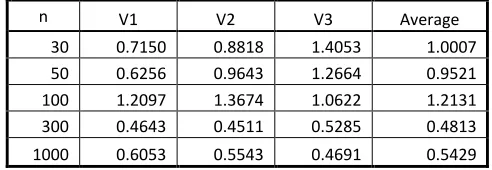
The BACE-AVAR procedure is better than or at par to the MINIC for the case wherein an
important variable is omitted. The relative MAPE of BACE-AVAR to the MAPE of the
MINIC reaches around 0.50 for the sample size of 1000 – a 50% improvement over the
MINIC. All the relative MAPE of the sample sizes that were subjected to the modified
posterior probability are less than one. This result is not contained only for the sample size of
300 and 1000 but is also evident for = 300, except for = 100, that exhibits a relative
30
not be a linear function of the sample size. Nevertheless, it is evident that the BACE-AVAR
procedure can reach a 50% improvement over the MINIC in terms of MAPE forecasts.
For the case of an omitted variable and excluded MA term, the BACE-AVAR procedure
improves over the MINIC for = 30, 300 š•g 1000. The relative MAPE for the sample
size 50 and 100 is 1.12 and 1.30, respectively. Furthermore, the improvement of the MINIC
over the BACE-AVAR procedure exhibits an upward trend from the sample size of 30 to
100, which are the sample sizes that use the original form of the posterior model probability.
This may imply that correction on the posterior probability may also be applied to improve
the overall performance of the BACE-AVAR procedure. Full results are given in Appendix
B.
5. Conclusion
Misspecification problems in VAR modeling such as incorrect AR lag, excluded MA terms,
and omitted relevant variables, are common in practice. The worst problem among those that
were stated is omitting an important variable since it is immeasurable given the data on hand.
Aside from that, it also gives biased and inconsistent estimates. The implication of this
problem is crucial in policy evaluation since it will yield misleading forecasts and incorrect
variable relationships.
This study presents the application of the BACE on AVAR models in forecasting in presence
of misspecification errors. Simulations under different scenarios were done to evaluate the
performance of the BACE-AVAR procedure over an automatically selected model using an
information criterion.
The results suggest that the BACE-AVAR procedure produces more accurate forecasts than
31
variables and omitted MA term. The forecasting accuracy of the BACE-AVAR procedure is
better for large sample sizes. On the other hand, if there are no omitted variable and excluded
MA term, the automatically selected model is better than the BACE-AVAR procedure. Given
the results of the study, the BACE-AVAR procedure is recommended in forecasting.
It is recommended to simulate the performance of the BACE-AVAR procedure for processes
generated from a structural VAR. It is also recommended to extend the BACE-AVAR
procedure for cointegrated variables. But before working on these recommendations, it is
suggested to improve the posterior model probability in order for the BACE-AVAR
procedure to be at par with the automatically selected model when there is no
32
B i b l i o g r a p h y
Akaike, H. (1973). A New Look at the Statistical Model Identification. IEEE Transactions on Automatic Control, Vol. 19(No. 6), pp. 716-723.
Akaike, H. (1974, Dec.). A new look at the statistical model identification. Automatic Control, IEEE Transactions on, Vol. 19(No. 6), pp. 716,723.
Braun, P. A., & Mittnik, S. (1993, Oct.). Misspecifications in vector autoregressions and their effects on impulse responses and variance decompositions. Journal of Econometrics, Vol. 59(No. 3), pp. 319-241.
Carriero, A., Kapetanios, G., & Marcellino, M. (2009). Forecasting Exchange Rates with a Large Bayesian VAR. International Journal of Forecasting, pp. 400-417.
Chen, A.-S., & Leung, M. T. (2003). A Bayesian Vector Error Correction Model in Forecasting Exchange Rates. Computers and Operations Research, Vol. 30, pp. 887-900.
Diebold, F. X., & Roberto, M. S. (1995, July). Comparing Predictive Accuracy. Journal of Business & Economic Statistics, Vol. 13(No. 3), pp. 253-263.
Fackler, J. S., & Krieger, S. C. (1986, Jan). An Application of Vector Time Series Techniques to Macroeconomic Forecasting. Journal of Business & Economic Statistics, Vol. 4(No. 1), pp. 71-80.
Hannan, E. J., & Quinn, B. G. (1979). The Determination of the Order of an Autoregression. Journal of the Royal Statistical Society. Series B (Methodological), Vol. 41(No. 2), pp. 190-195.
Harvey, D., Leybourne, S., & Newbold, P. (1997). Testing the Equality of Prediction Mean Squared Errors. International Journal of Forecasting, Vol. 13, pp. 281-291.
Hsiao, C. (1981). Autoregressive Modelling and Money-Income Causality Detection. Journal of Monetary Economics, Vol. 7(No. 1), pp 85-106.
Hurvich, C. M., & Tsai, C.-L. (1993). A Corrected Akaike Information Criterion for Vector Autoregressive Model Selection. Journal of Time Series Analysis, Vol. 14(No. 3), pp. 271-279.
Jorda, O. (2005, March). Estimation and Inference of Impulse Responses by Local Projections. The American Economic Review, Vol. 95(No. 1), pp. 161-182.
Kadilar, C., & Erdemir, C. (2002). Comparison of Performance Among Information Criteria in VAR and Seasonal VAR models. Hacettepe Journal of Mathematics and Statistics, Vol. 31, pp. 127-137.
Keating, J. W. (1993). Asymmetric Vector Autoregression. Proceedings of the Business and Economic Statistics Section (pp. pp. 68-73). American Statistical Association.
33
Keating, J. W. (2000). Macroeconomic Modeling with Asymmetric Vector Autoregressions. Journal of Macroeconomics, Vol. 22(No. 1), pp. 1-28.
Korobilis, D. (2010, March 4). VAR forecasting using Bayesian variable selection. Retrieved January 24, 2011, from Munich Personal RePec Archive: http://mpra.ub.uni-muenchen.de/21124/
Kullback, S., & Leibler, R. A. (1951). On Information and Sufficiency. Annals of Mathematical Statistics, Vol. 22(No. 1), pp. 79-86.
Leamer, E. E. (1983, March). Let's Take the Con Out of Econometrics. The American Economic Review, Vol. 73(No. 1), pp. 31-43.
Litterman, R. B. (1980). A Bayesian Procedure for Forecasting With Vector Autoregressions.
Working Paper.
Lütkepohl, H. (1990, Feb. ). Asymptotic Distributions of Impulse Response Functions and Forecast Error Variance Decompositions of Vector Autoregressive Models. The Review of Economics and Statistics, Vol. 72(No. 1), pp. 116-125.
Lütkepohl, H. (2004). Forecasting with VARMA Models. Department of Economics, European University Institute.
Ng, S., & Pierre, P. (2001, Nov.). Lag Length Selection and the Construction of Unit Root Tests with Good Size and Power. Econometrica, Vol. 69(No. 6), pp. 1519-1554.
Ozcicek, O., & McMillin, W. D. (1999, April). Lag length selection in vector autoregressive models: symmetric and asymmetric lags. Applied Economics, Vol. 31(No. 4), pp. 517-524.
Po, H. H., Chi, H. W., Shyu, J., & Hsiao, C. Y. (2002). A Litterman BVAR approach for production forecasting of technological industries. Technological Forecasting and Social Change, Vol.70, pp. 67-82.
Ramos, F. F. (2003). Forecasts of market shares from VAR and BVAR models: a comparison of their accuracy. International Journal of Forecasting, Vol. 19, pp. 95-100.
Runkle, D. E. (1987, Oct.). Vector Autoregressions and Reality. Journal of Business and Economic Statistics, Vol. 5(No. 4), pp. 437-42.
Sala-I-Martin, X. X. (1997, May). I Just Ran Two Million Regressions. The American Economic Review, Vol. 87(No. 2), pp. 178-183.
Sala-I-Martin, X., Doppelhofer, G., & Miller, R. (2004, September). Determinants of Long-Term Growth: A Bayesian Averaging of Classical Estimates (BACE). The American Economic Review, Vol. 94(No. 4), pp. 813-835.
Schwartz, G. (1978). Estimating the Dimension of a Model. Annals of Statistics, Vol. 6(No. 2), pp. 461-464.
34
Seghouane, A.-K. (2006, Oct.). Vector Autoregressive Model-Order Selection From Finite Samples Using Kullback’s Symmetric Divergence. Circuits and Systems I: Regular Papers, IEEE Transactions on, Vol. 53(No. 10), pp. 2327-2335.
Shibata, R. (1980). Asymptotically efficient selection of the order of the model for estimating parameters in a linear process. Annals of Statistics, Vol. 8(No. 1), pp. 147-146.
Sims, C. A. (1980). Comparison of Interwar and Postwar Business Cycles: Monetarism Reconsidered.
The American Economic Review: Papers and Proceedings of the Ninety-Second Annual Meeting of the American Economic Association.Vol. 70, No. 2, pp. pp. 250-257. American Economic Association.
Sims, C. A. (1980, Jan). Macroeconomics and Reality. Econometrica, Vol. 48(No. 1), pp. 1-48.
Sims, C. A., & Zha, T. (1999, Sep.). Error Bands for Impulse Responses. Econometrica, Vol. 67(No. 5), pp. 1113-1155.
Stock, J. H., & Watson, M. W. (1996, Jan.). Evidence on Structural Instability in Macroeconomic Time Series Relations. Journal of Business & Economic Statistics, Vol. 14(No. 1), pp. 11-30.
Stock, J. H., & Watson, M. W. (2001). Vector Autoregressions. The Journal of Economic Perspective, Vol. 15(No. 4), pp. 105-115.
Strachan, R., & van Dijk, H. K. (2007). Bayesian Model Averaging in Vector Autoregressive Processes with an Investigation of Stability of the US Great Ratios and Risk of a Liquidity Trap in the USA, UK and Japan. MRG Discussion Paper Series 1407.
Sun, D., & Ni, S. (2004). Bayesian analysis of vector-autoregressive models with noninformative priors. Journal of Statistical Planning and Inference, Vol. 121, pp. 291-309.
Tsay, R. S. (2005). Analysis of Financial Time Series (Second Edition ed.). Hoboken, New Jersey: John Wiley & Sons, Inc.
Waele, S. d., & Broersen, P. M. (2002, Oct.). Finite sample effects in vector autoregressive modelling.
Instrumentation and Measurement, IEEE Transactions on, Vol. 51(No. 5), pp. 917-992.
Waele, S. d., & Broersen, P. M. (2003, Feb.). Order Selection for Vector Autoregressive Models.
35
APPENDIX A
[image:29.595.71.528.153.403.2]M D M T e s t : P r o p o r t i o n o f S i g n i f i c a n c e
Table A.1.1
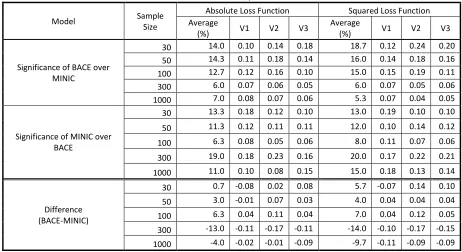
Alpha: 0.10; Number of Iterations: 100 Case: No Omitted Variable; No MA Terms
Model Sample
Size
Absolute Loss Function Squared Loss Function Average
(%) V1 V2 V3
Average
(%) V1 V2 V3
Significance of BACE over MINIC
30 0.15 0.13 0.15 15.7 0.14 0.13 0.20 0.15
50 0.18 0.15 0.15 15.0 0.16 0.15 0.14 0.18
100 0.11 0.13 0.08 11.3 0.10 0.16 0.08 0.11
300 0.06 0.05 0.02 6.0 0.08 0.07 0.03 0.06
1000 0.01 0.03 0.06 5.3 0.05 0.05 0.06 0.01
Significance of MINIC over BACE
30 0.12 0.10 0.08 13.3 0.14 0.16 0.10 0.12
50 0.08 0.04 0.05 6.7 0.10 0.06 0.04 0.08
100 0.07 0.12 0.12 12.3 0.09 0.15 0.13 0.07
300 0.23 0.22 0.22 22.3 0.21 0.27 0.19 0.23
1000 0.28 0.26 0.25 31.7 0.33 0.32 0.30 0.28
Difference (BACE-MINIC)
30 0.03 0.03 0.07 2.3 0.00 -0.03 0.10 0.03
50 0.10 0.11 0.10 8.3 0.06 0.09 0.10 0.10
100 0.04 0.01 -0.04 -1.0 0.01 0.01 -0.05 0.04
300 -0.17 -0.17 -0.20 -16.3 -0.13 -0.20 -0.16 -0.17 1000 -0.27 -0.23 -0.19 -26.3 -0.28 -0.27 -0.24 -0.27
Table A.1.2
Alpha: 0.10; Number of Iterations: 100 Case: No Omitted Variable; With MA Terms
Model Sample
Size
Absolute Loss Function Squared Loss Function Average
(%) V1 V2 V3
Average
(%) V1 V2 V3
Significance of BACE over MINIC
30 14.0 0.10 0.14 0.18 18.7 0.12 0.24 0.20
50 14.3 0.11 0.18 0.14 16.0 0.14 0.18 0.16
100 12.7 0.12 0.16 0.10 15.0 0.15 0.19 0.11
300 6.0 0.07 0.06 0.05 6.0 0.07 0.05 0.06
1000 7.0 0.08 0.07 0.06 5.3 0.07 0.04 0.05
Significance of MINIC over BACE
30 13.3 0.18 0.12 0.10 13.0 0.19 0.10 0.10
50 11.3 0.12 0.11 0.11 12.0 0.10 0.14 0.12
100 6.3 0.08 0.05 0.06 8.0 0.11 0.07 0.06
300 19.0 0.18 0.23 0.16 20.0 0.17 0.22 0.21
1000 11.0 0.10 0.08 0.15 15.0 0.18 0.13 0.14
Difference (BACE-MINIC)
30 0.7 -0.08 0.02 0.08 5.7 -0.07 0.14 0.10
50 3.0 -0.01 0.07 0.03 4.0 0.04 0.04 0.04
100 6.3 0.04 0.11 0.04 7.0 0.04 0.12 0.05
300 -13.0 -0.11 -0.17 -0.11 -14.0 -0.10 -0.17 -0.15
[image:29.595.66.528.466.718.2]36
Table A.1.3
Alpha: 0.10; Number of Iterations: 100 Case: With Omitted Variable; No MA Terms
Model Sample
Size
Absolute Loss Function Squared Loss Function Average
(%) V1 V2 V3
Average
(%) V1 V2 V3
Significance of BACE over MINIC
30 5.7 0.09 0.03 0.05 7.0 0.11 0.06 0.04
50 10.7 0.07 0.10 0.15 10.3 0.10 0.11 0.10
100 7.7 0.08 0.09 0.06 9.3 0.08 0.11 0.09
300 19.3 0.14 0.22 0.22 17.7 0.15 0.20 0.18
1000 16.3 0.17 0.15 0.17 20.7 0.23 0.21 0.18
Significance of MINIC over BACE
30 11.7 0.11 0.09 0.15 11.3 0.09 0.10 0.15
50 5.0 0.09 0.04 0.02 6.0 0.09 0.06 0.03
100 5.0 0.07 0.04 0.04 6.0 0.10 0.05 0.03
300 2.3 0.04 0.01 0.02 2.0 0.03 0.01 0.02
1000 2.0 0.03 0.01 0.02 2.0 0.02 0.02 0.02
Difference (BACE-MINIC)
30 -6.0 -0.02 -0.06 -0.10 -4.3 0.02 -0.04 -0.11
50 5.7 -0.02 0.06 0.13 4.3 0.01 0.05 0.07
100 2.7 0.01 0.05 0.02 3.3 -0.02 0.06 0.06
300 17.0 0.10 0.21 0.20 15.7 0.12 0.19 0.16
1000 14.3 0.14 0.14 0.15 18.7 0.21 0.19 0.16
Table A.1.4
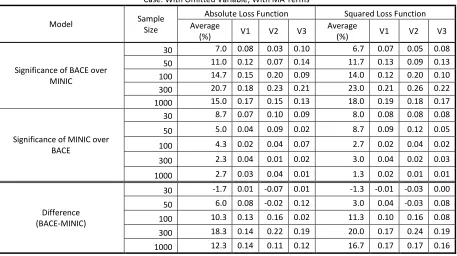
Alpha: 0.10; Number of Iterations: 100 Case: With Omitted Variable; With MA Terms
Model Sample
Size
Absolute Loss Function Squared Loss Function Average
(%) V1 V2 V3
Average
(%) V1 V2 V3
Significance of BACE over MINIC
30 7.0 0.08 0.03 0.10 6.7 0.07 0.05 0.08
50 11.0 0.12 0.07 0.14 11.7 0.13 0.09 0.13
100 14.7 0.15 0.20 0.09 14.0 0.12 0.20 0.10
300 20.7 0.18 0.23 0.21 23.0 0.21 0.26 0.22
1000 15.0 0.17 0.15 0.13 18.0 0.19 0.18 0.17
Significance of MINIC over BACE
30 8.7 0.07 0.10 0.09 8.0 0.08 0.08 0.08
50 5.0 0.04 0.09 0.02 8.7 0.09 0.12 0.05
100 4.3 0.02 0.04 0.07 2.7 0.02 0.04 0.02
300 2.3 0.04 0.01 0.02 3.0 0.04 0.02 0.03
1000 2.7 0.03 0.04 0.01 1.3 0.02 0.01 0.01
Difference (BACE-MINIC)
30 -1.7 0.01 -0.07 0.01 -1.3 -0.01 -0.03 0.00
50 6.0 0.08 -0.02 0.12 3.0 0.04 -0.03 0.08
100 10.3 0.13 0.16 0.02 11.3 0.10 0.16 0.08
300 18.3 0.14 0.22 0.19 20.0 0.17 0.24 0.19
[image:30.595.71.528.434.690.2]37
Table A.2.1
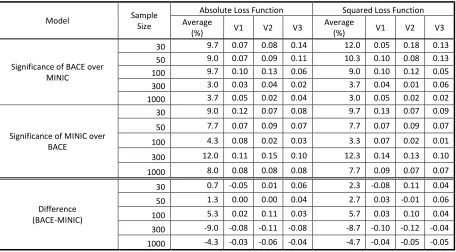
Alpha: 0.05; Number of Iterations: 100 Case: No Omitted Variable; No MA Terms
Model Sample
Size
Absolute Loss Function Squared Loss Function Average
(%) V1 V2 V3
Average
(%) V1 V2 V3
Significance of BACE over MINIC
30 10.0 0.11 0.08 0.11 11.0 0.11 0.10 0.12
50 9.3 0.10 0.10 0.08 8.7 0.08 0.09 0.09
100 6.3 0.06 0.09 0.04 7.3 0.08 0.11 0.03
300 2.0 0.04 0.02 0.00 4.0 0.06 0.04 0.02
1000 1.0 0.00 0.00 0.03 2.0 0.02 0.01 0.03
Significance of MINIC over BACE
30 8.0 0.08 0.08 0.08 7.7 0.09 0.08 0.06
50 2.7 0.04 0.02 0.02 3.7 0.04 0.04 0.03
100 5.0 0.04 0.07 0.04 6.7 0.05 0.08 0.07
300 16.3 0.17 0.17 0.15 16.0 0.19 0.14 0.15
1000 21.0 0.23 0.19 0.21 21.0 0.19 0.22 0.22
Difference (BACE-MINIC)
30 2.0 0.03 0.00 0.03 3.3 0.02 0.02 0.06
50 6.7 0.06 0.08 0.06 5.0 0.04 0.05 0.06
100 1.3 0.02 0.02 0.00 0.7 0.03 0.03 -0.04
300 -14.3 -0.13 -0.15 -0.15 -12.0 -0.13 -0.10 -0.13 1000 -20.0 -0.23 -0.19 -0.18 -19.0 -0.17 -0.21 -0.19
Table A.2.2
Alpha: 0.05; Number of Iterations: 100 Case: No Omitted Variable; With MA Terms
Model Sample
Size
Absolute Loss Function Squared Loss Function Average
(%) V1 V2 V3
Average
(%) V1 V2 V3
Significance of BACE over MINIC
30 9.7 0.07 0.08 0.14 12.0 0.05 0.18 0.13
50 9.0 0.07 0.09 0.11 10.3 0.10 0.08 0.13
100 9.7 0.10 0.13 0.06 9.0 0.10 0.12 0.05
300 3.0 0.03 0.04 0.02 3.7 0.04 0.01 0.06
1000 3.7 0.05 0.02 0.04 3.0 0.05 0.02 0.02
Significance of MINIC over BACE
30 9.0 0.12 0.07 0.08 9.7 0.13 0.07 0.09
50 7.7 0.07 0.09 0.07 7.7 0.07 0.09 0.07
100 4.3 0.08 0.02 0.03 3.3 0.07 0.02 0.01
300 12.0 0.11 0.15 0.10 12.3 0.14 0.13 0.10
1000 8.0 0.08 0.08 0.08 7.7 0.09 0.07 0.07
Difference (BACE-MINIC)
30 0.7 -0.05 0.01 0.06 2.3 -0.08 0.11 0.04
50 1.3 0.00 0.00 0.04 2.7 0.03 -0.01 0.06
100 5.3 0.02 0.11 0.03 5.7 0.03 0.10 0.04
300 -9.0 -0.08 -0.11 -0.08 -8.7 -0.10 -0.12 -0.04
[image:31.595.72.528.438.690.2]38
Table A.2.3
Alpha: 0.05; Number of Iterations: 100 Case: With Omitted Variable; No MA Terms
Model Sample
Size
Absolute Loss Function Squared Loss Function Average
(%) V1 V2 V3
Average
(%) V1 V2 V3
Significance of BACE over MINIC
30 3.0 0.07 0.01 0.01 3.7 0.09 0.01 0.01
50 8.0 0.05 0.09 0.10 6.3 0.05 0.08 0.06
100 3.7 0.02 0.05 0.04 5.3 0.06 0.04 0.06
300 9.3 0.08 0.11 0.09 9.3 0.07 0.12 0.09
1000 11.0 0.14 0.10 0.09 9.3 0.11 0.09 0.08
Significance of MINIC over BACE
30 7.7 0.07 0.07 0.09 6.0 0.05 0.07 0.06
50 2.3 0.04 0.03 0.00 3.0 0.05 0.02 0.02
100 3.3 0.06 0.01 0.03 3.0 0.04 0.02 0.03
300 1.7 0.02 0.01 0.02 2.0 0.03 0.01 0.02
1000 1.0 0.02 0.00 0.01 0.7 0.00 0.00 0.02
Difference (BACE-MINIC)
30 -4.7 0.00 -0.06 -0.08 -2.3 0.04 -0.06 -0.05
50 5.7 0.01 0.06 0.10 3.3 0.00 0.06 0.04
100 0.3 -0.04 0.04 0.01 2.3 0.02 0.02 0.03
300 7.7 0.06 0.10 0.07 7.3 0.04 0.11 0.07
1000 10.0 0.12 0.10 0.08 8.7 0.11 0.09 0.06
Table A.2.4
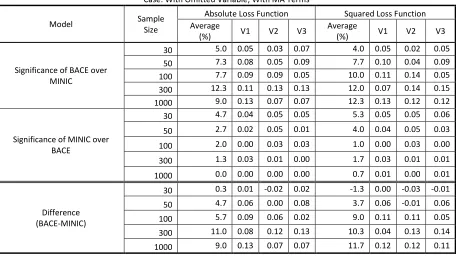
Alpha: 0.05; Number of Iterations: 100 Case: With Omitted Variable; With MA Terms
Model Sample
Size
Absolute Loss Function Squared Loss Function Average
(%) V1 V2 V3
Average
(%) V1 V2 V3
Significance of BACE over MINIC
30 5.0 0.05 0.03 0.07 4.0 0.05 0.02 0.05
50 7.3 0.08 0.05 0.09 7.7 0.10 0.04 0.09
100 7.7 0.09 0.09 0.05 10.0 0.11 0.14 0.05
300 12.3 0.11 0.13 0.13 12.0 0.07 0.14 0.15
1000 9.0 0.13 0.07 0.07 12.3 0.13 0.12 0.12
Significance of MINIC over BACE
30 4.7 0.04 0.05 0.05 5.3 0.05 0.05 0.06
50 2.7 0.02 0.05 0.01 4.0 0.04 0.05 0.03
100 2.0 0.00 0.03 0.03 1.0 0.00 0.03 0.00
300 1.3 0.03 0.01 0.00 1.7 0.03 0.01 0.01
1000 0.0 0.00 0.00 0.00 0.7 0.01 0.00 0.01
Difference (BACE-MINIC)
30 0.3 0.01 -0.02 0.02 -1.3 0.00 -0.03 -0.01
50 4.7 0.06 0.00 0.08 3.7 0.06 -0.01 0.06
100 5.7 0.09 0.06 0.02 9.0 0.11 0.11 0.05
300 11.0 0.08 0.12 0.13 10.3 0.04 0.13 0.14
[image:32.595.71.527.434.690.2]39
Table A.3.1
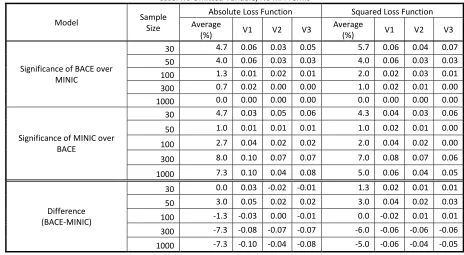
Alpha: 0.01; Number of Iterations: 100 Case: No Omitted Variable; No MA Terms
Model Sample
Size
Absolute Loss Function Squared Loss Function Average
(%) V1 V2 V3
Average
(%) V1 V2 V3
Significance of BACE over MINIC
30 4.7 0.06 0.03 0.05 5.7 0.06 0.04 0.07
50 4.0 0.06 0.03 0.03 4.0 0.06 0.03 0.03
100 1.3 0.01 0.02 0.01 2.0 0.02 0.03 0.01
300 0.7 0.02 0.00 0.00 1.0 0.02 0.01 0.00
1000 0.0 0.00 0.00 0.00 0.0 0.00 0.00 0.00
Significance of MINIC over BACE
30 4.7 0.03 0.05 0.06 4.3 0.04 0.03 0.06
50 1.0 0.01 0.01 0.01 1.0 0.02 0.01 0.00
100 2.7 0.04 0.02 0.02 2.0 0.04 0.02 0.00
300 8.0 0.10 0.07 0.07 7.0 0.08 0.07 0.06
1000 7.3 0.10 0.04 0.08 5.0 0.06 0.04 0.05
Difference (BACE-MINIC)
30 0.0 0.03 -0.02 -0.01 1.3 0.02 0.01 0.01
50 3.0 0.05 0.02 0.02 3.0 0.04 0.02 0.03
100 -1.3 -0.03 0.00 -0.01 0.0 -0.02 0.01 0.01
300 -7.3 -0.08 -0.07 -0.07 -6.0 -0.06 -0.06 -0.06
1000 -7.3 -0.10 -0.04 -0.08 -5.0 -0.06 -0.04 -0.05
Table A.3.2
Alpha: 0.01; Number of Iterations: 100 Case: No Omitted Variable; With MA Terms
Model Sample
Size
Absolute Loss Function Squared Loss Function Average
(%) V1 V2 V3
Average
(%) V1 V2 V3
Significance of BACE over MINIC
30 4.7 0.02 0.06 0.06 6.0 0.04 0.07 0.07
50 4.7 0.05 0.04 0.05 4.0 0.03 0.03 0.06
100 2.3 0.02 0.04 0.01 2.3 0.04 0.02 0.01
300 1.0 0.01 0.02 0.00 1.7 0.01 0.01 0.03
1000 1.0 0.01 0.00 0.02 1.3 0.03 0.00 0.01
Significance of MINIC over BACE
30 5.7 0.07 0.04 0.06 6.0 0.08 0.04 0.06
50 5.7 0.05 0.07 0.05 4.3 0.04 0.06 0.03
100 0.7 0.02 0.00 0.00 1.0 0.01 0.01 0.01
300 4.3 0.07 0.05 0.01 4.3 0.06 0.05 0.02
1000 2.3 0.00 0.03 0.04 2.3 0.03 0.02 0.02
Difference (BACE-MINIC)
30 -1.0 -0.05 0.02 0.00 0.0 -0.04 0.03 0.01
50 -1.0 0.00 -0.03 0.00 -0.3 -0.01 -0.03 0.03
100 1.7 0.00 0.04 0.01 1.3 0.03 0.01 0.00
300 -3.3 -0.06 -0.03 -0.01 -2.7 -0.05 -0.04 0.01
[image:33.595.72.528.438.690.2]40
Table A.3.3
Alpha: 0.01; Number of Iterations: 100 Case: With Omitted Variable; No MA Terms
Model Sample
Size
Absolute Loss Function Squared Loss Function Average
(%) V1 V2 V3
Average
(%) V1 V2 V3
Significance of BACE over MINIC
30 1.0 0.02 0.00 0.01 0.7 0.01 0.00 0.01
50 2.7 0.02 0.03 0.03 2.3 0.02 0.03 0.02
100 1.3 0.01 0.01 0.02 0.7 0.00 0.01 0.01
300 3.7 0.01 0.06 0.04 1.7 0.02 0.03 0.00
1000 3.0 0.04 0.03 0.02 3.0 0.05 0.03 0.01
Significance of MINIC over BACE
30 2.3 0.01 0.02 0.04 3.0 0.02 0.04 0.03
50 0.0 0.00 0.00 0.00 0.0 0.00 0.00 0.00
100 1.7 0.03 0.00 0.02 1.7 0.03 0.01 0.01
300 0.7 0.01 0.01 0.00 0.0 0.00 0.00 0.00
1000 0.0 0.00 0.00 0.00 0.0 0.00 0.00 0.00
Difference (BACE-MINIC)
30 -1.3 0.01 -0.02 -0.03 -2.3 -0.01 -0.04 -0.02
50 2.7 0.02 0.03 0.03 2.3 0.02 0.03 0.02
100 -0.3 -0.02 0.01 0.00 -1.0 -0.03 0.00 0.00
300 3.0 0.00 0.05 0.04 1.7 0.02 0.03 0.00
1000 3.0 0.04 0.03 0.02 3.0 0.05 0.03 0.01
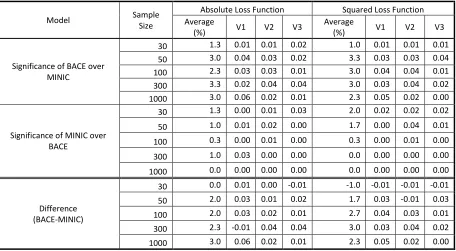
Table A.3.4
Alpha: 0.01; Number of Iterations: 100 Case: With Omitted Variable; With MA Terms
Model Sample
Size
Absolute Loss Function Squared Loss Function Average
(%) V1 V2 V3
Average
(%) V1 V2 V3
Significance of BACE over MINIC
30 1.3 0.01 0.01 0.02 1.0 0.01 0.01 0.01
50 3.0 0.04 0.03 0.02 3.3 0.03 0.03 0.04
100 2.3 0.03 0.03 0.01 3.0 0.04 0.04 0.01
300 3.3 0.02 0.04 0.04 3.0 0.03 0.04 0.02
1000 3.0 0.06 0.02 0.01 2.3 0.05 0.02 0.00
Significance of MINIC over BACE
30 1.3 0.00 0.01 0.03 2.0 0.02 0.02 0.02
50 1.0 0.01 0.02 0.00 1.7 0.00 0.04 0.01
100 0.3 0.00 0.01 0.00 0.3 0.00 0.01 0.00
300 1.0 0.03 0.00 0.00 0.0 0.00 0.00 0.00
1000 0.0 0.00 0.00 0.00 0.0 0.00 0.00 0.00
Difference (BACE-MINIC)
30 0.0 0.01 0.00 -0.01 -1.0 -0.01 -0.01 -0.01
50 2.0 0.03 0.01 0.02 1.7 0.03 -0.01 0.03
100 2.0 0.03 0.02 0.01 2.7 0.04 0.03 0.01
300 2.3 -0.01 0.04 0.04 3.0 0.03 0.04 0.02
[image:34.595.72.528.438.689.2]41
APPENDIX B
R e l a t i v e M A P E o f F o r e c a s t s
[image:35.595.174.419.171.257.2]MAPE(BACE-AVAR)/MAPE(MINIC)
Table B.1
Case: No Omitted Variable; No MA Term
n V1 V2 V3 Average
30 0.4684 0.6977 0.6924 0.6195
50 0.6220 0.7342 0.8100 0.7221
100 0.6338 1.4573 1.3457 1.1456
300 0.6588 0.5710 0.5329 0.5876
[image:35.595.174.419.316.400.2]1000 0.6678 0.7614 0.8349 0.7547
Table B.2
Case: No Omitted Variable; With MA Term
n V1 V2 V3 Average
30 0.6718 0.6824 0.5628 0.6390
50 2.1923 1.0767 0.8456 1.3715
100 0.2722 0.7403 1.1038 0.7054
300 0.3998 0.8795 0.6133 0.6308
1000 2.6022 0.9538 0.9723 1.5094
Table B.3
Case: With Omitted Variable; No MA Term
n V1 V2 V3 Average
30 0.7150 0.8818 1.4053 1.0007
50 0.6256 0.9643 1.2664 0.9521
100 1.2097 1.3674 1.0622 1.2131
300 0.4643 0.4511 0.5285 0.4813
1000 0.6053 0.5543 0.4691 0.5429
Table B.4
Case: With Omitted Variable; With MA Term
n V1 V2 V3 Average
30 0.5468 0.5716 1.2224 0.7803
50 1.2342 1.1004 1.0267 1.1204
100 1.4864 1.2833 1.1436 1.3044
300 1.1347 0.3448 0.3331 0.6042
[image:35.595.174.420.458.543.2] [image:35.595.175.418.598.683.2]