Reordering Model Using Syntactic Information of a Source Tree for
Statistical Machine Translation
Kei Hashimoto∗1, Hirohumi Yamamoto∗2∗3, Hideo Okuma∗2∗4, Eiichiro Sumita∗2∗4, and Keiichi Tokuda∗1∗2
∗1Nagoya Institute of Technology Department of Computer Science and Engineering / Gokiso-cho Syouwa-ku Nagoya-city Aichi Japan
∗2National Institute of Information and Communications Technology ∗3Kinki University School of Science and Engineering Department of Informaiton
∗4ATR Spoken Language Communication Research Labs.
Abstract
This paper presents a reordering model us-ing syntactic information of a source tree for phrase-based statistical machine translation. The proposed model is an extension of IST-ITG (imposing source tree on inversion trans-duction grammar) constraints. In the pro-posed method, the target-side word order is obtained by rotating nodes of the source-side parse-tree. We modeled the node rotation, monotone or swap, using word alignments based on a training parallel corpus and source-side parse-trees. The model efficiently sup-presses erroneous target word orderings, espe-cially global orderings. Furthermore, the pro-posed method conducts a probabilistic evalu-ation of target word reorderings. In English-to-Japanese and English-to-Chinese transla-tion experiments, the proposed method re-sulted in a 0.49-point improvement (29.31 to 29.80) and a 0.33-point improvement (18.60 to 18.93) in word BLEU-4 compared with IST-ITG constraints, respectively. This indi-cates the validity of the proposed reordering model.
1 Introduction
Statistical machine translation has been wiedely ap-plied in many state-of-the-art translation systems. A popular statistical machine translation paradigms is the phrase-based model (Koehn et al., 2003; Och and Ney, 2004). In phrase-based statistical ma-chine translation, errors in word reordering, espe-cially global reordering, are one of the most se-rious problems. To resolve this problem, many
word-reordering constraint techniques have been proposed. These techniques are categorized into two types. The first type is linguistically syntax-based. In this approach, tree structures for the source (Quirk et al., 2005; Huang et al., 2006), target (Ya-mada and Knight, 2000; Marcu et al., 2006), or both (Melamed, 2004) are used for model training. The second type is formal constraints on word permuta-tions. IBM constraints (Berger et al., 1996), the lex-ical word reordering model (Tillmann, 2004), and inversion transduction grammar (ITG) constraints (Wu, 1995; Wu, 1997) belong to this type of ap-proach. For ITG constraints, the target-side word order is obtained by rotating nodes of the source-side binary tree. In these node rotations, the source binary tree instance is not considered. Imposing a source tree on ITG (IST-ITG) constraints (Ya-mamoto et al., 2008) is an extension of ITG con-straints and a hybrid of the first and second type of approach. IST-ITG constraints directly introduce a source sentence tree structure. Therefore, IST-ITG can obtain stronger constraints for word reordering than the original ITG constraints. For example, IST-ITG constraints allows only eight word orderings for a four-word sentence, even though twenty-two word orderings are possible with respect to the original ITG constraints. Although IST-ITG constraints ef-ficiently suppress erroneous target word orderings, the method cannot assign the probability to the tar-get word orderings.
This paper presents a reordering model using syn-tactic information of a source tree for phrase-based statistical machine translation. The proposed re-ordering model is an extension of IST-ITG
straints. In the proposed method, the target-side word order is obtained by rotating nodes of a source-side parse-tree in a similar fashion to IST-ITG con-straints. We modeled the rotating positions, mono-tone or swap, from word alignments of a training parallel corpus and source-side parse-trees. The pro-posed method conducts a probabilistic evaluation of target word orderings using syntactic information of the source tree.
The rest of this paper is organized as follows. Section 2 describes the previous approach to re-solving erroneous word reordering. In Section 3, the reordering model using syntactic information of a source tree is presented. Section 4 shows ex-perimental results. Finally, Section 5 presnts the summary and some concluding remarks and future works.
2 Previous Works
First, we introduce two previous studies on related word reordering constraints, ITG and IST-ITG con-straints.
2.1 ITG Constraints
In one-to-one word-alignment, the source word fi
is translated into the target word ei. The source
sentence [f1, f2,· · · , fN] is translated into the
tar-get sentence which is the reordered tartar-get word se-quence[e1, e2,· · ·, eN]. The number of reorderings is N!. When ITG constraints are introduced, this
combinationN!can be reduced in accordance with
the following constraints.
• All possible binary tree structures are generated from the source word sequence.
• The target sentence is obtained by rotating any
node of the binary trees.
When N = 4, the ITG constraints can reduce the number of combinations from 4! = 24 to
22 by rejecting the combinations [e3, e1, e4, e2] and [e2, e4, e1, e3]. For a four-word sentence, the search space is reduced to 92% (22/24), but for a 10-word sentence, the search space is only 6% (206,098/3,628,800) of the original full space.
2.2 IST-ITG Constraints
In ITG constraints, the source-side binary tree in-stance is not considered. Therefore, if a source sen-tence tree structure is utilized, stronger constraints than the original ITG constraints can be created. IST-ITG constraints directly introduce a source sen-tence tree structure. The target sensen-tence is obtained with the following constraints.
• A source sentence tree structure is generated from the source sentence.
• The target sentence is obtained by rotating any node of the source sentence tree structure. By parsing the source sentence, the parse-tree is obtained. After parsing the source sentence, a bracketed sentence is obtained by removing the node syntactic labels; this bracketed sentence can then be converted into a tree structure. For example, the parse-tree “(S1 (S (NP (DT This)) (VP (AUX is) (NP (DT a) (NN pen)))))” is obtained from the source sentence “This is a pen,” which consists of four words. By removing the node syntactic labels, the bracketed sentence “((This) ((is) ((a) (pen))))” is obtained. Such a bracketed sentence can be used to produce constraints. If IST-ITG constraints is applied, the number of word orderings in N = 4
is reduced to 8, down from 22 with ITG cn-straints. For example, for the source-side bracketed tree “((f1f2) (f3f4)),” the eight target sequences
[e1, e2, e3, e4], [e2, e1, e3, e4], [e1, e2, e4, e3],
[e2, e1, e4, e3], [e3, e4, e1, e2], [e3, e4, e2, e1],
[e4, e3, e1, e2], and [e4, e3, e2, e1]are accepted. For the source-side bracketed tree “(((f1f2) f3) f4),” the eight sequences [e1, e2, e3, e4], [e2, e1, e3, e4],
[e3, e1, e2, e4], [e3, e2, e1, e4], [e4, e1, e2, e3],
[e4, e2, e1, e3],[e4, e3, e1, e2], and[e4, e3, e2, e1]are accepted. When the source sentence tree structure is a binary tree, the number of word orderings is reduced to2N−1. The parsing results sometimes do not produce binary trees. In this case, some subtrees have more than two child nodes. For a non-binary subtree, any reordering of child nodes is allowed. If a subtree has three child nodes, six reorderings of the nodes are accepted.
used for the constraint unit since the parse unit is a “word”. To absorb different units between transla-tion models and IST-ITG constraints, a new limita-tion for word reordering is applied.
• Word ordering that destroys a phrase is not
al-lowed.
When this limitation is applied, the translated word ordering is obtained from the bracketed source sen-tence tree by reordering the nodes in the tree, which is the same as for one-to-one word-alignment.
3 Reordering Model Using Syntactic Information of the Source Tree
In this section, we present a new reordering model using syntactic information of a source-side parse-tree.
3.1 Abstract of Proposed Method
The IST-ITG constraints method efficiently sup-presses erroneous target word orderings. However, IST-ITG constraints cannot evaluate the accuracy of the target word orderings; i.e., IST-ITG constraints assign an equal probability to all target word order-ings. This paper proposes a reordering model us-ing syntactic information of the source tree as an extension of IST-ITG constraints. The proposed re-ordering model conducts a probabilistic evaluation of target word orderings using syntactic information of the source-side parse-tree.
In the proposed method, the target-side word or-der is obtained by rotating nodes of the source-side parse-tree in a similar fashion to IST-ITG con-straints. Reordering probabilities are assigned to each subtree of source-side parse-treeSby reorder-ing the positions into two types: monotone and swap. If the subtree has more than two child nodes, the number of child node order is more than two. However, we assume the child node order other than monotone to be swap. The source-side parse-tree
S consists of subtrees {s1, s2,· · ·, sK}, where K
is the number of subtrees included in the source-side parse-tree. The subtree sk is which is
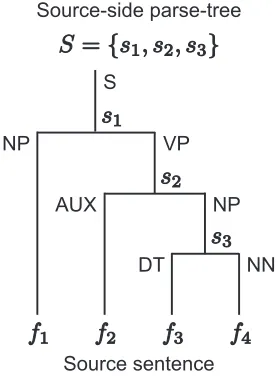
repre-sented by the parent node’s syntactic label and the order, from sentence head to sentence tail, of the child node’s syntactic labels. For example, Fig-ure 1 shows a source-side parse-tree for a four-word
Source-side parse-tree
Source sentence S
NP VP
NP AUX
[image:3.612.357.496.59.247.2]DT NN
Figure 1: Example of a source-side parse-tree fo a four-word source sentence consisting of three subtrees.
source sentence consisting of three subtrees. In Fig-ure 1, the subtreess1,s2, ands3 are represented by
S+NP+VP, VP+AUX+NP, and NP+DT+NN, re-spectively. Each subtree has a probabilityP(t|sk),
wheret is monotone (m) or swap (s). The proba-bility of the target word reordering is calculated as follows.
Pr= K
∏
k=1
P(t|sk) (1)
Each target candidate is assigned the different re-ordering probability by Equation (1). Since the pro-posed reordering model uses the syntactic labels, which is not considered in IST-ITG constraints, the different parse-tree assigns the different reordering probability. The proposed model is effective for global word reordering, because reordering proba-bilities are also assigned to higher-level subtrees of the source-side parse-tree.
3.2 Training of the Proposed Model
We modeled monotone or swap node rotating auto-matically from word alignments of a training paral-lel corpus and source-side parse-trees. The training algorithm for the proposed reordering model is as follows.
3 2
2,3 4
[image:4.612.126.247.55.240.2]2,3,4 1
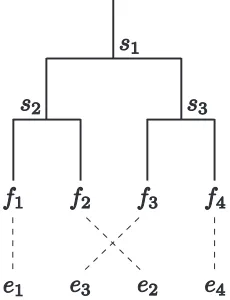
Figure 2: Example of a source-side parse-tree with word alignments using the training algorithm of the proposed model.
which is based on Och and Ney’s work (2004). This involves running GIZA++ (Och and Ney, 2003) on the corpus in both directions, and ap-plying refinement rules (the variant they desig-nate is “final-and”) to obtain a single many-to-many word alignment for each sentence. 2. Source-side parse-trees are created using a
source language phrase structure parser, which annotates each node with a syntactic label. A source-side parse-tree consists of several sub-trees with syntactic labels. For example, the parse-tree “(S1 (S (NP (DT This)) (VP (AUX is) (NP (DT a) (NN pen)))))” is obtained from the source sentence “This is a pen” which con-sists of four words.
3. Word alignments and source-side parse-trees are combined. Leaf nodes are assigned target word positions obtained from word alignments. Via the bottom-up process, target word posi-tions are assigned to all nodes. For example, in Figure 2, the left-side (sentence head) child node of subtrees2 is assigned the target word position “4,” and the right-side (sentence tail) child node is assigned the target word positions “2” and “3,” which are assigned to the child nodes of subtrees3.
4. The monotone and swap reordering positions are checked and counted for each subtree. By
Subtree type Monotone probability
S+PP+,+NP+VP+. 0.764
PP+IN+NP 0.816
NP+DT+NN+NN 0.664
VP+AUX+VP 0.864
VP+VBN+PP 0.837
NP+NP+PP 0.805
NP+DT+JJ+NN 0.653
NP+DT+JJ+VBP+NN 0.412
NP+DT+NN+CC+VB 0.357
Table 1: Example of proposed reordering models.
comparing the target word positions, which are assigned in the above step, the reordering posi-tion is determined. If the target word posiposi-tion of the left-side child node is smaller than one of the right-side child node, the reordering posi-tion determined as monotone. For example, in Figure 2, the subtrees s1,s2 ands3 are mono-tone, swap, and monomono-tone, respectively. 5. The reordering probability of the subtree can
be directly estimated by counting the reorder-ing positions in the trainreorder-ing data.
P(t|s) = ∑ct(s)
tct(s) (2)
wherect(s)is the count of reordering positont
included all training samples for the subtrees.
The parsing results sometimes do not produce bi-nary trees. For a non-bibi-nary subtree, any reorder-ing of child nodes is allowed. However, the pro-posed reordering model assumes that reordering po-sitions are only two, monotone and swap. That is, the reordering position which the order of child nodes do not change is monotone, and the other po-sitions are swap. Therefore, the probability of swap
P(s | sk) is derived from the probability of
mono-toneP(m|sk)as follows.
P(s|sk) = 1.0−P(m|sk) (3)
Table 1 shows the example of proposed reordering models.
[image:4.612.315.542.58.200.2]Figure 3: Example of a target word order which is not derived from rotating the nodes of source-side parse trees.
syntactic labels. However, in the possible subtrees, there are subtrees observed only a few times in train-ing sentences, especially when the subtree consists of more than three child nodes. Although a large number of subtree models can capture variations in the training samples, too many models lead to the over-fitting problem. Therefore, subtrees where the number of training samples is less than a heuristic threshold and unseen subtrees are clustered to deal with the data sparseness problem for robust model estimations.
After creating word alignments of a training par-allel corpus, there are target word orders which are not derived from rotating nodes of source-side parse-trees. Figure 3 shows a sample which is not derived from rotating nodes. Some are due to linguistic rea-sons, structual differences such as negation (French “ne...pas” and English “not”), adverb, modal and so on. Others are due to non-linguistic reasons, er-rors of automatic word alignments, syntactic anal-ysis, or human translation (Fox, 2002). The pro-posed method discards such problematic cases. In Figure 3, the subtrees1is then removed from train-ing samples, and the subtreess2 ands3 are used as training samples.
3.3 Decoding Using the Proposed Reordering Model
In this section, we describe a one-pass phrase-based decoding algorithm that uses the proposed reorder-ing model in the decoder. The translation target sen-tence is sequentially generated from left (sensen-tence
Figure 4: Example of a target candidate including a phrase.
head) to right (sentence tail), and all reordering is conducted on the source side. To introduce the pro-posed reordering model into the decoder, the target candidate must be checked for whether the reorder-ing position of a subtree is either monotone or swap whenever a new phrase is selected to extend a target candidate. The checking algorithm is as follows.
1. For old translation candidates, the subtree s,
which includes both translated and untranslated words, and its untranslated part u are
calcu-lated.
2. When a new target phrase e¯is generated, the
source phrasef¯and the untranslated partu
cal-culated in the above step are compared. If the source phrase f¯does not include the
untrans-lated partuand is not includedu, the new
can-didate is rejected.
3. In the accepted candidate, the reordering po-sitions for all subtrees included the source side parse-tree are checked by comparing the source phrasef¯with the source phrase sequence used
before.
Subtrees checked reordering positions are assigned a probability–monotone or swap–by the proposed re-ordering model, and the target word order is evalu-ated by Equation (1).
[image:5.612.128.243.60.210.2]Figure 5: Example of a non-binary subtree including a phrase.
reordering position of subtree included in a phrase. Therefore, in the decoding process using the pro-posed reordering model, we define that higher prob-ability, monotone or swap, are assigned to subtrees included in a source phrase. For example, in Fig-ure 4, the source sentence[[f1, f2], f3, f4]is trans-lated into the target sentence[[e1, e2], e4, e3], where
[f1, f2]and[e1, e2]are used as phrases. Then, the source phrase[f1, f2]includes the subtrees2. If the monotone probabilities of subtreess1,s2, ands3are
0.8,0.4 and0.7, the proposed reordering
probabil-ity is0.8×0.6×0.3 = 0.144. If a source phrase is[f1, f2, f3, f4]and a source-side parse-tree has the same tree structure used in Figure 4, the subtreess1,
s2, ands3 are assigned higher reordering probabili-ties. If the source phrase[f1, f2, f3, f4]used in Fig-ure 4, the subtreess1,s2, ands3are assigned higher reordering probabilities.
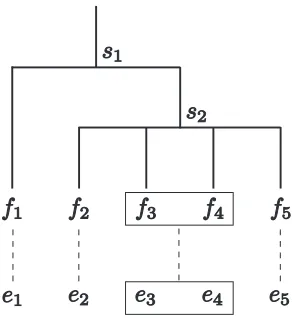
Non-binary subtrees are often observed in the source-side parse-tree. When a source phrase f¯is included in a non-binary subtree and does not in-clude a non-binary subtree, we cannot determine the reordering position. For example, the reordering po-sition of subtrees2 in Figure 5, which includes the phrase[f3, f4], can not be determined. In this case, we define that such subtrees are also to be assigned a higher probability.
4 Experiments
To evaluate the proposed model, we conducted two experiments: Japanese and English-to-Chinese translation.
English Japanese
Train Sentences 1.0M
Words 24.6M 24.6M
Dev Sentences 2.0K
Words 50.1K 58.7K
Test Sentences 2.0K
Words 49.5K 58.0K
Table 2: Statistics of training, development and test cor-pus for E-J translation.
4.1 English-to-Japanese Paper Abstract Translation Experiments
The first experiment was the English-to-Japanese (E-J) translation. Table 2 shows the training, de-velopment and test corpus statistics. JST Japanese-English paper abstract corpus consists of 1.0M parallel sentences were used for model training. This corpus was constructed from 2.0M Japanese-English paper abstract corpus belongs to JST by NICT using the method of Uchiyama and Isahara (2007). For phrase-based translation model training, we used the GIZA++ toolkit (Och and Ney, 2003), and 1.0M bilingual sentences. For language model training, we used the SRI language model toolkit (Stolcke, 2002), and 1.0M sentences for the trans-lation model training. The language model type was word 5-gram smoothed by Kneser-Ney discounting (Kneser and Ney, 1995). To tune the decoder pa-rameters, we conducted minimum error rate training (Och, 2003) with respect to the word BLEU score (Papineni et al., 2002) using 2.0K development sen-tence pairs. The test set with 2.0K sensen-tences is used. In the evaluation and development sets, a single ref-erence was used. For the creation of English sen-tence parse trees and segmentation of the English, we used the Charniak parser (Charniak, 2000). We used Chasen for segmentation of the Japanese sen-tences. For decoding, we used an in-house decoder that is a close relative of the Moses decoder. The performance of this decoder was configured to be the same as Moses. Other conditions were the same as the default conditions of the Moses decoder.
In this experiment, the following three methods were compared.
• Baseline : The IBM constraints and the
[image:6.612.330.522.56.156.2]Baseline IST-ITG Proposed
[image:7.612.322.531.57.156.2]BLEU 27.87 29.31 29.80
Table 3: BLEU score results for E-J translation. (1-reference)
reordering.
• IST-ITG : The IST-ITG constraints, the IBM
constraints, and the lexical reordering model were used for target word reordering.
• Proposed : The proposed reordering model,
the IBM constraints, and the lexical reordering model were used for target word reordering.
During minimum error training, each method used each reordering model and reordering constraint.
The proposed reordering model are trained from 1.0M bilingual sentences for the translation model training. The amount of available training samples represented by subtrees was 9.8M. In the available training samples, there were 54K subtree types. The heuristic threshold was 10, and subtrees with train-ing samples of less than 10 were clustered. The pro-posed reordering model consisted of 5,960 subtrees types and one clustered model “other”. The models not including “other” covered 99.29% of all training samples.
The BLEU scores are presented in Table 3. In comparing “Baseline” method with “IST-ITG” method, the improvement in BLEU was a 1.44-point. Furthermore, in comparing “IST-ITG” method with “Proposed” method, the improvement in BLEU was a 0.49-point. Both the IST-ITG con-straints and the proposed reordering model fixed the phrase position for the global reorderings. How-ever, the proposed method can conduct a probabilis-tic evaluation of target word reorderings which the IST-ITG constraints cannot. Therefore, “Proposed” method resulted in a better BLEU.
4.2 NIST MT08 English-to-Chinese Translation Experiments
Next, we conducted English-to-Chinese (E-C) news-paper translation experiments for different lan-guage pairs. The NIST MT08 evaluation campaign English-to-Chinese translation track was used for the training and evaluation corpora. Table 4 shows
English Chinese
Train Sentences 4.6M
Words 79.6M 73.4M
Dev Sentences 1.6K
Words 46.4K 39.0K
Test Sentences 1.9K
Words 45.7K 47.0K (Ave.)
Table 4: Statistics of training, development and test cor-pus for E-C translation.
Baseline IST-ITG Proposed
BLEU 17.54 18.60 18.93
Table 5: BLEU score results for E-C translation. (4-reference)
the training, development and test corpus statistics. For the translation model training, we used 4.6M bilingual sentences. For the language model train-ing, we used 4.6M sentences which are used for the translation model training. The language model type was word 3-gram smoothed by Kneser-Ney discounting. A development set with 1.6K sen-tences was used as evaluation data in the Chinese-to-English translation track for the NIST MT07 eval-uation campaign. A single reference was used in the development set. The evaluation set with 1.9K sentences is the same as the MT08 evaluation data, with 4 references. In this experiment, the compared methods were the same as in the E-J experiment.
The proposed reordering model are trained from 4.6M bilingual sentences for the translation model training. The amount of available training samples represented by subtrees was 39.6M. In the available training samples, there were 193K subtree types. As in the E-J experiments, the heuristic threshold was 10. The proposed reordering model consisted of 18,955 subtree types and one clustered model “other.” The models not including “other” covered 99.45% of all training samples.
demon-strated that the proposed method is effective for mul-tiple language pairs. However, the improvement of BLEU score in E-C translation is smaller than the improvement in E-J translation, because English and Chinese are similar sentence structures, such as SVO-languages (Japanese is SOV-language). When the sentence structures are different, the proposed re-ordering model is effective.
5 Conclusion
This paper proposed a new word reordering model using syntactic information of a source tree for phrase-based statistical machine translation. The proposed model is an extension of the IST-ITG con-straints. In both IST-ITG constraints and the pro-posed method, the target-side word order is obtained by rotating nodes of the source-side tree structure. Both the IST-ITG constraints and the proposed re-ordering model fix the phrase position for the global reorderings. However, the proposed method can conduct a probabilistic evaluation of target word re-orderings which the IST-ITG constraints cannot. In E-J and E-C translation experiments, the proposed method resulted in a 0.49-point improvement (29.31 to 29.80) and a 0.33-point improvement (18.60 to 18.93) in word BLEU-4 compared with IST-ITG constraints, respectively. This indicates the validity of the proposed reordering model.
Future work will focus on a reduction of com-putational cost of decoding including the proposed reordering model, and a simultaneous training of translation and reordering models. Moreover, we will deal with difference between source and target in multi level like in Gally et al. (2004).
The improvement could clearly be seen from vi-sual inspection of the output, a few examples of which are presented in the following Appendix.
A Samples from the English-to-Japanese Translation
A.1 Sentence 1
Source: Aggravation was obvious from the latter half of March to the end of April, and he contracted the disease in February to the beginning of May.
Baseline: 4月末に3月後半から5月上旬に2月 に疾患を発症し,著明な増悪した。
Reference: 3月後半から4月末に増悪が著明で,
2∼5月上旬に発症した。
Proposed: 3月後半から4月末に著明な増悪し, 5月上旬に2月に疾患を発症した。
A.2 Sentence 2
Source: The value of TF, on the other hand, was higher in the reverse order, indicating that high ox-idation rate causes severe defects on the surface of Ni crystallites.
Baseline: 一方,重症の表面上の欠陥の原因とな ることを示し,逆順に高かったが,TFの値は高 い酸化速度はNiの微結晶た。
Reference:一方,TFの値は逆の順序で高く,酸 化速度が高いことはNi結晶の表面欠陥の原因に なることを示した。
Proposed:一方,TFの値は逆の順序で高かった ことを示し,高い酸化速度は,Niの微結晶表面 に重篤な欠陥の原因となる。
A.3 Sentence 3
Source: After diagnosing the pleural effusion and ascites, vein catheter was left in place under the echo guide, and after removing the pleural effusion and ascites, OK-432 was administered locally.
Baseline:診断後,胸水,腹水,胸水・腹水を除去 した後,エコーガイド下で,静脈カテーテルを左 に代わってOK‐432を投与した。
Reference:胸水・腹水の診断を行った後にエコー ガイド下に静脈カテーテルを留置し,胸水・腹水 を除去し,OK‐432を局所投与した。
Proposed:胸水・腹水の診断後,静脈カテーテル を残したエコーガイド下で代わりに,胸水・腹水 を除去した後,OK‐432,局所的に投与した。
A.4 Sentence 4
Source: From result of the consideration, it was pointed that radiation from the loop elements was weak.
Baseline: 考察の結果からことを指摘し,ループ 素子からの放射は弱かった。
Reference:考察結果より,ループ素子からの放射 が弱いことを指摘する。
References
Adam L. Berger, Peter F. Brown, Stephen A. Della Pietra, Vincent J. Della Pietra, Andrew S. Kehler, and Robert L. Mercer 1996. Language translation apparatus and method of using context-based translation models. United States patent, patent number 5510981. Eugene Charniak. 2000. A Maximum-Entropy-Inspired
Parser. InProceedings of NAACL 2000, pages 132– 139.
Chasen
http://chasen-legacy.sourceforge.jp/
Heidi J. Fox, 2002. Phrasal cohesion and statistical ma-chine translation. In Proceedings of EMNLP, pages 304–311.
Michel Galley, Mark Hopkins, Kevin Knight, and Daniel Marcu. 2004. What’s in a translation rule? In Pro-ceedings of HLT/NAACL-04.
Liang Huang, Kevin Knight, and Aravind Joshi. 2006. Statistical Syntax-Directed Translation with Extended Domain of Locality. InProceedings of AMTA. Japanese-English paper abstract corpus
http://www.jst.go.jp
Reinhard Kneser and Hermann Ney. 1995. Improved backing-off for m-gram language model In Proceed-ings of ICASSP 1995, pages 181–184.
Philipp Koehn, Franz Josef Och, and Daniel Marcu. 2003. Statistical phrase-based translation. In Proceed-ings of HLT-NAACL 2003, pages 127–133.
Daniel Marcu, Wei Wang, Abdessamad Echihabi, and Kevin Knight. 2006. SPMT: Statistical Machine Translation with Syntactified Target Language Phrases InProceedings of EMNLP2006, pages 44–52. Dan Melamed. 2004. Statistical machine translation by
parsing InProceedings of ACL, pages 653–660. Moses
http://www.statmt.org/moses/
Franz josef Och and Hermann Ney. 2003. A Systematic Comparison of Various Statistical Alignment Models.
Computational Linguistics, 29(1), pages 19–51. Franz josef Och. 2003. Minimum error rate training for
statistical machine translation. InProceedings of ACL, pages 160–167.
Franz josef Och and Hermann Ney. 2004. The align-ment template approach to statistical machine trans-lation. Computational Linguistics, 30(4), pages 417– 449.
Chris Quirk, Arul Menezes, and Colin Cherry. 2005. De-pendency treelet translation: Syntactically informed phrasal SMT. InProceedings of ACL, pages 271–279. Kishore Papineni, Salim Roukos, Todd Ward, and Wei-Jing Zhu. 2002. Bleu: a method for automatic evalu-ation of machine translevalu-ation. InProceedings of ACL, pages 311–318.
Andreas Stolcke. 2002. SRILM - An Ex-tensible Language Model Toolkit In
Pro-ceedings of ICSLP2002, pages 901–904.
http://www.speech.sri.com/projects/srilm/
Christopher Tillmann. 2004. A unigram orientation model for statistical machine translation. In Proceed-ings of HLT-NAACL, pages 101–104.
Masao Uchiyama and Hitoshi Isahara. 2007. 2007. A japanese-english patent parallel corpus. In MT sum-mit XI, pages 475–482.
Dekai Wu. 1995. Stochastic inversion transduction grammars, with application to segmentation, bracket-ing, and alignment of parallel corpora. InProceedings of IJCAI, pages 1328–1334.
Dekai Wu. 1997. Stochastic inversion transduction grammars and bilingual parsing of parallel corpora.
Computational Linguiatics, 23(3), pages 377–403. Kenji Yamada and Kevin Knight. 2000. A syntax-based
statistical translation model In Proceedings of ACL, pages 523–530.