Multi-Reference Evaluation for Dialectal Speech Recognition System:
A Study for Egyptian ASR
Ahmed Ali1,2, Walid Magdy1, Steve Renals2
1Qatar Computing Research Institute, HBKU, Doha, Qatar
2University of Edinburgh, Edinburgh EH8 9AB, UK
{amali,wmagdy}@qf.org.qa, {ahmed.ali, s.renals}@ed.ac.uk
Abstract
Dialectal Arabic has no standard ortho-graphic representation. This creates a challenge when evaluating an Automatic Speech Recognition (ASR) system for di-alect. Since the reference transcription text can vary widely from one user to an-other, we propose an innovative approach for evaluating dialectal speech recognition using Multi-References. For each recog-nized speech segments, we ask five dif-ferent users to transcribe the speech. We combine the alignment for the multiple references, and use the combined align-ment to report a modified version of Word Error Rate (WER). This approach is in favor of accepting a recognized word if any of the references typed it in the same form. Our method proved to be more ef-fective in capturing many correctly rec-ognized words that have multiple accept-able spellings. The initial WER according to each of the five references individually ranged between 76.4% to 80.9%. When considering all references combined, the Multi-References MR-WER was found to be 53%.
1 Introduction
Arabic Automatic Speech Recognition (ASR) is a challenging task because of the lexical variety and data sparseness of the language. Arabic can be considered one of the most morphologically complex languages (Diehl et al., 2012). With more than 300 million people speaking Arabic as a mother tongue, it is counted as the fifth most widely spoken language. Modern Standard Ara-bic (MSA) is the official language amongst AraAra-bic native speakers. In fact, MSA is used in formal events, such as newspapers, formal speech, and broadcast news.
Nevertheless, MSA is rarely used in day-to-day communication. The vast majority of Ara-bic speakers use Dialectal AraAra-bic (DA) in ev-eryday communication (Cotterell and Callison-Burch, 2014). DA has many differences from MSA in morphology, phonology and the lexicon. A significant challenge in dialectal speech recog-nition is diglossia, in which the written language differs considerably from the spoken vernaculars (Elmahdy et al., 2014). Variance among differ-ent Arabic dialects such as Egyptian, Levantine or Gulf has been considered similar to the variance among Romance languages (Holes, 2004). There are many varieties of dialectal Arabic distributed over the 22 Arabic countries, often several variants of the Arabic language within the same country.
In natural language processing (NLP), re-searchers have aggregated dialectal Arabic into four regional language groups: Egyp-tian, Maghrebi, Gulf (Arabian Peninsula), and Levantine (Cotterell and Callison-Burch, 2014; Al-Sabbagh and Girju, 2012; Darwish and Magdy, 2014).
Most ASR systems are trained and tuned by minimizing WER, which counts word errors at the surface level. It does not consider the contex-tual and syntactic roles of a word, which are often critical for tasks like Machine Translation (MT), particularly in the end-to-end Speech Translation (ST) scenarios.
In a study by (He et al., 2011) , they showed that WER is not the optimal metric for a speech recognizer trained for a speech translation task. They developed a BLEU-optimized approach for training the scale parameters of a log-linear based speech translation system. In their study, they got better results using the new measure, although WER were found to be higher in the intermediate step of the speech recognition.
Dialectal Arabic can be viewed as an example of a language with no orthographic rules, since
there is no academies in DA nor enough amount of language resources, such as no standard lexicon or clear rules for writing. In a study by (Habash et al., 2012) in which they presented Conventional Orthography for Dialectal Arabic CODA, they ex-plain the design principles of CODA and provide description of CODA, and use the Egyptian dialect as an example, which has been presented mainly for the purpose of developing DA computational models.
In a similar study by (Ali et al., 2014a), they studied the best practices for writing Egyptian or-thography. They conducted experiments on both Acoustic Model (AM), Language Model (LM), and guidelines for transcribing Egyptian speech. They released guidelines for transcribing Egyptian speech for what is called augmented Conventional Orthography for Dialectal Arabic augmented-CODA. They also reported gain in Egyptian speech recognition when augmented-CODA is followed in transcribing Egyptian speech data.
Unlike previous work by (Habash et al., 2012; Ali et al., 2014a), where they studied the best prac-tices for writing DA, in this paper, we propose an evaluation method that accepts the variations in transcribing dialectal Arabic. We use multi-ple references, up to five different transcriptions per utterance, to evaluate the performance of the speech recognition engine. The main idea is to learn from the crowd and use multi-references to vote for each word in the recognized output. This is, in a way, similar to BLUE score used in MT, where multiple translation could be accepted for one source sentence. Here, we submit our speech data on a crowdsourcing platform, and ask for five different transcriptions for each speech segment. These five transcriptions typically capture the dif-ferent acceptable variations of the Arabic dialect, where we then use them as our multiple references to calculatemulti-referenceWER (MR-WER).
The rest of the paper is organized as follows: In section 2, we describe dialectal speech recogni-tion; section 3, we discuss the details of the multi-reference WER, and the proposed method evalu-ate dialectal ASR; section 4, we elaborevalu-ate the data used in this experiment; section 5, we discuss the experiment and the results; and section 6 is for conclusion and future work.
2 Dialectal Speech Recognition
Large Vocabulary Speech Recognition (LVCSR) has been studied thoroughly in well-developed languages such as English, French, and Spanish. Also, MSA has obtained good results over the past decade as a result of GALE project, as well as more attention is paid to Arabic Broadcast do-main(Diehl et al., 2012; Mangu et al., 2011; Car-dinal et al., 2014; Ali et al., 2014b).
Dialectal Arabic ASR could be seen as under-resourced as it is lacking the basic component to have a decent system, such as enough labeled speech data for training, a lexicon, and a Natural Language Processing (NLP) pipeline for phonetic systems. Moreover, DA Arabic lacks standard or-thography for writing. The absence of clear defi-nition for right and wrong spelling has led to many representations for each word.
In our Arabic ASR, we use a grapheme-based system using sequential Deep Neural Network for the acoustic modelling. Although, conven-tionally, a phoneme system always outperforms a grapheme system, so a valid question is why do we choose grapheme system here?
We have found that WER in the grapheme sys-tem has increased by less than 1% relative to conversational speech compared to the phoneme system, which could be explained as conversa-tional speech being mainly dialectal Arabic in most cases, and grapheme models will outperform phoneme models. Mainly, the NLP pipeline for phonetic system is not mature enough for dialectal Arabic, and is still facing challenges such as di-cratization, and phonetization. The other amusing feature in the grapheme system is having a 1:1 ra-tio between the number of types, and the number pronunciation in the lexicon, compared to 1:4 in the phoneme-based system. This enables us to in-crease the lexicon size from 500K words to more than 1.2M words for the same text in the Language Model (LM) with small impact on memory. This has reduced the Out Of Vocabulary (OOV) from 3.9% to 2.5%, which also enables us to have more coverage for dialectal words that have not been measured precisely at this stage.
3 Applying Multi-Reference Evaluation for ASR
of the standard method of using only one refer-ence. In addition, we introduce our methodology for applying multi-reference to ASR evaluation.
3.1 The Concept of Multi-Reference Evaluation
One of the tasks that uses multi-reference evalua-tion is Machine Translaevalua-tion (MT). The main rea-son here is that many translations in the target lan-guage are fully valid for a given sentence in the source language. Thus, the MT research commu-nity found it more appropriate when evaluating an MT system to compare the automatic translation to more than one possible manual reference trans-lations, typically translated by different language experts, to have a less biased evaluation to one translation. Therefore, most of the MT evaluation scores are designed to accept multiple references (Papineni et al., 2002).
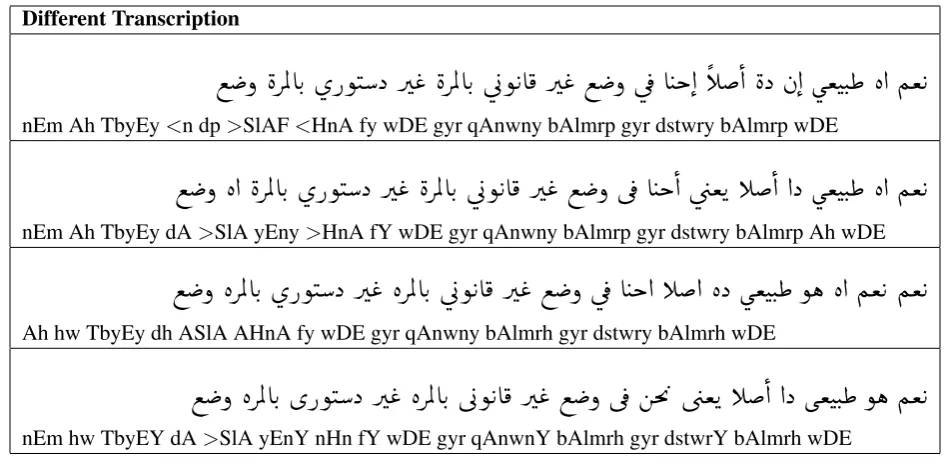
ASR is treated differently, since the speech recognition is seen to have a single exact match to a specific string, and one reference should be sufficient to transcribe or judge what is spoken in the speech segment. This assumption is valid in most of the spoken languages. However, for lan-guages with no standard orthographic representa-tion such as Dialectal Arabic, there are many dif-ferent ways to write a given spoken word. Ta-ble 1 shows an example for an Egyptian speech segment, which presents the transcription of one sound track from four different transcribers. As shown, many of the words presented has vari-ous spellings among the four transcribers. In addition, there are some words that are written by some transcribers but neglected by the oth-ers, such as the word “
è@
”(Ah) and “ú æªK
”(yEny), that could be seen by some people as noise or filler and not worthy of writing. The varia-tions in spelling the same words are clear in the shown example, such as{“èX
”(dh),“@X
”(dA)}and{“
A Jk@
”(AHnA),“ám '
”(nHn), “A Jk@
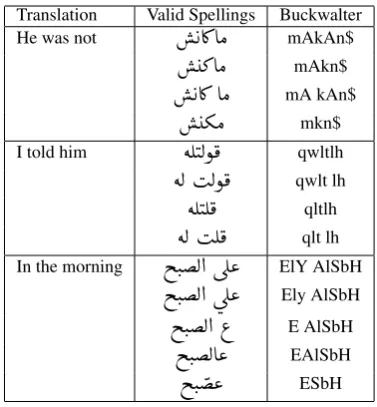
”(AHnA)}.Table 2 presents some additional samples of Arabic dialect words that have multiple acceptable spellings. These examples illustrate the problem of comparing an ASR output to only one reference that picks one of many possible spellings of a di-alect Arabic word.
Accordingly, we propose introducing a multi-reference evaluation methodology for ASR tasks that targets languages with no standardized or-thography. Similar to BLEU score in MT,
multi-reference increases the likelihood of accepting an automatic translation (speech recognition), if any of the manual translations (transcriptions) agreed with it in some portions.
3.2 Multi-References Alignment to Recognized Speech Text
Our approach here is to extend the current align-ment used when performing ASR evaluation be-tween recognized text and one reference text to al-low alignment between the recognized text andN
references.
For a recognized text Rec = {w0
1, w02, ....
w0
|Rec|}, and a set ofN references: Ref1={w11,
w12, .... w1|Ref1|} to RefN = {wN1, wN2, ....
wN|RefN|}, we perform the following steps:
• For each word in Rec, list all the words in
Ref1 toRefN that are aligned to it. Note, that some references may not include any corresponding word for some of the words in
Rec, which is counted as an insertion. The output of this process will be an array of size
N of reference words for each recognized word.
e.g.: w0
3 →[w12,w23,<INS>, ...,wN4]
• The previous step effectively captures in-sertions, substitutions, and correct recogni-tion. However, deletions would not be han-dled, since there is no corresponding word in the Rec to the deleted words in the ref-erence. In addition, different number of deletions could exist across different refer-ences. To map deletions effectively across multiple references, for each reference, we map any non-aligned word to the recognized text to a “deletion pointer” (<DEL>) with a counter to the position of the last aligned word in Rec. For example, if two dele-tions are detected for one reference after 3 aligned words withRec, the words in refer-ence would be mapped to{“03-01<DEL>”, “03-02 <DEL>”} in the Rec. If another deletion is detected after the fifth word in
Rec, it will be mapped to “05-01<DEL>”. For deletion pointers that are mapped to some of the references only, those reference that has nothing deleted would be assigned to “NULL”. See Table 3 as an example.
Different Transcription
© ð èQÖÏAK. øPñJX Q « èQÖÏAK. ú Gñ KA¯ Q « © ð ú ¯ A Jk@
C@ èX à@ ùªJJ.£ è@ Ѫ K
nEm Ah TbyEy<n dp>SlAF<HnA fy wDE gyr qAnwny bAlmrp gyr dstwry bAlmrp wDE
© ð è@ èQÖÏAK. øPñJX Q « èQÖÏAK. ú Gñ KA¯ Q « © ð ú ¯ A Jk
@ ú
æªK C@ @X ùªJJ.£ è@ Ѫ K
nEm Ah TbyEy dA>SlA yEny>HnA fY wDE gyr qAnwny bAlmrp gyr dstwry bAlmrp Ah wDE
© ð èQÖÏAK. øPñJX Q « èQÖÏAK. ú Gñ KA¯ Q « © ð ú ¯ A Jk@ C@ èX ùªJJ.£ ñë è@ Ѫ K Ѫ K
Ah hw TbyEy dh ASlA AHnA fy wDE gyr qAnwny bAlmrh gyr dstwry bAlmrh wDE
© ð èQÖÏAK. øPñJX Q « èQÖÏAK. ú Gñ KA¯ Q « © ð ú ¯ ám ' ú æªK C@ @X ùªJJ.£ ñë Ѫ K
[image:4.595.67.542.60.296.2]nEm hw TbyEY dA>SlA yEnY nHn fY wDE gyr qAnwnY bAlmrh gyr dstwrY bAlmrh wDE Table 1: Different transcriptions for the same utterance
“
ú Gñ KA¯ Q « © ð ú ¯ A Jk@ ú æªK C
@ @X àAK. ù¢«@
H.C® K@ éJ ¯ è
@ l @ð QÖÏAK. øPñJX Q « QÖÏAK.
”.The alignment algorithm with the four references would produce the alignments shown in Table 3. As shown, now each word in the recognition is aligned to N references, which maximize the likelihood of finding a possible match that is accepted by one of the references.
3.3 Calculating MR-WER
Using the multi-aligned references, the number of correct, insertions, substitutions, and deletions are calculated as follows:
• C (Correct): is the number of recognized words that has a match in any of the aligned reference words.
• S (Substitutions): is the number of recog-nized words that has alignment to at least one reference words, but none of them matches it.
• I (Insertions): is the number of recognized words that is not aligned to any reference word. i.e. all corresponding alignments are “<INS>”.
• D (Deletions): is the number of “<DEL>” instances in the Rec that has no “NULL” alignment in any of the references. The main reason for not counting deletions that has no corresponding word in one of the references
is for the following assumptions: if one of the reference transcriptions decided that one of the spoken words is not worth transcrib-ing, then the ASR should not be penalized for missing it. We can refer to example like the word “
è@
”(Ah) and “ú æªK
”(yEny) where some of the transcribers considered them as a noise, and they decided not to write it.Based on the counts of C, S, I, and D, MR-WET is calculated according to the following equation:
W ER= (SS++DD++CI)
In the case of multi transcriptions per reference, the length of the transcription varies from one ref-erence to another which means that the deletion count is different among different transcriptions as shown in Table 3. By look at examples in this ta-ble, we can see that first reference has 16 words, the second one has 17 words, the third 17, and the fourth 16, we can see the number of words varies from one example to another. More specif-ically, the second transcriber decided to add the word “
è@
”(Ah) which none of the other three ref-erences considered it as a valid word. We can also see the third reference decided to add the word “Ѫ K
”(nEm) at the beginning which no one else added.Translation Valid Spellings Buckwalter
He was not
A¿AÓ
mAkAn$ »AÓ
mAkn$ A¿ AÓ
mA kAn$ ºÓ
mkn$I told him
éÊJËñ¯
qwltlhéË IËñ¯
qwlt lhéÊJʯ
qltlhéË Iʯ
qlt lh In the morningiJ.Ë@ úΫ
ElY AlSbHiJ.Ë@ úΫ
Ely AlSbHiJ.Ë@ ¨
E AlSbHiJ.ËA«
EAlSbH [image:5.595.84.273.60.264.2]iJ. «
ESbHTable 2: Sample of phrases with multiple valid spellings
75%, reference 2 58%, reference 3 87%, and fi-nally reference 4 will have 78% WER.
The MR-WER will have better results than any of the references distinctively, the MR-WER will be calculated as follow: :
MR−W ER= (6 + 1 + 10)6 + 1 + 2
Which is 52.6% WER, obviously, this is lower than the the lowest WER in any of the references.
4 Data
The data used in our experimentation comes from Broadcast News BCN domain; particularly, Al-jazeera Arabic news channel. The nature of the data is debates and news programs which were up-loaded to Al Jazeera in the duration between June 2014 and January 2015. All the speech data have gone through the pre-processing steps before be-ing submitted to the used crowdsource platform1 for transcription. Pprocessing included: re-moving non-speech audio such as music or white noise, followed by speaker segmentation and clus-tering, diarization, and speaker linking within the same episode. In addition to this, a dialect clas-sification was performed using human computa-tion, which also occurred via crowdFlower plat-form. Utterances underwent dialect classification by 3-9 annotators per audio file into five broad Arabic dialect groups: Modern Standard Arabic (MSA), Egyptian (EGY), Levantine (LEV), North
1http://www.crowdFlower.com
Index Rec Ref1 Ref2 Ref3 Ref4
(00-1) <DEL> NULL NULL Ѫ K NULL
(00-2) <DEL> Ѫ K Ѫ K Ѫ K Ѫ K
(01) ù¢«@ è@ è@ è@ ñë
(02) àAK. ùªJJ.£ ùªJJ.£ ñë ùªJJ.£ (03) @X à@ @X ùªJJ.£ @X
(04) C@ èX C@ èX C@
(05) ú æªK C@ ú æªK C@ ú æªK (06) A Jk@ A Jk@ A Jk@ A Jk@ ám '
(07) ú ¯ ú ¯ ú ¯ ú ¯ ú ¯
(08) © ð © ð © ð © ð © ð
(09) Q « Q « Q « Q « Q «
(10) ú Gñ KA¯ ú Gñ KA¯ ú Gñ KA¯ ú Gñ KA¯ ú Gñ KA¯ (11) QÖÏAK. èQÖÏAK. èQÖÏAK. èQÖÏAK. èQÖÏAK.
(12) Q « Q « Q « Q « Q «
(13) øPñJX øPñJX øPñJX øPñJX <INS> (14) QÖÏAK. <INS> <INS> <INS> <INS> (15) l @ð <INS> <INS> <INS> <INS> (16) è@ <INS> èQÖÏAK. <INS> øPñJX (17) éJ ¯ èQÖÏAK. è@ èQÖÏAK. èQÖÏAK. (18) H.C® K@ © ð © ð © ð © ð
[image:5.595.309.522.62.315.2]WER MR:52% 75% 59% 88% 68%
Table 3: Alignment applied between a recognized text (Rec) and four different references
African/Maghrebi (NOR), and Gulf (GLF). For the current study, we used audio segments which had been classified as EGY with at least 75% agreement between annotators.
In this study, Egyptian data was chosen as a test case to take advantage of the fact that the clas-sification pre-processing showed us that approxi-mately 40% of users of the crowdsource platform in the Arab world are located in Egypt, meaning that focusing on EGY audio and Egyptian anno-tators allowed us to complete transcription fairly quickly. Furthermore, there were significantly more audio segments classified with high levels of inter-annotator agreement as EGY when com-pared to other dialect categories. Finally, EGY as a category contains a potentially less diverse set of dialects than a more geographically spread re-gional category.
than once was managed through the crowdFlower platform.
5 Experimentation
Our experiments are designed to address the fol-lowing research questions:
1. How many references should be used in the multi reference
2. What is the inter-reference agreement? How good is the crowdsource data? Do we need to filter bad transcription for the MR-WER evaluation?
3. How many times do we need to see correct word to count it correct?
5.1 Number of References
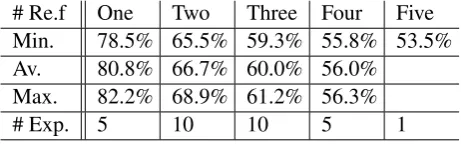
We have evaluated the speech recognition us-ing various number ofN reference transcriptions, where N ranged from 1 to 5. We have used all the combinations between reference transcriptions in cases whenN >1 to validate our findings. As shown in Table 4, for every experiment, we report the minimum, maximum and average MR-WER for each number of transcriptions we use. We con-clude from this experiments two findings:
1. The WER reduces considerably when we in-crease the number of transcriptions from one reference to five references, and may be there is potential to reduce the WER more if there are more transcriptions (although we can see the reduction in MR-WER between four and five references is not significant). The multi-reference evaluation has taken the error from an average WER of 80.8% to 53.5%. The 33% difference in performance are possibly happening due to various ways of writing DA not really due to bad ASR.
2. The variance in WER reduces noticeably when we increase the number of references. For example if you look at Figure3, the WER for five single references varies from 76.4% to 80.9%, with a absolute difference of 3.7% which is high error margin, for two refer-ences, the absolute difference is 3.4%, and in three references is 1.9% and in five ref-erences, it is only 0.5%. Obviously, we have only one WER for five transcriptions, as there is no combination between multiple
transcriptions. Possible explanation for this nice reduction is error margin is that multi reference is capable to capture some of the variations in transcription, and make the re-ported error rate more robust.
# Re.f One Two Three Four Five Min. 78.5% 65.5% 59.3% 55.8% 53.5% Av. 80.8% 66.7% 60.0% 56.0%
Max. 82.2% 68.9% 61.2% 56.3%
[image:6.595.307.538.155.228.2]# Exp. 5 10 10 5 1
Table 4: MR-WER for various number of refer-ences per experiment.
5.2 What is the inter-reference agreement
The transcribed data is suffering from a very lim-ited quality control that have been applied to it, which raised an important question: what is the inter-annotator agreement in this transcription task? This is a difficult question to ask in lan-guage with no clear orthographic rules. In most of the cases, if we consider exact string matches between different transcriptions even if it is per-fect, the inter-annotator agreement is almost zero as shown in Table 4.
We evaluated WER for every transcription file with the other four files. For every utterance in each reference, there will be four WER for the same utterance in the other four files, the WER will be averaged. Each file has 2760 utterances, corresponding to 4.8 hours. We split the 2760 av-eraged WER values into four bins, WER 0-25%, WER 25-50%, WER 50-75% and anything more than 75%. We plot the results as seen in figure 1. It is clear from the aforementioned figure that there is a great deal of missmatch between the five references. Partially, this is due to bad transcrip-tion coming from some of the crowd source con-tributors, that we did not apply quality check at this stage.
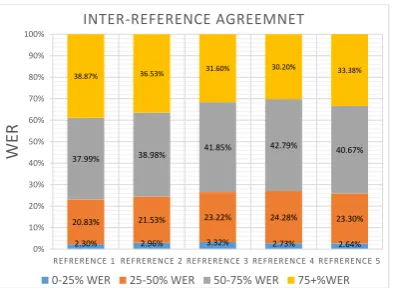
This experiment has reduced the number of utter-ances as shown in Table 5, soRef1has gone from 2765 utterances to 1824,Ref2from 2765 to 2160 .. etc. Also, we plot the clean data as shown in 2 To evaluate the impact of data cleaning on the MR-WER, we run the same algorithm as explained in section 3.3 on the clean data, and we found that the MR-WER for the five references actually has increased from 53.5% to 54.2%.
This is an interesting finding to say that by cleaning the evaluation data, the MR-WER has not got any better, which could be explained because removing the potentially noisy data did not impact the MR-WER rather than removing some of the examples that could help in finding alternatives for Dialectal words. Also, it is fair to say that the pro-posed method is robust for the noisy data.
1.52% 2.31% 2.82% 2.39% 2.10% 13.74% 16.82% 19.75% 21.19% 18.48% 25.06% 30.45% 35.62% 37.36% 32.26% 59.67% 50.42% 41.81% 39.06% 47.16% 0.00% 20.00% 40.00% 60.00% 80.00% 100.00% 120.00%
R E F R E R E N C E 1 R E F R E R E N C E 2 R E F R E R E N C E 3 R E F R E R E N C E 4 R E F R E R E N C E 5
W ER ME ASUR ED F OR EVER Y RE FER NCE W ITH TH E O THER FOUR FI LE S AXIS TITLE INTER-REFERENCE AGREEMNET
[image:7.595.322.520.76.220.2]0-25% WER 25-50% WER 50-75% WER 75+%WER
Figure 1: Inter-reference agreement for the full data
Ref1 Ref2 Ref3 Ref4 Ref5
1824 2160 2351 2414 2193 Table 5: Number of utterances per file after re-moving outlier transcriptions.
5.3 Counting Correct Words
In the case of single reference, the algorithm will loop over the solo reference, and check each word; insertion, deletion, substitution or correct. How-ever, in the MR scenario, someone can argue that the algorithm in acting like cherry picking and looking for correct word in any of the references to make the WER look better rather than validat-ing these findvalidat-ings. Basically, the spirit for this al-gorithm is try to find the recognized word in any
2.30% 2.96% 3.32% 2.73% 2.64% 20.83% 21.53% 23.22% 24.28% 23.30% 37.99% 38.98%
41.85% 42.79% 40.67% 38.87% 36.53% 31.60% 30.20% 33.38%
0% 10% 20% 30% 40% 50% 60% 70% 80% 90% 100%
REFRERENCE 1 REFRERENCE 2 REFRERENCE 3 REFRERENCE 4 REFRERENCE 5
WER
INTER-REFERENCE AGREEMNET
0-25% WER 25-50% WER 50-75% WER 75+%WER
Figure 2: Inter-reference agreement after remov-ing outlier transcriptions
of the references, obviously minding the position in text as explained in section 3.
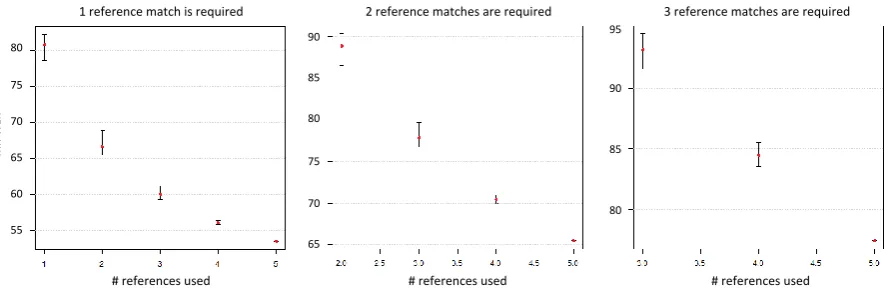
To address this concern, we explore the impact in MR-WER when the algorithm asks for more than one evidence that a word is correct, i.e the same word occurred in same position in more than one reference. We evaluated correct word count-ing in 1+ (standard), 2+ and 3+ occurrences. Ob-viously, we apply N number of times seeing the word correct if there isN number of references or more.
[image:7.595.85.285.320.462.2]80
75
70
65
60
55
90
85
80
75
70
65
95
90
85
80
65
MR
-WE
R
1 reference match is required 2 reference matches are required 3 reference matches are required
[image:8.595.78.524.64.208.2]# references used # references used # references used
Figure 3: MR-WER for counting correct once or more
One Two Three Four Five 1+ 80.8% 66.7% 60.0% 56.0% 53.5% 2+ NA 88.8% 77.8% 70.4% 65.5% 3+ NA NA NA 84.5% 77.5% Table 6: MR-WER for counting correct once or more.
6 Conclusion
In this paper, we have presented an innovative way for measuring the accuracy for speech recog-nition system in non-standard orthographic lan-guage; Multi-Reference Word Error Rate (MR-WER). Figure 3 summarized our findings in the multi reference approach applied on Dialectal Arabic (DA). We were able to report 53% MR-WER for five references collectively, while for the same test set the standard WER was between 76.4% to 80.9% when it used the same five refer-ences individually. We plan to extend this work to learn from multiple transcription the best orthog-raphy to improve the robustness of the computa-tional models. Also, the usage of multi-reference in tuning, and training, similar to the proposed us-age in evaluation.
References
[Al-Sabbagh and Girju2012] Rania Al-Sabbagh and Roxana Girju. 2012. Yadac: Yet another dialectal
arabic corpus. InLREC, pages 2882–2889.
[Ali et al.2014a] Ahmed Ali, Hamdy Mubarak, and Stephan Vogel. 2014a. Advances in dialectal ara-bic speech recognition: A study using twitter to
im-prove egyptian asr. InInternational Workshop on
Spoken Language Translation (IWSLT 2014), pages http–workshop2014.
[Ali et al.2014b] Ahmed Ali, Yifan Zhang, Patrick
Car-dinal, Najim Dahak, Stephan Vogel, and Jim Glass. 2014b. A complete kaldi recipe for building arabic
speech recognition systems. In Spoken Language
Technology Workshop (SLT), 2014 IEEE.
[Cardinal et al.2014] Patrick Cardinal, Ahmed Ali, De-hak, Najim, Yu Zhang, Al Hanai, Tuka, Yifan Zhang, James Glass, and Stephan Vogel. 2014. Re-cent advances in asr applied to an arabic
transcrip-tion system for al-jazeera. InINTERSPEECH.
[Cotterell and Callison-Burch2014] Ryan Cotterell and Chris Callison-Burch. 2014. A dialect,
multi-genre corpus of informal written arabic. In
Pro-ceedings of the Language Resources and Evaluation Conference (LREC).
[Darwish and Magdy2014] Kareem Darwish and Walid
Magdy. 2014. Arabic information retrieval.
Foundations and Trends in Information Retrieval, 7(4):239–342.
[Diehl et al.2012] Frank Diehl, Mark JF Gales, Mar-cus Tomalin, and Philip C Woodland. 2012. Mor-phological decomposition in Arabic ASR systems.
Computer Speech & Language, 26(4):229–243.
[Elmahdy et al.2014] Mohamed Elmahdy, Mark
Hasegawa-Johnson, and Eiman Mustafawi. 2014. Development of a tv broadcasts speech recognition system for qatari arabic.
[Habash et al.2012] Nizar Habash, Mona T Diab, and Owen Rambow. 2012. Conventional orthography for dialectal arabic. InLREC, pages 711–718.
[He et al.2011] Xiaodong He, Li Deng, and Alex Acero. 2011. Why word error rate is not a good metric for speech recognizer training for the speech
translation task? In Acoustics, Speech and
Sig-nal Processing (ICASSP), 2011 IEEE InternatioSig-nal Conference on, pages 5632–5635. IEEE.
[Holes2004] Clive Holes. 2004. Modern Arabic:
[Mangu et al.2011] Lidia Mangu, Hong-Kwang Kuo, Stephen Chu, Brian Kingsbury, George Saon, Ha-gen Soltau, and Fadi Biadsy. 2011. The ibm 2011 gale arabic speech transcription system. In
Automatic Speech Recognition and Understanding (ASRU), 2011 IEEE Workshop on, pages 272–277. IEEE.
[Papineni et al.2002] Kishore Papineni, Salim Roukos, Todd Ward, and Wei-Jing Zhu. 2002. Bleu: a method for automatic evaluation of machine
trans-lation. InProceedings of the 40th annual meeting