Event Extraction in pieces:
Tackling the partial event identification problem
on unseen corpora
Chrysoula Zerva
National Center of Text Mining, School of Computer Science, University of Manchester, UK
Sophia Ananiadou
National Center of Text Mining, School of Computer Science, University of Manchester, UK
Abstract
Biomedical event extraction systems have the potential to provide a reliable means of enhancing knowledge resources and min-ing the scientific literature. However, to achieve this goal, it is necessary that cur-rent event extraction models are improved, such that they can be applied confidently to unseen data with a minimal rate of error. Motivated by this requirement, this work targets a particular type of error, namely partial events, where an event is miss-ing one or more arguments. Specifically, we attempt to improve the performance of a state-of-the-art event extraction tool, EventMine, when applied to a new can-cer pathway curation corpus. We propose a post-processing ranking approach based on relaxed constraints, in order to recon-sider the candidate arguments for each event trigger, and suggest possible new ar-guments. The proposed methodology, ap-plicable to the output of any event extrac-tion system, achieves an improvement in argument recall of 2%-4% when applied to EventMine output, and thus constitutes a promising direction for further develop-ments.
1 Introduction
In text mining, events are currently the most com-plex information unit that can be extracted from raw text, in terms of their ability to capture n-ary dynamic relations between entities and/or other events as indicated in Figure 1. Their dynamic properties mean that events constitute the closest equivalent to human-extracted information. The structured information representation of events can be used to enrich current knowledge sources such as ontologies and databases in an automated
In order to study whether ATX expression affects motility-dependent processes
non-expressing cell lines, parental and ras-transformed NIH3T3 (clone7) cells.
The effect of ATX secretion on in vitro cell motility was variable.
The ras-transformed, ATX-secreting subclones had enhanced motility to
NIH3T3 cells transfected with atx, an inactive mutant gene, or empty vector.
In MatrigelTM invasion assays, all subclones, which secreted enzymatically active appropriate controls.
This difference in invasiveness was not caused by differences in gelatinase production,
GGP GGP Cancer +Reg +Reg
Localization Metastasis +Regulation Cell_transformation GGP
Cell
Eq Cause Th Theme Th
Cause Th
Cause
Theme
GGPEqGGP
GGPThExpressionCaReg Theme Metastasis
Expression Cell +Regulation GGP
Cell_transformation Cell
Theme Th
Theme
Th
Cause
+Reg GGP Th Localization Cell Th Localization
Cause Theme
Cell Th Planned_processInstrumentGGP
Cell FromLoc Localization Theme GGP
Theme
GGPThExpression
Organism Planned_process GGP Planned_process
Cell +Reg
Th Theme Theme
InstrumentInstrument
Cause
Metastasis
GGP Expression GGP +Regulation Cell_transformation
Cell +Regulation Carcinogenesis
Th Ca Theme Th
Th
+Regulation Cell_transformation GGP
Cell
Th Th
Cause
GGP Cause +RegThCell Cancer
Figure 1: Event Extraction example: Localisation events nested as arguments to Positive Regulation
(+Reg) event1
manner. This can be particularly useful for re-searchers in the biomedical domain, who use com-plicated models to represent molecular reactions, pathways etc. In order to improve these models, biologists currently need to sift through a continu-ously growing mountain of literature (Ananiadou et al., 2014). Thus, an automated means to ex-tract knowledge, using event exex-traction technol-ogy, and to exploit this knowledge to augment ex-isting models, would be an immense asset within biomedical research.
Motivated by the above, the Big Mechanism project (Cohen, 2014) aims to augment cancer pathway models automatically with events ex-tracted from biomedical literature. To this end, event extraction systems need to be able not only to extract high quality events that cover a wide range of biomedical event types but also to ro-bustly do so even when applied to unseen data. In-deed, the expectation is that event extraction sys-tems will be successful in carrying out this task even when parameters such as text type or domain, are altered, without the need to retain the system.
However, the structure of current event extrac-tion systems can hinder the ability to achieve the above goal. Since event extraction has so far been treated as a supervised learning task, the perfor-mance of systems is heavily dependent on the an-notation, context and domain of the training data, and may drop significantly when one of the initial
1Sentence taken BioNLP 2013 CG corpus (N´edellec et
al., 2013). Annotation visualised with BRAT annotation tool (Stenetorp et al., 2012).
specifications changes, even within the same do-main. Especially in pipelined architectures, which consist of sequential classification tasks, addi-tional annotation constraints are learned from the training corpus at each stage in the pipeline. While these additional constraints improve the model’s precision, they render it less adaptable to deviating event structures. One of the consequences of this is the failure to retrieve some of the information that should be associated with the event, leading to so-called partial event identification, where some of the event arguments are missing. Although such errors may not be of vital importance in all do-mains, they can be extremely detrimental when at-tempting to link an event to a biomedical model, since they can lead to erroneous or useless asser-tions.
The work described here focusses on resolv-ing the problem by applyresolv-ing a generic constraint relaxation post-processing strategy to the output of an event extraction system (EventMine (Miwa and Ananiadou, 2013)), with the aim of reducing the number of recognised events that have miss-ing arguments. Motivated by an analysis of the Big Mechanism testing corpus described in Sec-tion 3, we relax the annotaSec-tion constraints related to argument roles and subsequently reconsider all the entities within a sentence that are valid argu-ment candidates, by exploiting syntactical depen-dencies. We employ the confidence values
ob-tained from an Adaboost (Freund and Schapire,
1997) classifier to rank candidate arguments for each event trigger, and to determine which of them constitute valid additions to the event. Using this
approach, we are able to improve therecallon
par-tial events identified by EventMine by at least 2% and, importantly, we gain fruitful insights into fac-tors that could further improve performance.
2 Background: The Event Extraction Task in Biomedicine
In this section we provide an overview of the event extraction procedure, focussing on biomed-ical events. Our emphasis is on the details of pipelined event extraction, since this is the ap-proach employed by the EventMine system, which we use to perform event extraction. Finally, we re-view the main approaches for adapting event ex-traction to new or unseen data.
2.1 Event Structure
In text mining, events refer to units representing dynamic, n-ary relations between named entities. In the biomedical domain, this definition can be narrowed to units representing molecular interac-tions stated within textual documents (Bj¨orne and Salakoski, 2011).
The typical structure of events (as defined and used in BioNLP shared tasks, e.g., (Kim et al., 2009), (N´edellec et al., 2013)) includes an obliga-torypredicate/trigger, i.e., a word sequence in text that characterises the event type. Potentially, an
event may also have one or morearguments, i.e.,
entities in text that are semantically linked to the trigger. Considering the trigger and the arguments as nodes, the links between them can be consid-ered as directed edges (from the trigger to the ar-gument), which represent the role that the argu-ment plays with respect to the trigger. As events are dynamic elements, the same entity can partici-pate in different events, and may assume different roles in each event. Also, since events are solid in-formation units, they can themselves act as argu-ments to other events, leading to the extraction of complex/nested events (Bj¨orne et al., 2010). These characteristics can be observed in the example of Fig 1 presented in Section 1.
2.2 Event Mining Architecture
In order to extract structures of the complex-ity illustrated in Figure 1, current state-of-the-art systems break event extraction down into multi-ple classification tasks that have to be solved in order to produce the final structured event rep-resentation. The learning process to carry out these tasks can be undertaken either sequentially in a pipelined manner, as in EventMine (Miwa and Ananiadou, 2013) and TEES (Bj¨orne and Salakoski, 2013), or as joint learning task, as for FAUST (Riedel and McCallum, 2011). Event-Mine, the system employed in this work, utilises the pipelined approach, and consists of the follow-ing modules:
• Event trigger classifier: Identifies spans of text that act as triggers and annotates them with the corresponding type (event label).
• Argument detector: Links each trigger with at
most one argument and annotates the edge (link) with the corresponding argument role type.
final-ising each event structure.
• Modification detector: Identifies event modifi-cations (negation and speculation)
All the above are formulated as multi-class tasks that are learned in a supervised way, using one-versus-rest SVM implementation of LibLin-ear (Fan et al., 2008). EventMine is able to per-form with state-of-the-art accuracy, achieving F-score of 52% on the CG and 53% on PC task of the latest BioNLP shared task (N´edellec et al., 2013), rendering it a suitable tool for this study.
2.3 Adaptation and generalisation approaches
One of the problems usually encountered with su-pervised models, such as those used by Event-Mine, is that they are specifically tailored to fea-tures of the corpus on which they have been trained. As a result, their functionality is restricted to the trigger, argument and role types that they have been trained to identify and extract. For ex-ample, some corpora focus only on protein-protein interactions, while others include chemical reac-tions, anatomical entities and or a combination of the above. Intuitively, in order to capture events that encompass all the above types, either one would have to re-annotate a corpus with all the required types of interest, or use some combina-tion of either the corpora or the models trained on them.
Since corpus annotation is an expensive and time consuming task, various computational ap-proaches to combining information have been pro-posed. A particularly straightforward approach is to combine the models in a stacking manner as in (Wolpert, 1992), where a method inspired from cross-validation is used to train different models on subsets of the different corpora, and then use the validation set to learn how to combine their outputs to obtain the desired result. More re-cently, a range of domain adaptation techniques have been proposed that try to adapt to a new cor-pus by either selectively training on the instances and/or features that are expected to maximize per-formance (Chen et al., 2011; Xia et al., 2013), or by attempting to tailor feature distributions to the one of the new corpus with various methods such as kernel based ones (Daum´e III, 2009; Kulis et al., 2011) or transfer component analysis (Pan et al., 2011). Finally, (Miwa et al., 2013) sug-gests the use of a filtering model, which
consid-ers the overlap of the available corpora and filtconsid-ers redundant and contradicting labelling across dif-ferent corpora and then merges the corpora in or-der to train a single model on their combination. The filtering, as Miwa explains, is heuristically achieved by limiting the generation of negative in-stances in each corpus to only those cases in which the corresponding surface expression matches at least one positive instance of an annotated type in any corpus that shares that type. The method, referred to as wide coverage, when implemented in EventMine outperforms other stacking and do-main adaptation methods as shown in (Miwa et al., 2013). Accordingly, it was the chosen approach for this work.
3 Corpora and Annotation Considerations
3.1 Training Corpora
For training the wide coverage method was ap-plied on the combination of the training sets of the following corpora, treated as described in (Miwa et al., 2013) : Genia09 of BioNLP ’09 (Kim et al., 2009), Genia11, EPI & ID of BioNLP ’11 (Kim et al., 2011), DNA-methylation (Ohta et al., 2011), ePTM (Pyysalo et al., 2011), mTOR (Caron et al., 2010), and MLEE (Pyysalo et al., 2012).
3.2 Testing Corpora
The corpus that provided the motivation for this work, henceforth referred to as BM, is a small annotated set of six passages extracted from
full-text biomedical research papers in PubMed 2. It
concerns cancer pathway curation and was manu-ally annotated with biomedical named entities and events by expert biologists participating in the Big Mechanism project (Cohen, 2014). In total it con-sists of 155 event and 247 named entity annota-tions. The range of the entities and events anno-tated render it a valid candidate for the application of the wide coverage approach described in
Sec-tion 2.3, because the entities span across
Chem-ical, Protein and Cell instances, while the event types cover pathways, various protein interactions (Binding, Regulation, etc) and other cancer related events. Since there is no single related training corpus with similar annotations, a model that can learn labels from different corpora is necessary to facilitate recognition of all of the above event and entity types.
The annotation scheme in BM corpus differs from the uniform annotation scheme used in the training corpora in the following ways:
• The entity labels are different to those used in
the training corpora (see Fig 3 and section 4.1)
• No distinction is made between different event
types in the test corpus annotations
• A simplified edge type annotation was followed
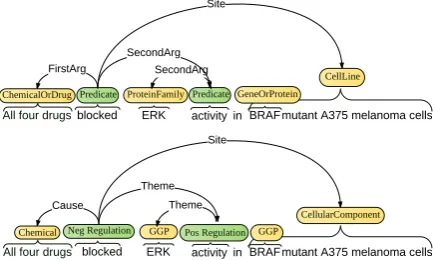
[image:4.595.308.519.169.291.2]in the BM corpus, discriminating only between simple arguments and arguments indicating the site (cellular location) where the event took place. As opposed to the BioNLP schema the edge annotations in BM contain less semantic information (there is no discrimination between roles such as Instrument, Participant, Cause etc) Figure 2 illustrates an event annotated according to both BioNLP guidelines and to the BM corpus guidelines. The simplifications of the BM corpus
All four drugs blocked ERK activity in BRAF mutant A375 melanoma cells
ChemicalOrDrugPredicate ProteinFamily Predicate GeneOrProtein CellLine
SecondArg SecondArg FirstArg
Site
Chemical Neg Regulation GGP Pos Regulation GGP
CellularComponent
Theme Theme Cause
Site
All four drugs blocked ERK activity in BRAF mutant A375 melanoma cells
Figure 2: Example of event annotation in the BM corpus (top) versus BioNLP (bottom) : we can ob-serve the different labels used for entities, events and edges
annotation scheme, compared to the scheme used in the training corpora, motivated our approach to relaxing the constraints used to link arguments to event triggers, as described in the previous section. Due to the small size of BM corpus presented above, our experiments were repeated on the MLEE corpus (Pyysalo et al., 2012), using the development set as a test case. The MLEE cor-pus was chosen because as BM it displays a wide range of entities and events that spanned across different levels of biological organisation (molec-ular to organ) instead of focusing on protein reac-tions. The experiments were repeated twice, once including the MLEE training corpus in the train-ing data, and once keeptrain-ing it only for test pur-poses, in order to provide a comparison between
application on seen and unseen data (see Section 6). For the purposes of this study, the edge
anno-tations in MLEE are simplified toArg1andArg2,
such that it is in line with the annotation scheme of the BM corpus, allowing for the relaxed constraint approach to be applied and for a better comparison of the results.
Protein Chemical
Organism
Cell
Cellular_Component
Organ
Multi_tissue_structure
Developing_structure
Immaterial_anatomical_entity
Organ_system Organism_subdivision
Organism_substance Pathological_formation
Tissue
GeneOrProtein
Cell ChemicalOrDrug CellLine
ProteinSite ProteinFamily
= All corpora = MLEE only = ID and MLEE = BM corpus Training corpora BM corpus
Figure 3: Initial named entity labels for the cor-pora used in the experiments. BM corpus labels were adapted to the training corpora as explained in section 4.1
4 Methodology
4.1 Adapting the entity labels without supervision
Since there is no widely accepted standard in the community in terms of the annotation labels for named entities, a common issue when processing multiple corpora, is overlapping annotations. In other words, different labels may be used to de-scribe the same entity type, and that exactly is the case for the BM corpus when compared to
the training corpora.3 Hence, when testing on
un-seen data, it is necessary to map the labels of the test corpus to the ones that the model is trained to recognise, in order to obtain optimal results. For
example, proteins were annotated as
GeneOrPro-teinin the BM corpus and asProteinin the training corpora. For the filtering and unification of anno-tations instead of manually identifying the over-lapping annotations, a heuristic automated label filtering method was implemented, in order to map the labels of the target/test corpus (T L) to those of
the source/training one (SL). To that end, label
similarity was calculated based on the following heuristic formula:
3The training corpora also contained conflicting /
[image:4.595.72.290.340.470.2]T Li→SLj,
SLj →argmax
k (
#(AnnE T Li∩AnnE SLk)
#AnnE SLk )
(1)
whereAnnE T Li corresponds to an annotated
text span under the labelT Liin the target corpus,
while AnnE SLj to an annotated text span
un-der the labelSLj. The aforementioned text spans,
can be single or multi-word tokens. Using this method, each label from the test corpus was as-signed to the most similar label in the training cor-pus. For BM the labels were adapted as following:
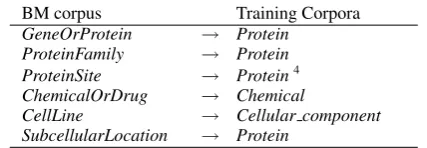
BM corpus Training Corpora GeneOrProtein → Protein
ProteinFamily → Protein ProteinSite → Protein4
ChemicalOrDrug → Chemical
[image:5.595.311.525.61.110.2]CellLine → Cellular component SubcellularLocation → Protein
Table 1: Mapping between BM and trining cor-pora named entity annotations
It should be mentioned that in the case of the BM corpus, while there were obviously synonymous labels, the actual overlap found by the above tech-nique was less than 10% for all labels, nonetheless still valid. In general this technique allows cor-pora to be added or removed without the need to fully revise the corpus. The same method could be used for different annotation types, such as event or edge type annotation.
4.2 Re-evaluating argument candidates of correct partial events
We hypothesise that, owing to the complexity of event patterns sought by the model, it sometimes fails to identify the complete set of arguments for an event, even if those arguments are correctly identified in the text as entities. This leads to the identification of partial events, such as the one pre-sented in Figure 4. In order to identify the miss-ing arguments, we aim to reduce the complexity of learned patterns, while complying with the anno-tation of the BM corpus.
Thus, we apply a relaxed post-processing step to the event extraction results, such that constraints regarding the learned roles of arguments are no longer imposed. Approaches that relax rule or pattern constraints have previously been shown to
4No overlap found, manual decision.
BRAF is not active and is not required for MEK/ERK activation in RAS mutant cells.
Ent Predicate Predicate
Ent
Ent Predicate Predicate
Entity Argument SiteSite
Missing_Argument
[image:5.595.74.288.259.333.2]Missing_Argument Argument Argument Argument
Figure 4: Example of partial event from the test
corpus: BRAF should also be linked to the event
but is missed by the EventMine model
constitute an efficient method of achieving gener-alisation and allowing models to be better adapted to other natural language processing tasks such as named entity recognition in (Tatar and Cicekli, 2011) and (Zhou and Su, 2003) or information ex-traction in (Ciravegnia and Lavelli, 2004). In our case, the relaxed constraints permit a re-evaluation of the possible relations between event triggers and recognised entities in a given sentence.
We implemented a ranking approach such that for each identified event trigger, all the entities in the same sentence that are not already linked to it by the EventMine model are ranked according to their likelihood of being related to the trigger.
BRAF is not active and is not required for MEK/ERK activation
Figure 5: Dependency link representation example for a Biomedical sentence as analysed by Enju
• Dependency type: Enju provides the
depen-dency type (prepositional, coordination, noun modifier, etc) for each dependency link/edge. This type can be exploited either to assign dif-ferent weights to each dependency edge of the argument-trigger path, or to consider different path patterns. Such manipulation has been em-ployed in rule-based event extraction in (Kil-icoglu and Bergler, 2009), achieving good ac-curacy but low recall. Also, extracting specific path patterns renders the approach dependent on a particular parser, thus limiting the indepen-dence and adaptability of its application. Since the focus of this study was on recall and adapt-ability, the dependency type information was ig-nored, except for the case that follows.
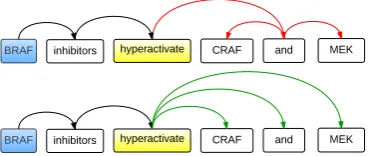
• Flattening coordination:We decided that pre-processing was necessary to resolve coordi-nation dependencies, such that a given entity would have the same distance to a trigger, re-gardless of the existence of a coordination ar-gument dependency. Accordingly, in the calcu-lation of the shortest paths, all coordination
de-pendencies (labelled ascoord argby Enju) are
flattened as shown in Figure 6.
BRAF inhibitors hyperactivate CRAF and MEK
BRAF inhibitors hyperactivate CRAF and MEK
Figure 6: Flattening coordination dependencies
• Nested Events: To handle nested events, ex-tracted events were also considered as entities, using the trigger as the representative text span, used to calculate the distance to the trigger of the top-level event and the rest of the features.
In order to obtain the rankings, we firstly consider
our problem as one ofbinary classification, where
the task is to classify each entity with respect to each trigger, as a valid (positive case) or non-valid (negative case) argument. Then, in training a clas-sifier on the above binary classification task, we can employ the prediction confidence of the clas-sifier model in order to rank the entities with re-spect to the event. The top ranked entity is selected and added to the event. In order to train a strong classifier model, a greater number of attributes that indicate the relation of an entity to a trigger were considered and implemented as additional features for the classifier. The main feature classes of the final feature set are listed below:
• Shortest dependency path (numeric)
• Entity Type (nominal)
• Participation in other events (binary)
• PoS (Part of Speech) (nominal)
• Context PoS (surrounding tokens) (nominal)
• Relative position to the event trigger
(be-fore/after) (nominal)
• Dependency on a prepositional token - type
of prepositional token (binary-nominal)
• Event type (nominal)
• Token distance to trigger (numeric).
For the binary classification task, after comparison of an SVM, a logistic regression and an Adaboost classifier (implemented with random tree models), the AdaBoost classifier was chosen as it outper-formed the rest by at least 10% (10 fold cross val-idation F-score on training set: 0.93).5
We also tried to avoid the addition of spurious arguments to events. Our initial experiments vealed that a considerable number of events re-quire either a single argument or no arguments.
For some event types such as Gene Expression,
such cases constituted more than 80% of the events. In order to avoid the addition of spuri-ous arguments, and inspired by (Rahman and Ng,
2009) , an artificial”null”named entity instance
was created for each event, and assigned to the events in the training set that did not require a sec-ond (or even a first) argument. Thus, the classifier would consider and rank the null entity along with the rest for each event.
Finally, to account for entities that are indirectly linked to events, i.e. those which occur as argu-ments of nested events, for each trigger, entities
5It should be noted that, while Adaboost appears to be
[image:6.595.92.278.539.617.2]belonging to its parent event or its nested events were excluded from ranking. Furthermore, enti-ties that were already assigned to a different event having the same trigger, as in Figure 7, were con-sidered mutually exclusive.
BRAF inhibitors hyperactivate CRAF and MEK in these cells
Pro Predicate
Predicate
Pro Pro
[image:7.595.308.526.61.180.2]SecondArg SecondArg
Figure 7: CRAF and MEK are mutually exclusive
5 Evaluation
In order to evaluate the performance of our method we compare the identified arguments with the ones annotated in the gold corpus.
For each event annotated by EventMine, we de-fine argument recall and precision as :
Recall= argEMarg∩arggold
gold (2)
P recision= argEMarg∩arggold
EM (3)
whereargEM is the set of arguments EventMine
identifies for this event and arggold the
corre-sponding set of arguments identified in the gold
standard.6
6 Results and Discussion 6.1 Experimental Results
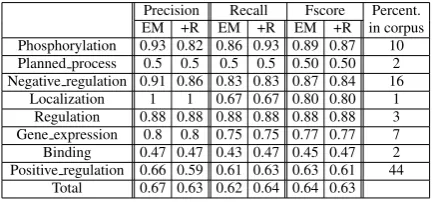
We applied and evaluated the ranking methodol-ogy to the corpora described in Section 3 and the results are shown in Tables 2 and 3.
Precision Recall Fscore Percent. EM +R EM +R EM +R in corpus Phosphorylation 0.93 0.82 0.86 0.93 0.89 0.87 10 Planned process 0.5 0.5 0.5 0.5 0.50 0.50 2 Negative regulation 0.91 0.86 0.83 0.83 0.87 0.84 16 Localization 1 1 0.67 0.67 0.80 0.80 1 Regulation 0.88 0.88 0.88 0.88 0.88 0.88 3 Gene expression 0.8 0.8 0.75 0.75 0.77 0.77 7 Binding 0.47 0.47 0.43 0.47 0.45 0.47 2 Positive regulation 0.66 0.59 0.61 0.63 0.63 0.61 44
Total 0.67 0.63 0.62 0.64 0.64 0.63
Table 2: Results on BM corpus before (EM) and after Re-ranking (+R)
For both corpora, our ranking method leads to an increase in recall compared to the default EventMine application. However, our method also results in a decrease in precision. In or-der to appreciate the impact of missing argu-ments on unseen data we repeat the experiment
6For events that are not matched in the gold standard both
values are zero.
Precision Recall Fscore Percent. EM +R EM +R EM +R in corpus Protein catabolism 0.5 0.5 0.5 0.5 0.50 0.50 2
Phosphorylation 0.69 0.59 0.69 0.69 0.69 0.64 5 Dissociation 0.78 0.44 1 1 0.88 0.61 1 Transcription 0.5 0.5 0.5 0.5 0.50 0.50 2 Negative regulation 0.5 0.48 0.38 0.5 0.43 0.49 9 Regulation 0.53 0.43 0.4 0.47 0.46 0.45 4 Gene expression 0.88 0.88 0.86 0.86 0.87 0.87 27 Localization 0.63 0.61 0.69 0.76 0.66 0.68 6 Positive regulation 0.72 0.65 0.63 0.67 0.67 0.66 32 Binding 0.66 0.68 0.56 0.64 0.61 0.66 11
[image:7.595.309.525.335.515.2]Total 0.7 0.67 0.64 0.68 0.67 0.67
Table 3: Results on MLEE corpus before (EM) and after Re-ranking (+R)
using the MLEE training corpus during training for EventMine. In this case (see Table 4), the re-call is higher and the improvement from the post-processing step not significant, suggesting that the post-processing methodology is advantageous mostly when EventMine is applied to new do-mains.
Precision Recall Fscore Percent. EM +R EM +R EM +R in corpus Protein catabolism 0.6 0.6 0.6 0.6 0.60 0.60 1
Death 0.71 0.71 0.71 0.71 0.71 0.71 1 Transcription 0.5 0.5 0.5 0.5 0.50 0.50 1 Localization 0.76 0.67 0.77 0.77 0.76 0.72 5 Development 0.55 0.55 0.55 0.55 0.55 0.55 4 Regulation 0.49 0.45 0.45 0.46 0.47 0.45 7 Breakdown 0.78 0.78 0.78 0.78 0.78 0.78 1 Positive regulation 0.68 0.64 0.63 0.64 0.65 0.64 22
Growth 0.88 0.88 0.88 0.88 0.88 0.88 3 Phosphorylation 0.69 0.56 0.69 0.69 0.69 0.62 2 Blood vessel development 0.96 0.96 0.75 0.75 0.84 0.84 16
Dissociation 0.67 0.42 1 1 0.80 0.59 1 Cell proliferation 0.92 0.92 0.92 0.92 0.92 0.92 1 Pathway 0.54 0.46 0.46 0.48 0.50 0.47 1 Planned process 0.81 0.77 0.7 0.71 0.75 0.74 10 Negative regulation 0.76 0.7 0.66 0.67 0.71 0.68 10 Gene expression 0.88 0.88 0.88 0.88 0.88 0.88 9
Binding 0.73 0.71 0.65 0.68 0.69 0.69 4 Tissue remodeling 1 1 1 1 1.00 1.00 1
Total 0.76 0.73 0.68 0.69 0.72 0.71
Table 4: Results on MLEE corpus before (EM) and after Re-Ranking (+R) (MLEE training set added to the training corpora of EventMine)
Moreover, we can observe in Tables 3 and 4 that the event types recognised are not 100% overlap-ping. Indeed, since in the first case EventMine is not trained on the MLEE corpus, the set of event types that it is trained to recognise only partially overlaps with the event types annotated in MLEE. As such, in a large number of cases, even though the event trigger is correctly extracted, it is at-tributed an event type other than the one annotated in the gold standard. For example some of the
BreakDownevents (in Table 4) tend to be
recog-nised as Negative Regulation when the model is
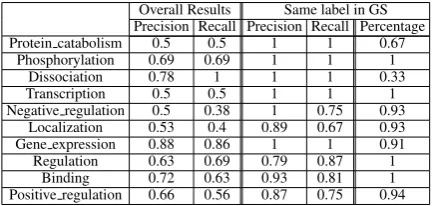
[image:7.595.73.290.518.619.2]event type identification on the linking and pre-cision of argument linking, given that EventMine models learn different annotation constraints for each event type. Table 5 compares the perfor-mance achieved by our method when the event type assigned by EventMine matches the label in the gold standard, with the overall performance. It can be observed that when the labels do match the performance increases significantly. Thus, it seems that part of error in linking arguments to an event derives from an erroneous recognition of the type of the argument, that is often linked to events that the model is not trained to recognise properly.
Overall Results Same label in GS Precision Recall Precision Recall Percentage Protein catabolism 0.5 0.5 1 1 0.67
Phosphorylation 0.69 0.69 1 1 1 Dissociation 0.78 1 1 1 0.33 Transcription 0.5 0.5 1 1 1 Negative regulation 0.5 0.38 1 0.75 0.93
Localization 0.53 0.4 0.89 0.67 0.93 Gene expression 0.88 0.86 1 1 0.91 Regulation 0.63 0.69 0.79 0.87 1
[image:8.595.310.527.61.125.2]Binding 0.72 0.63 0.93 0.81 1 Positive regulation 0.66 0.56 0.87 0.75 0.94
Table 5: Performance of EventMine for matching type annotations versus overall results
6.2 Analysis of Results and Performance Considerations
The results shown in the previous section are promising in terms of recall. However, there is still considerable room for improvement, especially in terms of decreasing the added noise, so as to min-imise the drop in precision. Below we present the most important observations regarding our results and we analyse the errors produced.
• Correct identification of the partial event but erroneous identification of the missing argu-ment: Of the noisy events, 60% constituted cases that were correctly identified as partial events, but where the ranking algorithm failed to identify the correct entity to link to the trigger. This was a common pattern in cases where the argument was an event, but the ranking system actually selected one of that event’s arguments instead of the whole event, as illustrated in Fig-ure 8. It is important to note that in some of such cases, the event trigger was not annotated by EventMine in the first place. Thus, it was im-possible for our method to capture it. This em-phasises the strong dependency of our method on EventMine’s performance. A possible solu-tion to this problem, which will be considered as
Dopamine pretreatment increases the translocation of SPH-2
Dopamine pretreatment increases the translocation of SPH-2
Chemical FirstArg Predicate FirstArg Predicate SecondArg Predicate FirstArg Pro
Chemical FirstArg Predicate Predicate SecondArg Predicate FirstArg Pro FirstArg
Figure 8: Linking the nested event argument in-stead of the trigger: Compare correct annotation (top) with produced one (bottom)
future work, is to reformulate the problem as a joint learning task, in which one classifier would focus on ranking single named entity candidates and the other on ranking event candidates, and they would be combined in the test corpus in or-der to choose the most likely solution. Such an approach would, however, have increased com-plexity, and its results remain to be tested.7 • Entities related to the event in a
complemen-tary manner: In a considerable number of er-roneous cases, the ranking system identified ar-guments that were not annotated in the gold cor-pus, but which nevertheless were related to the trigger. Two distinctive patterns emerged, as il-lustrated in Figure 9.
1. Aliases of the original argument, used in the same sentence (usually a superclass)
2. Text spans with multiple annotations that are linked multiple times to the event as separate entities
Its PLX4720 phenotype was associated with MEK/ERK activation
Sorafenib is a class II drug that inhibits V600EBRAF at 40 nM
Pro Chemical Pro
Pathway Pro
Predicate Predicate Argument Equiv_Argument Equiv_ArgumentArgument
Chemical Chemical Equiv_Argument2 Predicate Argument Protein Argument2
Figure 9: Multi annot. (top): Pathway entity erro-neously considered a valid additional argument Alias (bottom): Sorafenib and its superclass both considered valid argument candidates that are not mutually exclusive
• Overfitting to “null” instances:As can be de-duced from the result tables (2, 3 and 4), there was a considerable percentage of partial events whose missing arguments were still not fully identified by our method. In those cases, the classifier ranked the “null” instance mentioned
7However the performance will still depend on the recall
[image:8.595.73.291.248.351.2]in Section 4 as the best option. Investigation re-vealed that for partial events, the correct missing argument was ranked second after the “null” in-stance in more than 50% of cases (null inin-stance suggestions accounted for 80%-70% of the to-tal suggestions). A possible solution to further increase the recall would be to drop the “null” instance implementation, and use a confidence threshold instead. However, such a method
would be moread hoc, having severe
implica-tions on the generalisability of the model. As a final note, it should be mentioned that in some cases, our method made suggestions that could correct events containing errors (i.e., correct trig-ger but wrong argument). While these cases were not considered in the scope of this work, it would be interesting to investigate how our method could be adapted/expanded to suggest argument correc-tions as well as addicorrec-tions.
7 Conclusions and Future Work
Our novel approach to improving event extraction results has successfully shown that identifying and ranking additional arguments by relaxing annota-tion constraints can aid in improving the argument recall and reducing partial (and sometimes even erroneous) event extraction. Of particular note is the demonstration that our approach has the great-est impact when applied to unseen data. As such, we consider that our results are extremely promis-ing, even though there is still a large margin for further improvements and experimentation.
An important feature of our approach is that the methodology employed is generic enough to be applied to output of any other event extraction architecture (particularly pipelined ones) or any other biomedical corpus without significant mod-ification. Future testing on different corpora and annotation schemes will help to reinforce the ro-bustness and generalisability of our method.
However, this study has already revolved var-ious promising areas for further investigation, in terms of both increasing recall and reducing noisy additions. Of particular interest would be to see whether employing methods with multiple classifiers (co-training, joint-learning or ensemble methods) would improve the performance and re-duce the noise. Such an approach could target ei-ther classifiers trained on different argument types (named entities or entire events) or even classifiers specialising in particular event types. However,
this would constitute a whole new area of research and experimentation.
A further aspect, only minimally considered in this work, is the influence of the training instances and labels on the performance. On the MLEE cor-pus, it was observed that for events whose auto-matically assigned event type did not match the gold standard, argument recall and precision also deteriorated. Hence, we can deduce that improv-ing the accuracy of event type assignment would have a positive impact on event extraction perfor-mance. The same conclusion could hold also for the named entity labels; as mentioned in Section 4, the BM corpus was initially annotated with a dif-ferent NE label-set that was automatically (with-out supervision) aligned with the training corpus annotations in order for the trained model to be ap-plied to it. However, instead of adapting the test-ing corpus annotations, it would be worthwhile to provide efficient unsupervised methods for adapt-ing the labels in the trainadapt-ing corpus to those in the testing corpus. Such an approach could boost the precision without compromising recall by re-ducing the impact of training on instances (events) that are not related to the ones in the test set. To that end, it would be interesting to combine the wide coverage approach (Miwa et al., 2013) with domain adaptation approaches such as the ones mentioned in Section 2.3 or simply instance re-weighting ones such as (Jiang and Zhai, 2007).
The above considerations will be vital in facil-itating the incorporation of constraint relaxation as an integral part of the EventMine architecture, rather that as a post-processing step. This will help to enhance EventMine’s properties of gener-alisability and adaptability, and thus allow it it to achieve more robust performance. However, the challenge will be to consider the constraint relax-ation and adaptrelax-ation problem globally, rather than only for argument role annotation constraints.
Acknowledgments
This work was supported by the DARPA funded
Big MechanismProject, as well as by the EPSRC
fundedCentre for Doctoral Training in Computer
Sciencescholarship. We would like to thank Dr.
References
Sophia Ananiadou, Paul Thompson, Raheel Nawaz, John McNaught, and Douglas B Kell. 2014. Event-based text mining for biology and functional ge-nomics. Briefings in functional genomics, page elu015.
Jari Bj¨orne and Tapio Salakoski. 2011. Generaliz-ing biomedical event extraction. InProceedings of
the BioNLP Shared Task 2011 Workshop, BioNLP
Shared Task ’11, pages 183–191, Stroudsburg, PA, USA. Association for Computational Linguistics.
Jari Bj¨orne and Tapio Salakoski. 2013. Tees 2.1: Au-tomated annotation scheme learning in the bionlp 2013 shared task. In Proceedings of the BioNLP
Shared Task 2013 Workshop, pages 16–25.
Jari Bj¨orne, Filip Ginter, Sampo Pyysalo, Jun’ichi Tsujii, and Tapio Salakoski. 2010. Complex event extraction at pubmed scale. Bioinformatics, 26(12):i382–i390.
Ekaterina Buyko, Erik Faessler, Joachim Wermter, and Udo Hahn. 2009. Event extraction from trimmed dependency graphs. InProceedings of the Workshop on Current Trends in Biomedical Natural Language
Processing: Shared Task, BioNLP ’09, pages 19–
27, Stroudsburg, PA, USA. Association for Compu-tational Linguistics.
Etienne Caron, Samik Ghosh, Yukiko Matsuoka, Dariel Ashton-Beaucage, Marc Therrien, S´ebastien Lemieux, Claude Perreault, Philippe P Roux, and Hiroaki Kitano. 2010. A comprehensive map of the mtor signaling network. Molecular systems biology, 6(1).
Minmin Chen, Kilian Q Weinberger, and John Blitzer. 2011. Co-training for domain adaptation. In
Ad-vances in neural information processing systems,
pages 2456–2464.
F. Ciravegnia and A. Lavelli. 2004. Learning-pinocchio: adaptive information extraction for real world applications. Natural Language Engineering, 10:145–165, 6.
Paul R. Cohen. 2014. Darpa’s big mechanism pro-gram. http://www.darpa.mil/Our_Work/
I2O/Programs/Big_Mechanism.aspx.
Hal Daum´e III. 2009. Frustratingly easy domain adap-tation. arXiv preprint arXiv:0907.1815.
Rong-En Fan, Kai-Wei Chang, Cho-Jui Hsieh, Xiang-Rui Wang, and Chih-Jen Lin. 2008. Liblinear: A library for large linear classification. The Journal of
Machine Learning Research, 9:1871–1874.
Yoav Freund and Robert E Schapire. 1997. A decision-theoretic generalization of on-line learning and an application to boosting. Journal of computer
and system sciences, 55(1):119–139.
Jing Jiang and ChengXiang Zhai. 2007. Instance weighting for domain adaptation in nlp. In ACL, volume 7, pages 264–271.
Halil Kilicoglu and Sabine Bergler. 2009. Syntactic dependency based heuristics for biological event ex-traction. InProceedings of the Workshop on Current Trends in Biomedical Natural Language Processing:
Shared Task, pages 119–127. Association for
Com-putational Linguistics.
Jin-Dong Kim, Tomoko Ohta, Sampo Pyysalo, Yoshi-nobu Kano, and Jun’ichi Tsujii. 2009. Overview of bionlp’09 shared task on event extraction. In
Proceedings of the Workshop on Current Trends in Biomedical Natural Language Processing: Shared Task, pages 1–9. Association for Computational Lin-guistics.
Jin-Dong Kim, Sampo Pyysalo, Tomoko Ohta, Robert Bossy, Ngan Nguyen, and Jun’ichi Tsujii. 2011. Overview of bionlp shared task 2011. In
Proceed-ings of the BioNLP Shared Task 2011 Workshop,
pages 1–6. Association for Computational Linguis-tics.
B. Kulis, K. Saenko, and T. Darrell. 2011. What you saw is not what you get: Domain adaptation using asymmetric kernel transforms. InComputer Vision and Pattern Recognition (CVPR), 2011 IEEE
Con-ference on, pages 1785–1792, June.
Haibin Liu, Lawrence Hunter, Vlado Keˇselj, and Karin Verspoor. 2013. Approximate subgraph matching-based literature mining for biomedical events and re-lations.PloS one, 8(4):e60954.
Makoto Miwa and Sophia Ananiadou. 2013. Nactem eventmine for bionlp 2013 cg and pc tasks. In
Pro-ceedings of BioNLP Shared Task 2013 Workshop,
pages 94–98.
Makoto Miwa, Sampo Pyysalo, Tomoko Ohta, and Sophia Ananiadou. 2013. Wide coverage biomedi-cal event extraction using multiple partially overlap-ping corpora.BMC bioinformatics, 14(1):175. Yusuke Miyao, Rune Sætre, Kenji Sagae, Takuya
Mat-suzaki, and Jun’ichi Tsujii. 2008. Task-oriented evaluation of syntactic parsers and their representa-tions. InACL, volume 8, pages 46–54.
Claire N´edellec, Robert Bossy, Jin-Dong Kim, Jung-Jae Kim, Tomoko Ohta, Sampo Pyysalo, and Pierre Zweigenbaum. 2013. Overview of bionlp shared task 2013. In Proceedings of the BioNLP Shared
Task 2013 Workshop, pages 1–7.
Tomoko Ohta, Sampo Pyysalo, Makoto Miwa, and Jun’ichi Tsujii. 2011. Event extraction for dna methylation. J. Biomedical Semantics, 2(S-5):S2. Sinno Jialin Pan, I.W. Tsang, J.T. Kwok, and Qiang
Sampo Pyysalo, Tomoko Ohta, Makoto Miwa, and Ju-nichi Tsujii. 2011. Towards exhaustive event ex-traction for protein modifications. InProceedings of
BioNLP 2011 Workshop, pages 114–123.
Sampo Pyysalo, Tomoko Ohta, Makoto Miwa, Han-Cheol Cho, Jun’ichi Tsujii, and Sophia Ananiadou. 2012. Event extraction across multiple levels of bi-ological organization. Bioinformatics, 28(18):i575– i581.
Altaf Rahman and Vincent Ng. 2009. Supervised models for coreference resolution. InProceedings of the 2009 Conference on Empirical Methods in
Natural Language Processing: Volume 2-Volume 2,
pages 968–977. Association for Computational Lin-guistics.
Sebastian Riedel and Andrew McCallum. 2011. Fast and robust joint models for biomedical event extrac-tion. InProceedings of the Conference on Empirical
Methods in Natural Language Processing, pages 1–
12. Association for Computational Linguistics. Pontus Stenetorp, Sampo Pyysalo, Goran Topi´c,
Tomoko Ohta, Sophia Ananiadou, and Jun’ichi Tsu-jii. 2012. Brat: a web-based tool for nlp-assisted text annotation. InProceedings of the Demonstra-tions at the 13th Conference of the European Chap-ter of the Association for Computational Linguistics, pages 102–107. Association for Computational Lin-guistics.
Serhan Tatar and Ilyas Cicekli. 2011. Automatic rule learning exploiting morphological features for named entity recognition in turkish. Journal of
In-formation Science, 37(2):137–151.
David H Wolpert. 1992. Stacked generalization.
Neu-ral networks, 5(2):241–259.
Rui Xia, Chengqing Zong, Xuelei Hu, and E. Cambria. 2013. Feature ensemble plus sample selection: Do-main adaptation for sentiment classification.
Intelli-gent Systems, IEEE, 28(3):10–18, May.