A Framework for Procedural Text Understanding
Hirokuni Maeta∗ Cybozu, Inc.
2-7-1 Nihombashi, Chuo-ku, Tokyo, Japan
Tetsuro Sasada ACCMS, Kyoto University Yoshida Honmachi, Sakyo-ku,
Kyoto, Japan
Shinsuke Mori ACCMS, Kyoto University Yoshida Honmachi, Sakyo-ku,
Kyoto, Japan
Abstract
In this paper we propose a framework for procedural text understanding. Procedural texts are relatively clear without modality nor dependence on viewpoints, etc. and have many potential applications in arti-ficial intelligence. Thus they are suitable as the first target of natural language un-derstanding. As our framework we ex-tend parsing technologies to connect im-portant concepts in a text. Our frame-work first tokenizes the input text, a se-quence of sentences, then recognizes im-portant concepts like named entity recog-nition, and finally connect them like a sen-tence parser but dealing all the concepts in the text at once. We tested our framework on cooking recipe texts annotated with a directed acyclic graph as their meaning. We present experimental results and eval-uate our framework.
1 Introduction
Among many sorts of texts in natural languages, procedural texts are clear and related to the real world. Thus they are suitable for the first target of natural language understanding (NLU). A pro-cedural text is a sequence of sentences describing instructions to create an object or to change an ob-ject into a certain state. If a computer understands procedural texts, there are potentially tremendous applications: an intelligent search engine for how-to texts (Wang et al., 2008), more intelligent com-puter vision (Ramanathan et al., 2013), a work help system teaching the operator what to do the next (Hashimoto et al., 2008), etc.
The general natural language processing (NLP) tries to solve the understanding problem by a long
*This work was done when the first author was at Kyoto
University.
series of sub-problems: word identification, part-of-speech tagging, parsing, semantic analysis, and so on. Contrary to this design, in this paper, we propose a concise framework of NLU focus-ing on procedural texts. There have been a few attempts at procedural text understanding. Mo-mouchi (1980) tried to convert various procedu-ral texts into so-called PT-chart on the background of automatic programming. Hamada et al. (2000) proposed a method for interpreting cooking in-struction texts (recipes) to schedule two or more recipes. Although their definition of understand-ing was not clear and their approach was based on domain specific heuristic rules, these pioneer works inspired us to tackle a major problem of NLP, text understanding.
As the meaning representation of a procedural text we adopt a flow graph. Its vertices are im-portant concepts consisting of word sequences de-noting materials, tools, actions, etc. And its arcs denote relationships among them. It has a special vertex, root, corresponding to the final product. The problem which we try to solve in this paper is to convert a procedural text into the appropriate flow graph. The input of our NLU system is the entire text, but not a single sentence.
Our framework first segments sentences into words (word segmentation; abbreviated to WS hereafter). This process is only needed for some languages without clear word boundary. Then we identify concepts in the texts and classify them into some categories (concept identification; ab-breviated to CI hereafter). And finally we connect them with labeled arcs. For the first process, WS, we adapt an existing tool to the target domain and achieve an enough high accuracy. The second pro-cess, CI, can be solved by the named entity recog-nition (NER) technique given an annotated corpus (training data). The major difference is the defi-nition of named entities (NE). Contrary to many other NERs we propose a method that does not
require part-of-speech (POS) tags. This makes our text understanding framework simple. For the final process we extend a graph-based pars-ing method to deal with the entire text, a sequence of sentences, at once. The difference from sen-tence parsing is that the vertices are concepts but not words and there are words not covered by any concept functioning as clues for the structure.
As a representative of procedural texts, we se-lected cooking recipes, because there are many available resources not only in the NLP area but in the computer vision (CV) area. For exam-ple, the TACoS dataset (Regneri et al., 2013), is a collection of short videos recording fundamen-tal actions in cooking with descriptions written by Amazon Mechanical Turk. Another example, the KUSK dataset (Hashimoto et al., 2014), contains 40 videos recording entire executions (20 recipes by two persons). The recipes in the KUSK dataset are taken from the r-FG corpus (Mori et al., 2014), in which each recipe text is annotated with its “meaning.”
We tested our framework on recipe texts man-ually annotated with word boundary information, concepts, and a flow graph. We compare a naive application of an MST dependency parser and our extension for flow graph estimation. We also mea-sure the accuracy at each step with the gold input assuming the perfect preceding steps. Finally we evaluate the full automatic process of building a flow graph from a raw text. Our result can be a solid baseline for future improvement in the pro-cedural text understanding problem.
2 Related Work
Some attempts at procedural text understand-ing were proposed in the early 80’s (Momouchi, 1980). Then Hamada et al. (2000) proposed tree-based representation of cooking instruction texts (recipes) from the application point of view. These approaches used rule-based methods, but they, along with the current success of the machine learning approach, inspired us to conceive that the procedural text understanding can be a tractable problem for the current NLP.
In our framework the procedural text under-standing problem is decomposed into three pro-cesses. The first process is the well-known WS. There have been many researches reporting high accuracies in various languages based on the corpus-based approach (Merialdo, 1994; Neubig
et al., 2011, inter alia). The second one is CI, which can be solved in the same way of NER (Chinchor, 1998) with a different definition of named entities. The accuracy of the general NER is less than WS but is more than 90% when a large annotated corpus is available (Sang and Meulder, 2003,inter alia). So we can say that CI can also be solved given an annotated corpus. The only open question is how many examples are required to achieve a practically high accuracy. This pa-per gives a solution to this. The third one is our original text parsing, which outputs a flow graph taking a text and the concepts in it as the in-put. To solve this problem, we follow the idea of the graph-based dependency parsing (McDon-ald et al., 2006; McDon(McDon-ald et al., 2005). Depen-dency parsing attempts to connect all the words in an input sentence with labeled arcs to form a rooted tree. In our method, the units are concepts instead of words and the input is an entire text (a sequence of sentences), not a single sentence. The words not forming concepts (mainly function words), are only referred to as features to estimate the flow graph. We also add another module to form a directed acyclic graph (DAG).
From the NLP viewpoint, the major problems we are solving are 1) dependency parsing (Buch-holz and Marsi, 2006) among concepts only, 2) predicate-argument structure analysis (Taira et al., 2010; Yoshino et al., 2013), 3) semantic pars-ing (Wong and Mooney, 2007; Zettlemoyer and Collins, 2005), and 4) coreference, anaphora, and ellipsis resolution (Nielsen, 2004; Fern´andez et al., 2004). For dependency parsing we resolve the target of modifiers such as quantities, durations, timing clauses. For predicate-argument structure analysis, we figure out which action is applied to what object with what tools, even if it is stated in passive form or just by a past participle. For semantic parsing we resolve the relationships be-tween concepts. For coreference, anaphora, and ellipsis resolution, our DAG constructor links an action to another action that takes the result of the former action or an abstract expression to a con-crete intermediate product. Our method solves these problems focusing on important notions at once.
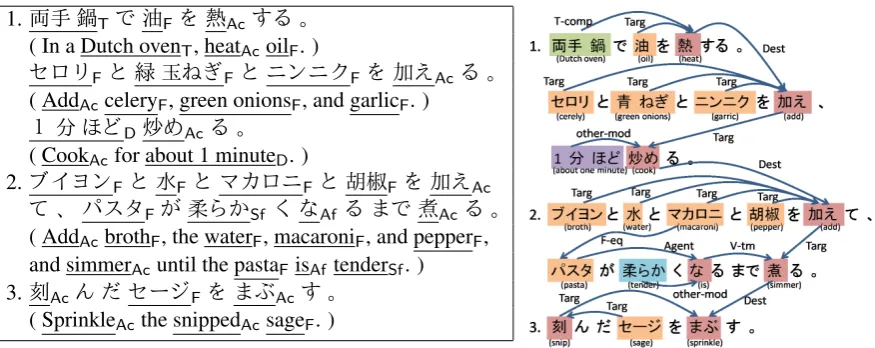
1.両手 鍋Tで 油Fを 熱Acする 。 ( In a Dutch ovenT, heatAcoilF. )
セロリFと 緑 玉ねぎFと ニンニクFを 加えAcる 。 ( AddAcceleryF, green onionsF, and garlicF. )
1 分 ほどD炒めAcる 。 ( CookAcfor about 1 minuteD. )
2.ブ イヨンFと 水Fと マカロニFと 胡椒Fを 加えAc て 、 パスタFが 柔らかSf く なAf る まで 煮Acる 。 ( AddAcbrothF, the waterF, macaroniF, and pepperF,
and simmerAcuntil the pastaFisAf tenderSf. )
[image:3.595.75.513.65.239.2]3.刻Acん だ セージFを まぶAcす 。 ( SprinkleActhe snippedAcsageF. )
Figure 1: Examples of a procedural text and its flow graph.
(Naim et al., 2014; Rohrbach et al., 2013). In these researches, the NLP part is very naive. They just identify the nouns in the text and apply a sequence-based alignment tool. Now the machine translation community is shifting to the tree-based approach to capture structural differences in two languages. The flow graph representation enables grounding of tuples consisting of an action and its target objects, and also absorbs the difference in the execution order of a procedural text and the video recording its execution.
Although NLU is the major scientific problem of AI, procedural text understanding is important from the viewpoint of applications as well. For cooking recipes for example, on which we test our framework in this paper, we can realize a more in-telligent search engine, summarization, or a help system (Wang et al., 2008; Yamakata et al., 2013; Hashimoto et al., 2008).
3 Recipe Flow Graph Corpus
As a test bed of the text parsing problem, we adopt the recipe flow graph corpus (r-FG corpus) (Mori et al., 2014). To our best knowledge, this is the only corpus annotated with flow graphs that matches with our requirements. In addition cook-ing recipes are representative procedural texts de-scribing very familiar activities of our daily life, and its meaning representation has various appli-cations. Our framework is, however, not limited to this corpus.
3.1 r-FG Corpus
The r-FG corpus contains randomly crawled recipes in Japanese from a famous Internet recipe
#recipes #sentences #NEs #words
200 1,303 7,268 25,446
Table 1: Corpus statistics.
site.1 The specification of the corpus is shown in
Table 1. The text part of a recipe consists of a se-quence of steps and the steps have some sentences. All the concepts (entities and actions) appearing in the sentences are identified and annotated with a concept tag.2 The text part is annotated with a
rooted DAG representing its meaning as shown in Figure 1.
3.2 Vertices
Each vertex of a flow graph corresponds to a con-cept represented by a word sequence in the text and a concept type such as food, tool, action. Ta-ble 2 lists the concept types along with the aver-age number of occurrences per recipe. There is one special vertex, root, corresponding to the final dish. In the Figure 1 example, the node of “splin-kle” is the root.
3.3 Arcs
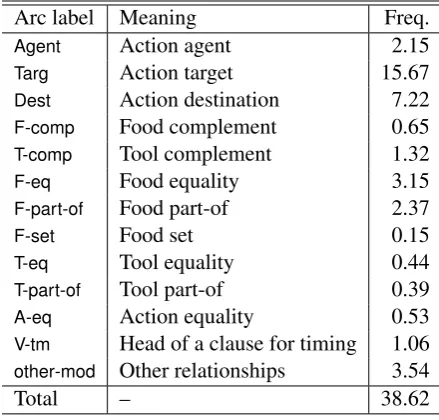
An arc between two vertices indicates that they have a certain relationship. An arc has a label de-noting its relationship type. Table 3 lists the arc types with their average frequencies per recipe. The most interesting relationships may be coref-erences and null-instantiated arguments. In
Fig-1http://cookpad.com(accessed on 2015 May 19) 2In the original r-FG paper (Mori et al., 2014), they call
Concept tag Meaning Freq.
F Food 11.87
T Tool 3.83
D Duration 0.67
Q Quantity 0.79
Ac Action by the chef 13.83
Af Action by foods 2.04
Sf State of foods 3.02
St State of tools 0.30
[image:4.595.81.283.61.202.2]Total – 36.34
Table 2: Concept tags with frequencies per recipe.
Arc label Meaning Freq.
Agent Action agent 2.15
Targ Action target 15.67
Dest Action destination 7.22
F-comp Food complement 0.65
T-comp Tool complement 1.32
F-eq Food equality 3.15
F-part-of Food part-of 2.37
F-set Food set 0.15
T-eq Tool equality 0.44
T-part-of Tool part-of 0.39
A-eq Action equality 0.53
V-tm Head of a clause for timing 1.06
other-mod Other relationships 3.54
Total – 38.62
Table 3: Arc labels with frequencies per recipe.
ure 1 for example, “macaroni” is equal to “pasta.” According to the world knowledge, macaroni is a sort of pasta, but in this recipe they are identi-cal. An example of a null-instantiated argument is the relationship between “heat” and “add.” Celery etc. should be added not to the initial cold Dutch oven without oil but to the hot Dutch oven with oil, which is the implicit result of the action “heat.” 4 Overview of Procedural Text
Understanding
Our framework of procedural text understanding consists of the following three processes combined in the cascaded manner.
1. Word segmentation (WS) 2. Concept identification (CI) 3. Flow graph estimation
The input of WS is a raw sentence and the out-put is a word sequence. For example the WS takes
the first sentence in Figure 1 without any tag as the input as follows:
両手鍋で油を熱する。
Then WS outputs the following word sequence separated by whitespace as the output.
両手 鍋 で 油 を 熱 する 。
The input of CI is the word sequence, the output of WS, and it identifies concepts, which are spans of words without overlap annotated with its type sequences. For the above example, the CI outputs three concepts as follows:
両手 鍋Fで 油Fを 熱Acする 。
This part is similar to NER. Contrary to a nor-mal NER, however, our method does not require POS tag for the words in the input. Thus we do not need to adapt a POS tagger to the target domain. For English or other languages with obvious word boundary, we can start from CI.
Now we have a text consisting of some sen-tences with concepts identified. An example is the left hand side of Figure 1. This is the input of the flow graph estimation step and the output is a flow graph as show on the right hand side of Figure 1 for example.
In the traditional NLP approach, many sub-problems proceed after NER. Syntactic parsing clarifies the intra-sentential relationships among NEs, then anaphora/coreference resolution figures out their inter-sentential relationships. Contrary, we process the entire text at once. In the subse-quent section, we describe the above three process in detail.
5 Word Segmentation
Some languages such as Japanese or Chinese, have no obvious word boundary like whitespace in En-glish. The first step of our framework is WS. For many European languages this process is almost obvious and instead of WS we only need to de-compose some special words like “isn’t” to “is” + “not” in English or “du” to “de” + “le” in French.
For WS we adopt the pointwise method (Neu-big et al., 2011) because of its flexibility for lan-guage resource addition.3 This characteristics is
suitable especially for domain adaptation. Below we explain pointwise WS briefly and our method to improve its accuracy for user generated recipes.
3An implementation and the default model for the
[image:4.595.71.291.233.443.2]Type Feature setting
Character xi−2,xi−1,xi,xi+1,xi+2,xi+3,
n-gram xi−2xi−1,xi−1xi,xixi+1,xi+1xi+2,xi+2xi+3,
xi−2xi−1xi,xi−1xixi+1,xixi+1xi+2,xi+1xi+2xi+3
Character c(xi−2),c(xi−1),c(xi),c(xi+1),c(xi+2),c(xi+3),
type c(xi−2)c(xi−1),c(xi−1)c(xi),c(xi)c(xi+1),c(xi+1)c(xi+2),c(xi+2)c(xi+3),
n-gram c(xi−2)c(xi−1)c(xi),c(xi−1)c(xi)c(xi+1)c(xi)c(xi+1)c(xi+2),c(xi+1)c(xi+2)c(xi+3)
Dictionary d(xi−2xi−1xixi+1),d(xi−1xixi+1xi+2),d(xixi+1xi+2xi+3)
[image:5.595.72.530.63.191.2]L(· · ·xi−2xi−1xi),R(xi+1xi+2xi+3· · ·)
Table 4: Features for word segmentation. The fuctionc(·) maps a character into one of six character types: symbol, alphabet, arabic, numberhiragana,katakana, andkanji. The fuctiond(·)returns whether the string is in the dictionary or not. And the functionsL(·)andR(·)return whether substrings of any length on the left hand side or right hand side match with a dictionary entry.
5.1 Pointwise Method
The pointwise method formulate WS as a binary classification problem, estimating boundary tags
bI−1 1. Tag bi = 1 indicates that a word bound-ary exists between charactersxi andxi+1, while
bi = 0 indicates that a word boundary does not exist. This classification problem can be solved by tools in the standard machine learning toolbox such as support vector machines (SVMs).
The features are character n-grams surround-ing the decision point i, which are substrings of xi−2xi−1xixi+1xi+2xi+3, character type
n-grams, and whether charactern-grams matches an entry in the dictionary or not. Table 4 lists the fea-tures.
As we can see, the pointwise WS does not refer to the other decisions, thus we can train it from a partially segmented sentences, in which only some points between characters are annotated with word boundary information.
5.2 Domain Adaptation
As the WS adaptation to recipes, we convert the r-FG corpus into partially segmented sentences fol-lowing (Mori and Neubig, 2014). In the corpus only r-NEs are segmented into words. That is to say, only both edges of the r-NEs and the inside of the r-NEs are annotated with word boundary infor-mation. If the r-NE in focus isホットドッグ com-posed of two words, then the partially segmented sentences are
ex.) 各|ホ-ッ-ト|ド-ッ-グ|に チ リ 、…, ex.) |ホ-ッ-ト|ド-ッ-グ|を ア ル ミ…, where the symbols “|,” “-,” and “ ” mean word boundary, no word boundary, and no information,
Type Feature setting
Word wi−2,wi−1,wi,wi+1,wi+2,
n-gram wi−2wi−1,wi−1wi,wiwi+1,wi+1wi+2,
wi−2wi−1wi,wi−1wiwi+1,wiwi+1wi+2
Table 5: Features for concept identification.
respectively. Then we use the partially annotated sentences which we obtained in this way as an ad-ditional language resource to train the model.
6 Concept Identification
The second step is the concept identification. The concept in the text parsing problem is a span of words without overlap annotated with its type. Thus the concept identification (CI) can be solved in the same manner as the named entity recog-nition (NER). NER is a sequence labeling prob-lem and many solutions have been proposed so far (Borthwick, 1999; Sang and Meulder, 2003,inter alia).
The standard NER method is based on linear chain conditional random fields (CRFs). In this paper we use an NER which allows a partially an-notated corpus as a training data as well as a nor-mal fully annotated corpus (Mori et al., 2012).4 In
the training step this NER estimates the parame-ters of a classifier based on logistic regression (Fan et al., 2008) from sentences fully (or partially) annotated with NEs (concepts). The features are word n-grams surrounding the word in the focus wi, Table 5 lists the features.
4CRFs are also trainable from a partially annotated corpus
At run-time, given a word sequence, the classi-fier enumerates all possible BIO2 tagsti for each wordwiwith their probabilities as follows:
PLR(ti|w−, wi,w+),
where w− andw+ are the word sequences
pre-ceding it and following it, respectively. Then this NER searches for the tag sequence of the high-est probability satisfying the tag sequence con-straints.5
7 Parsing an Entire Text
The final step is to build a flow graph. The input is a text whose sentences are segmented into words and all the concepts are identified. We call this part a text parsing. As we mentioned in Section 1, text parsing deals with various language phe-nomena at once, such as dependency, predicate-argument structure, and anaphora/coreference.
For text parsing we extend an MST parser (Mc-Donald et al., 2005). Since the flow graph is a la-beled DAG, we add some lala-beled arcs to the MST. Below we explain the processes one by one.
7.1 Spanning Tree Estimation
We first build a labeled spanning tree covering all the concepts (vertices) of the input text. LetV be a set of vertices andGbe a set of possible spanning trees on V. We assume that there exists a score functions(u, v, l)which represents the likelihood of making a labeled arc fromu tov with labell. Then the maximum spanning tree (MST) can be found as follows:
ˆ
G=argmax
G∈G
∑
(u,v,l)∈G
s(u, v, l).
We solve this problem using the Chu-Liu-Edmonds algorithm (Chu and Liu, 1965; Ed-monds, 1967). We define the score function s(u, v, l)as a probability6:
s(u, v, l) = ∑exp{Θ·f(u, v, l)}
(x,r)∈(V\{u})×L
exp{Θ·f(u, x, r)}.
Here L is the arc label set (See Table 3), Θ is a vector of weight parameters and f(u, v, l) is a
5For example, the tag sequenceF-I T-Iis invalid. 6This is the probability of a directed arc with labellfrom
a fixed vertexu, but not a probability over all the directed arcs. We have tried the latter scoring function but the result was worse than the former scoring function which we report in this paper.
1: G←Maximum spanning tree ofV.
2: A←Sequence of arcs that can be added toG without violating the acyclic condition. 3: SortAin the descending order of the value of
the score functions. 4: n←1
5: for(u, v)∈Ado
6: if G ∪ {(u, v)} is acyclic and p(n) < s(u, v)then
7: G←G∪ {(u, v)}
8: n←n+ 1
9: end if 10: end for 11: returnG
Figure 2: Algorithm of DAG estimation
function that maps a labeled arc into a feature vec-tor. The score function s(u, v, l) computes the probability of making a labeled arc from u to v with labellreferring to their word sequences, con-cept tags, surrounding words in the original recipe text, and labell. A detailed description is given in Subsection 7.3.
We use a log-linear model (Berger et al., 1996) in order to train the weight parameters Θ. Let {(Vt, ut, vt, lt)}T
t=1 denote a set ofT training
in-stances, where Vt is a set of the vertices and
(ut, vt, lt)is a gold standard arc with labellin the t-th training instance. Given these training exam-ples, weight parameters are estimated so that they maximize the following likelihood:
T
∑
t=1
log ∑exp(Θ·f(ut, vt, lt)
(x,r)∈(Vt\{ut})×L
exp(Θ·f(ut, x, r))− 1 2kΘk2.
Because our flow graph is not a tree but a DAG, there can be more than one arcs outgoing from a single vertex. In other words it may contain two arcs, (u, v, l) and(u, v0, l0), which share the same start vertex u. In these cases, we add both
(V, u, v, l)and(V, u, v0, l0)to the training data.
7.2 Arc Addition
Given the labeled MSTG, we add some labeled arcs to form a flow graph of a labeled DAG with a root. Our algorithm for adding arcs is described in Figure 2.
s(v, w, l) is the same score function used in the MST estimation andp(n)is a function that gives a penalty when then-th additional arc is added to G. Thus the arc of the highestsis added if thes value is larger than the penaltyp(n).
We adopt an exponentially increasing function as the penalty functionp(n)with parametersλand ξas follows7:
p(n) = λe−λnξ .
The denominator on the right-hand side is an expo-nential distribution with parameterλ. The numer-atorξis a scale parameter. At the training step we first estimateλwhich minimizes the square error between the training-data distribution of the num-ber of arcs added to the tree and the exponential distribution. Then we chooseξ which maximizes the F-measure on the held-out data, a small portion of training data, as we do in the deleted interpola-tion method (Jelinek, 1985).
7.3 Features
The feature function outputs a high dimensional feature vector that represents a characteristic of a labeled arc(u, v, l).
We extract features from labeled arcs (u, v, l)
by two processes: first we extract features from the arc and input recipe text and then we concatenate the label l to each feature we extract. First the following features are extracted from the input arc
(u, v)and the recipe text:
F1: The number of concepts existing between u andv with sign, which is +1 ifuis left to v and -1 otherwise,
F2: Whetheruandvare in the same sentence,
F3: Whetheruandvare in the same step,
F4: Word sequences, pronunciation and concept tags of eachuandv,8
F5: Three preceding words and three following words for bothuandv,
F6: concept tag ofu∧concept tag ofv,
7The reason is that, in small training data, the
relation-ship between the number of additional arcs and the number of the flow graph matched with an exponentially decreasing function well.
8The pronunciations are automatically estimated based on
the method described in (Mori and Neubig, 2011).
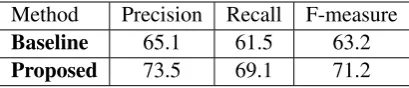
Method Precision Recall F-measure
Baseline 65.1 61.5 63.2
[image:7.595.314.519.64.108.2]Proposed 73.5 69.1 71.2
Table 6: Accuracies of the baseline and proposed methods.
F7: concept tag ofu∧concept tag ofv∧whether uandvare in the same sentence,
F8: concept tag ofu∧concept tag ofv∧whether
Ac exists betweenuandv∧whether a func-tion word exists betweenuandv,
F9: concept tag ofu∧concept tag ofv∧function words betweenuandv.
Here the symbol ∧ indicates the combination of individual features.
Next we simply concatenate the label l with each feature to construct feature vectors of labeled arcs. For example, we extracts a feature “concept tag of u ∧ concept tag ofv.” Then, this type of feature becomes “l∧concept tag ofu∧concept tag ofv.” by concatenating the labell. The same concatenation of a label is done on the other fea-tures.
So-called higher order features which refer to the neighboring vertices in the DAG are common in work on dependency parsing (McDonald et al., 2006; Koo and Collins, 2010), but we do not use these kinds of features because we only have 200 recipes annotated with DAGs9. This number is
much smaller than roughly 40,000 sentences of the Wall Street Journal which are commonly used to train dependency parsers (Marcus et al., 1994).
8 Evaluation
We evaluated our framework on the r-FG corpus described in Table 1. We executed 10-fold cross validation for more reliable results.
DAG estimation accuracy is measured by the F-measure of labeled arcs, which is the harmonic mean of precision and recall. LetNsys,Nref, and Nintbe the number of the estimated arcs, the gold standard arcs, and their intersection, respectively. Then precision =Nint/Nsys, recall =Nint/Nref, and F-measure =2Nint/(Nref+Nsys).
9Mori et al. (2014) state that it took about one our to
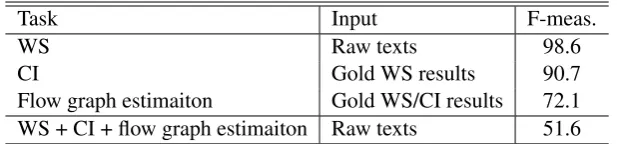
Task Input F-meas.
WS Raw texts 98.6
CI Gold WS results 90.7
[image:8.595.145.454.62.134.2]Flow graph estimaiton Gold WS/CI results 72.1 WS + CI + flow graph estimaiton Raw texts 51.6
Table 7: F-measure of each task and the overall task.
8.1 Flow Graph Estimation
As the first evaluation, we compared the simple application of the MST parser and our extension. We assumed the gold WS and CI results.
8.1.1 Settings of Flow Graph Estimation
We compared two methods in the following way.
Baseline A naive method for the text parsing is a simple application of MST parser (McDon-ald et al., 2005) to a concept sequence input. An MST parser takes a sequence of words an-notated with POSs and outputs a labeled tree connecting all the words. Thus our baseline for flow graph estimation takes a sequence of concepts (pairs of a word sequence and a con-cept type) as the input. The output of an MST parser is a tree, but not a DAG. So we add our arc addition module for a fair compari-son. As the implementation, we modified a Japanese dependency parser (Flannery et al., 2012) that uses the logistic regression as the scoring function.
Proposed This combines the spanning tree es-timation (Subsection 7.1) and the arc addi-tion (Subsecaddi-tion 7.2) in the cascaded manner. Different from theBaseline, this method re-ferred to words not included in concepts such as function words as the features .
Table 6 shows the accuracies of the baseline method and our MST extension. We can see that there is a significant difference in accuracy be-tweenBaselineandProposed. The major differ-ence between these two methods is whether or not they refer to the words not covered by the con-cepts in the original texts, such as in F5 for ex-ample. These words are mainly function words. Therefore we can say that the function words are, as we know intuitively, important for the relation-ships among the concepts.
8.2 Text Parsing on a Raw Text
We also executed the text parsing taking a raw text as the input. For this problem, we combine WS,
CI, and flow graph estimation (Proposed) in the cascaded manner.
The performance measurement is F-measure. Different from the first experiment, the unit is a triplet(hws, csi,hwe, cei, l). Here,wsandcsare the word sequence of the out-going vertex of the arc and its concept type, respectively. we andce are those of its in-coming vertex. Andlis its label. A triplet is correct if and only if all these elements match with those of an arc in the manually anno-tated data.
8.2.1 Settings of Word Segmentation and Concept Identification
We built an automatic word segmenter and an au-tomatic concept identifier in the following way.
WS: The word segmenter (see Section 5) is trained on the following corpora.
1. Balanced Corpus of Contemporary Written Japanese (Maekawa, 2008) containing fully segmented 53,899 sentences from newspaper articles, books, magazines, whitepapers, Web logs, and Web QAs.
2. The partially segmented sentences de-rived from 208 recipes in the r-FG cor-pus and additional 208 recipes anno-tated with concept types. In the exper-iment, we excluded the test part in 10-fold cross validation. Thus we built 10 models in total.
3. Partially annotated 1,651 sentences crawled from another recipe Web site10. CI: The concept identifier (see Section 6) is trained on the corpus 2. used in the WS train-ing in the same way. Thus we built 10 models in total for 10-fold cross validation11. 10http://park.ajinomoto.co.jp/ accessed on
2014/May/21.
11We made this concept identifier with the model
8.2.2 Results
Table 7 shows the accuracies of WS, CI, and flow graph estimation on the gold results of the preced-ing task and that of the combination of three tasks starting from a raw text to a flow graph.
As we see in the table, the flow graph estimation task is the most difficult and has a large room for improvement. The accuracy of WS without adap-tation was about 95% and our adapadap-tation tech-nique raised it to about 99% which is as high as in the general domain case. The accuracy of CI, trained on less than 3,000 sentences, is as high as the general NER whose accuracy is about 90% by a model trained on about 10,000 sentences. This is still lower than WS accuracy, so the concept iden-tifier is also a target of improvement.
From Table 7, the accuracy of the cascade com-bination of three tasks (WS + CI + flow graph estimation) is 51.6. This value is lower than the simple multiplication result that assumes the inde-pendence among the tasks 57.2 = (0.9861.27 ×
0.907)2×0.721×100, where 1.27 is the average
word length of the concepts. This indicates that it is worth trying to investigate joint methods for WS, CI, and flow graph estimation.
9 Conclusion
In this paper, we proposed a framework of pro-cedural text understanding consisting of the three processes. The first process is the well-known word identification. The second one is concept identification, which can be solved in the same way of named entity recognition with different definition of named entities. The third one is our original text parsing, which estimates a flow graph taking a text and the concepts in it as the input.
We tested our framework on recipe texts man-ually annotated with a flow graph. The results showed that our method outperforms a naive ap-plication of an MST dependency parser. Thus we can say that the simple application of dependency parsing to flow graph estimation does not work well, and that it is important to focus on not only concepts but also words surrounding them. Finally we evaluated the full automatic process of build-ing a flow graph from a raw text. Our result can be a solid baseline for future improvement in the procedural text understanding problem.
Our method is applicable to various procedural texts allowing us to realize more intelligent search engine for how-to texts, more sophisticated
sym-bol grounding by combining NLP and CV, etc. Acknowledgments
This work was supported by JSPS Grants-in-Aid for Scientific Research Grant Numbers 26280084, 26280039, and 24240030.
References
Adam L. Berger, Stephen A. Della Pietra, and Vin-cent J. Della Pietra. 1996. A maximum entropy approach to natural language processing. Compu-tational Linguistics, 22(1).
Andrew Borthwick. 1999. A Maximum Entropy Ap-proach to Named Entity Recognition. Ph.D. thesis, New York University.
Sabine Buchholz and Erwin Marsi. 2006. CoNLL-X shared task on multilingual dependency parsing. In
Proceedings of the Tenth Conference on Computa-tional Natural Language Learning, pages 149–164. Nancy A. Chinchor. 1998. Overview of
MUC-7/MET-2. In Proceedings of the Seventh Message Under-standing Conference.
Yoeng-Jin Chu and Tseng-Hong Liu. 1965. On the shortest arborescence of a directed graph. Science Sinica, 14:1396–1400.
Jack Edmonds. 1967. Optimum branchings. Jour-nal Research of the NatioJour-nal Bureau of Standards, 71B:233–240.
Rong-En Fan, Kai-Wei Chang, Cho-Jui Hsieh, Xiang-Rui Wang, and Chih-Jen Lin. 2008. LIBLINEAR: A library for large linear classification. Journal of Machine Learning Research, 9:1871–1874.
Raquel Fern´andez, Jonathan Ginzburg, and Shalom Lappin. 2004. Classifying ellipsis in dialogue: A machine learning approach. In Proceedings of the 20th International Conference on Computational Linguistics, pages 240–246.
Daniel Flannery, Yusuke Miyao, Graham Neubig, and Shinsuke Mori. 2012. A pointwise approach to training dependency parsers from partially anno-tated corpora. Journal of Natural Language Pro-cessing, 19(3).
Reiko Hamada, Ichiro Ide, Shuichi Sakai, and Hide-hiko Tanaka. 2000. Structural analysis of cook-ing preparation steps in Japanese. In Proceedings of the fifth International Workshop on Information Retrieval with Asian Languages, pages 157–164. Atsushi Hashimoto, Naoyuki Mori, Takuya Funatomi,
Atsushi Hashimoto, Tetsuro Sasada, Yoko Yamakata, Shinsuke Mori, and Michihiko Minoh. 2014. Kusk dataset: Toward a direct understanding of recipe text and human cooking activity. InProceedings of the SixthInternational Workshop on Cooking and Eating Activities.
Frederick Jelinek. 1985. Self-organized language modeling for speech recognition. Technical report, IBM T. J. Watson Research Center.
Terry Koo and Michael Collins. 2010. Efficient third-order dependency parsers. In Proceedings of the 48th Annual Meeting of the Association for Compu-tational Linguistics, pages 1–11.
Kikuo Maekawa. 2008. Balanced corpus of con-temporary written Japanese. In Proceedings of the 6th Workshop on Asian Language Resources, pages 101–102.
Mitchell Marcus, Grace Kim, Mary Ann Marcinkiewicz, Robert MacIntyre, Ann Bies, Mark Ferguson, Karen Katz, and Britta Schas-berger. 1994. The penn treebank: Annotating predicate argument structure. InProceedings of the ARPA Workshop on Human Language Technology, pages 114–119.
Ryan McDonald, Fernando Pereira, Kiril Ribarov, and Jan Hajiˇc. 2005. Non-projective dependency pars-ing uspars-ing spannpars-ing tree algorithms. In Proceed-ings of Human Language Technology Conference and Conference on Empirical Methods in Natural Language Processing, pages 523–530.
Ryan McDonald, Kevin Lerman, and Fernando Pereira. 2006. Multilingual dependency analysis with a two-stage discriminative parser. In Proceedings of the Tenth Conference on Computational Natural Lan-guage Learning, pages 216–220.
Bernard Merialdo. 1994. Tagging English text with a probabilistic model. Computational Linguistics, 20(2):155–171.
Yoshio Momouchi. 1980. Control structures for ac-tions in procedural texts and PT-chart. In Proceed-ings of the Eighth International Conference on Com-putational Linguistics, pages 108–114.
Shinsuke Mori and Graham Neubig. 2011. A point-wise approach to pronunciation estimation for a TTS front-end. InProceedings of the InterSpeech2011, pages 2181–2184, Florence, Italy.
Shinsuke Mori and Graham Neubig. 2014. Language resource addition: Dictionary or corpus? In Pro-ceedings of the Nineth International Conference on Language Resources and Evaluation, pages 1631– 1636.
Shinsuke Mori, Tetsuro Sasada, Yoko Yamakata, and Koichiro Yoshino. 2012. A machine learning ap-proach to recipe text processing. In Proceedings of the 1st Cooking with Computer Workshop, pages 29–34.
Shinsuke Mori, Hirokuni Maeta, Yoko Yamakata, and Tetsuro Sasada. 2014. Flow graph corpus from recipe texts. InProceedings of the Nineth Interna-tional Conference on Language Resources and Eval-uation, pages 2370–2377.
Iftekhar Naim, Young Chol Song, Qiguang Liu, Henry Kautz, Jiebo Luo, and Daniel Gildea. 2014. Unsu-pervised alignment of natural language instructions with video segments. InProceedings of the 28th Na-tional Conference on Artificial Intelligence.
Graham Neubig, Yosuke Nakata, and Shinsuke Mori. 2011. Pointwise prediction for robust, adaptable Japanese morphological analysis. InProceedings of the 49th Annual Meeting of the Association for Com-putational Linguistics, pages 529–533.
Leif Arda Nielsen. 2004. Verb phrase ellipsis detection using automatically parsed text. In Proceedings of the 20th International Conference on Computational Linguistics, pages 1093–1099.
Vignesh Ramanathan, Percy Liangy, and Li Fei-Fei. 2013. Video event understanding using natural lan-guage descriptions. In Proceedings of the 14th In-ternational Conference on Computer Vision.
Michaela Regneri, Marcus Rohrbach, Dominikus Wet-zel, Stefan Thater, Bernt Schiele, and Manfred Pinkal. 2013. Grounding action descriptions in videos. Transactions of the Association for Com-putational Linguistics, 1:25–36.
Marcus Rohrbach, Wei Qiu, Ivan Titov, Stefan Thater, Manfred Pinkal, and Bernt Schiele. 2013. Translat-ing video content to natural language descriptions. InProceedings of the 14th International Conference on Computer Vision.
Erik F. Tjong Kim Sang and Fien De Meulder. 2003. Introduction to the conll-2003 shared task: Language-independent named entity recognition. In
Proceedings of the Seventh Conference on Computa-tional Natural Language Learning, pages 142–147.
Tetsuro Sasada, Shinsuke Mori, Tatsuya Kawahara, and Yoko Yamakata. 2015. Named entity recognizer trainable from partially annotated data. In Proceed-ings of the Eleventh International Conference Pa-cific Association for Computational Linguistics.
Hirotoshi Taira, Sanae Fujita, and Masaaki Nagata. 2010. Predicate argument structure analysis using transformation-based learning. In Proceedings of the 48th Annual Meeting of the Association for Com-putational Linguistics.
Liping Wang, Qing Li, Na Li, Guozhu Dong, and Yu Yang. 2008. Substructure similarity measure-ment in Chinese recipes. InProceedings of the 17th International Conference on World Wide Web, pages 978–988.
Yuk Wah Wong and Raymond Mooney. 2007. Learn-ing synchronous grammars for semantic parsLearn-ing with lambda calculus. In Proceedings of the 45th Annual Meeting of the Association for Computa-tional Linguistics, pages 960–967.
Yoko Yamakata, Shinji Imahori, Yuichi Sugiyama, Shinsuke Mori, and Katsumi Tanaka. 2013. Feature extraction and summarization of recipes using flow graph. InProceedings of the 5th International Con-ference on Social Informatics, LNCS 8238, pages 241–254.
Koichiro Yoshino, Shinsuke Mori, and Tatsuya Kawa-hara. 2013. Predicate argument structure analysis using partially annotated corpora. InProceedings of the Sixth International Joint Conference on Natural Language Processing.