Towards Compositional Tree Kernels
Paolo Annesi, Danilo Croce, Roberto Basili Department of Enterprise Engineering
University of Roma, Tor Vergata 00133 Roma, Italy
{annesi,croce,basili}@info.uniroma2.it
Abstract
Distributional Compositional Semantics (DCS) methods combine lexical vectors according to algebraic operators or func-tions to model the meaning of complex lin-guistic phrases. On the other hand, several textual inference tasks rely on supervised kernel-based learning, whereas Tree Ker-nels (TK) have been shown suitable to the modeling of syntactic and semantic simi-larity between linguistic instances. While the modeling of DCS for complex phrases is still an open research issue, TKs do not account for compositionality. In this pa-per, a novel kernel called Compositionally Smoothed Partial Tree Kernel is proposed integrating DCS operators into the TK es-timation. Empirical results over Seman-tic Text Similarity and Question Classifi-cation tasks show the contribution of se-mantic compositions with respect to tradi-tional TKs.
1 Introduction
Since the introduction of Landauer and Dumais in (Landauer and Dumais, 1997) and Schutze in (Sch¨utze, 1998), Distributional Semantic Models (DMSs) have been an active area of research in computational linguistics and a promising tech-nique for solving the lexical acquisition bottle-neck by unsupervised learning. However, it is very difficult to reconcile these techniques with exist-ing theories of meanexist-ing in language, which re-volve around logical and ontological representa-tions. According to logical theories (Kamp and Reyle, 1993; Blackburn and Bos, 2005), sentences should be translated to a logical form that can be interpreted as a description of the state of the world. On the contrary, vector-based techniques are closer to the philosophy of “meaning as
con-text”, relying on the Wittgenstein’s (1953) “mean-ing just is use” and Firth’s “you shall know a word by the company it keeps” and the distributional hy-pothesis of Harris (1968), that words will occur in similar contexts if and only if they have simi-lar meanings. In these years attention has been focused on the question of how to combine word representations in order to characterize a model for sentence semantics. Since these models are typically directed at the representation of isolated words, a well formed theory on how to combine vectors and to represent complex phrases still rep-resents a research topic. Distributional Composi-tional Semantic (DCS) models capture bi-gram se-mantics, but they are not sensitive to the syntactic structure yet. On the other hand, Convolution Ker-nels (Haussler, 1999) are well-known similarity functions among such complex structures. In par-ticular, Tree Kernels (TKs) introduced in (Collins and Duffy, 2001), are largely used in NLP for their ability in capturing text grammatical information, directly from syntactic parse trees.
lexi-cal semantic information, it is possible to formu-late a new kernel function based on this tree rep-resentation, that takes into account for each node a distributional compositional metrics. Thus, the idea is to i) use the SPTK formulation in order to exploit the lexical information of the leaves, ii) define a procedure to mark nodes of a con-stituency parse tree that allow to spread lexical bigrams across the non-terminal nodes, iii) apply smoothing metrics sensible to the compositional-ity between the non-terminal labels. The resulting model has been called Compositionally Smoothed Partial Tree Kernel (CSPTK).
In Section 2, a summary of approaches for DCS and TKs is presented. The entire process of mark-ing parse trees is described in Section 3. Therefore in Section 4 the CSPTK similarity function is pre-sented. Finally, in Section 5, the CSPTK model is investigated in Semantic Text Similarity (STS) and Question Classification tasks.
2 Related Work
Distributional Compositional Semantics. Vector-based models typically represent isolated words and ignore grammatical structure (Turney and Pantel, 2010). They have thus a limited capability to model compositional operations over phrases and sentences. In order to overcome these limitations, Distributional Compositional Semantics (DCS) models have been investigated. In (Smolensky, 1990) compositionality of two vector!uand!vis accounted by the tensor product !u⊗!v, while in (Foltz et al., 1998) lexical vectors are summed, keeping the resulting vector with the same dimension of the input ones. In (Mitchell and Lapata, 2008) two general classes of composi-tional models have been defined: a linear additive model!p = A!u+B!vand a multiplicative model !
p = C!u!v. A andB are weight matrices and C is a weight tensor that project lexical vectors !u and!vonto the space of!p, i.e. the vector resulting from the composition.
These models usually assume that composition is a symmetric function of the constituents. While this might be reasonable for certain structures, such as lists, a model of composition based on syn-tactic structure requires some way of differentiat-ing the contributions of each constituent. In (Erk and Pado, 2008), the concept of astructured vec-tor spaceis introduced, where each word is asso-ciated to a set of vectors corresponding to
differ-ent syntactic dependencies. Noun compondiffer-ent of a composition between verb and noun is here given by an average of verbs that the noun is typically object of. In (Guevara, 2010) a regressor is trained for adjective-noun (AN) compositionality: pairs of adjective-noun vector concatenations are used as input in training data, whilst corpus-derived AN vectors as output. A similar approach was previ-ously undertaken by (Zanzotto et al., 2010).
A specific linear model of semantic composi-tion based on the idea of space projeccomposi-tion is pro-posed in (Annesi et al., 2012) for simple grammat-ical structures, i.e. syntactgrammat-ically typed bi-grams. Given a phrase such as “buy car” they project the source vectorsbuy! andcar! , into a so-called Sup-port Subspace, that is a subset of the original fea-ture space. Space Projection depends on both the two involved lexicals and selects only their ”com-mon” features: these concurrently constraint the suitable lexical interpretationlocalto the phrase.
Given two phasesp1 andp2, semantic similar-ity can be computed by first projecting the two pairs in the suitable Support Subspace and then applying the traditional cosine metrics. Projec-tion is expressed by a (filter) diagonal matrixM that projects each word into a subset of the origi-nal features. Different projections are discussed in (Annesi et al., 2012) aimed at identifying suitable semantic aspects of the underlying head/modifier relationships. The compositional similarity judg-ment between phrases p1 = (u, v) and p2 =
(u!, v!)over the support subspace ofp1is thus ex-pressed as:
Φ(◦)(p1, p2) = (M!u·M!u
!
)◦(M!v·M!v!) (1)
where first cosine similarity (·) between the
vec-tors projected in the selected support subspaces is computed and then a composition function◦, such
as the sum or the product, is applied. Notice how projection M may depend on the involved pairs in complex ways. A Support Subspace can be de-rived from just one pairpiand then being imposed to the other with a corresponding asymmetric be-havior of theΦmetrics, denoted by Φi. Alterna-tively, M can be derived from projecting in two Support Subspaces, as derived for the two pairs, and then combining them by making againΦ sym-metric. The symmetric composition function is thus obtained as the combination:
Φ(12")(p1, p2) = Φ(1◦)(p1, p2)#Φ(2◦)(p1, p2) (2)
into the Support Subspace of p1 (andp2, respec-tively), andΦiare then combined via the! opera-tor (e.g. sum). Although Support Subspaces can-not be applied to estimate similarity between com-plex linguistic structures, they seem very effective for simple syntactic structures. In (Annesi et al., 2012) experiments over different variants of Eq. 1 and 2, i.e. different choices for projectionsMand
compositions◦and!, are there discussed. Best re-sults are obtained within the dataset introduced in (Mitchell and Lapata, 2010) when a multiplicative operator◦is used in Eq. 1.
Recently, Compositional Semantics has been used in syntactic parsing, as shown in (Socher et al., 2013) where Compositional Vector Grammars (CVGs) have been defined to extend small-state Probabilistic Context-Free Grammars, introducing distributional semantic constraints in constituency parsing: interestingly, CVGs allows to estimate the plausibility of the corresponding syntactic con-stituent within a Recursive Neural Network, by as-signing scores to nodes in the parse tree. A sim-ilar integrated contribution of lexical information (i.e. word vectors) and syntactic constituency is proposed in semantic extensions of TKs, as in-troduced in (Croce et al., 2011). As they offer a framework to define similarity metrics strongly tied to the syntactic structure of entire sentences, they will be hereafter discussed.
Tree Kernels. Kernels are representationally efficient ways to encode similarity metrics able to support complex textual inferences (e.g. se-mantic role classification) in supervised learning models. Tree Kernels (TK) as they have been early introduced by (Collins and Duffy, 2001) correspond to Convolution Kernel (Haussler, 1999) over syntactic parse trees of sentence pairs. A TK computes the number of substructures (as well as their partial fragments) shared by two parse trees T1 and T2. For this purpose, let the set F ={f1, f2, . . . , f|F|} be a space of tree fragments and χi(n) be an indicator function: it is 1 if the target fi is rooted at node n and 0 otherwise. A tree-kernel function is a function T K(T1, T2) =!n1∈NT1
!
n2∈NT2 ∆(n1, n2),
where NT1 and NT2 are the sets of the
T1’s and T2’s nodes, respectively and
∆(n1, n2) =!|F|i=1χi(n1)χi(n2). The ∆ function recursively compute the amount of sim-ilarity due to the simsim-ilarity among substructures. The type of fragments allowed determine the
expressiveness of the kernel space and different tree kernels are characterized by different choices. Lexical information has been early neglected in recursive matching, so that only exact match-ing between node labels were given a weight higher than 0, (Collins and Duffy, 2001): even when leaves are involved they must be equal, so that no lexical generalization was considered. An effective modeling of lexical information is proposed by (Croce et al., 2011), in the so called Smoothed Partial Tree Kernel (SPTK). In SPTK, the TK extends the similarity between tree structures allowing a smoothed function of node similarity. The aim of SPTK is to measure the similarity between syntactic tree structures, which are semantically related, i.e. partially similar, even when nodes, e.g. words at the leaves, differ. This is achieved with the following formulation of the function∆over nodesni∈Ti:
∆σ(n1, n2)=µλσ(n1, n2),wheren1andn2
are leaves, else ∆σ(n1, n2)=µσ(n1, n2)
!
λ2+ "
"
I1,"I2,l(I"1)=l("I2)
(3)
λd("I1)+d("I2) l#("I1)
j=1
∆σ(cn1(I#1j), cn2(I#2j)) $
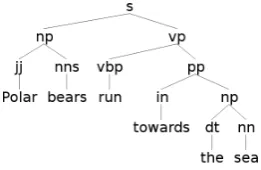
Figure 1: Constituency tree of the sentence “Polar bears run towards the sea”
functionσin Eq. 4.
3 Explicit compositions in Parse Tree In order to consider compositional semantic con-straints during a Tree Kernel computation, parse trees are here enriched to enable the definition of a Compositionally Smoothed Partial Tree Ker-nel, i.e. CSPTK. The input structures are thus tree pairs whose nodes are enriched with lexi-cal information needed for the recursive composi-tional matching foreseen by the adopted convolu-tion model. The syntactic structure of an individ-ual sentencesis the constituency-based parse tree, as shown in Figure 1. Nodes can be partitioned into: terminal nodes n (T), i.e. leaves repre-senting lexical information, in terms of!ln::posn", such aspolar::jorbear::n, wherelis the lemma of the token and pos its part-of-speech1; Pre-terminal nodes (PT) are the direct ancestors of terminals and they are marked through theposof their unique corresponding leaf; Non Pre-terminal nodes (N PT), i.e. nodes that are neither terminal nor pre-terminal and reflect the phrase type, e.g. nominal phrase (np) or verb phrase (vp). Notice that all nodes in a tree express either lexical in-formation (e.g. terminaln ∈ T) or the composi-tional information between one head and a mod-ifier corresponding to subtrees, such as the non pre-terminal inN PT. In order to model this in-formation, we need to associate each node with different types of information able to express ev-ery aspect of compositionality, i.e. lexical as well as grammatical properties. We model this infor-mation in a form of a complex mark-up of generic non pre-terminal nodesn∈ N PT, in order to ex-ploit them in a compositional extension of a tree kernel (such as in Eq. 4). Compositionality oper-ators acting on the subtrees depend on at least the following types of syntactic as well as lexical
in-1General POS tags are obtained from the PennTreebank
standard by truncating at their first char (as inbear::n).
formation:
Grammatical Types, denoted byGT, that express the grammatical category of the constituent cor-responding to the root of a subtree. Example of these types are thenporvptraditional categories of context-free grammars.
Lexical Information. Non pre-terminal nodes in general express binary grammatical relations be-tween a varying number of dominated subtrees (i.e. direct descendants). Each node can be ex-pressed in terms of an head/modifier pair, denoted by (h, m). In order to emphasize the semantic
contribution that a subtree (compositionally) ex-presses, the lexical information about the involved head (lh) and modifier (lm) lexicals must be ex-pressed: we denote this information through the 4-tuple !lh::posh,lm::posm". Notice that this in-formation can be used as an index to a distribu-tional semantic model where lexical entries are ex-pressed by unique vectors for individual lemma and POS tag pairs.
Syntactic Relations. Usually each node expresses a specific syntactical relation between the head and its modifier. Depending on linguistic theories several system of types have been proposed. As in this work, syntactic relations are only used to con-strain structural analogies between two trees, the reference relationship system adopted is not here discussed. We denote the set of syntactic relations SR, and they are usually derived by simply jux-taposing grammatical labels of the involved head and modifier, h and m, subtrees. Every relation is denoted by relh,m ∈ SR. Examples of the adopted syntactic relations are:vp/npfor verb ob-ject relation ornn/nnfor noun compounds.
Therefore, according to the definitions above, every non pre-terminaln∈ N PT is marked with the following triple
!gT, relh,m,!lh ::posh, lm::posm"" wheregT ∈ GT, relh,m ∈ SR, andli andposi are lexical entries, and POS tags. This triple en-ables the definition of a similarity function be-tween sentence pairs through the recursive com-parison of the marked subtrees. Given the recur-sive nature of a Convolution Kernel, we will show how the similarity estimation of two (sub)trees is made dependent on the semantic equivalence be-tween the triples assigned to their roots.
straightfor-wardly defined by adopting the DCS model dis-cussed in Section 2, and in particular Eq. 2. Given two subtrees inT1,T2, rooted atn1,n2, the corre-sponding head-modifier pairs (h1, m1),(h2, m2) are defined. This similarity metrics, based on the geometric projection into Support Subspace (Eq. 2), can be applied as follows:
σComp!(h1, m1),(h2, m2)"= Φ(12!)((h1, m1),(h2, m2)) (4) In particular, σComp is evaluated through the
Symmetric model introduced in (Annesi et al., 2012). This model is characterized by a projec-tionMthat selects the 50 dimensions of the space that maximize the component-wise product be-tween compounds, and by the operatordiamond that combines the similarity scores with the prod-uct function (Eq. 2). Moreover, similarity scores in each subspace are obtained by defining◦as the sum of cosine similarities in Eq. 1.
3.1 Mark-Up Rules for Constituency Trees While marking terminalT nodes and pre-terminal PT nodes is quite simple, the labeling of non pre-terminalN PT nodes is complex. Grammar spe-cific notations and rules are needed and mainly differ with respect to (1) the type of the children nodes, i.e. if they are all pre-terminal or not, and (2) the arity of the branching at the root of a sub-tree:n-ary , withn >2, can be found indeed.
N PT nodes with binary branches correspond to simple labeling, since exactly two subtrees are always involved. On the basis of the underlying CFG rule, the head and the modifier are deter-mined and labeled. In particular, the treatment of binary trees whose binary branches only involve pre-terminal nodes depends exclusively on lexical nodesn∈ T. Given two terminal nodes(n1, n2), described by#l1::pos1,l2::pos2$, the mark-up rule for their direct (non pre-terminal) ancestor is
pos2/pos1[h=n2, m=n1]←(n1, n2) (5)
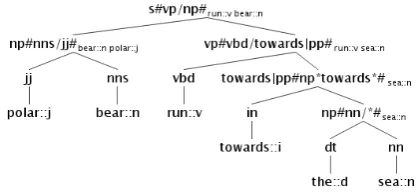
where [h = p2, m = p1] denotes that the sec-ond leaf node has been selected as the head, and the first as the modifier, while the rela-tion is relpos2,pos1. Figure 2 shows a fully la-beled tree for the sentence whose unlala-beled ver-sion has been shown in Figure 1. The np node spanning thepolar bear phrase is labeled s #np, nns/jj,(bear::n, polar::j)$.
Notice how usually the grammatical type as-signed to a node does not change the assignment
Figure 2: Marking of a Compositional con-stituency tree of the example in Figure 1
already provided by the tree. In some particular cases, the pair head h and modifier m and the syntactic relationrelh,mimplied by a node in the tree are not fully defined either because some null semantic content is encountered (e.g. a missing modifier) or because it is not possible to model some lexical as it is not present in distributional se-mantic representation. Some relations exist where the modifier seems not to carry relevant lexical in-formation, as the case of the relation between a de-terminer and a noun. In these cases, the modifier of a non pre-terminal node as well as the syntac-tic relation are neglected and null slots, i.e. ∗, are used. An example in Figure 2 is the labeling of the bi-gramthe sea.
The labeling of prepositional phrases consti-tute a somehow special case of the marking of non pre-terminal nodes N PT. The lexi-cal information carried out by prepositions is not directly expressed lexically but it is inte-grated both in the grammatical type gT and in the relh,m. This is the case of the triple
[image:5.595.317.526.65.161.2]the corresponding branches (i.e. the rightvp and the left np). When N PT nodes have more than 2 branches (e.g. all pre-terminal nodes or other
N PT nodes), criteria depending on the specific context free rules of the underlying grammar are adopted to select the proper head and modifier.
4 The Compositionally Smoothed Partial Tree Kernel
[image:6.595.309.529.395.593.2]When the compositionally enriched parse tree is available, it is possible to measure the similar-ity between this constituency structures through a Tree Kernel. We define here the Composition-ally Smoothed Partial Tree Kernel (CSPTK) as a similarity function for such that structures, by ex-tending the SPTK formulation. Let us consider the application of the SPTK on the tree shown in Figure 2. When estimating the similarity with a tree derived from sentences such as “Bear market runs towards the end” or “The commander runs the offense”, the kernel will estimate the similarity among all nodes. Then, the σ function in
Equa-tion 4 would not be able to exploit the different senses of the verb run, as a traditional distribu-tional model would provide a unique representa-tion. The aim of the CSPTK is to exploit the observable compositional relationships in order to emphasize the contributions of the compounds to the overall meaning, even where the syntactic structure does not change, such as in “run the of-fense”, i.e. attacking someone, vs. “run towards the end”.
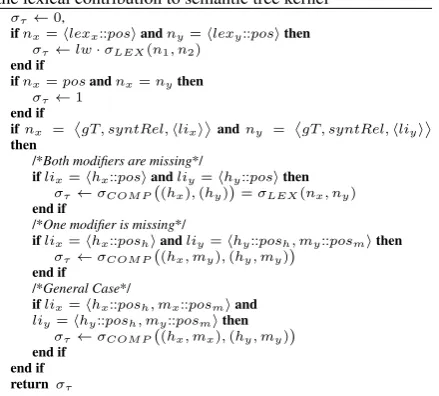
The core novelty of the CSPTK is the new es-timation of σ as described in Algorithm 1. For
the terminal nodes (i.e. LEXtype) a lexical kernel σLEX, i.e. the cosine similarity between words
sharing the same POS-Tag, is applied. Other-wise between pre-terminal nodes, a strong match-ing is required, assignmatch-ing 0/1 similarity only if pre-terminal nodes share the samePOS. The novel part
of Algorithm 1 is introduced with the similarity computation over non pre-terminal nodes. In order to activate the similarity function betweenN PT
nodes, they must have the samegT andrelh,m. In
this case, the Subspace operator in Equation 2 is applied between the involved(h, m)compounds:
lexical information pairs are checked and if their respective heads and modifiers share the corre-sponding POS, the compositional similarity
func-tion is applied.
As discussed in Section 3.1, modifier could be
missing in lexical information pair. The DCS model is applied according to three strategies:
General case. If nodes have both heads and mod-ifiers, the similarity function of Equation 4 is ap-plied as usual. Notice that thepos-tags of heads and modifiers must be the same.
A modifier is missing. An “optimistic” similar-ity estimator can be defined in this case. Let be
(hx,∗) and (hy, my) the lexical information of
two nodes x (that lacks of the modifier) and y.
The forced pair (hx, my) and the pair (hy, my)
projected and compared into their own subspaces, provide a measure of how the head hx is similar
tohy, with respect to the meaning that they evoke
together withmy. The morehx andhy could be
both modified bymyto specify the same meaning,
the higher is the received score.
Both modifiers are missing. This case is reduced to the treatment of lexical nodes (i.e. LEX type),
and no composition is observed: the lexical ker-nelσLEX, i.e. the cosine similarity between word
vectors, is adopted as no subspace is needed.
Algorithm 1στ(nx, ny, lw)Compositional estimation of the lexical contribution to semantic tree kernel
στ←0,
ifnx="lexx::pos#andny="lexy::pos#then
στ←lw·σLEX(n1, n2)
end if
ifnx=posandnx=nythen
στ←1 end if
ifnx = !gT, syntRel,"lix#"andny = !gT, syntRel,"liy#" then
/*Both modifiers are missing*/
iflix="hx::pos#andliy="hy::pos#then
στ←σCOM P#(hx),(hy)$=σLEX(nx, ny) end if
/*One modifier is missing*/
iflix="hx::posh#andliy="hy::posh, my::posm#then
στ←σCOM P#(hx, my),(hy, my)$ end if
/*General Case*/
iflix="hx::posh, mx::posm#and
liy="hy::posh, my::posm#then
στ←σCOM P #
(hx, mx),(hy, my) $ end if
end if returnστ
Notice that Algorithm 1 could be be still mod-ified further depending on how the non terminal similarity has to be strict on gT andrelh,m and
on how much is the weight of terminal and pre-terminal nodes.
5 Experimental Evaluations
similarity between sentences and as a feature to train machine learning classifiers.
5.1 Experimental Setup
In all experiments, sentences are processed with the Stanford CoreNLP2, for Part-of-speech tag-ging, lemmatization, and dependency and com-positionally enriched parsing. In order to reduce data sparseness introduce by fined grained Part-of-Speech classes, node are marked by coarse grained classes, e.g. looking:VBGorlooked:VBD are sim-plified inlook:V. In order to estimate the basic lex-ical similarity function employed in the Tree Ker-nels operators, a co-occurrence Word Space is ac-quired through the distributional analysis of the UkWaC corpus (Baroni et al., 2009). First, all words occurring more than 100 times (i.e. the tar-gets) are represented through vectors. The orig-inal space dimensions are generated from the set of the 20,000 most frequent words (i.e. features) in the UkWaC corpus. A co-occurrence Word-Space with a window of size 3 is acquired. Co-occurrencies are weighted by estimating the Point-wise Mutual Information between the 20k most frequent words. The SVD reduction is then ap-plied with a dimensionality cut ofd= 250. Left contexts are treated differently from the right ones, in order to capture asymmetric syntactic behaviors (e.g., useful for verbs): 40,000 dimensional vec-tors are thus derived for each target. Similarity between lexical nodes is estimated as the cosine similarity in the co-occurrence Word Space, as in (Croce et al., 2011).
5.2 The Semantic Text Similarity task
The first experiment aims to evaluate the contribu-tion of the Kernel-based operators in a STS task. In theCore STS taskgiven two sentences,s1and s2, participants are asked to provide a score
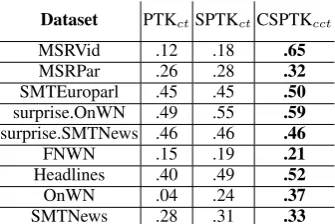
re-flecting the corresponding text similarity (Agirre et al., 2013). PTK, SPTK and CSPTK similar-ity functions are employed over the dataset of the *SEM 2013 shared task. In Table 1 results of Pearson Correlations between the Kernels opera-tors and the human scores are shown. We con-sidered all datasets composing the challenge train-ing set, i.e. MSRvid, MSRpar, SMTeuroparl, sur-prise.OnWn and surprise.SMTnews as well as the test set Headlines, FNWN and SMTnews. We did not report any comparison with the best results of
2http://nlp.stanford.edu/software/corenlp.shtml
the SemEval STS competition as those approaches are mostly supervised. On the contrary the pre-sented approach for the STS estimation is fully unsupervised. The purpose of the experiments is to i) investigate the differences between Ker-nels operators when lexical semantics (i.e. SPTK and CSPTK) is added to the syntactic information (i.e. PTK), ii) analyze the role of the the composi-tional compounds made explicit in parse trees and iii) measure the contribution of the DCS model adopted in the recursive CSPTK computation.
PTK and SPTK functions are both applied to the Constituency Tree representations, labeled with
ct, while the CSPTK model consists in: i)
lex-ical mark-up as a form of lexlex-ical compositional caching that generates the input Compositionally labeled Constituency Tree representation (denoted by cct) as introduced and discussed in Section 3
and ii) the matching function among the subtrees 3
Dataset PTKctSPTKctCSPTKcct
MSRVid .12 .18 .65
MSRPar .26 .28 .32
SMTEuroparl .45 .45 .50
surprise.OnWN .49 .55 .59
surprise.SMTNews .46 .46 .46
FNWN .15 .19 .21
Headlines .40 .49 .52
OnWN .04 .24 .37
[image:7.595.333.501.342.454.2]SMTNews .28 .31 .33
Table 1: Unsupervised results of Pearson correlation for Kernel-based features adopted in *SEM - Task 6 datasets
First and second columns in Table 1 show Pear-son results of PTKctand SPTKctfunctions applied
over a constituency tree, while the last column shows the CSPTKcctresults over the
composition-ally labeled tree. Notice how the introduction of the compositionality enrichment in a constituency tree structure, together with the CSPTK function led to a performance boost over all the training and test datasets. In some cases, the boost between SPTKct and CSPTKcct is remarkable, switching
from .18 to .65 in MSRvid and from .24 to .37
in OnWN.
The above difference is mainly due to the in-creasing sensitivity of PTK, SPTK and CSPTK to the incrementally rich lexical information. This is especially evident in sentence pairs with very
3For the SPTK, we selected the parametersλ= 0.1,µ= 0.1and lexical weight = 100 that provided best results in (Croce et al., 2012). Otherwise for CSPTK we selected
similar syntactic structure. For example in the MSRvid dataset, a sentence pair is given by The man are playing soccerandA man is riding a mo-torcycle, that are strictly syntactically correlated. As a side effect, PTK provides a similarity score of.647between the two sentences. It is a higher score with respect to the SPTK and CSPTK: dif-ferences between tree structures are confined only to the leaves. By scoring.461, SPTK introduces an improvement as the distributional similarity (function σ in Eq. 4) that acts as a smoothing factor between leaves better discriminates uncor-related words, likemotorcycleandsoccer. How-ever, ambiguous words such verbs ride andplay are still promoting a similarity that is locally mis-leading. Notice that both PTK and SPTK receive a strong contribution in the recursive computation of the kernels by the left branching of the tree, as the subject is the same, i.e. man. Compositional information about direct objects (soccer vs. mo-torcycle) is better propagated by the CSPTK op-erator. Its final scores for the pair is .36, as se-mantic differences between the sentences are em-phasized. Even if grammatical types strongly con-tribute to the final score (as in PTK or SPTK), now the DCS computation over these nodes (the com-pounds traced from the leaves, i.e. (ride::v, mo-torcycle::n) and (play::v, soccer::n) is faced with less ambiguous verb phrases, that contribute with lower scores.
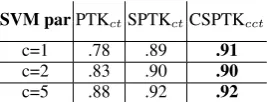
5.3 CSPTK for Question Classification Thanks to structural kernel similarity, a question classification (QC) task can be easily modeled by representing questions, i.e., the classification tar-gets, with their parse trees. The aim of the ex-periments is to analyze the role of lexical simi-larity embedded in the compositionally enriched constituency trees by the CSPTK operator. Thus, questions have been represented by the classic constituency tree, i.e. ct, and by the composition-ally enriched variant, i.e.cct. The first representa-tion is used over PTK and SPTK funcrepresenta-tions, while the latter over the CSPTK function. Our referring corpus is the UIUC dataset (Li and Roth, 2002). It is composed by a training set of 5,452 questions and a test set of 500 questions4. The latter are organized in six coarse-grained classes, i.e. AB-BREVIATION, ENTITY, DESCRIPTION, HU-MAN, LOCATION and NUMBER. For learning
4http://cogcomp.cs.illinois.edu/Data/QA/QC/
our models we employed LIBSVM5after comput-ing the entire Gram Matrix. The F1 of SVMs using (i) PTK and SPTK applied to ct and (ii) CSPTK applied tocct for QC, is reported in Ta-ble 2. Notice that we want to carry out a compar-ative evaluation of different syntactic kernels and not to optimize the QC accuracy as this requires a combination of lexical and syntagmatic kernels as discussed in (Croce et al., 2011). The results are in general outperforming the alternative ker-nel formulations, even if the improvement is mod-est. First, we outline that a more stable behavior wrtparameters is observed, with a corresponding lower risk of over-fitting the training data. Second, it is to be noticed that a large number of questions have a really simple syntactic structure: as a con-sequence the interrogative form of the sentence is very simple and very few compositional phenom-ena are observed that are captured by the distribu-tional information about word vectors.
SVM parPTKctSPTKctCSPTKcct
c=1 .78 .89 .91
c=2 .83 .90 .90
[image:8.595.350.484.343.394.2]c=5 .88 .92 .92
Table 2:Results in the Question Classification task
6 Conclusions
In this paper, a novel kernel function has been pro-posed in order to exploit Distributional Compo-sitional operators within Tree Kernels. The pro-posed approach propagates lexical semantic infor-mation over an entire constituency parse tree, by building a Compositionally labeled Constituency Tree. It enables the definition of the Composi-tional Smoothed Partial Tree Kernel as a Con-volution Kernel that measures the semantic sim-ilarity between complex linguistic structures by applying metrics sensible to the compositional-ity. First empirical results of the CSPTK in STS and QC tasks demonstrate the robustness and the generalization capability of the proposed kernel. Future investigation is needed in the adoption of the same compositionality perspective on depen-dency graphs, were the compositional represen-tations of the head/modifier compound are even more explicit. Further experiments for assessing the methodology are also foreseen against other NLP-tasks, e.g. verb classification.
References
Eneko Agirre, Daniel Cer, Mona Diab, Aitor Gonzalez-Agirre, and Weiwei Guo. 2013. *sem 2013 shared
task: Semantic textual similarity. In Second Joint
Conference on Lexical and Computational Seman-tics (*SEM), Volume 1: Proceedings of the Main Conference and the Shared Task: Semantic Textual Similarity, pages 32–43, Atlanta, Georgia, USA, June. Association for Computational Linguistics.
P. Annesi, V. Storch, and R. Basili. 2012. Space pro-jections as distributional models for semantic
com-position. In In Proceedings of CICLing 2012,
vol-ume 7181 of Lecture Notes in Computer Science,
pages 323–335. Springer.
M. Baroni, S. Bernardini, A. Ferraresi, and E. Zanchetta. 2009. The wacky wide web: a collection of very large linguistically processed
web-crawled corpora. Language Resources and
Evaluation, 43(3):209–226.
P. Blackburn and J. Bos. 2005. Representation and
Inference for Natural Language. A First Course in Computational Semantics. CSLI Publications.
M. Collins and N. Duffy. 2001. Convolution kernels
for natural language. In Proceedings of Neural
In-formation Processing Systems (NIPS), pages 625– 632.
D. Croce, A. Moschitti, and R. Basili. 2011. Struc-tured lexical similarity via convolution kernels on
dependency trees. InProceedings of EMNLP,
Ed-inburgh, Scotland, UK.
D. Croce, P. Annesi, V. Storch, and R. Basili. 2012. Unitor: Combining semantic text similarity
func-tions through sv regression. In *SEM 2012, pages
597–602, Montr´eal, Canada, 7-8 June.
K. Erk and S. Pado. 2008. A structured vector space
model for word meaning in context. InEMNLP ’08:
Proceedings of the Conference on Empirical Meth-ods in Natural Language Processing, pages 897– 906. ACL.
P. Foltz, W. Kintsch, and T. Landauer. 1998. The mea-surement of textual coherence with latent semantic
analysis. Discourse Processes, 25:285–307.
E. Guevara. 2010. A regression model of adjective-noun compositionality in distributional semantics. In Proceedings of the GEMS ’10, pages 33–37, Stroudsburg, PA, USA. Association for Computa-tional Linguistics.
D. Haussler. 1999. Convolution kernels on discrete structures. Technical report, Dept. of Computer Sci-ence, University of California at Santa Cruz.
H. Kamp and U. Reyle. 1993. From discourse to logic:
introduction to modeltheoretic semantics of natural language, formal logic and discourse representation theory. Part 1. Kluwer Academic.
T. Landauer and S. Dumais. 1997. A solution to platos problem: The latent semantic analysis theory of ac-quisition, induction, and representation of
knowl-edge. Psychological review, pages 211–240.
X. Li and D. Roth. 2002. Learning question classifiers. InProceedings of ACL ’02, COLING ’02, pages 1– 7, Stroudsburg, PA, USA. Association for Computa-tional Linguistics.
J. Mitchell and M. Lapata. 2008. Vector-based
mod-els of semantic composition. InIn Proceedings of
ACL/HLT 2008, pages 236–244.
J. Mitchell and M Lapata. 2010. Composition in dis-tributional models of semantics. Cognitive Science, 34(8):1388–1429.
H. Sch¨utze. 1998. Automatic word sense discrimina-tion. Comput. Linguist., 24(1):97–123, March.
P. Smolensky. 1990. Tensor product variable bind-ing and the representation of symbolic structures in
connectionist systems. Artif. Intell., 46:159–216,
November.
Richard Socher, John Bauer, Christopher D. Manning, and Ng Andrew Y. 2013. Parsing with
composi-tional vector grammars. InProceedings of the 51st
Annual Meeting of the Association for Computa-tional Linguistics (Volume 1: Long Papers), pages 455–465, Sofia, Bulgaria, August. Association for Computational Linguistics.
Peter D. Turney and Patrick Pantel. 2010. From frequency to meaning: Vector space models of se-mantics. Journal of artificial intelligence research, 37:141.