Comparing the Use of Edited and Unedited Text in Parser Self-Training
Jennifer Foster, ¨Ozlem C¸ etino˘glu, Joachim Wagner and Josef van Genabith
National Centre for Language Technology/Centre for Next Generation Localisation School of Computing
Dublin City University Ireland
{jfoster,ocetinoglu,jwagner,josef}@computing.dcu.ie
Abstract
We compare the use of edited text in the form of newswire and unedited text in the form of discussion forum posts as sources for training material in a self-training exper-iment involving the Brown reranking parser and a test set of sentences from an online sports discussion forum. We find that gram-mars induced from the two automatically parsed corpora achieve similar Parseval f-scores, with the grammars induced from the discussion forum material being slightly su-perior. An error analysis reveals that the two types of grammars do behave differently.
1 Introduction
There have been several successful attempts in re-cent years to employ automatically parsed data in semi- and unsupervised approaches to parser domain adaptation (McClosky et al., 2006b; Re-ichart and Rappaport, 2007; Huang and Harper, 2009; Petrov et al., 2010). We turn our attention to adapting a Wall-Street-Journal-trained parser to user-generated content from an online sports discussion forum. The sentences on the discus-sion forum are produced by a group of speakers who are communicating with each other about a shared interest and are discussing the same events, but, who, given the open, unedited nature of the medium itself, do not follow an in-house writing style. Our particular aim in this paper is to com-pare the use of discussion forum comments as a source of unlabelled training material to the use of edited, professionally written sentences on the same theme. We hypothesise that the well-formed sentences will be more suitable as training mate-rial since they are likely to be closer syntactically to the source domain Wall Street Journal (WSJ) sentences than the noisier discussion forum sen-tences, while at the same time, remaining lexically close to the target domain, thus acting as a type of
“self-training bridging corpus” (McClosky et al., 2006b).
2 Related Work
McClosky et al. (2006b) demonstrate that a WSJ-trained parser can be adapted to the fiction do-mains of the Brown corpus by performing a type of self-training that involves the use of the two-stage Brown reranking parser (Charniak and John-son, 2005). Their training protocol is as follows: sentences from the LA Times are parsed using the first-stage parser (Charniak, 2000) and reranked in the second stage. These parse trees are added to the original WSJ training set and the first-stage parser is retrained. The sentences from the tar-get domain, in this case, Brown corpus sentences are then parsed using the newly trained first-stage parser and reranked using the original reranker, re-sulting in a Parseval f-score increase from 85.2% to 87.8%.
McClosky and Charniak (2008) later show that the same procedure can be used to adapt a WSJ-trained parser to biomedical text. They also try an experiment which is very similar to the experiment described in this paper. Instead of using Medline abstracts as training material, they use sentences from a biology textbook under the assumption that the parses produced for these sentences will be more accurate (and thus more reliable as training data) than the sentences in the abstracts since they are closer to the source domain. They find, how-ever, that the textbook sentences are less effective than the target domain material. We attempt to repeat the experiment with Web 2.0 data, believ-ing that the two setups are sufficiently different for our experiment to be worthwhile — our bridging corpus is closely related in subject matter to our target corpus (both referring to the same events) but quite different in form (professionally edited versus an unedited mix of writing styles), whereas their bridging corpus is less closely related in
tent (biology textbooks versus Medline abstracts) and more closely related in form (both profession-ally edited and syntacticprofession-ally well-formed).
3 Data
Our dataset, summarised in Table 1, consists of a small treebank of hand-corrected phrase structure parse trees and two larger corpora of unannotated sentences.
Discussion Forum Treebank The treebank is an extension of that described in Foster (2010). It contains 481 sentences taken from two threads on the BBC Sport 606 discussion forum in Novem-ber 2009.1 The discussion forum posts were split
into sentences by hand. The sentences were first parsed automatically using an implementation of the Collins Model 2 generative statistical parser (Bikel, 2004). They were then corrected by hand using as a reference the Penn Treebank (PTB) bracketing guidelines (Bies et al., 1995) and the PTB trees themselves (Marcus et al., 1994). For more detail on the annotation process, see Foster et al. (2011). The development set contains 258 sentences and the test set 223. The experiments in this paper are carried out on the development set (which we refer to as FootballDev).
Discussion Forum Corpus The same discus-sion forum used to create the treebank was scraped during the final quarter of 2010. The content was stripped of HTML markup and passed through an in-house sentence splitter and tokeniser, resulting in a corpus of 1,009,646 sentences. We call this the FootballTrainDiscussion corpus.
Edited Text Corpus In order to compare the use of edited versus unedited text, we also collected a corpus of professionally written news articles on the same theme as the discussion forum sentences, namely, the English Premier League. Content was scraped from the online BBC sports site2and arti-cles dating from April 2010 to February 2011 re-trieved. Similar preprocessing was carried out on these as was carried out on the FootballTrainDis-cussion content, i.e. HTML-stripping, sentence splitting and tokenisation. The resulting corpus,
1http://www.bbc.co.uk/dna/606/F15264075? thread=7065503&show=50 and http://www.bbc.co. uk/dna/606/F15265997?thread=7066196&show=50
2http://www.bbc.co.uk/search/sport/ football and http://www.bbc.co.uk/search/ news/football
which we will refer to as FootballTrainEdited, contains 209,014 sentences.
4 Experiments
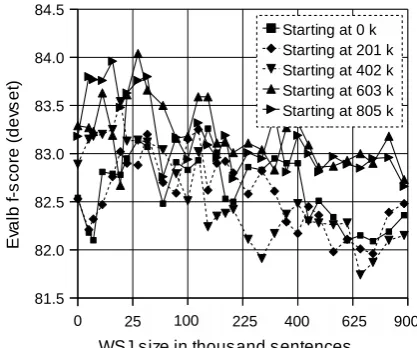
[image:2.595.312.521.274.448.2]We retrain the Brown parser using the self-training protocol of McClosky et al. (2006b), that is, we retrain the first-stage parser using combinations of trees produced by the rerank-ing parser for sentences from Sections 2 to 21 of the WSJ section of the Penn Treebank and from FootballTrainEdited|Discussion. We then parse the sentences in FootballDev using the re-trained first-stage parser and the original reranker. Because we have approximately five times the
Figure 1: Comparing the performance of five gram-mars trained on disjoint 200k subsections of
Football-TrainDiscussion in a Brown self-training experiment.
Results are on FootballDev.
number of sentences in FootballTrainDiscussion than in FootballTrainEdited, we first train five dif-ferent FootballTrainDiscussion grammars. The graph in Figure 1 shows the results on FootballDev when the training data contains disjoint subsec-tions of FootballTrainDiscussion, each containing 200,000 sentences, along with varying amount of WSJ2-21 trees. This gives us an idea of the amount of variation we might expect within one train-ing set source — the f-score noise is roughly 1.5 points wide (= 3 boxes in the graph).
Corpus Name #Sen SL Mean SL Med. σ
FootballDev 258 17.7 14 13.9
FootballTest 223 16.1 14 9.7
FootballTrainDiscussion 1,009,646 15.4 12 13.3
[image:3.595.159.444.62.124.2]FootballTrainEdited 209,014 17.7 17 11.4
Table 1: Basic Statistics on the Web 2.0 datasets: number of sentences, average sentence length, median sentence length and standard deviation
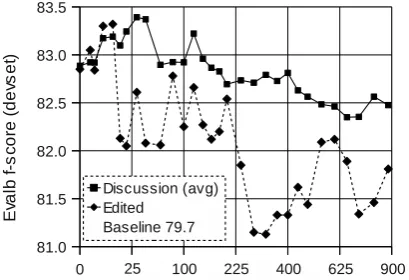
Figure 2: Comparing the use of discussion forum ma-terial (FootballTrainDiscussion) and newswire articles (FootballTrainEdited) in a Brown self-training experi-ment. Results are on FootballDev.
grammars on FootballDev. Note that a baseline grammar which is trained on one copy of WSJ02-21 and no automatically parsed data achieves a Parseval f-score of 79.7. The results in Figure 2 appear to refute our original hypothesis, suggest-ing that there is very little difference between the two corpora, with the user-generated content of FootballTrainDiscussion emerging as slightly su-perior on our development set.3 The only time that the FootballTrainEdited curve is above the Foot-ballTrainDiscussion is when the size of the orig-inal WSJ training set is restricted. This is an in-tuitively appealing result — in this scenario, the sentences in the FootballTrainEdited corpus are making up for the lack of WSJ trained material, although it is not clear whether this is because the FootballTrainEdited sentences are slightly longer than the FootballTrainDiscussion sentences (see
3Keeping the WSJ02-21 dataset size constant, we test
whether the difference between a FootballTrainEdited gram-mar and its five corresponding FootballTrainDiscussion grammars is statistically significant. Of the 150 pairs, 42
dif-ferences are statistically significant (p<0.05).
Table 1) or because they contain more WSJ-like constructions.
5 Analysis
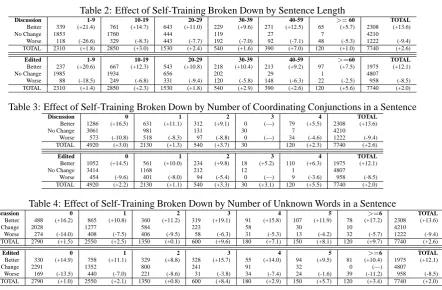
We next attempt to determine the strengths and weaknesses of the two types of training mate-rial by classifying our development set items into those that have improved as a result of self-training, those that have remained unchanged and those that have deteriorated. We examine all edited grammars shown in Figure 2, i.e. the thirty grammars obtained using 200,000 sentences from FootballTrainEdited and varying sized copies of WSJ02-21. For the discussion grammars, we examine the grammars trained using one of the five disjoint 200,000-sentence subsets of Foot-ballTrainDiscussion and varying sized copies of WSJ02-21 — we randomly choose the grammars marked with squares in Figure 1. Following Mc-Closky et al. (2006a), we present a breakdown of our results according to sentence length, num-ber of co-ordinating conjunctions (CC) in the sen-tence, and, number of unknown words4in the sen-tence. The results are shown in Tables 2, 3 and 4. Sentence counts are provided along with average f-score differences between a self-trained gram-mar and the baseline gramgram-mar.
It is not possible to discern strong patterns in the breakdown of results but we do observe the following subtle differences between the two types of grammars:
• The FootballTrainEdited grammars are more conservative than the FootballTrainDiscus-sion grammars, with a larger number of sen-tences unchanged by self-training.
• The FootballTrainDiscussion grammars out-perform the FootballTrainEdited grammars for short sentences.
4
[image:3.595.87.292.201.341.2]Table 2: Effect of Self-Training Broken Down by Sentence Length
Discussion 1-9 10-19 20-29 30-39 40-59 >=60 TOTAL Better 339 (+21.4) 761 (+14.7) 643 (+11.0) 229 (+9.6) 271 (+12.5) 65 (+5.7) 2308 (+13.6)
No Change 1853 1760 444 119 27 7 4210
Worse 118 (-26.6) 329 (-8.3) 443 (-7.7) 192 (-7.0) 92 (-7.1) 48 (-5.3) 1222 (-9.4) TOTAL 2310 (+1.8) 2850 (+3.0) 1530 (+2.4) 540 (+1.6) 390 (+7.0) 120 (+1.0) 7740 (+2.6) Edited 1-9 10-19 20-29 30-39 40-59 >=60 TOTAL Better 237 (+20.6) 667 (+12.3) 543 (+10.8) 218 (+10.4) 213 (+9.2) 97 (+7.5) 1975 (+12.1)
No Change 1985 1934 656 202 29 1 4807
Worse 88 (-18.5) 249 (-6.8) 331 (-9.4) 120 (-5.8) 148 (-6.3) 22 (-2.5) 958 (-8.5) TOTAL 2310 (+1.4) 2850 (+2.3) 1530 (+1.8) 540 (+2.9) 390 (+2.6) 120 (+5.6) 7740 (+2.0)
Table 3: Effect of Self-Training Broken Down by Number of Coordinating Conjunctions in a Sentence
Discussion 0 1 2 3 4 TOTAL
Better 1286 (+16.5) 631 (+11.1) 312 (+9.1) 0 (—) 79 (+5.5) 2308 (+13.6)
No Change 3061 981 131 30 7 4210
Worse 573 (-10.8) 518 (-8.3) 97 (-8.8) 0 (—) 34 (-4.6) 1222 (-9.4) TOTAL 4920 (+3.0) 2130 (+1.3) 540 (+3.7) 30 120 (+2.3) 7740 (+2.6)
Edited 0 1 2 3 4 TOTAL
Better 1052 (+14.5) 561 (+10.0) 234 (+9.8) 18 (+5.2) 110 (+6.3) 1975 (+12.1)
No Change 3414 1168 212 12 1 4807
Worse 454 (-9.6) 401 (-8.0) 94 (-5.4) 0 (—) 9 (-3.6) 958 (-8.5) TOTAL 4920 (+2.2) 2130 (+1.1) 540 (+3.3) 30 (+3.1) 120 (+5.5) 7740 (+2.0)
Table 4: Effect of Self-Training Broken Down by Number of Unknown Words in a Sentence
Discussion 0 1 2 3 4 5 >=6 TOTAL
Better 488 (+16.2) 865 (+10.8) 360 (+11.2) 319 (+19.1) 91 (+15.8) 107 (+11.9) 78 (+17.2) 2308 (+13.6)
No Change 2028 1277 584 223 58 30 10 4210
Worse 274 (-14.0) 408 (-7.5) 406 (-9.5) 58 (-6.3) 31 (-5.3) 13 (-4.2) 32 (-5.7) 1222 (-9.4) TOTAL 2790 (+1.5) 2550 (+2.5) 1350 (+0.1) 600 (+9.6) 180 (+7.1) 150 (+8.1) 120 (+9.7) 7740 (+2.6)
Edited 0 1 2 3 4 5 >=6 TOTAL
Better 330 (+14.9) 758 (+11.1) 329 (+8.8) 328 (+15.7) 55 (+14.0) 94 (+9.5) 81 (+10.4) 1975 (+12.1)
No Change 2291 1352 800 241 91 32 0 (—) 4807
Worse 169 (-13.5) 440 (-7.0) 221 (-8.6) 31 (-3.8) 34 (-7.4) 24 (-1.6) 39 (-11.2) 958 (-8.5) TOTAL 2790 (+1.0) 2550 (+2.1) 1350 (+0.8) 600 (+8.4) 180 (+2.9) 150 (+5.7) 120 (+3.4) 7740 (+2.0)
• The FootballTrainEdited grammars appear to perform better than the FootballTrainDiscus-sion grammars when there are a relatively high number of coordinating conjunctions in a sentence (greater than two).
• Self-training with both FootballTrainDis-cussion and FootballTrainEdited data tends to benefit sentences containing several un-known words, with the discussion grammars being superior.
6 Conclusion
We compare the use of edited versus unedited text in the task of adapting a WSJ-trained parser to the noisy language of an online discussion fo-rum. Given the small size of our development set, we have to be careful how we interpret the results. However, they do seem to suggest that the two corpora are performing at similar levels of effectiveness but exhibit differences. For ex-ample, if we take the best performing Football-TrainEdited and FootballTrainDiscussion gram-mars from those used in our error analysis of Sec-tion 5, we get two grammars with a Parseval f-score of 83.2 on FootballDev. Assuming the ex-istence of a perfect classifier, which, given an in-put sentence, can predict which of the two gram-mars will produce the higher-scoring tree, the
f-score for FootballDev increases from 83.2 to 85.6. When we include the baseline grammar (f-score: 79.7), this increases to 86.4. This suggests that the next step in our research is to build such a classi-fier including as features the sentential properties we examined in Section 5, as well as the features described in McClosky et al. (2010) and Ravi et al. (2008).
Acknowledgements
This research has been supported by Enterprise Ireland (CFTD/2007/229) and by Science Foun-dation Ireland (Grant 07/CE/ I1142) as part of the CNGL (www.cngl.ie) at the School of Computing, DCU.
References
Ann Bies, Mark Ferguson, Karen Katz, and Robert MacIntyre. 1995. Bracketing guidelines for Treebank II style. Technical report, University of Pennsylvania.
Daniel Bikel. 2004. Intricacies of Collins parsing model. Computational Linguistics, 30(4).
dis-criminative reranking. In Proceedings of the 43rd ACL.
Eugene Charniak. 2000. A maximum-entropy-inspired parser. In Proceedings of NAACL.
Jennifer Foster, ¨Ozlem C¸ etino˘glu, Joachim Wag-ner, Joseph Le Roux, Joakim Nivre, Deirdre Hogan, and Josef van Genabith. 2011. From News to Comment: Resources and benchmarks for parsing the language of Web 2.0. In Pro-ceedings of IJCNLP.
Jennifer Foster. 2010. “cba to check the spelling” Investigating parser performance on discussion forum posts. In Proceedings of HLT NAACL.
Zhongqiang Huang and Mary Harper. 2009. Self-training PCFG grammars with latent an-notations across languages. In Proceedings of EMNLP.
Mitchell Marcus, Grace Kim, Mary Ann Marcinkiewicz, Robert MacIntyre, Ann Bies, Mark Ferguson, Karen Katz, and Britta Schas-berger. 1994. The Penn Treebank: Annotating predicate argument structure. In Proceedings of the ARPA Speech and Natural Language Workshop.
David McClosky and Eugene Charniak. 2008. Self-training for biomedical parsing. In Pro-ceedings of ACL:HLT.
David McClosky, Eugene Charniak, and Mark Johnson. 2006a. Effective self-training for parsing. In Proceedings of NAACL.
David McClosky, Eugene Charniak, and Mark Johnson. 2006b. Reranking and self-training for parser adaptation. In Proceedings of ACL.
David McClosky, Eugene Charniak, and Mark Johnson. 2010. Automatic domain adaptation for parsing. In Proceedings of NAACL-HLT.
Slav Petrov, Pi-Chuan Chang, Michael Ringgaard, and Hiyan Alshawi. 2010. Uptraining for accu-rate deterministic question parsing. In Proceed-ings of EMNLP.
Sujith Ravi, Kevin Knight, and Radu Soricut. 2008. Automatic prediction of parser accuracy. In Proceedings of EMNLP.