Codeswitching Detection via Lexical Features using Conditional Random
Fields
Prajwol Shrestha
Verscend Technologies Pvt. Ltd.
Abstract
Half of the world’s population is estimated to be at least bilingual. Due to this fact many people use multiple languages interchange-ably for effective communication. At the Sec-ond Workshop on Computational Approaches to Code Switching, we are presented with a task to label codeswitched, Spanish-English (ES-EN) and Modern Standard Arabic-Dialect Arabic (MSA-DA), tweets. We built a Con-ditional Random Field (CRF) using well-rounded features to capture not only the two languages but also the other classes. On the Spanish-English(ES-EN) classification task, we obtained weighted F1-score of 0.88 on the tweet level and an accuracy of 96.5% on the token level. On the MSA-DA classification task, our system managed to obtain F1-score of 0.66 on tweet level and overall token level accuracy of 74.7%.
1 Introduction
It is very common to find people adept in two or more languages (Ansaldo et al., 2008). During in-teractions and conversations in real life as well as in social media, multilingual people tend to switch be-tween languages in written as well as verbal com-munication. Hale (2014) found that over 10% of Twitter users tweet in multiple languages and they are in general more active users than their mono-lingual counterparts. Modupeola (2013), in his re-search of an effective way of teaching English to Nigerian students, finds codeswitching from English to Nigerian by teachers as a necessity for generating interest, elaborating word meanings and the transfer
of knowledge of the secondary language in an effi-cient manner. Codeswitching phenomenon is more prevalent in multi-cultural societies, where means of communication is not primarily in a single lan-guage (Cheng and Butler, 1989; Auer, 2013). It can also be attributed to the huge amount of exposure to other languages due to social media, TV shows and movies. Codeswitched text identification is of-ten the first step for text to speech translation, auto-matic speech recognition and sentiment analysis.
Our paper deals with the phenomenon of codeswitching between Spanish and English (ES-EN) words and Modern Standard Arabic to Dialect Arabic (MSA-DA). The main aim of this paper is to describe our system submitted to the Second Work-shop on Computational Approaches to Code Switch-ing shared task (Molina et al., 2016). We use Con-ditional Random Fields (CRF) based system to cate-gorize the codeswitched text into eight different cat-egories: lang1, lang2, other, ne, mixed, unknown,
ambiguous, andfw(foreign words). The categories
lang1 and lang2 refer to the two main language pairs, while ne refers to named entities. ES-EN classification uses all these labels whereas MSA-DA classification does not use the labelsunk andfw la-bels. First we elaborate on the various features we chose to identify and distinguish one category from the other. Then we elaborate on our results and findings. Finally we will analyze the strengths and weaknesses of our system.
2 Related Work
Research into codeswitching and codeswitching de-tection is not new. There have been many studies on
codeswitching at socio-cultural level. According to Heredia and Altarriba (2001), the main reason mul-tilingual people codeswitch is the lack of a single language proficiency and frequency/ease of use of word of one language than the other in given context. Eldin (2014) highlight other factors such as clarifi-cation, persuasion, effective interaction and current mood and expression of the person for codeswitch-ing.
Recently many researchers have tried various computational methods for language identification in codeswitched text. Yu et al. (2012), Garrette et al. (2015) and Bacatan et al. (2014) use language mod-els and word n-grams with position and frequency data as part of their system to identify codeswitched text. Both achieved an accuracy of over 80%. Ma-harjan et al. (2015) collected codeswitched tweets for Spanish-English and Nepali-English language pairs. They first figured out some seed users who codeswitched frequently and then followed him/her to collect more codeswitched tweets.They obtained an accuracy of 86% and 87% for Spanish-English and Nepali-English dataset using CRF GE algo-rithm.
CRF has been used for many different tasks, especially dealing with sequence labeling such as POS tagging (Lafferty et al., 2001a; Silfverberg et al., 2014) and named entity recognition (McCal-lum and Li, 2003; Settles, 2004). Similar to us, three out of seven participating teams also used CRF for codeswitching detection for the EMNLP 2014 language identification shared task (Solorio et al., 2014). Other participants used Support Vector Machines (SVM),k Nearest Neighbour (KNN), Ex-tended Markov Models (eMM) and spell checker methods with external resources to tackle the prob-lem. In the same year of the shared task, we used dictionaries to store and search prefix ngrams and further used a spell checker to identify wrongly spelled words from social media lingo so they can be classified correctly (Shrestha and Dhulikhel, 2014).
3 Methodology
Our system uses CRF for modeling the sequence of codeswitched tweets. CRF is a very popular se-quence classifier for when constituents of a sese-quence are dependent upon their adjacent context. Rather
than modeling for each part separately, it makes more sense to model for the whole sequence. CRF calculates the probability of a whole sequence of la-bels given a sequence of tokens (words) by using Equation 1. Here~srepresents a sequence of labels and ~x represents a sequence of tokens. ~φ and ~w
are the feature vector and the weights for the feature vector respectively.
p(~s|~x;~w) = P exp(~w.~Φ(~x,~s)) ~s0Smexp(~w.~Φ(~x,~s0))
(1)
Using a CRF with task-specific features, given a context can result in very robust systems for se-quence labeling (Lafferty et al., 2001b; Ye et al., 2009). CRF fits the problem of codeswitching de-tection since frequent switching between languages is not very common. For example, if a token is in Spanish, it is very likely that the token before it and after it are also in Spanish. We describe our features in detail below.
3.1 Features
1. Token: The token itself is the biggest indicator of which language it might belong to. Fry and Kress (2012) estimate that the most frequent 1,000 words in the English language accounts for 89% of the text written in English. If the training data is large enough, even a dictionary based approach can provide a very good base-line to build upon. This feature is especially helpful for the tokens that are not shared be-tween the two languages.
2. Suffix: Most languages have distinctive suf-fixes that tokens end in. For example: In En-glish we addlyto adjectives to turn them into adverbs similarly in Spanish-menteis added to adjectives to turn them into adverbs. Sosimply
in English is simplementein Spanish. For the
ingform of the verb in English there is a close representation in Spanish using the characters
ando,iendo. English words ending in-tionhave a Spanish word equivalent in -cin. Similarly Englishency, ancyand Spanishencia, English
3. Prefix: Although many common prefixes in English have identical prefixes in Spanish
(eg:anti,auto,inter), similar to suffixes, these languages also have distinctive prefixes. For examplepseudoin English isseudoin Spanish. Sopseudosciencein English is spelled as seu-docienciain Spanish. Other examples include, words beginning in English withs,ph,poly gen-erally begin in Spanish with es,f,poli respec-tively. To incorporate these distinct prefixes during classification, we use 1-4 letter prefixes as features.
4. Prefix and Suffix bigrams: Rather than just using prefixes and suffixes, we also used bi-grams of prefixes and suffixes as features. 5. Titlecase: This feature can help catch named
entities as the most characteristic attribute of a named entity in a properly written text is that it is in titlecase.
6. Token is/has Punctuation(s): Punctuation to-kens and toto-kens containing many punctuations are more likely to fall in theothercategory. 7. has/all Unicode: Spanish tokens contain
ac-cented Unicode characters, whereas English ones do not. Also, if the number of Unicode characters in a word is very high, the word is likely to be in theothercategory, for example, in emoticons.
8. Number: Tokens containing numbers do not belong to either language.
9. Uppercase: Token containing many upper-case characters are usually abbreviations, NE or slangs.
We use the same system with exactly the same features for both ES-EN and MSA-DA language pairs.
4 Implementation Details
We performed a very simple preprocessing step of removing the hashtags since hashtags do not have any significance for this task. The presence of hash-tags might confuse the model instead. We also removed non-ASCII quotation marks since these
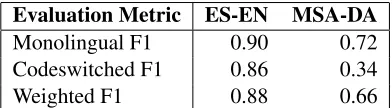
Evaluation Metric ES-EN MSA-DA
Monolingual F1 0.90 0.72
Codeswitched F1 0.86 0.34
[image:3.612.325.521.60.114.2]Weighted F1 0.88 0.66
Table 1:Tweet level results for both Spanish-English and
Mod-ern Standard Arabic-Dialect Arabic.
Label Recall Precision F1 score
ambiguous 0.000 0.000 0.000
lang1 0.919 0.919 0.919
lang2 0.981 0.975 0.978
mixed 0.000 0.000 0.000
ne 0.422 0.560 0.481
fw 0.000 0.000 0.000
other 0.993 0.994 0.994
unknown 0.000 0.000 0.000
Table 2: Recall, Precision and F1 score of token level results
for Spanish-English.
would wrongly be accounted as unicode features. For CRF, we used the sklearn-crfsuite package (Ko-robov, 2015), which itself is a wrapper over CRF-suite (Okazaki, 2007). In order to obtain the best model, we experimented over all of the available al-gorithms in CRFsuite namely, lbfgs, l2sgd, ap, pa, and arow. Using the provided development set, we found the pa algorithm to perform the best among them. We also performed hyperparamter optimiza-tion by using randomized search over parameters specific to each algorithm. We obtained the high-est accuracy on the development set withpa type=1
andc=10.0. We used these parameters to train a fi-nal model by combining both the training and the development datasets. We used this model to obtain our results on the test dataset.
5 Results
Tweet level results for both ES-EN and MSA-DA are shown in Table 1. For ES-EN, our F1 scores for both monolingual and codeswitched tweets are sim-ilar, although the results for monolingual tweets are slightly better. Our weighted F1 score is only 0.03 points below the system with the best weighted F1. The token level results broken down by labels for ES-EN are in Table 2. We could catch most of the
Label Recall Precision F1 score
ambiguous 0.000 0.000 0.000
lang1 0.959 0.551 0.699
lang2 0.586 0.943 0.722
mixed 0.000 0.000 0.000
ne 0.662 0.851 0.745
[image:4.612.315.533.60.280.2]other 0.977 0.973 0.975
Table 3: Recall, Precision and F1 score of token level results
for Modern Standard Arabic-Dialect Arabic.
catch nearly half of the name entities. Named enti-ties are harder to capture with our system since we do not have a specialized system for named entities, apart from the features that check for titlecase and uppercase. Our system did not catch any of the am-biguous, mixed, fw or unknown tokens. The main reason behind this might be how sparse these types of tokens are in training. These comprised of only 0.408% and 0.652% of the total tokens in the train-ing set the test set respectively. Most of the other systems in the shared task also failed to catch these tokens. Despite this, overall, our system was able to obtain good results in the ES-EN language pair codeswitching.
However, we did not fare as well for the MSA-DA language pair. The monolingual F1 is a lot higher at 0.72 than the codeswitched F1 at 0.34 and as such the weighted F1 also suffers. Our system has the propensity of predicting a high number of tokens as lang1, as evidenced by the token level results in Ta-ble 3. The recall for lang1is very high, while the recall for lang2is low. This might owe to the fact that the ratio of tokens in lang1 and lang2 are re-versed in training and test sets. In the training set, 68.74% of the tokens are lang1 and 11.70% of the to-kens arelang2. Whereas in the test set, only 28.10% of the tokens are lang1 and 46.62% of the tokens are
lang2. This might have led our model to predict high number oflang2tokens as lang1. Similar as in ES-EN, we again perform very well forothertokens. A surprising finding with the MSA-DA results is that we have a lot better results for named entities than for ES-EN in both precision and recall, although the system used for both language pairs are exactly the same. One reason might be that the model has a higher number of named entities to learn from in MSA-DA dataset than in the ES-EN dataset.
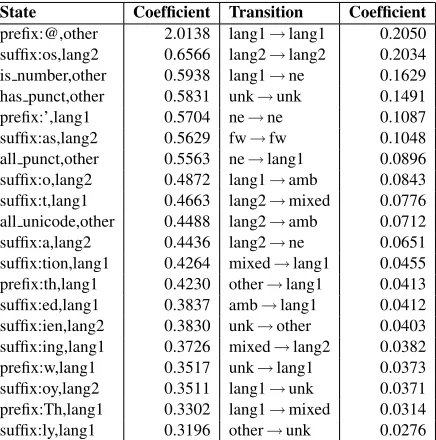
Unfor-State Coefficient Transition Coefficient
prefix:@,other 2.0138 lang1→lang1 0.2050
suffix:os,lang2 0.6566 lang2→lang2 0.2034
is number,other 0.5938 lang1→ne 0.1629
has punct,other 0.5831 unk→unk 0.1491
prefix:’,lang1 0.5704 ne→ne 0.1087
suffix:as,lang2 0.5629 fw→fw 0.1048
all punct,other 0.5563 ne→lang1 0.0896
suffix:o,lang2 0.4872 lang1→amb 0.0843
suffix:t,lang1 0.4663 lang2→mixed 0.0776
all unicode,other 0.4488 lang2→amb 0.0712
suffix:a,lang2 0.4436 lang2→ne 0.0651
suffix:tion,lang1 0.4264 mixed→lang1 0.0455
prefix:th,lang1 0.4230 other→lang1 0.0413
suffix:ed,lang1 0.3837 amb→lang1 0.0412
suffix:ien,lang2 0.3830 unk→other 0.0403
suffix:ing,lang1 0.3726 mixed→lang2 0.0382
prefix:w,lang1 0.3517 unk→lang1 0.0373
suffix:oy,lang2 0.3511 lang1→unk 0.0371
prefix:Th,lang1 0.3302 lang1→mixed 0.0314
[image:4.612.80.287.61.157.2]suffix:ly,lang1 0.3196 other→unk 0.0276
Table 4: Most likely states (state:feature,label) and transitions
for the ES-EN model.
tunately, apart from that, we cannot provide any fur-ther intuition into this due to our lack of knowledge of Arabic. Overall, our results for the MSA-DA lan-guage pair could definitely use some improvement.
6 Analysis
To gain an insight into what our model might be learning, we look at the most likely states and tran-sitions of our CRF model trained on the ES-EN lan-guage pair dataset. These are shown in Table 4. Most of the top likely states deal with prefixes and suffixes. The state with the highest coefficient is the one for tokens that have a prefix as@beingother. This is very intuitive as most of the tokens that start with @ are Twitter usernames and do indeed have
other as their label. The suffixes-os,asandahave been associated with Spanish whilet,tion, ed,ing, andlyhave been taken as indicators of the token be-ing English by our model. Similarly, the tokens that start with’as the prefix having labelotherhas high coefficient. This works for tokens such as’s,’ll,’d. Similarly most other top likely states are intuitive and are aligned our knowledge of Spanish and En-glish. The associations ofis number,has punctand
Four out of five most likely transitions are be-tween the same two labels. This shows that language users do not switch between labels too often. The most likely transitions are from English to English and from Spanish to Spanish. The transition from English to Spanish or vice versa did not fall under the top 20 likely transitions. This might be because a person can only use so many ne or other tokens before switching back to a language but when a per-son switches from one language to another, there is no such constraint and people are likely to keep on using the other language rather than switching back. We also looked at some of the instances in the de-velopment set where our system predicted the wrong label. We made the most number of mistakes for
ne. Almost all of these mistakes were for tokens that were not in titlecase. Since this was our only feature specific to named entities, our model could not catch these. There were also some cases where our model did correctly label the tokens as named entities, such as twitter, RT, iphones, etc but the labels given to them in the dataset were different. The most con-fusion between English and Spanish were for words that are present in both languages such asyo,a,no,
senior, etc. But this was rare and most of the time our model correctly labeled even these words.
7 Conclusion and Future Works
The task of codeswitching detection is highly suited to be solved using CRF as evidenced by our results. The performance of the system depends on the fea-tures chosen and in our case, these feafea-tures worked for ES-EN and did not work too well for MSA-DA. Our lack of knowledge of Arabic definitely proved to be a hindrance in crafting sensible features for MSA-DA. Nonetheless, we were able to obtain com-petitive scores for both language pairs. We were also able to see the characteristics of both English and Spanish being captured by our model, especially the most common prefixes and suffixes of both lan-guages. In our further research, we will work to-wards finding effective features for both ES-EN as well as MSA-DA language pairs. One of the short-comings of our system is also not being able to cap-ture named entities. In the fucap-ture, we will also look into named entity recognition systems that work for codeswitched texts.
Acknowledgments
We would like to thank the organizers of the Compu-tational Approaches to Code Switching shared task for providing us with this opportunity.
References
Ana In´es Ansaldo, Karine Marcotte, Lilian Scherer, and Gaelle Raboyeau. 2008. Language therapy and bilin-gual aphasia: Clinical implications of psycholinguistic and neuroimaging research. Journal of Neurolinguis-tics, 21(6):539–557.
Peter Auer. 2013. Code-switching in conversation: Lan-guage, interaction and identity. Routledge.
Arianna Clarisse R Bacatan, Bryan Loren D Castillo, Marjorie Janelle T Majan, Verlia F Palermo, and Ria A Sagum. 2014. Detection of intra-sentential code-switching points using word bigram and unigram fre-quency count.International Journal of Computer and Communication Engineering, 3(3):184.
Li-Rong Cheng and Katharine Butler. 1989. Code-switching: a natural phenomenon vs language defi-ciency.World Englishes, 8(3):293–309.
Ahmad Abdel Tawwab Sharaf Eldin. 2014. Socio lin-guistic study of code switching of the arabic language speakers on social networking. International journal of English linguistics, 4(6):78.
Edward B Fry and Jacqueline E Kress. 2012. The read-ing teacher’s book of lists, volume 55. John Wiley & Sons.
Dan Garrette, Hannah Alpert-Abrams, Taylor Berg-Kirkpatrick, and Dan Klein. 2015. Unsupervised code-switching for multilingual historical document transcription. InProceedings of the 2015 Conference of the North American Chapter of the Association for Computational Linguistics: Human Language Tech-nologies, pages 1036–1041.
Scott A Hale. 2014. Global connectivity and multilin-guals in the twitter network. In Proceedings of the SIGCHI Conference on Human Factors in Computing Systems, pages 833–842. ACM.
Roberto R Heredia and Jeanette Altarriba. 2001. Bilin-gual language mixing: Why do bilinBilin-guals code-switch? Current Directions in Psychological Science, 10(5):164–168.
Mikhail Korobov. 2015. sklearn-crfsuite.
John Lafferty, Andrew McCallum, and Fernando Pereira. 2001a. Conditional random fields: Probabilistic mod-els for segmenting and labeling sequence data. In
John Lafferty, Andrew McCallum, and Fernando Pereira. 2001b. Conditional random fields: Probabilistic mod-els for segmenting and labeling sequence data. In Pro-ceedings of the eighteenth international conference on machine learning, ICML, volume 1, pages 282–289. Suraj Maharjan, Elizabeth Blair, Steven Bethard, and
Thamar Solorio. 2015. Developing language-tagged corpora for code-switching tweets. InProc. LAW IX at NAACL.
Andrew McCallum and Wei Li. 2003. Early results for named entity recognition with conditional random fields, feature induction and web-enhanced lexicons. In Proceedings of the seventh conference on Natu-ral language learning at HLT-NAACL 2003-Volume 4, pages 188–191. Association for Computational Lin-guistics.
Olagunju Robert Modupeola. 2013. Code-switching as a teaching strategy: Implication for english language teaching and learning in a multilingual society. IOSR Journal of Humanities and Social Science, 14(3):92– 94.
Giovanni Molina, Fahad AlGhamdi, Mahmoud Ghoneim, Abdelati Hawwari, Nicolas Rey-Villamizar, Mona Diab, and Thamar Solorio. 2016. Overview for the second shared task on language identification in code-switched data. InProceedings of The Second Workshop on Computational Approaches to Linguistic Code Switching, held in conjunction with EMNLP 2016.
Naoaki Okazaki. 2007. Crfsuite: a fast implementation of conditional random fields (crfs).
Burr Settles. 2004. Biomedical named entity recognition using conditional random fields and rich feature sets. InProceedings of the International Joint Workshop on Natural Language Processing in Biomedicine and its Applications, pages 104–107. Association for Compu-tational Linguistics.
Prajwol Shrestha and Nepal Dhulikhel. 2014. Incre-mental n-gram approach for language identification in code-switched text. EMNLP 2014, page 133.
Miikka Silfverberg, Teemu Ruokolainen, Krister Linden, Mikko Kurimo, et al. 2014. Part-of-speech tagging using conditional random fields: Exploiting sub-label dependencies for improved accuracy. In ACL (2), pages 259–264.
Thamar Solorio, Elizabeth Blair, Suraj Maharjan, Steve Bethard, Mona Diab, Mahmoud Gonheim, Abdelati Hawwari, Fahad AlGhamdi, Julia Hirshberg, Alison Chang, and Pascale Fung. 2014. Overview for the first shared task on language identification in code-switched data. InProceedings of the First Workshop on Computational Approaches to Code-Switching. EMNLP 2014, Conference on Empirical Methods in Natural Language Processing, Doha, Qatar.
Nan Ye, Wee S Lee, Hai L Chieu, and Dan Wu. 2009. Conditional random fields with high-order features for sequence labeling. InAdvances in Neural Information Processing Systems, pages 2196–2204.