Developing Corpus of Lecture Utterances Aligned to Slide Components
Ryo Minamiguchi and Masatoshi Tsuchiya Department of Computer Science and Engineering
Toyohashi University of Technology
1–1 Hibarigaoka, Tempaku-cho, Toyohashi, Aichi, Japan
[email protected] and [email protected]
Abstract
The approach which formulates the automatic text summarization as a maximum coverage prob-lem with knapsack constraint over a set of textual units and a set of weighted conceptual units is promising. However, it is quite important and difficult to determine the appropriate granularity of conceptual units for this formulation. In order to resolve this problem, we are examining to use components of presentation slides as conceptual units to generate a summary of lecture ut-terances, instead of other possible conceptual units like base noun phrases or important nouns. This paper explains our developing corpus designed to evaluate our proposing approach, which consists of presentation slides and lecture utterances aligned to presentation slide components.
1 Introduction
Automatic text summarization is one of the tasks that have long been studied in natural language process-ing area. One of well-known approaches for automatic text summarization is an extractive method which picks important textual units (e.g. sentences) from given documents (Kupiec et al., 1995; Goldstein et al., 2000; Radev et al., 2000).
(Filatova and Hatzivassiloglou, 2004) introducedconceptual unitsto represent meaning components, and formulated the extractive method of text summarization as a maximum coverage problem with knap-sack constraint (henceforth, denoted as MCKP). Suppose a finite set T of textual units which means whole given documents, and a finite setCof conceptual units which represents whole information de-scribed byT. In this representation, a textual unit may describe one or more conceptual units, and an information overlap between picked textual units is considered as a redundant conceptual unit(s) which is described by plural textual units. In other words, the meaning of each textual unit is regarded as a subset ofC, and the extractive method of text summarization is defined as a problem to find a subset of T which satisfies the constraint of its total length and describes as many conceptual units as possible. Various methods including greedy algorithm (Filatova and Hatzivassiloglou, 2004), stack decoding (Yih et al., 2007) and linear programming solver (Takamura and Okumura, 2009) were employed to solve text summarization in this representation.
This representation provides a concrete and concise formulation of text summarization, however, a big problem still remains: the appropriate granularity of conceptual units. (Hovy et al., 2006) proposed to use basic elements as conceptual units, which are dependency subtrees obtained by trimming dependency trees. (Takamura and Okumura, 2009) proposed to use weighted content words as conceptual units, whose weights reflect their importance. Although these possible conceptual units treat linguistic clues of original documents, they do not represent the intuition of the writer (or the speaker) of the original documents.
In order to resolve this problem, we are examining to extract dependency structure between primitive objects such as texts, pictures, lines and basic diagrams, and to use these objects as conceptual units when generating a summary of lecture utterances. We think that this approach has two advantages than the previous approach of conceptual units. The first is that terminology and character formatting of these objects may reflect the intuition of the lecturer about his/her talk, because these objects are selected
Place license statement here for the camera-ready version, see Section??of the instructions for preparing a manuscript.
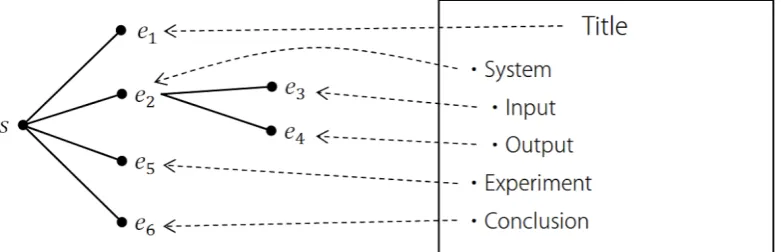
Figure 1: A presentation slide example
and located by him/herself. For example, he/she will use either a larger point font or a bold style font, to represent an important part of his/her talk. The second is that this approach naturally introduces multi-level granularity of conceptual units because our using method proposed by (Hayama et al., 2008) extracts relationship between objects as a tree structure. When multi-level granularity of conceptual units is available, the remaining problem to decide appropriate granularity of conceptual units can be considered as a simple optimization problem.
This paper explains our developing corpus which consists of lecture utterances, presentation slides, and their alignment information. We think that this corpus will give a foundation to evaluate our assumption about conceptual units.
2 Structure of Presentation Slide
Generally speaking, a presentation slide consists of one or more primitive objects, such as texts, pic-tures, lines and basic diagrams. We call these primitive objects asslide componentsin this paper. Slide components are carefully located in a presentation slide by its author, taking his/her presentation speech procedure into consideration. Thus, from the human view point, a dependency structure between slide components represented by either their relative positional relationship or basic diagrams including an arrow sign emerges.
Unfortunately, it is necessary to extract the dependency structure between slide components, because it is not explicitly represented in the slide data itself. We employ the method proposed by (Hayama et al., 2008), which uses relative positional relationship between slide components to extract dependency structure. Figure 1 shows an example of presentation slide designed in the traditional style and the dependency structure extracted from it. The root node represents the slidesitself. The root node has children including the headlinee1of the slide, the first-layer bulleted ed text snippetse2,e5, ande6. And
more, the nodee2 has the second-layer bulleted text snippetse3ande4as the children ofe2.
It is true that our using method cannot extract structures from all styles of presentation slides. In the modernized style introduced in (Alley et al., 2005), basic diagrams play more important role to represent relationships between slide components than ones in the traditional style. Because our using method uses relative positional relationship between slide components as key clues and does not handle basic diagrams, it faces limitation against the modernized style slides. However, the dependency structure between slide components still exists in the modernized style, and an improved structure extraction method will resolve this limitation.
Table 1: Statistics of CJLC # of speakers 15
# of courses 26 # of lectures 89
[image:3.595.176.420.190.249.2]Duration 3,780 min.
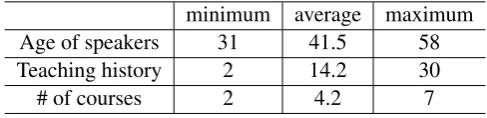
Table 2: Age of Speakers, their teaching history and number of their courses minimum average maximum
Age of speakers 31 41.5 58 Teaching history 2 14.2 30
# of courses 2 4.2 7
3.1 Corpus
Corpus of spoken Japanese Lecture Contents(henceforth, denoted as CJLC) developed by (Tsuchiya et al., 2008) is used as the main target of this research. It is designed as the fundamental basis of researches including large vocabulary continuous speech recognition and extraction of important sentences against lecture contents, and consists of speech, transcriptions, and presentation slides that were collected in real university classroom lectures. Thus, we think that the design objective of CJLC matches well our research.
CJLC is formally defined as a set of classroom lecture data, and each data consists of following 5 items:
1. a lecture speech recorded with several microphones, 2. its synchronized transcription,
3. a presentation slide data (Microsoft PowerPoint formed), 4. a timetable of slide show, and
5. a list of important utterances.
Table 1 shows the statistics of CJLC. Generally speaking, a course of CJLC is a series of one or more lectures. All speeches of CJLC were transcribed by human annotators. Table 2 shows the distribution of 15 speakers recorded in CJLC. A lecture speech data and its synchronized transcriptions are provided for all lectures, but a presentation slide data, a timetable of slide show and a list of important utterances are not attached to all lectures.
Note that each speech of CJLC was automatically segmented into utterances using the amplitude of the speech signal described in (Kitaoka et al., 2006; Otsu, 1979), and that their segmentation do not match to sentence boundaries for spontaneous speech proposed by (Takanashi et al., 2003). Although it means that automatically segmented utterances of CJLC are not sentential units from the view point of their senses, automatically segmented ones are referred as textual units, for two reasons. The first reason is that automatic detection methods of sentence boundary against spontaneous speech were proposed by (Shitaoka et al., 2004; Akita et al., 2006), however, they do not achieve sufficient performance when results of automatic speech recognition contain many errors. The second reason is to keep compatibility with important utterance extraction information of CJLC.
3.2 Alignment Labels
Content of utterance Aligned slide component ta Generally, a computer system has two kinds of operation
de-vices, such as an input device, an output device. e2 ...
tb Typical input devices are a keyboard and a mouse, and typical
output devices are a monitor and a speaker. e2 ...
tc In this stage, the monitor displayed the photos and the videos
[image:4.595.87.514.59.200.2]for the experiment. e4/e5
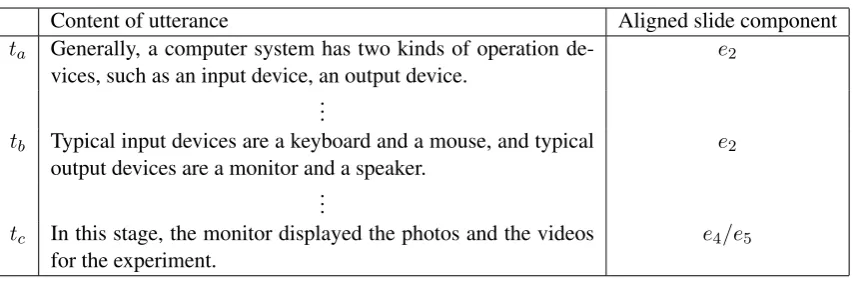
Figure 2: Example of alignment label with slide components
to any slide components or not. LabelBand LabelEare introduced to resolve mismatch between au-tomatic power-based boundary and sentence boundary. The following is more detailed descriptions of these labels.
• LabelImeans that its labeled textual unit is either an utterance or a part of an utterance to explain a slide component. An explanation may be carried by either a same content word, a synonym, a hypernym, a hyponym, a paraphrase, an expression to instantiate a general case shown by the slide component into a specific case, or an expression to abstract a specific case shown by the slide component into a general case. When the textual unitti explains the slide componentcj, a pair of
LabelIand the sequence numberjis assigned toti.
• Label Bmeans that its labeled textual unit belongs to the succeeding textual unit from the view point of sentence boundary, only when the succeeding unit has either LabelIor LabelB. In other words, the textual unit which has LabelBis a former part of a sentence, which must contain one or more textual units which have LabelI.
• Label E is the opposite label of Label B, and means that its labeled textual unit belongs to the preceding textual unit from the view point of sentence boundary only when the preceding unit has either LabelI or LabelE. In other words, the textual unit which has LabelE is a latter part of a sentence, which must contain one or more textual units which have LabelI.
• LabelOmeans that its labeled textual unit are not related to any slide components.
The alignment label system described in the above can represent the case that one or more textual units explain a slide component. It, however, involves difficulty for the case that a single textual unit explains multiple slide components.
In order to conquer this difficulty, this case is divided into three sub cases, and procedures to select an appropriate slide component are prepared. Figure 2 shows example of alignment label with slide components in three sub cases.
The first sub case is that a parent-child relationship exists between the two slide components explained by a single textual unit. Suppose that the slide component e2 and the slide componente3 of Figure 1
are explained by the single textual unitta. In this corpus, the parent nodee2 is selected as the label
of the textual unit ta. The second sub case is that a sibling relationship exists between the two slide
components explained by a single textual unit, and that two slide components share the same parent node. The example of the second sub case is that the slide componente3 and the slide component e4
of Figure 1 are explained by the single textual unittb. In this corpus, the parent nodee2 shared by the
explained nodese3 ande4 is selected as the label of the textual unittb. The last sub case is the rest of
the above sub cases. For example, suppose that the slide componente4 and the slide componente5are
explained by the single textual unittc. In order to resolve the last sub case, bothe4ande5 are recorded
analysis of this paper, the preceding nodee4 is referred as the label oftcand the succeeding nodee5is
ignored.
The alignment manual for annotators reflects the descriptions of labels explained in the above. The following is the abstract of the manual.
1. The supervisor supplies a set of textual units and a set slide components to the annotator.
2. The annotator is requested to find all kind of explanations and to assign all Label I in the given set. When a single textual unit explains multiple slide components, the annotator must select an appropriate node in compliance with the procedures described in the above.
3. After assignment of LabelI, the annotator is requested to find all LabelBand LabelEin the given set. In other words, the annotator must find sentence boundaries around textual units labeled as LabelI.
4. After that, LabelOis assigned to all remaining textual units.
3.3 Annotation Results
Two annotators1, who are master course students of the department of computer science, are employed
for the annotation work of the corpus. Table 3 shows their annotation results. Each lecture has a lecture ID (for example,L11M0011) which is composed of four parts: its first part is a letter Lwhich means a first letter of lecture, its second part is a two didit number11which identifies a anonymized speaker, its third part is a letter Mwhich means a gender of a speaker, and its last part is a four digit number 0011 which distinguishes a lecture. Furthermore, the last four digit number is composed of two sub parts: its first sub part is a three digit number001which means a course, and its second sub part is a one digit number1means the sequence number of the specified lecture in the course. In order to measure agreement of two human annotators’ results, the followingκstatistics (Chklovski and Mihalcea, 2003; Ng et al., 1999) is widely used.
κ= P1a−−PPe
e (1)
Here, Pa denotes the empirical agreement ratio between two human annotators, whilePe denotes the
probability of agreement by chance.
The annotation label system of our corpus is two layered: the first layer labels, such as Label I, Label B, Label E and Label O, represent whether their labeled textual units are related to slide components or not, and the second layer, which consists of sequence numbers of Label I, represents explanation relationships between textual units and slide components. In order to measure fairly agreements of this two layered label system, two kinds of granularity are introduced when computingκ statistics. When computingκ statistics for coarse granularity to measure the agreement of the first layer labels, the empirical agreement ratioPais defined as the following equation.
Pa=
∑
X={I,B,E,O}a(X)
|T| (2)
a(X)is the number of textual units which two human annotators give the same labelX, and|T|is the number of textual units. The probability of agreement by chancePeis calculated as follows:
Pe =
∑
X={I,B,E,O}
P2(X), (3)
where P(X) is the label occurrence probability. When maximum likelihood estimation is employed, P(X)is defined as follows:
P(X) = f|(X)T| , (4)
Table 3: Result of Manual Annotation
# of # of slide # of # of labels κstatistics Lecture ID slides components utterances I B E O coarse fine
L11M0010 21 370 742 578 4 26 134 0.68 0.61
L11M0011 29 431 704 584 11 14 95 0.58 0.72
L11M0012 12 276 811 546 2 5 258 0.83 0.65
L11M0030 58 822 680 414 41 57 168 0.92 0.75
L11M0050 22 159 2362 1280 39 81 962 0.68 0.6
L11M0064 27 469 1110 559 51 58 442 0.69 0.72
wheref(X)is the number of textual units to which LabelXis assigned.
When computingκstatistics for fine granularity to measure the agreement of the second layer labels, which means the agreement of sequence numbers, the empirical agreement ratio P′
a is defined as the
following equation.
P′ a=
∑|C|
j=1a(cj)
f(I) , (5)
where|C|is the number of slide components, anda(cj)is the number of textual units which are
associ-ated to the same slide componentcj. When the probability of agreement by chance is calculated for fine
granularity, as already described in Equation 3, the probability which a slide componentcis assigned to textual units by a human annotator is required. When uniform distribution is assumed in order to avoid zero frequency problem, it is defined as follows:
P(c) = |C1| (6)
The larger the κ statistics, the more reliable the results of the human annotators. (Carletta, 1996) reported thatκ >0.8means good reliability, while0.67< κ <0.8means that tentative conclusions can be drawn. According to his criteria, when measuring the agreement of two human annotators for coarse granularity, the reliability level of 2 lectures is good, the reliability level of three lectures is tentative, and the rest lecture, L11M0011, is not reliable. Its presentation slide contains many figures, and our using method to extract slide components from the presentation slide has the limitation to handle figures as already described in Section 2. We think that this limitation causes the inagreement of L11M0011. When measuring the agreement of two human annotators for fine granularity, the reliability level of all lectures are tentative.
4 Automatic Alignment between Slide Components and Lecture Utterances
Automatic alignment between slide components and lecture utterances will be required to realize auto-matic text summarization using slide components as conceptual units. This section explains our prelimi-nary result of automatic alignment.
First of all, we formulate the automatic alignment problem between slide components and lecture utterances as the problem to find the mapping setM. A member ofM is a single mappingmfrom a lecture utteranceuto a slide componente(u→e). Although there are many possible mapping sets, the eligible mapping setM must maximize the following objective function
f(M) =λ ∑
m∈M
fw(m) + (1−λ)
∑
m∈M
fc(m, M), (7)
wherefw(m)represents the content-based agreement between the utteranceuand the slide component
ewhich are specified by the mappingm, andfc(m)represents the consistency score.
The content-based agreement score functionfw(m)of the mappingmis defined as follows
fw(m) = ||NNu∪Ne|
Table 4: Result of Automatic Alignment (L11M0030) λ Accuracy Recall Overall accuracy
I O I O
0 0.0896 0.656 0.113 0.734 0.247 0.25 0.329 0.693 0.424 0.734 0.425 0.5 0.335 0.693 0.432 0.734 0.429 0.75 0.341 0.697 0.440 0.734 0.434 1 0.248 0.699 0.321 0.728 0.365
whereNu is a set of nouns included in the utteranceuspecified by the mapping m, andNe is a set of
nouns included in the slide componentespecified the mappingm. In this paper, the simplest agreement score function is employed as preliminary experiments, and it is future work to employ more sophisti-cated score function like (Guo and Diab, 2012).
Generally speaking, a common lecturer has a tendency to explain slide components in their appearance order. The latter member of the objective functionf(M)is designed to capture this tendency, and the consistency score functionfc(mi, M)is defined as follows:
fc(mi, M) =
−∑i−1
j=0
δ(ei < ej) fw(mi) = 0
0 otherwise
(9)
Suppose a mapping mj which appears former than the certain mappingmi in the utterance sequence.
In other words, the utterance uj specified by the mapping mj precedes the utterance ui specified by
the mappingmi. When the lecturer explains slide components in their appearance order, the slide
com-ponentej specified by the mappingmj precedes the slide componentei specified by the mappingmi
consistently. The above function counts the number of mappings which do not meet this condition. Table 4 shows the preliminary result of automatic alignment. λis allowed to vary with the result of experiments,fchas been found to not contribute significantly to the accuracy of the automatic alignment.
Therefore, to further improve accuracy of the automatic alignment is needed improvementsfw.
5 Conclusion
This paper describes our developing corpus of lecture utterances aligned to slide components, which contains two contributions. The first contribution is to design the label system which represents align-ment between textual units and slide components even when there are boundary mismatches between textual units and sentential boundaries. It is crucial inevitable problem to handle spontaneous speeches. The second contribution is to show the agreements between human annotators when the label system is employed. As a future work, we are going to investigate automatic decision of granularity level of slide components.
Acknowledgements
This work was supported by JSPS KAKENHI Grant No. 15K12097 and No. 25280062.
References
Yuya Akita, Masahiro Saikou, Hiroaki Nanjo, and Tatsuya Kawahara. 2006. Sentence boundary detection of spontaneous Japanese using statistical language model and support vector machines. InProceedings of
INTER-SPEECH, pages 1033–1036.
Jean Carletta. 1996. Assessing Agreement on Classification Tasks: The Kappa Statistic. Computational Linguis-tics, 22(2):249–254, 6.
Timothy Chklovski and Rada Mihalcea. 2003. Exploiting agreement and disagreement of human annotators for word sense disambiguation. In Proceedings of the Conference on Recent Advances in Natural Language
Processing (RANLP2003).
Elena Filatova and Vasileios Hatzivassiloglou. 2004. A formal model for information selection in multi-sentence text extraction. InProceedings of Coling 2004, pages 397–403, Geneva, Switzerland, Aug 23–Aug 27. COL-ING.
Jade Goldstein, Vibhu Mittal, Jaime Carbonell, and Mark Kantrowitz. 2000. Multi-document summarization by sentence extraction. InProceedings of the 2000 NAACL-ANLPWorkshop on Automatic summarization-Volume 4, pages 40–48. Association for Computational Linguistics.
Weiwei Guo and Mona Diab. 2012. Modeling sentences in the latent space. InProceedings of the 50th Annual Meeting of the Association for Computational Linguistics (Volume 1: Long Papers), pages 864–872, Jeju Island, Korea, July. Association for Computational Linguistics.
Tessai Hayama, Hidetsugu Nanba, and Susumu Kunifuji, 2008. PRICAI 2008: Trends in Artificial Intelligence: 10th Pacific Rim International Conference on Artificial Intelligence, Hanoi, V ietnam, December 15-19, 2008. Proceedings, chapter Structure Extraction from Presentation Slide Information, pages 678–687. Springer Berlin Heidelberg, Berlin, Heidelberg.
Eduard Hovy, Chin-Yew Lin, Liang Zhou, and Junichi Fukumoto. 2006. Automated summarization evaluation with basic elements. InProceedings of the Fifth Conference on Language Resources and Evaluation (LREC
2006), pages 604–611.
N. Kitaoka, T. Yamada, S. Tsuge, C. Miyajima, T. Nishiura, M.Nakayama, Y. Denda, M. Fujimoto, K. Yamamoto, T. Takiguchi, S.Kuroiwa, K. Takeda, and S. Nakamura. 2006. CENSREC-1-C: Development of evaluation framework for voice activity detection under noisy environment. InIPSJ technical report, Spoken Language Processing (SIG-SLP), Vol.2006, No.107, pages 1–6.
Julian Kupiec, Jan Pedersen, and Francine Chen. 1995. A trainable document summarizer. InProceedings of the
18th annual international ACM SIGIR conference on Research and development in information retrieval, pages
68–73. ACM.
Hwee Tou Ng, Chung Yong Lim, and Shou King Foo. 1999. A case study on inter-annotator agreement for word sense disambiguation. InProceedings of the ACL SIGLEX Workshop on Standadizing Lexical Resource
(SIGLEX99), pages 9–13.
N. Otsu. 1979. A threshold selection method from gray-level histograms. IEEE Transactions on Systems, Man
and Cybernetics, SMC-9(1):62–66.
Dragomir R Radev, Hongyan Jing, and Malgorzata Budzikowska. 2000. Centroid-based summarization of mul-tiple documents: sentence extraction, utility-based evaluation, and user studies. In Proceedings of the 2000
NAACL-ANLP Workshop on Automatic summarization, pages 21–30. Association for Computational
Linguis-tics.
Kazuya Shitaoka, Kiyotaka Uchimoto, Tatsuya Kawahara, and Hitoshi Isahara. 2004. Dependency structure analysis and sentence boundary detection in spontaneous japanese. InProceedings of the 20th International
Conference on Computational Linguistics, COLING ’04, Stroudsburg, PA, USA. Association for Computational
Linguistics.
Hiroya Takamura and Manabu Okumura. 2009. Text summarization model based on maximum coverage prob-lem and its variant. InProceedings of the 12th Conference of the European Chapter of the Association for Computational Linguistics, pages 781–789. Association for Computational Linguistics.
Katsuya Takanashi, Takehiko Maruyama, Kiyotaka Uchimoto, and Hitoshi Isahara. 2003. Identification of ”sen-tences” in spontaneous Japanese - detection and modification of clause boundaries. InISCA & IEEE Workshop
on Spontaneous Speech Processing and Recognition, pages 183–186.
Masatoshi Tsuchiya, Satoru Kogure, Hiromitsu Nishizaki, Kengo Ohta, and Seiichi Nakagawa. 2008. Developing corpus of Japanese classroom lecture speech contents. In European Language Resources Association (ELRA), editor,Proceedings of the Sixth International Language Resources and Evaluation (LREC’08).