CogALex-V Shared Task: CGSRC - Classifying Semantic Relations using
Convolutional Neural Networks
Chinnappa Guggilla
Abstract
In this paper, we describe a system (CGSRC) for classifying four semantic relations: synonym, hypernym, antonym and meronym using convolutional neural networks (CNN). We have partic-ipated in CogALex-V semantic shared task of corpus-based identification of semantic relations. Proposed approach using CNN-based deep neural networks leveraging pre-compiled word2vec distributional neural embeddings achieved 43.15% weighted-F1 accuracy on subtask-1 (check-ing existence of a relation between two terms) and 25.24% weighted-F1 accuracy on subtask-2 (classifying relation types).
1 Introduction
Discovering semantic relations and the corresponding relation types between word pairs is an impor-tant task in Natural Language Processing (NLP) with a wide range of applications, such as automatic Machine Translation, Question Answering Systems, Ontology Learning, Paraphrase Generation, etc. Corpus-driven automated methods for semantic relation identification have been promising an efficient and scalable solution in the recent past.
To discover semantic relations such as synonym, hypernym and antonym, most of the existing methods (Hearst, 1992; Snow et al., 2004) employed lexical patterns or distributional hypothesis, and suffer from sparsity and low accuracy problems. Moreover, many of these methodologies model individual semantic relations using external knowledge sources such as thesauri, WordNet, etc. Although semantic networks like WordNet1define semantic relations such as synonym, hypernym, antonym and part-of between word
types, however they are limited in scope and domain.
Recently, few approaches based on distributional word embeddings (Shwartz et al., 2016; Baroni et al., 2012; Ono et al., 2015; Leeuwenberg et al., 2016) reported significant improvements in identifying various lexical semantic relations such as hypernymy, antonymy, synonymy etc. Distributional represen-tations of words learned from a large corpus capture linguistic regularities and collapse similar words into groups (Mikolov et al., 2013b).
Inspired by these approaches, we propose a lexical semantic relation detection system using CNN-based deep neural networks by leveraging word2vec2 distributional word embeddings as part of 5th
edition of CogALex shared task . The shared task proposed two subtasks namely, relation detection and relation type identification. Subtask-1 aims at detecting a relation between two given terms and subtask-2 aims at identifying semantic relations such as synonym, hypernym, antonym, and part-of between two terms if a relation exists. This task is particularly challenging as local context for term pairs is not available in the training corpus.
The rest of the paper is organized as follows: in section 2, we describe related work and in section 3, we introduce deep learning-based supervised classification technique for identifying semantic relations. We describe datasets and the experimental results in section 4. In section 5, we analyze various types of errors in relation classification and conclude the paper.
This work is licensed under a Creative Commons Attribution 4.0 International Licence. Licence details:https://creativecommons.org/licenses/by/4.0/
1http://wordnetweb.princeton.edu/perl/webwn/ 2https://code.google.com/archive/p/word2vec/
2 Related Work
For discovering semantic relations between term pairs, several researchers have employed various meth-ods such as pattern-based, distributional, unsupervised and supervised approaches. Several methmeth-ods that have been developed for synonym extraction employed distributional hypothesis (Saveski and Tra-jkovski, 2010; Pak et al., 2015) approach. Van der Plas and Tiedemann (2006) combined distributional word similarity, and word-alignment context for synonym extraction in Dutch.
More recently, Leeuwenberg et al. (2016) proposed minimally supervised synonym extraction ap-proach based on neural word embeddings that are compiled using continuous bag-of-words model (CBoW) and the skip-gram model (SG). They analyzed word categories that are similar in the vector space using various combinations of similarity measures with part of speech (POS) information for ex-tracting synonyms from the corpus.
Shwartz et al. (2016) proposed an integrated approach based on deep neural networks by combining path-based and distributional methods for hypernymy detection. Initially, authors experimented with path-based model using dependency paths as embedding features and reported good improvement over prior path-based methods and comparable performance with the superior distributional methods. Later, they extended deep neural networks with distributed signals and showed significant improvement over state-of-the-art approaches. Our proposed approach is similar to this approach in employing deep neural networks and uses word2vec embeddings instead of dependency-based embeddings and also models other semantic relations synonymy, meronymy and antonymy along with hypernymy relation.
Most of the existing approaches (Yih et al., 2012; Zhang et al., 2014) for antonym extraction lever-aged thesauri information for distinguishing antonyms from synonyms. Ono et al. (2015) proposed a word embedding-based approach using supervised synonym and antonym information from thesauri, and distributional information from large-scale unlabeled text data and reported improved results.
Shoemaker and Ganapathi (2005) system for automatically discovering meronyms (part-whole) from text corpora using supervised SVM classifier based on empirical distribution over dependency relations as features. vor der Br¨uck and Helbig (2010) proposed semantic-oriented approach for meronymy rela-tion extracrela-tion based on semantic networks using automated theorem prover.
3 Methodology
Deep neural networks, with or without word embeddings, have recently shown significant improvements over traditional machine learning–based approaches when applied to various sentence- and relation-level classification tasks.
Kim (2014) have shown that CNNs outperform traditional machine learning-based approaches on several tasks, such as sentiment classification, question type classification, etc. using simple static word embeddings and tuning of hyper-parameters. Zhou et al. (2016) proposed attention-based bi-directional LSTM networks for relation classification task. More recently, (Shwartz et al., 2016) proposed LSTM-based integrated approach by combining path-LSTM-based and distributional methods for hypernymy detection and shown significant accuracy improvements.
3.1 CNN-based Relation Classification
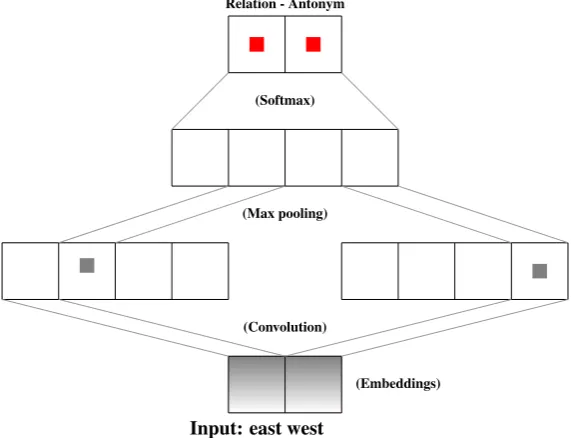
Following Kim (2014), we present a variant of the CNN architecture with four layer types: an input layer, a convolution layer, a max pooling layer, and a fully connected softmax layer for term pair relation classification as shown in figure 1. Each term pair (sentence) in the input layer is represented as a sentence(relation) comprised of distributional word embeddings. Let vi ∈ Rk be the k-dimensional
word vector corresponding to theith word in the term pair. Then a term pairSof length`is represented as the concatenation of its word vectors:
S =v1⊕v2⊕ · · · ⊕v`. (1)
(Convolution) (Max pooling) (Softmax) Relation - Antonym
(Embeddings)
[image:3.595.156.442.66.285.2]Input: east west
Figure 1: Illustration of an example term pair relation classification using convolutional neural networks
a non-linear activation function such as rectified linear unit (ReLU) for the convolution process and max-over-time pooling (Collobert et al., 2011; Kim, 2014) at pooling layer to deal with the variable sentence size. After a series of convolutions with different filters with different heights, the most important features are generated. Then, this feature representation,Z, is passed to a fully connected penultimate layer and outputs a distribution over different relation labels:
y= softmax(W ·Z+b), (2)
whereydenotes a distribution over different relation labels,W is the weight vector learned from the input word embeddings from the training corpus, andbis the bias term.
3.2 Experimental Setup
We model the relation classification as a sentence classification task. We use the CogALex-V 2016 shared task dataset in our experiments which is described in the next section. This dataset consist-ing of term pairs is tokenized usconsist-ing white space tokenizer. We performed both binary and multi-class classification on the given data set containing two binary and five multi-class relations from subtask-1 and subtask-2 respectively. We used Kim’s (2014) Theano implementation of CNN3 for training the
CNN model. We use word embeddings from word2vec which are learned using the skipgram model of Mikolov et. al (2013a,b) by predicting linear context words surrounding the target words. These word vectors are trained on about 100 billion words from Google News corpus. As word embeddings alone have shown good performance in various classification tasks, we also use them in isolation, with varying dimensions, in our experiment. We performed 10-fold cross-validation (CV) on the entire training set for both the subtasks in random and word2vec embedding settings. We initialized random embeddings in the range of[−0.25,0.25]. We did not use any external corpus for training our model but used pre-compiled word2vec embeddings trained on about 100 billion words from Google News corpus. We used a stochastic gradient descent-based optimization method for minimizing the cross entropy loss during the training with the Rectified Linear Unit (ReLU) non-linear activation function.
Tuning Hyper Parameters. The hyper-parameters we varied are the drop-out, batch size, embed-ding dimension and hidden node sizes for training our models in cross-validation setting for finembed-ding
TRUE FALSE Total
Train 826 2228 3054
Test 1201 3059 4260
[image:4.595.103.247.63.113.2]Total 2027 5287 7314
Table 1: Training and test data sets: Subtask-1 of CogALex-V shared task
ant hyper part of random syn Total
Train 241 255 163 2228 167 3054
Test 360 382 224 3059 235 4260
Total 601 637 387 5287 402 7314
Table 2: Training and test data sets: Subtask-2 of CogALex-V shared task
CNN Relation Precision Recall F1 random emb. true 41.23 37.26 39.00 false 77.45 80.26 78.80
weighted 41.23 37.26 39.00
word2vec emb. true 58.15 52.69 54.99 false 82.94 85.96 84.37
weighted 58.15 52.69 54.99
Table 3: Avg. 10-fold cross-validation results on subtask-2 with rand. & word2vec embeds.
Relation Precision Recall F1
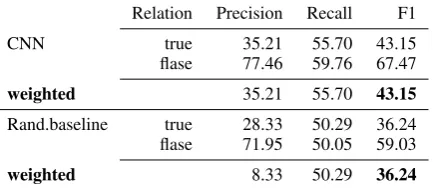
CNN true 35.21 55.70 43.15
flase 77.46 59.76 67.47
weighted 35.21 55.70 43.15
Rand.baseline true 28.33 50.29 36.24 flase 71.95 50.05 59.03
weighted 8.33 50.29 36.24
Table 4: Subtask-1 test set results word2vec embed-ding setting Vs. Random baseline.
the optimal model using training set. We performed grid search over these value ranges for the men-tioned hyper parameters: drop out{0.1,0.2,0.3,0.4,0.5,0.6}, batch size{12,24,32,48,60}, embedding di-mension{50,100,150,200,250,300} and hidden node sizes{100,200,300,400,500}. Optimal results are obtained using drop out-0.5, batch size-32,embedding size-300 and hidden node size-300 for subtask-1 and dropout-0.5, batchSize-24, embedding size-300 and hidden node size-400 for subtask-2 in cross val-idation setting as shown in tables 3 and 5. We used fixed context-window sizes set at [1,2] as max length of the term pair in given corpus is 2 for both the tasks. We also used fixed number of 25 iterations with default learning rate (0.95) for training our models.
4 Datasets and Evaluation Results
In this section, we describe CogALex-V 2016 shared task data sets and the experimental results.
Datasets. We used a dataset extracted from EVALution 1.0 (Santus et al., 2015), which was developed from WordNet and ConceptNet, and which was further filtered by native speakers in a CrowdFlower task. This data set is split into training and test sets. The distribution of training and test splits are shown in tables 1 and 2. The samples in the subtask-1 and subtask-2 test set are unbalanced and majority of relation classes are ”FALSE” and ”random” in the given train and test sets.
[image:4.595.306.523.171.266.2]CNN Rel.type Precision Recall F1 random emb. syn 22.61 16.46 18.01 ant 17.84 13.09 14.67 hyper 14.05 32.80 35.63 part of 40.87 27.98 32.08
weighted 27.82 20.01 22.68
random 69.65 77.15 73.15 word2vec emb. syn 21.36 12.30 15.03 ant 39.10 33.08 35.30 hyper 51.89 48.89 49.61 part of 49.24 39.11 42.63
weighted 42.09 34.93 37.31
[image:5.595.121.228.305.362.2]random 81.89 87.84 84.66
Table 5: Avg. 10-fold cross-validation results on subtask-2 with rand. & word2vec embeds.
Rel.type Precision Recall F1 syn 06.96 13.62 09.21
CNN ant 20.21 31.39 24.59
hyper 30.71 40.84 35.06 part of 25.20 27.68 26.38
weighted 21.89 30.22 25.24
random 77.40 62.93 69.42 syn 05.89 20.85 09.18 Rand.baseline ant 07.77 19.17 11.06 hyper 08.83 20.42 12.33 part of 05.31 20.09 08.40
weighted 07.28 20.07 10.60
random 71.57 18.93 29.94
Table 6: subtask-2 results in word2vec embedding setting vs Random baseline.
Predicted true false
Actual
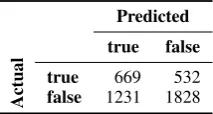
true 669 532
false 1231 1828
Table 7: Confusion matrix of subtask-1 test set results
Predicted
random syn ant hyper part-of
Actual
random 1925 336 363 280 155
syn 118 32 47 30 8
ant 190 39 113 12 6
hyper 145 35 31 156 15
part of 109 18 5 30 62
Table 8: Confusion matrix of subtask-2 test set re-sults
5 Discussion and Conclusion
We can assess the degree of confusion between various relation classes from the confusion matrix of CNN classification model as shown in tables 7 and 8. On subtask-1, 44% of the term pairs are false-negatives and 40% of the term pairs are reported as false-positives. On subtask-2, the ”synonym” relation is mostly confused with the ”antonym” and ”hypernym” and less confused with the ”part of” relation. We also observe a significant amount of confusion between ”part of” and the ”hypernym” relations. The relations– ”antonym” and ”hypernym” are less confused with the ”meronym” relation but both are confused with the ”synonym” relation. We also observe that majority of the identified relation classes largely confused with the majority ”random” class.
In our proposed approach, our system showed that distributional embeddings learned from the large corpus improve relation classification. There are a number of potential directions to improve relation classification accuracy. One possible future work might be to compile the common vocabulary among most confusing relation classes and for the vocabulary compile embeddings from large, unlabeled rela-tion corpora using neural networks, and encode both syntactic and semantic properties of words in the network representation.
References
Marco Baroni, Raffaella Bernardi, Ngoc-Quynh Do, and Chung-chieh Shan. 2012. Entailment above the word level in distributional semantics. InProceedings of the 13th Conference of the European Chapter of the Associ-ation for ComputAssoci-ational Linguistics, pages 23–32. Association for Computational Linguistics.
Ronan Collobert, Jason Weston, L´eon Bottou, Michael Karlen, Koray Kavukcuoglu, and Pavel Kuksa. 2011. Natural language processing (almost) from scratch.The Journal of Machine Learning Research, 12:2493–2537. Marti A Hearst. 1992. Automatic acquisition of hyponyms from large text corpora. InProceedings of the 14th conference on Computational linguistics-Volume 2, pages 539–545. Association for Computational Linguistics. Yoon Kim. 2014. Convolutional neural networks for sentence classification. InProceedings of the 2014
Confer-ence on Empirical Methods in Natural Language Processing, pages 1746–1751.
Artuur Leeuwenberg, Mihaela Vela, Jon Dehdari, and Josef van Genabith. 2016. A minimally supervised approach for synonym extraction with word embeddings. The Prague Bulletin of Mathematical Linguistics, 105(1):111– 142.
Tomas Mikolov, Ilya Sutskever, Kai Chen, Greg S Corrado, and Jeff Dean. 2013a. Distributed representations of words and phrases and their compositionality. InAdvances in Neural Information Processing Systems 26, pages 3111–3119.
Tomas Mikolov, Wen-tau Yih, and Geoffrey Zweig. 2013b. Linguistic regularities in continuous space word representations. InProceedings of the 2013 Conference of the North American Chapter of the Association for Computational Linguistics: Human Language Technologies, pages 746–751.
Masataka Ono, Makoto Miwa, and Yutaka Sasaki. 2015. Word embedding-based antonym detection using thesauri and distributional information. InProc. of NAACL.
Alexander Alexandrovich Pak, Sergazy Sakenovich Narynov, Arman Serikuly Zharmagambetov, Shol-pan Nazarovna Sagyndykova, Zhanat Elubaevna Kenzhebayeva, and Irbulat Turemuratovich. 2015. The method of synonyms extraction from unannotated corpus. InDigital Information, Networking, and Wireless Communications (DINWC), 2015 Third International Conference on, pages 1–5. IEEE.
Enrico Santus, Frances Yung, Alessandro Lenci, and Chu-Ren Huang. 2015. Evalution 1.0: an evolving semantic dataset for training and evaluation of distributional semantic models. InProceedings of the 4th Workshop on Linked Data in Linguistics: Resources and Applications, Association for Computational Linguistics, Beijing, China, pages 64–69.
Martin Saveski and Igor Trajkovski. 2010. Automatic construction of wordnets by using machine translation and language modeling. In13th Multiconference Information Society, Ljubljana, Slovenia.
Austin Shoemaker and Varun Ganapathi. 2005. Learning to automatically discover meronyms.
Vered Shwartz, Yoav Goldberg, and Ido Dagan. 2016. Improving hypernymy detection with an integrated path-based and distributional method. InProceedings of the 54th Annual Meeting of the Association for Computa-tional Linguistics, ACL 2016, August 7-12, 2016, Berlin, Germany, Volume 1: Long Papers.
Rion Snow, Daniel Jurafsky, and Andrew Y Ng. 2004. Learning syntactic patterns for automatic hypernym discovery. Advances in Neural Information Processing Systems 17.
Lonneke Van der Plas and J¨org Tiedemann. 2006. Finding synonyms using automatic word alignment and mea-sures of distributional similarity. In Proceedings of the COLING/ACL on Main conference poster sessions, pages 866–873. Association for Computational Linguistics.
Tim vor der Br¨uck and Hermann Helbig. 2010. Meronymy extraction using an automated theorem prover.JLCL, 25(1):57–81.
Wen-tau Yih, Geoffrey Zweig, and John C Platt. 2012. Polarity inducing latent semantic analysis. In Proceed-ings of the 2012 Joint Conference on Empirical Methods in Natural Language Processing and Computational Natural Language Learning, pages 1212–1222. Association for Computational Linguistics.
Jingwei Zhang, Jeremy Salwen, Michael R Glass, and Alfio Massimiliano Gliozzo. 2014. Word semantic repre-sentations using bayesian probabilistic tensor factorization. InEMNLP, pages 1522–1531.