Automatic Knowledge Base Construction using
Probabilistic Extraction, Deductive Reasoning, and Human Feedback
Daisy Zhe Wang
Yang Chen
Sean Goldberg
Department of Computer and Information Science and Engineering,
University of Florida
{
daisyw,yang,sean,cgrant,kli
}
@cise.ufl.edu
Christan Grant
Kun Li
Abstract
We envision an automatic knowledge base construction system consisting of three inter-related components. MADDEN is a knowl-edge extraction system applying statistical text analysis methods over database sys-tems (DBMS) and massive parallel processing (MPP) frameworks; PROBKB performs prob-abilistic reasoning over the extracted knowl-edge to derive additional facts not existing in the original text corpus; CAMEL leverages human intelligence to reduce the uncertainty resulting from both the information extraction and probabilistic reasoning processes.
1
Introduction
In order to build a better search engine that performs semantic search in addition to keyword matching, a knowledge base that contains information about all the entities and relationships on the web and beyond is needed. With recent advances in technology such as cloud computing and statistical machine learning (SML), automatic knowledge base construction is becoming possible and is receiving more and more interest from researchers. We envision an automatic knowledge base (KB) construction system that in-cludes three components: probabilistic extraction, deductive reasoning, and human feedback.
Much research has been conducted on text anal-ysis and extraction at web-scale using SML models and algorithms. We built our parallelized text anal-ysis library MADDENon top of relational database systems and MPP frameworks to achieve efficiency and scalability.
The automatically extracted information contains errors, uncertainties, and probabilities. We use a probabilistic database to preserve uncertainty in data representations and propagate probabilities through query processing.
Further, not all information can be extracted from the Web (Schoenmackers et al., 2008). A probabilis-tic deductive reasoning system is needed to infer ad-ditional facts from the existing facts and rules ex-tracted by MADDEN.
Finally, we propose to use human feedback to im-prove the quality of the machine-generated knowl-edge base since SML methods are not perfect. Crowdsourcing is one of the ways to collect this feedback and though much slower, it is often more accurate than the state-of-the-art SML algorithms.
2
System Overview
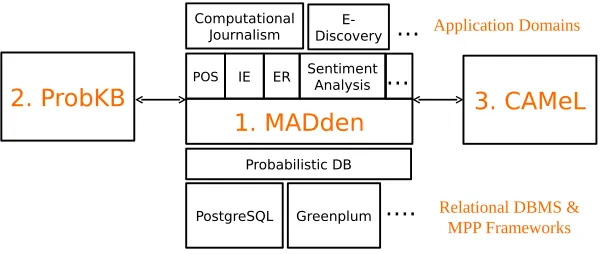
Our vision of the automatic knowledge base con-struction process consists of three main components as shown in Figure 1.
The first component is a knowledge extraction system called MADDEN that sits on top of a prob-abilistic database system such as BAYESSTORE or PrDB and treats probabilistic data, statistical mod-els, and algorithms as first-class citizens (Wang et al., 2008; Sen et al., 2009). MADDEN
specifi-cally implements SML models and algorithms on database systems (e.g., PostgreSQL) and massive parallel processing (MPP) frameworks (e.g., Green-plum) to extract various types of information from the text corpus, including entities, relations, and
rules. Different types of information are extracted by different text analysis tasks. For example, the
1. MADden
POS IE ER Sentiment Analysis…
ComputationalJournalism DiscoveryE-
…
PostgreSQL Greenplum
….
Probabilistic DB3. CAMeL
Application Domains
Relational DBMS & MPP Frameworks
[image:2.612.154.457.73.200.2]2. ProbKB
Figure 1: Architecture for Automatic Knowledge Base Construction
named entity recognition (NER) task extracts dif-ferent types ofentitiesincluding people, companies, and locations from text.
The second component is a probabilistic reason-ing system called PROBKB. Given a set of enti-ties, relations, and rules extracted from a text cor-pus (e.g., WWW), PROBKB enables large-scale in-ference and reasoning over uncertain entities and relations using probabilistic first-order logic rules. Such inference would generate a large number of new facts that did not exist in the original text cor-pus. The uncertain knowledge base is modeled by Markov logic networks (MLN) (Domingos et al., 2006). In this model, the probabilistic derivation of new facts from existing ones is equivalent to infer-ence over the MLNs.
The third component is a crowd-based human feedback system called Crowd-Assisted Machine Learning or CAMEL. Given the set of extracted and derived facts, rules and their uncertainties, CAMEL leverages the human computing power from crowd-sourcing services to improve the quality of the knowledge base. Based on the probabilities associ-ated with the extracted and derived information in an uncertain knowledge base, CAMEL effectively se-lects and formulates questions to push to the crowd.
The resulting knowledge base constructed from the extraction, derivation, and feedback steps can be used in various application domains such as compu-tational journalism and e-discovery.
3
MAD
DEN: Statistical Text Analysis on
MPP Frameworks
The focus of the MADDENproject has been to inte-grate statistical text analytics into DBMS and MPP frameworks to achieve scalability and paralleliza-tion. Structured and unstructured text are core assets for data analysis. The increasing use of text analysis in enterprise applications has increased the expecta-tion of customers and the opportunities for process-ing big data. The state-of-the-art text analysis and extraction tools are increasingly found to be based on statistical models and algorithms (Jurafsky et al., 2000; Feldman and Sanger, 2007).
Basic text analysis tasks include part-of-speech (POS) tagging, named entity extraction (NER), and entity resolution (ER) (Feldman and Sanger, 2007). Different statistical models and algorithms are im-plemented for each of these tasks with different runtime-accuracy trade-offs. An example entity res-olution task could be to find all mentions in a text corpus that refer to a real-world entity X. Such a task can be done efficiently by approximate string matching (Navarro, 2001) techniques to find all mentions that approximately match the name of en-tityX. Approximate string matching is a high re-call and low precision approach when compared to state-of-the-art collective entity resolution algo-rithms based on statistical models like Conditional Random Fields (CRFs) (Lafferty et al., 2001).
CRF (Viterbi), Markov chain Monte Carlo (MCMC) inference, and approximate string matching.
Text Feature Extraction: To analyze text, fea-tures need to be extracted from documents and it can be an expensive operation. To achieve results with high accuracy, CRF methods often compute hun-dreds of features over each token in the document, which can be high cost. Features are determined by functions over the sets of tokens. Examples of such features include: (1) dictionary features: does this token exist in a provided dictionary? (2) regex features: does this token match a provided regular expression? (3) edge features: is the label of a to-ken correlated with the label of a previous toto-ken?
(4) word features: does this the token appear in the training data?and (5) position features:is this token the first or last in the token sequence? The optimal combination of features depends on the application.
Approximate String Matching: A recurring primitive operation in text processing applications is the ability to match strings approximately. The technique we use is based on qgrams (Gravano et al., 2001). We create and index 3-grams over text. Given a string “Tim Tebow” we can create a 3-gram by using a sliding window of 3 characters over this text string. Given two strings we can compare the overlap of two sets of corresponding 3-grams and compute a similarity as the approximate matching score.
Once we have the features, the next step is to per-form inference on the model. We also implemented two types of statistical inference within the database: Viterbi (when we only want the most likely answer from a linear-chain CRF model) and MCMC (when we want the probabilities or confidence of an answer from a general CRF model).
Viterbi Inference: The Viterbi dynamic pro-gramming algorithm (Manning et al., 1999) is a pop-ular algorithm to find the top-k most likely labelings of a document for (linear-chain) CRF models.
To implement the Viterbi dynamic program-ming algorithm we experimented with two different implementations of macro-coordination over time. First, we chose to implement it using a combination of recursive SQL and window aggregate functions. We discussed this implementation at some length in earlier work (Wang et al., 2010). Second, we chose to implement a Python UDF that uses iterations to
drive the recursion in Viterbi. In the Greenplum MPP Framework, Viterbi can be run in parallel over different subsets of the document on a multi-core machine.
MCMC Inference: MCMC methods are classi-cal sampling algorithms that can be used to esti-mate probability distributions. We implemented two MCMC method: Gibbs sampling and Metropolis-Hastings (MCMC-MH).
The MCMC algorithms involve iterative proce-dures where the current values depend on previ-ous iterations. We use SQL window aggregates for macro-coordination in this case, to carry “state” across iterations to perform the Markov-chain pro-cess. We discussed this implementation at some length in recent work (Wang et al., 2011). We are currently developing MCMC algorithms over Greenplum DBMS.
4
P
ROBKB: Probabilistic Knowledge Base
The second component of our system is PROBKB, a probabilistic knowledge base designed to derive im-plicit knowledge from entities, relations, and rules extracted from a text corpus by knowledge ex-traction systems like MADDEN. Discovering new knowledge is a crucial step towards knowledge base construction since many valuable facts are not ex-plicitly stated in web text; they need to be inferred from extracted facts and rules.
PROBKB models uncertain facts as Markov logic networks (MLN) (Domingos et al., 2006). Markov logic networks are proposed to unify first-order logic and statistical inference by attaching a weight to each first-order formula (rule). These weights re-flect our confidence of the rules being true. To obtain these weighted formulae, we have used natural lan-guage processing (NLP) methods to extract entities and relations as described in Section 3 and learned the formulae from the extractions.
in-accessibility of evidence rather than being incorrect; they may prove to be true when new extractions are available as supporting evidence.
We are experimenting on some state-of-the-art implementations of MLNs like TUFFY (Niu et al., 2011) as a base to develop our large-scale proba-bilistic inference engine. Taking the MLN and un-certain facts, rules, and their confidence as inputs, the system is able to answer queries like “how likely will Bob develop a cancer?”. Though TUFFYis able to handle uncertainties resulted from extraction sys-tems, it is no easy task for the system to scale up to tens of millions of facts and thousands of rules. To address this problem, we are currently research-ing several possible ways to parallelize the inference computation. One challenge for parallelization is data dependency: the result set (derived facts) of one rule may affect that of another. As a first attempt, we are looking at two different partitioning strategies: partition by rules and partition by facts.
In addition to partitioning techniques, we are also trying to evaluate the possibility of implementing MLNs on different MPP frameworks: Greenplum Database, HadoopDB, and Datapath (Arumugam et al., 2010). These database systems allow effective parallel processing of big data and running of in-ference algorithms, which is essential for scaling up probabilistic reasoning in the PROBKB project.
5
CAM
EL: Crowd-Assisted Machine
Learning
The final proposed component for automatic con-struction of a knowledge base is a crowd-based sys-tem, CAMEL, designed for improving uncertainty. CAMEL is built on top of an existing
probabilis-tic knowledge or database like PROBKB and
MAD-DEN.
In addition to using SML techniques for large scale analysis, an increasing trend has been to har-ness human computation in a distributed manner us-ing crowdsourcus-ing (Quinn et al., 2010; Sorokin and Forsyth, 2008). Benefits can be gained in problems that are too difficult or expensive for computers. Ser-vices like Amazon Mechanical Turk (AMT) (Ipeiro-tis, 2010) have led the way by setting up an infras-tructure that allows payment for the combined re-sources of up to hundreds of thousands of people.
SML is not perfect: for some simple NLP tasks it achieves a relatively high accuracy while for other ones involving context and reasoning the results are much worse. Cases where the model is unable to ad-equately reason about a difficult piece of data intro-duces large uncertainties into the output. The need for a new type of data cleaning process has emerged. As discussed in Section 4, one approach is to thresh-old uncertainty and throw away those facts the ma-chine is unable to reason about, leaving the knowl-edge base incomplete. Another approach is to con-vert these high uncertainty examples into questions for the crowd to answer.
The main tenets of CAMEL are its selection model and integration model as described below.
Selection Model: The first important feature of CAMEL is its ability to distinguish and select the most uncertain fields in the knowledge base. For tasks involving CRFs (MADDEN), each hidden node can be marginalized to find a probability distri-bution over the label space. From the marginal dis-tribution, we can attach amarginal entropyto each node in the graph. Our algorithm selects the high-est entropy node to be sent to the crowd. Additional research is being done to take advantage of specifics of the graph structure such as the connectivity and dependency relationships of each node.
6
Conclusion
In this short paper, we described our vision of an automatic knowledge base construction system con-sisting of three major components—extraction, rea-soning, and human feedback. The resulting system is expected to be scalable, efficient, and useful in vaiours application domains.
Acknowledgments
This material is based upon work supported by the national Science Foundation Graduate Research Fel-lowship under Grant No. DGE-0802270 and a gen-erous gift from Greenplum.
References
Subi Arumugam, Alin Dobra, Christopher M. Jermaine, Niketan Pansare, and Luis Perez. 2010. The dat-apath system: a data-centric analytic processing en-gine for large data warehouses. In Proceedings of the 2010 international conference on Management of data, SIGMOD ’10, pages 519–530, New York, NY, USA. ACM.
A. P. Dawid and A. M. Skene. 1979. Maximum likeli-hood estimation of observer error-rates using the em algorithm.Applied Statistics, 28(1):20–28.
A. P. Dempster. 1967. Upper and lower probabilities induced by a multivalued mapping. Annals of Mathe-matical Statistics, 38:325–339.
Pedro Domingos, Stanley Kok, Hoifung Poon, Matthew Richardson, and Parag Singla. 2006. Unifying logi-cal and statistilogi-cal ai. InProceedings of the 21st na-tional conference on Artificial intelligence - Volume 1, AAAI’06, pages 2–7. AAAI Press.
R. Feldman and J. Sanger. 2007. The text mining hand-book: advanced approaches in analyzing unstructured data. Cambridge Univ Pr.
L. Gravano, P.G. Ipeirotis, H.V. Jagadish, N. Koudas, S. Muthukrishnan, L. Pietarinen, and D. Srivastava. 2001. Using q-grams in a dbms for approximate string processing. IEEE Data Engineering Bulletin, 24(4):28–34.
P.G. Ipeirotis. 2010. Analyzing the amazon mechanical turk marketplace. XRDS: Crossroads, The ACM Mag-azine for Students, 17(2):16–21.
D. Jurafsky, J.H. Martin, A. Kehler, K. Vander Linden, and N. Ward. 2000. Speech and language processing: An introduction to natural language processing, com-putational linguistics, and speech recognition, vol-ume 2. Prentice Hall New Jersey.
John D. Lafferty, Andrew McCallum, and Fernando C. N. Pereira. 2001. Conditional random fields: Proba-bilistic models for segmenting and labeling sequence data. InProceedings of the Eighteenth International Conference on Machine Learning, ICML ’01, pages 282–289, San Francisco, CA, USA. Morgan Kauf-mann Publishers Inc.
C.D. Manning, H. Sch¨utze, and MITCogNet. 1999. Foundations of statistical natural language process-ing, volume 999. MIT Press.
Gonzalo Navarro. 2001. A guided tour to approximate string matching. ACM Comput. Surv., 33(1):31–88, March.
Feng Niu, Christopher R´e, AnHai Doan, and Jude W. Shavlik. 2011. Tuffy: Scaling up statistical infer-ence in markov logic networks using an rdbms.CoRR, abs/1104.3216.
A. Quinn, B. Bederson, T. Yeh, and J. Lin. 2010. Crowd-Flow: Integrating Machine Learning with Mechanical Turk for Speed-Cost-Quality Flexibility. Technical re-port, University of Maryland, May.
Stefan Schoenmackers, Oren Etzioni, and Daniel S. Weld. 2008. Scaling textual inference to the web. In Proceedings of the Conference on Empirical Methods in Natural Language Processing, EMNLP ’08, pages 79–88, Stroudsburg, PA, USA. Association for Com-putational Linguistics.
Prithviraj Sen, Amol Deshpande, and Lise Getoor. 2009. Prdb: managing and exploiting rich correla-tions in probabilistic databases. The VLDB Journal, 18(5):1065–1090, October.
G. Shafer. 1976. A mathematical theory of evidence. Princeton university press.
Alexander Sorokin and David Forsyth. 2008. Utility data annotation with Amazon Mechanical Turk. In2008 IEEE Computer Society Conference on Computer Vi-sion and Pattern Recognition Workshops, pages 1–8. IEEE, June.
Daisy Zhe Wang, Eirinaios Michelakis, Minos Garo-falakis, and Joseph M. Hellerstein. 2008. Bayesstore: managing large, uncertain data repositories with prob-abilistic graphical models. Proc. VLDB Endow., 1:340–351, August.
Daisy Zhe Wang, Michael J. Franklin, Minos N. Garo-falakis, and Joseph M. Hellerstein. 2010. Query-ing probabilistic information extraction. PVLDB, 3(1):1057–1067.