Proceedings of the 15th Workshop on Biomedical Natural Language Processing, pages 136–140, Berlin, Germany, August 12, 2016. c2016 Association for Computational Linguistics
Modelling the Combination of Generic and Target Domain Embeddings in
a Convolutional Neural Network for Sentence Classification
Nut Limsopatham and Nigel Collier
Language Technology Lab
Department of Theoretical and Applied Linguistics University of Cambridge
Cambridge, UK
{nl347,nhc30}@cam.ac.uk
Abstract
Word embeddings have been successfully exploited in systems for NLP tasks, such as parsing and text classification. It is intu-itive that word embeddings created from a larger corpus would provide a better cover-age of vocabulary. Meanwhile, word em-beddings trained on a corpus related to the given task or target domain would more ef-fectively represent the semantics of terms. However, in some emerging domains (e.g. bio-surveillance using social media data), it may be difficult to find a domain corpus that is large enough for creating effective word embeddings. To deal with this prob-lem, we propose novel approaches that use both word embeddings created from generic and target domain corpora. Our experimental results on sentence classifi-cation tasks show that our approaches sig-nificantly improve the performance of an existing convolutional neural network that achieved state-of-the-art performances on several text classification tasks.
1 Introduction
Word embeddings (i.e. distributed vector re-presentation) represent words using dense, low-dimensional and real-valued vectors, where each dimension represents a latent feature of the word (Turian et al., 2010; Mikolov et al., 2013; Pennington et al., 2014). It has been empir-ically shown that word embeddings could cap-ture semantic and syntactic similarities between words (Turian et al., 2010; Mikolov et al., 2013; Pennington et al., 2014; Levy and Goldberg, 2014). Importantly, word embeddings have been effectively used for several NLP tasks (Turian et al., 2010; Collobert et al., 2011; Segura-Bedmar et al., 2015; Limsopatham and Collier, 2015a; Limsopatham and Collier, 2015b; Muneeb
et al., 2015). For example, Turian et al. (2010) used word embeddings as input features for sev-eral NLP systems, including a traditional chunk-ing system based on conditional random fields (CRFs) (Lafferty et al., 2001). Collobert et al. (2011) used word embeddings as inputs of a multilayer neural network for part-of-speech tag-ging, chunking, named entity recognition and se-mantic role labelling. Limsopatham and Col-lier (2016) leveraged semantics from word em-beddings when identifying medical concepts men-tioned in social media messages. Kim (2014) showed that using pre-built word embeddings, in-duced from 100 billion words of Google News us-ing word2vec (Mikolov et al., 2013), as inputs of a simple convolutional neural network (CNN) could achieve state-of-the-art performances on several sentence classification tasks, such as classification of positive and negative reviews of movies (Pang and Lee, 2005) and consumer products, e.g. cam-eras (Hu and Liu, 2004).
The quality of word embeddings (e.g. the abil-ity to capture semantics of words) highly depends on the corpus from which they are induced (Pen-nington et al., 2014). For instance, when induced from a generic corpus, such as Google News, the vector representation of ‘tissue’ would be simi-lar to the vectors of ‘paper’ and ‘toilet’. How-ever, when induced from medical corpora, such as PubMed1 or BioMed Central2, the vector of
‘tissue’ would be more similar to those of ‘cell’ and ‘organ’. Hence, word embeddings induced from the corpus related to the task or target do-main are likely to be more useful. Meanwhile, it is intuitive that the more training documents used, the more likely that more vocabulary is covered. Recent studies (e.g. (Faruqui et al., 2015; Xu et al., 2014; Yu and Dredze, 2014)) have attempted to improve the quality of word embeddings by
1https://www.ncbi.nlm.nih.gov/pubmed/ 2https://www.biomedcentral.com/
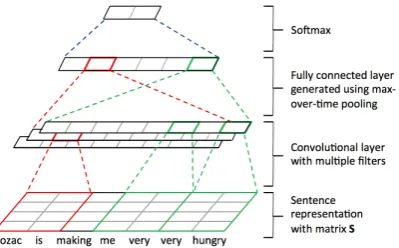
Figure 1: CNN for sentence classification.
enhancing the learning algorithm or injecting an existing knowledge-base, e.g. WordNet (Miller, 1995) or UMLS semantic network3. Pennington
et al. (2014) incorporated aggregated global word co-occurrence statistics from the corpus when in-ducing word embeddings. Xu et al. (2014) and Yu and Dredze (2014) exploited semantic knowl-edge to improve the semantic representation of word embeddings. Nevertheless, in some emerg-ing domains, e.g. detectemerg-ing adverse drug reactions (ADR) reported in social media, existing knowl-edge resources or corpora may not be large enough for creating effective embeddings.
In this work, we investigate novel approaches to incorporate both generic and target domain embeddings in CNN for sentence classification. We hypothesise that using both generic and target domain embeddings further improves the performance of CNN, since it can benefit from both the good coverage of vocabulary from the generic embedding, and the effective semantic representation of the target domain embedding. This would enable CNN to perform effectively without requiring new target domain embeddings induced from a large amount of domain docu-ments specifically related to individual tasks. We thoroughly evaluate our proposed approaches us-ing an ADR tweet classification task (Ginn et al., 2014). In addition, to show that our approaches are effective for different target domains, we also evaluate them using a movie review classification task (Pang and Lee, 2005). Our experimental results show that our approaches significantly improve the performance in term of accuracy over an existing strong baseline that uses only either the generic or the target domain embeddings.
2 CNN for Sentence Classification
CNN has been used to model sentences in differ-ent NLP tasks, such as sdiffer-entence classification and
3https://semanticnetwork.nlm.nih.gov/
sentence matching (Collobert and Weston, 2008; Kim, 2014; Kalchbrenner et al., 2014; Hu et al., 2014). In this work, we adapt the CNN model of Kim (2014) to exploit both generic and tar-get domain word embeddings, because of its sim-plicity and effectiveness. The model architecture of Kim (2014) is shown in Figure 1. In particu-lar, for a given input sentence of lengthnwords (padded where necessary), we create a sentence matrix S ∈ Rd×n, where each column is thed
-dimensional vector (i.e. embedding)xi ∈ Rd of
each word in the sentence:
S=
| | | |
x1 x2 ... xn
| | | |
(1)
The CNN with max pooling architecture (Col-lobert et al., 2011; Kim, 2014) is then used for modelling the sentence. Specifically, a convolu-tion operaconvolu-tion using a filterw ∈ Rd×h is applied
to a window ofhwords to extract a featurecifrom
a window of wordsxi:i+h−1as follows:
ci=f(w·xi:i+h−1+b) (2)
where f is an activation function, such as tanh or rectifier linear unit (ReLU) (Nair and Hinton, 2010), andb∈Ris a bias.
The filter wis convolved over the sequence of words represented in the sentence matrixSto cre-ate a feature matrixC. In order to capture the most important features, max pooling is applied to take the maximum value of each row in the matrixC:
cmax=
max(C1,:) .. . max(Cd,:)
(3)
This fixed sized vectorcmax forms a fully
con-nected layer, before passing to a softmax function for classification. Note that multiple filters (e.g. using different window sizes) can be used to ex-tract features for the fully connected layer.
3 Modelling the Combination of Word Embeddings
We investigate two approaches to model the com-bination of generic and target domain word em-beddings in the described CNN architecture.
3.1 Vector Concatenation
The first approach (namely,vector concatenation) is to concatenate vectors from the two embeddings when generating the sentence matrixS(i.e. at the input layer). In particular, each word vectorxi in
of the vectors from both generic and target domain embeddings corresponding to that word. This al-lows the filter wto learn the importance of each dimension of both embeddings4.
3.2 Combining when Forming the Fully Connected Layer
The second approach (namely, fully connected layer combination) models the combination of the word embeddings when forming the fully con-nected layer before applying softmax for classi-fication. Indeed, we apply the convolution oper-ation (i.e. the convolutional layer in Figure 1) on two different sentence matrices, each of which is created using either the generic or the target do-main embeddings. Then, the extracted features are concatenated at a single fully connected layer before applying softmax. This enables the model to learn the importance of each feature from both embeddings directly, before allowing the softmax to take into account the extracted features. Intu-itively, this approach should be more effective than the first approach, as it allows more parameters to be learned directly based on the effectiveness of the word vectors from each of the embeddings.
4 Experimental Setup
4.1 Test Collection
To evaluate our approaches, we use two different test collections, which represent domain-specific tasks where existing target domain documents for training word embeddings may be limited. First, the adverse drug reaction (ADR) tweet collec-tion (Ginn et al., 2014) contains 5,250 Twitter messages5that can be classified as ADR and
non-ADR discussions. Second, the movie review col-lection (Pang and Lee, 2005)6 consists of 10,662
sentences that can be classified as having a posi-tive or a negaposi-tive meaning. On average, a sentence contains 20 terms. For both collections, we re-port the performance based on the accuracy mea-sure (Pang and Lee, 2005; Ginn et al., 2014), and use paired t-test (p <0.05) to measure the signifi-cant difference between the performance achieved by the proposed approaches and the baselines.
4The size of the filterw∈Rd∗×hdepends on the dimen-siond∗of the concatenated vectors.
5We have a smaller dataset than the original paper because some tweets can no longer be accessed via Twitter API.
6https://www.cs.cornell.edu/people/
pabo/movie-review-data
4.2 Pre-trained Word Embeddings
As a representative of generic word embeddings, we use the publicly available 300-dimension em-beddings (vocabulary size of 3M) that were in-duced from 100 billion words from Google News using word2vec7, which has been shown to be
ef-fective for several tasks (Baroni et al., 2014; Kim, 2014). For target domain embeddings, we use the skip-gram model from word2vec (using de-fault parameters) to create 300-dimension word embeddings from two different publicly available corpora, which are considerably smaller than the Google News. Specifically, the first corpus, rep-resenting the target domain corpus of the ADR tweet classification task, contains 854M words from 119k medical articles from BioMed Cen-tral. The vocabulary size is 1.3M. For the movie review classification task, we use 24M words of 28k movie reviews from the IMDb archive8for
in-ducing the target domain embedding (vocabulary size of 63k). In addition, we use a vector of ran-dom values sampled from[−0.25,0.25]to represent
a word that does not exist in any embedding.
4.3 Hyper-parameters and Training Regime
We set the hyper-parameters of CNN in our ap-proaches and the baselines following Kim (2014), whose system achieved state-of-the-art perfor-mances on several sentence classification tasks, in-cluding the movie review classification task eval-uated in this paper. Indeed, we use ReLU as acti-vation functions, and use the filterwwith the win-dow size (h) of 3, 4 and 5, each of which with 100 feature maps. We also apply dropout (dropout rate 0.5) (Srivastava et al., 2014) andL2regularisation
of the weight vectors at the fully connected layer. We conduct experiments using 10-fold cross validation. The CNN model is trained over a mini-batch of size 50 by back-propagation. The stochastic gradient decent is performed using Adadelta update rule (Zeiler, 2012) to minimise the negative log-likelihood of correct predictions.
5 Experimental Results
We compare the performance of our approaches, i.e. vector concatenation (Section 3.1) and fully connected layer combination (Section 3.2), with that of the effective CNN model of Kim (2014) (denoted,simple CNN). Note that we use thestatic
7https://code.google.com/p/word2vec/ 8Downloaded from http://www.cs.cornell.
edu/people/pabo/movie-review-data/ polarity_html.zip.
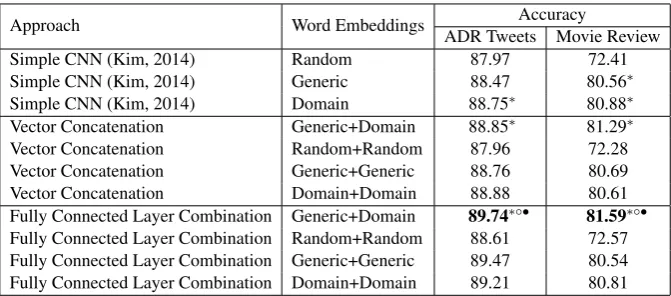
Approach Word Embeddings ADR Tweets Movie ReviewAccuracy
Simple CNN (Kim, 2014) Random 87.97 72.41
Simple CNN (Kim, 2014) Generic 88.47 80.56∗
Simple CNN (Kim, 2014) Domain 88.75∗ 80.88∗
Vector Concatenation Generic+Domain 88.85∗ 81.29∗
Vector Concatenation Random+Random 87.96 72.28
Vector Concatenation Generic+Generic 88.76 80.69
Vector Concatenation Domain+Domain 88.88 80.61
Fully Connected Layer Combination Generic+Domain 89.74∗◦• 81.59∗◦•
[image:4.595.131.467.61.209.2]Fully Connected Layer Combination Random+Random 88.61 72.57 Fully Connected Layer Combination Generic+Generic 89.47 80.54 Fully Connected Layer Combination Domain+Domain 89.21 80.81
Table 1: The accuracy performance of the proposed approaches and the simple CNN baselines (Kim, 2014). Significant differences (p < 0.05, paired t-test) compared to the simple CNN baselines with the
Random,GenericandDomainword embeddings, are denoted∗,◦and•, respectively.
variant of the CNN model, which does not al-low the input embeddings to be updated during training, as we aim to investigate the performance when using original embeddings9. In addition
to the pre-trained embeddings described in Sec-tion 4.2, we use 300-dimension randomly gener-ated word embeddings, as an alternative baseline.
Table 1 reports the accuracy performance of our approaches and the simple CNN baselines on the ADR tweet and movie review classification tasks. We first compare the effectiveness of the simple CNN baselines when applied with different word embeddings. For both tasks, the simple CNN with the target domain word embeddings (accu-racy 88.75% and 80.88%) outperforms the sim-ple CNN with either the generic (accuracy 88.47% and 80.56%) or the random (accuracy 87.97% and 72.41%) word embeddings. The performance dif-ferences between using the target domain and the random word embeddings are statistically signifi-cant (p <0.05) for both tasks. These results show the importance of target domain embedding for the simple CNN on the classification tasks.
Next, we discuss the performance of our two proposed approaches. As shown in Ta-ble 1, Fully Connected Layer Combination (Generic+Domain)performs better than all of the other approached reported in this paper for both the ADR tweet (accuracy 89.74%) and movie re-view (accuracy 81.59%) classification tasks. Im-portantly, it significantly (p < 0.05) outperforms the simple CNN baselines that use either the ran-dom, generic or target domain word embeddings for both tasks. Meanwhile, Vector Concatena-tion (Generic+Domain) also outperforms all of the simple CNN baselines. These support our
hy-9The performances of both Kim’s and our approaches will further improve, if we allow the embeddings to be updated.
pothesis that exploiting both the generic and tar-get domain word embeddings further improves the performance of CNN for sentence classification.
To further support that our approaches are ef-fective because of exploiting both generic and tar-get domain embeddings rather than because of al-lowing the model to learn more parameters, we compare our approaches with another set of base-lines that use either the generic, target domain, or random embedding twice in both of our proposed approaches. We observe that Fully Connected Layer Combination (Generic+Domain) outper-forms all of its corresponding baselines, e.g. Do-main+Domain, for both tasks. The same trends of performance are also observed for the vector con-catenation approach, excepting that Vector Con-catenation (Domain+Domain)marginally outper-forms Vector Concatenation (Generic+Domain)
on the ADR tweet classification task.
6 Conclusions
We have shown the potential of incorporating generic and target domain embeddings in CNN for sentence classification. This provides an al-ternative method for exploiting generic word em-beddings for a given task, where existing domain knowledge or corpora for creating word embed-dings are limited, as well as avoiding inducing new word embeddings from a large number of target domain documents for individual tasks. We pro-posed two approaches that modelled the combina-tion of the two embeddings at the input layer and the fully connected layer of a CNN model. Our experimental results conducted on the ADR tweet and movie review classification tasks showed that both approaches significantly improved the perfor-mance over a strong CNN baseline.
Acknowledgements
The authors acknowledge the support of the EP-SRC (grant number EP/M005089/1).
References
Marco Baroni, Georgiana Dinu, and Germ´an Kruszewski. 2014. Don’t count, predict! a systematic comparison of context-counting vs. context-predicting semantic vectors. InACL, pages 238–247.
Ronan Collobert and Jason Weston. 2008. A unified architecture for natural language processing: Deep neural networks with multitask learning. InICML, pages 160–167.
Ronan Collobert, Jason Weston, L´eon Bottou, Michael Karlen, Koray Kavukcuoglu, and Pavel Kuksa. 2011. Natural language processing (almost) from scratch. J. Mach. Learn. Res., 12:2493–2537. Manaal Faruqui, Jesse Dodge, Sujay Kumar Jauhar,
Chris Dyer, Eduard H. Hovy, and Noah A. Smith. 2015. Retrofitting word vectors to semantic lexi-cons. InNAACL, pages 1606–1615.
Rachel Ginn, Pranoti Pimpalkhute, Azadeh Nikfarjam, Apurv Patki, Karen OConnor, Abeed Sarker, Karen Smith, and Graciela Gonzalez. 2014. Mining twit-ter for adverse drug reaction mentions: a corpus and classification benchmark. In The fourth workshop on building and evaluating resources for health and biomedical text processing.
Minqing Hu and Bing Liu. 2004. Mining and summa-rizing customer reviews. InKDD, pages 168–177. Baotian Hu, Zhengdong Lu, Hang Li, and Qingcai
Chen. 2014. Convolutional neural network archi-tectures for matching natural language sentences. In
NIPS, pages 2042–2050.
Nal Kalchbrenner, Edward Grefenstette, and Phil Blun-som. 2014. A convolutional neural network for modelling sentences. InACL, pages 655–665. Yoon Kim. 2014. Convolutional neural networks for
sentence classification. In EMNLP, pages 1746– 1751.
John D. Lafferty, Andrew McCallum, and Fernando C. N. Pereira. 2001. Conditional Random Fields: Probabilistic models for segmenting and labeling se-quence data. InICML, pages 282–289.
Omer Levy and Yoav Goldberg. 2014. Dependency-based word embeddings. InACL, pages 302–308. Nut Limsopatham and Nigel Collier. 2015a. Adapting
phrase-based machine translation to normalise med-ical terms in social media messages. In EMNLP, pages 1675–1680.
Nut Limsopatham and Nigel Collier. 2015b. Towards the semantic interpretation of personal health mes-sages from social media. InProceedings of the ACM First International Workshop on Understanding the City with Urban Informatics, UCUI ’15, pages 27– 30.
Nut Limsopatham and Nigel Collier. 2016. Normalis-ing medical concepts in social media texts by learn-ing semantic representation. InACL.
Tomas Mikolov, Ilya Sutskever, Kai Chen, Greg S Cor-rado, and Jeff Dean. 2013. Distributed representa-tions of words and phrases and their compositional-ity. InNIPS, pages 3111–3119.
George A Miller. 1995. Wordnet: a lexical database for english. Communications of the ACM, 38(11):39–41.
TH Muneeb, Sunil Kumar Sahu, and Ashish Anand. 2015. Evaluating distributed word representations for capturing semantics of biomedical concepts. In
BioNLP, pages 158–163.
Vinod Nair and Geoffrey E Hinton. 2010. Rectified linear units improve restricted boltzmann machines. InICML, pages 807–814.
Bo Pang and Lillian Lee. 2005. Seeing stars: Exploit-ing class relationships for sentiment categorization with respect to rating scales. In ACL, pages 115– 124.
Jeffrey Pennington, Richard Socher, and Christopher D Manning. 2014. GloVe: Global vectors for word representation. InEMNLP, pages 1532–1543. Isabel Segura-Bedmar, Vıctor Su´arez-Paniagua, and
Paloma Martınez. 2015. Exploring word embed-ding for drug name recognition. InLOUHI, pages 64–72.
Nitish Srivastava, Geoffrey Hinton, Alex Krizhevsky, Ilya Sutskever, and Ruslan Salakhutdinov. 2014. Dropout: A simple way to prevent neural networks from overfitting. J. Mach. Learn. Res., 15(1):1929– 1958.
Joseph Turian, Lev Ratinov, and Yoshua Bengio. 2010. Word representations: a simple and general method for semi-supervised learning. InACL, pages 384– 394.
Chang Xu, Yalong Bai, Jiang Bian, Bin Gao, Gang Wang, Xiaoguang Liu, and Tie-Yan Liu. 2014. Rc-net: A general framework for incorporating knowl-edge into word representations. In CIKM, pages 1219–1228.
Mo Yu and Mark Dredze. 2014. Improving lexical em-beddings with semantic knowledge. InACL, pages 545–550.
Matthew D Zeiler. 2012. ADADELTA: an adaptive learning rate method. arXiv preprint arXiv:1212.5701.