Examining the Impacts of Dialogue Content and System Automation on
Affect Models in a Spoken Tutorial Dialogue System
Joanna Drummond Department of Computer Science
University of Pittsburgh Pittsburgh, PA 15260
Diane Litman
Department of Computer Science Learning Research & Development Ctr.
University of Pittsburgh Pittsburgh, PA 15260
Abstract
Many dialogue system developers use data gathered from previous versions of the dia-logue system to build models which enable the system to detect and respond to users’ affect. Previous work in the dialogue systems com-munity for domain adaptation has shown that large differences between versions of dialogue systems affect performance of ported models. Thus, we wish to investigate how more mi-nor differences, like small dialogue content changes and switching from a wizarded sys-tem to a fully automated syssys-tem, influence the performance of our affect detection models. We perform a post-hoc experiment where we use various data sets to train multiple mod-els, and compare against a test set from the most recent version of our dialogue system. Analyzing these results strongly suggests that these differences do impact these models’ per-formance.
1 Introduction
Many dialogue system developers use data gathered from previous versions of a system to train models for analyzing users’ interactions with later versions of the system in new ways, e.g. detecting users’ af-fect enables the system to respond more appropri-ately. However, this training data does not always accurately reflect the current version of the system. In particular, differences in the levels of automa-tion and the presentaautoma-tion of dialogue content com-monly vary between versions. For example, Raux et al (2006) changed dialogue strategies for their Let’s Go bus information system after real-world testing.
Previous work in dialogue systems with regards to analyzing the impact of using differing training data has primarily been in the domain adaptation field, and has focused on two areas. First, previous work empirically analyzed the need for domain adapta-tion, i.e. methods for porting existing classifiers to unrelated domains. For example, Webb and Liu (2008) developed a cue-phrase-based dialogue act classifier using the Switchboard corpus, and tested on call center data. While this performed reason-ably, training on the call center corpus and testing on Switchboard performed poorly.
The second research direction involves propos-ing methods for domain adaptation. Margolis et al. (2010) observed similar poor performance when porting their dialogue act classifier between three corpora: Switchboard, the Meeting Recorder Dia-log Act corpus, and a machine-translated version of the Spanish Callhome corpus. They report promis-ing results through varypromis-ing their feature set. Blitzer et al. (2007) also observed poor performance and the need for adaptation when porting product review sentiment classifiers. They used four review corpora from Amazon (books, DVDs, electronics, and small appliances), which yielded 12 cross-domain train-ing/testing pairs. Their algorithmic adaptation meth-ods showed promising results.
Our work is in the first direction, as we also em-pirically analyze the impact of differences in train-ing and testtrain-ing corpora to demonstrate the need for adaptation methods. However, our work differs from domain adaptation, as the corpora in this experiment all come from one intelligent spoken physics tutor. Instead, we analyze differences resulting from
ing levels of automation and small changes in dia-logue content between versions of our system.
With respect to analyzing automation, we em-pirically compare the impact of differences in train-ing on data from wizarded (WOZ) versus fully au-tomated systems. Though many systems use data from a WOZ version of the system to train models which are then used in fully automated versions of the system, the effectiveness of this method of dia-logue system development has not been tested. We hypothesize that models built with automated data will outperform models built with wizarded data.
Additionally, minor dialogue content changes typically exist between versions of systems. While large changes, like changing domains, have been shown to affect model performance, no work has in-vestigated the impact of these more minute changes. We hypothesize that these differences in dialogue
content presentation will also affect the models.
Finally, the amount of training data is a well known factor which affects performance of models built using supervised machine learning. We hy-pothesize that combining some, but not all, types of training corpora will improve the performance of the trained models, e.g. adding automated data to WOZ data will improve performance, as this provides fully automated examples. We hypothesize only provid-ing more WOZ data will not be as useful.
2 Data
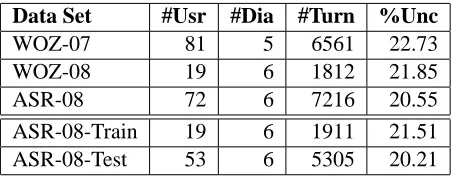
The data used for this work comes from two prior experiments using ITSPOKE, a spoken tutorial dia-logue system, which tutors physics novices. Table 1 describes all data used, displaying the number of users per data set, the number of dialogues between the system and each user, the total number of user turns per corpus, and the percentage of turns labeled uncertain. See Appendix A for more information.
The first experiment, in 2007, compared two dialogue-based strategies for remediating user un-certainty over and above correctness (Forbes-Riley and Litman, 2011b). The goal of this work was to not only test the hypothesis that this uncertainty re-mediation would improve users’ learning, but to in-vestigate what types of dialogue remediation would improve users’ learning the most. Since this experi-ment, WOZ-07, was designed to be a gold-standard
case of uncertainty remediation, all natural language understanding and uncertainty annotation was per-formed by a human wizard, in real time (WOZ). All annotations were made at the turn-level.
For WOZ-07, users’ dialogue interactions with the system would change based on which remedia-tion strategy they were assigned to. There were two different dialogue-based remediation strategies. In addition to varying the strategies, the two control conditions in this experiment also varied when the remediation strategy was applied.
The simple remediation dialogue strategy pro-vided additional information about the physics con-cept the user was struggling with, or asked them further questions about the concept. Both control conditions used the simple remediation strategy; one only applied the strategy when the user was incor-rect, the other applied it if the user was incorrect and randomly when the user was correct. The simple re-mediation experimental condition applied the reme-diation when the user was incorrect, or correct but uncertain about their answer. The fourth condition in WOZ-07 used the second dialogue strategy,
com-plex remediation. This strategy changed the way the
remediation was presented, depending on a combi-nation of the user’s correctness and certainty in their answer. Only users in the simple remediation exper-imental condition learned more than users in other conditions. Figure 1 shows an example of simple re-mediation; the tutor acknowledges that the user is in-correct, saying “Well...”, and then explains the con-cept the previous question tested. Appendix B com-pares simple and complex remediation strategies.
reme-TUTORp5: (Response to an incorrect answer) Well... We just discussed that by Newton’s Third law, when two objects collide, the forces they exert on each other are equal in magnitude and opposite in direction. This is true regardless of the objects’ differing masses. So the first question’s answer is that the impact forces on the truck and the car will have the same magnitude but opposite direction. Now, the second question asks about the ve-hicles’ change in motion. We can use Newton’s Second law to answer this. What does this law say?
TUTORp6: (Response to a correct, certain answer) Fine. So the first question’s answer is that the impact forces on the bus and the motorbike will have the same magnitude, but opposite direction. Now, the second question asks about the vehicles’ change in motion. We can use New-ton’s second law to answer this. What does this law say?
Figure 1: Corpus Excerpt: Remediation in Dialogue 5, and No Remediation in Isomorphic Dialogue 6
diation would be applied. For the ASR conditions, all models were trained on WOZ-07 data; users were randomly assigned to the WOZ-08 or ASR-08 con-dition as they participated.
In addition to eliminating the complex remedia-tion condiremedia-tion, a sixth dialogue, completely isomor-phic to the fifth dialogue, was added to all condi-tions. See Appendix B dialogue examples, high-lighting their content differences. Figure 1 displays two ASR-08 tutor turns with the same user. These turns are from the fifth problem, and the isomorphic sixth problem. Note that two things change between these two answers. First, the system responds to the user’s incorrectness in the first example. Had the user been correct and uncertain, this is also the di-alogue s/he would have seen. Second, notice that problem five discusses a car, while problem six dis-cusses a motorcycle. To create a completely iso-morphic problem, the scenario for the dialogue was changed from a car to a motorcycle.
For both the 2007 and 2008 corpora, all gold-standard uncertainty annotations were performed by a trained human annotator. Development and pre-vious testing of the annotation scheme between this annotator and another trained annotator resulted in
kappa = 0.62. All wizarded conditions were an-notated in real-time; all ASR conditions were
anno-Data Set #Usr #Dia #Turn %Unc
WOZ-07 81 5 6561 22.73
WOZ-08 19 6 1812 21.85
ASR-08 72 6 7216 20.55
ASR-08-Train 19 6 1911 21.51
[image:3.612.313.539.62.152.2]ASR-08-Test 53 6 5305 20.21
Table 1: Description of data sets
tated in a post-hoc manner.
In sum, the main differences between the two sys-tems’ data are differences in automation (i.e. WOZ and ASR) and content (i.e. presentation of content, reflected by differing dialogue strategies, and num-ber of physics dialogues).
3 Post-Hoc Experiment
In this post-hoc analysis, we will analyze the im-pact of content differences by comparing the perfor-mance of models built with WOZ-07 and WOZ-08, and automation differences by comparing models built with WOZ-08 and ASR-08 data. Instead of the original study design, where WOZ-08 and ASR-08 subjects were run in parallel, we could have gathered the WOZ data first, and used the WOZ data and the first few ASR users for system evaluation and devel-opment purposes. Thus, for the post-hoc analysis, we mimic this by using WOZ-08 as a training set, and splitting ASR-08 into two data sets–ASR-08-Train (the first few users), and ASR-08-Test. (Please see the last two rows of Table 1.) We held out the first 19 users for ASR-08-Train, since this approx-imates the amount of data used to train the model built with WOZ-08. For our post-hoc study, the re-maining 53 ASR users were used as a test set for all training sets, to mimic an authentic development lifestyle for a dialogue system. Additionally, this guaranteed that no users appear in both the training and testing set given any training set.
As all uncertainty remediation happens at the turn-level, we classified uncertainty at the turn-level, and compared these automated results with the gold-standard annotations. We used all the features that were designed for the original model. Since previ-ous experiments with our data showed little variance between different machine learning algorithms, we chose a J48 decision tree, implemented byWEKA,1
1
for all experiments due to its easy readability. Since our class distribution is skewed (see Table 1), we also used a cost matrix which heavily penalizes clas-sifying an uncertain instance as certain.
We use simple lexical, prosodic and system-specific features described in (Forbes-Riley and Lit-man, 2011a) to build our models. These features were kept constant through all experiments, so the results could be directly comparable. For all lexical features for all data sets, ASR text was used.2 For all WOZ conditions, we gathered ASR text post-hoc.
We trained models on individual training sets, to inspect the impact of content and automation dif-ferences. We then trained new models on combi-nations of these original training sets, to investigate possible interactions. To allow for direct compari-son, we used ASR-08-Test to evaluate all models.
Since detecting uncertainty is related to detecting affective user states, we use the evaluation measures Unweighted Average (UA) Recall and UA Precision, presented in (Schuller et al., 2009).We also use UA F-measure. Note that because only one hold-out evaluation set was used, rather than using multiple sets for cross-fold validation, we do not test for sta-tistical significance between models’ results.
4 Results
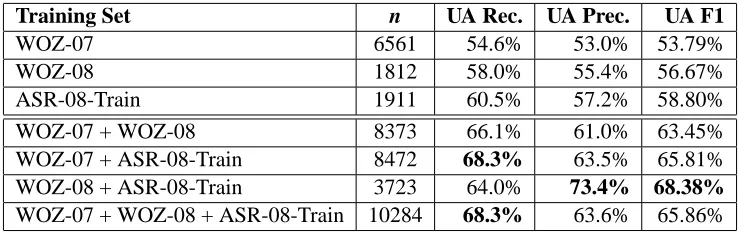
The first three rows of Table 2 present the results of training a model on each possible training set indi-vidually. Note that the number of instances per train-ing set varies. WOZ-07 simply has more users in the training set than WOZ-08 or ASR-08-Train. While WOZ-08 and ASR-08-Train have the same number of users, the number of turns slightly varies, since dialogues vary depending on users’ answers.
When comparing WOZ-08 to WOZ-07, first no-tice that WOZ-08 outperforms WOZ-07 with a much smaller amount of data. Both are wiz-arded versions, but content differences exist be-tween these experiments; WOZ-08 only used the
simple remediation strategy, and added a dialogue.
When comparing ASR-08-Train to the other two individual training sets, note that it best approxi-mates the test set. This training condition outper-forms all others, while using less data than
WOZ-2
We used ASR instead of manual transcriptions, to better approximate automated data.
07. While WOZ-08 and ASR-08 have the same
content, the system changes from wizarded to
au-tomated language recognition. This allows us to di-rectly compare how differences due to automation (e.g. errors in detecting correct answers) can affect performance of the models. Note that even though we used ASR transcriptions of WOZ-08 turns, the effects of ASR errors on later utterances are only propagated in ASR-08-Train. As ASR-08-Train no-ticeably outperforms WOZ-08, with approximately the same amount of training data, we conclude that using automated data for training better prepares the model for the data it will be classifying.
As we also wish to investigate how incorporat-ing more diverse trainincorporat-ing data would alter the per-formance of the model, we combined ASR-08-Train and WOZ-08 with the WOZ-07 training set, shown in Table 2. We combined these sets practically, as we wish to test how our model could have performed if we had used our first few 2008 users to train the model in the actual 2008 experiment.
First, note that all combination training sets out-perform individual training sets. As ASR-08-Train outperformed WOZ-08 for individual training sets, it is not surprising that WOZ-07+ASR-08-Train out-performs WOZ-07+WOZ-08.
However, we could have used WOZ-07 for feature development only, and trained on WOZ-08 + ASR-08-Train. Since the training and testing sets contain identical content, it is unsurprising that the preci-sion for this classifier is high. This classifier does not perform as well with respect to recall, perhaps since its training data is not as varied. Also note, while this model trained on few data points, we used additional data for feature development purposes.
Training Set n UA Rec. UA Prec. UA F1
WOZ-07 6561 54.6% 53.0% 53.79%
WOZ-08 1812 58.0% 55.4% 56.67%
ASR-08-Train 1911 60.5% 57.2% 58.80%
WOZ-07 + WOZ-08 8373 66.1% 61.0% 63.45%
WOZ-07 + ASR-08-Train 8472 68.3% 63.5% 65.81%
WOZ-08 + ASR-08-Train 3723 64.0% 73.4% 68.38%
[image:5.612.121.494.62.178.2]WOZ-07 + WOZ-08 + ASR-08-Train 10284 68.3% 63.6% 65.86%
Table 2: Results; Testing on ASR-08-Test (n= 5305). Bold denotes best performance per metric.
In sum, different training set combinations pro-vide different benefits. With respect to UA F1 and UA Precision, WOZ-08 + ASR-08-Train outper-forms all other training sets. Using only 3723 turns to train the model, this configuration uses the least amount of training data. However, this requires pre-viously collected data, such as WOZ-07, for fea-ture development purposes. Alternatively, WOZ-07 + ASR-08-Train performs better than WOZ-08 + ASR-08-Train with respect to UA Recall, and does not require a separate feature development set. Thus, the ‘best’ training set would depend on both the ex-perimental design, and the preferred metric.
5 Discussion and Future Work
In this paper, we provided evidence that the degree of automation of a system used to collect training data can impact the performance of a model when used in a fully automated system. Since one com-mon technique of building fully automated dialogue systems uses a semi-automated wizarded version, this result suggests incorporating a small amount of automated data could greatly improve performance of the models. Our results also suggest that the type of data is more important than the quantity when building these models, since well-performing mod-els were built with small amounts of data. We also investigated the impact of building models trained with different dialogue content, another common method of developing dialogue systems. As the WOZ-08 model outperforms the WOZ-07 model, it appears that this has a noticeable impact.
However, the WOZ-08 and WOZ-07 experiments may not have had identical user population, due to the timing differences between studies. We wish to perform further post hoc-experiments to analyze the impact of population differences in our data. To
do so, we will eliminate all dialogue strategy dif-ferences between WOZ-07 and WOZ-08. To fur-ther support our results regarding content differ-ences, we wish to split WOZ-08 into two training sets, one including the sixth problem, and one ex-cluding it. After controlling for differences in quan-tity of data, we will analyze the resulting models. To further strength our results regarding
automa-tion differences, we will eliminate all differences in
when the remediation dialogue strategy was applied between the WOZ-08 and ASR-08-Test corpus, and try to replicate the results found in this paper.
As our results suggest the need for applying do-main adaptation methods to improve models’ per-formance when there are differences in automation and content, future work could investigate applying already existing methods for domain adaptation, and developing new ones for this problem. In particular, the results we presented suggest a method for build-ing a dialogue system that could mitigate the effects of changes in automation and content. A small wiz-arded condition, with changes in dialogue content, could be used for feature development. This data, or data from another small wizarded condition, could then be used to train a preliminary model. This pre-liminary model could be tested with a small num-ber of users using an automated version. Then, the data from the preliminary conditions could be used to build the final model, which would be used for the current, fully automated version of the system.
Acknowledgments
References
J. Blitzer, M. Dredze, and F. Pereira. 2007. Biogra-phies, bollywood, boom-boxes and blenders: Domain adaptation for sentiment classification. In Annual
Meeting-Association For Computational Linguistics,
volume 45, page 440.
K. Forbes-Riley and D. Litman. 2011a. Benefits and challenges of real-time uncertainty detection and adap-tation in a spoken dialogue computer tutor. Speech
Communication.
K. Forbes-Riley and D. Litman. 2011b. Designing and evaluating a wizarded uncertainty-adaptive spoken di-alogue tutoring system. Computer Speech & Lan-guage, 25(1):105–126.
A. Margolis, K. Livescu, and M. Ostendorf. 2010. Do-main adaptation with unlabeled data for dialog act tag-ging. In Proceedings of the 2010 Workshop on
Do-main Adaptation for Natural Language Processing,
pages 45–52. Association for Computational Linguis-tics.
A. Raux, D. Bohus, B. Langner, A.W. Black, and M. Es-kenazi. 2006. Doing research on a deployed spoken dialogue system: One year of Lets Go! experience. In
Proc. Interspeech, pages 65–68. Citeseer.
B. Schuller, S. Steidl, and A. Batliner. 2009. The in-terspeech 2009 emotion challenge. In Tenth Annual
Conference of the International Speech Communica-tion AssociaCommunica-tion.
N. Webb and T. Liu. 2008. Investigating the portability of corpus-derived cue phrases for dialogue act classifi-cation. In Proceedings of the 22nd International
Con-ference on Computational Linguistics-Volume 1, pages
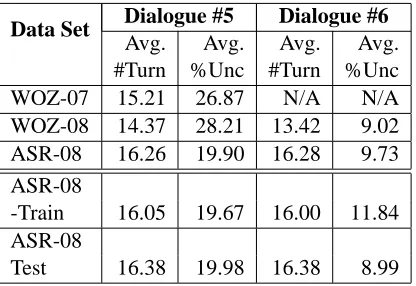
Data Set Dialogue #5 Dialogue #6
Avg. Avg. Avg. Avg. #Turn %Unc #Turn %Unc
WOZ-07 15.21 26.87 N/A N/A
WOZ-08 14.37 28.21 13.42 9.02 ASR-08 16.26 19.90 16.28 9.73 ASR-08
-Train 16.05 19.67 16.00 11.84 ASR-08
[image:7.612.83.291.62.205.2]Test 16.38 19.98 16.38 8.99
Table 3: Dialogue-level description of corpora
Appendix A Differences between corpora
We note that one possible difficulty in using dia-logues with differing content could be differing lev-els of users’ uncertainty between those dialogues. Thus, Table 3 depicts the average percent of uncer-tain turns over all users, per dialogue. Only Dia-logues #5 and #6 are presented; average number of turns and average percent uncertainty do change be-tween all problems. While the average number of turns are similar, the percentage of uncertain turns drops greatly between the two isomorphic problems.
Appendix B Dialogue Examples
We also present dialogue examples from our cor-pora to illustrate various content differences be-tween versions of ITSPOKE. The changes between Dialogues #5 and #6 are as follows: every instance of “car” in Dialogue #5 with “motorbike,” and ev-ery instance of “truck” is replaced with “PAT bus.” Since users discuss Problem #6 with ITSPOKE im-mediately after discussing Problem #5, the drop in percentage of user uncertainty between Dialogue #5 and Dialogue #6 show in Table 3 might be explained by this. However, all of the domain-specific words and all of the knowledge concepts will remain the same between these two problems.
Figures 1 (in the main paper) and 2 give examples of the two types of remediation found in the 2007 corpus. ITSPOKEcan change its dialogue based on not only how it presents the content, but also what feedback it gives. Complex remediation changes
both of these attributes. Table 4 displays possible feedbacks given to the user, depending on their lev-els of correctness and certainty. In Figure 2, the
seg-Tutor: What’s the overall net force on the truck equal to? User: Zero?? [Incorrect & Uncertain]
Tutor: That’s not correct, but don’t worry. You seem to be aware of your mistake. Let’s resolve it.
[FEED-BACK] The net force on the truck is equal to the impact
force on it. Let’s walk through this answer step by step.
[NEW SHORT ANSWER] We can derive the net force on
the truck by summing the individual forces on it, just like we did for the car. First, what horizontal force is exerted on the truck during the collision? [EXISTING
SUBDIA-LOGUE]
Figure 2: Example of Complex uncertainty remediation.
User Answer Examples of Feedback Phrases
Simple Complex
Correct & That’s That’s right. Certain right.
Correct & That’s That’s right, but you don’t Uncertain right. sound very certain, so let’s
recap.
Incorrect & Well... Good try, but that’s not Uncertain right. It sounds like you
knew there might be an error in your answer. Let’s fix it.
Incorrect & Well... I’m sorry, but there’s a Certain mistake in your answer that
we need to work out.
Table 4: Example Feedback Phrases used in Simple and
Complex Remediation