Rule-based and machine learning approaches for second language
sentence-level readability
Ildik´o Pil´an, Elena Volodina and Richard Johansson Spr˚akbanken, University of Gothenburg
Box 200, Gothenburg, Sweden
{ildiko.pilan, elena.volodina, richard.johansson}@svenska.gu.se
Abstract
We present approaches for the identifica-tion of sentences understandable by sec-ond language learners of Swedish, which can be used in automatically generated ex-ercises based on corpora. In this work we merged methods and knowledge from ma-chine learning-based readability research, from rule-based studies of Good Dictio-nary Examples and from second language learning syllabuses. The proposed selec-tion methods have also been implemented as a module in a free web-based lan-guage learning platform. Users can use different parameters and linguistic filters to personalize their sentence search with or without a machine learning component assessing readability. The sentences se-lected have already found practical use as multiple-choice exercise items within the same platform. Out of a number of deep linguistic indicators explored, we found mainly lexical-morphological and seman-tic features informative for second lan-guage sentence-level readability. We ob-tained a readability classification accuracy result of 71%, which approaches the per-formance of other models used in simi-lar tasks. Furthermore, during an empir-ical evaluation with teachers and students, about seven out of ten sentences selected were considered understandable, the rule-based approach slightly outperforming the method incorporating the machine learn-ing model.
1 Introduction and motivation
Despite the fact that there is a vast selection of ex-isting materials, many language teachers opt for completing course syllabuses with either invented
examples or authentic resources, customized to the need of specific learners (Howard and Major, 2004). Collections with millions of tokens of dig-ital text are available for several languages today, part of which would offer adequate practice mate-rial for learners of a second or foreign language (L2) to develop their skills further. However, a necessary first step representing a major challenge when reusing copora for automatic exercise gen-eration is how to assess the suitability of the avail-able material. In this study, we explored how we could exploit existing Natural Language Process-ing (NLP) tools and resources for this purpose.
To overcome copyright issues often limiting full-text access to certain corpora, we decided to work with sentences as linguistic unit when as-sessing the characteristics of suitability and when generating exercise items. Although a large num-ber of studies exist investigating readability, i.e. understandability, at the text level, the sentence level remains little explored. Similarly, the focus of previous investigations has mainly been read-ability from native language (L1) readers’ per-spective, but aspects of L2 readability have been less widely studied. To our knowledge no previ-ous research have explored this latter dimension for Swedish before, hence we aim at filling this gap, which can be useful, besides the purposes mentioned above, also in future sentence and text simplification and adaptation tasks.
We propose a rule-based as well as a combi-nation of rule-based and machine learning meth-ods for the identification of sentences understand-able by L2 learners and suitunderstand-able as exercise items. During the selection of linguistic indicators, we have taken into consideration previously studied features of readability (Franc¸ois and Fairon, 2012; Heimann M¨uhlenbock, 2013; Vajjala and Meur-ers, 2012), L2 Swedish curricula (Levy Scherrer and Lindemalm, 2009; Folkuniversitet, 2013) and aspects of Good Dictionary Examples (GDEX)
(Hus´ak, 2010; Kilgarriff et al., 2008), being that we believe they have some properties in common with exercise items. The current version of the machine learning model distinguishes sentences readable by students at an intermediate level of proficiency from sentences of a higher readabil-ity level. The approaches have been implemented and integrated into an online Intelligent Computer-Assisted Language Learning (ICALL) platform, L¨arka (Volodina et al., 2013). Besides a module where users can experiment with the filtering of corpus hits, a module with inflectional and vocab-ulary exercises (making use of the selected sen-tences with our method) is also available. An ini-tial evaluation with students, teachers and linguists indicated that more than 70% of the sentences selected were understandable, and about 60% of them would be suitable as exercise items accord-ing to the two latter respondent groups.
2 Background
2.1 Text-level readability
Readability of texts in different languages has been the subject of several studies and they range from simpler formulas, taking into ac-count superficial text properties, to more sophis-ticated NLP methods. Traditional readability measures for L1 Swedish at the text level in-cludeLIX(L¨asbarthetsindex, “Readability index”) (Bj¨ornsson, 1968) and the Nominal Ratio (Hult-man and West(Hult-man, 1977). In recent years a num-ber of studies, mostly focusing on the L1 con-text, appeared which take into consideration lin-guistic features based on a deeper text processing. Morphosyntactic aspects informative for L1 read-ability include, among others, parse tree depth, subordination features and dependency link depth (length) (Dell’Orletta et al., 2011). Language models have also been commonly used for read-ability predictions (Collins-Thompson and Callan, 2004; Schwarm and Ostendorf, 2005). A recently proposed measure, the Coh-Metrix (Graesser et al., 2011), aims at a multilevel analysis of texts, in-spired by psycholinguistic principles. It measures not only linguistic difficulty, but also cohesion in texts.
Research on L1 readability for Swedish, using machine learning, is described in Heimann M¨uhlenbock (2013) and Falkenjack et al. (2013). Heimann M¨uhlenbock (2013) examined readability along five dimensions:
surface features, word usage, sentence structure, idea density and human interest. Mean depen-dency distance, subordinate clauses and modifiers proved good predictors for L1 Swedish.
Although a number of readability formulas ex-ist for native language users, these might not be suitable predictors of L2 difficulty being that the acquisition processes of L1 and L2 present a num-ber of differences (Beinborn et al., 2012). Studies focusing on L2 readability are considerably fewer in the literature. The linguistic features in this con-text include, among others, relative clauses, pas-sive voice (Heilman et al., 2007) and the num-ber of coordinate phrases per clause (Vajjala and Meurers, 2012). Crossley et al. (2008) applied some Coh-Metrix indicators to English L2 read-ability. The authors found that lexical corefer-entiality, syntactic similarity and word frequency measures outperformed traditional L1 readability formulas. A language-independent approach to L2 readability assessment, using an online ma-chine learning algorithm, is presented by Shen et al. (2013) which, however, employed only the sur-face features of average sentence and word length, and word frequencies as lexical feature. The au-thors found that none of the features in isolation was able to clearly distinguish between the levels. In the second language teaching scenario, a widely used scale is the Common European Framework of Reference for Languages (CEFR) (Council of Europe, 2001), which, however, has been less frequently adopted so far in readability studies. The CEFR guidelines for L2 teaching and assessment define six different proficiency levels: A1 (beginner), A2 (elementary), B1 (intermedi-ate), B2 (upper intermedi(intermedi-ate), C1 (advanced) and C2 (proficiency). Franc¸ois and Fairon (2012) pro-posed a CEFR-based readability formula for L2 French. Some of the predictive features proved to be structural properties, including shallow length features as well as different morpho-syntactic cat-egories (e.g. present participles) and the presence of words in a list of easy words.
2.2 Sentence-level readability
(Hus´ak, 2010; Kilgarriff et al., 2008) is a sentence evaluation algorithm, which, on the basis of lex-ical and syntactlex-ical criteria, automatlex-ically ranks example candidates from corpora. Some of the influential linguistic aspects of appropriate exam-ple sentences are: their length and structure, the presence of short and common vocabulary items which do not need disambiguation and the ab-sence of anaphoric pronouns. Segler (2007) fo-cuses on the L2 rather than on the lexicographic context. He explores the characteristics of helpful vocabulary examples to be used via an ICALL sys-tem for L2 German and underlines the importance of syntactic complexity. Research about ranking Swedish corpus examples is presented in Volodina et al. (2012b). Their first algorithm includes four heuristic rules concerning sentence length, infre-quent lexical items, keyword position and the pres-ence of finite verbs, complemented by a sentpres-ence similarity measure in the second algorithm. Read-ability experiments focusing at the sentence level have started to appear recently both for language learning purposes (Pil´an et al., 2013) and for de-tecting differences between simplified and unsim-plified sentence pairs (Vajjala and Meurers, 2014).
3 Resources
Our sentence selection module utilizes a number of tools, resources and web services available for Swedish. Korp1, an infrastructure for accessing
and maintaining corpora (Borin et al., 2012), con-tains a large number of Swedish texts which are equipped with automatic annotations (with some exceptions) for part-of-speech (POS), syntactic (dependency) relations, lemma forms and sense ids. Korp offers, among others, a web service for concordances, which makes a search in cor-pora based on a query (e.g. a keyword and its POS) and returns hits with a sentence-long con-text. Moreover, with the corpus pipeline of Korp, tools for automatically annotating corpora are also available. A variety of different modern Swedish corpora from Korp have been used throughout this study including novel, newspaper and blog texts.
Another source for sentences was the CEFR corpus (Volodina and Johansson Kokkinakis, 2013), a collection of CEFR-related L2 Swedish course book texts. The corpus contains: (a) man-ual annotations indicating the structure of each les-son in the book (exercises, instructions, texts etc.);
1http://spraakbanken.gu.se/korp/
(b) automatic linguistic annotations obtained with the annotation tools available through Korp. The CEFR corpus at the time of writing included B1 texts from three course books and B2 texts from one course book. The annotation of additional ma-terial covering other CEFR levels was ongoing.
Not only corpora, but also information from fre-quency word lists has been used for determining the appropriateness of a sentence. The Kelly list
(Volodina and Kokkinakis, 2012) is a frequency-based vocabulary list mostly built on a corpus of web texts from 2010. Besides frequency infor-mation, an associated CEFR level is available for each item. Another frequency-based word list em-ployed for the machine learning experiments is the
Wikipedia list(Volodina et al., 2012b). It contains the POS and the number of occurrences for each word form in a corpus of Swedish Wikipedia texts. A central resource of the present study isL¨arka2
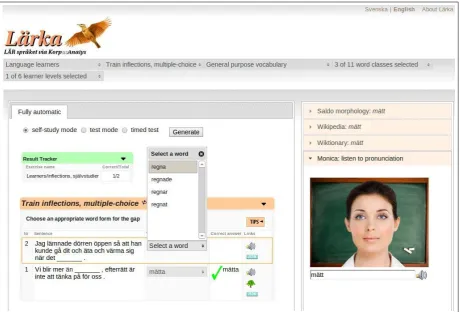
(Volodina et al., 2013), a freely available online ICALL platform. Currently its exercise generator module offers tasks both for students of linguistics and learners of L2 Swedish (Figure 1). Additional parts include a corpus editor used for the annota-tion of the CEFR corpus and the sentence selecannota-tion module presented in this paper,Hit-Ex3(Hitta Ex-empel, “Find Examples” or Hit Examples). The version under development contains also dictation and spelling exercises (Volodina et al., 2013).
4 Machine learning experiments for readability
4.1 Dataset
We distinguished two different classes in the dataset for the machine learning experiments: (a) sentences understandable at (within) B1 level and (b) sentences above B1 level. For the former group, sentences were collected from B1-level texts from the CEFR corpus. Sentences above B1 level consisted partly of B2-level sentences from the CEFR corpus, and partly of native language sentences from Korp retrieved on the basis of key-words between B2 and C2 levels according to the Kelly list. Only sentences between the length of 5 and 30 tokens were collected from all resources to decrease the influence of sentence length on the decisions made by the classifiers and to increase the importance of other linguistic features. The
2http://spraakbanken.gu.se/larka/
Figure 1: Inflectional exercise.
size of the dataset and the number of sentences per level are illustrated in Table 1.
Level Source Nr. sentences
Within B1 B1 (CEFR) texts 2358
Above B1 B2 (CEFR) textsKorp corpora 1528795
[image:4.595.73.534.61.373.2]Total size of dataset 4681
Table 1: The source and the number of sentences in the dataset.
4.2 Method
We performed supervised classification using as training and test data the set of sentences described in section 4.1. Thus, we aimed at a two-way clas-sification distinguishing sentences within B1 level from those above. This level, besides being ap-proximately a middle point of the CEFR scale, is typically divided into sub-levels in language courses (Folkuniversitet, 2013) which indicates a more substantial linguistic content. Consequently, additional practice for learners can be beneficial at this stage. Self-study activities may also be more common in this phase since students have
suffi-cient L2 autonomy. We experimented with dif-ferent classification algorithms4 available through
the Scikit-learn Python package (Pedregosa et al., 2011), out of which we present the results only of the best performing one here, a linear Support Vector Machine (SVM) classifier. The SVM clas-sifier aims at separating instances into classes with a hyperplane (Tanwani et al., 2009), equivalent to a line in a two-dimensional space. This hyperplane is defined based on the feature values of instances and weights associated with them. Once extracted, the values for each feature were scaled and cen-tered.
Evaluation was carried out with stratified 10-fold cross-validation, i.e. the proportion of labels in each fold was kept the same as that in the whole training set during the ten iterations of training and testing. The evaluation measures taken into consideration were accuracy, precision, recall and the F1 score, a combination of precision and re-call, the two of them being equally important (Pe-dregosa et al., 2011).
4The other classification methods used were a Na¨ıve
4.3 Features
After a thorough overview of the machine learn-ing approaches for readability in the literature, a number of features were chosen to be tested in our experiments. The features selected aimed at a deep analysis of the sentences at different lin-guistic levels. Besides traditional readability indi-cators, a number of syntactic, morphological, lexi-cal and semantic aspects have been taken into con-sideration. Our initial set contained altogether 28 features, as presented in Table 2 on the next page. A number of popular traditional (shallow) fea-tures were included in the feature set (feafea-tures 1-4). These required less sophisticated text pro-cessing and had previously been used in sev-eral studies with success (Beinborn et al., 2012; Dell’Orletta et al., 2011; Franc¸ois and Fairon, 2012; Heimann M¨uhlenbock, 2013; Vajjala and Meurers, 2012). We computed sentence length as the number of tokens including punctuation, and token length as the number of characters per to-ken.
Part of the syntactic features was based on the depth (length) and direction of dependency arcs (features 5-8). Another group of these features relied on the type of dependency relations. In feature 9 (Mod) nominal pre-modifiers (e.g. ad-jectives) and post-modifiers (e.g. relative clauses, prepositional phrases) were counted, similarly to Heimann M¨uhlenbock (2013). Variation fea-tures (ModVar, AdvVar) measured the ratio of a morphosyntactic category to the number of lex-ical (content) words in the sentence, as in Va-jjala and Meurers (2012). These lexical cate-gories comprised nouns, verbs, adverbs and ad-jectives. Subordinates (11) were detected on the basis of the “UA“ (subordinate clause minus subordinating conjunction) dependency relation tag (Heimann M¨uhlenbock, 2013). Features De-pDepth, Mod, Sub and RightDep, PrepComp have previously been empoyed for Swedish L1 read-ability at the text level in Heimann M¨uhlenbock (2013) and Falkenjack et al. (2013) respectively.
The lexical-morphological features (features 13-25) constituted the largest group. Difficulty at the lexical level was determined based on both the TTR feature mentioned above, expressing vo-cabulary diversity, and on the basis of the rar-ity of words (features 13-17) according to the Kelly list and the Wikipedia word list. An anal-ogous approach was adopted also by Franc¸ois and
Fairon (2012), Vajjala and Meurers (2012) and Heimann M¨uhlenbock (2013) with positive re-sults. The LexD feature considers the ratio of lexical words (nouns, verbs, adjectives and ad-verbs) to the sum of tokens in the sentence (Vajjala and Meurers, 2012). The NN/VB ratio feature, which has a higher value in written text, can also indicate a more complex sentence (Biber et al., 2004; Heimann M¨uhlenbock, 2013). Features 21-25 are based on evidence from the content of L2 Swedish course syllabuses (Folkuniversitet, 2013) and course books (Levy Scherrer and Lindemalm, 2009), part of them being language-dependent, namely S-VB/VB and S-VB%. These two features cover different types of Swedish verbs ending in
-s which can indicate either a reciprocal verb, a passive construction or a deponent verb, active in meaning but passive in form (Fasth and Kanner-mark, 1989).
Our feature set included three semantic fea-tures (26-28). The intuition behind 28 is that words with multiple senses (polysemous words), increase reading complexity as, in order to under-stand the sentence, word senses need to be dis-ambiguated (Graesser et al., 2011). This feature was computed by counting the number of sense IDs per token according to a lexical-semantic re-source for Swedish, SALDO (Borin et al., 2013), and dividing this value by the number of tokens in the sentence. As pronouns indicate a poten-tially more difficult text (Graesser et al., 2011), we included PN/NN in our set. Both NomR and PN/NN capture idea density, i.e. how com-plex the relation between the ideas expressed are (Heimann M¨uhlenbock, 2013).
4.4 Classification results
The results obtained using the complete set of 28 features is shown in Table 3. The results of the SVM are presented in comparison to a baseline classifier assigning the most frequent output label in the dataset to each instance.
Classifier Acc F1 B1 Prec B1 Recall Baseline 0.50 0.66 0.50 1.00
SVM 0.71 0.70 0.73 0.68
Table 3: Classification results with the complete feature set.
Nr. Feature Name Feature
ID Nr. Feature Name FeatureID
Traditional Lexical-morphological
1 Sentence length SentLen 13 Average word frequency
(Wikipedia list) WikiFr
2 Average token length TokLen 14 Average word frequency (Kelly
list) KellyFr
3 Percentage of words longer
than 6 characters LongW% 15 Percentage of words above B1level DiffW%
4 Type-token ratio TTR 16 Number of words above B1
level DiffWs
Syntactic 17 Percentage of words at B1 level B1W%
5 Average dependency depth DepDepth 18 Lexical density LexD
6 Dependency arcs deeper than 4 DeepDep 19 Nouns/verbs NN/VB
7 Deepest dependency / sentence
length DDepSentLen / 20 Adverb variation AdvVar
8 Ratio of right dependency arcs RightDep 21 Modal verbs / verbs MVB/VB
9 Modifiers Mod 22 Participles / verbs PCVB/VB
10 Modifier variation ModVar 23 S-verbs / verbs S-VB/VB
11 Subordinates Sub 24 Percentage of S-verbs S-VB%
12 Prepositional complements PrepComp 25 Relative pronouns RelPN
Semantic
26 Nominal ratio NomR
27 Pronoun/noun PN/NN
28 Average number of senses per
[image:6.595.74.529.63.416.2]word Sense/W
Table 2: The complete feature set.
classes was about 50-50%. The SVM classified 7 out of 10 sentences accurately. The precision and recall values for the identification of B1 sentences was 73% and 68%. Previous classification results for a similar task obtained an average of 77.25% of precision for the classification of easy-to-read texts within an L1 Swedish text-level readabil-ity study (Heimann M¨uhlenbock, 2013). Another classification at the sentence level, but for Italian and from an L1 perspective achieved an accuracy of 78.2%, thus 7% higher compared to our results (Dell’Orletta et al., 2011). The 73% precision of our SVM model for classifying B1 sentences was close to the precision of 75.1% obtained for the easy-to-read sentences from Dell’Orletta et al. (2011). Franc¸ois and Fairon (2012) in a classi-fication study from the L2 perspective, aiming at distinguishing all 6 CEFR levels for French at the text level, concluded that intermediate levels are harder to distinguish than the levels at the edges of the CEFR scale. The authors reported an adja-cent accuracy of 67% for B1 level, i.e. the level
of almost 7 out of 10 texts was predicted either correctly or with only one level of difference com-pared to the original level. Precise comparison with previous results is, however, difficult since, to our knowledge, there are no results reported for L2 readability at the sentence level. Thus, the val-ues mentioned above serve more as a side-by-side illustration.
Besides experimenting with the complete fea-ture set, groups of feafea-tures were also separately tested. The results are presented in Table 4.
Feature group
(Nr of features) Acc F1
Traditional (4) 0.59 0.55
Syntactic (8) 0.59 0.54
Lexical (13) 0.70 0.70
Semantic (3) 0.61 0.55
Table 4: SVM results per feature group.
[image:6.595.334.497.619.705.2]In-Rank Feature ID Weight
1 DiffW% 0.576
2 Sense/W 0.438
3 DiffWs 0.422
4 SentLen 0.258
5 Mod 0.223
6 KellyFr 0.215
7 NomR 0.132
8 AdvVar 0.114
9 Ddep/SentLen 0.08
[image:7.595.99.266.62.215.2]10 DeepDep 0.08
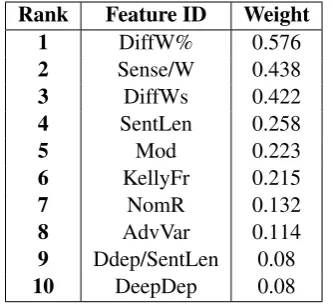
Table 5: The 10 most informative features according to the SVM weights.
terestingly, although semantic features represented the smallest group, they performed 2% better than traditional or syntactic features. The largest group of features including lexical-morphological indi-cators performed around 10% more accurately than other feature groups.
Among the 10 features that influenced most the decisions of our SVM classifier, we can find at-tributes from different feature groups. The ID of these features together with the SVM weights are reported in Table 5. An informative traditional measure was sentence length, similarly to the re-sults of previous studies (Beinborn et al., 2012; Dell’Orletta et al., 2011; Franc¸ois and Fairon, 2012; Heimann M¨uhlenbock, 2013; Vajjala and Meurers, 2012). Lexical-morphological features based on information about the frequency and the CEFR level of items in the Kelly list (DiffW%, DiffWs and KellyFr) also proved to be influential for the classification, as well as AdvVar. Two out of our three semantic features, namely NomR and, in particular, Sense/W, were also highly predictive. Syntactic features Ddep/SentLen and DeepDep, based on information about dependency arcs, were also among the ten features with highest weights, but they were somewhat less useful, as the weights in Table 5 show.
Contrary to our results, Franc¸ois and Fairon (2012) found syntactic features more informative than semantic ones for L2 French. This may de-pend either on the difference between the features used or the target languages. Moreover, in the case of Swedish L1 text readability the noun/pronoun ratio and modifiers proved to be indicative of text-level difficulty (Heimann M¨uhlenbock, 2013), but at the sentence level from the L2 perspective only
the latter seemed influential in our experiments. The data used for the experiments was labeled for CEFR levels at the text level, not at the sen-tence level. This introduced some noise in the data and made the classification task somewhat harder. In the future, the availability of data labeled at the sentence level could contribute to more ac-curate results. Excluding potentially lower level sentences from those appearing in higher level texts based on the distance between feature vec-tors could also be explored, in a similar fashion to Dell’Orletta et al. (2011).
5 Heuristics: GDEX parameters for sentence filtering and ranking
Besides SVM classification, our sentence selec-tion module, Hit-Ex, offers also a number of heuristic parameter options5, usable either in
com-bination or as an alternative to the machine learn-ing model (for further details see section 6). Part of these search parameters are generic preferences including the keyword to search for, its POS, the corpora from Korp to be used during selection and the desired CEFR level of the sentences. Further-more, it is possible to avoid sentences containing: abbreviations, proper names, keyword repetition, negative formulations (inte”not“ orutom”except“ in the sentence), modal verbs, participles, s-verbs and sentences lacking finite verbs. Users can also allow these categories and choose a penalty point between 0 and -50 for them. The penalty score for each filtering criteria is summed for obtain-ing a final score per sentence, based on which a final ranking is produced for all sentences re-trieved from Korp, the ranking reflecting the ex-tent to which they satisfy the search criteria. Some additional parameters, partly overlapping with the machine learning model’s features, are also avail-able for users to experiment with, being that the machine learning model does not cover all CEFR levels. Based on statistical evidence from corpora, we suggested default values for all parameters for retrieving sentences of B1, B2, C1 level with rule-based parameters only. However, additional data and further testing is required to verify the appro-priateness of the proposed values.
5See Pil´an (2013) or the Hit-Ex webpage,
6 Combined approach
As mentioned in the previous subsection, the heuristic parameters and the machine learning ap-proach have been implemented and tested also in combination. Parameters are kept to perform a GDEX-like filtering, whilst the SVM model is employed to ensure that hits were of a suitable level for learners. During this combined filtering, first a ranking for each unfiltered sentence coming from the web service of Korp is computed with heuristics. During these calculations, the parame-ters partly or fully overlapping with certain fea-tures of the machine learning model are deacti-vated, i.e. receive penalty points set to 0, thus, they do not influence the ranking. Instead, those aspects are taken care of by the machine learning model, in a subsequent step. Only the 100 sen-tences ranked highest are given for classification to the machine learning model for efficiency rea-sons. Finally, once the classification has been per-formed, sentences classified as understandable at B1 level are returned in the order of their heuris-tic ranking. Figure 2 shows part of the interface of Hit-Ex, as well as the highest ranked three sen-tences6 of an example search for the noun hund
”dog” at B1 level. Besides the Hit-Ex page, both the heuristics-only and the combined approaches are available also as web services.
7 Evaluation
The purpose of the evaluation was to explore how many sentences, collected from native language corpora in Korp with our algorithms, were under-standable at B1 level (at B1 or below) and thus, ap-propriate to be presented to learners of L2 Swedish of that CEFR level. Participants included three L2 Swedish teachers, twenty-six L2 Swedish students at B1 level, according to their current or most re-cent language course, and five linguists familiar with the CEFR scale. Besides the criteria of un-derstandability (readability), the aspect of being an appropriate exercise item was also explored. We selected altogether 196 sentences using both our approaches, with two different parameter set-tings for the rule-based method (See Pil´an et al. (2013) and Pil´an (2013) for further details about the evaluation). Evaluators were asked to indicate whether they found the sentences understandable 6English translations of the selected sentences: (1)“It
would be enough for a normal dog.”; (2)“They left the body in the form of a dog.”; (3)“There was a person with a dog.”
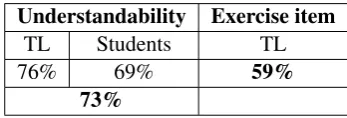
at B1 level or not. Teachers and linguists (TL) rated the sentences also as potential exercise items. The results of the evaluation are presented in Table 6.
Understandability Exercise item
TL Students TL
76% 69% 59%
[image:8.595.328.502.132.191.2]73%
Table 6: Evaluation results.
Respondents found overall 73% percent of the sentences selected by both our methods under-standable at B1 level, whilst somewhat less, about six out of ten items, proved to be suitable for being included in exercises for L2 Swedish learning.
According to our evaluators, the two settings of the rule-based approach (Alg1-s1 and Alg1-s2) satisfied the two criteria observed between 1-5% more of the cases. On average, teachers, linguists and students considered 75% of the sentences se-lected with Alg1-s1 understandable, but only 70% of those identified with the combined approach (Alg2). The detailed results per algorithm, crite-ria and user group are shown in Figure 3.
Figure 3: Comparison of algorithms.
[image:8.595.308.532.446.573.2]Figure 2: Part of the user interface and example search results.
8 Conclusion
In this study we investigated linguistic fac-tors influencing the sentence-level readability of Swedish from a L2 learning point of view. The main contribution of our work consists of two sentence selection methods and their implemen-tation for identifying sentences from a variety of Swedish corpora which are not only readable, but potentially suitable also as automatically gen-erated exercise items for learners at intermedi-ate (CEFR B1) level and above. We proposed a heuristics-only and a combined selection ap-proach, the latter merging rule-based parameters (targeting mainly the filtering of “undesired“ lin-guistic elements), and machine learning methods for classifying the readability of sentences from L2 learners’ perspective. We obtained a classi-fication accuracy of 71% with an SVM classifier which compares well to previously reported re-sults for similar tasks. Our rere-sults indicate the suc-cess of lexical-morphological and semantic fac-tors over syntactic ones in the L2 context. The most predictive indicators include, besides sen-tence length, the amount of difficult words in the sentence, adverb variation, nominal pre- and post-modifiers and two semantic criteria, the average number of senses per word and nominal ratio (Ta-ble 5). Within a smaller-scale evaluation, about 73% of the sentences selected by our methods were understandable at B1 level, whilst about 60% of the sentences proved to be suitable as exercise
References
Lisa Beinborn, Torsten Zesch, and Iryna Gurevych. 2012. Towards fine-grained readability measures for self-directed language learning. InElectronic Con-ference Proceedings, volume 80, pages 11–19. Douglas Biber, Susan Conrad, Randi Reppen, Pat
Byrd, Marie Helt, Victoria Clark, Viviana Cortes,
Eniko Csomay, and Alfredo Urzua. 2004.
Repre-senting language use in the university: Analysis of the TOEFL 2000 spoken and written academic lan-guage corpus. Test of English as a Foreign Lan-guage.
Carl Hugo Bj¨ornsson. 1968.L¨asbarhet. Liber. Lars Borin, Markus Forsberg, and Johan
Roxen-dal. 2012. Korp - the corpus infrastructure of
Spr˚akbanken. InProceedings of LREC, pages 474–
478.
Lars Borin, Markus Forsberg, and Lennart L¨onngren. 2013. SALDO: a touch of yin to WordNet’s yang.
Language Resources and Evaluation, 47(4):1191– 1211.
Kevyn Collins-Thompson and James P Callan. 2004. A language modeling approach to predicting reading
difficulty. InHLT-NAACL, pages 193–200.
Council of Europe. 2001. Common European
Frame-work of Reference for Languages: Learning, Teach-ing, Assessment. Cambridge University Press. Scott A Crossley, Jerry Greenfield, and Danielle S
McNamara. 2008. Assessing text readability
us-ing cognitively based indices. Tesol Quarterly,
42(3):475–493.
Felice Dell’Orletta, Simonetta Montemagni, and Giu-lia Venturi. 2011. Read-it: Assessing readability of Italian texts with a view to text simplification. In Proceedings of the Second Workshop on Speech and Language Processing for Assistive
Technolo-gies, pages 73–83. Association for Computational
Linguistics.
Johan Falkenjack, Katarina Heimann M¨uhlenbock, and Arne J¨onsson. 2013. Features indicating readability
in Swedish text. InProceedings of the 19th Nordic
Conference of Computational Linguistics (NODAL-IDA 2013), pages 27–40.
Cecilia Fasth and Anita Kannermark. 1989. Goda
grunder. Folkuniversitetets F¨orlag.
Folkuniversitet. 2013. Kurser i svenska. Svenska
B1. http://www.folkuniversitetet.
se/Kurser--Utbildningar/ Sprakkurser/Svenska_Swedish/
Svenska-B1--Swedish-B1/.
Thomas Franc¸ois and C´edrick Fairon. 2012. An AI readability formula for French as a foreign language. In Proceedings of the 2012 Joint Conference on
Empirical Methods in Natural Language Process-ing and Computational Natural Language LearnProcess-ing, pages 466–477. Association for Computational Lin-guistics.
Arthur C Graesser, Danielle S McNamara, and Jonna M Kulikowich. 2011. Coh-Metrix providing multilevel analyses of text characteristics. Educa-tional Researcher, 40(5):223–234.
Michal J. Heilman, Kevyn Collins-Thompson, Jamie Callan, and Maxine Eskenazi. 2007. Combining lexical and grammatical features to improve read-ability measures for first and second language texts. InProceedings of NAACL HLT, pages 460–467.
Katarina Heimann M¨uhlenbock. 2013. I see what you
mean. Ph.D. thesis, University of Gothenburg. Jocelyn Howard and Jae Major. 2004. Guidelines for
designing effective English language teaching mate-rials. In9th Conference of Pan Pacific Association of Applied Linguistics.
Tor G Hultman and Margareta Westman. 1977.
Gym-nasistsvenska. Liber.
Milos Hus´ak. 2010. Automatic retrieval of good
dic-tionary examples. Bachelor Thesis, Brno.
Adam Kilgarriff, Milos Hus´ak, Katy McAdam, Michael Rundell, and Pavel Rychl`y. 2008. GDEX: Automatically finding good dictionary examples in a corpus. InProceedings of Euralex.
Paula Levy Scherrer and Karl Lindemalm. 2009.
Rivs-tart B1 + B2. Textbok. Natur och Kultur, Stockholm. Fabian Pedregosa, Ga¨el Varoquaux, Alexandre Gram-fort, Vincent Michel, Bertrand Thirion, Olivier Grisel, Mathieu Blondel, Peter Prettenhofer, Ron Weiss, Vincent Dubourg, et al. 2011. Scikit-learn:
Machine learning in Python. The Journal of
Ma-chine Learning Research, 12:2825–2830.
Ildik´o Pil´an, Elena Volodina, and Richard Johans-son. 2013. Automatic selection of suitable sen-tences for language learning exercises. In20 Years of EUROCALL: Learning from the Past, Looking to the Future. 2013 EUROCALL Conference, 11th to 14th September 2013 ´Evora, Portugal, Proceed-ings., pages 218–225.
Ildik´o Pil´an. 2013. NLP-based Approaches to
Sentence Readability for Second Language Learn-ing Purposes. Master’s Thesis, University of
Gothenburg. https://www.academia.edu/
6845845/NLP-based_Approaches_to_ Sentence_Readability_for_Second_
Language_Learning_Purposes.
Sarah E Schwarm and Mari Ostendorf. 2005. Read-ing level assessment usRead-ing support vector machines
and statistical language models. In Proceedings of
Thomas M Segler. 2007. Investigating the selection of example sentences for unknown target words in ICALL reading texts for L2 German. PhD Thesis. University of Edinburgh.
Wade Shen, Jennifer Williams, Tamas Marius, and Elizabeth Salesky. 2013. A language-independent approach to automatic text difficulty assessment for second-language learners. InProceedings of the 2nd Workshop on Predicting and Improving Text Read-ability for Target Reader Populations, pages 30–38. Association for Computational Linguistics.
Ajay Kumar Tanwani, Jamal Afridi, M Zubair Shafiq, and Muddassar Farooq. 2009. Guidelines to se-lect machine learning scheme for classification of
biomedical datasets. InEvolutionary Computation,
Machine Learning and Data Mining in Bioinformat-ics, pages 128–139. Springer.
Sowmya Vajjala and Detmar Meurers. 2012. On im-proving the accuracy of readability classification us-ing insights from second language acquisition. In
Proceedings of the Seventh Workshop on Innovative Use of NLP for Building Educational Applications, pages 163–173. Association for Computational Lin-guistics.
Sowmya Vajjala and Detmar Meurers. 2014. Assess-ing the relative readAssess-ing level of sentence pairs for text simplification. InProceedings of the 14th Con-ference of the European Chapter of the Association for Computational Linguistics (EACL-14), Gothen-burg, Sweden. Association for Computational Lin-guistics.
Elena Volodina and Sofie Johansson Kokkinakis. 2013.
Compiling a corpus of CEFR-related texts. In
Pro-ceedings of the Language Testing and CEFR confer-ence, Antwerpen, Belgium, May 27-29, 2013. Elena Volodina and Sofie Johansson Kokkinakis. 2012.
Introducing the Swedish Kelly-list, a new lexical
e-resource for Swedish. InProceedings of LREC,
pages 1040–1046.
Elena Volodina, Richard Johansson, and Sofie Johans-son Kokkinakis. 2012b. Semi-automatic selec-tion of best corpus examples for Swedish:
Ini-tial algorithm evaluation. In Workshop on NLP
in Computer-Assisted Language Learning. Proceed-ings of the SLTC 2012 workshop on NLP for CALL. Link¨oping Electronic Conference Proceedings, vol-ume 80, pages 59–70.