Improving the precision of automatically constructed human-oriented
translation dictionaries
Alexandra Antonova Yandex
16, Leo Tolstoy St., Moscow, Russia
Alexey Misyurev Yandex
16, Leo Tolstoy St., Moscow, Russia
Abstract
In this paper we address the problem of automatic acquisition of a human-oriented translation dictionary from a large-scale parallel corpus. The initial translation equivalents can be extracted with the help of the techniques and tools developed for the phrase-table construction in statistical machine translation. The acquired transla-tion equivalents usually provide good lexi-con coverage, but they also lexi-contain a large amount of noise. We propose a super-vised learning algorithm for the detection of noisy translations, which takes into ac-count the context and syntax features, av-eraged over the sentences in which a given phrase pair occurred. Across nine Euro-pean language pairs the number of seri-ous translation errors is reduced by 43.2%, compared to a baseline which uses only phrase-level statistics.
1 Introduction
The automatic acquisition of translation equiva-lents from parallel texts has been extensively stud-ied since the 1990s. At the beginning, the acquired bilingual lexicons had much poorer quality as compared to the human-built translation dictionar-ies. The limited size of available parallel corpora often resulted in small coverage and the imper-fections of alignment methods introduced a con-siderable amount of noisy translations. However, the automatimacally acquired lexicons served as internal resources for statistical machine trans-lation (SMT) (Brown et al., 1993), information retrieval (IR) (McEvan et al., 2002; Velupillai, 2008), or computer-assisted lexicography (Atkins, 1994; Hartmann, 1994).
The current progress in search of web-based parallel documents (Resnik, 2003; Smith, 2013)
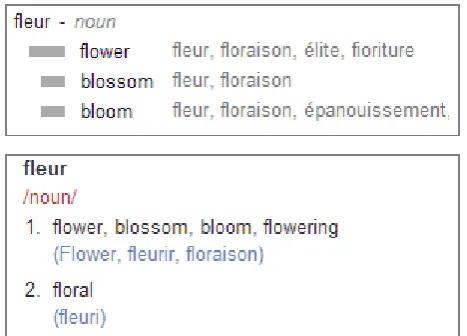
[image:1.595.308.542.401.569.2]makes it possible to automatically construct large-scale bilingual lexicons. These lexicons can al-ready compare in coverage to the traditional trans-lation dictionaries. Hence a new interesting pos-sibility arises - to produce automatically acquired human-oriented translation dictionaries, that have a practical application. A machine translation sys-tem can output an automatically generated dictio-nary entry in response to the short queries. The percentage of short queries can be quite large, and the system benefits from showing several possible translations instead of a single result of machine translation (Figure 1).
Figure 1: Examples of dictionary entries in two online statistical machine translation systems.
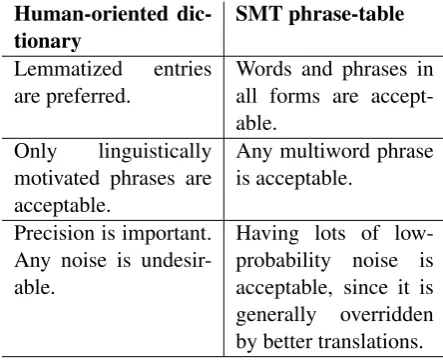
The initial translation equivalents for a bilin-gual lexicon can be extracted with the help of the techniques and tools developed for the phrase-table construction in SMT. The widely used word alignment and phrase extraction algorithms are de-scribed in Brown et.al (1993) and Och (2004). Though an SMT phrase-table actually consists of translation equivalents, it may differ substantially from a traditional dictionary (Table 1).
Human-oriented
dic-tionary SMT phrase-table Lemmatized entries
are preferred. Words and phrases inall forms are accept-able.
Only linguistically motivated phrases are acceptable.
Any multiword phrase is acceptable.
Precision is important. Any noise is undesir-able.
[image:2.595.71.293.63.243.2]Having lots of low-probability noise is acceptable, since it is generally overridden by better translations.
Table 1: Differences between a human-oriented dictionary and an SMT phrase-table.
While the problems of lemmatization and se-lection of linguistically motivated phrases can be addressed by applying appropriate morphological and syntactic tools, the problem of noise reduc-tion is essential for the dicreduc-tionary quality. The cur-rent progress in the automatic acquisition of simi-lar Web documents in different languages (Resnik, 2003; Smith, 2013) allows to collect large-scale corpora. But the automatically found documents can be non-parallel, or contain spam, machine translation, language recognition mistakes, badly parsed HTML-markup. The noisy parallel sen-tences can be the source of lots of noisy transla-tions — unrelated, misspelled, or belonging to a different language. For example, non-parallel sen-tences
The apartment is at a height of 36 floors! (English)
La plage est `a 1 minute en voiture. (French: The beach is 1 minute by car.)
may produce a wrong translation ”apartment -plage”. Or, automatically translated sentences
The figures in the foreground and back-ground play off each other well. (En-glish)
Les chiffres du premier plan et jouer hors de l’autre bien. (French: The dig-its of the foreground and play out of the other well.)
may produce a wrong phrase translation ”figures in the foreground - chiffres du premier plan”.
An intuitive approach would be to apply noise filtering to the corpus, not to the lexicon. One could discard those sentences that deviate too much from the expected behavior. For example, sentences that have many unknown words and few symmetrically aligned words are unlikely to be re-ally parallel. However, natural language demon-strates a great variability. A single sentence pair can deviate strongly from the expected behavior, and still contain some good translations. On the other hand, many noisy translations can still pen-etrate the lexicon, and further noise detection is necessary.
In a bilingual lexicon we want not just to lower the probabilities of noisy translations, but to re-move them completely. This can be regarded as a binary classification task — the phrase pairs are to be classified into good and noisy ones.
Different types of information can be com-bined in a feature vector. We take advantage of the phrase-level features, such as co-occurrence counts or translation probabilities, and also pro-pose a number of sentence-level context features. To calculate the sentence-level features for a given phrase-pair, we average the characteristics of all the sentences where it occurs.
We test the proposed algorithm experimentally, by constructing the bilingual lexicons for nine lan-guage pairs. The manually annotated samples of phrase pairs serve as the data for training su-pervised classifiers. The experiment shows that the use of the sentence-level features increases the classification accuracy, compared to a baseline which uses only phrase frequencies and translation probabilities. We compare the accuracy of differ-ent classifiers and evaluate the importance of dif-ferent features.
The rest of the paper is organized as follows. In Section 2 we outline the related work. Section 3 describes our approach to the noise reduction in a bilingual lexicon and discusses the proposed fea-tures. We describe our experiments on training classifiers in Section 4. Section 5 concludes the paper.
2 Previous work
to re-estimate and filter out indirect word asso-ciations. However, he works with a carefully prepared Hansards parallel corpus and the noise comes only from the imperfections of statistical modeling.
Sahlgren (2004) proposes a co-occurrence-based approach, representing words as high-dimensional random index vectors. The vectors of translation equivalents are expected to have high correlation. Yet, he notes that low-frequency words do not produce reliable statistics for this method.
The methods of bilingual lexicon extraction from comparable texts (Rapp, 1995; Fung, 1998; Otero, 2007) also deal with the problem of noise reduction. However, the precision/recall ratio of a lexicon extracted from comparable corpus is gen-erally lower. For the purpose of building a human-oriented dictionary, the parallel texts may provide the larger coverage and better quality of the trans-lation equivalents.
The noise reduction task is addressed by some of the SMT phrase-table pruning techniques. The most straightforward approach is thresholding on the translation probability (Koehn et al., 2003). Moore (2004) proposes the log-likelihood ratio and Fisher’s exact test to re-estimate word asso-ciation strength. Johnson et al. (2007) applies Fisher’s exact test to dramatically reduce the num-ber of phrase pairs in the phrase-table. They get rid of phrases that appear as alignment artifacts or are unlikely to occur again. The implementation of their algorithm requires a special index of all parallel corpus in order to enable a quick look-up for a given phrase pair. Eck et al. (2007) assesses the phrase pairs based on the actual usage statistics when translating a large amount of text. Entropy-based criteria are proposed in Ling et al. (2012), Zens et al. (2012).
Automatically acquired bilingual lexicons are capable to reflect many word meanings and trans-lation patterns, which are often not obvious even to the professional lexicographers (Sharoff, 2004). Their content can also be updated regularly to in-corporate more parallel texts and capture the trans-lations of new words and expressions. Thus, the methods allowing to improve the quality of au-tomatic bilingual lexicons are of practical impor-tance.
3 Noise detection features
We treat the noise recognition task as a binary classification problem. A set of nonlexical con-text features is designed to be sensitive to differ-ent types of noise in the parallel corpus. We ex-pect that the combination of these features with the phrase-level features based on co-occurrence statistics can improve the accuracy of the classifi-cation and the overall quality of a bilingual lexi-con.
3.1 Context feature extraction algorithm The procedure of getting the context features is outlined in Algorithm 1. Unlike Johnson et al. (2007) we do not rely on any pre-constructed index of the parallel sentences, because it requires a lot of RAM on large corpora. Instead we re-run the phrase extraction algorithm of the Moses toolkit (Koehn et al., 2007) and update the con-text features at the moment when a phrase pairtis found.
Algorithm 1Calculate context features for all lex-icon entries
Require: Parallel corpus — C; {word-aligned sentences}
Require: Bilingual lexicon — D; {this is a phrase-table, derived from C and modified as descibed in 4.1}
Ensure: V = {v¯(d):d∈D}; {resulting fea-tures}
for alld∈Ddo
¯
v(d)←0; n(d)←0; for alls∈Cdo
T ← P hraseExtraction(s);{Moses func-tion}
for allt∈Tdo ift∈Dthen
¯
v(t)←v¯(t) +SentF eats(s);{Alg. 2}
n(t)←n(t) + 1; for alld∈Ddo
¯
v(d) ← v¯(d)/(1 + n(d)); {average, +1 smoothing}
return V
3.2 Sentence-level features
phrase-level statistics is insufficient in case of a noisy corpus.
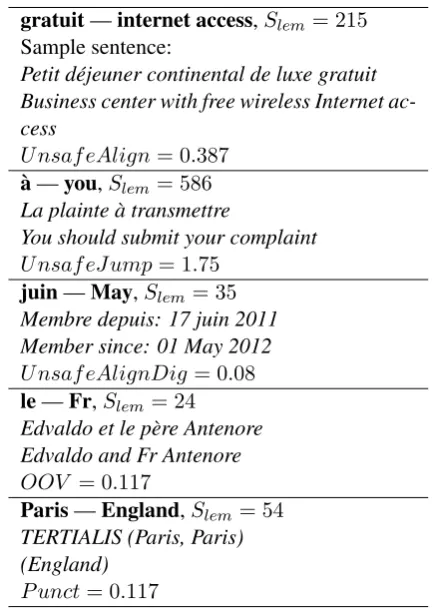
The sentence-level features are designed to partly restore the information which is lost dur-ing the phrase extraction process. We try to es-timate the general characteristics of the whole set of parallel sentences where a given phrase pair oc-curred. The proposed sentence-level features rely on the different sources of information, which are discussed in 3.2.1, 3.2.2 and 3.2.3. Table 2 pro-vides illustrating examples of noisy phrase pairs and sample sentences.
3.2.1 Word-alignment annotation
We use the intersection of direct and reverse Giza++ (Och and Ney, 2004) alignments as a heuristic rule to find words reliably aligned to each other. The alignment information gives rise to sev-eral sentence-level features:
• UnsafeAlign- percentage of words that are not symmetrically aligned to each other.
• UnsafeJump - average distance between the translations of subsequent input words.
• UnsafeDigAlign percentage of unequal digits among the symmetrically aligned words.
TheUnsafeAlignandUnsafeJumpvalues can vary in different sentences. However, their being too large on the whole set of sentences where a given phrase pair occurred possibly indicates some systematic noise.
The translations of digits are not included to the dictionary by themselves. But if a pair of digits is wrongly aligned, then its nearest context may also be aligned wrongly.
3.2.2 One-side morphological and syntactic annotation
The target side of our parallel sentences has been processed by a rule-based parser. The syntax gives rise to:
• UnsafeStruct- percentage of words having no dependence on any other word in the parse tree.
The morphological annotation participates in:
• OOV - percentage of out-of-vocabulary words in the sentence.
The low parse tree connectivity may indicate that the sentence is ungrammatical or produced by a poor-quality machine translation system. Sen-tences containing many out-of-vocabulary words probably do not belong to the given language. We compute out-of-vocabulary words according to an external vocabulary, which is embedded in tagging and parsing tools. However, instead one can use a collection of unigrams filtered by some frequency threshold..
gratuit—internet access,Slem= 215
Sample sentence:
Petit d´ejeuner continental de luxe gratuit Business center with free wireless Internet ac-cess
UnsafeAlign= 0.387
`a—you,Slem= 586
La plainte `a transmettre
You should submit your complaint UnsafeJump= 1.75
juin—May,Slem= 35
Membre depuis: 17 juin 2011 Member since: 01 May 2012 UnsafeAlignDig= 0.08
le—Fr,Slem= 24
Edvaldo et le p`ere Antenore Edvaldo and Fr Antenore OOV = 0.117
Paris—England,Slem= 54
TERTIALIS (Paris, Paris) (England)
[image:4.595.307.525.205.510.2]P unct= 0.117
Table 2: Examples of noisy French-English trans-lations to which different sentence-level features may be sensitive. Slem — is the number of
sentences where a lemmatized phrase pair co-occurred. Sample sentences are provided.
3.2.3 Surface text
The surface word tokens can be used for:
• P unct- percentage of non-word/punctuation tokens in the sentence.
• Uniqueness- the percentage of unique uni-grams in both source and target language sen-tences.
aligned incorrectly, because punctuation tokens, like many commas, are easily mapped to each other. The low Uniqueness possibly indicates that the sentences containing a given phrase pair are similar to each other. This can lead to overes-timated translation probabilities.
Algorithm 2 Get features of one sentence pair (SentF eats)
Require: sentsrc= (w1, ..., wm);
Require: sentdst= (w1, ..., wn);
Require: Alignment matrix — Mm,n : x ∈ {0,1}; {intersection of two Giza++ align-ments}
Require: oov = (x1, ..., xn), x ∈ {0,1}; {xi = 1 ⇐⇒ sentdst[i] is
out-of-vocabulary}
Require: pnt = (x1, ..., xn), x ∈ {0,1}; {xi = 1 ⇐⇒ sentdst[i]is punctuation}
Require: nohead = (x1, ..., xn), x ∈ {0,1}; {xi = 1 ⇐⇒ sentdst[i] is not dependent
on any other word in the parse}
Ensure: v¯= (v1, ..., v7);{features}
¯
v←0; v2 ← 1n P
x∈noheadx;{UnsafeStruct}
LetAbe the set of pairs of indices of symmet-rically aligned words, ordered by the source in-dices:
A← {(i, j)|M(i, j) = 1};
v3 ←1−m|A+|n;{UnsafeAlign}
for all(i, j)∈Ado
ifwords with indices i, j are unequal digits then
v4 ←v4+ 1;
v4 ← |vA4|;{UnsafeAlignDig}
v5 ← |A1|P(i,j)∈Aji−ji−1;{UnsafeJump}
v6 ← 1n P
x∈oovx;{OOV}
v7 ← 1n P
x∈pntx;{P unct}
return v¯
3.3 Phrase-level statistics
Multiple phrase-level features can be derived from the occurrence and co-occurrence counts, that are
calculated during the phrase extraction procedure as described in Koehn et. al (2003).
• C(f),C(e),C(e, f)— surface phrase occur-rence counts.
• Clem(f), Clem(e), Clem(e, f) — same for
lemmatized phrases.
• S(e, f), Slem(e, f) — the number of
sen-tences, in which the surface (or lemmatized) phrases co-occurred.
• P(e|f), P(f|e) — translation probabilities of surface phrases.
• Plem(e|f), Plem(f|e) — translation
proba-bilities of lemmatized phrases.
Some of these features are highly correlated, and it is hard to tell in advance which subset leads to better performance.
4 Experiment
We conducted experiments on nine language pairs: German-English, German-Russian, French-English, French-Russian, French-English, Italian-Russian, Spanish-English, Spanish-Russian and English-Russian. The parallel corpora consisted of the sentence-aligned documents automatically collected from multilingual web-sites.
We implemented the procedure of bilingual lex-icon construction and the algorithm calculating the sentence-level features (Section 3).
The annotated phrase pair samples, one for each language pair, provided positive and nega-tive examples for training a supervised classifier. We compared the accuracy of several classifiers trained on different feature sets. The importance of different features was evaluated .
4.1 Bilingual lexicon creation
The extracted English phrases were restricted to at most 3 words, provided that they were con-nected in the dependency tree. The same restric-tions were imposed on the Russian phrases. The extracted phrases for all other languages were re-stricted to single words to avoid the ungrammati-cal multiword expressions.
Each extracted phrase pair was assigned a lem-matized key consisting of lemmas of all words in it. The co-occurrence counts were summed over all phrase pairs sharing the same key, giv-ing the aggregate count Clem(e, f). Then a
sin-gle pair was chosen to serve as a best substitute for a lemmatized lexicon entry. The choice was made heuristically, based on the morphological at-tributes and co-occurrence counts.
As a preliminary lexicon cleanup we removed the phrase pairs which contained punctuation sym-bols or digits on either side. We also removed the pairs that co-occurred only once in the corpus. An example of differences between the size of original phrase table and the size of bilingual lexicon af-ter lemmatization and preliminary cleanup is rep-resented in Table 3.
Millions of phrase pairs fr-en fr-ru Initial 1-3 phrase-table 16.4 30.8 After lemmatization 7.9 6.4 After preliminary cleanup 1.6 0.8
Table 3: The number of phrase pairs on different stages of French-English and French-Russian dic-tionary creation. Phrase pairs in the initial phrase table are restricted to at most 1 source word and at most 3 target words.
4.2 Experimental data
For the experiment we selected random1
transla-tion equivalents from the nine translatransla-tion lexicons, to which no further noise reduction had been ap-plied. The resulting translation equivalents were assessed by human experts. The annotation task was to determine how well a phrase pair fits for a human-oriented translation dictionary. The anno-tators classified each translation according to the following gradation:
Class 0 — difficult to assess.
1Random was used proportionally to the square root of joint frequency, in order to balance rare and frequent phrase pairs in the sample.
Class 1 — totally wrong or noisy (e.g. misspelled);
Class 2 — incorrect or incomplete trans-lation;
Class 3 — not a mistake, but unneces-sary translation;
Class 4 — good, but not vital;
Class 5 — vital translation (must be present in human-built dictionary);
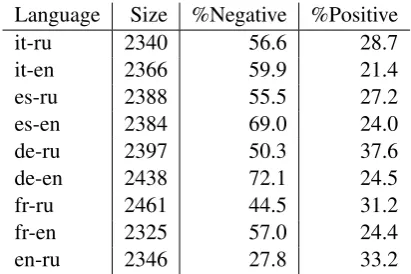
The pairs annotated as 0 usually represented the translations of unfamiliar words, abbreviations and the like. Such phrases were excluded from training and testing. We didn’t use ”acceptable, but unnecessary” translation pairs either, because they do not influence the quality of the lexicon. We treated as negative the phrase pairs that were annotated as 1 or 2. Analogously, the positive ex-amples had to belong to 4 or 5 class. The annota-tion statistics is given in Table 4.
Language Size %Negative %Positive
it-ru 2340 56.6 28.7
it-en 2366 59.9 21.4
es-ru 2388 55.5 27.2
es-en 2384 69.0 24.0
de-ru 2397 50.3 37.6
de-en 2438 72.1 24.5
fr-ru 2461 44.5 31.2
fr-en 2325 57.0 24.4
[image:6.595.313.519.357.494.2]en-ru 2346 27.8 33.2
Table 4: Statistics of the annotated data: the num-ber of annotated phrase pairs, the percentage of negative and positive examples.
4.3 Training setting
The experiments were run with two different fea-ture sets:
• Baseline — features based on co-occurrence counts.
• Full — baseline and sentence-level features. We had to choose a subset of co-occurrence-based features experimentally (see, Section 3.3). The best subset for our data consisted of three features: log(Slem), log(P(e|f)), log(P(f|e)). In the full
We considered three metrics related to the im-provement of the lexicon quality:
• Err — the percentage of prediction errors;
• Err-1 — the percentage of class 1 examples which were classified as positive.
• F1 — the harmonic mean of precision and re-call w.r.t. the positive and negative examples;
We used the standard packages of the R pro-gramming language, to train and tune differ-ent classifiers: random forest (RF), support vec-tor machines (SVM), logistic regression (GLM), Naive Bayes classifier, neural networks, k-Nearest Neighbors and some of the combinations of these methods with SVD. To assess the predictive accu-racy we used repeated random sub-sampling val-idation. In each of 40 iterations, a 10% test set was randomly chosen from the dataset, the model was trained on the rest of the data, and then tested. The resulting accuracy was averaged over the iter-ations.
Classifier Full feature set Base feature set %Err %Err-1 %Err %Err-1
RF 19.80 8.31 24.00 14.62
SVM 19.63 9.36 23.49 12.91
[image:7.595.308.537.63.200.2]GLM 22.74 6.35 25.23 7.30
Table 5: Percentage of prediction errors of dif-ferent classifiers, averaged over the nine language pairs.
The results of RF, SVM and GLM are reported in Table 5. Though the composition of different classifiers could perform slightly better, it would require an individual tuning for each language pair. For clearness, we use a single classifier (RF) for the rest of the experiments.
The experiment showed that training on the full feature set reduced the total amount of prediction errors by 17.5%, compared to the baseline setting. The number of false positives among the class 1 examples reduced by 43%. It is also important that better results were obtained on each of the nine language pairs, not only on average. In Table 6 the baseline results are shown in brackets and one can see that F1 diminishes in the baseline setting, while the percentage of errors goes up. The classi-fication accuracy depends on the size of the train-ing set (Table 7).
Lang %Err %Err-1 F1
de-en 18.0 (+3.6) 4.0 (+5.2) .562 (-.050) de-ru 25.7 (+4.0) 13.5 (+6.7) .672 (-.040) es-en 16.4 (+3.8) 3.2 (+4.0) .610 (-.059) es-ru 20.6 (+4.7) 8.3 (+6.0) .643 (-.064) fr-en 20.5 (+1.5) 6.0 (+5.8) .603 (-.031) fr-ru 21.4 (+6.1) 15.5 (+10.8) .704 (-.070) it-en 15.2 (+3.3) 3.5 (+2.9) .663 (-.059) it-ru 19.6 (+5.5) 9.4 (+6.7) .670 (-.071) en-ru 20.8 (+5.6) 11.5 (+8.8) .797 (-.048)
Table 6: Classification quality of the classifier trained on all features, compared to the baseline trained only on phrase-level features. The relative change of the baseline values is given in brackets.
Examples 1700 680 272 108 43 Accuracy .803 .794 .780 .757 .709
Table 7: Classification accuracy w.r.t different size of training set averaged over eight language pairs.
We measured the impact of different features, as described in Breiman (2001), with the help of the standard function of the R library ”random-Forest” (Table 8). The three baseline features were ranked as most important, followed by Un-safeAlign, OOV, UnsafeJump and others.
Feature Importance
log(Slem) 35.679
log(P(e|f)) 33.9729 log(P(f|e)) 28.8637 UnsafeAlign 24.3705
OOV 22.8306
UnsafeJump 20.1108 P unct 15.4501 UnsafeStruct 15.1157 Uniqueness 13.5049 UnsafeDigAlign 12.915
Table 8: Feature importance measured by the mean decrease of classification accu-racy (Breiman, 2001). The value is averaged over the nine language pairs.
[image:7.595.337.497.467.617.2]lan-guage pairs are shown in Figure 2. The accu-racy function was smoothed with cubic smooth-ing spline. The differences in the distribution of classification errors between language pairs sug-gest that the nature of the noise can vary for dif-ferent corpora. The general U shape of the curves in Figure 2 is partly due to the fact that there are many true negatives in the low-frequency area, and many true positives in the high-frequency area.
0 500 1000 1500 2000
0.6
0.7
0.8
0.9
rf svm glm rf−b svm−b glm−b
0 500 1000 1500
0.70
0.75
0.80
0.85
0.90
0.95 rf
[image:8.595.309.527.86.226.2]svm glm rf−b svm−b glm−b
Figure 2: Prediction accuracy of different classi-fiers w.r.t. the phrase pairs sorted by the ascend-ing co-occurrence count. The upper plot relates to the German-English pair, the bottom relates to French-English pair. The labels rf, svm, glm re-fer to the classifiers trained on the full feature set; rf-b, svm-b, glm-b refer to the baseline setting.
Table 9 reports the top English translations of the French word ”connexion” before the noise re-duction and shows which variants were recognized
as positive and negative by the RF classifier.
English C(e, f) p(f|e) p(e|f) RF connection 58018 0.689 0.374 + wireless 32630 0.450 0.211
-free 31775 0.113 0.205
-wifi 16272 0.382 0.105
-login 4910 0.443 0.032 +
connectivity 394 0.055 0.003 +
logon 290 0.185 0.002 +
access 276 0.001 0.002
-link 148 0.001 0.001
-Table 9: English translations of the French word ”connexion”. C(e, f)is the co-occurrence count, p(f|e), p(e|f) are the translation probabilities of lemmatized pairs. The last column shows the clas-sification result.
5 Conclusion
The main contributions of this paper are the fol-lowing. We address the problem of noise reduc-tion in automatic construcreduc-tion of human-oriented translation dictionary. We introduce an approach to increase the precision of automatically acquired bilingual lexicon, which allows to mitigate the negative impact of a noisy corpus. Our noise reduction method relies on the supervised learn-ing on a small set of annotated translation pairs. In addition to the phrase-level statistics, such as co-occurrence counts and translation probabilities, we propose a set of non-lexical context features based on the analysis of sentences in which a phrase pair occurred. The experiment demon-strates a substantial improvement in the accuracy of the detection of noisy translations, compared to a baseline which uses only phrase-level statistics.
We have shown that the proposed noise de-tection method is applicable to various language pairs. The alignment-based features can be easily obtained for any parallel corpus, even if other tools do not exist. We hope that our noise detection ap-proach can also be adapted for SMT phrase-tables, if the initial parallel sentences are still available.
References
B. T. Sue Atkins. 1994. A corpus-based dictionary.
In Oxford-Hachette French Dictionary, Introduction xix-xxxii. Oxford: Oxford University Press.
Leo Breiman. 2001.Random Forests. Machine
[image:8.595.80.281.204.599.2]Peter F. Brown, Stephen A. Della Pietra, Vincent J.
Della Pietra and Robert L. Mercer. 1993. The
Mathematics of Statistical Machine Translation: Parameter estimation. Computational Linguistics, 19(2):263–312, June.
Matthias Eck, Stephan Vogel, and Alex Waibel. 2007.
Translation model pruning via usage statistics for statistical machine translation. In Human Language Technologies 2007: The Conference of the NAACL; Companion Volume, Short Papers, pages 21–24, Rochester, New York, April. Association for Com-putational Linguistics
Pascale Fung. 1998. A Statistical View on Bilingual
Lexicon Extraction from Parallel Corpora to Non-parallel Corpora. Parallel Text Processing: Align-ment and Use of Translation Corpora. Kluwer Aca-demic Publishers
Hartmann, R.R.K. 1994. The use of parallel text
cor-pora in the generation of translation equivalents for bilingual lexicography. In W. Martin, et al. (Eds.), Euralex 1994 Proceedings (pp. 291-297). Amster-dam: Vrije Universiteit.
Howard Johnson, Joel Martin, George Foster, and
Roland Kuhn 2007. Improving translation quality
by discarding most of the phrasetable. In Proceed-ings of EMNLP-CoNLL, ACL, Prague, Czech Re-public, pages 967-975.
Philipp Koehn, Franz Josef Och, and Daniel Marcu 2003. Statistical phrase-based translation. In Pro-ceedings of HLT-NAACL 2003, pages 127–133. Philipp Koehn, Hieu Hoang, Alexandra Birch, Chris
Callison-Burch, Marcello Federico, Nicola Bertoldi, Brooke Cowan, Wade Shen, Christine Moran, Richard Zens, Chris Dyer, Ond˘rej Bojar, Alexandra
Constantin, and Evan Herbst 2007. Moses: Open
source toolkit for statistical machine translation. In Proceedings of the 45th Annual Meeting of the ACL on Interactive Poster and Demonstration Sessions, pages 177–180, Prague, Czech Republic
Akira Kumano and Hideki Hirakawa. 1994.
Build-ing An MT Dictionary From Parallel Texts Based On Linguistic And Statistical Information. COLING 1994: 76-81
Wang Ling, Jo˜ao Grac¸a, Isabel Trancoso and Alan
Black 2012. Entropy-based Pruning for
Phrase-based Machine Translation. In Proceedings of EMNLP-CoNLL, Association for Computational Linguistics, Jeju Island, Korea, pp. 972-983 C. J. A. McEwan, I. Ounis, and I. Ruthven. 2002.
Building bilingual dictionaries from parallel web documents. In Proceedings of the 24th BCS-IRSG European Colloquium on IR Research, pp. 303-323. Springer-Verlag.
I. Dan Melamed. 1996. Automatic construction
of clean broad-coverage translation lexicons. In
Proceedings of the 2nd Conference of the Associa-tion for Machine TranslaAssocia-tion in the Americas, pages 125–134, Montreal, Canada
I. Dan Melamed. 2000. Models of Translational
Equivalence among Words. Computational Linguis-tics 26(2), 221-249, June.
Robert C. Moore. 2004. On Log-Likelihood-Ratios
and the Significance of Rare Events. In Proceed-ings of the 2004 Conference on Empirical Methods in Natural Language Processing, Barcelona, Spain.
Franz Josef Och and Hermann Ney. 2000. Improved
Statistical Alignment Models. Proceedings of the 38th Annual Meeting of the ACL, pp. 440-447, Hongkong, China.
Franz Josef Och and Hermann Ney. 2004. The
Alignment Template Approach to Statistical Ma-chine Translation. Computational Linguistics, vol. 30 (2004), pp. 417-449.
Pablo Gamallo Otero. 2007. Learning bilingual
lexi-cons from comparable English and Spanish corpora. Proceedings of MT Summit XI, pages 191–198. Reinhard Rapp. 1995.Identifying word translations in
non-parallel texts. In Proceedings of the ACL 33, 320-322.
Resnik, Philip and Noah A. Smith. 2003. The web as
a parallel corpus.. Computational Linguistics, 29, pp.349–380
Magnus Sahlgren. 2004. Automatic Bilingual
Lexi-con Acquisition Using Random Indexing. Journal of Natural Language Engineering, Special Issue on Parallel Texts, 11.
Serge Sharoff. 2004. Harnessing the lawless: using
comparable corpora to find translation equivalents. Journal of Applied Linguistics 1(3), 333-350. Jason Smith, Herve Saint-Amand, Magdalena
Pla-mada, Philipp Koehn, Chris Callison-Burch and
Adam Lopez. 2013. Dirt Cheap Web-Scale
Par-allel Text from the Common Crawl. To appear in Proceedings of ACL 2013.
Dan Tufis¸ and Ana-Maria Barbu. 2001.
Computa-tional Bilingual Lexicography: Automatic Extrac-tion of TranslaExtrac-tion DicExtrac-tionaries. In International Journal on Science and Technology of Informa-tion, Romanian Academy, ISSN 1453-8245, 4/3-4, pp.325-352
Velupillai, Sumithra, Martin Hassel, and Hercules
Dalianis. 2008. ”Automatic Dictionary
Construc-tion and IdentificaConstruc-tion of Parallel Text Pairs. In Pro-ceedings of the International Symposium on Using Corpora in Contrastive and Translation Studies (UC-CTS).
Richard Zens, Daisy Stanton and Peng Xu. 2012.