NATIONAL INSTITUTE OF OCEANOGRAPHY
W O R M L E Y , G O D A L M I N G . SURREY
N. I. 0. Computer Programs 2
by
DIANA CATTON
N . I . O . INTERNAL R E P O R T N O . N 2
N.I.O. COMPUTER PROGRAMS 11
by
Diana Gatton
N.I.O. Programs II
13 Tide Prediotion. Harmonic constituents,
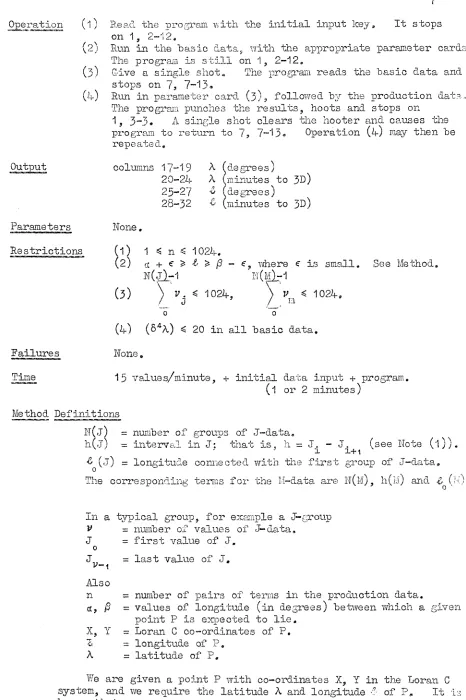
14 Conversion of Loran C to latitude and longitude,
15 Reverse series.
16 Matrix tape to cards oonversion.
17 Tape to cards conversion for 4-digit integers,
18 Prepare harmonic conatanta.
19 Pitch and roll buoy azimuth correction,
20 Scale data.
21 Separate two series.
22 Cross band spectra.
23 Tide prediction.
24 Predict harmonic constituents.
Introduction
Thia report contains a collection of programs written for DEUCE
Mark I between July 1960 and September 196I. It is a continuation of
N.I.O, Internal Report Nl, and all tlie general comments at the beginning of that report apply here.
All the programs except 14- and. 22 are connected with the N.I.O. Tide
Elimination and Prediction Scheme (see Internal Report
N.I.O. PROGRAM 13
Title Tide :
Code Deuce basic.
Hamonio Cc^sti^wonts,
Purpose To obtain modified harmonio components from those calculated by N.I.O, Program j.
Order of Cards Program (cards 0—112 and constants carda^see Parameters), basic matrices, extreme z card, S harmonics, 8 harmonics.
Parameter Cards (l) Basic matrices. Two sets of these constants are
available, for H = 8856 (cards 0-275) an& N = 8^20
(cards 0-27?), i# standard Scheme B biaary fcrm. For
their calculation see N.I.O. Programs 33 and I6,
(2) Extreme % card. Columns 18-21 z
-n
23-26 z + 0
+n
sign in column 17
22
27
Data
(1)
(2)
End Card
Operation
28-31 C
c must be punched even if it is zero
S harmonic8o_ This is the output from N.I.O. Program 3,
with series S as data. See 2!ote (1),
8* harmonics. As (1) but with series 8* as data.
None.
(1) Read the program with the initial input key, (2) Run in the parameter cards and data.
IVhen one calculation is oomplete the program hoots. After clearing the hooter operation (2) may be repeated.
Output (1) 63 cards.
Columns 17-19 20-26
i ; X,;
sign in column 17 20
28-3^ Y,. 28
36-42 •A.. 5 36
4^1^-4-8 '.y
44-1 card.
Columns 17-26
'•'0' sign in column 17.
A. and
*o are given to 3D.
is given to 2D, and -180° < < +
Parameters
(i)
(ii)
(1) If another N is used, and there are q values of u instead of 82, then (program) card ^ row 9a must be
altered from 81 P to (q-l) P .
17 - 1 7
(2) There are 12 "conatants cards", numbered 0-11, to be inserted between cards 108 and 10$ of the program. These exist complete for N = 8^20 and N = 8856,
Cards 0-3 ^tracks 15/10^15/12). The 82 (or q) values of u
are punched consecutively, in ascending order of magnitude except that u = 0 is last, as binary integers x P in the
afiald. ^
Cards 9-11 (track I5/13) contain several constants which must be copied from the cards for one of the above values
necessary:-w
0 P ! 7 on card 9, row 3c:
a P
i7 5,
fc
2 P 17 9, 7a
w_ P
17 9, 9a:
6) P
1 7 10, Z']!
W
5 P 10, 1
w
6 P i 7 10, 3 A
''S P 1 7
10, 3 A
(0
8 P 17
10, TO:
(10=2 1:/%) P on card 11
1 , r,
Traoks are punched in triads, the first value being punched The Ta row of the first card
on row of the first card.*
for track q/b contains
p b.P
1 5 17 a,P 2 1
Restrictions
12
( 3 )
(4-)
n < 4960; that is, H < 9920.
1 < < 32, i = o(l)8. There must be 9 groups,
The basic matrices may vary in size but may occupy not more than 82 tracka in all.
An i % j matric occupies (ij + 4) mwC., and a new matrix starts on a fresh track.
1 < q < 96.
Failures (1)
(2)
4 , 1-31x. Wrong matrix parameter card. This occurs if
the first basic matrix card has been forgotten. There are many other failures but they all indicate
machine failure. The whole program should be restarted.
Time About 10 minutes.
Method The calculation is in two stages (see Note (2)).
(l) Two sets of harmonic components are available, calculated by
NoI.O. Program ) for the two half-years. The size of DEUCE
makes this division necessary, and it may also be necessary
to scale the original data r = -n(l.) + by the
subtraction of a constant c." This constant, and th^/values
of (which were not used by N.I.O. Program 3) are required
(see parameter card (2)).
The first stage is merely to assemble the harmonic components
for the whole year. We call these
G u a a d for u > 0
where u takes the values specified in H.I.O. Program 3 . For
both N = 8320 and N = 8836 there are 82 values of u. including u = 0.
the whole year.
Note thatu is effectively the moan over
The second stage is to reduce the number of harmonic
components & and to the 63 values corresponding to known
tidal components. The basic matrices (see Parameter card (lJ
do this, by the method of Least SquaroS; and the final ra&ulc is a table of 63 components
X^, Yj, A^ and where A. = (X.z + Y.2)x
1 1 1
and = arc tan Y./X. ,(-180^
1 1/ gu < 180°),
for i = 0(l)(%
.Notes (1) The following synboja refer to Program 3. The paronotgrs required
^re:-H + 1 = 8)
n = or .';;?6n
k = 2
Tha values of depend on the original number of taras:
the values of s are the sine as u in. ^.I.O. Pro^rnm 33, and parameter cards and s-data cards exist for the two oases already oonaidered.
(2) A more oonprehensive account of the theory is given in the M.I.O. Tide Elimination Schene description.
Title Code
Piirpose
N.I.O. PROGRMI 12^
Conversion.!, of Loran C to mtitu&e and. Longitiiie, Deuoe basio.
Given oblique co-ord.inate8 of a geographical position, the program finda its Latitude (North) and Longitude (West) from a table of the co-ordinate intersections vrith the degrees of latitude.
Order of Cards Program (cards 0-71), parauetor card (1), basic data,
parameter card (3), data.
Parameter Cards (1) columns 17-20 N(j)
21-24 h(j)
25-28 6^(J)
29-2)2 ITLM)
33-36 h(K)
37-40 4 ( H )
(2) columns 17-20 -C. (degrees)
21-28 j"" or M 1 . .
0 0 I integers
29-36 J, or M J
(3) columns 17-20 n -)
21-24 (( ) degrees
25-28 J
Data (1) Bas ic data. This is in two main groups, the J-data and the
M-data. The two groups are punched in exactly the same way,
30 only the J-data group is described.
The J-data. is divided into N(j) groups, (N ^ H(j) for the rest of this section),each group corresponding to a degree of
longitude j = 0(1)N-1, where always + 1 . Each
J J \
of these N groups is preceded by a parameter card (2), The
data within a group is punched two values to a card, in degrees. and minutes to 3D (latitude A.), in the order whioh ensures that
J^ > 3 where v is the number of terms in the group.
The layout
is:-oolumns 17-19 (degrees)
20-24 (minutes to 3^)
25-27 (degrees)
14-1
28-32 A. (minutes to 3D)
1+1
If tliere is an odd number of values of A in a group, columns 25-32 on the last card may be left blank.
The order of cards is thus parameter card (1)
parameter card (2) for group j ) . ^
J-data for group j j
parameter card (2) for group m ) ^ _ o(i)i\T(M)-1
M-data for group m J
(2) Production data,
columns 17-24 X
25-32 Y
Both X and Y are punched to 1D,
End Card None.
Operation (l) Bead, the iDroRram i^ith the initial input key. It stops (2) Rum in the basic data, -with the appropriate parameter cards
The program is still on 2-12.
(3) Give a single shot. The program reads the basic data and
stops on 7, 7-13.
(4) Run in parameter card (3), followed by the production data., The program punches the results, hoots and stops on
3-3. A single shot clears the hooter and causes the
on 1 .12.
Output
Parameters
Restrictions
program to return to 7, 7-13. repeated.
Operation (4) may then be
columns 17-19 20-24 25-27 28-32 None. A. (degrees)
A (minutes to 3D) '6 (degrees)
(minutes to 3D)
\diere f is small. 1) 1 < n < 1024.
2) cC + C ^ & > ^ -N(jlr1
(3) ) < 1024,
0 0
(4) (6*A,) < 20 in all basic data.
See Method.
) 1/ < 1024.
/
Failures
Time
None.
15 values/minute. initial data input + program.
(1 or 2 minutes)
Method Definitions
h(j)
6 (j)
number of groups of J-data.
interval in J: J. - J. (see Note (1)).
1 X+1
longitude connected with the first group of J-data, The corresponding terms for the H-data are N(M), h(M) and
±n a V J 0 "v-, Also n a, ^ X, Y ~0. A
i^ical group, for example a J^group = number of values of J-data. = first value of J.
= last value of J.
number of pairs of terms in the production data.
values of longitude (in degrees) betiveen which a given point P is expected to lie.
Loran C co-ordinates of P. longitude of P.
latitude of P.
We are given a point P with co-ordinates X, Y in the Loran C system, and T/e require the latitude A and longitude
knoTOi that
I
where c is small and g = ^ + 1 (in degrees '
The basic data consists of tables of latitude (by now converted to minutes) against J and latitude against M for each required degreo
of longitude. For any speciCied longitude the latitude
[image:9.626.86.552.87.787.2]corresponding to X may be obtained by direct interpolation in the
table with argument J. Similarly the latitude corresponding to Y
may be obtained from the H-tables. The arguments J and M correspond
to the two sets of reference lines in the Loran C co-ordinate svstem.
into 2 stages
(1) Direct interpolation, (2) Inverse interpolation. Stame (1)
We first select a longitude say. This determines the group
of J-data to be used. Frcm ^his group we select 4 consecutive
argument values J. , J., J. , J. so that
1-1' 1* 1+1* 1+2 J. > X > J.
1 X+1
Lagrange 4-point interpolation is adequate provided < 20,
so we find the latitude A. corresponding to X by the formula
+ A / q ) \
H-where corresponds to J_, and so on,
and q = 10J^- X .
10b .
In general, if & and are properly selected,
0 < q < 1.
The A(q) are the usual Lagrange coefficients, and we assume that enough basic data is given to avoid end of table
complications,
This procedure is repeated for . and . , giving
2*. values in all.
Then the whole calculation is repeated for Y, using the M-data, for the same 4 values of longitude.
Sta^e (2)
We have now two tables, of A. and A. respectively, both with the same argument; namely ^
(=C ) A. A
j—1 m—1 J—1 m—1
•$ . (= --v ) A. A
J ^ m '' J m
C . (= C ) A. A
J4*1 ni4-i 1 m+1
•u . (= V. ) A. A
j+g m+2 J4-2 m+2
Tfe require p, in order to calculate ^ and A, where
= 6o(<' j " p) (1)
and A = A. + pAA. + B (p)(A^A. + A^A.) + (2)
J J 2 J-i J
Both -& and A are in minutes. Similar relations hold with j
replaced by m, and p may be obtained to sufficient accuracy from the recursion
^
where a = (A - A.)/y,
^ m J '
b = (A^A + A^A - A^A. - A^A.)/y
m-i m j-1 *
and y = AA. - AA .
J m
Differences above the second are negligible. B (p) is the Bessel interpolation coefficiDYib, Substitution in (l) and (z)
gives and which may then be converted back to degrees and
minutes.
Notes (l) This is a special, purpose program, but it may work (with or without small modifications)
for:-(i) ^ " (I 4 %
(ii) East longitudes and/or South latitudes, (iii) Latitude and longitude interchanged.
10
N.I.O. PROGRAM ^5
Title Sgverae Serlos.
Code Deuoe baaic.
Purpose To reverse a serios term by term.
Order of Cards Program (cards 0-^7) parameter card, data,
Parameter Card Columns 17-20 -n; sign in column 17.
Date 8 signed 4-digit numbers per card in the a-field.
End Card None.
Operation (l) Read the program with the initial input key. (2) Run in the parameter card, followed by the data.
When the results have been punched the program hoots and
stops on 2, 1'^. A single shot clears the hooter.
Operation (2) may then be repeated.
Output 8 signed ^-dieit numbers per card in the g-field. The number
of cards punched must be a multiple of 4^ and any card (or part of a card) occurrh^after the true end of the results is filled with zeros.
Parameters None,
Restrictions 1 < n < 7520.
Failures None,
Time About ^/^OO minutes.
Method A series R is converted into a series R
Notes
where
Z , X , X
0' 1' s
s
, each with n terms,
z
R
n-f X
n-n"2' r—1
1 •'
(1) This program is used to prepare data for N.I.O. Programs 13 and 23; that is, the Tide Elimination Scheme,
(2) x must bo at the beginning of a card.
11
N.I.O. PROGRAM l6
Title Matrix tape to cards conversion.
Deuce baaic. Code
Purpose To convert a decimal matrix, given on tape in Mercury code, to
standard Scheme B binary form on cards. Order of input
Parameter oard
Program (cards 0-25% parameter card, data tape,
Columns 17-20 m
21-24 n
25-28 P
29-32 k
33-36 d
Data
End card
An m X n matrix, punched row by row, to d decimal places.
Decimal points are ignored. Each element is preceded by
F8 CR LP CR and followed by
Sp Sp,
except that the last element in a row is followed by 8p 8p LF.
The elements must be single length and in fixed point form. Tape in this form can be produced by the Mercury Autocode
function 1^8 (See Note (1))
None.
n (1) Read the program :Tith the initial input key. Tt stops
on 3, 4^16,
2) Run in the parameter card. Stimulate the tape reader.
Give a single shot, When one matrix is converted, the
program fitops or 3, and operations ( 2 ) , (i)) and (^|.)
may be reneatod..
Output (1) Scheme B parameter card.
m.P Y row
a X row
(X
1 7 n.P
1 7 0 row: p.P
d 17
(2)
1 r o w :
a k.P 1 7
Scheme B binary matrix.
The matrix is punched row by row in the a-field, to p binary places, each row starting on the Y row of a fresh
card. The last of the n elements in R row is followed b}
the row sum, shifted down k binaary places. Parameters
Restrictions 2^^ |x| < 1'07 X 10^, where x is any element.
Failures (1)
None,
(1)
regarded as an integer.
( 2 ) 1 < m < 32
(3) 1 < n $ 31
( 4 ) 0 < p < 31
(5) 0 < k < 31 (6) 0 < d < 9
(7) ( 0 < p - 3d < 31 if 0 < d < 3
(1 < p - 3 d < 32 if 4 < d < 9
3, 4-l6x with hooter. d > 10,
Time
Method
Notes
12
( 2 ) 2, 9-24%:. Eon-n.UE.erio character read. Move the tape tack to the beginning of the number and give
a single shot. The program will tiy to read
the number again.
This is effectively Reading + Punching time.
The folloTfing symbols are used:-m = nuused:-mber of roiTS,
n = number of columns,
p = number of binary places in the output.
k = row sum shift. If the true row sum is 8, then
2 " ^ is punched,
d = number of decimal places in the input.
The program first reada the complete matrix and then punches it, preceded by a parameter card,
( 1 ) If the decimal matrix is regarded aa being pi^mched column by column, for listing purposes, this program will produce the transpose on cards.
13 N.I.O, PROGRAM 1?
Title
rnose
Tape to cards conversion for 4-digit integers.
Deuce bisic*
To transfer decimal integers from tape to cards, punching 8 signed 4-digit integers per card.
Order of incut Program (cards 0-40), parameter card, data tape.
Parameter card Columns 17-20 n.
Data n sigped decimal integers of not more than 4 digits, punched
on paper tape in the standard Mercury code. (See Note (l)).
End card None.
Operation (l) Read the prog%%m with the initial input key. It stops
on 2, 1-13%.
(2) Run in the parameter card. (3) Stimulate the tape reader.
(4) Give a single shot. IMhen one run is complete operations
(2), (3) and (4) may be repeated.
Output (1) n signed ^-digit integers, punched 8 to a card in the
(2)
g-field. The number of cards punched must be a multiple
of 4, and any card (or part of a card) occurriagafter the true end of the results is filled with zeros.
Sum: Columns 18-36 % ; sign in column 17? where 2 is the sum of the n terms.
Parameters None,
Restrictions 1 < n < 7424.
Failures (1) 1, 6-6x with hooter. n > 7424. Clear the hooter and
give a single shot. The program returns to 2, 1-13% and
a new parameter card may be read,
(2) 2, 9-24%. Non^numeric character read. Move the tape
back to the beginning of the number and give a single shot. The pro^fom will try to read the number again.
(3) 1, 7-24.) Sum check failure. This is a machine fault,
and the whole program should be read in again.
Time About jg' seconds.
Method The program reads the data in groups of 32 numbers (the last
group may contain less), calculates the sum and writes them on
to the drum. It then reads the track down a gain, recalculates
the sum and checka that it is the same as before. If it is
not Failure (3) is shown. If all is well the current sum is
added to the sum of all the previously read numbers. In this
way the whole tape is read.
The n numbers are then punched as described in Output, followed by a single card containing the sum.
Notes (1) This program is suitable for use with the output from
NIO Program 23.
14 M.I.O. mOG-RAM 18
Title Prepare harmonic oonstants.
Coda Deuoe basio.
Purpose To prepare oonstf^zits to be used, to mod.ify the harmonio
oomponents of a specified, year so that they will apply to another
specified, year. (See N.I.O. Tid.e Elimination Scheme]
Order of cards Program (cards 0-97), parameter oard, data,
there may be no data.
Note that
Parameter oard 17-21 8 ; sign in coluTiin 17
22-26 h 5 22
27-31 P 5 27
32-36 N > 32
37 - or blank.
s, h, p, N are given to 2D and are in degrees. Column 37
contains - (punching in the X row/ if there ia Ro data to follow, otherwise it must be left blank.
Data Columns 17-19
2 0 - 2 6
28-34 36-42 44-48 %i(3D) ; Y^(3D) ; Aj^(3D) ; <^^^(25) ;
m-sign in column 17
20
28
36 44
for i = 0(1)62. This will generally be the first 63 cards of
N.I.O. Program 13 output. End card None,
Output
(1) Read the program ^vith the initial input key,
(2) Run in the parameter card and data (if any% The
program alternately reads a oard and punches a card, and when 63 cards have been punched it hoots and stops on
1,1-1. A single shot clears the hooter. Operation (2)
may then be repeated.
Columns 17-18 19-25 26-30 31-36 37-41 42-46 X Hj^(3D) gi(2D) fj^(5D) u X Z D ) V^(2D)
sign in column 17 19 26 31 37 42
for i = 0(1)62. The angles (that is, g, u and V) are in degrees
and lie between 0° and 360°, Parameters Restrictiins Failures None, (1) None.
-999-99' 8, h, p, N < + 999'99'=
Time About 5 minutes.
Method For each i, we have f u ^ ^ and V. defined separately in terms of
8, h, p and N. A list of the definitions is available.
(See Note (1)).
If thei-e are no harmonic components, that is, there is no data, then
H.
X u. + V. for i X X 0(1)62,
N . 2
1 5
If data is available, thk^n
H. = A . / fg . = <^. + u. + V. for i = 0(l)62
As usual, we have
= arc tan Y./X., for i = 0(1)62
where X. and Y. ozo defined in H.IoOo Program 1
Notes (l) A list of the f, u, and V definitions may be found in:
A,T^ Doodoon, %ie .^malyais of Tidal Observationa,
-16
Title Pitch and. roll huoy azimuth correction.
Deuce basiCo
To obtain true pitch and. roll components from the observations taken ^rith variable axes.
Order of oar&s Program (oards 0-58), pei-ameter card., data,
P parameter card, P data, E parameter card, R data.
Parameter cards (1) parameter card.
ColuLins 17-20 N
21-24 h
sign in column 25 29 33
Data
25-28 10"o( ;
29-32 10^)8 ;
33-36 y ;
(2) P parameter card.
Columns 17-20 n
(3) R parameter card.
Columns 17-20 n
(1) data: 8 signed 4-(iigit numbers per card in the a-field,
is given to the nearest degree.
P data: 8 positive 4—digit numbers per CBrd in the a-field. E data: 8 positive 4-cl.igit numbers per card in the a-field. End card None,
Operation (1) Read the program ivith the initial input key,
(2) Run in the parameter cards and data. 1!l:ie prqgrpm punches
P* and stops on 8, 8-21.
(3) Give a single shot. The program punches R*, hoots and
stops on 8, 3-3,
(4) A single shot clears the hooter. Operations (2), (3) an-d
(4-) may then be repeated.
Output (1) (r = 0(l)n-l), punched as 8 signed 4-(3.igit numbers
(see Note (3)) per card in the g-field.
(2) R * (r = O(l)n'-l), punched like P *. each case the
number of cards punched must be a multiple of 4, and any card (or part of a card) occuirizig after the true end of the results is filled with zeros.
Parameters
Restrictions
None,
[2)
2 < N < 480.I 360, w = 0(l)n-1,
3) 1 < h < 364 (see Note (1)). 4) 1 < n < 3328.
(5) 0 < P ,Ry< 999, r = 0(1)n-1.
|P^*I, |R^*I < 9999 (see Note (2)).
(6)
|y| < 9999. |j9| < 2.
I a I ^
Failures None.
Time About n/lOO minutes.
^ei^od For r = 0(l)n-1 Tze define
P , R_^ = obsei-vptions of pitch and roll respectively. P_^*, R * - true values of pitch and roll.
17
To obtain P * and. R * fiom P and. E the axes must "be rotated,
r r r r
through c
Thus P^* = y + (i(P_ - P) COS ^ - 5) sin
E * = y + a(P - P) sin (jb + ^(R - R) cos ^
r r ' r r r
where a, y are constants d.epend.ing partly on the j^sti-uments
used, and partly on the limitations of DEUCE, azid. P, R are means defined, in the usual way.
To obtain , we define
r'
M = number of values of
h = interval between consecutive values of assunuig
the interval between consecutife values of P (or R ) to be unity.
Thus ^ ie given for r = 0(h)Nh-h^ and. intermed-iate values are found, from
"^r ^ k h + h'
where hp = r - kh and. k is a positive in.teger.
To ensure that
kh < r < kh + h,
it is best to choose H so that n < hE.
If r > a value for is found, by extrapolation, but it may
not be reliable.
Notes (l) The d.ivision subroutine used, to calculate /'h is very slow for
small h. It may be speed.ed. up as
follows:--p8
12 Set 2 so that /h has 3 s.f. (integer)
2 0
6 Shift up (27-s) places.
At present s = 17. Time = 2^10 ^h seconds
h 2^^/h Time (sees)
1 131072 131 = 2'2 mins
50 2621 "44 2'6
100 1310-72 1'3
130 873'81 0'9
200 655-36 0'7
300 4.36-90 0-Z|.
364 360-09
0-4-(_2) If P^* and. R * are required, for input to RAE174- (correlation)
then they must also satisfy
0 < P / , R / < 999.
(3) P * Eind. R * have a maximum error of ±0-51 in. units of the last
r r
d.ecimal place.
18
N.I.O. PROGRAM 20
Title Scale data.
Code Deuce basic.
Purpose To scale 4-digit signed integers.
Order of cards Program (cards 0-34), parameter card, data.
Parameter card Columns 17-20 n
21-24 10*a ; sign in column 21
25-28 c ; 25
If a = 1, columns 21-24- must be left blank. If c = 0, columns 25-28 may be left blank,
Data 8 signed 4-digit numbers in the a-field.
End card None.
Operation (l) Read the program with the initial ioput key. It stops
on 1, 2-12.
(2) Run in the parameter card, followed by the data.
(3) Give a single shot. When a run is complete the program
hoots and returns to 1, 2-12. The hooter may then be
cleared and operations (2) and (3) repeated.
Output 8 signed 4-digit integers in the a-field. The number of cards
punched must be a multiple of 4, and any card (or part of a card) ooouBru%gafter the true end of the results is filled with zeros.
Parameters None.
Restrictions (1) 0 < n < 7584.
(2) -9999 < lO^a < 9998, unless a = 1.
( 3 ) - 9 9 9 9 < 0 < 9 9 9 8 .
(4) |ax^ + o| < 9999, for all i. Failures None.
Time About ^/8 seconds.
Method Given the n integers i = 0(l)n-1, the program computes
ax^ + c, i = 0(l)n-1,
where a and 0 are constants.
19
N.I.O. PROGRAM 21
Title Separate two series.
Code Deuce basic.
P^^pose To separate two series of 4-cLigit numbers punohecl alternately,
possibly omitting terms at the beginning and/or at "the end.
Order of oarda Program (cards 0-34), parameter card, data.
Parameter card Columns 17-20 n
21-24 s
25-28 t
Data 8 signed 4-djgit numbers per card in the a-field,
End card None.
(Sei ries xJ
Operation (l) Read the program with the initial input key. It stops
on 3, 16-1.
(2) Run in the parameter card, followed by the data. The
program punches Series y and stops on 1, 4-21.
(3) Give a single shot. The program punches Series z, hoots
and stops on 4, 7-7.
(4) Give a single shot. The program returns to 3, I6-I and
the hooter is cleared. Operations (2), (3) and (4) may
then be repeated.
Output (1) y , (p = o(l)H-l) punched as 8 signed 4-digit numbers per
card in the a-field.
(2) z , (p = 0(l)H-l) punched in the same way as In each
P
case the number of cards punched must be a multiple of 4, and aqy card (or part of a card) occurring after the tru3 end of the results is filled with zeros.
Parameters
Restrictions
None,
(1) n < 5056.
(2) N = 2{n-t-s) > 0 and integral. Failures
Time
None.
About r/6 seconds,
Method We are given a series of n terms x_, r = 0(l)n-1, of which izi
general alternate termj belong to Series y and the rest belong to
Series z. There may be terms at the beginning an^/or end of
Series x which belong to neither Series y nor Series z.
n = number of terms in Series x.
s = number of unwanted terms at the beginning of Series x. t = number of unwanted terms at the end of Series x.
N - number of terms in Series y (and in Series z).
Clearly N = ^X^-t-s), where t and s must be chosen so that N is an integer.
y aad z are defined by
P P
P X s+p'
X
S + p + 1 • where p = 0(l)N-1,
20
N.I.O. mOGRAM 22
Title Cross band, spectra,
Cod.e Deuce basic.
-pose To condense and. combine two related, sets of data.
Order of card-s Program (O-76), parameter caird, data series 1, data series 2^ group cards (in the required order), end card. Parameter cards (1) Parameter card.
Y row: data layout. A one in each digit (or sign)
position except the last digit of a number,
and zeros everywhere else. (See Data)
Columns 17-20 n.
(2) Group card(3).
Columns 17-20 N
21-24 r
2 5 - 2 8 3
0
Data 2 single length signed integers per card in the c-field. The
signs must be overpunched and the first number may begin in any
of columns 18 to 47, It must not begin in column 17.
End card Columns 17-20 zeros.
Operation (1) Read the program with the initial input key. It stops
on 1,9-12.
(2) Give a single shot.
(3) Run in the parameter card, folio/red by Series 1 and then Series 2.
(4) Run in the group card(s) followed by the end card.
T?hen the end card has been read the program punches results as
follows:-Output (1). After punching the program stops on [P^], 1,11-1c
Output (2). " " " " " " [P^],1,11-1.
Output (j). " " " " " " [P ],1,11-1.
Output (4). " " " " " " [PJ,6,11-1.
Output (5). " " " " " " 1,9-12.
In the first 4 oases a single shot enables the next set of
output to be punched. After Output (5) operations (2) - (4J
may be repeated.
Outputs (2), (3) Eind (4) are punched continuously, and in
outputs (1) and (5) the punch pauses betv/een each card.
Output There are 5 sets of output.
(1) Columns 18-22 M ; sign in column 18
26-30 P ; 26
34-38 zero ; 34,
Note that P = l(l)r, and that s is replaced by zero in all except the first of the r groups of N terms,
(5) Columns 18-24 orotan y; sign in column 18.
This is given in radians to 3D,
(2), (3), (4) Columns 17 b ; sign in column 17
18-24 a ; 18
1 '
25 b^ ; 25
21
Columna
32|.-40 a ;
41 ;
42-^48 a ; 4
wfiere flor.tin^ p(.
10^^,
.oo:
sign in colurim 33 34 41 42 io reproacntecl by
where a^ is given, to 6D and. b^^ is an integer (see Note (2)),.
The aotual numbers punohed. are
Parameters
Restrictions
Failures
(2) 2,^, 2/9^.
(3) 10'"''2A_a_, 10"^
Tine
Method.
(4) 21
The same plugboard will list outputs (l) - (5).
None.
(1) 0 < n < 1024 (2) 0 < N < 32 (3) m < n (4) 0 < m < 84
(5) 1 < 2 M % < 10^°, where x is any of A, B, a, ^
and |x| < M (see Note (2)).
1, 5-5 n > 1024 Give a single shot to read a new
parameter card.
(2) 7, 6-6 N > 32
(3) 7, 7-7 m > n
(4) 7, 8-8 m > 04
If any of (2), (3) or (4) occur, give a sin^e shot to read a new group card,
(5) 1, 3-3 (6) 1, 4-4
Failures (5) and (6) nean that the program has been asked to store data on the drum in a non existent mc
(> 8191). They should never occur, but if they do,
a machine fault ia indicated, and the program should be restarted.
All these failures are accompanied by the hooter.
(7) Overflow. This may occur in Outputs (2), (3), (4) .t'
Restriction (5) is violated, (See Note (2)),
About ( ^ + ) minutes, aasuming n = rN, + time to reset card
nurbora ctc, botwoGn (proupa,
n = number of data cards in each series, N = number of terms in a group.
m = number of groups.
r = number of (consecutive) times the group rf N terms is to
he-re peated,
s = the label of the first term of the first group specified.
A , B , p = 0(l)n-1 are the terms of Series 1. P P A and B are
punched on one card.
Similarly jS are the terms of Series 2,
For eaoh group the program computes
P
22
10^'SApCp,
Zip, lO-'SlSp, 2.^^ 10-,2.:^
where all the au:-.:s r,ro taken over IT terns, and iTliere
s = ('i, ^
and i = (a ^ + 0
P P P
The program also computes arcta^ y,
where y = r.CAp.3p - B ^ a J / S(A^ctj, +
The first group starts at p = 0.
Notes (l) This program supersedes N.I.O. Program 2,
(2) Restriction (5)
Tha punch subroutine (^^26) requires that the floating
point number c^ = satisfies -9 < b^ < 9,
-10 < a^ < + 10;that is 10 < |o^| < 10+^° or = 0.
Let |A| < M, |B| < M, |a| < M, < M in any one group of
n terms. Then for this group
2A < NM, 10"*2Aa < loT^NNf 21 < NMV2, 10"*2l2 < 10"*N.2M2
and similarly for the corresponding terms in B, &, and 0, The restriction c^ > 10 i°is necessarily satisfied
(except when c^ = O) since A, B, a, ^ are all integers. The restriction c^ < 10^° is satisfied if both
NMV2 < 10^° and 25M^ < 10^^ are satisfied. If we assume
N = 32 the safe limit is M < 2'2 z lOS. This is not
unreasonable as for single length working we already requli M < 2=1-1 < 2*14. X 109,
23
N.I.O, PROGRM? 25
Title Tiie l^t].ioticcL.
Code Deuce basic.
^urpose To pretlict ticlal heights, onA to calculr.to tho
residuals if observeil hai^^hts oro r.vailnblo.
Order of cards Program (cards 0 - 6 1 h a r m o n i c components, range card,
S parsLmeter card, 8 , 8 parameter card, 8 . Parameter cards (1) Range card.
Columns 17"-26 a
27-36 b
37-46 c
(See restrictions aiid note (l)).
(2) 8 parameter card.
Columns 17-20 n + 1.
(3) 8^ parameter card.
Columns 17-20 n + 1.
Data (1) Harmonic components. There are 64 cards,which are
either the complete IT.I.O. rrocT^^' 13 output
or the complete N.I.O. Progi-am 24 output (63 cards)
followed by a hand punched card containing a . (See Note (gj
Columns 17-19 i ; sign in column 17
20-26 ; 20
28-34 T ; 28
for cards 0-62, and
Columns 17-26 oc ; sign in column 17
for card 63.
(2) 8 ; ^ p punched consecutively as 8 signed
4-digtt integers per card in the a-field. (See Note (3))o
(3) S^; Z , Z , Z punched consecutively as 8 signed
0 1 +n
4-digit integers per card in the g-field. (See Note (3))i,
End card None,
Operation (1) Read the program with the initial input key. It stops
on 7, 8-12.
(2) Give a sin^e shot. Run in the harmonic components
(64 cards) followed by the range card. When 2 has bee
calculated and stored for the required range the progr&u' stops on 3, 16-1.
(3) Run in the 8" parameter card, followed by S", T and 'J
are punched for r = -o (b) - a and the progroi: stops on
3, tG-1. ^
(4) Run in the 8 paraaeter card, follo-.;od by 8 . T and
2 are punched for r = a + b (b) c. Note that tEe la^ %
8 columns on the last card punched contain rubbish,
(See Note (1)). The program hoots and stops on 1, 6-24.
(5) G-ive a single shot to clear the hooter and return tiie
Output
24
Operotiona (2) to (s) nay then
8 signed. 4-&igit integers per oard in the a-field, T and 2,
progron to 7, 8-12. be repeated.
r (h) - a and r = a + b ^b) o. are punched alternately for r =
During
output:-before operation (3) set colunn 11 switch to 9, and before operation (4) set column 11 switch to 1,
P a r a m e t e r s
Restrictions
N o n e ,
(1) 0 > a » 0.
(2) Q/4 must be an integer, where bm = c - a + b, (3) 4 < m < 1216.
(4) 1 < n < 4448.
(5) 0 < < 180°, all i in degrees).
(6) 0 < r < 2 (7)
15 32767.
a > 0 .
0
Failures (1) 1, 7-7, with hooter. This meana ™/4 ia not an integer.
Clear the hooter, give a single shot and run in a correct range card,
(2) If m ia not an integer, the program goes into a loop. Correct the rang^ card, and restart the whole program (the last program card, may be used).
Time About (7'7m + 0'034N) aeconda, where N = 2n,
Method The notation oorresponda with the N.I.O. Tide Prediction
Scheme, For any r,
Z = the observed tidal height, 2 = the calculated tidal height.
ana T
Now Z exists for r = 0(l)n oh^y, so when r > n, 2^ gives a prediction,
define
2 = c
T is the residual, r
62
+ 2 )x. cos (rv.)° + Y. sin (rv.)°
^ ^ / X X X X
where the constants v\ are stored within the program.
Notes (1) The N.I.O. Tide P&edlotion scdM^e requires T and 2^ at
3-hourly intervals, from data punched at hourly intervals.
so here b = 3. Tba two chief caaes
are:-N = 8856 ; r N = 8520 ; r
- 4 4 2 9 ( 3 ) + 4 4 2 9
-4261 (3) + 4261,
Inspection of restriction (3) shows that at least two
range carda are necessary. The most satisfactory
arrangement at present (taking into account the possible unreliability of DEUCE) is to carry out five runa of
about 45 minutes each. The range cards
are:-a = 0, 0 = 897
(ii) a = 888, 0 = 1785
(iii) a = 1776, c = 2673
(iv) a = 2664, 0 = 3561
25
In all oases b = 3, m = 300 and ^/4 = 75. 1% the S case
the runs overlap by one whole card, and in the 8 case there is still an overlap of one card, but the last two numbers on the last card of a pack do not agree with the correct values.
(2) If predicted harmonic components are used, the value of
a &ay be assumed to be the same as the & for the year
fr-0 0
which the prediction was imade*
(3) If Nal.O, Program 23 is to be used purely for prediction, and no data (Z^) is available, t#o artificial series 8 and S* must be constructed as follows
8 parameter card: put n = 0, thus implying 1 term
only in 8 ;
8 itself consists of 1 card, with zeros punched in
columns 17-20.
Code
Pumose
26
N.I.O. PROGRAM 24
Title Predict harmonic conatitMento.
Deuce basic.
To predict the hamonic components for a specified year B by modifying the corresponding hamonic components for another year A.
Order of cards Program (cards 0-40) data (l), data (2),
Parameter card None,
Data (l) i, E, g for year A (63 cards).
Columns 17-10 i ; sif^n in column 1?
19-25 H(3D] ; ' 19
26-30 g(2D) ; 26
(2) i, f', u', V for year B (63 cards).
Columns I7-I8 1 ; sign in column 1?
31-36 f<5D) ; 31
37-41 u^(2D) ; 37
42-46 V'(2D) ; 42
Either or both sets of data may be produced by E.I.O. Program 18.
H, f' and i are numbers and g, u^, V' are in degrees and satisfy
0 < g , u ' , 7 ' < 3 6 0
End card None,
Operation (1) Read the program with the initial input key.
(2) Run in Data (1) followed by Data ( 2 ) , The reader does
not run continuously. When all the data is read, results
are punched and the program hoots and stops on 1, 1-1,
A single shot clears the hooter, and operation (2) may thei
be repeated.
Output Columns 17-19 i : sign in column 17
2 0 - 2 6 X . ; 2 0
1'
28-34 y^; 28
3 6 - 4 2 A ^ ^ 3 6
44-48 9^; 44
There are 63 cards, for i = C(l)62, which correspond to the
first 63 cards of N.I.O. Program 13 output. See Note ( 1 ) .
Parameters None,
Restrictions (1) 0 < g, u', < 360°
H| 3 999*999 f'l < 3*0.
Failures (1) 1, 2-2% with hooter.
If this occurs during reading, it means that i on the card just read does not agree with the internal count..
The cards are probably out of order, A single shot
clears the hooter and allows the corrected card to bo read, and then the program proceeds normally.
Time About 5 minutes.
27
Method The notation used is thaT of N.1,0. Programs 13 and 18,
For any year, N.I.O, Program 18 oonputes five quantities for each har&onio, namely
H . , s . , f . , u . , V . f o r i = 0 ( 1 ) 6 2 .
In some cases and are missing,
consider tno years A and B. Usually B will be the year
immediately following A, and we assume that the data for both years comes from the same source.
We require an estimate of x., y., a., for year B from the
1' 1' 1/ 1
known values X^, Y , A^, for year A, (i = 0(l)62), and various
conatants, X., Y. are the amplitudes for specified harmonics,
and ' ^
±
A_ = = arc tan Y. ,/Xja
Similar relations hold for y., a., 8.,
N.I.O. Program I8 provides the absolute constants and for
year A, but only provides f., u. and V. (now known as f'^,
3- %.
-I-for year B as this is all that can be obtained from the available data,
The results are comDuted using
z. = f'.H. cos (g. - u'. - V'.) 1 1
y. = f'.H sin (g - u'^ - V )
-L ± j_ 1 _L J.
a. = f'.H.
9. = g. - u'. - V'. (-180 < 8. < I 8 0 ) .
Notes (1) If the output is to be used in the N.I.O* Tide Prediction.
Scheme, it must be made to correspond exactly with the output from N.I.O. Program 13; that is, a card numbered 63 &nd containing a to 3D must be placed at the end of t^
output pack, °
Colu^ma 17-26 a ; sign in column 17.