Munich Personal RePEc Archive
Multi-jumps
Caporin, Massimiliano and Kolokolov, Aleksey and Renò,
Roberto
28 August 2014
Online at
https://mpra.ub.uni-muenchen.de/58175/
Multi-jumps
∗
Massimiliano Caporin
†, Aleksey Kolokolov
‡and Roberto Ren`o
§First draft: October 2013
This draft: August 28, 2014
Abstract
We provide clear-cut evidence for economically and statistically significant
mul-tivariate jumps (multi-jumps) occurring simultaneously in stock prices by using a
novel nonparametric test based on smoothed estimators of integrated variances.
Detecting multi-jumps in a panel of liquid stocks is more statistically powerful and
economically informative than the detection of univariate jumps in the market
in-dex. On the contrary of index jumps, multi-jumps can indeed be associated with
sudden and large increases of the variance risk-premium, and possess a statistically
significant forecasting power for future volatility and correlations which implies a
sizable deterioration in the diversification potential of asset allocation.
∗We thank Fulvio Corsi, Giampiero Gallo, Cecilia Mancini, Giovanna Nicodano, Francesco Ravazzolo,
and the participants to the XV Workshop in Quantitative Finance (Florence, 2013) and at the 7th
Financial Risk International Forum in Paris (20-21 March, 2014), and the workshop Measuring and Modeling Financial Risk with High Frequency Data in Florence (19-20 June, 2014) for useful discussions. All errors and omissions are our own. The first author acknowledges financial support from the European Union, Seventh Framework Program FP7/2007-2013 under grant agreement SYRTO-SSH-2012-320270, and from Institute Europlace de Finance (EIF) under the research programSystemic Risk. The second author acknowledges financial support from the Riksbankens Jubileumsfond Grant Dnr: P13-1024:1 and the VR Grant Dnr: 340-2013-5180. The third author acknowledges financial support from Institute Europlace de Finance (EIF) under the research program A New Measure of Liquidity in Financial Markets.
†University of Padova, Department of Economics and Management,
1
Introduction
Figure 1 shows the intraday log-returns of four financial stocks (see Table 6) on
Decem-ber, 11th 2007. In that day, a FOMC meeting was taking place, ending with the decision
of lowering the target for federal funds rate of 25 basis points, due to ”slowing economic
growth reflecting the intensification of the housing correction” and ”financial strains”1.
The four financial companies collapsed all together in the afternoon, with a
contempora-neous log-return of approximately −3% which is clearly visible in the figure. The figure
also shows an evident increase, after the collapse, of both the stocks’ volatility and their
correlation. Moreover, the VIX index rose that day to 23.59 from 20.74 (+13.7%).
In the continuous time literature, a price movement of 3% (when the local volatility is
less than 0.5%, thus of more than six standard deviations in volatility units) is typically
modeled as a jump, that is a discontinuous variation of the price process. There are three
possible routes to the detection of collective events like that in Figure 1 in the data: i)
detection of a jump in a portfolio which includes the stocks (e.g., the equity index); ii)
detection of jumps in individual stocks; iii) direct detection of the multivariate jump (or
multi-jump as we call it in this paper). Surprisingly, a lot of effort has been devoted to
i) and ii), both theoretically and empirically, but almost none to iii). In this paper, we
introduce a formal test for the detection of multi-jumps, we argue that the third option is
actually the most effective and we show that it reveals additional economic information
which could not be revealed by the first two.
Multi-jumps are crucial events for asset allocation and risk management, as recognized
by the financial literature. For example, Longin and Solnik (2001) show that correlations
increase after a collective crash in the market, dampening the diversification potential of
portfolio managers, and Das and Uppal (2004) use multivariate jumps to model systemic
risk and its impact on portfolio choice. Bollerslev et al. (2008) use multi-jumps (common
1FOMC press release, December, 11th2007, available at
09:35 11:05 12:40 14:15 15:50 −3
−2.5 −2 −1.5 −1 −0.5 0 0.5 1
11−Dec−2007
Time
5−minutes returns (%)
[image:4.595.125.458.77.249.2]BAC C JPM WFC
Figure 1: Intraday price changes (log-returns over 5 minutes) of Bank of America (BAC), Citigroup (C), JP Morgan (JPM) and Wells Fargo (WFC) on 11 December 2007. The four banking stocks collapse altogether around 14.15, while a FOMC meeting was taking place. We label this event a multi-jump. After the collapse, both volatility and correlation among stocks increases.
jumps, in their terminology) to explain jumps in the aggregated market index and discuss
that, for asset allocation, it is more important to be able to detect jumps occurring
simultaneously among a large number of assets, since the effect of co-jumps in a pair of
assets is negligible in a huge portfolio; Gilder et al. (2014) also study the relation between
common jumps and jumps in the market portfolio, and relate common jumps and news.
If rare, dramatic multi-jumps can be interpreted as systemic events carrying
market-wide information on economic fundamentals, their occurrence is also likely to affect the
aggregate attitude to risk and thus have an impact on risk premia. For example, Bollerslev
and Todorov (2011) empirically supported the view that risk compensation due to large
jumps is quite large and time-varying, while Drechsler and Yaron (2011) and Drechsler
(2013) highlight the importance of transient non-Gaussian shocks to fundamentals in
explaining the magnitude of risk premia. In this paper, we complement this evidence
by showing that multi-jumps can be associated with large increases in the variance risk
premium.
Despite the statistical, economic and financial importance of multi-jumps, the financial
their detection. A vast literature2 concentrated on univariate jump tests. Progress on
developing tests for common jumps in a pair of asset prices was started by
Barndorff-Nielsen and Shephard (2003). They propose a way to separate out the continuous and
co-jump parts of quadratic covariation of a pair of asset prices. Mancini and Gobbi (2012)
developed an alternative threshold-based estimator of continuous covariation. Jacod and
Todorov (2009) proposed two tests for co-jumps, their approach relying on functionals
which depend, asymptotically, on co-jumps only. Finally, Bibinger and Winkelmann
(2013) develop a co-jumps test using spectral methods. However, these methodologies
apply to the case N = 2 only and their generalization to the case N > 2 is non-trivial.
Bollerslev et al. (2008) propose a test for common jumps in a large panel (N → ∞)
which is based on the pairwise cross-product of intraday returns. In empirical work,
detection of multivariate jumps is typically achieved with a simple co-exceedance rule
(see, e.g., Gilder et al., 2014), according to which the multi-jump test is the intersection
of univariate tests.
We fill this gap in the literature by introducing a novel testing procedure for
multi-jumps which naturally applies to the caseN ≥2, withN finite. The proposed approach
builds on the comparison of two types of suitably introduced smoothed power variations.
High values of the test-statistics (which is asymptotically χ2(N) under the null) signal
the presence of a multi-jump among at least M stocks, with M ≤ N. The smoothing
procedure depends on a bandwidth which can be used to approximately select the desired
M, with higher bandwidth values corresponding to higherM. We propose an automated
bandwidth selection procedure which can be tuned to get the desired M.
Using simulations of realistic price processes which accommodate for the most relevant
empirical features and which are implemented at the 5−minutesfrequency (thus making
the testing procedure virtually immune from distortions due to the presence of
microstruc-ture noise), we show that the proposed procedure i) has desirable size properties; ii) is
2Barndorff-Nielsen and Shephard (2006); Lee and Mykland (2008); Jiang and Oomen (2008);
more powerful and better sized than the Jacod and Todorov (2009) test, which needs a
much higher frequency (that is, many more data) to become effective; iii) is remarkably
powerful in detecting multi-jumps and iv) strongly outperforms the co-exceedance rule
in terms of power.
Results on real data are also encouraging. When applied to 16 liquid US stocks in the
pe-riod 2003-2012, the test reveals the significant presence of multi-jumps. Not surprisingly,
the multi-jumps occurrence rate becomes smaller with larger bandwidth, that is when we
increase the minimal orderM of stocks jumping jointly. However, multi-jumps with large
M (high bandwidth) are rare but important events, which can be always associated with
relevant market-wide economic news. This allows to interpret them as systemic events
affecting the market on a whole.
Importantly, detection of multi-jumps in the stocks reveals additional information with
respect to that conveyed by univariate jumps in the index. Indeed, while theoretically
a multi-jump in the constituents should always correspond to a jump in the index,
em-piricallythis is not necessarily true since the multi-jumps could have different directions
(even if empirical evidence reported in Section 5 documents that this is a quite unlikely
event: multi-jumps have typically the same direction) or they could occur in a small
sub-set of stocks, such that the jump in the index could be rather small and hard to detect.
These considerations are confirmed by the data: roughly a half of detected multi-jumps
in our sample cannot be associated with jumps in the index, unveiling information that
univariate jumps could not reveal.
The additional information conveyed by multi-jumps is economically significant. We
show that multi-jumps are strongly correlated with large increases in the variance risk
premium, while univariate jumps on the index are not. This result is in line with recent
theoretical literature, mentioned above, underscoring the impact of jumps in
fundamen-tals on changes in aggregate risk aversion, and the empirical result in Todorov (2010),
vari-ation in the variance risk-premium. When multi-jumps are used, the associvari-ation with
changes in the variance risk-premium becomes clear-cut also in our fully non-parametric
setting. This further indicates that multi-jumps are particularly suitable to test for
sys-temic events, while questioning the usage of index jumps via univariate statistics to this
purpose.
To further verify the potential empirical impact of multi-jumps, we show that they have
substantial predictive power for volatility and correlations. Both stock correlations and
volatilities are found to significantly increase after the occurrence of a multi-jump, thus
confirming, on a formal statistical ground, the anedoctical evidence in Figure 1. In
particular, the impact of multi-jumps on the correlation coefficient between a given pair
of stocks is quite strong, especially when compared to the impact of idiosyncratic co-jumps
between the same pair. These results have compelling implications for asset allocation.
A risk-averse investor who allocates her wealth in a portfolio of stocks and a risk-free
asset is harmed by the presence of multi-jumps in two ways. The first, which could be
dealt with the model developed by Das and Uppal (2004), is the change in the optimal
allocation strategy due to the presence of multi-jumps with respect to the case without
multi-jumps. The second, which we quantify here, is the impact of multi-jump on the
covariance matrix of the stocks, which implies an additional utility loss due to the increase
in the portfolio variance and the worsening of the diversification potential. The latter
effects would induce a less risky, that is less invested in stocks, optimal allocation strategy
than that recommended by traditional models.
The remainder of the paper is organized as follows. Section 2 describes the
continuous-time jump-diffusion model adopted in the paper. Section 3 explains the formal testing
procedure and provides asymptotic results. Section 4 presents results on simulated price
dynamics. Section 5 applies the test to real data and contains the empirical results and
2
Model
Denote the log-prices of an N-dimensional vector of assets byX = (X(i))
i=1,...,N. We
as-sume that stock prices evolve continuously on a filtered probability space (Ω,F,(F)t∈[0,T],P)
satisfying the usual conditions, and we assume the following dynamics for X,
accommo-dating for continuous (through Brownian motion) and discontinuous (through jumps)
shocks.
Assumption 1. X is an N-dimensional Ito semimartingale following:
dXt=atdt+ΣtdWt+dJt
where at (in RN) and Σt (in RN×M) are c`adl`ag adapted processes, Wt is standard
mul-tivariate Brownian motion in RM and J
t is a finite activity jump process of the form
Jt(i) = PNt(i)
k=1γ (i)
τk(i), i= 1, . . . , N, and N
(i)
t is a non-explosive counting process. Moreover,
we assume that the jump sizes are such that, ∀k = 1, . . ., we have P
γ(i)
τk(i) = 0
= 0,
i= 1, . . . , N.
The model, which is very general and encompasses virtually all parametric models
typi-cally used in financial applications, allows each component of X to include idiosyncratic
jumps (that occur only for a single stock) as well as common jumps among stocks. Define
the process
∆Xt=Xt−Xt−, (1)
and, as an example, consider the caseN = 3. The common jumps betweenX(1) andX(2)
satisfy
∆Xt(1)∆X
(2)
t =γ
1(2)
t γ
2(1)
t ∆Nt12+γ
1(23)
t γ
2(13)
t ∆Nt123,
the three processes3 satisfy
∆Xt(1)∆X
(2)
t ∆X
(3)
t =γ
1(23)
t γ
2(13)
t γ
3(21)
t ∆Nt123.
The inference procedure is designed to test the null
X
0≤t≤T
∆Xt(1)∆X
(2)
t ∆X
(3)
t = 0
against the alternative
X
0≤t≤T
∆Xt(1)∆Xt(2)∆Xt(3) 6= 0.
Note that the presence of a multi-jump among three assets implies the presence of
co-jumps between each pair of them. However, the presence of co-co-jumps between each pair
of assets does not necessarily imply the presence of a multi-jump among them.
We do not explicitly include in the model market microstructure contaminations, since
the proposed method is thought to be applied at moderately low frequencies (e.g., five
minutes) where the impact of microstructure noise should be negligible. The theory
could however be easily extended to include market microstructure noise by adapting our
return smoothing technique to preaveraged estimators robust to both jumps and market
microstructure noise, as in Podolskij and Vetter (2009) and Hautsch and Podolskij (2013).
The theory could also be extended for infinite activity jumps (see, e.g., A¨ıt-Sahalia and
Jacod, 2012 and the references therein), since the test procedure developed below is based
on smoothed estimators of integrated variances which have been shown to be consistent
even in the presence of this kind of shock, see Mancini (2009) and Mancini and Gobbi
(2012).
3To underscore the methodological contribution of this paper, we use the word co-jump when the
3
Multi-jumps inference
Assume to recordXin the interval [0, T], withT fixed, in the form ofn+1 equally spaced
observations4 and denote by ∆ =T /n. Define the evenly sampled logarithmic returns as
∆jX =Xj∆−X(j−1)∆, j = 1, . . . , n. (2)
In order to formulate the statistical properties of the test, define the following sets:
ΩM J,NT ={ω∈Ω | the process
N Y
j=1
∆X(j)
t is not identically 0}
ΩNT = Ω\Ω M J,N T .
The set ΩM J,NT contains trajectories with common multi-jumps among all N assets in
[0, T]. The complementary set ΩNT contains trajectories without multi-jumps inN stocks;
it could however contain jumps and multi-jumps up to N −1 stocks. Testing for
multi-jumps is equivalent to testing the following:
H0 :
(Xt(ω))t∈[0,T]∈Ω
N T
vs. H1 :
(Xt(ω))t∈[0,T]∈ΩM J,NT
. (3)
Inference is based on the definition of two newly defined integrated variance estimators
which constitute a generalization, particularly suitable to our application, of the truncated
realized variance estimator of Mancini (2009). To this purpose we need a definition of a
kernel and a bandwidth.
Assumption 2. A kernel is a function K(·) : R → R, which is differentiable with
bounded first derivative almost everywhere in R, and such that K(0) = 1, 0≤ K(·) ≤1
and limx→∞K(|x|) = 0. The bandwidth process is a sequence Ht,n of processes in RN
4This requirement can be easily generalized to non-equally spaced observations, if we set ¯∆ =
maxi=1,...,n(ti−ti−1), whereti are observation times, and require ¯∆→0, see Remark i) of Theorem 4
which can be written as Ht,n =hnξt,n, where hn is a sequence such that
lim
n→∞hn = 0, nlim→∞
1 hn
r logn
n = 0, (4)
and ξt,n is a vector of N positive adapted stochastic process on [0, T] which are all a.s.
bounded with a strictly positive lower bound.
The bandwidth is written in the formhnξt,nto allow for data-dependent and time-varying
bandwidth. Indeed, in our application ξt,n is the local variance estimated by the
obser-vations themselves, see Eq. (31). We call hn the bandwidth parameter, and provide an
automated criterion for its selection in Section B.1 in the Appendix.
We now define two novel jump-robust integrated variance estimators, which are both
called Smoothed Realized Variance. The first one takes the form
SRV(X(i)) :=
n X
j=1
∆jX(i) 2
·K ∆jX
(i)
Hj(∆i),n !
, (5)
where X(i), H(i) are the i-th components of the vectors X, H and K(·) and H
t,n are
the kernel and bandwidth defined in Assumption 2. This estimator coincides with the
estimator in Mancini (2009) when K(x) = I{|x|≤Ht,n}, but allows for a different choice
of the kernel. The intuition is however similar to that of Mancini (2009): ”smoothed”
squared returns ∆jX(i) 2
· K∆jX(i)/H
(i)
j∆,n
are close to squared returns ∆jX(i) 2
when they are small; smoothed squared returns are instead small when returns are large,
where the extent of ”largeness” is gauged by the bandwidth Hj∆,n. Asymptotically, this
procedure annihilates the jumps. The estimator of Mancini (2009) is the most draconian
in this respect, since using the indicator function implies that smoothed returns are zero
when returns are larger than Hj∆,n (dubbed threshold in Mancini’s terminology). The
advantage of replacing the indicator function with a smooth kernel is that it provides an
estimator which depends smoothly on the bandwidth: This stabilizes the procedure in
selection) and also eases bandwidth selection.
The following theorem (proof in Appendix A) shows that SRV(X(i)) in Eq. (5) is a
jump-robust consistent estimator of integrated variance.
Theorem 3.1. Let the process X satisfy Assumption 1, and the kernel and bandwidth
satisfy Assumption 2. Then, as n → ∞ we have
SRV(X(i)) p
−→
Z T
0
(σ(i))2
udu, (6)
where σ(i) is the volatility of X(i)
t .
The following remark introduce a correction to improve the estimator performance in
small samples.
Remark 1. (Small Sample Correction) In order to improve the finite samples
un-biasedness of the estimator defined in Eq. (5), it is advisable to normalize it as follows:
n X
j=1
∆jX(i)
2·K ∆jX
(i)
Hj(∆i),n !
∆
n X
j=1
K ∆jX
(i)
Hj(∆i),n
! −→p
Z T
0
(σ(i))2
udu,
since ∆Pnj=1K
∆jX(i)
Hj(i∆),n
p
−→1.
The second estimator takes the form:
g
SRVN(X(i)) := n X
j=1
∆jX(i) 2
· K ∆jX
(i)
Hj(∆i),n !
+
N Y
k=1
1−K ∆jX
(k)
Hj(k∆),n
!!!
. (7)
Returns in Eq. (7) are smoothed as in Eq. (5), but they are also kept similar to the
original returns if all multivariate returns are big. Thus, even if, when n → ∞, both
smoothing procedures are meant to annihilate jumps, the smoothing in Eq. (7) will
Appendix A), which represents the base for inference and testing.
Theorem 3.2. Let the process X satisfy Assumption 1, and the kernel and bandwidth
satisfy Assumption 2. Then, as n → ∞,
g
SRVN(X(i)) p
−→ RT
0 (σ (i))2
udu+
X
∆Xt(1)...∆Xt(N)6=0
∆Xt(i)
2
on ΩM J,NT
RT
0 (σ (i))2
udu, on Ω
N T
; (8)
where σ(i) is the volatility of X(i)
t .
Theorems 3.1 and 3.2 introduce a natural estimator for the multi-jumps on each series.
By the light of Remark 1 the jump size of stock i corresponding to a multi-jump among
all stocks is naturally derived in the following remark.
Remark 2. (Multi-jump Size Estimation)
g
SRVN(X(i))−SRV(X(i))
∆
n X
j=1
K ∆jX
(i)
Hj(∆i),n
! −→p
X
∆Xt(1)...∆Xt(N)6=0
∆Xt(i)
2
on ΩM J,NT
0, on ΩNT
. (9)
In order to define the test statistics, we follow Podolskij and Ziggel (2010) and
de-fine a iid N × n matrix of draws (ηi
j)1≤i≤N,1≤j≤n, defined on the canonical extension
(Ω′,F′,(F′)
t∈[0,T],P′) of the original probability space (Ω,F,(F)t∈[0,T],P) and
indepen-dent from F. We assume thatEηi j
= 1 andVarηi j
=Vη <∞. Define:
f
SV(X(i)) := n X
j=1
∆jX(i) 2·K
∆jX(i) Hj∆,n
·ηji, i= 1, . . . , N, (10)
and
SQ(X(i)) :=
n X
j=1
∆jX(i) 4·K2
∆jX(i) Hj∆,n
The test statistics is then defined as
Sn,N:= 1 Vη
N X
i=1
f
SV(X(i))−SRVgN(X(i))2
SQ(X(i)) (12)
and its asymptotics is described in the following Theorem (proof in Appendix A).
Theorem 3.3. Under Assumption 1 and 2, if (ηi
j)1≤i≤N,1≤j≤n are pairwise independent,
as n → ∞, it holds:
Sn,N−→d χ2(N), on ΩN
T
Sn,N−→p +∞ on ΩM J,NT
; (13)
where χ2(N) denotes the χ-square distribution with N degrees of freedom.
Theorem 3.3 implies that the statistic Sn,N can be used for testing for the presence of
multi-jumps. Under H0, the value of Sn,N will be distributed as a χ2 with N degrees of
freedom. UnderH1, that is in the presence of multi-jumps, it will diverge as the number
of observations n increases.
Notice that the test defined in Eq. (12) is of computational orderN, in the sense that the
computational burden increases linearly with N. In particular, the test does not require
the estimation of the covariance between stocks (which would increase the computational
burden as N2).
Following the suggestions of Podolskij and Ziggel (2010) for the univariate jump test, the
random variables ηi
j are allowed to take the values {1 +τ,1−τ} with equal probability,
so that Vη =τ2. In both Monte Carlo and empirical exercises we use τ = 0.05.
4
Simulation study
In order to simulate the dynamics of realistic prices, we simulate a multivariate model
idiosyncratic jumps and multi-jumps. All these components have been shown to be
present in the dynamics of high-frequency financial prices, and we use realistic parameter
values. We do not include market microstructure noise (see the discussion above). The
dynamics of the continuous parts of each component are given by the same stochastic
differential equations driven by correlated Brownian motions:
dXt(i) = µ dt+γtσt(i)dW
(i)
t +dJ
(i)
t
dlog(σt(i))2 = (α−βlog(σ
(i)
t )2)dt+ηdfW
(i)
t ,
(14)
wherei= 1, . . . ,16,W(i)andWf(i)are standard Brownian motions with corrdW(i), dfW(i)=
e
ρ; σt(i) are stochastic volatility factors and γt represent intraday effects. The Brownian
motionsW(i) driving the price dynamics can be correlated, as specified below. The pure
jump parts of X(i) are different compound Poisson processes.
The parameters of the model are taken to be as estimated by Andersen et al. (2002) on
S&P500 prices: µ = 0.0304, α =−0.012, β = 0.0145, η = 0.1153, ρe=−0.6127; where
the parameters are expressed in daily units and returns are in percentage. The intraday
effects are given by:
γt =
1
0.1033(0.1271·t
2−0.1260·t+ 0.1239),
as estimated on S&P500 intraday returns. In our simulations, we always have t∈ [0,1],
with initial values for prices and volatility taken from the last simulated day.
The model (14) is discretized with the Euler scheme, using discretization step of ∆ = 801
which roughly corresponds to 5-minutes returns for a trading day of 6.5 hours (n = 80).
We generate samples of 1,000 days with different specifications for the jump processes
4.1
Two assets
We start with the case N = 2. The two assets are correlated, with
corr dW(1), dW(2)=ρ
with ρ= 0.5.
We generate different samples, subdivided into five categories. Jumps, when present,
come in the form of big jumps, with a size of 8p1/80, or small jumps, with a size of
4p1/80 (the average volatility in simulations being around 1). In the first category
(continuous processes), there are no generated jumps. In the second category (one big
jump) there are no co-jumps, but we generate a single big jump in the first component
X(1), located randomly within the day. In the third category (big idiosyncratic jumps),
bothX(1) andX(2) have big jumps, but they are idiosyncratic in the sense that they never
occur in the same time interval. The first three categories thus fall under the null. In the
fourth and firth categories (big co-jumpsand small co-jumps), which are the alternatives,
X(1) and X(2) contain one big-big and small-small co-jump respectively.
In this set of simulations, the Sn,N statistics are implemented using different bandwidth
parameters hn (see Section B.1 in the Appendix), namely hn = 5 and hn = 6.5 (see
Figure 9). For comparison, we also implement two co-jump tests proposed by Jacod and
Todorov (2009): Φj
n, which is used to test the null hypothesis of the presence of co-jumps,
and Φd
n, which is used to test the null of absence of co-jumps. The tests are described in
Section B.2 in the Appendix.
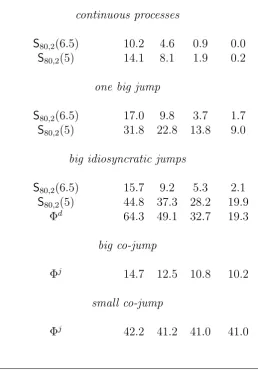
Table 1 analyzes the size properties for the three considered tests. Notice that the size of
Sn,N and Φn
d should be computed when co-jumps are absent, while the size of Φjn should
be evaluated when co-jumps are present. To underscore the dependence of the Sn,N on
the bandwidth, we denote it by Sn,N(hn). In the absence of jumps, both S80,2(5) and
jumps are added, size distortions appear, more strongly with lowerhn, and the distortions
are larger in the presence of two idiosyncratic jumps. In the case withhn= 6.5, however,
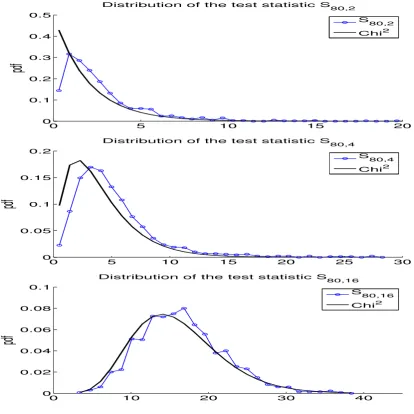
size distortions are reasonable: The simulated distribution of S80,2(6.5), in the most
challenging case with big idiosyncratic jumps, is compared to its asymptotic limit in
Figure 2, top panel. On the other hand, the size of both Φj
n and Φdn is quite distorted.
This is not surprising, since also in Jacod and Todorov (2009) these tests have been shown
to need a much larger value of n to work properly.
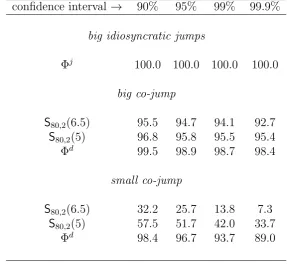
Table 2 analyzes the power of the three tests. All the tests perform equally well when
co-jumps are big. When co-jumps are small they are obviously more difficult to detect.
The power of theS80,2(6.5) increases with smallerhn, paralleling the corresponding larger
size distortions.
These results suggest that bandwidth selection can be used to trade-off size and power.
Higher bandwidth correspond to more reliable size but less power. In the case we are
testing for multi-jumps with largerN, this can be particularly useful, as we discuss below.
4.2
Four assets
We next proceed to simulate a system with N = 4. Continuous dynamics of all the
com-ponents is simulated as in equation (14), without jumps. The Brownian motions, driving
the first pair of components, are positively correlated: corr(W(1), W(2)) = 0.5. The
sec-ond pair of components are negatively correlated: corr(W(3), W(4)) =−0.5. Correlations
between the other pairs is null: corr(W(1), W(3)) =corr(W(1), W(4)) = 0.
In this set of simulations, we consider five cases:
1. Case 1: all components of X are continuous.
2. Case 2: all components of X contain a single big jump, but the four jumps occur
Table 1: Compares the size of competing tests in the case N = 2. Differ-ent processes for the null are considered. The sampling frequency is n= 80, corresponding to 5-minute intraday observations.
confidence interval → 90% 95% 99% 99.9%
continuous processes
S80,2(6.5) 10.2 4.6 0.9 0.0
S80,2(5) 14.1 8.1 1.9 0.2
one big jump
S80,2(6.5) 17.0 9.8 3.7 1.7
S80,2(5) 31.8 22.8 13.8 9.0
big idiosyncratic jumps
S80,2(6.5) 15.7 9.2 5.3 2.1
S80,2(5) 44.8 37.3 28.2 19.9
Φd 64.3 49.1 32.7 19.3
big co-jump
Φj 14.7 12.5 10.8 10.2
small co-jump
Φj 42.2 41.2 41.0 41.0
3. Case 3: there is a single multi-jump in the first triplet of the components ofX and
jumps are big.
4. Case 4: there is a multi-jump among the four processes and all jumps are small.
5. Case 5: there is a multi-jump among the four processes and all jumps are big.
Thus, Cases 1,2,3 represent the null and Cases 4,5 represent the alternative. The Sn,N
Table 2: Compares thepowerof competing tests in the caseN = 2. Different processes for the alternative are considerers. The sampling frequency isn= 80, corresponding to 5-minute intraday observations.
confidence interval → 90% 95% 99% 99.9%
big idiosyncratic jumps
Φj 100.0 100.0 100.0 100.0
big co-jump
S80,2(6.5) 95.5 94.7 94.1 92.7
S80,2(5) 96.8 95.8 95.5 95.4
Φd 99.5 98.9 98.7 98.4
small co-jump
S80,2(6.5) 32.2 25.7 13.8 7.3
S80,2(5) 57.5 51.7 42.0 33.7
Φd 98.4 96.7 93.7 89.0
Table 3 shows the results for all Cases. With continuous processes and idiosyncratic
jumps, the size distortions (increasing with smaller hn, as before) are negligible. They
are instead quite strong against a multi-jump among M = 3 stocks with hn = 2.5,3.5.
The automated bandwidth selection indicates a value of hn = 5.5 in this case, and this
indeed provides a reasonable size (the distribution of the test in this case is compared to
the asymptotic limit in the middle panel of Figure 2). Power is practically unaffected by
the bandwidth if the multi-jump is composed of big jumps; while it decreases with higher
bandwidth if multi-jumps are small.
Again, the bandwidth parameter can thus be used to trade-off size and power.
Reason-able size can always be achieved, but at the obvious cost of less power. This opens an
interesting possibility for the econometrician. The null (no multi-jumps acrossN assets)
0 5 10 15 20 0
0.1 0.2 0.3 0.4 0.5
Distribution of the test statistic S80,2
S80,2
Chi2
0 5 10 15 20 25 30
0 0.05 0.1 0.15 0.2
Distribution of the test statistic S
80,4
S80,4
Chi2
0 10 20 30 40
0 0.02 0.04 0.06 0.08 0.1
Distribution of the test statistic S80,16
[image:20.595.77.492.71.486.2]S80,16 Chi2
Figure 2: Shows the simulated distribution of the proposed multi-jump tests together with its asymptotic distribution under the null (which isχ2(N)); the
tests are S80,2(6.5) for N = 2 in the case with big idiosyncratic jumps (top
panel),S80,4(5.5) forN = 4 in Case 3 (center panel) andS80,16(4.5) forN = 16
in Case 3 (bottom panel).
could consider several alternatives when computing the test on N assets: multi-jump in
N assets, in N −1 assets, in N −2 assets and so on. The bandwidth parameter can
be used to disentangle these cases. For example, looking at Table 3, we see that with
hn = 5.5 we would disentangle a multi-jump in 4 stocks by a multi-jump in 3 stocks; with
hn = 3.5 we would also detect multi-jumps in three stocks, and with hn = 2.5 we would
also detect multi-jumps in two stocks. In empirical work, the choice of hn could depend
Table 3: Shows thesize andpower of the proposed test in the caseN = 4. Different processes under the null and the alternative are considered. The sampling frequencyn= 80 corresponds to 5-minute intraday observations.
confidence interval → 90% 95% 99% 99.9%
Case 1: continuous processes
S80,4(2.5) 12.3 6.2 1.6 0.1
S80,4(3.5) 9.9 4.1 0.6 0.1
S80,4(5.5) 11.1 5.1 0.7 0.0
Case 2: big idiosyncratic jumps
S80,4(2.5) 14.0 7.7 3.1 1.4
S80,4(3.5) 8.6 4.3 0.4 0.0
S80,4(5.5) 5.7 1.8 0.1 0.0
Case 3: multi-jump in N = 3 stocks
S80,4(2.5) 71.8 68.6 63.6 61.3
S80,4(3.5) 55.8 50.9 45.1 41.1
S80,4(5.5) 14.0 9.3 3.6 2.1
Case 4: small multi-jump
S80,4(2.5) 94.2 92.9 90.4 87.2
S80,4(3.5) 53.2 46.9 37.5 30.4
S80,4(5.5) 10.2 4.8 0.9 0.2
Case 5: big multi-jump
S80,4(2.5) 98.7 98.7 98.6 98.6
S80,4(3.5) 98.8 98.7 98.6 98.6
S80,4(5.5) 98.2 98.0 97.5 96.7
4.3
Many assets
We finally simulate a large number of stocks, that isN = 16 as in the empirical application
below. Continuous parts of all components follow equation (14). The Brownian motions
the stock returns used in the empirical application in Section 5. We now consider the
following settings:
1. Case 1: all components of X are continuous.
2. Case 2: there is a multi-jump in M = 4 components of X with big jumps.
3. Case 3: there is a multi-jump in M = 15 components of X with big jumps.
4. Case 4: there is a multi-jump in M =N = 16 components of X and all jumps are
small.
5. Case 5: there is a multi-jump in M =N = 16 components of X and all jumps are
big.
In this setting, Cases 1,2,3 represent the null and Cases 4,5 two possible alternatives.
Here we implement Sn,N-test with hn= 1,2,4.5 (see Figure 9). The bandwidth hn = 4.5
is selected by our automated bandwidth selection method under a null with M = 15
multi-jumps.
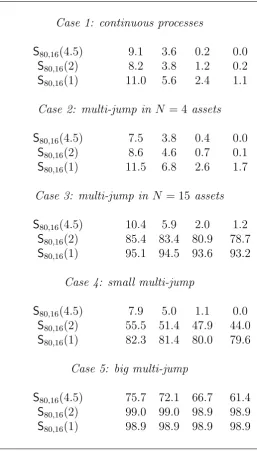
Table 4 shows the results. For all the considered bandwidth, size is reasonable in the
case of continuous processes and moderate multi-jump (M = 4), but becomes distorted
in the case M = 15 unless we use the automatically selected value hn= 4.5. This result
is in line with the simulation evidence presented above; size is more reliable with higher
bandwidth, while power is instead higher with lower bandwidth. The econometrician
should then choosehn= 4.5 if he is interested in multi-jumps among 16 jumpsonly. This
will somewhat sacrifice power. If instead one is interested in multi-jumps across fewer
stocks, a smaller hn can be used; for example, with hn = 2 we are still robust against
moderate multi-jumps across M = 4 stocks, but we would detect most of the
multi-jumps with M = 15 too (and, with decreasing power, with M = 14,13, . . .) also when
their magnitude is modest. This feature of the test is actually very appealing, especially
with a very large N, and indeed in our empirical application we take advantage of it by
Table 4: Shows thesizeandpowerof the proposed test in the caseN = 16. Different processes under the null and the alternative are considered. The sampling frequencyn= 80 corresponds to 5-minute intraday observations.
confidence interval → 90% 95% 99% 99.9%
Case 1: continuous processes
S80,16(4.5) 9.1 3.6 0.2 0.0
S80,16(2) 8.2 3.8 1.2 0.2
S80,16(1) 11.0 5.6 2.4 1.1
Case 2: multi-jump in N = 4 assets
S80,16(4.5) 7.5 3.8 0.4 0.0
S80,16(2) 8.6 4.6 0.7 0.1
S80,16(1) 11.5 6.8 2.6 1.7
Case 3: multi-jump in N = 15 assets
S80,16(4.5) 10.4 5.9 2.0 1.2
S80,16(2) 85.4 83.4 80.9 78.7
S80,16(1) 95.1 94.5 93.6 93.2
Case 4: small multi-jump
S80,16(4.5) 7.9 5.0 1.1 0.0
S80,16(2) 55.5 51.4 47.9 44.0
S80,16(1) 82.3 81.4 80.0 79.6
Case 5: big multi-jump
S80,16(4.5) 75.7 72.1 66.7 61.4
S80,16(2) 99.0 99.0 98.9 98.9
S80,16(1) 98.9 98.9 98.9 98.9
Summarizing, our simulation experiments indicate that the bandwidth parameter, which
trades off size and power, can always be set (with an automated procedure) to get correct
size and reasonable power. Moreover, by tuning the bandwidth parameter the test can
be sensibly used to detect multi-jumps with a given maximum order M, up to the total
4.4
Comparison with univariate tests
An alternative way to test for multi-jumps is the intersection of univariate test, also named
co-exceedance rule, as in Gilder et al. (2014). In this section we show, with simulated
data, that the new multi-jump test proposed in this paper is much more powerful than
the intersection of univariate tests.
We state the co-exceedance rule as follows: reject the absence of multi-jumps in the N
-dimensional price vector if the absence of jumps is rejected (based on a univariate jump
test) for each component. We compare three univariate jump tests: the CPR test of
Corsi et al. (2010), the BNS test of Barndorff-Nielsen and Shephard (2006) and the ABD
test of Andersen, Bollerslev and Dobrev (2007), all described in Appendix B.2.
We simulate 1,000 paths ofN = 16 stocks, with the continuous part as in subsection 4.3.
Each path contains a single multi-jump across the 16 stocks, with jump sizes normally
distributed with mean being equal to 8√∆ and standard deviation 2√∆. Hence, jump
sizes are sufficiently large on average, but show dispersion such that some of the univariate
jumps might be smaller (we recall that the continuous daily variance hovers around 1).
Table 5 shows size and power for univariate jump tests and multi-jump tests based on the
Sn,N statistics and the co-exceedance rule. For univariate tests, we confirm the findings in
the literature (see Dumitru and Urga, 2012 for a wider comparison). The most powerful
test is ABD, but at the cost of a distorted size. CPR and BNS are correctly sized, but
CPR has higher power, thus striking a superior balance. For this reason, we mainly use
CPR for detecting univariate jumps in the empirical application in Section 5.
For multi-jump test, theSn,Nproposed here is much more powerful than the co-exceedance
rule. The intersection of CPR would miss nearly 75% true multi-jumps at the 95%
confidence level; the intersection of ABD misses only 34% at the same confidence level,
but just because its size is distorted. This is not totally surprising: the co-exceedance rule
Table 5: Shows thesizeandpowerof the proposed test in comparison with the co-exceedance rule, for the caseN= 16, and for univariate jump tests. The size is computed under the assumption of continuous processes. The sampling frequencyn= 80 corresponds to 5-minute intraday observations.
confidence interval → 90% 95% 99% 99.9%
Multi-jump tests: power
S80,16(2) 98.6 98.5 98.5 98.4
T16
i=1CP R 32.7 25.1 9.1 1.8
T16
i=1BN S 14.2 7.9 1.5 0.0
T16
i=1ABD 71.8 66.0 53.7 37.1
Univariate tests on individual stocks: power
CP R 91.2 89.0 84.4 73.9
BN S 86.0 81.9 71.5 56.1
ABD 97.0 96.6 95.1 92.8
Multi-jump tests: size
S80,16(2) 7.7 2.6 0.3 0.0
Univariate tests on individual stocks: size
CP R 9.2 5.3 2.1 0.0
BN S 8.6 4.8 1.9 0.0
ABD 17.3 10.8 3.0 0.8
cost of increasing spurious detection of univariate jumps. The size of the Sn,N, computed
on a multi-variate process without jumps, is again reasonably correct. The size of the
intersection tests cannot be reported since the distribution under the null is unknown.
It is also interesting to note that the Sn,N can be conveniently used as a preliminary
tool in a two-steps procedure to detect days with jumps in the first step, and then
complemented by univariate tests, applied singularly to each stock, in the second step.
Moreover, Sn,N can be much more effective in detecting univariate jumps (which could
they are synchronous. Indeed, the power ofSn,N declines at a much slower rate than the
power of univariate tests when increasing the confidence interval. After all, many jumps
are better seen than only one.
These considerations can be important for empirical studies, since jumps (and
multi-jumps) are rare events. For example, with N = 2,000 days, testing against a jump
arrival rate of 2% per day using CPR at 99% confidence interval, we expect (based
on figures in Table 5) to detect 35.8 true jumps (out of 40) and 20 spurious jumps,
which would jeopardize empirical work based on these measures. For this reason, very
large confidence intervals (such as 99.9% or 99.99%) are tipically used in practice. With
confidence intervals so selective, the Sn,N could be an effective companion tool for jump
detection, which is certainly more effective if these jumps are actually multi-jumps. This
can be especially important when detecting jumps in large portfolios, like the stock index,
as we further discuss in Section 5.
To summarize, the results in this subsection show that the co-exceedance rule is not
accurate, even when it is based on relatively powerful univariate tests, while the
multi-jumpSn,Ntest proposed here is powerful and accurate, thus indicating a strong preference
for the latter in empirical work. We point out that such a feature would be crucial in
a number of applications, for instance when dealing with the identification of systemic
multi-jumps.
5
Empirical application
The data set we use for the empirical application is the collection of N = 16 blue chip
stocks quoted on the New York Stock Exchange and belonging to four different economic
sectors, and of the S&P500 index. The stocks and the corresponding ticker are listed in
Table 6. The data were recovered from the TickData One Minute Equity Data (OMED)
Table 6: Reports the list of the sixteen blue chip stocks used in the empirical application, their ticker and the estimated β computed with respect to the S&P500 index and used in the asset allocation exercise in Section 5.5.
Company Ticker β
Bank of America BAC 1.77 Citigroup Inc. C 1.70 JPMorgan Chase & Co. JPM 1.60 Wells Fargo & Company WFC 1.52
Boeing BA 0.95
Caterpillar Inc. CAT 1.18 FedEx Corporation FDX 1.02 Honeywell International Inc. HON 1.03 Hewlett-Packard Company HPQ 0.79 International Business Machines Corp. IBM 0.93 AT&T Inc. T 1.05 Texas Instruments Incorporated TXN 0.82 Kraft Foods Inc. KFT 0.57 PepsiCo, Inc. PEP 0.55 The Procter & Gamble Company PG 0.56 Time Warner Inc. TWX 1.05
went trough a standard filtering procedure. TickData one-minute equity data are adjusted
for corporate actions such as mergers and acquisitions or symbol changes. Moreover, the
underlying tick data used to build 1-minute time series are first controlled for cancelled
trades, or records not temporally aligned with previous/subsequent data; then filtered to
identify bad ticks which are corrected using validation with third-party sources.
In our empirical application, we use returns at the 5-minutes frequency, corresponding to
n = 77 intraday returns. This frequency represents a tradeoff between achieving enough
statistical power and avoiding distortions which could potentially arise from
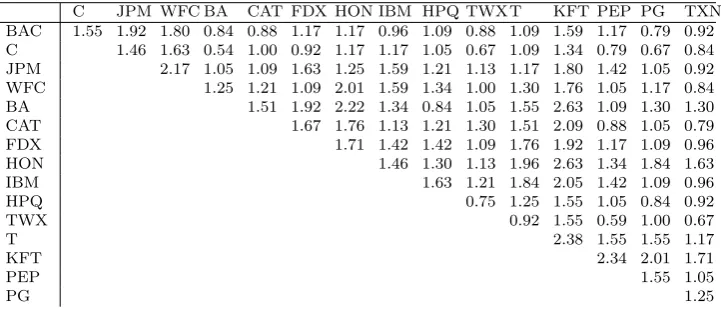
Table 7: Reports the frequencies of rejections (in percentage) for the null hypothesis of absence of co-jumps between stock pairs (that is, the percentage of days with co-jumps), tested with the proposed multi-jump testS77,2(6.5) at
0.1% confidence level. The global average of rejections among pairs is 1.33%.
C JPM WFC BA CAT FDX HON IBM HPQ TWXT KFT PEP PG TXN
BAC 1.55 1.92 1.80 0.84 0.88 1.17 1.17 0.96 1.09 0.88 1.09 1.59 1.17 0.79 0.92 C 1.46 1.63 0.54 1.00 0.92 1.17 1.17 1.05 0.67 1.09 1.34 0.79 0.67 0.84 JPM 2.17 1.05 1.09 1.63 1.25 1.59 1.21 1.13 1.17 1.80 1.42 1.05 0.92 WFC 1.25 1.21 1.09 2.01 1.59 1.34 1.00 1.30 1.76 1.05 1.17 0.84
BA 1.51 1.92 2.22 1.34 0.84 1.05 1.55 2.63 1.09 1.30 1.30
CAT 1.67 1.76 1.13 1.21 1.30 1.51 2.09 0.88 1.05 0.79
FDX 1.71 1.42 1.42 1.09 1.76 1.92 1.17 1.09 0.96
HON 1.46 1.30 1.13 1.96 2.63 1.34 1.84 1.63
IBM 1.63 1.21 1.84 2.05 1.42 1.09 0.96
HPQ 0.75 1.25 1.55 1.05 0.84 0.92
TWX 0.92 1.55 0.59 1.00 0.67
T 2.38 1.55 1.55 1.17
KFT 2.34 2.01 1.71
PEP 1.55 1.05
PG 1.25
5.1
Multi-jumps in the market
We start by applying the co-jumps test (N = 2) for all the 120 pairs throughout all the
sample. Table 7 reports the percentage of rejections of the null at the 99.9% confidence
level for all pairs. Co-jumps are significant events. On average (among pairs), we detect
co-jumps in 1.33% of days. The low probability of co-jumps is in line with other existing
empirical work (see, e.g., Table III of Lahaye et al., 2011 for stock indexes and FX rates).
The co-jumps are distributed quite uniformly among stock pairs. The maximum amount
of rejections is obtained between HON and KFT (2.63%), while the minimum is observed
between C and BA (0.54%).
We then detect multi-jumps among all 16 stocks using a confidence interval 1−α such
that the expected number of spurious detection in the sample is 0.1 asymptotically, that
is α = 4.18·10−5. We are thus looking for solid rejection of the null, that is strong
signals and virtually no false positives. We use bandwidth parametershn between 1 and
3. As documented in the simulation study, the higher bandwidth hn= 3 corresponds to
more correct size against the null of absence of multi-jumps inallthe 16 stocks, meaning
1 1.25 1.5 1.75 2 2.25 2.5 2.75 3 3
6 8 10 22 44 90 197 481
Bandwidth parameter
[image:29.595.105.483.86.290.2]Number of significant multi−jumps
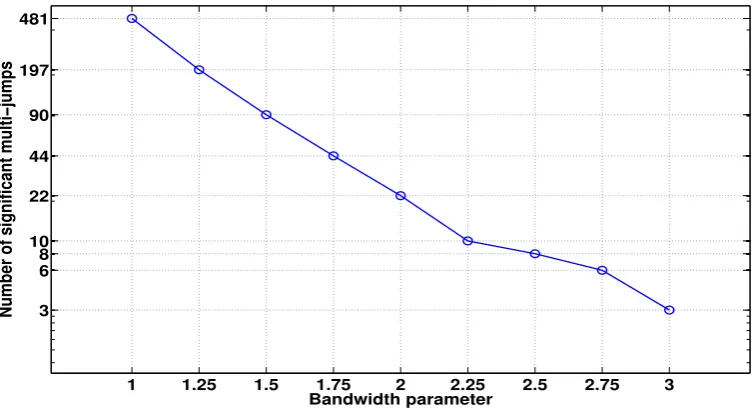
Figure 3: Reports the number of multi-jumps detected by the test introduced in Section 3. The test outcome is reported for different bandwidth parameters. The smaller bandwidthhn= 1 corresponds to the detection of at leastM ≃5
multi-jumps. The larger bandwidth hn= 3 corresponds to the detection of at
leastM ≃15 multi-jumps.
certainly too stringent for empirical analysis. Table 4 shows instead that, with the lower
bandwidth hn = 1, the test is reasonably sized against the contemporaneous presence of
M = 4 multi-jumps (at least). Thus, we interpret the rejection of the null with 1≤hn≤3
as a signal for the presence of a significant multi-jumps in at leastM stocks, withM ≈5
for hn = 1 and M ≈ 13 for hn = 2 (see Figure 9). In the case hn = 2, therefore, the
multi-jump would involve all the four economic sectors.
Figure 3 reports the number of detected multi-jumps corresponding to different
band-widths. Their number vary from 481 (20.1% of the sample) at hn = 1 to just 3 (0.13%
of the sample) at hn = 3. Thus, multi-jumps are largely statistically significant in our
sample, but multi-jumps across many stocks are rare events.
However, these rare events are strongly economically significant. Table 8 reports the dates
of the 22 multi-jumps detected with hn = 2, and associates macroeconomic/financial
information to each date; it also reports the corresponding VIX daily changes, SP500
Table 8: Multi-jump dates (when the test is implemented withhn= 2, that is
with approximately more thanM ≃13 multi-jumps) are listed together with i) multi-jump direction, ii) percentage change in S&P500, iii) percentage volume change, iv) VIX difference and v) economic/financial events occurred on those days.
date Multi-jump
direction
SP500 change (%)
Volume change (%)
VIX change
Economic/Financial events
25-Jun-2003 negative −0.83 +1.81 +0.06 FOMC meeting cuts federal fund rate of 25bps
18-Apr-2006 positive +1.71 +35.19 −1.18 Release of minutes of FOMC meet-ing of 27-28 Mar
08-Aug-2006 negative −0.34 +29.23 −0.00 FOMC keeps its target for the fed-eral funds rates
18-Sep-2007 positive +2.92 +30.98 −6.13 FOMC lowers its target for the fed-eral funds rates by 50 bps
25-Feb-2008 positive +1.38 −5.74 −1.03 FED Term Auction Facility 16-Jul-2008 positive +2.51 +4.70 −3.44 Release of minutes of FOMC
meet-ing of 24-25 Jun
29-Sep-2008 negative −8.81 +15.37 +11.98 FOMC meeting unscheduled 10-Feb-2009 negative −4.91 +29.58 +3.03 U.S. Treasury Secretary Geithner
announces a Financial Stability Plan 17-Feb-2009 both −4.56 +20.10 +5.73 27-28 FOMC minutes released on
Feb 18
23-Feb-2010 negative −1.21 +14.80 +1.43 FED releases minutes of its discount rate meeting on January 25, 2010. 06-May-2010 negative −3.24 +49.28 +7.89 The Flash Crash
28-May-2010 negative −1.24 −7.66 +2.39 FED announces three small auctions through the Term Deposit Facility 01-Sep-2010 positive +2.95 +13.44 −2.16 Release of minutes of FOMC
meet-ing of 27-28 Mar (Aug 31) 23-Jun-2011 positive −0.28 +32.84 +0.77 FOMC meetings (21 and 22 June) 01-Jul-2011 positive +1.44 −34.12 −0.65 Arab Spring starts
01-Aug-2011 negative −0.41 −2.19 −1.59 Unscheduled FOMC meeting 01-Sep-2011 positive −1.19 −18.67 +0.20 Release of minutes of FOMC
meet-ing of 27-28 Mar (Aug 30)
31-Oct-2011 negative −2.47 −7.49 +5.43 FOMC committee scheduled for 1-2 November
23-Nov-2011 negative −2.21 −3.50 +2.01 Release of the minutes of the FOMC committee of 1-2 November 28-Nov-2011 positive +2.92 +50.79 −2.34 FOMC meeting unscheduled 03-Apr-2012 negative −0.40 +7.99 +0.02 13 March FOMC minutes released 14-Jun-2012 positive +1.08 −3.91 −2.59 Federal Reserve Board issues
en-forcement actions
see that almost all the multi-jumps in the Table can be easily associated with impactful
economic news, mainly related to FED activity, more prominently FOMC meetings, but
also important financial and global news. Moreover, the traded volume tends to be
considerably higher (than the previous day) on days in which a multi-jump occurs. The
VIX index tends to move, in multi-jump days, in an opposite direction with respect to
the market, as also noticed in Todorov and Tauchen (2010). Below we provide formal
statistical evidence of a significant increase of the variance premium associated with
Multi-jumps are also typically, but not always, associated with jumps in the S&P 500
stock index. We use three tests for detecting jumps in the stock index: the ABD test,
the BNS test and the CPR test (see Appendix B.2 for their description) at the 99.9%
confidence interval. The left panel of Table 9 reports the percentage of cases in which,
in a day with a multi-jump, we also detect a jump in the index. We can see that testing
for jumps in the index results in a significant information loss with respect to testing for
multi-jumps. The test with the highest overlap is ABD, which however is also the test
with largest size distortions (that is, with supposedly more false positives).
The fact that decreasing the bandwidth parameter we have less overlap between
multi-jumps and multi-jumps in the index is not surprising: multi-jumps in the index are easier to detect
in the presence of multi-jumps among more constituents. The fact that jumps in the
stock index are not detected in all multi-jump days deserves further investigation. This
could be due to a subset effect (only the 16 stocks considered here jumped, but not the
other index constituents) or to a power effect (if the univariate tests on the index are
less powerful than the multi-jump test). To shed light on this issue, we also compute the
univariate jump tests on the equally weighted portfolio of the sixteen stocks (right panel
of Table 9), thus eliminating the subset effect. We can indeed observe a slight increase of
the performance of CPR and ABD tests, but not such to fill the gap with the multi-jump
test. The performance of BNS on the equally weighted portfolio is even worst. This result
demonstrates that the power effect is dominant: a multi-jump in the 16 stocks certainly
implies a jump in their portfolio, which however the univariate tests are often unable to
detect. The problem is very severe for the BNS test, whose performance is particularly
poor. These results altogether suggests that it is significantly more powerful to test for
multi-jumps among stocks than for jumps in a portfolio. The next sections also show
that the additional information carried by the multi-jump test, which cannot be revealed
by univariate jump tests, is economically significant.
Finally, most jumps in the index can be associated to multi-jumps in the stocks: using
Multi-jumps and jumps in the S&P 500 index
hn= 2 hn = 1.5 hn= 1
CPR 59.1% 43.2% 33.3% BNS 40.9% 25.0% 16.7% ABD 81.8% 63.6% 58.9%
Multi-jumps and jumps in the equally weighted portfolio
hn= 2 hn= 1.5 hn = 1
[image:32.595.94.506.71.250.2]CPR 68.2% 54.5% 40.0% BNS 36.4% 22.7% 13.3% ABD 90.9% 75.0% 64.4%
Table 9: Reports the percentage of days with a detected multi-jumps (accord-ing to the bandwidth parametershn = 2,1.5,1) in which we also detect a jump
in the S&P500 index (left panel) and in the equally weighted portfolio of the 16 stocks (right panel) according to three different jump tests at the 99.9% confidence interval. Testing for a jump in the portfolio is less powerful than testing for multi-jumps among constituents.
Of these jumps, 77 correspond to days in which there is a multi-jump withhn≥1. Thus,
jumps in the index can be typically (but not always) associated with multi-jumps in its
most liquid constituents. The remaining jumps in the index could be explained by jumps
in a subset of constituents with not enough overlap with the stocks considered here, or
by size distortions larger than what predicted by our simulated data.
5.2
Jumps, multi-jumps and the variance risk premium
This section shows the relevance of detecting multi-jumps in the data (with respect to
jumps in the index) by associating their occurrence to changes in the variance risk
pre-mium. The variance risk premium on day t for a given maturity τ is defined as:
V RPt =QVQ(t, t+τ)−QV(t, t+τ) (15)
where QVQ(t, t+τ) is the risk-neutral quadratic variation of the stock index between
times tand t+τ, andQV(t, t+τ) is the actual quadratic variation in the same interval.
showing that V RPt carries significant forecasting power for future returns; see also Carr
and Wu (2009); Bollerslev and Todorov (2011). We use τ = 1 month and we estimate
V RPt in our sample using:
\
V RPt=V IXt,t2+30−RVgt,t+30 (16)
where V IXt,t+30 is the 30-days VIX index computed by CBOE, that is the model-free
implied volatility (Jiang and Tian, 2005), andRVgt,t+30is the forecasted realized variance
in the same period obtained with the regression:
logRVt,t+30=α1+α2logRVt−30,t−1 +α3logRVt−90,t−1+εt, (17)
where εt is iid noise and
RVt,t+h = 252·ψ· X
t≤t′≤t+h
RVt′,
with RVt′ being the 5-minutes open-to-close realized variance on day t, properly rescaled
by 252 (to convert it to yearly units) and by the constant ψ, which is the ratio between
the sum of squared close-to-close S&P500 daily returns and the average of RV in the
sample, and which is meant to take into account the contribution of overnight returns to
the total variance.
The time series of the estimated variance risk premium in our sample is shown in Figure
4. As expected from the theory, it is almost always positive. We associate it to jumps
in the stock market index (S&P500) and multi-jumps in the sample of sixteen stocks, by
using the following regression models, in which the variance risk premium is driven by
an autoregressive process and by dummy variables for jumps,
[
V RPt=γ0+γ1V RP[t−1+γJeJt+γM JM Jgt+γM J− M Jgt·I{rSP
2003 2004 2005 2006 2007 2008 2009 2010 2011 2012 2013 −2000
−1000 0 1000 2000 3000 4000
[image:34.595.108.487.77.274.2]Variance Risk Premium
Figure 4: Reports the daily estimated variance risk premium, computed as in equation (16), for the available sample.
where t denotes the day,eJt is an indicator function signaling jump in S&P500 index (we
use the CPR test at 99.9% confidence level),M Jgtis an indicator function for the presence
of a multi-jump (withhn= 2, 1.75 and 1.5), I{rSP
t <0} is an indicator function fornegative
close-to-close return on S&P500 on dayt and ǫt are iid shocks with zero mean and finite
variance.
We also run the same regression with lagged dummy variables, that is with eJt → eJt−1, g
M Jt →M Jgt−1 andI{rSP
t <0} →I{rSPt−1<0}, to examine the predictive power of multi-jumps on the variance risk premium. Estimation results, adjusted with the standard Newey and
West correction, are presented in Table 10 for various restrictions and multi-jump test
bandwidth parameters.
We find that the constant γ0 and the auto-regressive coefficient γ1 are strongly
signifi-cant. More importantly, our results show that the occurrence of jumps in the index is
insignificant (or mildly negative) when regressed together with variance premium, and
thus cannot be associated to it. On the contrary, multi-jumps are significant and have a
strong impact, especially when they contribute to a market downturn. When the
Table 10: Estimates (Newey-West corrected) of model (18) with different restrictions and different choices of the multi-jump dummy. T-statistics are in parenthesis. Top panel: regression with contemporaneous dummies. Bottom panel: regression with lagged dummies. One star denotes 90%, two star 95% and three stars 99% significance.
Contemporaneous regressions
γ0 31.7∗∗∗ 31∗∗∗ 30.3∗∗∗ 30.2∗∗∗ 31.5∗∗∗ 30.7∗∗∗ 30.1∗∗∗ 28.8∗∗∗ 31.3∗∗∗ 31.3∗∗∗ (5.18) (5.2) (5.17) (5.17) (5.18) (5.16) (5.1) (4.97) (5.15) (5.14) γ1 0.836∗∗∗ 0.835∗∗∗ 0.833∗∗∗ 0.832∗∗∗ 0.835∗∗∗ 0.835∗∗∗ 0.832∗∗∗ 0.83∗∗∗ 0.835∗∗∗ 0.835∗∗∗
(24) (24.1) (23.8) (23.6) (24) (24.1) (23.7) (23.7) (24) (24)
γJ −0.41 −8.15 −8.52 −4.67
(-0.0491)
(-0.881)
(-0.98) (-0.534)
γM J 89.3 93.9∗ −96∗∗∗
(hn= 2) (1.64) (1.68) (-2.94)
γM J 104∗∗∗
(hn= 1.75) (2.75)
γM J 60.6∗
(hn= 1.5) (1.86)
γ−
M J 184∗∗∗ 188∗∗∗ 282∗∗∗
(hn= 2) (2.75) (2.78) (3.85)
γ−
M J 193∗∗∗
(hn= 1.75) (3.82)
γ−
M J 176∗∗∗
(hn= 1.5) (3.81)
Lagged regressions
γ0 32.2∗∗∗ 31.5∗∗∗ 31.6∗∗∗ 30.5∗∗∗ 32.2∗∗∗ 31.5∗∗∗ 31.7∗∗∗ 31.4∗∗∗ 32.2∗∗∗ 32.2∗∗∗ (5.3) (5.27) (5.25) (5.2) (5.3) (5.27) (5.27) (5.25) (5.31) (5.31) γ1 0.835∗∗∗ 0.835∗∗∗ 0.835∗∗∗ 0.831∗∗∗ 0.835∗∗∗ 0.835∗∗∗ 0.836∗∗∗ 0.834∗∗∗ 0.834∗∗∗ 0.834∗∗∗
(24) (24) (24) (23.5) (24) (23.9) (23.9) (23.6) (23.9) (23.9)
γJ −7.44 −10.8∗ −10.5∗ −9.66∗
(-1.48) (-1.79) (-1.92) (-1.71)
γM J 34.5 40.6 −22.5∗∗∗
(hn= 2) (0.804) (0.91) (-2.58)
γM J 4.07
(hn= 1.75) (0.0728)
γM J 51.8
(hn= 1.5) (1.34)
γ−
M J 67 71.7 93.8
(hn= 2) (1.07) (1.13) (1.52)
γ−
M J 2.49
(hn= 1.75) (0.0303)
γ−
M J 29.4
of contemporaneous multi-jumps ranges from 60.6 to 104 points, and from 176 to 193
points when associated with negative S&P500 returns. This is substantial, since the
av-erage variance risk premium in our sample is equal to 193.6. This means that variance
premium almost doubles (on average) in days with a multi-jump and a downturn of the
market. The effect of downward multi-jump is so strong that it subsides the effect of
jumps and overall multi-jump, the latter becoming significantly negative in the
encom-passing regression (last column of Table 10) indicating that positive multi-jump have the
opposite effect on the variance risk premium.
Summarizing, multi-jumps, and precisely negative ones, can be associated with a
signif-icant increase in the variance risk premium, while index jumps cannot. The inability of
jumps in capturing variance risk premia changes might depend on the documented
in-adequacy of nonparametric univariate tests in capturing economically significant jumps.
From a theoretical point of view, our finding corroborates the view that non-Gaussian
shocks to fundamentals (sometimes referred to as disasters) have a substantial impact
on risk premia, see e.g. Barro (2006); Gabaix (2012) and Drechsler and Yaron (2011);
Drechsler (2013) for economic models directly focusing on the relation between jumps in
fundamentals and the variance risk premium. From this theoretical perspective, the
ab-sence of correlation between jumps in the stock market index and variance risk premium
changes is rather puzzling. Indeed, also Todorov (2010) shows a strong link between
index jump measures and variance risk premium changes through the estimation of a
parametric model.5 This paper documents that this puzzle is due to the relatively low
power of univariate jump tests to detect systemic market events affecting fundamental
value, and that this shortcoming can be overcome by testing for multi-jumps in a (not
very large, but economically representative) stock panel.
5In his preliminary analysis, Todorov (2010) also reports a significant correlation between the variance