Source-side Syntactic Reordering Patterns with Functional Words for
Improved Phrase-based SMT
Jie Jiang, Jinhua Du, Andy Way
CNGL, School of Computing, Dublin City University {jjiang,jdu,away}@computing.dcu.ie
Abstract
Inspired by previous source-side syntactic reordering methods for SMT, this paper focuses on using automatically learned syntactic reordering patterns with func-tional words which indicate structural re-orderings between the source and target language. This approach takes advan-tage of phrase alignments and source-side parse trees for pattern extraction, and then filters out those patterns without func-tional words. Word lattices transformed by the generated patterns are fed into PB-SMT systems to incorporate potential re-orderings from the inputs. Experiments are carried out on a medium-sized cor-pus for a Chinese–English SMT task. The proposed method outperforms the base-line system by 1.38% relative on a ran-domly selected testset and 10.45% rela-tive on the NIST 2008 testset in terms of BLEU score. Furthermore, a system with just 61.88% of the patterns filtered by functional words obtains a comparable performance with the unfiltered one on the randomly selected testset, and achieves 1.74% relative improvements on the NIST 2008 testset.
1 Introduction
Previous work has shown that the problem of structural differences between language pairs in SMT can be alleviated by source-side syntactic reordering. Taking account for the integration with SMT systems, these methods can be divided into two different kinds of approaches (Elming,
2008): the deterministic reordering and the non-deterministic reordering approach.
To carry out the deterministic approach, syntac-tic reordering is performed uniformly on the train-ing, devset and testset before being fed into the SMT systems, so that only the reordered source sentences are dealt with while building during the SMT system. In this case, most work is fo-cused on methods to extract and to apply syntac-tic reordering patterns which come from manually created rules (Collins et al., 2005; Wang et al., 2007a), or via an automatic extraction process tak-ing advantage of parse trees (Collins et al., 2005; Habash, 2007). Because reordered source sen-tence cannot be undone by the SMT decoders (Al-Onaizan et al., 2006), which implies a systematic error for this approach, classifiers (Chang et al., 2009b; Du & Way, 2010) are utilized to obtain high-performance reordering for some specialized syntactic structures (e.g. DE construction in Chi-nese).
Elm-ing, 2009) uses syntactic rules to score the output word order, both on English–Danish and English– Arabic tasks. Syntactic reordering information is also considered as an extra feature to improve PB-SMT in (Chang et al., 2009b) for the Chinese– English task. These results confirmed the effec-tiveness of syntactic reorderings.
However, for the particular case of Chinese source inputs, although the DE construction has been addressed for both PBSMT and HPBSMT systems in (Chang et al., 2009b; Du & Way, 2010), as indicated by (Wang et al., 2007a), there are still lots of unexamined structures that im-ply source-side reordering, especially in the non-deterministic approach. As specified in (Xue, 2005), these include the bei-construction, ba-construction, three kinds of de-construction (in-cluding DE construction) and general preposition constructions. Such structures are referred with functional words in this paper, and all the con-structions can be identified by their correspond-ing tags in the Penn Chinese TreeBank. It is in-teresting to investigate these functional words for the syntactic reordering task since most of them tend to produce structural reordering between the source and target sentences.
Another related work is to filter the bilingual phrase pairs with closed-class words (S´anchez-Mart´ınez, 2009). By taking account of the word alignments and word types, the filtering process reduces the phrase tables by up to a third, but still provide a system with competitive performance compared to the baseline. Similarly, our idea is to use special type of words for the filtering purpose on the syntactic reordering patterns.
In this paper, our objective is to exploit these functional words for source-side syntac-tic reordering of Chinese–English SMT in the non-deterministic approach. Our assumption is that syntactic reordering patterns with functional words are the most effective ones, and others can be pruned for both speed and performance.
To validate this assumption, three systems are compared in this paper: a baseline PBSMT sys-tem, a syntactic reordering system with all pat-terns extracted from a corpus, and a syntactic re-ordering system with patterns filtered with func-tional words. To accomplish this, firstly the
lat-tice scoring approach (Jiang et al., 2010) is uti-lized to discover non-monotonic phrase align-ments, and then syntactic reordering patterns are extracted from source-side parse trees. After that, functional word tags specified in (Xue, 2005) are adopted to perform pattern filtering. Finally, both the unfiltered pattern set and the filtered one are used to transform inputs into word lattices to present potential reorderings for improving PB-SMT system. A comparison between the three systems is carried out to examine the performance of syntactic reordering as well as the usefulness of functional words for pattern filtering.
The rest of this paper is organized as follows: in section 2 we describe the extraction process of syntactic reordering patterns, including the lattice scoring approach and the extraction procedures. Then section 3 presents the filtering process used to obtain patterns with functional words. After that, section 4 shows the generation of word lat-tices with patterns, and experimental setup and re-sults included related discussion are presented in section 5. Finally, we give our conclusion and av-enues for future work in section 6.
2 Syntactic reordering patterns extraction
Instead of top-down approaches such as (Wang et al., 2007a; Chang et al., 2009a), we use a bottom-up approach similar to (Xia et al., 2004; Crego et al., 2007) to extract syntactic reordering patterns from non-monotonic phrase alignments and source-side parse trees. The following steps are carried out to extract syntactic reordering pat-terns: 1) the lattice scoring approach proposed in (Jiang et al., 2010) is used to obtain phrase alignments from the training corpus; 2) reorder-ing regions from the non-monotonic phrase align-ments are used to identify minimum treelets for pattern extraction; and 3) the treelets are trans-formed into syntactic reordering patterns which are then weighted by their occurrences in the training corpus. Details of each of these steps are presented in the rest of this section.
2.1 Lattice scoring for phrase alignments
To clean the training corpus, word alignments are used to obtain approximate decoding results, which are then used to calculate BLEU (Papineni et al., 2002) scores to filter out low-scoring sen-tences pairs. The following steps are taken in the lattice scoring approach: 1) train an initial PBSMT model; 2) collect anchor pairs contain-ing source and target phrase positions from word alignments generated in the training phase; 3) build source-side lattices from the anchor pairs and the translation model; 4) search on the source-side lattices to obtain approximate decoding re-sults; 5) calculate BLEU scores for the purpose of data cleaning.
Note that the source-side lattices in step 3 come from anchor pairs, so each edge in the lattices con-tain both the source and target phrase positions. Thus the outputs of step 4 contain phrase ments on the training corpus. These phrase align-ments are used to identify non-monotonic areas for the extraction of reordering patterns.
2.2 Reordering patterns
Non-monotonic regions of the phrase alignments are examined as potential source-side reorderings. By taking a bottom-up approach, the reordering regions are identified and mapped to minimum treelets on the source parse trees. After that, syn-tactic reordering patterns are transformed from these minimum treelets.
In this paper, reordering regionsAandB indi-cating swapping operations on the source side are only considered as potential source-side reorder-ings. Thus, given reordering regionsAB, this im-plies (1):
AB⇒BA (1)
on the source-side word sequences. Referring to the phrase alignment extraction in the last section, each non-monotonic phrase alignment produces one reordering region. Furthermore, for each re-ordering region identified, all of its sub-areas in-dicating non-monotonic alignments are also at-tempted to produce more reordering regions.
To represent the reordering region using syn-tactic structure, given the extracted reordering re-gions AB, the following steps are taken to map them onto the source-side parse trees, and to gen-erate corresponding patterns:
1. Generate a parse tree for each of the source sentences. The Berkeley parser (Petrov, 2006) is used in this paper. To obtain sim-pler tree structures, right-binarization is per-formed on the parse trees, while tags gener-ated from binarization are not distinguished from the original ones (e.g. @V P and V P are the same).
2. Map reordering regions AB onto the parse trees. DenoteNAas the set of leaf nodes in regionAandNBfor regionB. The mapping is carried out on the parse tree to find a
mini-mum treeletT, which satisfies the following two criteria: 1) there must exist a path from each node inNA∪NB to the root node of T; 2) each leaf node of T can only be the ancestor of nodes inNA orNB (or none of them).
3. Traverse T in pre-order to obtain syntactic reordering patternP. Label all the leaf nodes ofT withA orB as reorder options, which indicate that the descendants of nodes with label A are supposed to be swapped with those with labelB.
Instead of using subtrees, we use treelets to refer the located parse tree substructures, since treelets do not necessarily go down to leaf nodes.
Since phrase alignments cannot always be per-fectly matched with parse trees, we also expand ABto the right and/or the left side with a limited number of words to find a minimum treelet. In this situation, a minimum number of ancestors of expanded tree nodes are kept inT but they are as-signed the same labels as those from which they have been expanded. In this case, the expanded tree nodes are considered as the context nodes of syntactic reordering patterns.
op-A B T
Figure 1: Reordering pattern extraction
erations. Thus the syntactic reordering pattern P is obtained fromT as in (2):
P ={V P (P P (P N P) V P)|O={LA, LB}}
(2)
where the first part of P is the V P with its tree structure, and the second partO indicates the re-ordering scheme, which implies that source words corresponding with descendants of LA are sup-posed to be swapped with those ofLB.
2.3 Pattern weights estimation
We usepreoto represent the chance of reordering when a treelet is located by a pattern on the parse tree. It is estimated by the number of reorderings for each of the occurrences of the pattern as in (3):
preo(P) =
count{reorderings of P}
count{observation of P} (3)
By contrast, one syntactic pattern P usually con-tains several reordering schemes (specified in for-mula (2)), each of them weighted as in (4):
w(O, P) = count{reorderings of O in P}
count{reorderings of P}
(4)
Generally, a syntactic reordering pattern is ex-pressed as in (5):
P ={tree|preo|O1, w1,· · ·, On, wn} (5)
where tree is the tree structures of the pattern, preo is the reordering probability, Oi and wi are the reordering schemes and weights (1≤i≤n).
3 Patterns with functional words
Some of the patterns extracted may not benefit the final system since the extraction process is controlled by phrase alignments rather than syn-tactic knowledge. Inspired by the study of DE constructions (Chang et al., 2009a; Du & Way, 2010), we assume that syntactic reorderings are indicated by functional words for the Chinese– English task. To incorporate the knowledge of functional words into the extracted patterns, in-stead of directly specifying the syntactic struc-ture from the linguistic aspects, we use functional word tags to filter the extracted patterns. In this case, we assume that all patterns containing func-tional words tend to produce meaningful syntactic reorderings. Thus the filtered patterns carry the re-ordering information from the phrase alignments as well as the linguistic knowledge. Thus the noise produced in phrase alignments and the size of pattern set can be reduced, so that the speed and the performance of the system can be improved.
The functional word tags used in this paper are shown in Table 1, which come from (Xue, 2005). We choose them as functional words because nor-mally they imply word reorders between Chinese and English sentence pairs.
Tag Description
BA ba-construction
DEC de (1stkind) in a relative-clause DEG associative de (1stkind) DER de (2ndkind) in V-de const. & V-de-R
DEV de (3rdkind) before VP
LB bei in long bei-construction
[image:4.595.99.266.67.253.2]P preposition excluding bei and ba SB bei in short bei-construction
Table 1: Syntactic reordering tags for functional words
4 Word lattice construction
Both the devset and testset are transformed into word lattices by the extracted patterns to incor-porate potential reorderings. Figure 2 illustrates this process: treelet T′ is matched with a pat-tern, then its leaf nodes{a1,· · ·am} ∈LA (span-ning {w1,· · ·, wp}) are swapped with leaf nodes
{b1,· · ·, bn} ∈ LB (spanning {v1,· · ·, vq}) on
the generated paths in the word lattice.
T’
a1
am b1
bn
... ...
... ...
w1 w2 ... wp v1 v2 ... vq
w1 w2 ... wp v1 v2 ... vq
w2
... wp
v1
v2 ...
... ...
vq w1 Sub parse tree
matched with a pattern
Source side sentence
[image:5.595.79.279.217.362.2]Generated lattice
Figure 2: Incorporating potential reorderings into lattices
We sort the matched patterns bypreoin formula (5), and only apply a pdefined number of re-orderings for each sentence. For each lattice node, if we denoteE0as the edge from the original
sen-tence, while patterns{P1,· · ·, Pi,· · ·, Pk}are ap-plied to this node, thenE0is weighted as in (6):
w(E0) =α+
k X
i=1
{(1−kα) ∗ {1−preo(Pi)}}
(6)
where preo(Pi) is the pattern weight in formula (3), andαis the base probability to avoid E0
be-ing equal to zero. Suppose{Es,· · ·, Es+r−1}are
generated byrreordering schemes ofPi, thenEj is weighted as in (7):
w(Ej) =
(1−α)
k ∗preo(Pi)∗
ws−j+1(Pi) Pr
t=1wt(Pi)
(7)
wherewt(Pi)is the reordering scheme in formula (5), and s <= j < s+r. Reordering patterns with the same root lattice node share equal proba-bilities in formula (6) and (7).
5 Experiments and results
We conducted our experiments on a medium-sized corpus FBIS (a multilingual paragraph-aligned corpus with LDC resource number LDC2003E14) for the Chinese–English SMT task. The Cham-pollion aligner (Ma, 2006) is utilized to perform sentence alignment. A total number of 256,911 sentence pairs are obtained, while 2,000 pairs for devset and 2,000 pairs for testset are randomly se-lected, which we call FBIS set. The rest of the data is used as the training corpus.
The baseline system is Moses (Koehn et al., 2007), and GIZA++1 is used to perform word alignment. Minimum error rate training (MERT) (Och, 2003) is carried out for tuning. A 5-gram language model built via SRILM2is used for all the experiments in this paper.
Experiments results are reported on two differ-ent sets: the FBIS set and the NIST set. For the NIST set, the NIST 2005 testset (1,082 sentences) is used as the devset, and the NIST 2008 test-set (1,357 sentences) is used as the testtest-set. The FBIS set contains only one reference translation for both devset and testset, while NIST set has four references.
5.1 Pattern extraction and filtering with functional words
The lattice scoring approach is carried out with the same baseline system as specified above to produce the phrase alignments. The initial PB-SMT system in the lattice scoring approach is tuned with the FBIS devset to obtain the weights. As specified in section 2.1, phrase alignments are generated in the step 4 of the lattice scoring ap-proach.
From the generated phrase alignments and source-side parse trees of the training corpus, we obtain 48,285 syntactic reordering patterns (57,861 reordering schemes) with an average number of 11.02 non-terminals. For computa-tional efficiency, any patterns with number of non-terminal less than 3 and more than 9 are pruned. This procedure leaves 18,169 syntactic reordering patterns (22,850 reordering schemes) with a
aver-1
http://fjoch.com/GIZA++.html
age number of 7.6 non-terminals. This pattern set is used to built the syntactic reordering PBSMT system without pattern filtering, which here after we call the ‘unfiltered system’.
Using the tags specified in Table 1, the ex-tracted syntactic reordering patterns without func-tional words are filtered out, while only 6,926 syn-tactic reordering patterns (with 9,572 reordering schemes) are retained. Thus the pattern set are reduced by 61.88%, and over half of them are pruned by the functional word tags. The filtered pattern set is used to build the syntactic reorder-ing PBSMT system with pattern filterreorder-ing, which we refer as the ‘filtered system’.
Type Tag Patterns Percent
ba-const. BA 222 3.20%
bei-const. LB 97 2.79%
SB 96
de-const. (1st) DEC 1662 60.11%
DEG 2501
de-const. (2nd) DER 52 0.75%
de-const. (3rd) DEV 178 2.57% preposition
P 2591 37.41%
excl. ba & bei
Table 2: Statistics on the number of patterns for each type of functional word
Statistics on the patterns with respect to func-tional word types are shown in Table 2. The num-ber of patterns for each functional word in the fil-tered pattern set are illustrated, and percentages of functional word types are also reported. Note that some patterns contain more than one kind of func-tional word, so that the percentages of funcfunc-tional word types do not sum to one.
As demonstrated in Table 2, the first kind of de-construction takes up 60.11% of the filtered pat-tern set, and is the main type of patpat-terns used in our experiment. This indicates that more than half of the patterns are closely related to the DE con-struction examined in (Chang et al., 2009b; Du & Way, 2010). However, the general preposi-tion construcpreposi-tion (excluding bei and ba) accounts for 37.41% of the filtered patterns, which implies that it is also a major source of syntactic reorder-ing. By contrast, other constructions have much smaller amount of percentages, so have a minor
impact on our experiments.
5.2 Word lattice construction
As specified in section 4, for both unfiltered and the filtered systems, both the devset and testset are converted into word lattices with the unfiltered and filtered syntactic reordering patterns respec-tively. To avoid a dramatic increase in size of the lattices, the following constraints are applied: for each source sentence, the maximum number of re-ordering schemes is 30, and the maximum span of a pattern is 30.
For the lattice construction, the base probabil-ity in (6) and (7) is set to 0.05. The two syntac-tic reordering PBSMT systems also incorporate the built-in reordering models (distance-based and lexical reordering) of Moses, and their weights in the log-linear model are tuned with respect to the devsets.
The effects of the pattern filtering by functional words are also reported in Table 3. For both the FBIS and NIST sets, the average number of nodes in word lattices are illustrated before and after pat-tern filtering. From the table, it is clear that the pattern filtering procedure dramatically reduces the input size for the PBSMT system. The reduc-tion is up to 37.99% for the NIST testset.
Data set Unfiltered Filtered Reduced
FBIS dev 183.13 131.38 28.26%
FBIS test 183.68 136.56 25.65%
NIST dev 175.78 115.89 34.07%
NIST test 149.13 92.48 37.99%
Table 3: Comparison of the average number of nodes in word lattices
5.3 Results on FBIS set
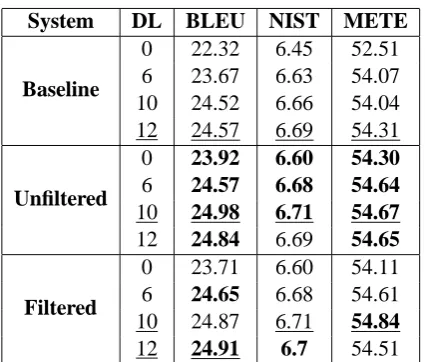
Three systems are compared on the FBIS set: the baseline PBSMT system, and the syntactic reordering systems with and without pattern fil-tering. Since the built-in reordering models of Moses are enabled, several values of the distor-tion limit (DL) parameter are chosen to validate consistency. The evaluation results on the FBIS set are shown in Table 4.
outper-System DL BLEU NIST METE
Baseline
0 22.32 6.45 52.51
6 23.67 6.63 54.07
10 24.52 6.66 54.04
12 24.57 6.69 54.31
Unfiltered
0 23.92 6.60 54.30
6 24.57 6.68 54.64
10 24.98 6.71 54.67
12 24.84 6.69 54.65
Filtered
0 23.71 6.60 54.11
6 24.65 6.68 54.61
10 24.87 6.71 54.84
[image:7.595.75.289.67.248.2]12 24.91 6.7 54.51
Table 4: Results on FBIS testset (DL = distortion limit, METE=METEOR)
form the baseline system for each of the distortion limit parameters in terms of the BLEU, NIST and METEOR scores (scores in bold face). By con-trast, the filtered systems has a comparable perfor-mance with the unfiltered system: for some of the distortion limits, the filtered systems even outper-forms the unfiltered system (scores in bold face, e.g. BLEU and NIST for DL=12, METEOR for DL=10).
The best performance of the baseline system is obtained with distortion limit 12 (underlined); the best performance of the unfiltered system is achieved with distortion limit 10 (underlined); while for the filtered system, the best BLEU score is accomplished with distortion limit 12 (under-lined), and the best NIST and METEOR scores are shown with distortion limit 10 (underlined). Thus the unfiltered system outperforms the base-line by 0.41 (1.67% relative) BLEU points, 0.02 (0.30% relative) NIST points and 0.36 (0.66% relative) METEOR points. By contrast, the fil-tered system outperforms the baseline by 0.34 (1.38% relative) BLEU points, 0.02 (0.30% rel-ative) NIST points and 0.53 (0.98% relrel-ative) ME-TEOR points.
Compared with the unfiltered system, pattern filtering with functional words degrades perfor-mance by 0.07 (0.28% relative) in term of BLEU, but improves the system by 0.17 (0.31% rela-tive) in term of METEOR, while the two systems achieved the same best NIST score.
These results indicates that the filtered system has a comparable performance with the unfiltered one on the FBIS set, while both of them outper-form the baseline.
5.4 Results on NIST set
The evaluation results on the NIST set are illus-trated in Table 5.
System DL BLEU NIST METE
Baseline
0 14.43 5.75 45.03
6 15.61 5.88 45.75
10 15.73 5.78 45.27
12 15.89 6.16 45.88
Unfiltered
0 16.77 6.54 47.16
6 17.25 6.67 47.65
10 17.15 6.64 47.78
12 16.88 6.56 47.17
Filtered
0 16.79 6.64 47.67
6 17.55 6.71 48.06
10 17.51 6.72 48.15
[image:7.595.306.517.183.366.2]12 17.37 6.72 48.08
Table 5: Results on NIST testset (DL = distortion limit, METE=METEOR)
Compared with the unfiltered system, patterns with functional words boost the performance by 0.30 (1.74% relative) in term of BLEU, 0.05 (0.75% relative) in term of NIST, and 0.37 (0.77% relative) in term of METEOR.
These results demonstrate that the pattern filter-ing improves the syntactic reorderfilter-ing system on the NIST set, while both of them significantly out-perform the baseline.
5.5 Discussion
Experiments in the previous sections demonstrate that: 1) the two syntactic reordering systems im-prove the PBSMT system by providing potential reorderings obtained from phrase alignments and parse trees; 2) patterns with functional words play a major role in the syntactic reordering process, and filtering the patterns with functional words maintains or even improves the system perfor-mance for Chinese–English SMT task. Further-more, as shown in the previous section, pattern filtering prunes the whole pattern set by 61.88% and also reduces the sizes of word lattices by up to 37.99%, thus the whole syntactic reordering procedure for the original inputs as well as the tuning/decoding steps are sped up dramatically, which make the proposed methods more useful in the real world, especially for online SMT systems. From the statistics on the filtered pattern set in Table 2, we also argue that the first kind of de-construction and general preposition (ex-cluding bei and ba) are the main sources of Chinese–English syntactic reordering. Previous work (Chang et al., 2009b; Du & Way, 2010) showed the advantages of dealing with the DE construction. In our experiments too, even though all the patterns are automatically extracted from phrase alignments, these two constructions still dominate the filtered pattern set. This result con-firms the effectiveness of previous work on DE construction, and also highlights the importance of the general preposition construction in this task.
6 Conclusion and future work
Syntactic reordering patterns with functional words are examined in this paper. The aim is to exploit these functional words within the syntactic reordering patterns extracted from phrase
align-ments and parse trees. Three systems are com-pared: a baseline PBSMT system, a syntactic re-ordering system with all patterns extracted from a corpus and a syntactic reordering system with pat-terns filtered with functional words. Evaluation results on a medium-sized corpus showed that the two syntactic reordering systems consistently out-perform the baseline system. The pattern filtering with functional words prunes 61.88% of patterns, but still maintains a comparable performance with the unfiltered one on the randomly select testset, and even obtains 1.74% relative improvement on the NIST 2008 testset.
In future work, the structures of patterns con-taining functional words will be investigated to obtain fine-grained analysis on such words in this task. Furthermore, experiments on larger corpora as well as on other language pairs will also be car-ried out to validation our method.
Acknowledgements
This research is supported by Science Foundation Ireland (Grant 07/CE/I1142) as part of the Centre for Next Generation Localisation (www.cngl.ie) at Dublin City University. Thanks to Yanjun Ma for the sentence-aligned FBIS corpus.
References
Yaser Al-Onaizan and Kishore Papineni 2006. Dis-tortion models for statistical machine translation. Coling-ACL 2006: Proceedings of the 21st Inter-national Conference on Computational Linguistics and 44th Annual Meeting of the Association for Computational Linguistics, pages 529-536, Sydney, Australia.
Pi-Chuan Chang, Dan Jurafsky, and Christopher D.Manning 2009a. Disambiguating DE for Chinese–English machine translation. Proceed-ings of the Fourth Workshop on Statistical Machine Translation, pages 215-223, Athens, Greece.
Pi-Chuan Chang, Huihsin Tseng, Dan Jurafsky, and Christopher D. Manning. 2009b. Discriminative reordering with Chinese grammatical features. Pro-ceedings of SSST-3: Third Workshop on Syntax and Structure in Statistical Translation, pages 51-59, Boulder, CO.
Association for Computational Linguistics, pages 531-540, University of Michigan, Ann Arbor, MI.
Josep M. Crego, and Jos´e B. Mari˜no. 2007. Syntax-enhanced N-gram-based SMT. MT Summit XI, pages 111-118, Copenhagen, Denmark.
Jinhua Du and Andy Way. 2010. The Impact of Source-Side Syntactic Reordering on Hierarchical Phrase-based SMT. EAMT 2010: 14th Annual Con-ference of the European Association for Machine Translation, Saint-Rapha¨el, France.
Jakob Elming. 2008. Syntactic reordering integrated with phrase-based SMT. Coling 2008: 22nd In-ternational Conference on Computational Linguis-tics, Proceedings of the conference, pages 209-216, Manchester, UK.
Jakob Elming, and Nizar Habash. 2009. Syntac-tic reordering for English-Arabic phrase-based ma-chine translation. Proceedings of the EACL 2009 Workhop on Computational Approaches to Semitic Languages, pages 69-77, Athens, Greece.
Nizar Habash. 2007. Syntactic preprocessing for sta-tistical machine translation. MT Summit XI, pages 215-222, Copenhagen, Denmark.
Jie Jiang, Andy Way, Julie Carson-Berndsen. 2010. Lattice Score-Based Data Cleaning For Phrase-Based Statistical Machine Translation. EAMT 2010: 14th Annual Conference of the European As-sociation for Machine Translation, Saint-Rapha¨el, France.
Philipp Koehn, Hieu Hoang, Alexandra Birch, Chris Callison-Burch, Marcello Federico, Nicola Bertoldi, Brooke Cowan, Wade Shen, Christine Moran, Richard Zens, Chris Dyer, Ondrej Bojar, Alexandra Constantin, and Evan Herbst. 2007. Moses: Open Source Toolkit for Statistical Machine Translation. ACL 2007: proceedings of demo and poster sessions, pp. 177-180, Prague, Czech Repub-lic.
Chi-Ho Li, Dongdong Zhang, Mu Li, Ming Zhou, Minghui Li, and Yi Guan 2007. A probabilistic approach to syntax-based reordering for statistical machine translation. ACL 2007: proceedings of the 45th Annual Meeting of the Association for Compu-tational Linguistics, pages 720-727, Prague, Czech Republic.
Xiaoyi Ma. 2006. Champollion: A Robust Paral-lel Text Sentence Aligner. LREC 2006: Fifth In-ternational Conference on Language Resources and Evaluation, pp.489-492, Genova, Italy.
Franz Josef Och. 2003. Minimum Error Rate Train-ing in Statistical Machine Translation. ACL-2003:
41st Annual meeting of the Association for Compu-tational Linguistics, pp. 160-167, Sapporo, Japan.
Kishore Papineni, Salim Roukos, Todd Ward, and Wei-Jing Zhu. 2002. BLEU: A Method For Automatic Evaluation of Machine Translation. ACL-2002: 40th Annual meeting of the Association for Compu-tational Linguistics, pp.311-318, Philadelphia, PA.
Slav Petrov, Leon Barrett, Romain Thibaux and Dan Klein. 2006. Learning Accurate, Compact, and Interpretable Tree Annotation. Coling-ACL 2006: Proceedings of the 21st International Conference on Computational Linguistics and 44th Annual Meet-ing of the Association for Computational LMeet-inguis- Linguis-tics, pages 433-440, Sydney, Australia.
Felipe S´anchez-Mart´ınez and Andy Way. 2009. Marker-based filtering of bilingual phrase pairs for SMT. EAMT-2009: Proceedings of the 13th An-nual Conference of the European Association for Machine Translation, pages 144-151, Barcelona, Spain.
Chao Wang, Michael Collins, and Philipp Koehn. 2007a. Chinese syntactic reordering for statistical machine translation. EMNLP-CoNLL-2007: Pro-ceedings of the 2007 Joint Conference on Empiri-cal Methods in Natural Language Processing and Computational Natural Language Learning, pages 737-745, Prague, Czech Republic.
Fei Xia, and Michael McCord 2004. Improving a statistical MT system with automatically learned rewrite patterns. Coling 2004: 20th International Conference on Computational Linguistics, pages 508-514, University of Geneva, Switzerland.
Nianwen Xue, Fei Xia, Fu-dong Chiou, and Martha Palmer. 2005. The Penn Chinese TreeBank: Phrase structure annotation of a large corpus. Natural Lan-guage Engineering, 11(2), pages 207-238.
Richard Zens, Franz Josef Och, and Hermann Ney. 2002. Phrase-based statistical machine translation. Proceedings of the 47th Annual Meeting of the ACL and the 4th IJCNLP, pages 333-341, Suntec, Singa-pore.
Yuqi Zhang, Richard Zens, and Hermann Ney 2007a. Chunk-level reordering of source language sen-tences with automatically learned rules for statisti-cal machine translation. SSST, NAACL-HLT-2007 AMTA Workshop on Syntax and Structure in Statis-tical Translation, pages 1-8, Rochester, NY.