Declan Dagger, Alexander O’Connor, Séamus Lawless, Eddie Walsh,
and Vincent P. Wade
Trinity College Dublin
Service-Oriented
E-Learning Platforms
From Monolithic Systems to Flexible Services
The learning management system (LMS) has dominated Internet-based education for the past two decades. However, the traditional LMS is failing to keep pace with advances in Internet technologies and social interactions online. To support technological diversity, current frameworks such as the E-Learning Framework (ELF), the IMS Abstract Framework, and the Open Knowledge Initiative (OKI) have defined the initial steps toward service-oriented e-learning platforms. Next-generation platforms will be based on these service-oriented visions. Here, the authors discuss LMS evolution and present core challenges that must be addressed to achieve information interoperability in next-generation e-learning platforms.
A
s Internet technologies proliferate into our daily lives, we come closer to realizing new and exciting online opportunities. One such opportunity is in e-learning, in which more dynamic plat-forms are emerging and replacing tradi-tional, passive ones. Active e-learning employs a broad range of Internet tech-nologies, such as personalization, simu-lation, and mobility, to achieve pedagogic scenarios otherwise inaccessible to tradi-tional forms of learning.1Thus, today’se-learning platforms must deal with an increasing set of requirements.
The demand for modularized and per-sonalizable e-learning platforms is grow-ing.2Traditional platforms can’t support
architectural flexibility due to their mono-lithic designs. E-learning vendors are addressing this demand by providing toolkits that support customization or by making their source code available for modification under various open source licenses. This indicates an emerging shift from generic solutions to specific applica-tions. Future e-learning platforms will sup-port a wider range of needs by providing interoperability architectures for various existing and emergent services. These needs include federated exchange among services (information and control), various levels of interoperability (intradomain and interdomain), and service composition (orchestration and choreography).
er, these next-generation platforms also introduce wide-ranging issues from numerous research areas, including the Semantic Web, adaptive hypermedia, dynamic services, and federated modeling.
Here, we explore e-learning platforms’ evolu-tion and illustrate some key challenges to informa-tion interoperability in next-generainforma-tion platforms.
E-Learning Platforms
Traditional e-learning platforms, or learning man-agement systems (LMSs), provide holistic environ-ments for delivering and managing educational experiences. They present suites of tools that sup-port online course creation, maintenance, and deliv-ery, student enrollment and management, education administration, and student performance reporting. We can group LMSs into two main categories:
• Open source initiatives include Moodle (www. moodle.org), Sakai (www.sakaiproject.org), ATutor (www.atutor.ca), and Whiteboard (http:// whiteboard.sourceforge.net).
• Proprietary solutions include WebCT/Black board (www.blackboard.com), Gradepoint (www. gradepoint.net), Desire2Learn (www.desire2 learn.com), and Learn.com (www.learn.com).
Open source LMSs are typically built on extensi-ble frameworks that let implementers adjust and modify the systems to suit their specific needs. Although the proprietary sector hasn’t widely adopted it, this approach is emerging through such initiatives as WebCT’s PowerLinks kit and Black-board’s Building Blocks. These provide software developers with “hooks” to tie third-party software into the LMS.
First Generation
The first generation of e-learning platforms (from roughly 1993 on) provided, in essence, black-box solutions. For the most part, these systems used proprietary formats to manage courses directly. You could commonly find a one-to-one mapping between systems and courses, with very limited user tracking, if any. These platforms focused on the delivery and interoperability of content designed for a specific purpose, such as a particu-lar course. During this time, a range of standards emerged — Dublin Core (www.dublincore.org), IMS Learning Resource Metadata (www.imsglobal.org/ specifications.html), IEEE Learning Object Metada-ta (http://ltsc.ieee.org/wg12/), and others that are
still in use today. These standards described con-tent that compliant LMSs could share at the asset level; however, this practice wasn’t widespread. Instead, these standards made provisions for inter-operability between different systems at the con-tent level via communication channels such as AICC Computer Managed Instruction (CMI; www. aicc.org/pages/aicc_ts.htm). AICC described a common communication API to be included in all content that supported such functionalities as notifications to the LMS indicating the com-mencement and completion of learning content. First-generation platforms provided for future evolution via their support for sharing content in an interoperable way. Examples of these early e-learning platforms include the first versions of WebCT and Blackboard.
Second Generation
on learning administration (course management) rather than on the learner.
Evolution
As these changes continue, they forge a path toward next-generation e-learning platforms. This, in essence, involves applying service frameworks to the platforms’ modular design. Separating LMS and learning content management system (LCMS) functionality will provide support for greater inter-operability, in which systems can not only share content and learning scenarios but also exchange tools, functionalities, semantics, and control seam-lessly and dynamically. This also involves a much wider range of information — such as user infor-mation, context, sequencing, workflow, and con-trol — which services can use and reason across in e-learning platforms. This will let users build cus-tom learning platforms from a vast range of e-learning services, for their specific needs, at specific times, and in dynamic ways. The LMS ven-dor of old will no longer sell monolithic, one-size-fits-all solutions, but rather interoperable platforms and a range of e-learning services, letting con-sumers choose the right combination of services for their requirements.
Challenges for Flexibility and Interoperability
Next-generation e-learning platforms introduce several key challenges for information interoper-ability — in part due to the shift toward semantic exchange — that we must address going forward. Information will be not only exportable and importable across different environments but also exchangeable among heterogeneous environ-ments. Current e-learning platforms, for example, can send user information (knowledge state, skill level, preferences, and so on) or content informa-tion (metadata about subject area, technical aspects of the content, and so on) between envi-ronments. However, there is no support for these environments to understand such information’s semantics, how to reason across it, or how differ-ent environmdiffer-ents can use it. For this level of inter-operability, environments must exchange both the information’s syntax and its semantics. This can’t occur through what some call “shared” semantics — that is, single global semantic models. In reality, people (the core ingredient of information systems) are adversely different in, for example, how they describe objects.3 Thus, flexible solutions must
identify and support dynamic semantic mappings to support true semantic interoperability.4
Another key aspect to such semantic exchange relates to control. We can’t assume that e-learning services are simply dumb content. They have and will continue to have their own internal represen-tations, control flows, and, in some cases, tracking mechanisms. Thus, future e-learning platforms must support the exchange of control between interoperating services.
A further challenge is to support higher levels of interoperability. One aspect of intradomain interop-erability involves creating frameworks and stan-dards to support plugability, which numerous initiatives and standards bodies have already begun. Interdomaininteroperability, however, is a much newer field — it involves the interoperability of con-text, a topic we describe further in a later section.
Service composition will let these e-learning platforms dynamically discover and assemble e-learning services to achieve a given user’s specif-ic purpose. This will include the realization of service orchestration and service choreography,5
topics that merit lengthy discussion but are out-side this article’s scope. Research initiatives in this area are beginning to address all these challenges, but most work is in its early stages.
Standards and Technologies
Several standards and technologies support the interoperability requirements for next-generation e-learning platforms, as Figure 1 illustrates. Exist-ing and emergExist-ing methodologies evolve around modularization and separation of concerns. This, in essence, means that functionality is divided into modules, which can then be combined to provide an integrated e-learning platform. Service-orient-ed architectures (SOAs) describe an architectural concept that defines the expression of processes and logic as individual services, which in turn publish or expose facets of their functionality in a standardized way, letting other services access and use this functionality in a flexible manner.
Component-oriented architectures (COAs), on the other hand, are more finely grained and tight-ly coupled than SOAs. Changes to individual com-ponents typically impact the software those components access, making COAs less flexible and extensible than SOAs. A COA is primarily con-cerned with a local component, its properties, and its methods.
between applications, or services facilitates inter-operability, helping to provide services such as identification, authentication, authorization, infor-mation exchange, and security. Middleware is especially applicable to modern knowledge-based systems developed on XML, SOAP, and SOAs. In-deed, middleware is often considered the “plumb-ing” between Web services.
The standards community has been pioneering a variety of frameworks, specifications, and guide-lines for service-oriented e-learning platforms for some time. The IMS Abstract Framework (www. imsglobal.org/specifications.html) loosely identi-fies and represents the core components and inter-faces of an e-learning system. The E-Learning Framework (ELF; www.elframework.org) illustrates e-learning systems’ common functionalities. Sim-ilarly, the Open Knowledge Initiative (OKI; www.okiproject.org) defines service layers for developing e-learning platforms. The common approach among these emergent standards is to modularize functionality, usually defining the fol-lowing groupings:
• sets of applications (such as LMSs);
• application services (finer-grained services, such as quizzes and simulations, with which the user directly interacts);
• educational services (usually revolving around education administration such as course man-agement and scheduling);
• common services (functionality that the user isn’t directly exposed to but that is essential, such as authentication, file sharing, logging, and database management); and
• infrastructure (the backbone of the services, including HTTP, SOAP, and XML).
The frameworks, specifications, and guidelines then define layered approaches to constructing e-learn-ing systems from these collections of previously defined services. These specifications provide repre-sentations for person and group information (IMS Enterprise), a person’s profile and learning history (IMS Learner Information Package and ePortfolio), assessment (IMS Question and Test Interface), groupings of learning content (IMS Content Pack-age and SCORM), dynamic content sequencing (IMS Simple Sequencing), learner competencies (IMS Reusable Definition for Competence and Edu-cational Objectives), learning activities (IMS Learn-ing Design), searchLearn-ing across federated databases
(IMS Digital Repositories Interoperability), and con-necting diverse eLearning tools (IMS Tool Interop-erability; see www.imsglobal.org/specifications. html for more about these specifications). At a fine-grained level, these standards and specifications describe the syntax that the various services should implement to present information externally. How-ever, a crucial component of interoperability is missing — the ability to dynamically use the infor-mation meaningfully. This is where the Semantic Web community makes a vital contribution.
A key assumption with machine-readable information and services is that they can interop-erate and negotiate on the fly. The Semantic Web began with RDF and DAML+OIL and has since pro-gressed toward the Web Ontology Language (OWL; www.w3.org/TR/owl-features/), which recently became a W3C standard. OWL can be used to express ontologies— knowledge bases of concepts that services can query to retrieve information. In particular, ontologies can help produce new knowledge, in that inference can occur within the knowledge base to achieve a goal, independently of information input specifically by the ontology’s creator. This ability extends to the realm of Web services with OWL for Services (OWL-S).
At a finer-grained level, developers can use W3C’s Web Service Description Language (WSDL; www.w3.org/TR/wsdl) to describe a Web service’s functionality in terms of its inputs, outputs,
pre-Figure 1. Generations of learning management systems. First-generation systems supported content-only interoperation. Second-generation systems began to take account of users and their associated profiles, whereas next-generation systems will support targeted personalization.
Methods
Technologies
Standards
Monolithic
DC
RDF LRM IMS
LD
IMS enterprise LOM
AICC CMI
Modular Service-oriented
Time
ELF OKI SCORM
IMS content package IMS abstract framework
ePortoflio IMS LIP
IMS TI
Stand-alone
Semantic Web Web-based
[image:4.585.275.553.69.274.2]conditions, and effects(IOPE). WSDL provides a syntax through which a calling system or service can access exposed functionality without concern-ing itself with its inner workconcern-ings.
At a broader level of granularity, the Seman-tic Web community is developing specifications for services organization and workflow. Web Ser-vices Business Process Execution Language (WSBPEL; http://docs.oasis-open.org/wsbpel/2.0/ wsbpel-specification-draft.html) supports service organization and flow within SOAs. Enterprise Ser-vice Bus (ESB)6also illustrates service
organiza-tion and orchestraorganiza-tion.
Adaptive hypermedia7systems form the second
tranche of technology for interoperation. Adaptive systems benefit from a different approach because they tend to be open-ended information systems with a highly developed sense of their domain. This means that external sources can add new information relatively easily and that a small amount of additional information will consider-ably improve performance. Adaptive services, tak-ing advantage of OWL-S in addition to core OWL, provide a rich, highly expressive framework for interoperating services.
The main link between the Semantic Web and adaptive hypermedia is Web service technology and composition. SOAP and REST allow remote systems to use Web-based communication to cre-ate complex systems built from atomic services.
E-Learning Services
E-learning services can represent and manage any technical aspect of an e-learning scenario. Initiatives such as ELF, the IMS Abstract Frame-work, and OKI have defined a wide variety of coarse-grained functionalities that e-learning services can provide. E-learning services include traditional functionalities such as authentication, tracking, course management, scheduling, activ-ities, tools, and assessment, as well as emerging functionalities such as personalization, resource harvesting, context management, federated exchange, simulation, games, wiki, blogging, podcasting, and so on. Thus, an e-learning plat-form must support this expanding range of coarse-grained and emerging finer-grained ser-vices to provide real flexibility. The complexities and variations in these second-generation stan-dards will lead to more diverse implementations than with first-generation (content-related) stan-dards. Additionally, e-learning platforms must be
able to support loose coupling, thus enabling interoperability of services’ semantics.
Service Interoperability
Service interoperability concerns the seamless cre-ation, deployment, consumption, and orchestra-tion of Web-based services. Most research in this field focuses on service syntax interoperation — that is, the ability to create a service on any plat-form in any environment and interact with it from a different platform and environment. Through specifications such as OKI, the e-learning commu-nity is specifying common framework-based APIs for certain e-learning application areas. However, these APIs provide support for tightly knit collec-tions of services, grouped according to function-ality. Going forward, looser connections should provide greater potential for interoperability and flexibility, IMS Tool Interoperability being a posi-tive step in this direction. Instead of specifying APIs for communications in a common syntax, we will focus on semantic-exchange and control-flow management between services. The semantic exchange supports a more detailed view of what a service can do, what it produces, how to manage it, and its uses. It also paves the way for generating and interpreting other information, such as con-text, trust, and security.
Context-informed services.Pure ubiquitous com-puting research is based on two key concepts: per-vasive computing and calm computing.8Pervasive,
calm systems help users by managing their com-plex information profiles in an easy, blended way. Context-informed e-learning aims to lower the information burden on users and let them concen-trate on their learning tasks. Numerous projects (see www.cs.cmu.edu/~aura/ for one) demonstrate how various cooperating systems can enhance users’ experience by placing a much wider variety of information at their immediate disposal.
Educational applications represent a natural application domain for this type of work, in part because of their immediate familiarity for academ-ic researchers, but more importantly because of students’ rich information needs. Projects such as ActiveClass9 address domain-specific concerns
while maintaining the generalized ubiquitous com-puting approach.
Typically, current systems10represent context
information sources made available by a service-oriented approach. Services will provide a great deal of information about learners and their activ-ities, including metadata to describe that informa-tion. This richer information space lets systems incorporate a much wider amount of information, much of it located and integrated at runtime.
One approach we’re currently investigating involves integrating adaptive systems with seman-tically described services.11This approach uses a
semantic overlay network to create links between the knowledge residing in external services and the e-learning application. The informed environment can then use these links to transfer information known by external services to the e-learning appli-cation based on users’ situations and needs (that is, their context).
By generating a shared semantic viewof the user’s context, the e-learning platform can include a wide variety of extra information relevant to his or her task without having to model the types of useful information a priori. The semantic approach provides a way to tailor adaptive systems’ knowl-edge and behavior to exploit extra available knowledge in a dynamic fashion. The platform designer needn’t specify the type of information in advance; rather, the informed environment discov-ers services and finds links based on the descrip-tions that accompany those services. Initiatives designed to add rich descriptions to services and their information (such as the Semantic Web) pres-ent a clear opportunity to greatly enhance the e-learning process.
Flexible service interoperability.To illustrate flex-ible service interoperability in an e-learning envi-ronment, consider the following example. David is a site engineer working for the Tech Corporation, a large software services and hardware vendor. As part of his work, David travels to client premises to perform upgrades and maintenance on a wide vari-ety of software and servers that Tech Corp provides.
In this particular scenario, David is on site with Widgets Inc. and needs to upgrade the client’s servers. The task involves some new technologies that David isn’t familiar with, so he needs to use Tech Corp’s knowledge base for assistance.
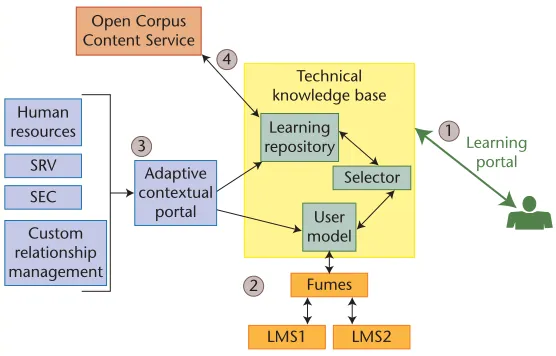
Tech Corp maintains a technical knowledge base (TKB), illustrated in Figure 2, to assist employees of different levels and areas in learning new skills and performing specific tasks. In addition to the TKB, Tech Corp maintains a human resources (HR)
database with details of individuals and their posi-tions. This is complemented by a customer rela-tionship management (CRM) database containing each customer’s deployment details. Finally, the site that Widgets Inc. maintains includes security-and server-management services.
First, David connects to the Tech Corp TKB, through a learning portal (such as an LMS or a corporate Web site), which authenticates and man-ages his session and exchanges information as required with the ancillary services. Next, the TKB retrieves David’s learning preferences through a federated user modeling exchange service(FUMES), which extracts them from LMS services (LMS1 and LMS2) that he’s previously used. This provides a semantically rich description of David’s past e-learning experiences.
The TKB is a context-informed adaptive serv-ice suite. The adaptive contextual portal(ACP)11
that manages it is aware of the services situated both on site and in David’s office. The ACP main-tains a shared semantic view of David’s context and can tailor his learning experience, based on information held in the CRM and HR services. The system can guide David in his choice of learning resources and specify additional parameters for personalizing his experience. The system chooses to select technical, descriptive learning resources because David is an on-site engineer who needs practical advice on task completion.
[image:6.585.275.553.70.248.2]The TKB maintains an archive of content that Tech Corp believes is both necessary and benefi-cial to its staff’s training and professional devel-opment. However, a task assigned to an employee
Figure 2. Dynamic personalized e-learning scenario. Loosely coupled services dynamically interoperate to personalize and contextualize the content and activities of an e-learning experience.
Human resources
SRV
Fumes
LMS1 LMS2
SEC
Custom relationship management
Learning portal
Technical knowledge base
Learning repository
User model
Selector 3
2
1 4
Adaptive contextual
might occasionally involve technologies that the TKB doesn’t currently support. In that case, the TKB could use a complementary content-harvest-ing service called the Open Corpus Content Service (OCCS). Research is ongoing into the development of this service, which can leverage open corpus content for use in e-learning environments.12
The OCCS employs a focused Web crawler to traverse the Web and many digital repositories, creating an archive of all the relevant content it encounters. The OCCS indexes this archive, and the TKB can request content from it. The TKB extracts content requirements from the semantic interpre-tation of David’s task, as derived by the ACP from his current learning preferences and past learning experiences (FUMES).
The OCCS must address some interoperability issues in order to leverage the available Web con-tent, including problems with content that has insufficient or, in some cases, no associated meta-data descriptions. Problems also arise when incom-patible metadata standards are implemented on various pieces of content. To overcome these issues, the OCCS applies semantic mappings to a canonical metadata model using a fixed taxono-my of terms. Semiautomatic or automatic content annotation also generates descriptions of content with no associated metadata.
For this context-informed approach, the TKB participates in the following process. Each service located for the ACP registers an ontology of the information that it can share. A reasoner suite then examines the concepts known to each service and builds a shared semantic view as a topic map with-in the system. As the TKB performs the operations needed to build the course for David, hooks with-in the TKB share the current knowledge of the service with the ACP. The external services enhance this knowledge with their knowledge via the ACP’s shared semantic view and “push” it back to the TKB. David then engages the offering from the TKB (step 5 in Figure 2) and successfully com-pletes the current task. The context-informed approach means that the TKB’s designers needed only to define the points at which the TKB could use context and allow the aware environment to push context-enhanced models to the system.
A
s innovative Internet technologies and appli-cations continue to grow, people are placing more aspects of their lives online. Passivecon-sumer models are rapidly being outpaced by more active producer models. Defining rigid frameworks and boundaries for e-learning platforms doesn’t fit with the free model of the Internet. Wrapping e-learning as a deliverable is a failed approach. In reality, every contribution to the Web has a learn-ing-related value associated with it. Tomorrow’s e-learning platforms will deliver knowledge when, where, and how you want it.
EU projects such as iClass, PROLearn, and Unfold are pioneering European efforts to create sustainable e-learning services in a range of educa-tional sectors. The iClass project, in which we’re par-ticipating, is responsible for researching, developing, and disseminating e-learning services for a self-regulated personalized e-learning environment for the primary and secondary (K12) school market.
Much of the current work in this field is con-cerned with interoperation and exchange. Howev-er, only a few services are generally available for consumption. Without a critical mass of such serv-ices, we risk hindering the evolution of next-generation LMSs.
Acknowledgments
The Embark Initiative of the Irish Research Council for Science, Engineering, and Technology has partially supported this work. The support of the Informatics Commercialisation Initiative of Enterprise Ireland is gratefully acknowledged.
References
1. T. Mayes and S. de Freitas, “Review of E-Learning Theories, Frameworks, and Models,” Joint Information Systems Com-mittee (JISC) e-Learning Models Desk Study, 2004; www. jisc.ac.uk/uploaded_documents/Stage%202%20Learning% 20Models%20(Version%201).pdf.
2. P. Trafford, “PLEs as Environments for Personal and Per-sonalised Learning,” position paper as part of the RAMBLE project; www.weblearn.ox.ac.uk/site/asuc/oucs/staff/pault/ research/ramble/present/uploads/PaulT_Mini%20PLEPaper 1.0.pdf.
3. A. Mathes, “Folksonomies — Cooperative Classification and Communication through Shared Metadata,” Computer-Mediated Communication Magazine, 2004; www.adam mathes.com/academic/computer-mediated-communication/ folksonomies.html.
4. D. O’Sullivan and D. Lewis, “Semantically Driven Service Interoperability for Pervasive Computing,” Proc. 3rd ACM Int’l Workshop on Data Engineering for Wireless and Mobile Access, ACM Press, 2003, pp. 80–92.
Intelligent Computing (ICIC), 2005; http://platon.escet.urjc. es/~axel/publications/feie-etal-2005.pdf.
6. D.A. Chappell, Enterprise Service Bus, O’Reilly Media, 2004. 7. P. Brusilovsky, “Methods and Techniques of Adaptive Hypermedia,” User Modeling and User-Adapted Interaction, vol. 6, nos. 2–3,1996, pp. 87–129.
8. M. Weiser, “The Computer for the 21st Century,” Scientific Am., vol. 9, Sept. 1991, pp. 933–940.
9. M. Ratto et al., "The ActiveClass Project: Experiments in Encouraging Classrom Participation," Proc. Int'l Conf. Com-puter Support for Collaborative Learning 2003, Computer-Supported Collaborative Learning Series, vol. 2, B. Wasson, S. Ludvigsen, and U. Hoppe, eds., Kluwer Academic, 2003, pp. 477–486.
10. P. Lonsdale et al., “Context Awareness for MOBIlearn: Cre-ating an Engaging Learning Experience in an Art Muse-um,” Proc. MLearn 2004: Learning Anytime, Everywhere,
Learning and Skills Development Agency (LSDA), 2004, pp. 115–118.
11. A. O’Connor and V. Wade, “Informing Context to Support Adaptive Services,” Proc. Conf. Adaptive Hypermedia and Adaptive Web-Based Systems, LNCS 4018, Springer-Verlag, 2006, pp. 366–369; doi 10.1007/11768012_52. 12. S. Lawless and V. Wade, “Dynamic Content Discovery,
Har-vesting, and Delivery from Open Corpus Sources, for Adap-tive Systems” Proc. 4th Int’l Conf. Adaptive Hypermedia and Adaptive Web-based Systems, V. Wade, H. Ashman, and B. Smyth, eds., LNCS 4018, Springer-Verlag, 2006, pp. 445–451; www.cs.tcd.ie/~slawless/papers/ah2006.pdf.
Declan Daggeris a research fellow in the Knowledge and Data Engineering Group in Trinity College Dublin’s Department of Computer Science. His research interests include user-centric adaptivity and personalization, composition meth-odologies for knowledge-driven adaptive systems, and user-driven interoperability. Dagger has a PhD in comput-er science from Trinity College Dublin. Contact him at [email protected].
Alexander O’Connoris a PhD candidate in the Knowledge and Data Engineering Group in Trinity College Dublin’s Depart-ment of Computer Science. His research interests include semantic interoperation, e-learning, and ubiquitous com-puting. O’Connor has a masters degree in networks and dis-tributed systems from Trinity College Dublin. He is a member of the ACM. Contact him at [email protected].
Séamus Lawlessis a PhD candidate in the Knowledge and Data Engineering Group in Trinity College Dublin’s Department of Computer Science. His research interests include open corpus content, information retrieval, and personalized e-learning systems. Lawless has an honors degree, BSc, in
computer science from Trinity College Dublin. Contact him at [email protected].
Eddie Walshis a PhD Candidate in the Knowledge and Data Engineering Group in Trinity College Dublin’s Department of Computer Science. His research interests include e-learn-ing, user modele-learn-ing, and semantic interoperation. Walsh has an MSc (research) in e-learning from the University of Lim-erick. Contact him at [email protected].
Vincent P. Wadeis research director at the Intelligent Systems Laboratory in Trinity College Dublin’s Department of Com-puter Science. His research interests include knowledge-driven adaptive systems, service composition and content personalization, knowledge-driven management and con-trol systems, knowledge-driven integration and interoper-ability, knowledge elicitation and machine learning, and user-centric knowledge and data engineering. Wade has a PhD in computer science from Trinity College Dublin. He is a member of the IEEE, the ACM, and the AACE. Contact him at [email protected].
IEEE Computer Society presents
ee--lleeaarrnniinngg ccaam
mppuuss
Further your
career or just
increase your
knowledge
The e-Learning campus provides easy access to online learning materials to IEEE Computer Society members. These resources are either included in your membership or offered at a special discount price to members.
Online Courses
Over 1,300 technical courses available online for Computer Society members.
IEEE Computer Society Digital Library
The Digital Library provides decades of authoritative peer-reviewed research at your fingertips: Have online access to 25 society magazines and transactions, and more than 1,700 selected conference proceedings.
Books/Technical Papers
Members can access over 500 quality online books and technical papers anytime they want them.
IEEE ReadyNotesare guidebooks and tuto-rials that serve as a quick-start reference for busy computing professionals. They are avail-able as an immediate PDF download.
Certifications
The CSDP (Certified Software Development Professional) is a professional certification meant for experienced software professionals.
Brainbench exams available free for Computer Society members, provide solid measurements of skills commonly requested by employers. Official Brainbench certificates are also available at a discounted price.