Truly Exploring Multiple References for Machine Translation Evaluation
Ying Qin
Dept. of Computer Science Beijing Foreign Studies University
Lucia Specia Dept. of Computer Science
University of Sheffield [email protected]
Abstract
Multiple references in machine transla-tion evaluatransla-tion are usually under-explored: they are ignored by alignment-based met-rics and treated as bags of n-grams in string matching evaluation metrics, none of which take full advantage of the recur-ring information in these references. By exploring information on the n-gram dis-tribution and on divergences in multiple references, we propose a method of n-gram weighting and implement it to gen-erate new versions of the popular BLEU and NIST metrics. Our metrics are tested in two into-English machine translation datasets. They lead to a significant in-crease in Pearson’s correlation with human fluency judgements at system-level eval-uation. The new NIST metric also out-performs the standard NIST for document-level evaluation.
1 Introduction
Quality evaluation plays a critical role in Machine Translation (MT). Since its conception, the BLEU metric (Papineni et al., 2002) has had a signifi -cant impact on MT development. Although hu-man evaluation has been used in recent evalua-tion campaigns such as WMT (Workshop on Sta-tistical MT) (Bojar et al., 2014) and other forms of reference-less metrics have been proposed (Ga-mon et al., 2005; Specia et al., 2010), the merit of language and resource-independent n-gram based metrics such as BLEU is undeniable. Despite its
c
�2015 The authors. This article is licensed under a Creative Commons 3.0 licence, no derivative works, attribution, CC-BY-ND.
criticisms, BLEU is thus still considered the de factoor at least a baseline metric for MT quality evaluation.
Due to the cost of human translation, often only one reference translation is available at evaluation time. However, generally there are numerous valid translations for a given sentence or document. Dif-ferent references provide valid variations in lin-guistic aspects such as style, word choice and word order. Therefore, having multiple reference trans-lations is key to improve the reliability of n-gram based evaluation metrics: the more references, the more chances for n-grams correctly translated to be captured. HyTER, an n-gram matching metric based on an exponential number of reference trans-lations for a given target sentence, demonstrates the potential for better machine translation evalua-tion results from having as many references as pos-sible (Dreyer and Marcu, 2012). Nevertheless, in the more realistic case where only a few references are available, if these are simply taken as bags of n-grams, increasing the number of references will not lead to the best possible results, as pointed out by Doddington (2002).
In this paper we explore how to use multiple ref-erences by means other than simply viewing them as bags of n-gram like BLEU, NIST (Dodding-ton, 2002) and other n-gram co-occurrence based metrics do. Our assumption is that each reference reflects the complete meaning of the source seg-ment. The semantic entirety of the translation will be adversely affected if all the n-grams from var-ious references are simply put together. We pro-pose a method of modifying the weight assignment strategy in BLEU and NIST by taking into account the n-gram distributions and divergences over dif-ferent references.
into-English translation datasets released by LDC, lead-ing to promislead-ing results. In the remainder of this paper we will first review BLEU and related n-gram based evaluation metrics (Section 2). We then describe the method we propose to explore multiple references by reassigning the weights of n-grams that are common in system translations and references (Section 3), and the experiments performed and their results (Section 4). These il-lustrate how the modified BLEU and NIST scores compare against standard BLEU and NIST scores at the system, document and sentence levels.
2 N-gram based evaluation
2.1 BLEU
The BLEU metric applies a straightforward method of counting the n-grams that overlap in the system translation and given human translations under the assumption that human translations pre-cisely reproduce the meaning of the source text. The closer to the reference, the higher the transla-tion quality of the system translatransla-tion will be. The core formula is given in Eq. 1 (Papineni et al., 2002), so that we can subsequently compare it to our approach.
SB=BP×exp N
�
n=1
wnlogPn, (1)
where
Pn=
�
C∈Candi
�
ngram∈CCountclip(ngram)
�
C∈Candi
�
ngram�∈C�Count(ngram�)
BP =
�
1, if|c|≥|r|
e(1−|r|/|c|), if|c|<|r|
wnis a weighting factor usually set as1/N, where
N is the longest possible n-gram considered by the matching method. N is usually set to 4 to
avoid data sparseness issues resulting from longer n-grams. Pn is the n-gram precision at a given
n and in essence represents the proportion of n
-grams in the candidate translation that also appear in the reference translation. BPis a penalty factor for shorter segments. candrare the length of the
candidate segment and reference segment, respec-tively.
When multiple references are available,
Countclip(ngram) is clipped at the maximum count of n-grams which occurs in a single refer-ence, and r is set as the length of the reference
closest in size to the candidate translation.
Due to the sparsity of n-grams with largenand
the geometric average of n-gram precisions, BLEU is not suitable for sentence-level evaluation. Sev-eral smoothing approaches have been proposed to alleviate this issue, such as the standard plus-one smoothing (Lin and Och, 2004) and combinations of smoothing techniques (Chen and Cherry, 2014). A great deal of methods have been proposed to improve the performance of BLEU. These include metrics such as m-bleu (Agarwal and Lavie, 2008) and Amber (Chen and Kuhn, 2011). However, these metrics still treat n-grams in different ref-erences equally, regardless of whether the n-gram appears only once or is found in all references.
2.2 NIST
The NIST metric weights n-grams that occur less frequently in references more heavily (Dodding-ton, 2002), as shown in Eq. 2.
SN= N
�
n=1
�
w1...wn
co−occur
Inf o(w1. . . wn)/
�
w1...wn
in system
(1)
× exp
� βlog2
�
min(Lsys
Lref ,1)
��
, (2)
where
Inf o(w1. . . wn) =log(# of occur ofw1. . . wn−1
# of occur ofw1. . . wn
)
andLref is the average number of words in all ref-erences,Lsysis the number of words in the system translation, β is used as a weight for the penalty
factor, andN is often 5.
The NIST metric focuses on nopopular n-grams in references and assumes that highly fre-quent n-grams, such as function words, tend to carry little meaning. However, this method con-sequently weakens the validity of n-grams that re-cur in multiple references. Since all references are valid translations for the same source text, one would expect multiple references to share com-mon words and phrases that convey core mean-ing. Therefore, reducing the importance of these common n-grams is not beneficial to quality eval-uation.
2.3 Improvements on n-gram based metrics
flexible matching strategy, for example using WordNet to capture synonyms as in METEOR (Banerjee and Lavie, 2005). The second category uses different functions to calculate the degree of similarity, for example edit distance, error rate, semantic distance (Nießen et al., 2000; Leusch et al., 2003; Snover et al., 2006; Snover et al., 2009). And the last category weights or combines the outcome of similarity functions as features (Liu et al., 2010; Gim´enez and M`arquez, 2010).
These methods focus on different forms of com-parison between candidates and references. How-ever, to our knowledge there are no other attempts to mine recurring information from multiple refer-ences if these are provided. Assuming all the pos-sible translations form a “semantic” space, each reference only covers a subspace. The recurring n-grams among them should constitute the core part of this semantic space, which is more likely to rep-resent the meaning of the source text. It is this kind of information that we want to explore and apply with our n-gram weighting technique.
3 Exploring information from multiple references
Although references can vary with translators and styles, many essential words and expressions are usually expected to be identical or similar for the same source text. For example, consider the seg-ments below from our datasets: four references and one system (Sys) translation.
Ref1: The gunman was shot to death by the po-lice.
Ref2: Police killed the gunman.
Ref3: The gunman was shot dead by the police.
Ref4: The gunman was shot to death by the po-lice.
Sys: Gunman is shot dead by police.
Four unigrams appear in all four references: ., the, gunman, police. The wordsshotandbyappear three times whilst dead only appears once. The most recurring content unigrams in the references convey most of the meaning of the sentence. For the system output, there are six unigrams match-ing those in references, among themgunman, po-lice, which occur in all references. However these are equally counted by BLEU and set as to have the lowest information value by NIST, compared to other unigrams such asdead, which only occurs once in one reference. This results in very low scores. The smoothed BLEU score for this
seg-ment is 0.3217 since there are no 3/4-grams match-ings. The NIST score is 2.8867. However this is a rather good translation, with human judgements onfluency and accuracy of 4 and 4.7, respectively (human judgement ranges over 1-5). Taking into account the recurring n-grams in multiple refer-ences and assigning them heavier weights could thus be helpful to capture the quality of this sys-tem translation.
If function words are disregarded, an n-gram that recurs in most of the references could repre-sent the core meaning of the source. The more of-ten an n-gram is found in multiple references, the higher the probability that a matching n-gram ap-pears in a high quality translation. Therefore, fo-cusing on common n-grams found in multiple ref-erences, we propose a modified n-gram weighting approach for BLEU and NIST on the basis of the following factors.
3.1 Frequency of recurring n-grams in references
The degree of n-gram recurrence among references is represented by the number of times an n-gram appears in the references M divided by the total
number of references ref no. Nevertheless, it is
unlikely that the number of times an n-gram oc-curs in references increases the significance of the respective n-gram by that number compared to an n-gram that occurs only once. Therefore we use the logarithm ratio instead. As an n-gram may be contained in all references, the add-one approach is then applied to avoid the expression in the loga-rithm returning a value of zero, as in Eq. 3.
log(1 +M/ref no) (3)
This attempt to reweight n-grams in BLEU and information content in NIST however did not lead to satisfactory results. Upon further analysis of the weighting strategy, we discovered that it is bi-ased towards n-grams with a small n whose co-occurrence probability may be much higher than n-grams with a largen. In other words, the weighting
3.2 Divergence of n-grams
In order to reduce the weight of most frequent function words, the distribution of n-grams is taken into account to improve Eq. 3. Less overlap among references may indicate that the translation is diffi -cult, or that several different valid translations ex-ist. In this scenario, recurring n-grams tend to be function words rather than content words. For in-stance, only function words repeat in the three ref-erences below, which may indicate that the source can be translated in many ways:
a. At this time, the police have blocked the bombing scene.
b. They have now sealed off the spot.
c. The police has already blockaded the scene of the explosion.
To address the problem, a unit called n-gram di-vergence is defined as in Eq. 4 to describe the degree of concentration of n-grams among refer-ences. The more divergent the distribution of n-grams in the references, the lower weight that is assigned to the most frequent common n-grams in the references.
N gramdiver= # total of n-gram# type of n-gram, (4)
i.e. the count of different n-grams divided by total number of grams. The higher the number of n-gram types found in multiple references, the more flexible or variable the translation will be, resulting in a higher value for n-gram divergence. This unit is used to measure the degree to which multiple references are similar.
3.3 Length of n-grams
The quality of the translation improves with the length of the matching n-grams, both in terms of fluency and accuracy evaluation. An additional modification of Eq. 3 is performed by replacing the constant1with the length of n-gramn, as de-picted in Eq. 5,
log(n+M/ref no). (5)
Eq. 6, denoted asR, is thefinal expression ap-plied to reweight n-grams in BLEU and NIST and incorporates all of the factors described above.
R=N gramdiver×log(n+M/ref no) (6)
3.4 Using Zipf’s law
An alternative approach of neutralising function words in references is to use the Zipf’s law. Ha et al. (2002) verify Zipf’s law on n-grams by ranking all n-grams (n ≥ 1). So the n-grams recurring in references in Eq. 3 can be represented by the prod-uct between frequencyf and the ranking orderr
of n-grams divided byref no, as in Eq. 7.
R� =log(1 +r×f /ref no) (7)
The new BLEU score, denoted as SBM, i.e., Score of BM, is rewritten in Eq. 8,
SBM=BP×exp( N
�
n=1
wnlog(R×Pn)), (8)
whereBP, wn andPn are as stated as in Eq. 1. Add-one smoothing is applied to the segment level evaluation. In the equation, R can be replaced
by R�. We compare the performance of the two
weighting approaches in our experiments.
The modified NIST score formula, denoted as
SN M (Score of metric NM), is shown as Eq. 9.
SN M= N
�
n=1
�
w1...wn
co−occur
Inf o(w1. . . wn)/
�
w1...wn
in system
(1)
×R×exp
� βlog2
�
min(Lsys
Lref ,1)
��
(9)
3.5 Arithmetic mean BLEU
Another modification in NIST with respect to BLEU is the fact that it uses arithmetic instead of geometric mean (Doddington, 2002). Although our method focuses on scenarios with multiple ref-erences in evaluation, further comparison to NIST is made by changing the averaging strategy in BM to that of NIST, denoted as BMA (BLEU Multi-reference Arithmetic mean).
4 Experiments and results
4.1 Data
P2-09 and P2-14 with human judgements on fl u-ency and accuracy respectively. The other dataset is Multiple-Translation Chinese Part 4 (MTC-P4) (LDC2006T04), also with 4 references, 100 news stories each with 280-605 characters, totally 919 segments. Six system translations P4-09, P4-11, P4-12, P4-14, P4-15 and P4-22 are judged by 2-3 human annotators.
Human judgements for the nine system trans-lations were carried out at segment level within limited time. Hence we firstly check the agree-ment among human annotators. We considered an agreement when two out of two judgements or two out of three judgements are same. The agree-ment proportion at system level is the number of segments agreed upon divided by the total num-ber of segments in the system. This agreement proportion is normalised by the degree of agree-ment by chance, i.e., using Cohen’s kappa coeffi -cient which is commonly applied in WMT. Since the scale of human annotation is 1 to 5, the agree-ment by chance value is set as 0.2. Table 1 shows the kappa agreement of human annotators on all system translations. Note that the average agree-ment on fluency is only fair, while the agreement on accuracy is even worse. Given the subjectivity of the task, however, this range of figures is not uncommon.
Flu Acc
[image:5.595.133.230.475.589.2]p2-05 0.311 0.254 p2-09 0.320 0.257 p2-14 0.294 0.280 p4-09 0.132 0.123 p4-11 0.143 0.094 p4-12 0.218 0.053 p4-14 0.247 0.106 p4-15 0.150 0.120 p4-22 0.229 0.264 Mean 0.227 0.172
Table 1: Kappa agreement of human judgement on system translations
Our evaluation is performed at the system, doc-ument and segment levels. Different human judge-ments are averaged for thefinal score of a segment, and all segment scores in a text are averaged for the final document score. While scores for smoothed BLEU and standard BLEU are similar at system and document levels, the standard BLEU score is generally below the smoothed BLEU score for seg-ment level. BM is derived from smoothed BLEU.
4.2 System level
We compare the Pearson correlation for various automatic evaluation scores with human scores at system level in terms offluency (F lu) and
accu-racy (Acc), as shown in Table 2.
BLEU BM BMA NIST NM
Flu 0.7021 0.7090 0.7136 0.5657 0.5938 Acc 0.6957 0.6947 0.7114 0.7941 0.7756
Table 2: Pearson correlation at system level
For fluency judgements, BMA displays the highest correlation with human scores, 26.14% higher than NIST score and 1.64% better than BLEU. These results are promising. Compared to BLEU, BM is slightly better. NM scores also outperform NIST. The results are not as positive when measuring correlation to accuracy judge-ments. NIST still performs the best, however, the gap between BMA and NIST is much lower for accuracy than forfluency.
When we apply Eq. 7 to reweight BLEU, the correlation with human scores at system level achieves 0.6926 on fluency and 0.7391 on accu-racy. This represents a distinct increase in corre-lation for accuracy judgements, making the gap to the best performing metric (NIST) even smaller. However, it leads to a slight decrease in correla-tion for fluency evaluation. Overall, our results demonstrate that the proposed methods is effective forfluency evaluation at system level.
4.3 Document level
Tables 3 and 4 shows the metrics comparison for document level evaluation. Forfluency (Table 3), BM outperforms BLEU in 6 out of 9 systems, and its average correlation exceeds that of stan-dard BLEU. BMA leads to even more promising results compared to BLEU. However at document level the BMA metric does not perform as well as NIST even using the same averaging method. Note that the performance of NM is better than standard NIST, indicating that the use of recurring n-grams in multiple references works. In fact, NM leads to the bestfluency evaluation for all systems.
this may be because Zipf’s law is less applicable to small scale datasets such as ours. Nevertheless, the n-gram weighting approach proposed in Eq. 6 proved effective.
BLEU BM BMA NIST NM
p2-05 0.1510 0.1637 0.1627 0.2495 0.2401 p2-09 0.0990 0.0867 0.0992 0.0467 0.0653 p2-14 0.1666 0.1707 0.2102 0.2644 0.2474
p4-09 0.3423 0.3392 0.3716 0.4343 0.4291 p4-11 0.1310 0.1423 0.1492 0.1486 0.1681
p4-12 0.1479 0.1424 0.1711 0.1955 0.2032
p4-14 0.1168 0.1191 0.1373 0.1610 0.1577 p4-15 0.2384 0.2397 0.2703 0.3189 0.3163 p4-22 0.1568 0.1589 0.1660 0.2202 0.2211
Mean 0.1722 0.1736 0.1931 0.2266 0.2276
Table 3: Doc-level Pearson correlation onfluency
BLEU BM BMA NIST NM
p2-05 0.2571 0.2621 0.2778 0.3334 0.3549
p2-09 0.0942 0.0874 0.1015 0.0936 0.0850 p2-14 0.2613 0.2633 0.2943 0.3161 0.3015 p4-09 0.3867 0.3808 0.4186 0.4928 0.4844 p4-11 0.1656 0.1825 0.1890 0.1604 0.2016
p4-12 0.3218 0.3197 0.3537 0.3751 0.3847
p4-14 0.1532 0.1495 0.1719 0.1934 0.1828 p4-15 0.2367 0.2292 0.2730 0.4010 0.3887 p4-22 0.0887 0.0922 0.0829 0.2428 0.2363 Mean 0.2184 0.2185 0.2403 0.2898 0.2911
Table 4: Doc-level Pearson correlation on accu-racy
4.4 Segment level
In all datasets, BM performs worse at segment level than smoothed BLEU. The average gap in correlation between BM and BLEU is 4.5% on fluency and 2.9% on accuracy. NM outperforms NIST at segment level on 4 out of 9 systems onfl u-ency, but overall, NM is slightly worse than NIST, for bothfluency and accuracy.
We believe the main reason is that data spar-sity of recurring n-grams at segment level is more severe than at document and system levels. The second possible cause is that the smoothed BLEU score is not based on actual n-gram matching be-tween the candidates and references, but a pre-dictable score computed even if there is no n-gram matching. It is hard to apply common information in multiple references to this score. Closer investi-gation is presented in the following section. Also important, the low agreement among humans on quality judgements might pose more challenges to evaluation than the methods themselves.
4.5 Discussion
Fluency and accuracy evaluation At system and document level, the reweighting strategy by considering multiple references yields better re-sults than both BLEU and NIST. The improve-ments onfluency are much promising than on ac-curacy.
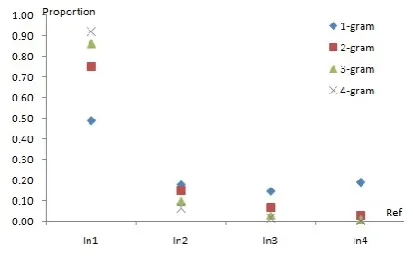
We examine the recurring n-grams in the four references in MTC-P2 in detail. Taking unigrams as example, among the unigrams in all references, 48.7% occur in a single reference, 17.8% are cov-ered by any two references. As expected, the per-centage of common n-grams decreases as we in-crease the number of references. There is a sharp drop when the number of references changes from one to two, indicating that most n-grams appear only in one reference. This becomes a more severe limitation of the dataset for n-grams with largern,
as depicted in Figure 1. 91.86% of 4-grams appear in a single reference, while only 0.24% are covered by the four references.
Figure 1: Common 1-4grams in references of MTC P2 (InX denotes covered by X references)
[image:6.595.314.521.371.499.2]the other hand, many higher-order n-grams were found in more than one reference, which explains the improvements onfluency evaluation.
Figure 2: Matching n-grams distribution of P2-05
Content vs functional n-grams Using Eq. 7 to assign heavier weight to content n-grams improves the correlation for accuracy evaluation at system level, but leads to a drop in correlation for doc-ument and segment level evaluations. Thus there is no clear advantage for using such an approach to weighting function words and content n-grams differently, at least for the datasets used in the ex-periments.
Influence of number of references Our exper-iments use four references, only a small portion of the valid translations for the source texts. This somewhat limited the exploration of the proposed reweighting method.
Eq. 5 indicates that the larger the number of ref-erences, the lower the weighting ratio for recur-ring n-grams. For instance, for bigrams appearecur-ring twice in 10 references, the outcome of Eq. 5 is 0.3424, while for bigrams appearing once, the out-come of Eq. 5 is 0.3222. However since there are only four references, the weighting ratio is larger, 0.3979/0.3522. In other words, the larger the number of references, the lower the impact of the reweighting method on the results.
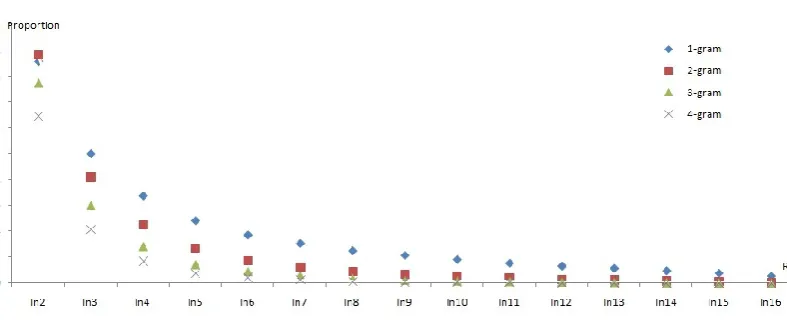
Increasing the number of references could help discriminate function words and content words as well. To check the recurrence of n-grams in larger numbers of references, we investigate the devset1-3 of BTEC (Takezawa et al., 2002), which contains 1512 source sentences, each with 16 English refer-ences. We show the average 1-4grams distribution over 2 to 16 translations in Figure 3. As expected, the proportion of n-grams covered by multiple ref-erences decreases as the number of refref-erences in-creases, showing that more translation variety is
obtained with more references. The total number of 1-4grams found in three references (In3) is still as high as 28.4%, demonstrating the potential ben-efits of exploring multiple references.
5 Conclusions and future work
Recurring n-grams in references can help capture important words and sequences of words that are chosen by various translators. By combining re-currence distributions, divergence information and the length of n-grams, a modified weighting strat-egy for BLEU and NIST was proposed to make better use of multiple references in translation evaluation. This strategy was tested with different reweighting schemes. The results on two datasets proved promising.
Overall, the strategy favoursfluency evaluation over accuracy evaluation. To address that, in future work we will further improve the metric by tack-ling common n-grams carrying lower information content. We also observed how the weaknesses of exact n-gram matching affects the performance of the proposed metrics. In future work, in addition to the n-gram distributions, divergence information and length of n-grams, synonym recurrence infor-mation will also be explored. Adapting this ap-proach to other metrics such as METEOR is an-other direction for future work.
Acknowledgements
Ying Qin’s work is supported by a Beijing Social Science Funding Project (15WYA006) and the Na-tional Research Centre for Foreign Language Edu-cation, BFSU.
References
Agarwal, A and A Lavie. 2008. Meteor, bleu and m-ter: Evaluation metrics for high-correlation with hu-man rankings of machine translation output. In Pro-ceedings of the Third Workshop on Statistical Ma-chine Translation. ACL, pages 115–118.
Banerjee, S and A Lavie. 2005. Meteor: An auto-matic metric for mt evaluation with improved corre-lation with human judgments. InProceedings of the ACL Workshop on Intrinsic and Extrinsic Evaluation Measures for Machine Translation and/or Summa-rization, pages 65–72.
Figure 3: 1-4grams distribution in the BTEC corpus
Chen, Boxing and Colin Cherry. 2014. A systematic comparison of smoothing techniques for sentence-level bleu. InACL 2014, page 362.
Chen, Boxing and Roland Kuhn. 2011. Amber: A modified bleu, enhanced ranking metric. In Pro-ceedings of the 6th Workshop on Statistical Machine Translation, pages 71–77.
Doddington, G. 2002. Automatic evaluation of ma-chine translation quality using n-gram co-occurrence statistics. In Proceedings of the second interna-tional conference on Human Language Technology Research, pages 138–145.
Dreyer, Markus and Daniel Marcu. 2012. Hyter: Meaning-equivalent semantics for translation evalu-ation. In 2012 Conference of the North American Chapter of the ACL: Human Language Technologies, pages 162–171.
Gamon, Michael, Anthony Aue, and Martine Smets. 2005. Sentence-level mt evaluation without refer-ence translations: Beyond language modeling. In
Proceedings of EAMT, pages 103–111.
Gim´enez, Jes´us and Llu´ıs M`arquez. 2010. Asiya: An Open Toolkit for Automatic Machine Translation (Meta-)Evaluation. The Prague Bulletin of Mathe-matical Linguistics, (94):77–86.
Ha, Le Quan, Elvira I Sicilia-Garcia, Ji Ming, and F Jack Smith. 2002. Extension of zipf’s law to words and phrases. InProceedings of the 19th in-ternational conference on Computational linguistics, pages 1–6. ACL.
Leusch, G, N Ueffing, and H Ney. 2003. A novel string-to-string distance measure with applications to machine translation evaluation. In Proceedings of MT Summit IX, pages 33–40.
Lin, Chin Yew and Franz Josef Och. 2004. Orange: a method for evaluating automatic evaluation metrics for machine translation. InProceedings of the 20th international conference on Computational Linguis-tics.ACL, pages 501–507.
Liu, C, D Dahlmeier, and H. T. Ng. 2010. Tesla: Translation evaluation of sentences with linear-programming-based analysis. InProceedings of the Joint Fifth Workshop on Statistical Machine Trans-lation and MetricsMATR. ACL, pages 354–359.
Nießen, Sonja, Franz Josef Och, Gregor Leusch, Her-mann Ney, et al. 2000. An evaluation tool for ma-chine translation: Fast evaluation for mt research. In
LREC.
Papineni, K, S Roukos, T Ward, et al. 2002. Bleu: a method for automatic evaluation of machine transla-tion. InProceedings of the 40th annual meeting on ACL, pages 311–318.
Snover, Matthew, Bonnie Dorr, Richard Schwartz, Lin-nea Micciulla, and John Makhoul. 2006. A study of translation edit rate with targeted human annotation. In Proceedings of association for machine transla-tion in the Americas, pages 223–231.
Snover, Matthew, Nitin Madnani, Bonnie J Dorr, and Richard Schwartz. 2009. Fluency, adequacy, or hter?: exploring different human judgments with a tunable mt metric. In Proceedings of the Fourth Workshop on Statistical Machine Translation, pages 259–268. ACL.
Specia, L, D Raj, and M. Turchi. 2010. Machine trans-lation evaluation versus quality estimation.Machine translation, 24(1):39–50.