ELECTRONIC STRUCTURES AND REACTIVITY PATTERNS OF
DIPALLADIUM(II,II) AND DIPLATINUM(II,II) COMPLEXES
Thesis by Alec Charles Durrell
In Partial Fulfillment of the Requirements for the degree of
Doctor of Philosophy
CALIFORNIA INSTITUTE OF TECHNOLOGY
Pasadena, California 2012
2012
ACKNOWLEDGEMENTS
During my time at Caltech, I have been fortunate enough to work and interact with a number of brilliant people who have had a huge impact on my scientific path and to whom I owe a great deal of thanks. First and foremost, I must thank my advisor, Harry Gray. I am constantly amazed at Harry’s indefatigable enthusiasm and support for me and all his students. He is the model for the chemist I aspire to be. I am a proud member of the Gray Nation. I would also like to thank Jay Winkler. Jay is the prototypical scientist. He is methodical and thorough and goes only where the data takes him. While my enthusiasm sometimes gets the best of me, I have tried to emulate these traits as they can never lead you astray. I am grateful to the other members of my committee, Mitchio Okumura, Nate Lewis, and John Bercaw. While committee meetings were never too common they were always willing to respond to me if I needed them. John, in particular, was always willing to discuss any chemistry concerns I was having.
I owe special thanks to Nilay Hazari. I was incredibly fortunate to begin a collaboration with him that ultimately sparked the bulk of my thesis project. More than that, he has been a great friend to me and I look forward to further developing that friendship upon my move to New Haven.
continue to be great friends and I have enjoyed keeping up with them as their lives have taken them to other parts of the country. I am grateful to Josh both for his friendship and for our collaborations, which allow me to make the dubious claim that I am an expert in corrole photophysics. Ian Tonks is another member of the class with whom I was able to work closely on occasion. I enjoyed our collaborations a great deal. Kyle Lancaster was a wonderful office mate, except for those two months when he would not stop quoting from Silence of the Lambs. Despite that, he continues to be a great friend and colleague and I wish him continued success in his scientific pursuits. I thank Bryan Stubbert for many helpful discussions, some of which were even related to science. Jillian Dempsey and I spent a good deal of time together as both TAs for 153 and GLAs in the laser lab. She set a high standard in both and I did my best to maintain that level in my TA and GLA duties after she graduated. As I leave those duties behind, I have complete confidence in Maraia Ener to carry on the standard of excellence. Gretchen Keller has been a great friend and coworker. I am especially grateful to have her as a collaborator on certain difficult projects, where her expertise and demeanor have made things much easier. I have enjoyed working with Yan Choi Lam on his platinum project, and I am happy knowing that he continues to keep d8–d8 chemistry alive. Paul Bracher was an amazing person to have down the hall. I deeply enjoyed our conversations on a wide range of topics. Peter Agbo, if you’re reading this, get back to work.
great deal about electrochemistry. Astrid Mueller’s knowledge and experience with the laser systems was truly beneficial. Jeff Warren was always helpful and in good spirits, despite my constant pestering of him.
Megan Jackson began working with me as a SURF student her freshman year. From the very beginning, she brought enthusiasm and skill to her work. Had she not joined the lab, the last chapter of my thesis may have been much sparser. I am happy that she will be carrying on d8–d8 chemistry in her final year at Caltech and wish her continued success in whatever she decides to do next.
ABSTRACT
This work explores the electronic structures and reactivity patterns of diplatinum(II, II) and dipalladium(II, II) complexes. Complexes containing metal-metal bonds play important roles in both inorganic and organometallic chemistry. Among the many examples of these complexes, dimers of square planar RhI, IrI, and PtII centers comprise a special class that feature attractive d8–d8 interactions. The unique electronic structure characteristic of these complexes gives rise to chemical, photochemical, and photophysical properties that have engaged researchers for the past 35 years.
One of the best-known examples of these compounds is tetrakis(µ-pyrophosphito)platinum(II), Pt(pop). Herein, the photophysical properties of Pt(pop) are compared with its fluoroborated analogue, Pt(pop-BF2). This complex possesses eight BF2 groups that replace the hydrogen atoms located between each “pop” ligand. When compared with Pt(pop), Pt(pop-BF2) has a much greater singlet lifetime (1.56 ns) and singlet quantum yield (0.27). The enhancement is the result of a drastically slower 1A2u → 3A2u intersystem crossing rate. In particular, the thermal barrier to intersystem crossing is significantly higher in Pt(pop-BF2) (2230 cm-1 vs. 1190 cm-1). We believe this is primarily the result of the increased rigidity of the complex afforded by the BF2 groups. The rigidity increases the energy of symmetry-lowering vibrational modes, which are necessary to promote spin-orbit mixing of the 1dσ*pσ and 3dσ*pσ states.
molecules adopt this unusual geometry in part because of a d8–d8 bonding interaction between the two Pd centers. Density functional theory (DFT) and ab initio (AI) analyses confirm the presence of a Pd–Pd bonding interaction in [(2-phenylpyridine)Pd(µ-X)]2 and show that the HOMO is a dz2 σ*Pd–Pd antibonding orbital, while the LUMO and proximal unoccupied orbitals are mainly located on the 2-phenylpyridine rings. Computational analyses of other PdII–PdII dimers that have short Pd–Pd distances yield an orbital ordering similar to that of [(2-phenylpyridine)Pd(µ-X)]2, but quite different from that found for d8– d8 dimers of Rh, Ir, and Pt. This difference in orbital ordering arises because of the unusually large energy gap between the 4d and 5p orbitals in Pd, and may explain why Pd d8–d8 dimers do not exhibit the distinctive photophysical properties of related Rh, Ir, and Pt species.
TABLE OF CONTENTS
Acknowledgements ... iii
Abstract ... vi
Table of Contents ... ix
List of Figures ... xi
List of Schemes ... xiv
List of Tables ... xv
Chapter 1: Electronic structures, photophysical and photochemical properties, and reactivity of d8–d8 binuclear complexes ... 1
1.1 Introduction ... 2
1.2 Electronic structures ... 3
1.3 Photophysical properties ... 8
1.4 Chemical properties ... 11
1.5 Photochemical properties ... 12
1.6 Binuclear palladium(II) complexes... 15
1.7 References ... 17
Chapter 2: Twist it to mix it! 1A2u-to-3A2u intersystem crossing in diplatinum(II,II) complexes ... 20
2.1 Abstract ... 21
2.2 Introduction ... 22
2.3 Photophysical properties ... 27
2.4 Concluding remarks ... 49
2.5 References ... 50
Chapter 3: Electronic structures of palladium(II) dimers ... 53
3.1 Abstract ... 54
3.2 Introduction ... 55
3.3 Results and discussion ... 58
3.4 Concluding remarks ... 93
3.5 Materials and methods ... 93
3.6 References ... 98
Chapter 4: Carbon-chlorine bond formation from a binuclear palladium(II) electrocatalyst ... 101
4.1 Abstract ... 102
4.2 Introduction ... 102
4.3 Results and discussion ... 110
4.4 Concluding remarks ... 124
4.6 References ... 127
Appendix A: Electron transfer triggered by optical excitation of PTZ-tris(meta-phenylene ethynylene)-(CO)3(bpy)(py)rhenium(I) ... 129
A.1 Abstract ... 130
A.2 Introduction ... 130
A.3 Results and discussion ... 131
A.4 Concluding remarks ... 150
A.5 Materials and methods... 151
A.6 References ... 166
Appendix B: Photophysics of Ir(III) corroles ... 170
B.1 Abstract ... 171
B.2 Introduction ... 172
B.3 Results and discussion ... 173
B.4 Concluding remarks ... 183
B.5 Materials and methods ... 183
B.6 References ... 189
LIST OF FIGURES
Number Page
1.1. Orbital energy level diagram for d8–d8 ... 5
1.2. Examples of d8–d8 binuclear complexes ... 6
2.1 Electronic structures of d8–d8 complexes ... 23
2.2 Structure of Pt(pop) and its conversion to Pt(pop-BF2) ... 24
2.3 Absorption spectrum of Pt(pop-BF2) ... 30
2.4 Emission and excitation spectra of Pt(pop-BF2) ... 31
2.5 Temperature dependence of the emission spectrum of Pt(pop-BF2) ... 33
2.6. Temperature-dependence of the quantum yield of Pt(pop-BF2) ... 34
2.7. Phosphorescence rise and fluorescence decay of Pt(pop-BF2) ... 36
2.8. Fluorescence decay of Pt(pop-BF2) measured with a streak camera ... 37
2.9. Phosphorescence rise of Pt(pop-BF2) measured with a streak camera ... 38
2.10. Temperature-dependent fluorescence decay of Pt(pop-BF2) ... 41
2.11. Fitted temp-dependence of Pt(pop-BF2) lifetime and quantum yield ... 42
3.3. Orbital energy level diagram for d8–d8 ... 56
3.2. The structures of compounds 1–4 ... 61
3.3. Selected bond distances in 1–4. ... 63
3.4. The structure of [(2-phenylpyridine)Pd(µ-Cl)]2 (5) ... 64
3.6. Differential pulse voltammograms of compounds 1–4 ... 67
3.7. Electronic absorption spectra of 1–6 in 2-MeTHF solutions ... 72
3.8. Emission spectrum of 1 in a 2-MeTHF glass at 77 K ... 74
3.9. Absorption and excitation spectra of 2 in 2-MeTHF at 77 K ... 77
3.10. Selected molecular orbitals of 1 ... 82
3.11. Molecular orbital diagram for 1 ... 83
3.12. Complexes with short Pd–Pd interactions for DFT calculations ... 85
3.13. Complexes with d8–d8 interactions selected for DFT calculations ... 86
3.14. Plot of charge density and Laplacian against M-M distance ... 88
4.1. Orbital energy level diagram for d8–d8 ... 109
4.2. Cyclic voltammogram of PdII–PdII in dichloromethane ... 112
4.3. CV of [(2-phenylpyridine)PdII(µ-OAc)]2 as with increasing chloride .... 115
4.4. Absorbance spectrum from electrochemical oxidation of PdII–PdII ... 116
4.5. UV–vis spectrum following oxidation of PdII–PdII with chloride ... 118
4.6. Spectra following oxidation of PdII–PdII with bromide and acetate ... 118
4.7. Cyclic voltammogram of tris(acetylacetonato)iron(III) ... 123
A.1. Absorption (a) and corrected emission (b) spectra of PTZ-bridge-Re ... 135
A.2. Quantum yield measurements of PTZ-bridge-Re ... 136
A.3. Time-resolved emission decay profiles of PTZ-bridge-Re ... 139
A.4. Concentration-dependent luminescence of PTZ-bridge-Re ... 140
A.5. Stretched-exponential fit of the rapid decay component ... 141
A.6. NNLS fitting of the rapid decay component ... 142
A.8. Absorption spectra of PTZ-bridge-Re at various concentrations ... 145
A.9. Emission spectra of PTZ-bridge-Re at various concentrations ... 146
A.10. 1H-NMR spectra of PTZ-bridge-Re at various concentrations. ... 147
A.11. Calculated m-phenylene-ethynylene fragment from DFT ... 149
B.1. Iridium(III) corroles ... 173
B.2. UV-vis spectra of Ir(III) corroles ... 174
B.3 Emission spectra of Ir(III) corroles a. 298 K; b. 77 K ... 175
B.4. Normalized excitation profiles of. Ir(III) corroles ... 176
B.5. Shifts of the second Soret peak as a function of solvent polarizability .. 179
B.6. Shifts of other absorption bands as a function of solvent polarizability. 180 B.7. Raman spectra of 1-Ir(tma)2, 1b-Ir(tma)2, and 1-Ir(py)2 ... 181
C.1. Cyclic voltammograms of 1–4 in CH2Cl2 ... 191
C.2. Cyclic voltammograms of 1–5 in MeCN ... 192
C.3. Steady-state emission spectra of 1–4, 77 K, λex = 355 nm ... 193
C.4. Steady-state emission spectra of 1–5, 77 K, λex = 355 nm ... 194
C.5. Excitation spectrum of 1–4, 77 K, λem = 460 nm ... 195
C.6. Excitation spectrum of 1–4, 77 K, λem = 790 nm ... 196
C.7. Luminescence decay of 1 at 77 K at 460 nm (a) and 720 nm (b)... 198
C.8. Luminescence decay of 2 at 77 K at 460 nm (a) and 720 nm (b)... 199
C.9. Luminescence decay of 3 at 77 K at 460 nm (a) and 720 nm (b)... 200
C.10. Luminescence decay of 4 at 77 K at 460 nm (a) and 720 nm (b)... 201
LIST OF SCHEMES
Number Page
LIST OF TABLES
Number Page
1.6. Metal–metal bond distances for selected selected d8–d8 complexes ... 7
1.7. Absorption properties for selected d8–d8 binuclear complexes ... 9
1.3 Photophysical parameters for selected d8–d8 binuclear complexes ... 10
1.4 Ground and excited state ν(M–M) frequencies for selected complexes .... 13
2.1 Absorption and emission properties of Pt(pop-BF2) and Pt(pop) ... 32
2.2 Temperature dependence of Pt(pop-BF2) quantum yields ... 35
2.3 Temperature dependence of Pt(pop-BF2) fluorescence lifetime ... 43
2.4 Kinetics parameters for 1A2u excited states of Pt(pop-BF2) and Pt(pop) ... 44
3.1 Selected bond distances in 1–4 ... 56
3.2 Reduction potentials for compounds 1–4 in CH2Cl2 ... 68
3.3 Reduction potentials for compounds 1–5 in CH3CN ... 70
3.4 Absorption and emission data for 1–5 ... 76
3.5 Energy of the nd → (n+1)p transition ... 90
3.6 Relative contribution of the d, s, and p orbitals to the M–M orbitals ... 92
B.1 Photophysical data for Ir(III) corroles in toluene solution... 177
C h a p t e r 1
1.1 Introduction
Binuclear metal complexes are attractive systems of study for the activation of organic substrates due to the potential cooperativity between the two metal sites.1 Many biological processes are driven by metalloenzymes with multiple metal centers and catalyze a diverse array of difficult multi-electron reactions including, nitrogen fixation,2 oxygen reduction,3 methane hydroxylation,4 water oxidation,5 and carbon dioxide reduction. Despite their prominence in Nature, the majority of synthetic work has focused on mononuclear catalysts for performing many reactions, particularly those involved in the functionalization of C–H bonds.
Binuclear complexes with square planar RhI, IrI, and PtII centers are members of a special class that feature attractive d8–d8 interactions, as documented by optical and vibrational spectroscopy,6–8 x-ray crystallography,9,10 extended x-ray absorption fine structure,11 and ab initio electronic structure theory.12,13 The first report of these complexes occurred in 1975, when Mann et al. reported the electronic spectroscopic characterization of [Rh(CNPh)4]nn+ (n = 1, 2, or 3) in
acetonitrile solution and proposed that aggregation occurred through a direct Rh– Rh interaction. This aggregration was attributable to the unsupported metal–metal interaction between the monomers along the z-axis. Since this initial discovery, many d8–d8 dimers of RhI, IrI, and PtII have been discovered. These complexes possess similar electronic structures and interesting chemical, photophysical, and photochemical properties.
photophysical and photochemical properties when compared to traditional d8–d8 species. However, the recent discovery of productive thermal reactivity of PdII dimers has rejuvenated interest in these complexes.14–17 Electronic structure studies have provided insight into the characteristics that make binuclear PdII complexes chemically unique.18
1.2 Electronic structures
The electronic structures of d8–d8 complexes can be interpreted in terms of a simple molecular orbital (MO) model where two d8 square planar fragments combine along the z-axis in a face-to-face orientation (Figure 1.1).7 This leads to substantial interaction between the orbitals on each metal center, particularly those with substantial electron density along the z-axis. This electronic configuration results in a metal–metal antibonding dσ* HOMO and a metal–metal bonding pσ
LUMO. Formally, d8–d8 complexes have no metal–metal bond, as the contributions of four filled bonding orbitals are cancelled by four filled antibonding orbitals. However, perturbational mixing between the dz2 and pz orbitals stabilizes the metal–
metal dσ and dσ* orbitals (and raises the corresponding pσ and pσ* orbitals),
resulting in a net bonding interaction. Such d8–d8 interactions most commonly lead to discrete dimers or trimers, although in some cases higher-order oligomers are formed.7,19In the excited state, an electron is promoted to the pσ molecular orbital, resulting in formation of a metal–metal single bond.
symmetry). This is the preferred geometry of many d8–d8 species, including the original dirhodium(I) isocyanide species as well as many ligand-supported d8–d8 architectures. Alternatively, certain ligands can force d8–d8 complexes to adopt a “clamshell” or “A-frame” orientation (limiting C2v symmetry).20 Examples of these two geometries are shown in Figure 1.2. In this case, the two ML4 fragments combine at an angle to one another. This has the effect of decreasing the extent of electronic interaction between the two fragments due to decreased orbital overlap. The relative ordering of the molecular orbitals remains largely unaffected.
Figure 1.1. Orbital energy level diagram for interaction along the metal−metal axis
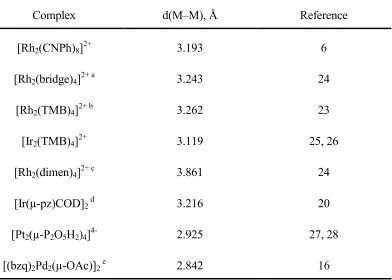
Table 1.1. Metal–metal bond distances for selected selected d8–d8 complexes as determined by x-ray crystallography
Complex d(M–M), Å Reference
[Rh2(CNPh)8]2+ 3.193 6
[Rh2(bridge)4]2+ a 3.243 24
[Rh2(TMB)4]2+ b 3.262 23
[Ir2(TMB)4]2+ 3.119 25, 26
[Rh2(dimen)4]2+ c 3.861 24
[Ir(µ-pz)COD]2 d 3.216 20
[Pt2(µ-P2O5H2)4]4- 2.925 27, 28
[(bzq)2Pd2(µ-OAc)]2 e 2.842 16
abridge = 1,3-diisocanyopropane, bTMB = 2,5-dimethyl-2,5-diisocyanohexane, c dimen =
1,8-diisocyano-p-menthane, dpz = pyrazolyl, COD = 1,5-cyclooctadiene, e bzq =
1.3 Photophysical properties
The photophysical properties of these complexes are strongly influenced by electronic structure. Monomeric d8 species often display little color in the visible region as their strong ligand-to-metal-charge-transfer (LMCT) bands are often in the ultraviolet region, particularly amongst 4d and 5d metals.29 By contrast, the optical spectrum of bimetallic d8 complexes are often brightly colored.23,30–33 Their
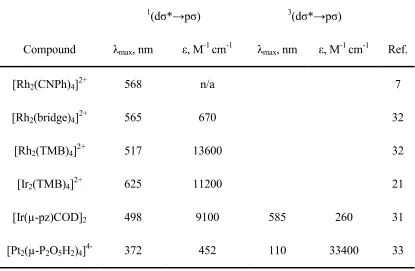
spectrum is dominated by the dσ*→pσ electronic transition, which removes an electron from a metal–metal antibonding orbital and places it in a metal–metal bonding orbital. Direct triplet dσ*→pσ absorption bands are weak and often obscured beneath the allowed singlet transition. The absorption properties for several complexes are presented in Table 1.2.
Photophysical studies of numerous d8–d8 complexes have found them to luminesce from both the lowest energy singlet and triplet excited states derived
Table 1.2. Absorption properties for selected d8–d8 binuclear complexes
1(dσ*→pσ) 3(dσ*→pσ)
Compound λmax, nm ε, M-1 cm-1 λmax, nm ε, M-1 cm-1 Ref.
[Rh2(CNPh)4]2+ 568 n/a 7
[Rh2(bridge)4]2+ 565 670 32
[Rh2(TMB)4]2+ 517 13600 32
[Ir2(TMB)4]2+ 625 11200 21
[Ir(µ-pz)COD]2 498 9100 585 260 31
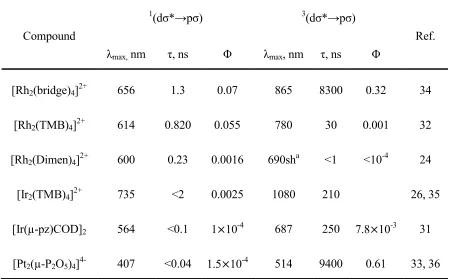
Table 1.3. Photophysical parameters for selected d8–d8 binuclear complexes. All measurements were conducted at room temperature in fluid solution unless otherwise specified.
Compound
1(dσ*→pσ) 3(dσ*→pσ)
Ref.
λmax, nm τ, ns Φ λmax, nm τ, ns Φ
[Rh2(bridge)4]2+ 656 1.3 0.07 865 8300 0.32 34
[Rh2(TMB)4]2+ 614 0.820 0.055 780 30 0.001 32
[Rh2(Dimen)4]2+ 600 0.23 0.0016 690sha <1 <10-4 24
[Ir2(TMB)4]2+ 735 <2 0.0025 1080 210 26, 35
[Ir(µ-pz)COD]2 564 <0.1 1×10⁻⁴ 687 250 7.8×10⁻³ 31 [Pt2(µ-P2O5)4]4- 407 <0.04 1.5×10⁻⁴ 514 9400 0.61 33, 36
aObserved in PMMA film at 25oC. No phosphorescence was detected at room temperatures in fluid
solution.
The excited state can be interpreted as a metal-centered diradical, with one electron localized on the exterior of the metal–metal core (in the dσ* orbital) and
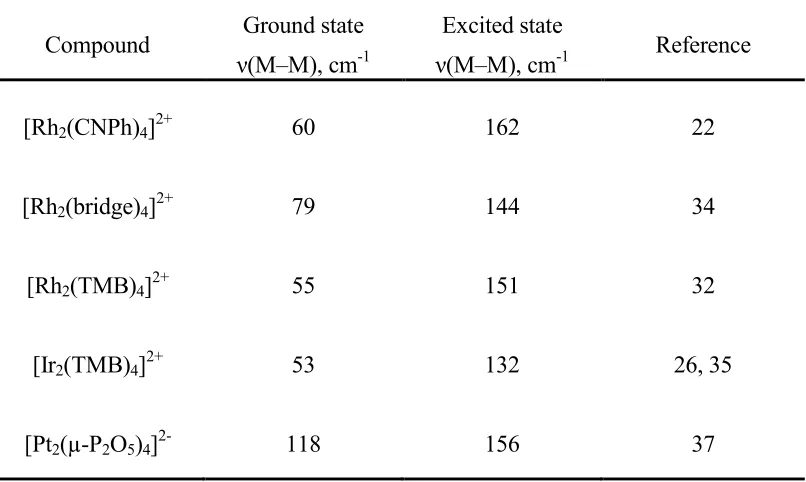
the other between the two metal centers (in the pσ orbital). The excited state possesses a formal bond order of one, which results in significantly higher metal– metal bond strengths relative to the ground state. This observation is confirmed by both resonance Raman22,26,32,34,35,37 and absorption/emission studies on several d8–d8 species.24,38 The ground- and excited-state M–M stretching frequencies for several d8–d8 complexes are shown in Table 1.4. A M–M bond length contraction of approximately 0.2–0.3 Å in the excited state has been observed in Pt2(µ-P2O5H2)44– (Pt2) by time-resolved x-ray and electronic spectroscopies.39,40 This value is consistent with the Franck-Condon analysis of Pt2 which predicted a similar contraction in the excited state (Δr = 0.279 Å).41
1.4 Chemical properties
As expected from the simple MO picture for d8–d8 complexes, oxidation will remove two electrons from the M–M antibonding dσ* orbital and result in the
formation of a metal–metal single bond. This is accompanied by a contraction of the metal–metal bond. The degree of contraction is dependent on the extent of
electron donation into the dσ* orbital by the axial ligands. For Pt2, Pt–Pt distances range from 2.695 Å (Pt2Cl2) to 2.782 Å (Pt2CH3I). For reference, unmodified Pt2 has a Pt–Pt distance of 2.925 Å.27,28 Similar chemical behavior is displayed by d8– d8 complexes of Rh and Ir.51
1.5 Photochemical properties
Table 1.4. Ground and excited state metal–metal stretching frequencies for selected d8–d8 complexes
Compound Ground state
ν(M–M), cm-1
Excited state
ν(M–M), cm-1 Reference
[Rh2(CNPh)4]2+ 60 162 22
[Rh2(bridge)4]2+ 79 144 34
[Rh2(TMB)4]2+ 55 151 32
[Ir2(TMB)4]2+ 53 132 26, 35
Atom-transfer reactions
Photoexcited d8–d8 complexes are particularly active in atom-transfer reactions.21,25,33 These reactions are promoted by the diradical nature of the excited
state, which places a hole in the dσ* that extends away from the open coordination sites of the metals. Multiple d8–d8 systems are capable of H–atom abstraction from a variety of organic and organometallic substrates. Following excitation into the
dσ* → pσ transition, (λmax = 372 nm) Pt2* will react with hydrogen-atom donors such as (CH3)2CHOH, PhCH(OH)CH3, Bu3SnH, Et3SiH, and H3PO3.46,54,55 Rates of reaction of Pt2* with Ph3EH (E = Sn, Ge, Si) decrease as E–H bond strengths increase.33,56
A great deal of mechanistic work on hydrogen–atom in d8–d8 complexes has focused on the light-induced conversion of isopropanol to acetone by Pt2.57 The reaction occurs through initial abstraction of the α-hydrogen to form a monohydride Pt2H species and the alcohol radical. The monohydride complex has been observed through transient absorption spectroscopy before decaying to form the dihydride Pt2H2 complex and acetone. This reaction can be observed with UV–vis through the
disappearance of the dσ→dσ* transition at 372 nm and the appearance of the Pt2H2
dσ → dσ* transition at 325 nm. Pt2H2 thermally decomposes into H2 and Pt2;
however, this reaction can be accelerated by photoexcitation into the dσ → dσ*
transition of the d7–d7 complex, which rapidly liberates H2.58
proportional to Ar–X bond strength. Similarly to the ground-state reaction to X2, halogen atom abstraction proceeds by initial formation of mixed-valence Pt2X, followed by disproportionation to Pt2X2 and Pt2.
In a similar fashion, illumination of Ir2(TMB)42+ into the dσ* → pσ transition (λmax = 625 nm) in the presence of 9,10-dihydroanthracene (C–H bond strength 77 kcal/mol) results in formation of Ir2(TMB)4H22+ and anthracene. NMR
spectroscopy following illumination confirms formation of anthracene as well as Ir2(TMB)4H22+. The dihydride species has also been chemically isolated and
structurally characterized.25 Ir2(TMB)44– has also showed photoreactivity with cyclohexadiene, forming benzene.
1.6 Binuclear PdII complexes
The great majority of research into d8–d8 complexes has focused on complexes of PtII, RhI, and IrI. However, many examples of PdII dimers with short M–M distances exist in the literature. The lack of reports on the photophysical and photochemical properties of these species are due to the fact that these properties are largely nonexistent. In fact, there are no reports of photochemical reactivity for bimetallic PdII species. Some complexes have been shown to luminesce at cryogenic temperatures,18 and at least one recent report has identified room-temperature emission from a PdII dimer.60
Experimental and computational work suggests the unique behavior of binuclear PdII species is a result of their altered electronic structure with respect to traditional d8–d8 species. Both systems possess a dσ* M–M-antibonding HOMO.
PtII, RhI, and IrI species, the LUMO of most Pd2 species appear to be ligand-based
π* orbitals. The resulting excited state places a large amount of electron density on
the ligands. As a result, the Pd2* excited state is often short-lived. In this excited state, the bond order is roughly one-half.
The altered electronic structure that leads to a ligand-π* orbital rather than a pσ orbital is a result of the unusually large 4d–5p splitting found in PdII. Gas-phase atomic absorption measurements show this splitting to be nearly 10,000 cm-1 higher than what is observed for PtII, RhI, and IrI.61 As such, the pσ orbital is raised in energy above the ligand-π*. Importantly, this large 4d–5p separation also serves to decrease the extent of d–p mixing. This mixing stabilizes the occupied dσ and dσ*
orbitals, resulting in a net bonding interaction in the ground state, resulting in substantially weaker ground-state metal–metal interactions in palladium.
are catalytically relevant, in addition to the more established monometallic Pd0/II and PdII/IV cycles. Since this initial report, additional reactivity of PdII dimers has been discussed.14
1.7 References
(1) Cotton, F. A. Inorg. Chem. 1998, 37, 5710–5720.
(2) Lancaster, K. M.; Roemelt, M.; Ettenhuber, P.; Hu, Y.; Ribbe, M. W.; Neese, F.; Bergmann, U.; DeBeer, S. Science 2011, 334, 974–977.
(3) Solomon, E. I.; Sundaram, U. M.; Machonkin, T. E. Chem. Rev. 1996, 96, 2563–2606.
(4) Merkx, M.; Kopp, D. A.; Sazinsky, M. H.; Blazyk, J. L.; Müller, J.; Lippard, S. J. Angew. Chem. Int. Ed. Engl. 2001, 40, 2782–2807.
(5) Ferreira, K. N.; Iverson, T. M.; Maghlaoui, K.; Barber, J.; Iwata, S. Science 2004, 303, 1831–1838.
(6) Mann, K. R.; Gray, H. B. In Inorganic Compounds with Unusual
Properties - II; Advances in Chemistry; ACS, 1979 vol. 173, pp. 225–235. (7) Mann, K. R.; Gordon, J. G.; Gray, H. B. J. Am. Chem. Soc. 1975, 97, 3553–
3555.
(8) Rice, S. F.; Milder, S. J.; Gray, H. B.; Goldbeck, R. A.; Kliger, D. S. Coord. Chem. Rev. 1982, 43, 349–354.
(9) Osborn, R. S.; Rogers, D. J. Chem. Soc., Dalton Trans. 1002–1004. (10) Connick, W. B.; Marsh, R. E.; Schaefer, W. P.; Gray, H. B. Inorg. Chem.
1997, 36, 913–922.
(11) Carr, N.; Crossley, J. G.; Dent, A. J.; Gouge, J. R.; Greaves, G. N.; Jarrett, P. S.; Orpen, A. G. J. Chem. Soc., Chem. Commun. 1990,1369–1371. (12) Novoa, J. J.; Aullon, G.; Alemany, P.; Alvarez, S. J. Am. Chem. Soc. 1995,
117, 7169–7171.
(13) Aullón, G.; Alvarez, S. Chem. Eur–J 1997, 3, 655–664. (14) Powers, D. C.; Ritter, T. Acc. Chem. Res. 2011.
(15) Powers, D. C.; Geibel, M. A. L.; Klein, J. E. M. N.; Ritter, T. J. Am. Chem. Soc. 2009, 131, 17050–17051.
(16) Powers, D. C.; Ritter, T. Nat Chem 2009, 1, 302–309.
(17) Lyons, T. W.; Sanford, M. S. Chemical Reviews 2010, 110, 1147–1169. (18) Bercaw, J. E.; Durrell, A. C.; Gray, H. B.; Green, J. C.; Hazari, N.;
Labinger, J. A.; Winkler, J. R. Inorg. Chem. 2010, 49, 1801–1810. (19) Wong, K. M.-C.; Yam, V. W.-W. Acc. Chem. Res. 2011, 44, 424–434. (20) Beveridge, K. A.; Bushnell, G. W.; Dixon, K. R.; Eadie, D. T.; Stobart, S.
R.; Atwood, J. L.; Zaworotko, M. J. J. Am. Chem. Soc. 1982, 104, 920– 922.
(21) Smith, D. C.; Gray, H. B. Coord. Chem. Rev. 1990, 100, 169–181.
(23) Rice, S. F.; Miskowski, V. M.; Gray, H. B. Inorg. Chem. 1988, 27, 4704– 4708.
(24) Miskowski, V. M.; Rice, S. F.; Gray, H. B.; Dallinger, R. F.; Milder, S. J.; Hill, M. G.; Exstrom, C. L.; Mann, K. R. Inorg. Chem. 1994, 33, 2799– 2807.
(25) Smith, D. C.; Marsh, R. E.; Schaefer, W. P.; Loehr, T. M.; Gray, H. B. Inorg. Chem. 1990, 29, 534–538.
(26) Smith, D. C. Ph. D. Thesis. California Institute of Technology, Pasadena, CA, 1989.
(27) Dos Remedios Pinto, M. A. F.; Sadler, P. J.; Neidle, S.; Sanderson, M. R.; Subbiah, A.; Kuroda, R. J. Chem. Soc., Chem. Commun. 1980, 13–15. (28) Marsh, R. E.; Herbstein, F. H. Acta Crystallogr. Sect. B–Struct. Sci. 1983,
39, 280–287.
(29) Mason, W. R.; Gray, H. B. J. Am. Chem. Soc. 1968, 90, 5721–5729. (30) Marshall, J. L.; Hopkins, M. D.; Miskowski, V. M.; Gray, H. B. Inorg.
Chem. 1992, 31, 5034–5040.
(31) Marshall, J. L.; Stobart, S. R.; Gray, H. B. J. Am. Chem. Soc. 1984, 106, 3027–3029.
(32) Smith, D. C.; Miskowski, V. M.; Mason, W. R.; Gray, H. B. J. Am. Chem. Soc. 1990, 112, 3759–3767.
(33) Roundhill, D. M.; Gray, H. B.; Che, C. M. Acc. Chem. Res. 1989, 22, 55– 61.
(34) Rice, S. F.; Gray, H. B. J. Am. Chem. Soc. 1981, 103, 1593–1595. (35) Harvey, P. D. Coord. Chem. Rev. 2001, 219–221, 17–52.
(36) Che, C. M.; Butler, L. G.; Gray, H. B. J. Am. Chem. Soc. 1981, 103, 7796– 7797.
(37) Bradley, P. G.; Kress, N.; Hornberger, B. A.; Dallinger, R. F.; Woodruff, W. H. J. Am. Chem. Soc. 1981, 103, 7441–7446.
(38) Miskowski, V. M.; Rice, S. F.; Gray, H. B.; Milder, S. J. J. Phys. Chem. 1993, 97, 4277–4283.
(39) Christensen, M.; Haldrup, K.; Bechgaard, K.; Feidenhans’l, R.; Kong, Q.; Cammarata, M.; Russo, M. L.; Wulff, M.; Harrit, N.; Nielsen, M. M. J. Am. Chem. Soc. 2008, 131, 502–508.
(40) van der Veen, R. M.; Cannizzo, A.; van Mourik, F.; Vlček, A.; Chergui, M. J. Am. Chem. Soc. 2010, 133, 305–315.
(41) Fordyce, W. A.; Brummer, J. G.; Crosby, G. A. J. Am. Chem. Soc. 1981, 103, 7061–7064.
(42) Che, C. M.; Schaefer, W. P.; Gray, H. B.; Dickson, M. K.; Stein, P. B.; Roundhill, D. M. J. Am. Chem. Soc. 1982, 104, 4253–4255.
(43) Che, C. M.; Mak, T. C. W.; Gray, H. B. Inorg. Chem. 1984, 23, 4386– 4388.
(44) Coleman, A. W.; Eadie, D. T.; Stobart, S. R.; Zaworotko, M. J.; Atwood, J. L. J. Am. Chem. Soc. 1982, 104, 922–923.
(46) Bryan, S. A.; Dickson, M. K.; Roundhill, D. M. Inorg. Chem. 1987, 26, 3878–3886.
(47) Che, C. M.; Lee, W. M.; Cho, K. C. J. Am. Chem. Soc. 1988, 110, 5407– 5411.
(48) Che, C. M.; Herbstein, F. H.; Schaefer, W. P.; Marsh, R. E.; Gray, H. B. J. Am. Chem. Soc. 1983, 105, 4604–4607.
(49) Bryan, S. A.; Dickson, M. K.; Roundhill, D. M. J. Am. Chem. Soc. 1984, 106, 1882–1883.
(50) Bryan, S. A.; Schmehl, R. H.; Roundhill, D. M. J. Am. Chem. Soc. 1986, 108, 5408–5412.
(51) Cotton, F. A. Multiple bonds between metal atoms. Springer, 2005. (52) Fox, L. S.; Kozik, M.; Winkler, J. R.; Gray, H. B. Science 1990, 247,
1069–1071.
(53) Wenger, O. S.; Leigh, B. S.; Villahermosa, R. M.; Gray, H. B.; Winkler, J. R. Science 2005, 307, 99–102.
(54) Harvey, E. L. Ph. D. Thesis. California Institute of Technology, Pasadena, CA, 1990.
(55) Roundhill, D. M.; Atherton, S. J.; Shen, Z. P. J. Am. Chem. Soc. 1987, 109, 6076–6079.
(56) Vlcek, A.; Gray, H. B. Inorg. Chem. 1987, 26, 1997–2001. (57) Roundhill, D. M. J. Am. Chem. Soc. 1985, 107, 4354–4356.
(58) Sweeney, R. J.; Harvey, E. L.; Gray, H. B. Coord. Chem. Rev. 1990, 105, 23–34.
(59) Che, C. M.; Lee, W. M.; Cho, K. C.; Harvey, P. D.; Gray, H. B. J. Phys. Chem. 1989, 93, 3095–3099.
(60) Santana, M. D.; García-Bueno, R.; García, G.; Sánchez, G.; García, J.; Kapdi, A. R.; Naik, M.; Pednekar, S.; Pérez, J.; García, L.; Pérez, E.; Serrano, J. L. Dalton Trans. 2012, 41, 3832–3842.
C h a p t e r 2
Twist it to mix it! 1A2u-to-3A2u intersystem crossing in diplatinum (II,II) complexes
2.1 Abstract
2.2 Introduction
HO O P P Pt Pt O P P P OH O O HO O OH O OH P P O HO O HO O OH O O 4-O P O O P P Pt Pt O P P P O O O O O O O O P P O O O O O O O O 4-O P
F2B
F2B
F2B
F2B
BF2
B
F2
BF2 BF2
F3B OEt2 Room temperature
2 days
singlet→triplet conversion (i.e., intersystem crossing).10,11,23 It is of special interest that 1dσ*pσ excited-state lifetimes vary from a few ps to almost 1 ns in a d8–d8 Rh2 complex,24 and that substantially different chemical reactivities have been found for singlet and triplet dσ*pσ states of Ir2 derivatives.6,24–26 A major goal of our work is to understand the factors that control the lifetimes of these energy-rich singlet states, as potentially they could be key players in photocatalysis and light-energy-harvesting schemes.
by the BF2 groups. The rigidity increases the energy of symmetry-lowering vibrational modes, which are necessary to promote spin-orbit mixing of the 1dσ*pσ and 3dσ*pσ states.
2.3 Photophysical Properties
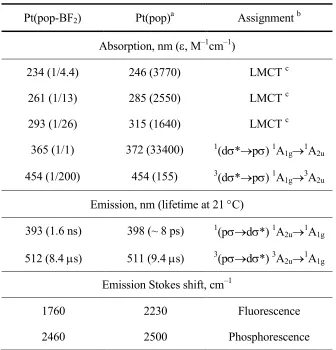
The absorption spectrum of Pt(pop-BF2) exhibits an intense band at 365 nm attributable to the dσ*→pσ (1A1g→1A2u) transition, an assignment based on work on Pt(pop), which has a similar absorption feature at 372 nm (Figure 2.3 and Table 2.1).12,18,29 The corresponding spin-forbidden dσ*→pσ transition (1A1g→3A2u) gives rise to a ~ 200× weaker band at 454 nm, virtually identical with that of Pt(pop).12 Both complexes show qualitatively similar spectral patterns at shorter wavelengths [three relatively weak bands at 293 (1/26 main peak intensity), 261 (1/13), and 234 nm (1/4.4) in the spectrum of Pt(pop-BF2), and at 315 (1640), 285 (2550) and 246 (3770) nm for Pt(pop)]. The 2100–3200 cm–1 high-energy shifts of these bands upon perfluoroboration are in line with their LMCT character, as revealed by TD-DFT calculations on Pt(pop).21,22,30
Figure 2.3. Absorption spectrum of Pt(pop-BF2) in MeCN solution 200 250 300 350 400 450 500 550
0.0 0.5 1.0 1.5 2.0 2.5
Y A
xis
T
itle
X Axis Title x3
Figure 2.4. Red: emission spectrum of Pt(pop-BF2) measured using 373 nm excitation. Blue: normalized excitation spectra of in MeCN obtained at λem = 405 and 512 nm (the two spectra are indistinguishable. Measured in a MeCN solution at 21 °C, freeze-pump-thaw degassed at 4×10⁻⁵ mbar
350 400 450 500 550 600
Int
ens
ity
/ a.
u.
Table 2.1. Absorption and emission properties of Pt(pop-BF2) and Pt(pop) in MeCN
Pt(pop-BF2) Pt(pop)a Assignment b
Absorption, nm (ε, M–1cm–1)
234 (1/4.4) 246 (3770) LMCT c
261 (1/13) 285 (2550) LMCT c
293 (1/26) 315 (1640) LMCT c
365 (1/1) 372 (33400) 1(dσ*→pσ) 1A1g→1A2u 454 (1/200) 454 (155) 3(dσ*→pσ) 1A1g→3A2u
Emission, nm (lifetime at 21 °C)
393 (1.6 ns) 398 (~ 8 ps) 1(pσ→dσ*) 1A2u→1A1g 512 (8.4 µs) 511 (9.4 µs) 3(pσ→dσ*) 3A2u→1A1g
Emission Stokes shift, cm–1
1760 2230 Fluorescence
2460 2500 Phosphorescence
Figure 2.5. Temperature dependence of the emission spectrum of Pt(pop-BF2) in MeCN solution. Excitation at 355 nm
400 450 500 550 600
In
te
ns
ity
/ a
.u.
Wavelength / nm
Figure 2.6. Temperature-dependence of the fluorescence (red) and phosphorescence (blue) quantum yield of Pt(pop-BF2) in MeCN
260 280 300 320 340
0.0 0.1 0.2 0.3 0.4 0.5 0.6 0.7
Q
uant
um
Y
iel
d
Table 2.2. The temperature dependence of Pt(pop-BF2) fluorescence (φfl) and
phosphorescence (φph) quantum yields measured in degassed MeCN solution
T [°C] T [K] φfl φph φfl + φph
-5 268.15 0.42 - -
0 273.15 0.39 0.34 0.73
7 280.15 - 0.40 -
10 283.15 0.33 - -
20 293.15 0.27 0.49 0.76
30 303.15 0.22 0.54 0.76
40 313.15 0.18 0.58 0.76
50 323.15 0.14 0.61 0.75
60 333.15 0.11 - -
65 338.15 - 0.66 -
Figure 2.7. Phosphorescence rise (red), fluorescence decay (green) of Pt(pop-BF2) in MeCN, shown together with a 373 nm excitation-pulse profile (black). Fluorescence and phosphorescence intensities were measured at 405 and 512 nm, respectively. The blue and magenta curves are single-exponential fits in the 0.3– 17.2 ns interval with lifetimes of 1.56±0.02 and 1.58±0.001 ns, respectively.
0 2 4 6 8 10 12 14
Co
un
ts
/ a
.u
.
Figure 2.8. Fluorescence decay of Pt(pop-BF2) in MeCN measured with a streak camera, excited at 355 nm, 10 ps. Emission in the 400–415 nm range was selected by a bandpass filter. Red curve: single-exponential fit with τ = 1.58±0.01 ns
0 2 4 6 8 10
0 500 1000 1500 2000 2500
Fl
uor
es
cenc
e i
nt
ens
ity
/ c
ount
s
Figure 2.9. Phosphorescence rise of Pt(pop-BF2) in MeCN measured with a streak camera, excited at 355 nm, 1 ps pulse. Emission wavelengths > 500 nm were selected by a cut-off filter. Red curve: single-exponential fit with τ = 1.62±0.09 ns
0 2 4 6 8 10 12 14 16 18
0 20 40 60 80 100 120
Phos
phor
es
cenc
e i
nt
ens
ity
/ c
ount
s
The Pt(pop-BF2) room-temperature fluorescence lifetime of 1.6 ns is about 100 times longer than the 8–18 ps values reported for Pt(pop) in MeCN12 and similar solvents.10,11 Figure 2.10 shows that the Pt(pop-BF2) fluorescence decay is strongly dependent on temperature, and the kinetics are predominantly32 single-exponential (lifetimes are collected in Table 2.3). To analyze the temperature dependence of the fluorescence lifetime and quantum yield (Figure 2.11), we express the nonradiative decay rate constant knr as a sum of ISC rate constants, kISC,
and the nonradiative decay to the ground state, kd (eq. 1). Owing to the long
fluorescence lifetime, the latter cannot be a priori neglected, as in the case of Pt(pop). kISC is assumed to follow Arrhenius-like behavior (eq. 1), as proposed10 for
Pt(pop).
(1)
The lifetime and quantum yield are then given by equations 2 and 3, respectively.
(2)
(3)
Fitting the experimental data to these equations gives: kr + kd + k0 =
(2.55±0.07)×108 s–1; A = (3.0±0.2)×1014 cm1/2s–1; Ea = 2229±20 cm–1 for the
lifetime, and (kd+k0)/kr = 0.6±0.1; A/kr = (1.7±0.5)×106 cm1/2; Ea = 2233±75 cm–1
for the quantum yield (Figure 2.10). The activation energies from these two fits are
/ 0
(
E k Ta B)
nr d ISC d
B
A
k
k
k
k
k
e
k T
−
=
+
=
+
+
/ 0
1
E k Ta Br nr r d
B
A
k
k
k
k
k
e
k T
τ
−=
+
=
+
+
+
/ 01 1
nr1
d E k Ta Bfl r r r B
k
k
k
A
e
k
k
k k T
φ
−
+
virtually identical, in accordance with eqs. 2–3 and the assumption of T-independent kr and kd (T-dependent kd would require two exponential terms, for
which we have no evidence). The radiative rate constant (kr) can be estimated to be
1.7×10⁸ s–1, which is ~ 8 × larger than that of Pt(pop) (2×10⁷ s–1);12 and 8.5×10⁷ s–1 is the rate for T-independent nonradiative decay (kd+ k0).
Pt(pop-BF2) phosphorescence decay was observed on a longer timescale, occurring with a slightly temperature-dependent lifetime: 8.6, 8.4, and 7.6 µs at 0, 20, and 80 °C, respectively. In absolute terms, the phosphorescence lifetime is comparable to that of Pt(pop), 9.4 µs, which, however, was reported to be independent of temperature.12
Figure 2.10. Temperature-dependent fluorescence decay of Pt(pop-BF2) in MeCN solution. Excitation at 373 nm; emission detected at 405 nm
0 2 4 6 8 10
0 2000 4000 6000 8000 10000
Fl
uor
es
cenc
e /
c
ount
s
Time / ns
Figure 2.11. Temperature dependence of Pt(pop-BF2) fluorescence lifetime and quantum yield fitted to equations 2 (red) and 3 (blue), respectively. Data from Tables 2.3 and 2.4.
0.0028 0.0030 0.0032 0.0034 0.0036 0.0038 0.4 0.6 0.8 1.0 1.2 1.4 1.6 1.8 2.0 2.2 1/ τ [10
9 s -1 ]
1/T [K-1]
0.0028 0.0030 0.0032 0.0034 0.0036 0.0038 2 4 6 8 10 12 1/ φfl
Table 2.3. Temperature dependence of Pt(pop-BF2) fluorescence lifetime. The values were obtained by deconvolution of the TCSPC signal and the actual excitation pulse profile. The nonradiative 1A2u decay rate constants k
nr were
calculated as 1/τ – kr; assuming kr = 1.7×10⁸ s–1.
t [°C] T [K] τ1 [ns] τ [ns] A1 [%] A2 [%] knr [108 s–1]
3.4 276.55 0.29 2.20 5 95 2.8
12.0 285.15 0.12 1.86 8 95 3.7
20.8 293.95 0.20 1.56 9 91 4.7
30.2 303.35 0.20 1.28 9 91 6.1
39.4 312.55 0.14 1.03 10 90 8.0
49.7 322.85 0.12 0.81 11 89 10.6
60.6 333.75 0.08 0.63 12 88 14.2
Table 2.4. Decay kinetics parameters for the 1A2u excited states of Pt(pop-BF2) and Pt(pop)
Parameter Pt(pop-BF2) Pt(pop)a kr 1.7×10⁸ s–1 2×10⁷ s–1
k0 < 8.5×10⁷ s–1 c 1.5×10⁹ s–1
A 3.0×1014 cm1/2s–1 2.6×1014 cm1/2s–1
Ea 2230 cm–1 1190 cm–1
A/√kB×293 2.1×10¹³ s–1 1.8×10¹³ s–1
exp(–Ea/kB×293) 1.749×10⁻⁵ 2.893×10⁻³
knrb 4.7×10⁸ s–1 5.4×10¹⁰ s–1
a k
r from reference 12 measured in MeCN. Other parameters from reference 10,
We assume that ISC rates are given by eq. (4), where HSO is the spin-orbit
(SO) operator and FC is the Franck-Condon factor that accounts for the thermally weighted overlap between vibrational wavefunctions of the initial and final states.
(4) Temperature-independent 1A2u→3A2u direct tunneling (k
0) is more than 18 times
slower than that for Pt(pop). Note that direct ISC between states of identical symmetries is allowed only in point groups where one of the rotation components belongs to the totally symmetric representation [it is forbidden in the D4h group of the Pt2(P–O–P)4 core (i.e., ), but it is allowed in C4h, C2h, or C2]. However, even in D4h, ISC could become partially allowed by SO mixing with higher triplet states33–35 and/or through a spin-vibronic mechanism.23,36–38 In particular, SO coupling between 1A2u and 3Eu LMCT is symmetry allowed, admixing triplet character into 1A2u that then can undergo internal conversion to Eu and/or A1u spin components of the 3A2u state. In both Pt(pop-BF2) and Pt(pop), the higher-lying 3Eu LMCT is the likely coupling state.23 As documented by UV spectra, perfluoroboration raises the energy of LMCT states relative to 1A2u, thereby diminishing the 3A2u–3Eu coupling, which in turn slows ISC (eq. 5).
(5)
Irrespective of the details of the indirect spin-orbit interaction, the ISC tunneling pathway is expected to be disfavored in Pt(pop-BF2) because of the smaller FC factor. Since the 1A2u and 3A2u states largely behave as two imbedded
2
1 3
2 2
ISC u SO u
k ∝ A H A FC
1 3
2u SO 2u 0
A H A =
2 1 3 2 3 1 2 ( ) ( )
u SO u
ISC
u u
A H E
k FC
E E E A
∝
Pt–Pt harmonic oscillators,11 the overlap between their vibrational wavefunctions is small and solvent vibrations gain in importance as energy-accepting modes, as clearly manifested by the strong solvent dependence of the Pt(pop) k0.10 As BF2
groups are much bulkier than –O–H⋅⋅⋅⋅O– units, they will exclude direct interactions between the solvent and terminal P(=O)O groups, as well as with the Pt atoms. Perfluoroboration thus diminishes the ability of the solvent to provide vibrational coupling between the singlet and triplet states, which is required to accept the ~ 5650 cm–1 released during ISC.
energy surface has harmonic character, which would suggest the absence of an avoided crossing with any low-lying intermediate state. For the same reason, it would be hard to justify an assumption of strong coupling (i.e., surface crossing) between 1A2u and 3A2u, whose potential energy surfaces appear to be imbedded, owing to the very similar structures of these states. (Note, however, that the Stokes shift is larger for phosphorescence than fluorescence, indicating that 3A2u is more distorted with respect to the ground state than 1A2u.)
increases the energy of activating vibrational modes, so that higher temperatures are required for distortion amplitudes sufficient to induce SO coupling.
Long-lived singlet excited states are rare for transition-metal complexes. For example, the 1MLCT states of [MII(bpy)3]2+ (M = Fe, Ru) decay to the
corresponding triplets in less than 30 fs,39,40 while 80–150 fs lifetimes have been reported for the singlet excited states of ReI carbonyl-diimine sensitizers.41–43 Besides Pt(pop), ps-lived singlet states were observed at ambient temperatures for d8–d8 complexes of Rh and Ir.6,24,44–46 In particular, [Rh2(1,3-disocyanopropane)4]2+
corresponding nonemissive triplets in 4 to 20 ps.50,51 Among mononuclear complexes, picosecond ISC times have been reported for 1MLCT states of flattened-tetrahedral complexes of CuI (13–16 ps)38 and Pt0 (3.2 ps).52 Symmetry-forbidden first-order SO coupling between optically excited singlet and lowest triplet states is a common feature for all systems with ps-ns singlet lifetimes. Still, forbidden ISC in metal complexes is many orders of magnitude faster than ISC in organic molecules. Theories of spin-vibronic coupling and ISC rates have been elaborated in detail for organic systems that are characterized by very weak SO and small structural perturbations.23,36–38 Understanding the dynamics of SO-coupled states of metal-containing molecules and developing systems capable of harvesting singlet excitation energy is a major goal of contemporary transition-metal photophysics.33
2.4 Concluding remarks
a much more rigid structure, owing to covalent –BF2– bridges linking the pop ligands; and (iii) steric protection by BF2 groups, which shield the Pt2(P–O–P)4 core from solvent. The distinctive photophysical features of Pt(pop-BF2) provide a unique opportunity to investigate independently the structures, dynamics, and reactivities of both singlet and triplet dσ*→pσ excited states in the same molecule. We expect that long-lived vibrational coherence will be observed for the singlet state, and that excited-state reactivity will reflect the asymptotic zwitterionic character of the singlet53,54 and the radical-like behavior of the triplet.2,3,5,13,14
2.5 References
(1) Roundhill, D. M.; Gray, H. B.; Che, C.-M. Acc. Chem. Res. 1989, 22, 55. (2) Smith, D. C.; Gray, H. B. Coord. Chem. Rev. 1990, 100, 169.
(3) Smith, D. C.; Gray, H. B. In ACS Symposium Series 394. The Challenge of d and f Electrons.; Salahub, D. R., Zerner, M. C., Eds. American Chemical Society, Washington, DC, 1989, p. 356.
(4) Marshall, J. L.; Stiegman, A. E.; Gray, H. B. In Excited States and Reactive Intermediates. ACS Symposium Series.; Lever, A. B. P., Ed. American Chemical Society, Washington, DC, 1986; vol. 307, p. 166.
(5) Sweeney, R. J.; Harvey, E. L.; Gray, H. B. Coord. Chem. Rev. 1990, 105, 23. (6) Fox, L. S.; Kozik, M.; Winkler, J. R.; Gray, H. B. Science 1990, 247, 1069. (7) Fox, L. S.; Marshall, J. L.; Gray, H. B. J. Am. Chem. Soc. 1987, 109, 6901. (8) Farid, R. S.; Chang, I.-J.; Winkler, J. R.; Gray, H. B. J. Phys. Chem. 1994, 98, 5176.
(9) Gray, H. B.; Winkler, J. R.; Wiedenfeld, D. Coord. Chem. Rev. 2000, 200-202, 875.
(10) Milder, S. J.; Brunschwig, B. S. J. Phys. Chem. 1992, 96, 2189.
(11) van der Veen, R. M.; Cannizzo, A.; van Mourik, F.; Vlček, A., Jr. ; Chergui,
M. J. Am. Chem. Soc. 2011, 133, 305.
(12) Stiegman, A. E.; Rice, S. F.; Gray, H. B.; Miskowski, V. M. Inorg. Chem. 1987, 26, 1112.
(13) Vlček, A., Jr.; Gray, H. B. J. Am. Chem. Soc. 1987, 109, 286. (14) Vlček, A., Jr.; Gray, H. B. Inorg. Chem. 1987, 26, 1997.
(15) Kalsbeck, W. A.; Gingell, D. M.; Malinsky, J. E.; Thorp, H. H. Inorg. Chem. 1994, 33, 3313.
(17) mChe, C.-M.; Butler, L. G.; Gray, H. B.; Crooks, R. M.; Woodruff, W. H. J. Am. Chem. Soc. 1983, 105, 5492.
(18) Rice, S. F.; Gray, H. B. J. Am. Chem. Soc. 1983, 105, 4571.
(19) Kim, C. D.; Pillet, S.; Wu, G.; Fullagar, W. K.; Coppens, P. Acta Crystallogr. A 2002, 58, 133.
(20) van der Veen, R. M.; Milne, C. J.; El Nahhas, A.; Lima, F. A.; Pham, V.-T.; Best, J.; Weinstein, J. A.; Borca, C. N.; Abela, R.; Bressler, C.; Chergui, M. Angew. Chem. Int. Ed. 2009, 48, 2711
(21) Stoyanov, S. R.; Villegas, J. M.; Rillema, D. P. J. Phys. Chem. B 2004, 108, 12175.
(22) Novozhilova; Volkov, A. V.; Coppens, P. J. Am. Chem. Soc. 2003, 125, 1079. (23) Shimizu, Y.; Tanaka, Y.; Azumi, T. J. Phys. Chem. 1984, 88, 2423.
(24) Winkler, J. R.; Marshall, J. L.; Netzel, T. L.; Gray, H. B. J. Am. Chem. Soc. 1986, 108, 2263.
(25) McCleskey, T. M.; Winkler, J. R.; Gray, H. B. J. Am. Chem. Soc. 1992, 114, 6935.
(26) Caspar, J. V.; Gray, H. B. J. Am. Chem. Soc. 1984, 106, 3029.
(27) King, C.; Auerbach, R. A.; Fronczek, F. R.; Roundhill, D. M. J. Am. Chem. Soc. 1986, 108, 5626.
(28) Roundhill, D. M.; Shen, Z.-P.; King, C.; Atherton, S. J. J. Phys. Chem. 1988, 92, 4088.
(29) Fordyce, W. A.; Brummer, J. G.; Crosby, G. A. J. Am. Chem. Soc. 1981, 103, 7061.
(30) Pan, Q.-J.; Fu, H.-G.; Yu, H.-T.; Zhang, H.-X. Inorg. Chem. 2006, 45, 8729. (31) Peterson, J. R.; Kalyanasundaram, K. J. Phys. Chem. 1985, 89, 2486.
(32) Footnote.
(33) Baková, R.; Chergui, M.; Daniel, C.; Vlček, A., Jr.; Záliš, S. Coord. Chem. Rev. 2011, 255, 975.
(34) Yersin, H.; Rausch, A. F.; Czerwieniec, R.; Hofbeck, T.; Fischer, T. Coord. Chem. Rev. 2011, 255, 2622.
(35) Yersin, H.; Finkenzeller, W. J. In Highly Efficient OLEDs with Phosphorescent Materials; Yersin, H., Ed. Wiley-VCH, Weinheim, 2008, p. 1. (36) Siebrand, W. Chem. Phys. Lett. 1970, 6, 192.
(37) Lawetz, V.; Orlandi, G.; Siebrand, W. J. Chem. Phys. 1972, 56, 4058.
(38) Siddique, Z. A.; Yamamoto, Y.; Ohno, T.; Nozaki, K. Inorg. Chem. 2003, 42, 6366.
(39) Cannizzo, A.; van Mourik, F.; Gawelda, W.; Zgrablic, G.; Bressler, C.; Chergui, M.
Angew. Chem. Int. Ed. 2006, 45, 3174.
(40) Gawelda, W.; Cannizzo, A.; Pham, V.-T.; van Mourik, F.; Bressler, C.; Chergui,
M. J. Am. Chem. Soc. 2007, 129, 8199.
(41) Cannizzo, A.; Blanco-Rodríguez, A. M.; Nahhas, A.; Šebera, J.; Záliš, S.; Vlček,
(42) El Nahhas, A.; Cannizzo, A.; van Mourik, F.; Blanco-Rodríguez, A. M.; Záliš, S.; Vlček, A., Jr.; Chergui, M. J. Phys. Chem. A 2010, 114, 6361.
(43) El Nahhas, A.; Consani, C.; Blanco-Rodríguez, A. M.; Lancaster, K. M.; Braem, O.;
Cannizzo, A.; Towrie, M.; Clark, I. P.; Záliš, S.; Chergui, M.; Vlček, A., Jr. Inorg. Chem. 2011, 50, 2932.
(44) Miskowski, V. M.; Rice, S. F.; Gray, H. B.; Dallinger, R. F.; Milder, S. J.; Hill, M. G.;
Exstrom, C. L.; Mann, K. R. Inorg. Chem. 1994, 33, 2799.
(45) Miskowski, V. M.; Rice, S. F.; Gray, H. B. J. Phys. Chem. 1993, 97, 4277. (46) Marshall, J. L.; Stobart, S. R.; Gray, H. B. J. Am. Chem. Soc. 1984, 106, 3027. (47) Miskowski, V. M.; Goldbeck, R. A.; Kliger, D. S.; Gray, H. B. Inorg. Chem. 1979, 18, 86.
(48) Hopkins, M. D.; Gray, H. B. J. Am. Chem. Soc. 1984, 106, 2468.
(49) Alberding, B. G.; Chisholm, M. H.; Gustafson, T. L. Inorg. Chem. 2012, 51,
491−498.
(50) Byrnes, M. J.; Chisholm, M. H.; Gallucci, J. A.; Liu, Y.; Ramnauth, R.; Turro, C. J. Am.
Chem. Soc. 2005, 127, 17343.
(51) Alberding, B. G.; Chisholm, M. H.; Gallucci, J. C.; Ghosh, Y.; Gustafson, T. L. Proc. Natl. Acad. Sci. U.S.A. 2011, 108, 8152.
(52) Siddique, Z. A.; Ohno, T.; Nozaki, K. Inorg. Chem. 2004, 43, 663.
C h a p t e r 3 :
Electronic structures of palladium(II) dimers
The text in this chapter was taken in part from:
3.1 Abstract
3.2 Introduction
Complexes containing metal-metal bonds play an important role in both inorganic and organometallic chemistry.1 Among the many such complexes, dimers of square planar RhI, IrI and PtII centers are members of a special class that feature attractive d8–d8 interactions, as documented by optical and vibrational spectroscopy,2 x-ray crystallography,3 EXAFS4 and ab initio electronic structure theory.5 Overlap in the axial direction between the valence dz2 orbitals of the square planar metal centers results in both filled bonding (dσ) and antibonding (dσ*) orbitals; however, there is a net overall bonding interaction due to
Figure 3.1: Orbital energy level diagram for interaction along the metal–metal axis of two d8 square-planar units, in both ground and excited states
dz2
M En er gy pz dσ M M-M
dz2 12 electrons
dxz,dxy,dyz
pz
dσ* pσ*
pσ
M-M Bond Order > 0 Ground State: (dσ*)2(pσ)0
dz2
M pz
dσ
M M-M
dz2 12 electrons
dxz,dxy,dyz
pz
dσ* pσ*
pσ
In 1975, Mann et al. reported the electronic spectroscopic characterization of [Rh(CNPh)4]nn+ (n = 1, 2, or 3) in acetonitrile solution and proposed that aggregation occurred through a direct Rh–Rh interaction.2a Since this initial discovery, many d8–d8 dimers of RhI, IrI, and PtII have been found to exhibit a rich diversity of reactions resulting from photoexcitation and the accompanying increase in metal–metal bond order. A particularly widely studied d8–d8 dimer is Pt2(µ-P2O5H2)44- (Pt-pop),6 which exhibits electronic absorption bands at 367 and 435 nm, assigned to singlet and triplet dσ* → pσ transitions, respectively, as well as 514 nm
phosphorescence (τ ~ 9 µs at ambient temperature) from the lowest excited triplet and 407 nm fluorescence from a much shorter-lived (8–40 ps) excited singlet.7 When irradiated at 367 nm, Pt-pop exhibits very rich chemistry, including: electron transfer reactions with various substrates; hydrogen atom abstraction from hydrocarbons, alcohols, stannanes, and silanes; halogen atom abstraction from alkyl and aryl chlorides; duplex DNA cleavage; and catalytic conversion of isopropanol to acetone and hydrogen.6,8
3.020 Å) was suggested based on MP2 and TDDFT calculations.9b,9c Although SCF-Xα-SW calculations on the model compound [Pd(HNCHNH)2]2 predicted an even shorter Pd–Pd distance (2.622 Å), it was concluded that there was no bonding interaction.11
As part of an investigation into selective oxidation catalysts,12 we have studied several members of a family of [(2-arylpyridine)PdII(O2CCX3)]2 dimers; notably, there has been considerable recent interest in these and related species as precursors to PdIII-PdIII or PdII-PdIV dimers that are catalytically active for C–C bond forming reactions.13 Here we present spectroscopic data combined with theoretical analyses, using both DFT and Atoms in Molecules (AIM) methods, that strongly support the presence of weakly bonding d8–d8 interactions in these dimers. We extend our results to a number of other PdII species with short Pd–Pd distances, and demonstrate that the ordering of unoccupied molecular orbitals differs from that found for Rh, Ir, and Pt dimers containing d8–d8 interactions, thereby accounting for striking differences in photophysical properties and reactivities.
3.3 Results and discussion
Synthesis and solid-state structures
two closely related species, [(2-phenylpyridine)Pd(µ-TFA)]2 (3) and [(2-p-tolylpyridine)Pd(µ-TFA)]2 (4) using a modification of a literature procedure.16 The structures of 1–4 are closely related: all four molecules adopt the clamshell geometry (Figure 3.2 and Table 3.1), a consequence, we suggest, of both an attractive d8–d8 interaction between the two Pd centers and a parallel displaced (slipped) π-stacking interaction between the phenylpyridine rings.17 In all structures the distances between the ring centroids vary from 3.70 Å to over 4 Å, and the angles between the ring normal of the plane and the centroid vector are between 20° and 40°, consistent with the approximate upper limits for significant interaction;17
π-stacking between the phenylpyridine rings presumably contributes to the short Pd–Pd distance, but we believe that the d8–d8 interaction plays the main role in determining the overall geometry, because in principle the molecule could π-stack just as effectively if it were planar. The structures of the TFA bridged species 3 and 4 both contain 3 independent molecules, with similar bond distances and angles in
the asymmetric unit, while there is disorder associated with the methyl groups of the 2-p-tolylpyridine ligands in 2 and 4. The Pd–Pd distance decreases by approximately 0.01 Å when moving from phenylpyridine to the more electron donating 2-p-tolylpyridine, while moving from OAc to the less-electron-donating TFA increases the distance by 0.01 Å.
between all-cis or a 50%-50% mixture of cis and trans (for which crystallographic averaging would give the observed structure). However, the structure of 2, though disordered, shows a preference for the trans orientation, with only approximately 15% cis. The structure of 4 is even more highly disordered, but both orientations can be observed, again with a preference for trans.
(a) (b)
Pd–Pd = 2.86216(11) Pd–Pd = 2.8567(2)
(c) (d)
[image:76.612.93.535.72.603.2]Pd–Pd = 2.8701(4), 2.8963(4), Pd–Pd = 2.8589(12), 2.8801(12), 2.8656(4) 2.8546(13)
Table 3.1. Selected bond distances in 1–4
1 2 3a 4a
Pd(1)–C(11) 1.9566(8) 1.956(2) 1.969(3), 1.958(3), 1.960(4)
1.946(5), 1.925(7), 1.897(15) Pd(1)–N(1) 2.0116(6) 2.0161(17) 2.008(3), 2.009(3),
2.005(3)
1.982(6), 1.974(6), 2.037(13) Pd(1)–O(3) 2.0473(5) 2.0474(14) 2.093(2), 2.111(3),
2.096(2)
2.062(9), 2.081(7), 2.088(8) Pd(1)–O(1) 2.1428(6) 2.1378(16) 2.171(2), 2.152(2),
2.184(3)
2.172(8), 2.120(7), 2.132(8) Pd(1)–Pd(2) 2.86216(11) 2.8567(2) 2.8701(4),
2.8963(4), 2.8656(4)
2.8589(12), 2.8801(12), 2.8546(13) Pd(2)–C(22) 1.9616(7) 1.937(2) 1.960(4), 1.964(4),
1.976(4)
1.792(9), 1.974(6), 1.894(6) Pd(2)–N(2) 2.0052(6) 2.0590(16) 2.000(3), 1.964(4),
1.998(4)
2.195(10), 1.999(6), 2.027(6) Pd(2)–O(2) 2.0520(6) 2.0636(17) 2.077(3), 2.097(3),
2.074(3)
2.088(11), 2.106(8), 2.096(8) Pd(2)–O(4) 2.1562(5) 2.1407(15) 2.163(2), 2.133(3),
2.156(2)
Electrochemistry
Cyclic voltammograms of 1–4 in CH2Cl2 are shown in Figure 3.5; differential pulse voltammetry (Figure 3.6) was used to further resolve the electrochemical features (Table 3.2). Compounds 1 and 2 show one reversible peak (390 and 350 mV, respectively) assigned to PdIII–PdII / PdII–PdII and one irreversible peak (710 and 740 mV) assigned as the PdIII–PdIII / PdII–PdIII couple. The decreased area under the second peak is attributable to disproportionation of the PdII–PdIII mixed-valence state:
2 PdII–PdIII→ PdII–PdII+ PdIII–PdIII.
Table 3.2. Reduction potentials for compounds 1–4 (mV vs. Fc+ / Fc) from DPV
experiments in CH2Cl2
Compound PdII-PdIII / PdII-PdII PdIIIPdIII / PdII-PdIII
1 390 710
2 350 680
3 660 Not observed
A CV for 5 could not be obtained in CH2Cl2 owing to solubility problems; however, measurements made in acetonitrile reveal a single irreversible oxidation near 820 mV, assigned to PdII–PdIII / PdII–PdII (Figure C.2). The CVs for 1–4 in acetonitrile are surprisingly different from those reported in CH2Cl2 (Table 3). The potential associated with the first oxidation depends strongly on the identity of the bridging ligand, ranging from 380 mV (vs. Fc+ / Fc) for acetate-bridged 2 to 1180
Table 3.3: Reduction potentials for compounds 1–5 (mV vs Fc+/Fc) from DPV
experiments in CH3CN
Compound PdII–PdIII/PdII–PdII PdIII–PdIII / PdII–PdIII
1 430 1400
2 380 1350
3 1160 1400
4 1180 1370

![Figure 1.2. Examples of d8–d8 binuclear complexes: (a) Unsupported dimer of tetrakis(phenyl isocyanide) rhodium(I), (b) supported face-to-face d8–d8 binuclear complex, tetrakis(µ-pyrophosphito)diplatinate(II), and (c) supported “clamshell” complex benzo[h]quinolinyl palladium acetate dimer](https://thumb-us.123doks.com/thumbv2/123dok_us/1500470.690728/21.612.195.381.108.550/unsupported-isocyanide-binuclear-pyrophosphito-diplatinate-supported-clamshell-quinolinyl.webp)