Language comparison through sparse multilingual word alignment
Thomas Mayer
Research Unit
Quantitative Language Comparison LMU Munich
Michael Cysouw
Research Center Deutscher Sprachatlas Philipp University of Marburg [email protected]
Abstract
In this paper, we propose a novel approach to compare languages on the basis of par-allel texts. Instead of using word lists or abstract grammatical characteristics to infer (phylogenetic) relationships, we use mul-tilingual alignments of words in sentences to establish measures of language similar-ity. To this end, we introduce a new method to quickly infer a multilingual alignment of words, using the co-occurrence of words in a massively parallel text (MPT) to simulta-neously align a large number of languages. The idea is that a simultaneous multilin-gual alignment yields a more adequate clus-tering of words across different languages than the successive analysis of bilingual alignments. Since the method is computa-tionally demanding for a larger number of languages, we reformulate the problem us-ing sparse matrix calculations. The useful-ness of the approach is tested on an MPT that has been extracted from pamphlets of the Jehova’s Witnesses. Our preliminary experiments show that this approach can supplement both the historical and the ty-pological comparison of languages.
1 Introduction
The application of quantitative methods in histor-ical linguistics has attracted a lot of attention in recent years (cf. Steiner et al. (2011) for a sur-vey). Many ideas have been adapted from evolu-tionary biology and bioinformatics, where similar problems occur with respect to the genealogical grouping of species and the multiple alignment of strings/sequences. One of the main differences between those areas and attempts to uncover lan-guage history is the limited amount of suitable
data that can serve as the basis for language com-parison. A widely used resource are Swadesh lists or similar collections of translational equivalents in the form of word lists. Likewise, phylogenetic methods have been applied using structural char-acteristics (e.g., Dunn et al. (2005)). In this paper, we propose yet another data source, namely par-allel texts.
Many analogies have been drawn between the evolution of species and languages (see, for in-stance, Pagel (2009) for such a comparison). One of the central problems is to establish what is the equivalent of the gene in the reproduction of lan-guages. Like in evolutionary biology, where gene sequences in organisms are compared to infer phylogenetic trees, a comparison of the “genes” of language would be most appropriate for a quan-titative analysis of languages. Yet, Swadesh-like wordlists or structural characteristics do not neatly fit into this scheme as they are most likely not the basis on which languages are replicated. After all, language is passed on as the expression of propositions, i.e. sentences, which usually con-sists of more than single words. Hence, follow-ing Croft (2000), we assume that the basic unit of replication is a linguistic structure embodied in a concrete utterance.
realizations of a phoneme, to give just a few ex-amples.
In this paper, we want to propose an approach that we consider to be a first step in the direc-tion of using the structure of utterances as the basic unit for the comparison of languages. For this purpose, a multilingual alignment of words in parallel sentences (as the equivalent of utterances in parallel texts) is computed, similar to multi-species alignments of DNA sequences.1 These alignments are clusters of words from different languages in the parallel translations of the same sentence.2
The remainder of the paper is organized as fol-lows. First, we quickly review the position of our approach in relation to the large body of work on parallel text analysis (Section 2). Then we de-scribe the method for the multilingual alignment of words (Section 3). Since the number of lan-guages and sentences that have to be analyzed re-quire a lot of computationally expensive calcula-tions of co-occurrence counts, the whole analysis is reformulated into manipulations of sparse ma-trices. The various steps are presented in detail to give a better overview of the calculations that are needed to infer the similarities. Subsequently, we give a short description of the material that we used in order to test our method (Section 4). In Section 5 we report on some of the experiments that we carried out, followed by a discussion of the results and their implications. Finally, we con-clude with directions for future work in this area.
2 Word Alignment
Alignment of words using parallel texts has been widely applied in the field of statistical ma-chine translation (cf. Koehn (2010)). Alignment methods have largely been employed for bitexts, i.e., parallel texts of two languages (Tiedemann, 2011). In a multilingual context, the same meth-ods could in principle be used for each pair of lan-guages in the sample. One of the goals of this
pa-1
The choice of translational equivalents in the form of sentences rather than words accounts for the fact that some words cannot be translated accurately between some lan-guages whereas most sentences can.
2
In practice, we simply use wordforms as separated by spaces or punctuation instead of any more linguistically sen-sible notion of ‘word’. For better performance, more detailed language-specific analysis is necessary, like morpheme sep-aration, or the recognition of multi-word expressions and phrase structures.
per, however, is to investigate what can be gained when including additional languages in the align-ment process at the same time and not iteratively looking for correspondences in pairs of languages (see Simard (1999), Simard (2000) for a similar approach).
There are basically two approaches to comput-ing word alignments as discussed in the literature (cf. Och and Ney (2003)): (i) statistical alignment models and (ii) heuristic models. The former have traditionally been used for the training of parame-ters in statistical machine translation and are char-acterized by their high complexity, which makes them difficult to implement and tune. The latter are considerably simpler and thus easier to im-plement as they only require a function for the association of words, which is computed from their occurrence counts. A wide variety of co-occurrence measures have been employed in the literature. We decided to use a heuristic method for the first steps reported on here, but plan to inte-grate statistical alignment models for future work. Using a global co-occurrence measure, we pur-sue an approach in which the words are compared for each sentence individually, but for all lan-guages at the same time. That is, a co-occurrence matrix is created for each sentence, containing all the words of all languages that occur in the cor-responding translational equivalents for that sen-tence. This matrix then serves as the input for a partitioning algorithm whose results are inter-preted as a partial alignment of the sentence. In most cases, the resulting alignments do not in-clude words from all languages. Only those words that are close translational equivalents occur in alignments. This behavior, while not optimal for machine translation, is highly useful for lan-guage comparison because differences between languages are implicitly marked as such by split-ting different structures into separate alignments.
The languages are then compared on the basis of having words in the same clusters with other languages. The more word forms they share in the same clusters, the more similar the languages are considered to be.3 The form of the words them-selves is thereby of no importance. What counts
is their frequency of co-occurrence in alignments across languages. This is in stark contrast to methods which focus on the form of words with similar meanings (e.g., using Swadesh lists) in or-der to compute some kind of language similar-ity. One major disadvantage of the present ap-proach for a comparison of languages from a his-torical perspective is the fact that such similarities also could be a consequence of language contact. This is a side effect that is shared by the word list approach, in which loanwords have a simi-lar effect on the results. It has to be seen how strongly this influences the final results in order to assess whether our current approach is useful for the quantitative analysis of genealogical relat-edness.
3 Method
We start from a massively parallel text, which we consider as ann×mmatrix consisting ofn differ-ent parallel sdiffer-entencesS ={S1, S2, S3, ..., Sn}in
mdifferent languagesL ={L1, L2, L3, ..., Lm}.
This data-matrix is called SL(‘sentences× lan-guages’). We assume here that the parallel sen-tences are short enough so that most words occur only once per sentence. Because of this assump-tion we can ignore the problem of decoding the correct alignment of multiple occurring words, a problem we leave to be tackled in future research. We also ignore the complications of language-specific chunking and simply take spaces and punctuation marks to provide a word-based sep-aration of the sentences into parts. In future re-search we are planning to include the (language-specific) recognition of bound morphemes, multi-word expressions and phrase structures to allow for more precise cross-language alignment.
Based on these assumptions, we decompose the SLmatrix into two sparse matricesWS(‘words × sentences’) and WL (‘words × languages’) based on all words w that occur across all lan-guages in the parallel texts. We define them as follows. First, WSij = 1 when word wi
oc-curs in sentence Sj, and is0elsewhere. Second,
WLij = 1when wordwiis a word of language
Lj, and is0elsewhere. The productWST·WL
then results in a matrix of the same size as SL, listing in each cell the number of different words in each sentence. Instead of the current approach of usingWSonly for marking the occurrence of a word in a sentence (i.e., a ‘bag of words’
ap-proach), it is also possible to include the order of words in the sentences by defining WSij = k
when word wi occurs in position k in sentence
Sj. We will not use this extension in this paper.
The matrix WS will be used to compute co-occurrence statistics of all pairs of words, both within and across languages. Basically, we define O(‘observed co-occurrences’) and E(‘expected co-occurrences’) as:
O=WS·WST
E=WS·1SS
n ·WS T
Eij thereby gives the expected number of
sen-tences wherewi andwj occur in the
correspond-ing translational equivalents, on the assumption that words from different languages are statisti-cally independent of each other and occur at ran-dom in the translational equivalents. Note that the symbol ‘1ab’ in our matrix multiplications
refers to a matrix of size a × b consisting of only 1’s. Widespread co-occurrence measures are pointwise mutual information, which under these definitions simply islogE−logO, or the cosine similarity, which would be √O
n·E. However, we
assume that the co-occurrence of words follow a poisson process (Quasthoff and Wolff, 2002), which leads us to define the co-occurrence matrix WW (‘words×words’) using a poisson distri-bution as:
WW=−log[E
Oexp(−E)
O! ]
=E+ logO!−OlogE
This WW matrix represents a similarity ma-trix of words based on their co-occurrence in translational equivalents for the respective lan-guage pair. Using the alignment clustering that is based on theWWmatrices for each sentence, we then decompose the words-by-sentences ma-trixWSinto two sparse matricesWA(‘words× alignments’) andAS(‘alignments×sentences’) such thatWS=WA·AS. This decomposition is the basic innovation of the current paper.
The idea is to compute concrete alignments from the statistical alignments inWW for each sentence separately, but for all languages at the same time. For each sentence Si we take the
i.e., only those words that occur in sentence Si.
We then perform a partitioning on this subset of the similarity matrixWW. In this paper we use the affinity propagation clustering approach from Frey and Dueck (2007) to identify the clusters, but this is mainly a practical choice and other meth-ods could be used here as well. The reason for this choice is that this clustering does not require a pre-defined number of clusters, but establishes the optimal number of clusters together with the clustering itself.4 In addition, it yields an exem-plar for each cluster, which is the most typical member of the cluster. This enables an inspec-tion of intermediate results of what the clusters actually contain. The resulting clustering for each sentence identifies groups of words that are sim-ilar to each other, which represent words that are to be aligned across languages. Note that we do not force such clusters to include words from all languages, nor do we force any restrictions on the number of words per language in each cluster.5 In practice, most alignments only include words from a small number of the languages included.
To give a concrete example for the clustering results, consider the English sentence given below (no. 93 in our corpus, see next section) together with its translational equivalents in German, Bul-garian, Spanish, Maltese and Ewe (without punc-tuation and capitalization).
i. who will rule with jesus (English, en) ii. wer wird mit jesus regieren (German, de)
iii. ko$i we upravlva s isus (Bulgarian, bl)
iv. qui´enes gobernar´an con jes´us (Spanish, es) v. min se ja¯hkem ma ˙ges`u (Maltese, mt) vi. amekawoe aãu fia kple yesu (Ewe, ew)
These six languages are only a subset of the 50 languages that served as input for the matrix WWwhere all words that occur in the respective sentence for all 50 languages are listed together with their co-occurrence significance. When re-stricting the output of the clustering to those words that occur in the six languages given above,
4Instead of a prespecified number of clusters, affinity propagation in fact takes a real number as input for each data point where data points with larger values are more likely to be chosen as exemplars. If no input preference is given for each data point, as we did in our experiments, exemplar pref-erences are initialized as the median of non infinity values in the input matrix.
5
Again, this takes into account that some words cannot be translated accurately between some languages.
however, the following clustering result is ob-tained:
1. isusbl jesusen fiaew yesuew ˙ges`umt jes´uses
jesusde
2. ko$iblwhoenminmtwerde
3. regierende
4. upravlvablaãuewja¯hkemmtgobernar´anes
5. amekawoeewqui´eneses
6. weblwillensemtwirdde
7. sblwithenconesmitde
8. kpleew
9. mamt
10. ruleen
First note that the algorithm does not require all languages to be given in the same script. Bul-garian isusis grouped together with its transla-tional equivalents in cluster 1 even though it does not share any grapheme with them. Rather, words from different languages end up in the same clus-ter if they behave similarly across languages in terms of their co-occurrence frequency. Further, note that the “question word” clusters 2 and 5 dif-fer in their behavior as will be discussed in more detail in Section 5.2. Also note that the English “rule” and German “regieren” are not included in the cluster 4 with similar translations in the other languages. This turns out to be a side effect of the very low frequency of these words in the current corpus.
In the following, we will refer to these clusters of words as alignments (many-to-many mappings between words) within the same sentence across languages. For instance, sentences i., iii. and v. above would have the following alignment, where indices mark those words that are aligned by the alignment clusters (1.-10.) above:
who2will6rule10with7jesus1
min2se6ja¯hkem4ma7 ˙ges`u1
ko$i2we6upravlva4s7isus1
All alignment-clusters from all sentences are summarized as columns in the sparse matrixWA, defined as WAij = 1 when word wi is part of
alignmentAj, and is0elsewhere.6 We also
estab-lish the ‘book-keeping’ matrixASto keep track
6
of which alignment belongs to which sentence, defined asASij = 1when the alignmentAi
oc-curs in sentence Sj, and as 0 elsewhere. The
alignment matrix WA is the basic information to be used for language comparison. For exam-ple, the productWA·WAT represents a sparse version of the words × words similarity matrix WW.
A more interesting usage ofWA is to derive a similarity between the alignmentsAA. We de-fine both a sparse version of AA, based on the number of words that co-occur in a pair of align-ments, and a statistical version ofAA, based on the average similarity between the words in the two alignments:
AAsparse=WAT·WA
AAstatistical=
WAT·WW·WA
WAT·1
WW·WA
The AA matrices will be used to select suit-able alignments from the parallel texts to be used for language comparison. Basically, the statistical AA will be used to identify similar alignments within a single sentence and the sparseAA will be used to identify similar alignments across dif-ferent sentences. Using a suitable selection of alignments (we here use the notationA0 for a se-lection of alignments7), a similarity between lan-guagesLLcan be defined as:
LL=LA0·LA0T
by defining LA0 (‘languages × alignments’) as the number of words per language that occur in each selected alignment:
LA0=WLT·WA0
The similarity between two languagesLLis then basically defined as the number of times words are attested in the selected alignments for both languages. It thus gives an overview of how structurally similar two languages are, where lan-guages are considered to have a more similar structure the more words they share in the align-ment clusters.
7
Note that the prime in this case does not stand for the transpose of a matrix, as it is sometimes used.
4 Data
Parallel corpora have received a lot of attention since the advent of statistical machine translation (Brown et al., 1988) where they serve as training material for the underlying alignment models. For this reason, the last two decades have seen an in-creasing interest in the collection of parallel cor-pora for a number of language pairs (Hansard8), also including text corpora which contain texts in three or more languages (OPUS9, Europarl10, Multext-East11). Yet there are only few resources which comprise texts for which translations are available into many different languages. Such texts are here referred to as ‘massively parallel texts’ (MPT; cf. Cysouw and W¨alchli (2007)). The most well-known MPT is the Bible, which has a long tradition in being used as the basis for language comparison. Apart from that, other religious texts are also available online and can be used as MPTs. One of them is a collection of pamphlets of the Jehova’s Witnesses, some of which are available for over 250 languages.
In order to test our methods on a variety of languages, we collected a number of pamphlets from the Watchtower website http://www. watchtower.org) together with their trans-lational equivalents for 146 languages in total. The texts needed some preprocessing to remove HTML markup, and they were aligned with re-spect to the paragraphs according to the HTML markup. We extracted all paragraphs which con-sisted of only one sentence in the English ver-sion and contained exactly one English question word (how, who, where, what, why, whom, whose, when, which) and a question mark at the end. From these we manually excluded all sentences where the “question word” is used with a differ-ent function (e.g., wherewhois a relative pronoun rather than a question word). In the end we were left with 252 questions in the English version and the corresponding sentences in the 145 other lan-guages. Note that an English interrogative sen-tence is not necessarily translated as a question in each other language (e.g., the English question what is the truth about God? is simply translated into German asdie Wahrheit ¨uber Gott‘the truth
8http://www.isi.edu/natural-language/ download/hansard/
9http://opus.lingfil.uu.se 10http://www.statmt.org/europarl/ 11
about God’). However, such translations appear to be exceptions.
5 Experiments
5.1 Global comparison of Indo-European
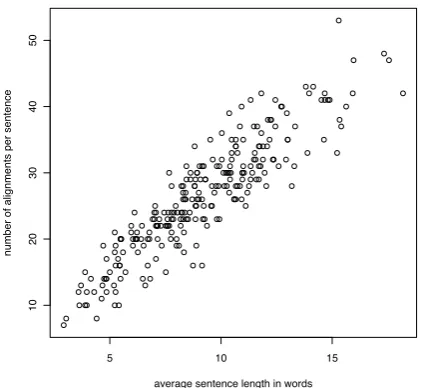
As a first step to show that our method yields promising results we ran the method for the 27 Indo-European languages in our sample in order to see what kind of global language similarity arises when using the present approach. In our procedure, each sentence is separated into various multilingual alignments. Because the structures of languages are different, not each alignment will span across all languages. Most alignments will be ‘sparse’, i.e., they will only include words from a subset of all languages included. In total, we obtained 6,660alignments (i.e., 26.4 alignments per sentence on average), with each alignment in-cluding on average 9.36 words. The number of alignments per sentence turns out to be linearly related to the average number of words per sen-tence, as shown in Fig. 1. A linear interpolation results in a slope of2.85, i.e., there are about three times as many alignments per sentence as the av-erage number of words. We expect that this slope depends on the number of languages that are in-cluded in the analysis: the more languages, the steeper the slope.
5 10 15
10
20
30
40
50
average sentence length in words
[image:6.595.76.287.502.696.2]number of alignments per sentence
Figure 1: Linear relation between the average number of words per sentence and number of alignments per sentence
We use the LLmatrix as the similarity matrix for languages including all6,660alignments. For each language pair this matrix contains the num-ber of times words from both languages are at-tested in the same alignment. This similarity ma-trix is converted into a distance mama-trix by sub-tracting the similarity value from the highest value that occurs in the matrix:
LLdist =max(LL)−LL
This distance matrixLLdistis transformed into
a NeighborNet visualization for an inspection of the structures that are latent in the distance ma-trix. The NeighborNet in Fig. 2 reveals an ap-proximate grouping of languages according to the major language families, the Germanic family on the right, the Romance family on the top and the Slavic family at the bottom. Note that the sole Celtic language in our sample, Welsh, is included inside the Germanic languages, closest to English. This might be caused by horizontal influence from English on Welsh. Further, the only Baltic lan-guage in our sample, Lithuanian, is grouped with the Slavic languages (which is phylogenetically expected behavior in line with Gray and Atkin-son (2003)), though note that it is grouped par-ticularly close to Russian and Polish, which sug-gests more recent horizontal transfer. Interest-ingly, the separate languages Albanian and Greek roughly group together with two languages from the other families: Romanian (Romance) and Bul-garian (Slavic). This result is not in line with their phylogenetic relatedness but rather reflects a con-tact situation in which all four languages are part of the Balkan Sprachbund.
Afrikaans
English
Welsh
German
Icelandic
Lithuanian Polish
Russian Ukrainian Czech Slovak Slovenian Croatian
Serbian Albanian
Greek Bulgarian
Romanian Portuguese
Spanish Catalan
French Italian
Danish
Norwegian Swedish
[image:7.595.150.465.86.342.2]Dutch 1000000.0
Figure 2: NeighborNet (created with SplitsTree, Huson and Bryant (2006)) of all Indo-European languages in the sample
the influence of language contact is not related to loanwords but to the borrowing of similar con-structions or structural features. In the Balkan case, linguists have noted over one hundred such shared structural features, among them the loss of the infinitive, syncretism of dative and geni-tive case and postposed articles (cf. Joseph (1992) and references therein). These features are partic-ularly prone to lead to a higher similarity in our approach where the alignment of words within sentences is sensitive to the fact that certain word forms are identical or different even though the exact form of the word is not relevant.
5.2 Typology of PERSON interrogatives
A second experiment we conducted involved a closer study of just a few questions in the data at hand to obtain a better impression of the results of the alignment procedure. For this experiment, we took the same 252 questions for a worldwide sample of 50 languages. After running the whole procedure, we selected just the six sentences in the sample that were formulated in English with a who interrogative, i.e., questions as to the person who did something. The English sentences are the
following:
I Who will be resurrected? II Who will rule with Jesus? III Who created all living things?
IV Who are god’s true worshipers on earth to-day?
V Who is Jesus Christ?
VI Who is Michael the Archangel?
We expected to be able to find all translations of English who in the alignments. Interestingly, this is not what happened. The six alignments that comprised the English who only included words in 23 to 30 other languages in the sample, so we are clearly not finding all translations ofwho. By using a clustering onAAstatistical we were able
clusters of languages, two ‘types’ so to speak, as can be seen in Fig. 3.
Investigating the reason for these two types, it turns out that the languages in the right cluster of Fig. 3 consistently separate the six sentences into two groups. The first, second, and fourth sen-tence are differently marked than the third, fifth and sixth sentence. For example, Finnish uses ketk¨a vs. kuka and Spanish qui´enes vs. qui´en. These are both oppositions in number, suggesting that all languages in the right cluster of Fig. 3 dis-tinguish between a singular and a plural form of who. Interpreting the meaning of the English sen-tences quoted above, this distinction makes com-plete sense. The Ewe formamekawoein example vi.(see Section 3) contains the plural marker-wo, which distinguishes it from the singular form and indeed correctly clusters together withqui´enesin the alignment cluster 5.
This example shows that it is possible to use parallel texts to derive a typology of languages for a highly specific characteristic.
6 Conclusion and Future Work
One major problem with using our approach for phylogentic reconstruction is the influence of lan-guage contact. Traits of the lanlan-guages which are not inherited from a common proto-language but are transmitted through contact situations lead to noise in the similarity matrix which does not re-flect a genealogical signal. However, other meth-ods also suffer from the shortcoming that lan-guage contact cannot be automatically subtracted from the comparison of languages without man-ual input (such as manman-ually created cognate lists). With translational equivalents, a further problem for the present approach is the influence of trans-lationese on the results. If one version in a lan-guage is a direct translation of another lanlan-guage, the structural similarity might get a higher score due to the fact that constructions will be literally translated which otherwise would be expressed differently in that language.
The experiments that have been presented in this paper are only a first step. However, we firmly believe that a multilingual alignment of words is more appropriate for a large-scale comparison of languages than an iterative bilingual alignment. Yet so far we do not have the appropriate evalu-ation method to prove this. We therefore plan to include a validation scheme in order to test how
much can be gained from the simultaneous analy-sis of more than two languages. Apart from this, we intend to improve the alignment method itself by integrating techniques from statistical align-ment models, like adding morpheme separation or phrase structures into the analysis.
Another central problem for the further devel-opment of this method is the selection of align-ments for the language comparison. As our sec-ond experiment showed, just starting from a se-lection of English words will not automatically generate the corresponding words in the other lan-guages. It is possible to use theAA matrices to search for further similar alignments, but this pro-cedure is not yet formalized enough to automati-cally produce language classification for selected linguistic domains (like for the PERSON interrog-atives in our experiment). When this step is better understood, we will be able to automatically gen-erate typological parameters for a large number of the world’s languages, and thus easily produce more data on which to base future language com-parison.
Acknowledgements
This work has been funded by the DFG project “Algorithmic corpus-based approaches to typo-logical comparison”. We are grateful to four anonymous reviewers for their valuable com-ments and suggestions.
References
Peter F. Brown, John Cocke, Stephen A. Della-Pietra, Vincent J. Della-Pietra, Frederick Jelinek, Robert L. Mercer, and Paul S. Roossin. 1988. A statistical approach to language translation. In Proceedings of the 12th International Conference on Computa-tional Linguistics (COLING-88), pages 71–76. William Croft. 2000. Explaining Language Change:
An Evolutionary Approach. Harlow: Longman.
Michael Cysouw and Bernhard W¨alchli. 2007. Paral-lel texts: using translational equivalents in linguis-tic typology. Sprachtypologie und Universalien-forschung STUF, 60(2):95–99.
Michael Dunn, Angela Terrill, Ger Reesink, R. A. Fo-ley, and Steve C. Levinson. 2005. Structural phylo-genetics and the reconstruction of ancient language history. Science, 309(5743):2072–5, 9.
Al ba ni an R aro to ng an Ma lte se Ma la ga sy Lithuanian Ilo ko C ro at ia n C hi ch ew a Bu lg ari an G erma n Po na pe an Pa pi ame nt o (Aru ba ) Pa pi ame nt o (C ura ça o) D ut ch
Niuean Miski
to In do ne si an
Italian Kirib
at i F re nch En gl ish D an ish H ai tia n C re ol e Catalan Af rika an s At eso Fijian T uva lu an Sw ed ish Guna H un ga ria n Q ue ch ua (An ca sh ) Kw an ya ma T umb uka C hi n (H akh a) T sw an a Sp an ish
Ndonga Nya
ne ka G re ek F in ni sh Ew e D an gme Chitonga Sh on a Bi co l Xi tsh w a Ach ol i Luganda Se pe di 10 15 20 25 30 Cluster Dendrogram
hclust (*, "complete") as.dist(max(LL) - LL)
[image:9.595.99.504.75.230.2]Height
Figure 3: Hierarchical cluster using Ward’s minimum variance method (created with R, R Development Core Team (2010)) depicting a typology of languages according to the structure of their PERSON interrogatives
Russell D. Gray and Quentin D. Atkinson. 2003. Language-tree divergence times support the Ana-tolian theory of Indo-European origin. Nature, 426:435–439.
Daniel H. Huson and David Bryant. 2006. Applica-tion of phylogenetic networks in evoluApplica-tionary stud-ies. Molecular Biology and Evolution, 23(2):254– 267.
Brian D. Joseph. 1992. The Balkan languages. In William Bright, editor,International Encyclopedia of Linguistics, pages 153–155. Oxford: Oxford Uni-versity Press.
Philipp Koehn. 2010. Statistical Machine Translation. Cambridge University Press.
Franz Josef Och and Hermann Ney. 2003. A sys-tematic comparison of various statistical alignment models.Computational Linguistics, 29(1):19–51. Mark Pagel. 2009. Human language as a culturally
transmitted replicator. Nature Reviews Genetics, 10:405–415.
Uwe Quasthoff and Christian Wolff. 2002. The poisson collocation measure and its applications. InProceedings of the 2nd International Workshop on Computational Approaches to Collocations, Vi-enna, Austria.
R Development Core Team, 2010. R: A language and environment for statistical computing. Wien: R Foundation for Statistical Computing.
Michel Simard. 1999. Text-translation alignment: Three languages are better than two. In
Proceed-ings of EMNLP/VLC-99, pages 2–11.
Michel Simard. 2000. Text-translation alignment: Aligning three or more versions of a text. In Jean V´eronis, editor, Parallel Text Processing: Align-ment and Use of Translation Corpora, pages 49–67. Dordrecht: Kluwer Academic Publishers.
Lydia Steiner, Peter F. Stadler, and Michael Cysouw. 2011. A pipeline for computational historical
linguistics. Language Dynamics and Change, 1(1):89–127.
J¨org Tiedemann. 2011. Bitext Alignment. Morgan & Claypool Publishers.