Automatic generation of conversational utterances and narrative for
Augmentative and Alternative Communication: a prototype system
Martin Dempster & Norman Alm
Ehud Reiter
School of Computing
Computer Science Department
University of Dundee
University of Aberdeen
Dundee, Scotland, DD1 4HN, UK
Aberdeen, Scotland, AB24 3UE, UK
[email protected]
[email protected]
[email protected]
Abstract
We detail the design, development and evalua-tion of Augmentative and Alternative Com-munication (AAC) software which encourages rapid conversational interaction. The system uses Natural Language Generation (NLG) technology to automatically generate conver-sational utterances from a domain knowledge base modelled from content suggested by a small AAC user group. Findings from this work are presented along with a discussion about how NLG might be successfully applied to conversational AAC systems in the future.
1
Introduction
Augmentative and Alternative Communication (AAC) systems assist non-speaking people communi-cate. Reasons for lack of speech are varied and can be complex, but they are typically related to some pro-found cognitive and/or motor impairment.
Most AAC systems are computer based, utilize syn-thesized speech output and employ a phrase-construction approach to input. This approach requires the user to construct the majority of their utterances live during conversation. Undoubtedly this facilitated com-munication is hugely important to those without natural speech. However, this process is often unacceptably slow and can lead to problematic and stilted interac-tions, mostly due to the rapid nature of unimpeded face-to-face communication.
Previous work has shown that it is possible to hold mutually rewarding conversations using wholly pre-stored material, known as the phrase-storage approach. Utterances are authored ahead of time and can be se-lected and output immediately leading to quicker
com-munication rates. However, this approach suffers from several drawbacks which may have affected its more general adoption.
Furthermore, Natural Language Processing (NLP) technology has proven to be a fruitful line of inquiry within the field. It has offered a powerful means to im-prove system productivity and usability. We are current-ly investigating how Natural Language Generation (NLG) might be applied in a useful way within an AAC device geared towards fast-paced and rewarding social interactions. It is hoped that the linguistic control and automaticity offered by NLG may go some way towards addressing the previous criticisms of pre-stored material regarding its inflexibility and cost in effort.
2
Background
2.1 Limitations of current AAC
High-tech AAC systems typically augment commu-nication for non-speaking people by allowing live mes-sage construction through some orthographic means. Completed messages are generally sent to a speech syn-thesis engine for output during communication with others. Many people who require AAC have associated physical disabilities which reduce the speed achievable using input methods such as keyboards, pointing devic-es or touch-screens. The rate achievable using most commercial AAC systems is highly dependent on the nature of the user‟s disabilities but a generally accepted figure is in the region of 2-15 words per minute (Hig-ginbotham, Shane et al. 2007), at least an order of mag-nitude slower than most natural speakers.
This relatively slow rate of input is a crucial factor in some of the issues that arise in AAC-facilitated commu-nication. Because of the effort and time required to create utterances, the user may not be able to construct messages quickly enough to take active roles in fast
paced conversations. As a result users may become pas-sive while also typically using a smaller communicative repertoire than natural speakers (Light 1988).
Narrative, an important type of interpersonal com-munication, is not well handled in most communication aids (Waller 1992). Delayed response and slow rate of aided-communication are correlated with higher inci-dence of breakdown in communication and lesser per-ceptions of the AAC user (Todman and Rzepecka 2003; McCarthy and Light 2005). This is primarily due to conflict between the relatively long time necessary to formulate an utterance and the fast paced nature of con-versation.
These problems are particularly critical in social con-texts. AAC users typically have small social circles and are dependent on contact with families and carers. They often lack self-esteem and have negative self-image. As a result, developing new relationships and experiencing new things can be difficult, despite being a major priori-ty in their lives (Datillo, Estrella et al. 2007).
Some work has suggested that the use of pre-stored conversational material based on conversation models could help increase communication rate and conversa-tion quality. Alm (1988) showed that it is possible to successfully model short „chat‟ conversations involving greetings, personal enquiries and small-talk. Further-more, the TALK system allowed a user to pre-store a large volume of material on specific topics so that whole utterances could be selected and output. The sys-tem also made heavy use of quick-fire phrases, classes of regularly used utterance which could be accessed quickly, and showed that communication using solely pre-stored material was viable (Todman and Alm 2003). Despite encouraging results and the development of a commercial product, the phrase-storage approach to social communication has not gained wide popularity. The reasons for this are complex, but include: the rela-tive inflexibility of pre-stored material; the costs asso-ciated with authoring the material and keeping the material up-to-date; and the vastly different nature of the approach and different training requirements neces-sary to achieve success.
2.2 The role of NLP in AAC
NLP technology has provided many benefits to AAC system designers. Possibly the first technology to be included in many commercial systems to date was word prediction and completion. There have also been many research prototypes exploring the applicability of more emerging technologies such as named entity recognition from synthesized speech (Wisenburn and Higginbotham 2008), the generation of well-formed utterances from
telegraphic input (McCoy, Pennington et al. 1998) and the automatic identification of contextual vocabulary from the web (Higginbotham, Bisantz et al. 2008). Netzer and Elhadad (2006) used NLG to allow the se-mantic authoring of utterances.
However, NLG, in the sense of data-to-text (Reiter and Dale 2000), has had limited application within AAC thus far, although Reiter et al. (2009) showed it is possi-ble to generate stories from sensor data which allow a child using AAC to tell others about their day at school.
2.3 System Rationale
This project is exploring the use of NLG to produce conversational utterances in AAC systems designed for social interaction. At the outset it was hoped that using NLG might address some of the difficulties observed in pre-storage systems. For instance, the generation com-ponent could theoretically produce a range of utterances and speech act types automatically from the same un-derlying data and adapt these somewhat to the interac-tional context. Using NLG would also have the benefit of offering control over the well-formedness of the out-put, an important consideration given the difficulty some AAC users have in achieving literacy (Sandberg and Hjelmquist 1997). The fact that the system has an inherent awareness of the semantic content of the lin-guistic output, rather than simply being stored as canned text, is also a potential benefit. In other words, NLG might offer a level of automaticity and flexibility that traditional pre-storage systems cannot offer, as well as potentially reducing the level of pre-authoring required from the user.
3
System Development
3.1 User-centered methodology
To try to assess how useful NLG could be in this context we adopted a user-centered approach to the de-sign of the system. A group of 3 AAC users has been recruited, all of whom currently use some form of high-tech AAC. Literacy amongst the group is varied. Two of the individuals use the alphabetic keyboard-based Lightwriter communication device currently, and have normal cognitive and visual-perceptive skills. All of the users have cerebral palsy and dysarthria, and have been involved in previous software evaluations.
discussion about the user‟s ideas for the software and technology; the identification of topics and collation of input data to the system; demonstrations of the new fea-tures or changes since the last session; system training; and dry-run testconversations between the investigators and the users.
3.2 System Architecture
A growing line of inquiry in the NLG community is the generation of language from ontologies (Mellish and Sun 2005). An ontology is a logical and hierarchical model of the different concepts and the nature of rela-tionships between concepts in a particular domain. These concepts and relationships can be mapped onto linguistic constructs to allow for the production of natu-ral language descriptions (Karakatsiotis, Galanis et al. 2008) of parts of the ontology.
In the case of our system, we are trying to model conversational topics that would be of interest in social conversation between users of the system and their co-conversationalists. The current categories of topic we are experimenting with include travelling, listening to music, watching films and attending concerts. Many categories are based on a simple event model which defines the basic characteristics common to all events, such as a time of occurrence (see Fig.1). We have also included concepts such as Person and Place which are associated with events to form a logical model of a par-ticular event type.
[image:3.612.329.508.322.480.2]A separate file is created unique to each user which is linked to the original model. This is filled with individ-uals consisting of data from the user. In other words, rather than defining the concept of an event as we did with the original ontology, here we are creating a de-scription of an actual event and any other details, such as people or places, associated with it. We have defined our ontology in OWL, a standard language for the defi-nition of ontologies, and each piece of knowledge is effectively stored as a RDF Triple consisting of a sub-ject, predicate and object.
Figure 1: The abstract event model
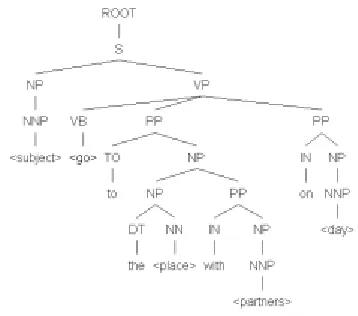
The user‟s knowledge base is turned into useful con-versational utterances through a template-driven utter-ance generation system (e.g. Van Deemter, Krahmer et al. 2005). A large set of templates has been authored, using the SimpleNLG programming interface, which turn data from the onotlogy into natural language utter-ances. The templates are created as concrete syntax trees containing unspecified „slots‟ and parameters (See Fig.2). These syntax trees map out the syntactic struc-ture of the template), and are linked to a particular class in the ontology so that only appropriate templates are applied to each individual. Slots are used to add con-textually relevant clauses to our utterances. For exam-ple, a template might contain a ‘time’ slot, the contents of which are derived from the time of the event in ques-tion. For instance, the slot might be filled with “next Tuesday evening”, “a month ago” or “this morning” depending on the context. Example parameters include the tense with which the utterance should be generated, and whether a pronoun or full noun phrase should be used to refer to the subject of the utterance.
Figure 2: An example syntax tree with empty slots In addition to the language produced from the model and knowledge base we have included the ability to add canned text phrases to each individual.
[image:3.612.84.288.565.678.2]The system has also been designed to learn over time the sequences of utterances a user selects and suggest next moves based on past behavior. The system does this by maintaining a directional weighted graph which records sequences of utterances as they are used. The graph works by recording each individual utterance as a node in the graph and creating relationships between these nodes as they occur. The more often two utter-ances appear in sequence the higher the value given to the edge between the two corresponding nodes.
3.3 Conversation model and interface issues
Perhaps the most challenging aspect of taking the system from initial concept to working prototype has been finding the most effective way of interfacing the technology. We have found that due to the complexity of the underlying technology, reaching the stage where generated utterances are both useful and accessible to the user during conversation has required careful con-sideration and the trialing of several approaches with the user group.
It was envisaged that the generative power of NLG would be its most powerful benefit. The system could realize the same piece of data as numerous speech act types and, within a speech type, in several different phrasings. This offered the ability to counteract the in-flexibility and uniformity of pre-stored utterances somewhat. However, we have had mixed success in achieving this goal as it has proven difficult to find an effective way to interface this enhanced choice and va-riety to the user. If there is a large volume of generated utterances available to choose from we must provide an efficient means by which the material is presented or organized so that the desired utterance can be located quickly. If a large choice results in a delayed selection and thus conversational turn, we may then lose any rate and speed of response benefits which would negate the need to use pre-stored and generated material at all.
To address this problem, we attempted to design a conversational model which controlled the generation of utterances so that only the utterances deemed most like-ly were presented to the user, thus reducing the cogni-tive load required to search through a large set. This was done using a basic system where the templates were tagged according to where it might be most likely to be used in a conversation on a topic. For instance, a tem-plate might produce a pre-sequence, an introduction, elaboration or concluding remark, or it may produce a interrogative. With the addition of historical sequential moves from our directional graph we could begin to present subsets of utterances to the user according to where they were in topic development.
Another approach trialed was inspired by the Gricean maxim of quantity. Each template contains meta-data about the information it expresses. For each generated utterance selected, we can „rule out‟ further generation of the same information. This is based on the assump-tion that speakers will generally avoid repetiassump-tion. We have found that this technique provides a useful way of supporting discourse coherence within conversations.
Finally, using the logical model of topics we have created, it is possible to support and model stepwise topic progression. We can suggest, based on the model and the user knowledge base, other topics linked to the one currently selected. For example, if we were talking about an upcoming holiday to London with a friend called Bob we may want to the change topical perspec-tive to related aspects of the trip. We might want to talk about London as a place, Bob as a friend, and other trips we have taken with Bob or to London. Because these concepts are all distinct within the model, they each have their own set of associated templates and result in sets of candidate utterances with differing perspectives. Navigating to related topics in this manner should be quicker since related topics do not have to be located manually. Although the users are still being trained in this approach to topic change, early evaluations are promising. It enables a „one-click‟ transition to related topics, allowing the user to elaborate on certain aspects of a previous topic and respond quickly to questions from their conversational partners.
Building on the last two mechanisms, we can also generate bridging phrases which allow for more cohe-sive changes in topic. This allows for a more eloquent transition to a new topic and also aids the discourse co-herence.
All of these approaches in fact belie, to some degree, the complexity of conversation. By its very nature, con-versation is unpredictable, and the purpose and meaning of sequential moves are highly dependent on their con-text (Clark 1996). However, any form of concon-text identi-fication, such as speech recognition (Wisenburn and Higginbotham 2008), is likely to present a major tech-nical challenge in any production AAC system at the current time. The above are simply at attempt to model, using the NLP/AI techniques available, aspects of communication process, to show the potential benefits when using NLG-produced utterances rather than sim-ple canned text utterances.
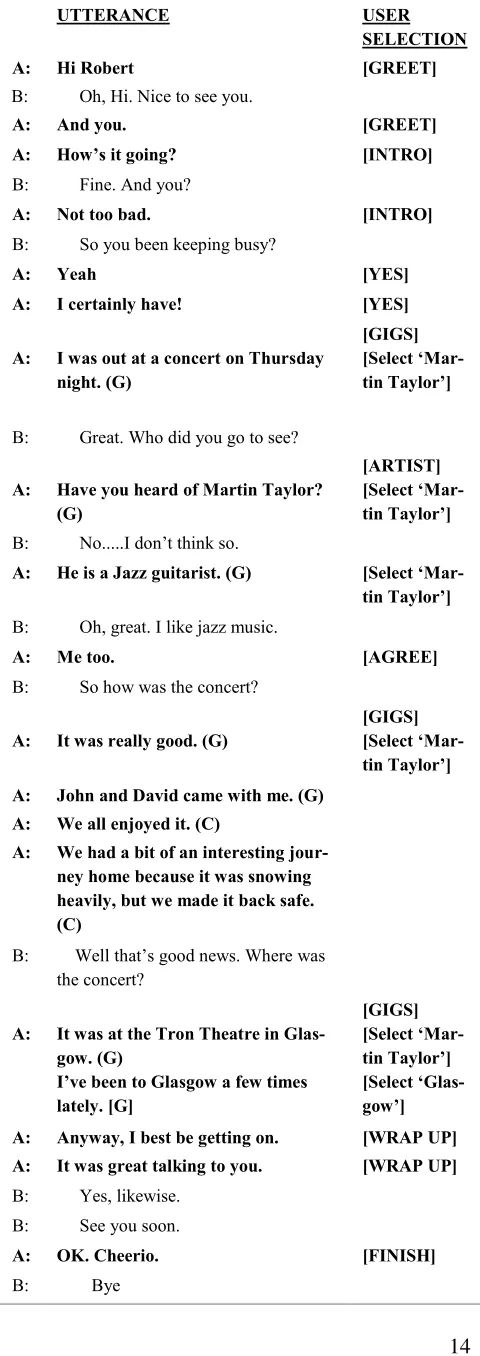
Table 1: An example conversation produced using the system. Speaker A is the user and speaker B is an unaided speaker. The right-hand column shows the interface selections necessary prior to selecting the utterance from a set of possibilities. The marker G represents a generated utterance, C represents canned text. The remainder are quick-fire utterances.
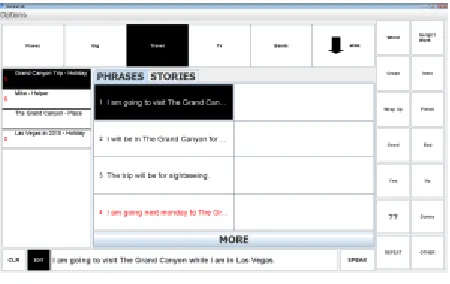
We believe this does not suggest that use of such conversational models and semantic processing is not feasible, but simply that in the scope of the current work it has not been possible to fully evaluate their potential. Thus we have chosen to generate candidate phrases in a static manner without the predictive as-pects described above. These changes have allowed for quicker achievement of proficiency and have lowered the cognitive effort required to navigate the interface. In the latest version of the software, we have de-fined a set of templates for each topic which when realized in series produce a coherent narrative. They can still be selected individually by the user for output, so they retain ultimate control of what is said, but the utterances are presented in a natural order. This means that the user can easily make use of the utterances as a narrative or can choose according to the particular sit-uation and context. Any interrogative templates are displayed in a different part of the interface. We have set up a two column display so that interrogatives and other statements are clearly delineated.
This approach has had very promising results as we have found that users no longer have to search through a list of suggestions which changes after each conver-sational turn. They can also use the structured nature of the generated utterances to confidently introduce the different topics in conversation. We are finding some evidence of increased self-selection at the end of their current turn as the user is easily able to continue their narrative automatically without having to worry about the location of their next turn in the interface. There is some other evidence of this structured application of NLG to narrative as being a promising area (Reiter, Turner et al. 2009).
We also believe that the passivity and lack of initia-tion observed in AAC users could be positively ad-dressed if AAC systems can better support a more varied communicative repertoire and suitable training is administered to show users how to confidently use these different constructs (e.g. Todman 2000). Early training sessions with our user group have again proved positive with increased use of the trained fea-tures and interaction styles.
UTTERANCE USER
SELECTION
A: Hi Robert [GREET]
B: Oh, Hi. Nice to see you.
A: And you. [GREET]
A: How’s it going? [INTRO]
B: Fine. And you?
A: Not too bad. [INTRO]
B: So you been keeping busy?
A: Yeah [YES]
A: I certainly have! [YES]
A: I was out at a concert on Thursday night. (G)
[GIGS] [Select ‘Mar-tin Taylor’]
B: Great. Who did you go to see?
A: Have you heard of Martin Taylor? (G)
[ARTIST] [Select ‘Mar-tin Taylor’]
B: No...I don‟t think so.
A: He is a Jazz guitarist. (G) [Select ‘Mar-tin Taylor’]
B: Oh, great. I like jazz music.
A: Me too. [AGREE]
B: So how was the concert?
A: It was really good. (G)
[GIGS] [Select ‘Mar-tin Taylor’] A: John and David came with me. (G)
A: We all enjoyed it. (C)
A: We had a bit of an interesting jour-ney home because it was snowing heavily, but we made it back safe. (C)
B: Well that‟s good news. Where was the concert?
A: It was at the Tron Theatre in Glas-gow. (G)
I’ve been to Glasgow a few times lately. [G]
[GIGS] [Select ‘Mar-tin Taylor’] [Select ‘Glas-gow’] A: Anyway, I best be getting on. [WRAP UP] A: It was great talking to you. [WRAP UP]
B: Yes, likewise. B: See you soon.
A: OK. Cheerio. [FINISH]
[image:5.612.66.306.58.736.2]3.4 Authoring user content
Currently we have not managed to produce a tool that the user can use to update their knowledge base them-selves. The ontology editing tool used in the program, Protégé, is a free academic software package designed for knowledge engineers and thus has a high degree of internal complexity and takes time to learn. It is also not a particularly accessible piece of software.
We have worked with the users to build up their knowledge bases over a series of meetings by allowing them to suggest individuals to add while entering the details for them into the system. The process of defining new individual is very quick, usually requiring the input of just a few words and selection of the associated indi-viduals. However, one of the main criticisms on the part of the users is that for the system to be useful in the long term, it must be kept up to date, as old material will quickly become less relevant and useful in less frequent situations. For this reason it is critical to the success of any NLG-driven communication system that the data input is as simple and seamless as possible.
We have shown in our system that it is possible to get some limited data automatically from online sources, rather than having to input it manually. Many web ser-vices are being made available which enable program-mers to access data from online services in their applications. For instance, both Amazon and YouTube have their own APIs which allow 3rd party applications
to request content information from these services. The notion of the semantic web is also related to this. There is a large effort underway to define how we might structure and link information on the web in such a way that more of it can be processed automatically by com-puters and made available in interchangeable formats.
Shared data and semantic web technologies such as these operate on the same premise as our proposed communication system in that they map out the basic
vocabulary required to describe a domain, and allow people describe aspects of the domain in these terms.
We have used an API provided by social music web-site Last.fm to show that it is possible to create relevant conversational utterances without any authoring re-quirement whatsoever. By supplying the users Last.fm username, we can use a web service supplied by the site to query the user‟s recent activity, for instance the songs they have listened to, songs rated highly or events which they have signed up to attend. Because the output from these services comes as structured XML document we can simply map it‟s schema onto our own vocabulary and feed the appropriate data to our templates to pro-duce utterances.
If web services are to be used we must have an equivalent local vocabulary to which we can map the data returned from any queries we send the service. However, in the case of semantic web sources, for ex-ample the FOAF (friend-of-a-friend) vocabulary (Brick-ley) describing online social networks, the process is simpler as we can simply use the pre-existing vocabu-lary standard ourselves rather than having to develop our own. Despite the semantic web being in its infancy, the notion of shared data is growing in popularity and many popular websites and organizations are providing access to their information in a structured way.
One problem with using these types of data acquisi-tion methods for our purposes is that the data is largely generic and any personal opinion or evaluative informa-tion personal to the user is limited. In some cases we may be able to query the data source for a rating awarded to a particular piece of content, for instance the star rating system on YouTube, but it is not clear how expressive the produced language will be since the process is likely to be a simple mapping from the rating to a suitable adjective. As in our system, the potential usefulness of the generated language is likely to be in-creased if it is possible for the user to annotate the top-ics with their own canned text expressions and evaluations. This will enable the system to express more of the individual‟s personality and opinions.
[image:6.612.73.298.65.207.2]and gain wider adoption it should be clearer what the potential of the technology is.
4
Formal Evaluation Methodology
In our evaluations so far, we have concentrated on training the users in its operation, updating conversa-tional material and implementing changes based on the user feedback. We have recently begun testing the sys-tem in real conversational encounters and the results have been promising. We have found it is possible to hold pleasing conversations lasting up to 20 minutes with unfamiliar partners, with the aided communicator achieving a rate of upwards of 40 wpm.
There also seems to be higher incidences of initia-tions on the part of the user, with them making good use of both the scripted NLG material, the quick fire phrases and their own pre-stored material. The topic progression feature is currently being underused but subjects are responding well to training sessions on how to incorpo-rate this to reduce their response time and expand on topics to extend the amount they are able to say.
Formal evaluations are now being undertaken. An AB multiple-baseline study design is being conducted in which each aided communicator has a series of conver-sations with 12 unknown and unaided conversation partners. In the A condition, the aided participants use their existing AAC system, while in the B condition they use our prototype system. Each conversation will be limited to approximately 10 minutes, and the ses-sions will be split across a three non-consecutive days to avoid user fatigue.
There will be at least 3 conversations in both the A and B conditions, and the intervention point will be ran-domized across the remaining 6 conversations to allow for valid inferences to be made despite the small n value (Todman and Dugard 2001). This also reduces the bias introduced by any training effects and avoids the need to use a response-guided intervention after baseline per-formance has been established. The difficulty and ex-pense of recruiting large numbers of subjects in AAC studies is a known problem (Higginbotham 1995) and therefore any findings from quantitative analysis per-formed cannot be generalized across the AAC popula-tion. However, we expect to be able to achieve a p value using the randomization design of <0.05 so the results should at least be internally robust and give a good indi-cation of whether further investigation is warranted.
The conversations will be audio-recorded and ana-lyzed for a number of metrics. Primarily we are interest-ed in measuring the rate at which people are able to communicate using the new system as this seems to be
one of the clearest indicators of success when evaluating a new AAC intervention. We expect to the effect size observed across the conditions to be large.
We are also particularly interested whether it is poss-ible to use automatically generated material while main-taining or enhancing the enjoyment and quality of the encounter for all participants. It is still unclear how acceptable generated material will be to the user so we will measure the relative frequency of generated and canned-text utterances.
In previous studies it has also been shown that the use of a whole-utterance approach can change the dy-namics of communication, such as relative speech act distribution and number and type of initiation, so we are interested to see how the availability generated material might impact this and what role it might play. A coding schema based on Wang (2007) will be used to categor-ize the utterances used.
We are also asking the aided and unaided conversa-tion partners to complete quesconversa-tionnaires regarding vari-ous subjective ratings of the interactions and, in the case of the unaided speakers, impressions of the aided com-municator. The questions will be based on a re-evaluation of those suggested by Todman (2000) and answers will be requested on a 7-point rating scale. Pre-vious work has shown that quicker, flowing interactions with less breakdowns or delays can lead to more re-warding interactions for both participants. We expect to observe these effects in our system but it‟s as yet un-clear what impact the automatically generated phrases will have, if any, on perceptions of the user.
Although the relatively small number of participants means it is unlikely that we will be able to make robust inferences from this data, we hope that results will be indicative of the naturalness and acceptability of auto-matically generated utterances.
5
Discussion & Future Plans
One of the primary reasons that AAC systems featur-ing NLP technology prove useful is that they go some way to leveling the playing field for many users. They have the potential to support the user in ways which reduce the effort required to communicate yet may im-prove the quality of the communication. There are many NLP technologies, such as NLG, that deserve further attention within the field of AAC to determine what they can offer.
are to use. Given that the user has not authored the form of the utterances themselves there is an argument that using them may feel unnatural. After the formal evalua-tions we should be able provide analysis indicating whether NLG phrases are being used and in which sit-uations they are proving most useful.
One of the most challenging aspects of designing the system was the HCI challenge of incorporating some of these technologies. While it is obvious to the user that phrases are being generated automatically, and that these phrases are generated when a topic is selected, it is still important to note that the technologies have been intentionally kept largely transparent to the user. When using a communication system, the most important thing is the ability to say what you want to say, but is not yet clear whether the technical nature of the soft-ware may be an alienating factor since the user current-ly has no access to the template construction or domain modeling aspects of the system.
At the current time, the domain modeling and tem-plate construction processes are quite complex and ex-pensive. Tools are becoming available, from the NLG community, which go some way to addressing the diffi-culty of interfacing these types of technology to non-experts (Bilidas, Theologou et al. 2007; Power, Stevens et al. 2009) but these are largely unsolved problems.
Domain modeling itself is problematic in that one persons notion of what defines a particular concept is often different to someone else‟s. For instance, one per-son‟s idea of sport might encompass the sporting activi-ties they take part in, while another person‟s idea of sport is that which they follow or watch on the televi-sion. This has clear implications for the general usabili-ty of the system. Using semantic web vocabularies may address this somewhat since they are likely to be more specific to a particular purpose and be more mature and interoperable than the ‘home-brew’ domain models we have used for the prototype.
Using whole-utterance approaches to communication clearly requires the adoption of a different mindset. Ra-ther than being able to construct a novel message the user has to „make do’ with whatever is available in the system. Despite the advantages observed while using such systems, they have still not become generally pop-ular. It is likely that any NLG whole utterance system would similarly not gain immediate acceptance because it is vastly different to other systems and approaches to communication available. To some degree we are ask-ing the user of our NLG system to think in an object orientated manner since they must understand the un-derlying model and the way the concepts are structured to make the most of the system. Again it is not yet clear how natural this process is and how much training is required to become an expert user of such a system.
However perhaps the major strength of these types of system is the way in which they help scaffold interac-tion so the AAC user can be much more active in con-versation and use an increased repertoire. The design of the software is such that it encourages the use of types of phrases often underused by AAC users, for example, initiations, elaborating moves, questions and the differ-ent classes of quick-fire remarks. One interesting ques-tion is whether the use of NLG might make it easier to encourage the user to use new types of conversational move. Since no full text-authoring is required the user does not even have feel confident authoring the utter-ance, it is simply provided and can be used or experi-mented with. Scaffolding interactions in this way may be one of the most interesting avenues for NLP and AI technologies with AAC in the future.
The architecture of the prototype, although effective, lacks efficiency and may be difficult to reuse. A great deal of work is being done by NLG researchers investi-gating how NLG architectures might be made more modular and reusable. This is an ongoing problem but it seems sensible to consider how a pipeline architecture (Reiter and Dale 2000) might work in practice for this type of system.
At the moment, the system requires a reasonable lev-el of literacy because the interface is mainly text based. However, semiotic systems are preferred because of the literacy problems observed in many AAC users. It is not clear how NLG may impact on semiotic message con-struction but systems such as Compansion (McCoy, Pennington et al. 1998) show there may useful applica-tions in this area too.
6
Conclusion
Despite having only been able to perform informal evaluations so far, we believe we have seen some en-couraging signals that NLG may have potential as an augmentative communication technology to assist in generating conversational utterances. We believe that the rapid access to well-formed, contextually generated material offered in our system could lead to significant benefits for the AAC user and their interlocutors.
7
References
Alm, N. A. (1988). Towards a Conversation Aid for Severely Phisically Disabled Non-Speaking People. Applied Computing Department. Dundee, University Of Dundee. Doctor Philosophy: 197.
Bilidas, D., M. Theologou, et al. (2007). Enriching OWL Ontologies with Linguistic and User-related Annotations: the ELEON system. 19th IEEE Interna-tional Conference on Tools with Artificial Intelli-gence, IEEE.
Brickley, D. (25.2.10). "FOAF Vocabulary Specifica-tion ", from http://xmlns.com/foaf/0.1/
Clark, H. H. (1996). Using Language, Cambridge Uni-versity Press.
Cohen, K. J. (1999). Using the Internet to Empower Augmented Communicators. CSUN'99.
Datillo, J., G. Estrella, et al. (2007). ""I have chosen to live life abundantly": Perceptions of leisure by adults who use Augmentative and Alternative Communica-tion." Augmentative & Alternative Communication 24(1): 16-28.
Higginbotham, D. J. (1995). "Use of nondisabled sub-jects in AAC Research : Confessions of a research in-fidel." Augmentative and Alternative Communication 11(1): 2-5.
Higginbotham, D. J., A. M. Bisantz, et al. (2008). "The Effect of Context Priming and Task Type on Augmen-tative Communication Performance." AugmenAugmen-tative & Alternative Communication.
Higginbotham, D. J., H. Shane, et al. (2007). "Access to AAC: Present, past, and future." Augmentative & Al-ternative Communication 23(3): 243-257.
Karakatsiotis, G., D. Galanis, et al. (2008). Natura-lOWL: Generating Texts from OWL Ontologies in Protege and in Second Life. 18th European Confe-rence on Artificial Intelligence.
Light, J. (1988). "Interaction Involving Individuals us-ing Augmentative and Alternative Communication Systems: State of the Art and Future Directions." Augmentative and Alternative Communication 4(2): 66-82.
McCarthy, J. and J. Light (2005). "Attitudes towards individuals who use Augmentative and Alternative Communication: Research Review." Augmentative and Alternative Communication 21(1): 41-55.
McCoy, K. F., C. A. Pennington, et al. (1998). "Com-pansion: From research prototype to practical integra-tion." Natural Language Engineering 4(1): 73-95. Mellish, C. and X. Sun (2005). The Semantic Web as a
Linguistic Resource: Opportunities for Natural Lan-guage Generation. International Conference on theory, practical and application of Artificial Intelligence. M.
Bramer, F. Coenen and T. Allen. Cambridge, UK, Springer: 77.
Netzer, Y. and M. Elhadad (2006). Using Semantic Au-thoring for Blissymbols Communication Boards. HLT-2006.
Power, R., R. Stevens, et al. (2009). Editing OWL through generated CNL. Workshop on Controlled Natural Language (CNL'09). Marettimo Island, Italy. Reiter, E. and R. Dale (2000). Building Natural
Lan-guage Generation Systems. Cambridge Cambridge University Press.
Reiter, E., R. Turner, et al. (2009). Using NLG to help language-impaired users tell stories and participate in social dialogues. Proceedings of the 12th European Workshop on Natural Language Generation. Athens, Greece, ACL.
Sandberg, A. D. and E. Hjelmquist (1997). " Language and literacy in nonvocal children with cerebral palsy." Reading and Writing 9(2): 107-133.
Todman, J. (2000). "Rate and quality of conversations using a text-storage AAC system: Single-case training study." Augmentative and Alternative Communication 16: 164-179.
Todman, J. and N. A. Alm (2003). "Modelling conver-sational pragmatics in communication aids." Journal of Pragmatics(35): 523-538.
Todman, J. and P. Dugard (2001). Single-case and small-n experimental designs: A practical guide to randomisation tests. Mahwah, NJ, Lawrence Erlbaum Associates.
Todman, J. and H. Rzepecka (2003). "Effect of pre-utterance pause length on perceptions of communica-tive competence in AAC-aided social conversations." Augmentative and Alternative Communication 19(4): 222-234.
Van Deemter, K., E. Krahmer, et al. (2005). "Plan-based vs. Template-based NLG: A false opposition?" Com-putational Linguistics 31(1).
Waller, A. (1992). Providing Narratives in an Augmen-tative Communication System. Applied Computing. Dundee, University Of Dundee. Doctor of Philoso-phy: 163.
Wang, Y. (2007). A model of conversational structure for augmentative and alternative communication (AAC) systems. University of Dundee, Unpublished PhD Thesis. PhD.