Proceedings of the NAACL HLT 2010 Workshop on Creating Speech and Language Data with Amazon’s Mechanical Turk, pages 71–79,
Annotating Large Email Datasets for Named Entity Recognition with
Mechanical Turk
Nolan Lawson, Kevin Eustice,
Mike Perkowitz
Meliha Yetisgen-Yildiz
Kiha Software Biomedical and Health Informatics 100 South King Street, Suite 320 University of Washington
Seattle, WA 98104 Seattle, WA 98101
{nolan,kevin,mikep}@kiha.com [email protected]
Abstract
Amazon's Mechanical Turk service has been successfully applied to many natural language processing tasks. However, the task of named entity recognition presents unique challenges. In a large annotation task involving over 20,000 emails, we demonstrate that a compet itive bonus system and interannotator agree ment can be used to improve the quality of named entity annotations from Mechanical Turk. We also build several statistical named entity recognition models trained with these annotations, which compare favorably to sim ilar models trained on expert annotations.
1 Introduction
It is well known that the performance of many machine learning systems is heavily determined by the size and quality of the data used as input to the training algorithms. Additionally, for cer tain applications in natural language processing (NLP), it has been noted that the particular al gorithms or feature sets used tend to become ir relevant as the size of the corpus increases (Banko and Brill 2001). It is therefore not sur prising that obtaining large annotated datasets is an issue of great practical importance for the working researcher. Traditionally, annotated training data have been provided by experts in the field or the researchers themselves, often at great costs in terms of time and money. Re cently, however, attempts have been made to leverage nonexpert annotations provided by Amazon's Mechanical Turk (MTurk) service to create large training corpora at a fraction of the usual costs (Snow et al. 2008). The initial results seem promising, and a new avenue for enhancing existing sources of annotated data appears to have been opened.
Named entity recognition (NER) is one of the many fields of NLP that rely on machine learn ing methods, and therefore large training cor
pora. Indeed, it is a field where more is almost always better, as indicated by the traditional use of named entity gazetteers (often culled from ex ternal sources) to simulate data that would have been inferred from a larger training set (Minkov
et al. 2005; Mikheev et al. 1999). Therefore, it appears to be a field that could profit from the enormous bargainprice workforce available through MTurk.
It is not immediately obvious, though, that MTurk is wellsuited for the task of NER annota tion. Commonly, MTurk has been used for the classification task (Snow et al. 2008) or for straightforward data entry. However, NER does not fit well into either of these formats. As poin ted out by Kozareva (2006), NER can be thought of as a composition of two subtasks: 1) determin ing the start and end boundaries of a textual en tity, and 2) determining the label of the identified span. The second task is the wellunderstood classification task, but the first task presents subtler problems. One is that MTurk's form based user interface is inappropriate for the task of identifying textual spans. Another problem is that MTurk's fixedfee payment system encour ages low recall on the part of the annotators, since they receive the same pay no matter how many entities they identify.
This paper addresses both of these problems by describing a custom user interface and com petitive payment system that together create a fluid user experience while encouraging high quality annotations. Further, we demonstrate that MTurk successfully scales to the task of an notating a very large set of documents (over 20,000), with each document annotated by mul tiple workers. We also present a system for resolving interannotator conflicts to create the final training corpus, and determine the ideal agreement threshold to maximize precision and recall of a statistical named entity recognition model. Finally, we demonstrate that a model
trained on our corpus is on par with one trained from expert annotations, when applied to a labeled test set.
2 Related Work
Mechanical Turk is a virtual market in which any requester can post tasks that are simple for hu mans but difficult for computers. MTurk has been adopted for a variety of uses both in in dustry and academia from user studies (Kittur et al. 2008) to image labeling (Sorokin and Forsyth 2008). In March 2007, Amazon claimed the user base of MTurk consisted of over 100,000 users from 100 countries (Pontin 2007).
In the scope of this paper, we examine the feasibility of MTurk in creating largescale cor pora for training statistical named entity recogni tion models. However, our work was not the first application of MTurk in the NLP domain. Snow
et al. (2008) examined the quality of labels cre ated by MTurk workers for various NLP tasks in cluding word sense disambiguation, word simil arity, text entailment, and temporal ordering. Since the publication of Snow et al.’s paper, MTurk has become increasingly popular as an annotation tool for NLP research. Examples in clude Nakov’s work on creating a manually an notated resource for nounnoun compound inter pretation based on paraphrasing verbs by MTurk (Nakov 2008) and CallisonBurch’s machine translation evaluation study with MTurk (Callis onBurch 2009). In contrast to the existing re search, we both evaluated the quality of corpora generated by MTurk in different named entity re cognition tasks and explored ways to motivate the workers to do higher quality work. We be lieve the experiences we present in this paper will contribute greatly to other researchers as they design similar largescale annotation tasks.
3 General Problem Definition
Named entity recognition (NER) is a wellknown subtask of information extraction. Traditionally, the task has been based on identifying words and phrases that refer to various entities of interest, including persons, locations, and organizations, (Nadeau and Sekine 2007). The problem is usu ally posed as a sequence labeling task similar to the partofspeech (POS) tagging or phrase chunking tasks, where each token in the input text corresponds to a label in the output, and is solved with sequential classification algorithms (such as CRF, SVMCMM, or MEMM).
Previous works have tackled NER within the biomedical domain (Settles 2004), newswire do main (Grishman and Sundheim 1996), and email domain (Minkov et al. 2005). In this paper, we focus on extracting entities from email text.
It should be noted that email text has many distinctive features that create a unique challenge when applying NER. For one, email text tends to be more informal than either newswire or bio medical text, which reduces the usefulness of learned features that depend on patterns of capit alization and spelling. Also, the choice of cor pora in email text is particularly important. As email corpora tend to come from either a single company (e.g., the Enron Email Dataset1) or a
small group of people (e.g., the Sarah Palin email set2), it is easy to build a classifier that overfits
the data. For instance, a classifier trained to ex tract personal names from Enron emails might show an especially high preference to words such as “White,” “Lay,” and “Germany,” because they correspond to the names of Enron employees.
Within the newswire and biomedical domains, such overfitting may be benign or actually bene ficial, since documents in those domains tend to deal with a relatively small and predetermined set of named entities (e.g., politicians and large corporations for newswire text, gene and protein names for biomedical text). For NER in the email domain, however, such overfitting is unac ceptable. The personal nature of emails ensures that they will almost always contain references to people, places, and organizations not covered by the training data. Therefore, for the classifier to be useful on any spontaneous piece of email text, a large, heterogeneous training set is desired.
To achieve this effect, we chose four different sources of unlabeled email text to be annotated by the Mechanical Turk workers for input into the training algorithms:
1. The Enron Email Dataset.
2. The 2005 TREC Public Spam Corpus (nonspam only).3
3. The 20 Newsgroups Dataset.4
4. A private mailing list for synthesizer afi cionados called “Analogue Heaven.”
4 Mechanical Turk for NER
As described previously, MTurk is not explicitly designed for NER tasks. Because of this, we de
1 http://www.cs.cmu.edu/~enron/ 2 http://palinemail.crivellawest.net/
cided to build a custom user interface and bonus payment system that largely circumvents the de fault MTurk web interface and instead performs its operations through the MTurk Command Line Tools.5 Additionally, we built a separate set of
tools designed to determine the ideal number of workers to assign per email.
4.1 User Interface
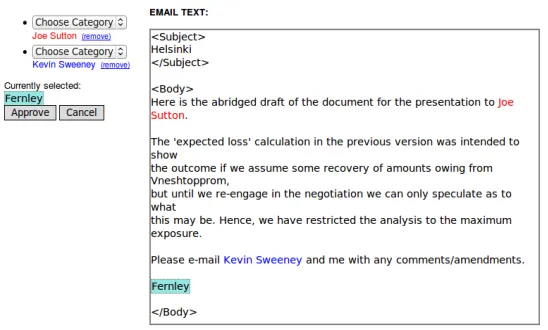
In order to adapt the task of NER annotation to the Mechanical Turk format, we developed a webbased graphical user interface using JavaS cript that allowed the user to select a span of text with the mouse cursor and choose different cat egories of entities from a dropdown menu. The interface also used simple tokenization heuristics to divide the text into highlightable spans and re solve partial overlaps or doubleclicks into the next largest span. For instance, highlighting the word “Mary” from “M” to “r” would result in the entire word being selected.
Each Human Intelligence Task (or HIT, a unit of payable work in the Mechanical Turk system) presented the entire subject and body of an email from one of the four corpora. To keep the HITs at a reasonable size, emails with bodies having less than 60 characters or more than 900 charac ters were omitted. The average email length, in cluding both subject and body, was 405.39 char acters.
For the labeling task, we chose three distinct entity types to identify: PERSON, LOCATION, and ORGANIZATION. To reduce potential worker confu sion and make the task size smaller, we also broke up each individual HIT by entity type, so the user only had to concentrate on one at a time.
For the PERSON and LOCATION entity types, we noticed during initial tests that there was a user
5 http://mturkclt.sourceforge.net
tendency to conflate unnamed references (such as “my mom” and “your house”) with true named references. Because NER is intended to be limited only to named entities (i.e., references that contain proper nouns), we asked the users to distinguish between “named” and “unnamed” persons and locations, and to tag both separately. The inclusion of unnamed entities was intended to keep their named counterparts pure and undi luted; the unnamed entities were discarded after the annotation process was complete. The same mechanism could have been used for the ORGANIZATION entity type, but the risk of unnamed references seemed smaller.
Initially, we ran a small trial with a base rate of $0.03 for each HIT. However, after compiling the results we noticed that there was a general tendency for the workers to undertag the entit ies. Besides outright freeloaders (i.e., workers who simply clicked “no entities” each time), there were also many who would highlight the first one or two entities, and then ignore the rest of the email.
[image:3.612.170.444.60.225.2]This may have been due to a misunderstanding of the HIT instructions, but we conjectured that a deeper reason was that we were paying a base rate regardless of the number of entities identi fied. Ideally, a HIT with many entities to high light should pay more than a HIT with fewer. However, the default fixedrate system was pay ing the same for both, and the workers were re sponding to such an inflexible incentive system accordingly. To remedy this situation, we set about to create a payment system that would mo tivate higher recall on entityrich emails, while still discouraging the opposite extreme of ran dom overtagging.
4.2 Bonus Payment System
Mechanical Turk provides two methods for pay ing workers: fixed rates on each HIT and bo nuses to individual workers for especially good work. We chose to leverage these bonuses to form the core of our payment system. Each HIT would pay a base rate of $0.01, but each tagged entity could elicit a bonus of $0.01$0.02. PERSON entities paid $0.01, while LOCATION and ORGANIZATION entities paid $0.02 (since they were rarer).
To ensure quality and discourage overtagging, bonuses for each highlighted entity were limited based on an agreement threshold with other workers. This threshold was usually set such that a majority agreement was required, which was an arbitrary decision we made in order to control costs. The terms of the bonuses were explained in detail in the instructions page for each HIT.
Additionally, we decided to leverage this bo nus system to encourage improvements in work er performance over time. Since the agreedupon spans that elicited bonuses were assumed to be mostly correct, we realized we could give feed back to the workers on these entities to encour age similar performance in the future.
In general, worker bonuses are a mysterious and poorly understood motivational mechanism. Our feedback system attempted to make these bonuses more predictable and transparent. The system we built uses Amazon's “NotifyWorkers” REST API to send messages directly to the workers' email accounts. Bonuses were batched on a daily basis, and the notification emails gave a summary description of the day's bonuses.
Both the UI and the bonus/notification system were works in progress that were continually re fined based on comments from the worker com munity. We were pleasantly surprised to find that, throughout the annotation process, the Mechanical Turk workers were generally enthu siastic about the HITs, and also interested in im proving the quality of their annotations. Out of 169,156 total HITs, we received 702 comments from 140 different workers, as well as over 50 email responses and a dedicated thread at Turk
erNation.com6. Most of the feedback was posit
ive, and negative feedback was almost solely dir ected at the UI. Based on their comments, we continually tweaked and debugged the UI and HIT instructions, but kept the basic structure of the bonus system.
4.3 Worker Distribution
With the bonus system in place, it was still ne cessary to determine the ideal number of workers to assign per email. Previously, Snow et al.
(2008) used expert annotations to find how many Mechanical Turk workers could “equal” an ex pert in terms of annotation quality. Because we lacked expert annotations, we developed an al ternative system to determine the ideal number of workers based purely on interannotator agree ment.
As described in the previous section, the most significant problem faced with our HITs was that of low recall. Low precision was generally not considered to be a problem, since, with enough annotators, interannotator agreement could al ways be set arbitrarily high in order to weed out false positives. Recall, on the other hand, could be consistently expected to improve as more an notators were added to the worker pool. There fore, the only problem that remained was to cal culate the marginal utility (in terms of recall) of each additional annotator assigned to an email.
In order to estimate this marginal recall gain for each entity type, we first ran small initial tests with a relatively large number of workers. From these results, we took all the entities identified by at least two workers and set those aside as the gold standard annotations; any overlapping an notations were collapsed into the larger one. Next, for each n number of workers between 2 and the size of the entire worker pool, we ran domly sampled n workers from the pool, recal culated the entities based on agreement from at least two workers within that group, and calcu lated the recall relative to the gold standard an notation. The threshold of 2 was chosen arbitrar ily for the purpose of this experiment.
From this data we generated a marginal recall curve for each entity type, which roughly ap proximates how many workers are required per email before recall starts to drop off signific antly. As expected, each graph shows a plateau like behavior as the number of workers increases, but some entity types reach their plateau earlier
6 http://turkers.proboards.com/index.cgi?action =display&board=everyoneelse&thread=3177
In recognition of your performance, you were awarded a bonus of $0.5 ($0.02x25) for catching the following span(s): ['ve gas', 'Mt. Hood', 'Holland', [...]
than others. Most saliently, Person entities seem to require only a few workers to reach a relat ively high recall, compared to LOCATION or ORGANIZATION entities.
Based on the expected diminishing returns for each entity type, we determined some number of workers to assign per email that we felt would maximize entity recall while staying within our budgetary limits. After some tinkering and ex perimentation with marginal recall curves, we ul timately settled on 4 assignments for PERSON en tities, 6 for LOCATION entities, and 7 for ORGANIZATION entities.
5 Corpora and Experiments
We ran our Mechanical Turk tasks over a period of about three months, from August 2008 to November 2008. We typically processed 500 1,500 documents per day. In the end, the work ers annotated 20,609 unique emails which totaled 7.9 megabytes, including both subject and body.
All in all, we were pleasantly surprised by the speed at which each HIT series was completed. Out of 39 total HIT series, the average comple tion time (i.e. from when the HITs were first pos ted to MTurk.com until the last HIT was com pleted) was 3.13 hours, with an average of 715.34 emails per HIT series. The fastest com pletion time per number of emails was 1.9 hours for a 1,000email task, and the slowest was 5.13 hours for a 100email task. We noticed, that, paradoxically, larger HIT series were often com pleted more quickly – most likely because Amazon promotes the larger tasks to the front page.
5.1 Corpora Annotation
In Table 1, we present several statistics regard ing the annotation tasks, grouped by corpus and entity type. Here, “Cost” is the sum of all bo nuses and base rates for the HITs, “Avg. Cost” is the average amount we paid in bonuses and
base rates per email, “Avg. # Workers” is the av erage number of workers assigned per email, “Avg. Bonus” is the average bonus per HIT, “Avg. # Spans” is the average number of entities highlighted per HIT, and “Avg. Time” is the av erage time of completion per HIT in seconds. Precision and recall are reported relative to the “gold standards” determined by the bonus agree ment thresholds. None of the reported costs in clude fees paid to Amazon, which varied based on how the bonuses were batched.
A few interesting observations emerge from these data. For one, the average bonus was usu ally a bit more than the base rate of $0.01. The implication is that bonuses actually comprised the majority of the compensation, somewhat call ing into question their role as a “bonus.”
Also noteworthy is that ORGANIZATION entities took less time per identified span to complete than either location or person entities. However, we suspect that this is due to the fact that we ran the ORGANIZATION tasks last (after PERSON and LOCATION), and by that time we had ironed out several bugs in the UI, and our workers had be come more adept at using it.
5.2 Worker Performance
In the end, we had 798 unique workers complete 169,156 total HITs. The average number of HITs per worker was 211.97, but the median was only 30. Ten workers who tagged no entities were blocked, and the 1,029 HITs they com pleted were rejected without payment.
For the most part, a small number of dedicated workers completed the majority of the tasks. Out of all nonrejected HITs, the top 10 most prolific workers completed 22.51%, the top 25 com pleted 38.59%, the top 50 completed 55.39%, and the top 100 completed 74.93%.
CallisonBurch (2009) found in their own Mechanical Turk system that the workers who contributed more tended to show lower quality,
2 3 4
0 0.2 0.4 0.6 0.8 1
2 3 4 5 6 7 8 0
0.2 0.4 0.6 0.8 1
2 3 4 5 6 7 8 9 10 0
[image:5.612.147.464.65.168.2]0.2 0.4 0.6 0.8 1
as measured by agreement with an expert. We had hoped that our bonus system, by rewarding quality work with higher pay, would yield the opposite effect, and in practice, our most prolific workers did indeed tend to show the highest en tity recall.
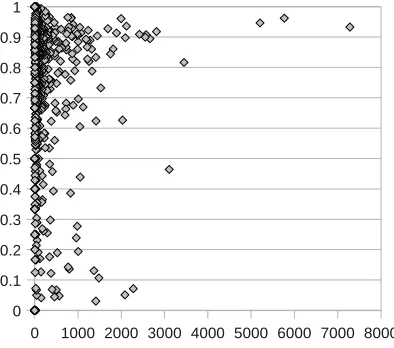
0 1000 2000 3000 4000 5000 6000 7000 8000 0
[image:6.612.96.293.293.467.2]0.1 0.2 0.3 0.4 0.5 0.6 0.7 0.8 0.9 1
Fig. 4: # HITs Completed vs. Recall Figure 4 shows how each of the nonrejected workers fared in terms of entity recall (relative to the “gold standard” determined by the bonus agreement threshold), compared to the number of HITs completed. As the chart shows, out of the 10 most productive workers, only one had an av erage recall score below 60%, and the rest all had scores above 80%. While there are still quite a few underperforming workers within the core group of highthroughput annotators, the general trend seemed to be that the more HITs a worker completes, the more likely he/she is to agree with the other annotators. This chart may be directly compared to a similar one in CallisonBurch (2009), where the curve takes largely the oppos ite shape. One interpretation of this is that our bonus system had the desired effect on annotator quality.
5.3 Annotation Quality Experiments
To evaluate the quality of the worker annota tions, one would ideally like to have at least a subset annotated by an expert, and then compare the expert's judgments with the Mechanical Turk workers'. However, in our case we lacked expert annotations for any of the annotated emails. Thus, we devised an alternative method to evalu ate the annotation quality, using the NER system built into the opensource MinorThird toolkit.7
MinorThird is a popular machine learning and natural language processing library that has pre viously been applied to the problem of NER with some success (Downey et al. 2007). For our pur poses, we wanted to minimize the irregularity in troduced by deviating from the core features and algorithms available in MinorThird, and there fore did not apply any feature selection or feature engineering in our experiments. We chose to use MinorThird's default “CRFLearner,” which is a module that learns feature weights using the IITB CRF library8 and then applies them to a condi
tional Markov modelbased extractor. All of the parameters were set to their default value, includ ing the builtin “TokenFE” feature extractor, which extracts features for the lowercase value of each token and its capitalization pattern. The version of MinorThird used was 13.7.10.8.
In order to convert the Mechanical Turk an notations to a format that could be input as train ing data to the NER system, we had to resolve the conflicting annotations of the multiple work ers into a unified set of labeled documents. Sim ilarly to the bonus system, we achieved this using a simple voting scheme. In contrast to the bonus system, though, we experimented with multiple interannotator agreement thresholds between 1 and 4. For the PERSON corpora this meant a relat ively stricter threshold than for the LOCATION or
7 http://minorthird.sourceforge.net 8 http://crf.sourceforge.net
Table 1: Statistics by corpus and entity type (omitting rejected work).
Corpus Entity Cost #Emails Avg. Cost Avg. #Workers Avg. Bonus Avg. #Spans Avg. Precision Avg. Recall Avg. Time
20N. 315.68 1999 0.1579 6 0.0163 1.6885 0.5036 0.7993 144.34
A.H. 412.2 2500 0.1649 6.4 0.0158 1.1924 0.6881 0.8092 105.34
323.54 3000 0.1078 6.23 0.0073 1.0832 0.3813 0.7889 105.25
TREC 274.88 2500 0.1100 6 0.0083 1.1847 0.3794 0.7864 122.97
20N. 438.44 3500 0.1253 7 0.0079 1.2396 0.3274 0.6277 105.68
A.H. 396.48 2500 0.1586 7 0.0127 1.2769 0.4997 0.7062 92.01
539.19 2500 0.2157 8.6 0.0151 1.3454 0.5590 0.7415 80.55
TREC 179.94 1500 0.1200 7 0.0071 0.8923 0.4414 0.6992 84.23
20N. Per. 282.51 2500 0.1130 4 0.0183 2.8693 0.7267 0.9297 152.77
A.H. Per. 208.78 2500 0.0835 4 0.0109 1.6529 0.7459 0.9308 112.4
Per. 54.11 400 0.1353 6.14 0.0120 2.7360 0.8343 0.8841 111.23
TREC Per. 214.37 2500 0.0857 4 0.0114 1.5918 0.7950 0.9406 103.73
Loc. Loc. Enron Loc. Loc. Org. Org. Enron Org. Org.
ORGANIZATION corpora, since the PERSON corpora typically had only 4 annotations per document. Mail subjects and bodies were split into separate documents.
Four separate experiments were run with these corpora. The first was a 5fold crossevaluation (i.e., a 80%/20% split) train/test experiment on each of the twelve corpora. Because this test did not rely on any expert annotations in the gold standard, our goal here was only to roughly measure the “cohesiveness” of the corpus. Low precision and recall scores should indicate a messy corpus, where annotations in the training portion do not necessarily help the extractor to discover annotations in the test portion. Con versely, high precision and recall scores should indicate a more cohesive corpus – one that is at least somewhat internally consistent across the training and test portions.
The second test was another train/test experi ment, but with the entire Mechanical Turk corpus as training data, and with a small set of 182 emails, of which 99 were from the W3C Email Corpus9 and 83 were from emails belonging to
various Kiha Software employees, as test data. These 182 test emails were handannotated for the three entity types by the authors. Although this test data was small, our goal here was to demonstrate how well the trained extractors could fare against email text from a completely different source than the training data.
The third test was similar to the second, but used as its test data 3,116 Enron emails annotated for PERSON entities.10 The labels were manually corrected by the authors before testing. The goal here was the same as with the second test, al though it must be acknowledged that the PERSON training data did make use of 400 Enron emails, and therefore the test data was not from a com pletely separate domain.
The fourth test was intended to increase the comparability of our own results with those that others have shown in NER on email text. For the test data, we chose two subsets of the Enron Email Corpus used in Minkov et al. (2005).11
The first, “EnronMeetings,” contains 244 train ing documents, 242 tuning documents, and 247 test documents. The second, “EnronRandom,” contains 89 training documents, 82 tuning docu ments, and 83 test documents. For each, we
9 http://tides.umiacs.umd.edu/webtrec/trecent/parsed _w3c_corpus.html
10 http://www.cs.cmu.edu/~wcohen/repository.tgz and http://www.cs.cmu.edu/~einat/datasets.html. 11 http://www.cs.cmu.edu/~einat/datasets.html.
tested our statistical recognizers against all three divisions combined as well as the test set alone.
6 Results
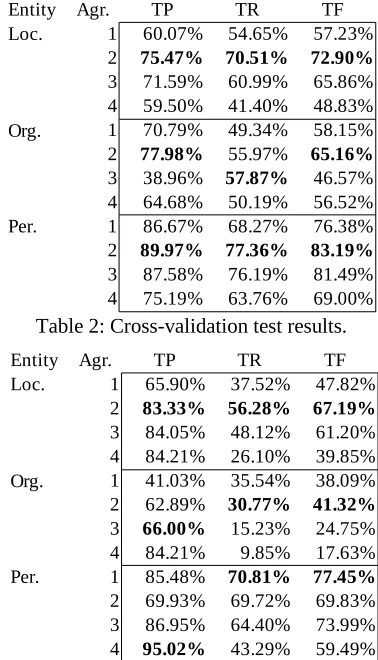
[image:7.612.320.509.213.543.2]The results from these four tests are presented in Tables 25. In these tables, “Agr.” refers to in terannotator agreement, “TP” to token precision, “SP” to span precision, “TR” to token recall, “SR” to span recall, “TF” to token Fmeasure, and “SF” to span Fmeasure. “Span” scores do not award partial credit for entities, and are there fore a stricter measure than “token” scores.
Table 2: Crossvalidation test results.
The crossvalidation test results seem to indic ate that, in general, an interannotator agreement threshold of 2 produces the most cohesive cor pora regardless of the number of workers as signed per email. In all cases, the Fmeasure peaks at 2 and then begins to drop afterwards.
The results from the second test, using the W3C and Kiha emails as test data, tell a slightly different story, however. One predictable obser vation from these data is that precision tends to increase as more interannotator agreement is re quired, while recall decreases. We believe that
Table 3: Results from the second test.
Entity TP TR TF
1 65.90% 37.52% 47.82%
2 83.33% 56.28% 67.19%
3 84.05% 48.12% 61.20% 4 84.21% 26.10% 39.85% 1 41.03% 35.54% 38.09% 2 62.89% 30.77% 41.32%
3 66.00% 15.23% 24.75%
4 84.21% 9.85% 17.63% Per. 1 85.48% 70.81% 77.45%
2 69.93% 69.72% 69.83% 3 86.95% 64.40% 73.99%
4 95.02% 43.29% 59.49%
Agr. Loc.
Org.
Entity TP TR TF
1 60.07% 54.65% 57.23%
2 75.47% 70.51% 72.90%
3 71.59% 60.99% 65.86% 4 59.50% 41.40% 48.83% 1 70.79% 49.34% 58.15%
2 77.98% 55.97% 65.16%
3 38.96% 57.87% 46.57% 4 64.68% 50.19% 56.52% Per. 1 86.67% 68.27% 76.38%
2 89.97% 77.36% 83.19%
3 87.58% 76.19% 81.49% 4 75.19% 63.76% 69.00% Agr.
Loc.
this is due to the fact that entities that were con firmed by more workers tended to be less contro versial or ambiguous than those confirmed by fewer. Most surprising about these results is that, although Fmeasure peaks with the 2agree ment corpora for both LOCATION and ORGANIZATION entities, PERSON entities actually show the worst precision when using the 2agreement corpus. In the case of PERSON entities, the corpus generated using no interannotator agreement at all, i.e., an notator agreement of 1, actually performs the best in terms of Fmeasure.
Table 4: Results from the third test.
Data TP TR TF SP SR SF
EM 1 100% 57.16% 72.74% 100% 50.10% 66.75% (All) 2 100% 64.31% 78.28% 100% 56.11% 71.88%
3 100% 50.44% 67.06% 100% 45.11% 62.18% 4 100% 31.41% 47.81% 100% 27.91% 43.64% EM 1 100% 62.17% 76.68% 100% 51.30% 67.81% (Test) 2 100% 66.36% 79.78% 100% 54.28% 70.36%
3 100% 55.72% 71.56% 100% 45.72% 62.76% 4 100% 42.24% 59.39% 100% 36.06% 53.01% ER 1 36.36% 59.91% 45.25% 40.30% 53.75% 46.07% (All) 2 70.83%65.32% 67.96% 67.64% 57.68% 62.26% 3 88.69% 58.63%70.60% 82.93% 54.38% 65.68%
4 93.59% 43.68% 59.56%89.33% 41.22% 56.41% ER 1 100% 60.87% 75.68% 100% 54.82% 70.82% (Test) 2 100% 64.70% 78.56% 100% 59.05% 74.26%
[image:8.612.94.298.204.452.2]3 100% 63.06% 77.34% 100% 58.38% 73.72% 4 100% 43.04% 60.18% 100% 40.10% 57.25% Agr.
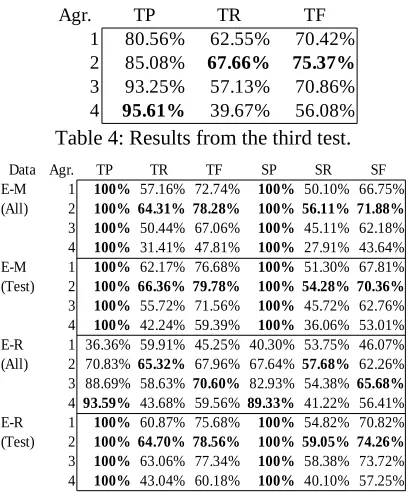
Table 5: Results from the fourth test. With the third test, however, the results are more in line with those from the crossvalidation tests: Fmeasure peaks with the 2agreement cor pus and drops off as the threshold increases. Most likely these results can be considered more significant than those from the second test, since this test corpus contains almost 20 times the number of documents.
For the fourth test, we report both tokenlevel statistics and spanlevel statistics (i.e., where credit for partially correct entity boundaries is not awarded) in order to increase comparability with Minkov et al. (2005). With one exception, these tests seem to show again that the highest F measure comes from the annotator created using an agreement level of 2, confirming results from the first and third tests.
The fourth test may also be directly compared to the results in Minkov et al. (2005), which re port span Fmeasure scores of 59.0% on Enron
Meetings and 68.1% on EnronRandom, for a CRFbased recognizer using the “Basic” feature set (which is identical to ours) and using the “train” division for training and the “test” divi sion for testing. In both cases, our bestperform ing annotators exceed these scores – an 11.5% improvement on EnronMeetings and a 6.16% improvement on EnronRandom. This is an en couraging result, given that our training data largely come from a different source than the test data, and that the labels come from nonexperts. We see this as confirmation that very large cor pora annotated by Mechanical Turk workers can surpass the quality of smaller corpora annotated by experts.
7 Conclusion
In order to quickly and economically build a large annotated dataset for NER, we leveraged Amazon’s Mechanical Turk. MTurk allowed us to build a dataset of 20,609 unique emails with 169,156 total annotations in less than four months. The MTurk worker population respon ded well to NER tasks, and in particular respon ded well to the bonus and feedback scheme we put into place to improve annotation quality. The bonus feedback system was designed to improve the transparency of the compensation system and motivate higher quality work over time. Encour agingly, our results indicate that the workers who completed the most documents also had consist ently high entity recall, i.e., agreement with other workers, indicating that the system achieved the desired effect.
Given a large body of MTurk annotated docu ments, we were able to leverage interannotator agreement to control the precision and recall of a CRFbased recognizer trained on the data. Im portantly, we also showed that interannotator agreement can be used to predict the appropriate number of workers to assign to a given email in order to maximize entity recall and reduce costs.
Finally, a direct comparison of the entity re cognizers generated from MTurk annotations to those generated from expert annotations was very promising, suggesting that Mechanical Turk is appropriate for NER annotation tasks, when care is taken to manage annotator error.
Acknowledgments
Thanks to Dolores Labs for the initial version of the UI, and thanks to Amazon and the 798 Mech anical Turk workers for making this work pos sible.
TP TR TF
1 80.56% 62.55% 70.42% 2 85.08% 67.66% 75.37%
3 93.25% 57.13% 70.86%
4 95.61% 39.67% 56.08%
References
Michele Banko and Eric Brill. 2001. Scaling to very very large corpora for natural language disambigu ation. In ACL '01:2633.
Chris CallisonBurch. 2009. Fast, cheap, and creative: evaluating translation quality using Amazon's Mechanical Turk. In EMNLP '09:286295.
Doug Downey, Matthew Broadhead, and Oren Et zioni. 2007. Locating complex named entities in web text. In IJCAI '07.
Ralph Grishman and Beth Sundheim. 1996. Message Understanding Conference6: a brief history. In Proceedings of the 16th conference on Computa tional Linguistics:466471.
Aniket Kittur, Ed H. Chi, and Bongwon Suh. 2008. Crowdsourcing user studies with Mechanical Turk. In Proceedings of CHI 2008.
Zornitsa Kozareva. 2006. Bootstrapping named entity recognition with automatically generated gazetteer lists. In Proceedings of the Eleventh Conference of the European Chapter of the Association for Com putational Linguistics:1521.
Andrei Mikheev, Marc Moens, and Claire Grover. 1999. Named entity recognition without gazetteers. In Proceedings of the Ninth Conference of the European chapter of the Association for Computa tional Linguistics:18.
Einat Minkov, Richard C. Wang, and William W. Co hen. 2005. Extracting personal names from email: applying named entity recognition to informal text. In HTL '05:443450.
David Nadeau and Satoshi Sekine. 2007. A survey of named entity recognition and classification. Lin guisticae Investigationes, 30(1):326.
Preslav Nakov. 2008. Noun compound interpretation using paraphrasing verbs: Feasibility study. In Pro ceedings of the 13th international conference on Artificial Intelligence: Methodology, Systems and Applications (AIMSA 2008):103–117.
Jason Pontin. 2007. Artificial Intelligence, With Help From the Humans. In New York Times (March 25, 2007).
Burr Settles. 2004. Biomedical named entity recogni tion using conditional random fields and rich fea ture sets. In Proceedings of the COLING 2004 In ternational Joint Workshop on Natural Language Processing in Biomedicine and its Applications. Rion Snow, Brendan O'Connor, Daniel Jurafsky, and
Andrew Y. Ng. 2008. Cheap and fast – but is it good?: evaluating nonexpert annotations for natur al language tasks. In EMNLP '08:254263.