Unsupervised Sentence Simplification Using Deep Semantics
Shashi Narayan
School of Informatics The University of Edinburgh
Edinburgh, EH8 9AB, UK [email protected]
Claire Gardent
CNRS, LORIA, UMR 7503 Vandoeuvre-l`es-Nancy, F-54500, France
Abstract
We present a novel approach to sentence simplification which departs from previ-ous work in two main ways. First, it requires neither hand written rules nor a training corpus of aligned standard and simplified sentences. Second, sentence splitting operates on deep semantic struc-ture. We show (i) that the unsupervised framework we propose is competitive with four state-of-the-art supervised systems and (ii) that our semantic based approach allows for a principled and effective han-dling of sentence splitting.
1 Introduction
Sentence simplification maps a sentence to a sim-pler, more readable one approximating its content. As has been argued in (Shardlow, 2014), sentence simplification has many potential applications. It is useful as a preprocessing step for a variety of NLP systems such as parsers and machine trans-lation systems (Chandrasekar et al., 1996), sum-marisation (Knight and Marcu, 2000), sentence fusion (Filippova and Strube, 2008) and seman-tic role labelling (Vickrey and Koller, 2008). It also has wide ranging potential societal applica-tions as a reading aid for people with aphasia (Car-roll et al., 1999), for low literacy readers (Watan-abe et al., 2009) and for non native speakers (Sid-dharthan, 2002).
In this paper, we present a novel approach to sentence simplification which departs from pre-vious work in two main ways. First, it requires neither hand written rules nor a training corpus of aligned standard and simplified sentences. In-stead, we exploit non aligned Simple and English Wikipedia to learn the probability of lexical sim-plifications, of the semantics of simple sentences and of optional phrases i.e., phrase which may be
deleted when simplifying. Second, sentence split-ting is semantic based. We show (i) that our unsu-pervised framework is competitive with four state-of-the-art systems and (ii) that our semantic based approach allows for a principled and effective han-dling of sentence splitting.
2 Related Work
Earlier work on sentence simplification relied on handcrafted rules to capture syntactic simplifica-tion e.g., to split coordinated and subordinated sentences into several, simpler clauses or to model e.g., active/passive transformations (Siddharthan, 2002; Chandrasekar and Srinivas, 1997; Canning, 2002; Siddharthan, 2011; Siddharthan, 2010). While these hand-crafted approaches can encode precise and linguistically well-informed syntactic transformations, they do not account for lexical simplifications and their interaction with the sen-tential context. Siddharthan and Mandya (2014) therefore propose an approach where hand-crafted syntactic simplification rules are combined with lexical simplification rules extracted from aligned English and simple English sentences, and revi-sion histories of Simple Wikipedia.
Using the parallel dataset formed by Simple En-glish Wikipedia (SWKP)1and traditional English
Wikipedia (EWKP)2, further work has focused on
developing machine learning approaches to sen-tence simplification.
Zhu et al. (2010) constructed a parallel Wikipedia corpus (PWKP) of 108,016/114,924 complex/simple sentences by aligning sentences from EWKP and SWKP and used the result-ing bitext to train a simplification model in-spired bysyntax-based machine translation (Ya-mada and Knight, 2001). Their simplification model encodes the probabilities for four rewrit-ing operations on the parse tree of an input
sen-1http://simple.wikipedia.org 2http://en.wikipedia.org
tences namely, substitution, reordering, splitting and deletion. It is combined with a language model to improve grammaticality and the decoder translates sentences into simpler ones by greedily selecting the output sentence with highest proba-bility.
Using both the PWKP corpus developed by Zhu et al. (2010) and the edit history of simple Wikipedia, Woodsend and Lapata (2011) learn a quasi synchronous grammar (Smith and Eisner, 2006) describing a loose alignment between parse trees of complex and of simple sentences. Fol-lowing Dras (1999), they then generate all possi-ble rewrites for a source tree and use integer lin-ear programming to select the most appropriate simplification. They evaluate their model on the same dataset used by Zhu et al. (2010) namely, an aligned corpus of 100/131 EWKP/SWKP sen-tences.
Wubben et al. (2012), Coster and Kauchak (2011) and Xu et al. (2016) saw simplification as a monolingual translation task where the complex sentence is the source and the simpler one is the target. To account for deletions, reordering and substitution, Coster and Kauchak (2011) trained a phrase based machine translation system on the PWKP corpus while modifying the word align-ment output by GIZA++ in Moses to allow for null phrasal alignments. In this way, they allow for phrases to be deleted during translation. Similarly, Wubben et al. (2012) used Moses and the PWKP data to train a phrase based machine translation system augmented with a post-hoc reranking pro-cedure designed to rank the output based on their dissimilarity from the source sentence. Unlinke Wubben et al. (2012) and Coster and Kauchak (2011) who used machine translation as a black box, Xu et al. (2016) proposed to modify the opti-mization function of SMT systems by tuning them for the sentence simplification task. However, in their work they primarily focus on lexical simpli-fication.
Finally, Narayan and Gardent (2014) present a hybrid approach combining a probabilistic model for sentence splitting and deletion with a statistical machine translation system trained on PWKP for substitution and reordering.
Our proposal differs from all these approaches in that it does not use the parallel PWKP corpus for training. Nor do we use hand-written rules. Another difference is that we use a deep semantic
representation as input for simplification. While a similar approach was proposed in (Narayan and Gardent, 2014), the probabilistic models differ in that we determine splitting points based on the maximum likelihood of sequences of thematic role sets present in SWKP whereas Narayan and Gar-dent (2014) derive the probability of a split from the aligned EWKP/SWKP corpus using expecta-tion maximisaexpecta-tion. As we shall see in Secexpecta-tion 4, because their data is more sparse, Narayan and Gardent (2014) predicts less and lower quality simplifications by sentence splitting.
3 Simplification Framework
Our simplification framework pipelines three ded-icated modules inspired from previous work on lexical simplification, syntactic simplification and sentence compression. All three modules are un-supervised.
3.1 Example Simplification
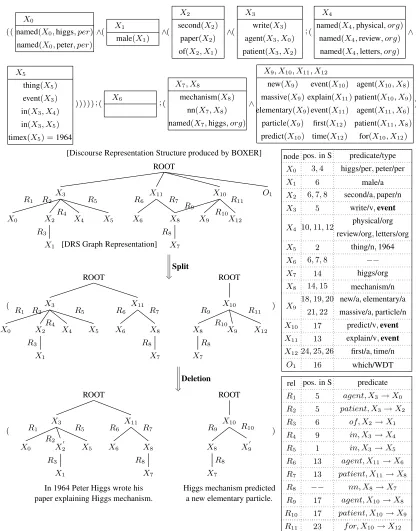
Before describing the three main modules of our simplification framework, we illustrate its work-ing with an example. Figure 1 shows the input semantic representation associated with sentence (1C) and illustrates the successive simplification steps yielding the intermediate and final simplified sentences shown in (1S1-S).
(1) C.In 1964 Peter Higgs published his second paper in Physical Review Letters describing Higgs mechanism which predicted a new massive spin-zero boson for the first time.
S1 (Lex Simp). In 1964 Peter Higgs wrote his
sec-ond paper in Physical Review Letters explaining Higgs mechanism which predicted a new massive elementary particle for the first time.
S2(Split). In 1964 Peter Higgs wrote his second
pa-per in Physical Review Letters explaining Higgs mech-anism. Higgs mechanism predicted a new massive ele-mentary particle for the first time.
S (Deletion). In 1964 Peter Higgs wrote his paper explaining Higgs mechanism. Higgs mechanism pre-dicted a new elementary particle.
First, the input (1C) is rewritten as (1S1) by
re-placing standard words with simpler ones using the context aware lexical simplification method proposed in (Biran et al., 2011).
Splitting is then applied to the semantic repre-sentation of (1S1). Following Narayan and
Gar-dent (2014), we use Boxer3(Curran et al., 2007)
to map the output sentence from the lexical simpli-fication step (here S1) to a Discourse
Representa-tion Structure (DRS, (Kamp, 1981)). The DRS for
3http://svn.ask.it.usyd.edu.au/trac/
In 1964 Peter Higgs published his second paper in Physical Review Letters describing Higgs mechanism which predicted a new massive spin-zero boson for the first time .w
w w w
Lex Simpl.
In 1964 Peter Higgs wrote his second paper in Physical Review Letters explaining Higgs mechanism which predicted a new massive elementary particle for the first time .
(( X0
named(X0,higgs, per)
named(X0,peter, per)
∧( X1
male(X1) ∧(
X2
second(X2)
paper(X2)
of(X2, X1)
∧( X3
write(X3)
agent(X3, X0)
patient(X3, X2)
; ( X4
named(X4,physical, org)
named(X4,review, org)
named(X4,letters, org)
∧
X5
thing(X5)
event(X3)
in(X3, X4)
in(X3, X5)
timex(X5) =1964
))))) ; ( X6 ; (
X7, X8
mechanism(X8)
nn(X7, X8)
named(X7,higgs, org)
∧
X9, X10, X11, X12
new(X9)
massive(X9)
elementary(X9)
particle(X9)
predict(X10)
event(X10)
explain(X11)
event(X11)
first(X12)
time(X12)
agent(X10, X8)
patient(X10, X9)
agent(X11, X6)
patient(X11, X8)
for(X10, X12)
))
[Discourse Representation Structure produced by BOXER] ROOT
O1
X10
X12
X9 R10
R11 X11 X8 X7 R8 X6
R6 R7
X3 X5 X4 X2 X1 R3 X0
R1 R2
R4
R5
R9
[DRS Graph Representation]
O1 16 which/WDT
X1224,25,26 first/a,time/n
X11 13 explain/v,event
X10 17 predict/v,event
X9 1821,19,22,20 new/a,elementary/a
massive/a,particle/n
X8 14,15 mechanism/n
X7 14 higgs/org
X6 6,7,8 −−
X5 2 thing/n,1964
X4 10,11,12 physical/org
review/org,letters/org
X3 5 write/v,event
X2 6,7,8 second/a,paper/n
X1 6 male/a
X0 3,4 higgs/per,peter/per
node pos. in S predicate/type
R11 23 for, X10→X12
R10 17 patient, X10→X9
R9 17 agent, X10→X8
R8 −− nn, X8→X7
R7 13 patient, X11→X8
R6 13 agent, X11→X6
R5 1 in, X3→X5
R4 9 in, X3→X4
R3 6 of, X2→X1
R2 5 patient, X3→X2
R1 5 agent, X3→X0
rel pos. in S predicate ROOT X11 X8 X7 R8 X6
R6 R7
X3 X5 X4 X2 X1 R3 X0
R1 R2
R4 R5 ROOT X10 X12 X9 X8 X7 R8 R9 R10 R11 ( ) w w w w Split ROOT X11 X8 X7 R8 X6
R6 R7
X3
X5
X2′
X1 R3 X0 R1 R2 R5
In 1964 Peter Higgs wrote his paper explaining Higgs mechanism.
ROOT
X10
X9′
X8
X7
R8
R9 R10
Higgs mechanism predicted a new elementary particle.
[image:3.612.101.517.133.664.2]( ) w w w w Deletion
S1is shown at the top of Figure 1 and a graph
rep-resentation4 of the dependencies between its
vari-ables is shown immediately below. In this graph, each DRS variable labels a node in the graph and each edge is labelled with the relation holding be-tween the variables labelling its end vertices. The two tables to the right of the picture show the pred-icates (top table) associated with each variable and the relation label (bottom table) associated with each edge. Boxer also outputs the associated po-sitions in the complex sentence for each predicate (not shown in the DRS but shown in the graph ta-bles). Orphan words i.e., words which have no corresponding material in the DRS (e.g.,whichat position16), are added to the graph (nodeO1) thus
ensuring that the position set associated with the graph exactly generates the input sentence.
Using probabilities over sequences of thematic role sets acquired from the DRS representations of SWKP, the split module determines where and how to split the input DRS. In this case, one split is applied betweenX11(explain) andX10(predict).
The simpler sentences resulting from the split are then derived from the DRS using the word or-der information associated with the predicates, du-plicating or pronominalising any shared element (e.g.,Higgs mechanismin Figure 1) and deleting any Orphan words (e.g., which) which occurs at the split boundary. Splitting thus derives S2from
S1.
Finally, deletion or sentence compression ap-plies transforming S2into S3.
3.2 Context-Aware Lexical Simplification
We extract context-aware lexical simplification rules from EWKP and SWKP5using the approach
described by Biran et al. (2011). The underly-ing intuition behind these rules is that the wordC
from EWKP can be replaced with a wordS from SWKP ifC andS share similar contexts (ten to-ken window) in EWKP and SWKP respectively. Given an input sentence and the set of simplifica-tion rules extracted from EWKP and SWKP, we
4The DRS to graph conversion goes through several
pre-processing steps: the relationnnis inverted making modi-fier noun (higgs) dependent of modified noun (mechanism),
named and timexare converted to unary predicates, e.g.,
named(x, peter)is mapped topeter(x)andtimex(x) = 1964is mapped to1964(x); and nodes are introduced for orphan words (e.g.,which).
5We downloaded the snapshots of English Wikipedia
dated 2013-12-31 and of Simple English Wikipedia dated 2014-01-01 available at http://dumps.wikimedia. org.
then consider all possible(C, S)substitutions li-censed by the extracted rules and we identify the best combination of lexical simplifications using dynamic programming and rule scores which cap-ture the adequacy, in context, of each possible sub-stitution6.
3.3 Sentence Splitting
A distinguishing feature of our approach is that splitting is based on deep semantic representations rather than phrase structure trees – as in (Zhu et al., 2010; Woodsend and Lapata, 2011) – or de-pendency trees – as in (Siddharthan and Mandya, 2014).
While Woodsend and Lapata (2011) report learning 438 splitting rules for their simplifica-tion approach operating on phrase structure trees Siddharthan and Mandya (2014) defines 26 hand-crafted rules for simplifying apposition and/or rel-ative clauses in dependency structures and 85 rules to handle subordination and coordination.
In contrast, we do not need to specify or to learn complex rewrite rules for splitting a complex sen-tence into several simpler sensen-tences. Instead, we simply learn the probability of sequences of the-matic role sets likely to cooccur in a simplified sentence.
The intuition underlying our approach is that:
Semantic representations give a clear handle on events, on their associated roles sets and on shared elements thereby facilitating both the identification of possible splitting points and the reconstruction of shared elements in the sen-tences resulting from a split.
For instance, the DRS in Figure 1 makes clear that sentence (1S1) contains 3 main events and that
Higgs mechanismis shared between two proposi-tions.
To determine whether and where to split the in-put sentence, we use a probabilistic model trained on the DRSs of the Simple Wikipedia sentences and a language model also trained on Simple Wikipedia. Given the event variables contained in the DRS of the input sentence, we consider all possible splits between subsequences of events and choose the split(s) with maximum split score. For instance, in the sentence shown in Figure 1, there are three event variablesX3, X10 andX11
6For more details on the lexical simplification process, we
in the DRS. So we will consider 5 split possi-bilities namely, no split ({X3, X10, X11}), two
splits resulting in three sentences describing an event each ({X3}, {X10}, {X11}) and one split
resulting in two sentences describing one and two events respectively (i.e.,({X3},{X10, X11}), ({X3, X10},{X11})and{X10},{X3, X11}). The
split {X10},{X3, X11} gets the maximum split
score and is chosen to split the sentence (1S1)
pro-ducing the sentences (1S2).
Semantic Pattern prob.
[image:5.612.102.300.202.241.2]h(agent,patient)i 0.059 h(agent,in,in,patient)i 0.002 h(agent,patient), (agent,in,in,patient)i 0.023
Table 1: Split Feature Table (SFT) showing some of the semantic patterns from Figure 1.
Formally, the split scorePsplit associated with the splitting of a sentence S into a sequence of sentencess1...snis defined as:
Psplit=n1
X
si
Lsplit
Lsplit+|Lsplit−Lsi|
×lmsi×SF Tsi
wherenis the number of sentences produced af-ter splitting;Lsplitis the average length of the split sentences (Lsplit = LSn where LS is the length of the sentence S); Lsi is the length of the sen-tence si; lmsi is the probability of si given by the language model andSF Tsiis the likelihood of the semantic pattern associated withsi. The Split Feature Table (SFT, Table 1) is derived from the corpus of DRSs associated with the SWKP sen-tences and the counts of sequences of thematic role sets licenced by the DRSs of SWKP sen-tences. Intuitively, Psplit favors splits involving frequent semantic patterns (frequent sequences of thematic role sets) and sub-sentences of roughly equal length. This way of semantic pattern based splitting also avoids over-splitting of a complex sentence.
3.4 Phrasal Deletion
Following Filippova and Strube (2008), we for-mulate phrase deletion as an optimization prob-lem which is solved using integer linear program-ming7. Given the DRSK associated with a
sen-tence to be simplified, for each relationr ∈ K, the deletion module determines whetherrand its associated DRS subgraphs should be deleted by maximising the following objective function:
7In our implementation, we use lp solve, http://
sourceforge.net/projects/lpsolve.
X
x
xr
h,w×P(r|h)×P(w) r6∈ {agent, patient, theme, eq}
where for each relationr ∈ K,xr
h,w = 1ifr
is preserved andxr
h,w = 0 otherwise; P(r|h) is the conditional probability (estimated on the DRS corpus derived from SWKP) ofr given the head labelh; andP(w)is the relative frequency ofwin SWKP8.
Intuitively, this objective function will favor obligatory dependencies over optional ones and simple words (i.e., words that are frequent in SWKP). In addition, the objective function is sub-jected to constraints which ensure (i) that some deletion takes place and (ii) that the resulting DRS is a well-formed graph.
4 Evaluation
We evaluate our approach both globally and by module focusing in particular on the splitting com-ponent of our simplification approach.
4.1 Global evaluation
The testset provided by Zhu et al. (2010) was used by four supervised systems for automatic evaluation using metrics such as BLEU, sentence length and number of edits. In addition, most re-cent simplification approaches carry out a human evaluation on a small set of randomly selected complex/simple sentence pairs. Thus Wubben et al. (2012), Narayan and Gardent (2014) and Sid-dharthan and Mandya (2014) carry out a human evaluation on 20, 20 and 25 sentences respectively. Accordingly, we perform an automatic com-parative evaluation using (Zhu et al., 2010)’s testset namely, an aligned corpus of 100/131
EWKP/SWKP sentences; and we carry out a human-based evaluation.
Automatic Evaluation Following Wubben et al. (2012), Zhu et al. (2010) and Woodsend and Lap-ata (2011), we use metrics that are directly related to the simplification task namely, the number of splits in the overall data, the number of output sen-tences with no edits (i.e., sensen-tences which have not
8To account for modifiers which are represented as
predi-cates on nodes rather than relations, we preprocess the DRSs and transform each of these predicates into a single node sub-tree of the node it modifies. For example in Figure 1, the node
X2labeled with the modifier predicatesecondis updated to a
new nodeX′
2dominating a child labeled with that predicate
and related toX′
System Levenshtein Edit distance BLEUw.r.t simple Sentenceswith splits Averagesentence length
Average token length Complex to
System System to Sim-ple LD No edit LD No edit
GOLD 12.24 3 0 100 100 28 27.80 4.40
Zhu 7.87 2 14.64 0 37.4 80 24.21 4.38
[image:6.612.131.483.65.157.2]Woodsend 8.63 24 16.03 2 42 63 28.10 4.50 Wubben 3.33 6 13.57 2 41.4 1 28.25 4.41 Narayan 6.32 4 11.53 3 53.6 10 26.24 4.36 UNSUP 6.75 3 14.29 0 38.47 49 26.22 4.40
Table 2: Automatic evaluation results. Zhu, Woodsend, Wubben, Narayan are the best output of the models of Zhu et al. (2010), Woodsend and Lapata (2011), Wubben et al. (2012) and Narayan and Gardent (2014) respectively. UNSUP is our model.
System Levenshtein Edit distance BLEU Scoreswith respect to Averagesentence length
Average token length Complex to
System System to Sim-ple
LD No edit LD No edit complex simple
complex 0 100 12.24 3 100 49.85 27.80 4.62
[image:6.612.103.515.196.314.2]LexSimpl 2.07 22 13.00 1 82.05 44.29 27.80 4.46 Split 2.27 51 13.62 1 89.70 46.15 29.10 4.63 Deletion 2.39 4 12.34 0 85.15 47.33 25.41 4.54 LexSimpl-Split 4.43 11 14.39 0 73.20 41.18 29.15 4.48 LexSimpl-Deletion 4.29 3 13.09 0 69.84 41.91 25.42 4.38 Split-Deletion 4.63 4 13.42 0 77.82 43.44 26.19 4.55 LexSimpl-Split-Deletion 6.75 3 14.29 0 63.41 38.47 26.22 4.40 GOLD (simple) 12.24 3 0 100 49.85 100 23.38 4.40
Table 3:Automated Metrics for Simplification: Modular evaluation. LexSimpl-Split-Deletion is our final system UNSUP.
been simplified) and the average Levenshtein dis-tance (LD) between the system output and both the complex and the simple reference sentences. We use BLEU9 as a means to evaluate how close the
systems output are to the reference corpus. Table 2 shows the results of the automatic eval-uation. The most noticeable result is that our un-supervised system yields results that are similar to those of the supervised approaches.
The results also show that, in contrast to Wood-send system which often leaves the input unsim-plified (24% of the input), our system almost al-ways modifies the input sentence (only 3% of the input are not simplified); and that the number of simplifications including a split is relatively high (49% of the cases) suggesting a good ability to split complex sentences into simpler ones.
Human Evaluation Human judges were asked to rate input/output pairs w.r.t. to adequacy (How much does the simplified sentence(s) preserve the meaning of the input?), to simplification (How much does the generated sentence(s) simplify the complex input?) and to fluency (how grammatical and fluent are the sentences?).
We randomly selected 18 complex sentences from Zhu’s test corpus and included in the eval-uation corpus: the corresponding simple (Gold)
9Moses support tools: multi-bleu http://www.
statmt.org/moses/?n=Moses.SupportTools.
sentence from Zhu’s test corpus, the output of our system (UNSUP) and the output of the other four systems (Zhu, Woodsend, Narayan and Wubben) which were provided to us by the system au-thors10. We collected ratings from 18 participants.
All were either native speakers or proficient in glish, having taken part in a Master taught in En-glish or lived in an EnEn-glish speaking country for an extended period of time. The evaluation was done online using the LG-Eval toolkit (Kow and Belz, 2012)11 and a Latin Square Experimental Design
(LSED) was used to ensure a fair distribution of the systems and the data across raters.
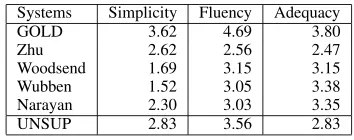
[image:6.612.326.503.509.579.2]Systems Simplicity Fluency Adequacy GOLD 3.62 4.69 3.80 Zhu 2.62 2.56 2.47 Woodsend 1.69 3.15 3.15 Wubben 1.52 3.05 3.38 Narayan 2.30 3.03 3.35 UNSUP 2.83 3.56 2.83
Table 4: Average Human Ratings for simplicity, fluency and adequacy.
Table 4 shows the average ratings of the hu-man evaluation on a scale from 0 to 5. Pair-wise comparisons between all models and their statistical significance were carried out using a one-way ANOVA with post-hoc Tukey HSD tests.
10We upload the outputs from all the systems as
supple-mentary material with this paper.
System pairs Average Score (number of split sentences)
A B ALL-A ALL-B ONLY-A BOTH-ABA B ONLY-B
UNSUP
GOLD
2.37(49)
[image:7.612.147.470.64.142.2]3.85(28) 2.15(32) 2.80(17) 3.70(17) 4.05(11) Zhu 2.25(80) 1.53(4) 2.45(45) 2.42(45) 2.02(35) Woodsend 2.08(63) 2.42(11) 2.36(38) 2.29(38) 1.78(25) Wubben 2.73(1) 2.32(48) 4.75(1) 2.73(1) 0(0) Narayan 2.09(10) 2.29(41) 2.78(8) 1.79(8) 3.81(2)
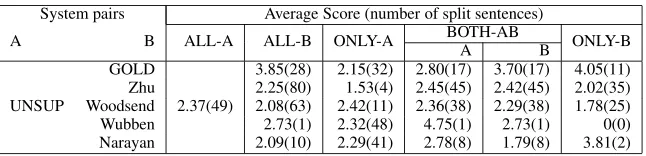
Table 5:Pairwise split evaluation: Each row shows the pairwise comparison of the quality of splits in UNSUP and some other system. Last six columns show the average scores and number of associated split sentences. The second column (ALL-A) and the third column (ALL-B) present the quality of all splits by systems A and B respectively. The fourth column (ONLY-A) represents sentences where A splits but not B. The fifth and sixth columns represents sentences where both A and B split. The seventh column (ONLY-B) represents sentences where B splits but not A.
If we group together systems for which there is no significant difference (significance level: p<
0.05), our system is in the first group together with Narayan and Zhu for simplicity; in the first group for fluency; and in the second group for ade-quacy (together with Woodsend and Zhu). A man-ual examination of the results indicates that UN-SUP achieves good simplicity rates through both deletion and sentence splitting. Indeed, the aver-age word length of simplified sentences is smaller for UNSUP (26.22) than for Wubben (28.25) and Woodsend (28.10); comparable with Narayan (26.19) and higher only than Zhu (24.21).
4.2 Modular Evaluation
To assess the relative impact of each module (lexi-cal simplification, deletion and sentence splitting), we also conduct an automated evaluation on each module separately. The results are shown in Ta-ble 3.
One first observation is that each module has an impact on simplification. Thus the average Lev-enshtein Edit distance (LD) to the source clause (complex) is never null for any module while the number of “No edit” indicates that lexical simpli-fication modifies the input sentence in 78%, sen-tence splitting 49% and deletion 96% of the cases. In terms of output quality and in particular, sim-ilarity with respect to the target clause, deletion is the most effective (smallest LD, best BLEU score w.r.t. target). Further, the results for average token length indicate that lexical simplification is effec-tive in producing shorter words (smaller average length for this module compared to the other two modules).
Predictably, combining modules yields systems that have stronger impact on the source clause (higher LD to complex, lower number of No Ed-its) with the full system (i.e., the system combin-ing the 3 modules) showcombin-ing the largest LD to the
sources (LD to complex) and the smallest number of source sentences without simplification (3 No Edits).
4.3 Sentence Splitting Using Deep Semantics
To compare our sentence splitting approach with existing systems, we collected in a second human evaluation, all the outputs for which at least one system applied sentence splitting. The raters were then asked to compare pairs of split sentences pro-duced by two distinct systems and to evaluate the quality (0:very bad to 5:very good) of these split sentences taking into account boundary choice, sentence completion and sentence reordering.
Table 5 shows the results of this second evalua-tion. For each system pair comparing UNSUP (A) with another system (B), the Table gives the scores and the number of splits of both systems: for the inputs on which both systems split (BOTH-AB), on which only UNSUP splits (ONLY-A) and on which only the compared system split (ONLY-B). UNSUP achieves a better average score (ALL-A = 2.37) than all other systems ((ALL-ALL-B column) except Wubben (2.73). However Wubben only achieves one split and on that sentence, UNSUP score is 4.75 while Wubben has a score of 2.73 and produces an incorrect split (cf.S3in Figure 6).
UNSUP
S1 Complex. This array distributes data across multiple disks, but the array is seen by the computer user and operating system as one single disk.
Zhu.This array sells data across multiple disks but the array is seen. The computer user and operating as one disk. [0]
Woodsend. This array distributes data across several disks. The array is seen by the computer user and operating system as one single disk. [4.85]
UNSUP.This array moves data across disks. The array is seen by the computer user and operating system as one disk. [4.83]
S2 Complex. Here, simulations of evolution using evolutionary algorithms and artificial life started with the work of Nils Aall Barricelli in the 1960s, and was extended by Alex Fraser, who published a series of papers on simulation of artificial selection.
Zhu.Here, simulations of evolution using evolutionary algorithms and artificial life started with the work of nils aall barricelli in the 1960s, and was extended by alex fraser. Alex fraser published a series of papers on feeling of artificial selection. [3.6]
Woodsend.It has Genetic algorithms. Evolution is using artificial life. This is Nils Aall Barricelli in the 1960s. Here, simulations started with the work. He was extended by Alex Fraser. He published a group of papers on simulation of artificial selection. [0.33]
UNSUP.Here, models of evolution using evolutionary algorithms and artificial life started with the work in the 1960s, and was led by Alex Fraser. Alex Fraser wrote a series of papers on model of selection. [5]
S3 Complex.By 1928, the regional government was moved from the old Cossack capital Novocherkassk to Rostov, which also engulfed the nearby Armenian town of Nor Nakhijevan.
Zhu.By 1928, the government was moved from the old cossack capital novocherkassk to rostov. Rostov also of the city the nearby armenian town of nor nakhijevan. [2.8]
Woodsend.By 1928, the regional government was moved from the old Cossack capital Novocherkassk to Rostov. Both also engulfed the nearby Armenian town of Nor Nakhijevan. [3]
Wubben. by 1928 , the regional government was moved from the old cossack capital novocherkassk to rostov. the nearby armenian town of nor nakhichevan. [2.7]
Narayan.by 1928, the regional government was moved from the old cossack capital novocherkassk to rostov. rostov that engulfed the nearby armenian town of nor nakhichevan. [2.7]
[image:8.612.104.517.60.352.2]UNSUP.The regional government was moved from the old Cossack capital Novocherkassk to Rostov. Rostov also absorbed the nearby town of Nor Nakhijevan. [4.75]
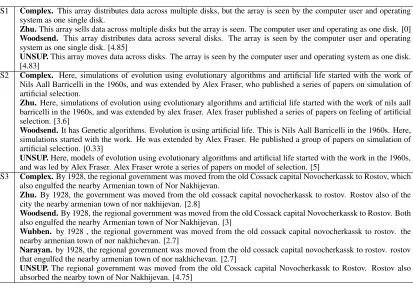
Table 6:Example Outputs for Sentence splitting with their average human annotation scores.
In sum, the unsupervised, semantic-based split-ting strategy allows for a high number (49%) of good quality (2.37 score) sentence splits . Be-cause there are less possible patterns of thematic role sets in simple sentences than possible con-figurations of parse/dependency trees for complex sentences, it is less prone to data sparsity than the syntax based approach. Because the probabilities learned are not tied to specific syntactic structures but to more abstract semantic patterns, it is also perhaps less sensitive to parse errors.
4.4 Examples from the Test Set
Table 6 shows some examples from the evaluation dataset which were selected to illustrate the work-ings of our approach and to help interpret the re-sults in Table 2, 4 and 5.
S1 and S2 and S3 show examples of context-aware unsupervised lexical substitutions which are nicely performed by our system. In S1,The array distributes datais correctly simplified toThe ar-ray moves datawhereas Zhu’s system incorrectly simplifies this clause toThe array sells data. Simi-larly, in S2, our system correctly simplifiesPapers on simulation of artificial selectiontoPapers on models of selectionwhile the other systems either do not simplify or simplify toPapers on feeling.
For splitting, the examples show two types of splitting performed by our approach namely, split-ting of coordinated sentences (S1) and splitsplit-ting be-tween a main and a relative clause (S2,S3). S2 il-lustrates how the Woodsend system over-splits, an issue already noticed in (Siddharthan and Mandya, 2014); and how Zhu’s system predicts an incorrect split between a verb (seen) and its agent argument (by the user). Barring a parse error, such incorrect splits will not be predicted by our approach since, in our cases, splits only occur between (verbali-sations of) events. S1, S2 and S3 also illustrates how our semantic based approach allows for an adequate reconstruction of shared elements.
5 Conclusion
6 Acknowledgements
We are grateful to Zhemin Zhu, Kristian Wood-send and Sander Wubben for sharing their data. We would like to thank our annotators for partic-ipating in our human evaluation experiments and to anonymous reviewers for their insightful com-ments. This research was supported by an EP-SRC grant (EP/L02411X/1) and an EU H2020 grant (688139/H2020-ICT-2015; SUMMA). We also thank the French National Research Agency for funding the research presented in this paper in the context of the WebNLG project.
References
Or Biran, Samuel Brody, and No´emie Elhadad. 2011. Putting it simply: a context-aware approach to lex-ical simplification. InProceedings of the 49th An-nual Meeting of the Association for Computational Linguistics: Human Language Technologies: short papers-Volume 2, pages 496–501. Association for Computational Linguistics.
Yvonne Margaret Canning. 2002.Syntactic simplifica-tion of Text. Ph.D. thesis, University of Sunderland. John Carroll, Guido Minnen, Darren Pearce, Yvonne Canning, Siobhan Devlin, and John Tait. 1999. Simplifying text for language-impaired readers. In
Proceedings of 9th Conference of the European Chapter of the Association for Computational Lin-guistics (EACL), volume 99, pages 269–270. Cite-seer.
Raman Chandrasekar and Bangalore Srinivas. 1997. Automatic induction of rules for text simplification.
Knowledge-Based Systems, 10(3):183–190. Raman Chandrasekar, Christine Doran, and
Banga-lore Srinivas. 1996. Motivations and methods for text simplification. InProceedings of the 16th In-ternational conference on Computational linguistics (COLING), pages 1041–1044. Association for Com-putational Linguistics.
William Coster and David Kauchak. 2011. Learning to simplify sentences using wikipedia. InProceedings of the Workshop on Monolingual Text-To-Text Gen-eration, pages 1–9. Association for Computational Linguistics.
James R Curran, Stephen Clark, and Johan Bos. 2007. Linguistically motivated large-scale NLP with C&C and Boxer. InProceedings of the 45th Annual Meet-ing of the Association for Computational LMeet-inguistics (ACL) on Interactive Poster and Demonstration Ses-sions, pages 33–36. Association for Computational Linguistics.
Mark Dras. 1999. Tree adjoining grammar and the reluctant paraphrasing of text. Ph.D. thesis, Mac-quarie University NSW 2109 Australia.
Katja Filippova and Michael Strube. 2008. Depen-dency tree based sentence compression. In Proceed-ings of the Fifth International Natural Language Generation Conference (INLG), pages 25–32. Asso-ciation for Computational Linguistics.
Hans Kamp. 1981. A theory of truth and semantic rep-resentation. In J.A.G. Groenendijk, T.M.V. Janssen, B.J. Stokhof, and M.J.B. Stokhof, editors,Formal methods in the study of language, number pt. 1 in Mathematical Centre tracts. Mathematisch Centrum.
Kevin Knight and Daniel Marcu. 2000. Statistics-based summarization-step one: Sentence compres-sion. InProceedings of the Seventeenth National Conference on Artificial Intelligence (AAAI) and Twelfth Conference on Innovative Applications of Artificial Intelligence (IAAI), pages 703–710. AAAI Press.
Eric Kow and Anja Belz. 2012. LG-Eval: A Toolkit for Creating Online Language Evaluation Experi-ments. In Proceedings of the 8th International Conference on Language Resources and Evaluation (LREC), pages 4033–4037.
Shashi Narayan and Claire Gardent. 2014. Hybrid simplification using deep semantics and machine translation. In Proceedings of the 52nd Annual Meeting of the Association for Computational Lin-guistics. Association for Computational Linguistics.
Matthew Shardlow. 2014. A survey of automated text simplification. International Journal of Advanced Computer Science and Applications (IJACSA), Spe-cial Issue on Natural Language Processing.
Advaith Siddharthan and Angrosh Mandya. 2014. Hy-brid text simplification using synchronous depen-dency grammars with hand-written and automati-cally harvested rules. InProceedings of the 14th Conference of the European Chapter of the Associa-tion for ComputaAssocia-tional Linguistics, pages 722–731, Gothenburg, Sweden, April. Association for Com-putational Linguistics.
Advaith Siddharthan. 2002. An architecture for a text simplification system. InProceedings of the Lan-guage Engineering Conference (LEC), pages 64–71. IEEE Computer Society.
Advaith Siddharthan. 2010. Complex lexico-syntactic reformulation of sentences using typed dependency representations. InProceedings of the 6th Inter-national Natural Language Generation Conference (INLG), pages 125–133. Association for Computa-tional Linguistics.
David A Smith and Jason Eisner. 2006. Quasi-synchronous grammars: Alignment by soft projec-tion of syntactic dependencies. InProceedings of the HLT-NAACL Workshop on Statistical Machine Translation, pages 23–30. Association for Compu-tational Linguistics.
David Vickrey and Daphne Koller. 2008. Sentence simplification for semantic role labeling. In Pro-ceedings of the 46th Annual Meeting of the Associ-ation for ComputAssoci-ational Linguistics (ACL) and the Human Language Technology Conference (HLT), pages 344–352.
Willian Massami Watanabe, Arnaldo Candido Junior, Vin´ıcius Rodriguez Uzˆeda, Renata Pontin de Mat-tos Fortes, Thiago Alexandre Salgueiro Pardo, and Sandra Maria Alu´ısio. 2009. Facilita: reading as-sistance for low-literacy readers. InProceedings of the 27th ACM international conference on Design of communication, pages 29–36. ACM.
Kristian Woodsend and Mirella Lapata. 2011. Learn-ing to simplify sentences with quasi-synchronous grammar and integer programming. InProceedings of the Conference on Empirical Methods in Natu-ral Language Processing (EMNLP), pages 409–420. Association for Computational Linguistics. Sander Wubben, Antal van den Bosch, and Emiel
Krahmer. 2012. Sentence simplification by mono-lingual machine translation. InProceedings of the 50th Annual Meeting of the Association for Com-putational Linguistics (ACL): Long Papers-Volume 1, pages 1015–1024. Association for Computational Linguistics.
Wei Xu, Courtney Napoles, Ellie Pavlick, Quanze Chen, and Chris Callison-Burch. 2016. Optimizing statistical machine translation for text simplification.
Transactions of the Association for Computational Linguistics.
Kenji Yamada and Kevin Knight. 2001. A syntax-based statistical translation model. InProceedings of the 39th Annual Meeting on Association for Com-putational Linguistics (ACL), pages 523–530. Asso-ciation for Computational Linguistics.