Translating Negation: A Manual Error Analysis
Federico Fancellu and Bonnie Webber School of Informatics
University of Edinburgh 11 Crichton Street, Edinburgh
f.fancellu[at]sms.ed.ac.uk,bonnie[at]inf.ed.ac.uk
Abstract
Statistical Machine Translation has come a long way improving the translation quality of a range of different linguistic phenom-ena. With negation however, techniques pro-posed and implemented for improving transla-tion performance on negatransla-tion have simply fol-lowed from the developers’ beliefs about why performance is worse. These beliefs, however, have never been validated by an error analysis of the translation output. In contrast, the cur-rent paper shows that an informative empiri-cal error analysis can be formulated in terms of (1) the set of semantic elements involved in the meaning of negation, and (2) a small set of string-based operations that can char-acterise errors in the translation of those ele-ments. Results on a Chinese-to-English trans-lation task confirm the robustness of our anal-ysis cross-linguistically and the basic assump-tions can inform an automated investigation into the causes of translation errors. Conclu-sions drawn from this analysis should guide future work on improving the translation of negative sentences.
1 Introduction
In recent years, there has been increasing interest in improving the quality of SMT systems over a wide range of linguistic phenomena, including corefer-ence resolution (Hardmeier et al., 2014) and modal-ity (Baker et al., 2012). Amongst these, however, translating negation is still a problem that has not been researched thoroughly.
This paper takes an empirical approach towards
understanding why negation is a problem in SMT. More specifically, we try to answer two main ques-tions:
1. What kindof errors are involved in translating negation?
2. What are the causes of these errors during de-coding?
While previous work (section 2) has shown that translating negation is a problem, it has not ad-dressed either of these questions.
The present paper focuses on the first one; we show that tailoring to a semantic task, string-based error categories standardly used to evaluate the qual-ity of the machine translation output, allows us to cover the wide range of errors occurring while translating negative sentences (section 3). We re-port the results of the analysis of a Hierarchical Phrase Based Model (Chiang, 2007) on a Chinese-to-English translation task (section 4), where we show that all error categories occur to some extent with scope reordering being the most frequent (sec-tion 5).
Addressing question (2) requires connecting the assumptions behind this manual error analysis to er-rors occurring along the translation pipeline. As such, we complete the analysis by briefly introduce an automatic method to investigate the causes of the errors at decoding time (section 6).
2 Previous Work
In recent years, automatic recognition of negation has been the focus of considerable work. Follow-ing Blanco and Moldovan (2011) and Morante and Blanco (2012) detecting negation is a task of unrav-eling its structure, i.e. locating in a text its four main components:
• Cue: the word or multi-word unit inherently expressing negation (e.g. ‘He is not driving a car’)
• Event: the lexical element the cue directly refers to (e.g. ‘He is not driving a car’)
• Scope: all the elements whose falsity would prove negation to be false; given that the cue is not included, the scope is often discontinuous (e.g. ‘He is not driving a car’)
• Focus: the portion of the statement negation primarily refers to (e.g. ‘He is not driving a car).
The *SEM 2012 shared task represented a first at-tempt to apply machine learning methods to the problem of automatically detect the aforementioned elements in English. In particular CRFs and SVMs, making use of syntactic (both constituent and de-pendency based) clues, were shown to lead to the best results in a supervised machine learning setting (Read et al., 2012; Chowdhury and Mahbub, 2012). The shared task also saw the release of a fully an-notated corpus in the literature domain, which rep-resents, along with the BioScope corpus (Szarvas et al., 2008), the only resource specifically annotated for negation.
There were also a few attempts in automatically detecting negation in Chinese texts. Li et al. (2008) designed a negation detection algorithm based on syntactic patterns; similarly, Zheng et al. (2014) implemented an FSA for automatic recognition of negation structures in Chinese medical texts, using a list of manually defined cues and the syntactic struc-tures they appear in.
In a bilingual setting such as the SMT, however, most work has only considered negation as a side problem. For this reason, no actual analysis on the type of errors involved in translating negation or
their causes has been specifically carried out. The standard approach has been to formulate an hypoth-esis about what can go wrong when translating nega-tion, modify the SMT system in a way aimed at re-ducing the number of times that happens, and then assume that any increase in BLEU score - the stan-dard automatic evaluation metric used in SMT - con-firms the initial hypothesis. Collins et al. (2005) and Li et al. (2009) consider negation, along with other linguistic phenomena, as a problem of struc-tural mismatch between source and target; Wetzel and Bond (2012) consider it instead as a problem of
training data sparsity; finally Baker et al. (2012) and Fancellu and Webber (2014) consider it as amodel problem, where the system needs enhancement with respect to the semantics of negation. Given that all these works assess the quality of translation of negative sentences using ann-gramoverlap metric, there is no certainty whether any improvement de-rives from a better rendering of negation or from other, non-negation related elements.
Evaluating the semantic adequacy of the SMT output has also stimulated interest in recent years. Traditional error categories, such as the ones pre-sented in (Vilar et al., 2006), are mostly based on n-gram overlap between hypothesis and reference and so are the most widely used automatic evalu-ation metrics used in SMT (e.g. BLEU (Papineni et al., 2002) and TER (Snover et al., 2009)). In contrast, MEANT (Lo and Wu, 2010, 2011) and its human counterpart, HMEANT, attempt to abstract from simple string matching and assess the degree of semantic similarity between machine output and ref-erence sentence. To do so, both sides are annotated using Propbank-like semantic labels, and the fillers matched if both sides contain the same event. To as-sign a score to the test set evaluated, an F1measure over precision and recall of matched fillers is then computed.
3 Methodology
3.1 Manual Annotation
event and scope. Isolating a small set of seman-tic elements involved in the construction of negation is useful in the context of SMT to reduce negation into tangible elements at the string level. Moreover each of the three elements above represents differ-ent translation problems: if, for instance, translating thecue mainly involves ensuring the presence of a negation marker, translating the scope involves in-stead ensuring that semantic elements are translated in the right domain and most of the times, around the negatedevent.
We carried out the annotation of cue, event and
scopeon both the source Chinese sentences and the correspondent translation output by the SMT sys-tem, following the guidelines released during the SEM* 2012 shared task (Morante et al., 2011). To our understanding, this is the first work that applies these guidelines to a language other than English. It is however worth noticing that while these guide-lines were released with the goal in mind of auto-matically extracting information from text, with a particular emphasis on factuality, the present work focuses on translation, where each negation instance is taken into consideration as potential source of er-ror. This leads to some differences in the annotation process, especially in the case of theevent:
1. While the original guidelines do not annotate negation scoping on non-factual events, such as in conditional clauses (‘if he doesn’t come, I will blame you’), the demands of translation require it to be annotated.
2. While the original guidelines do not include modals or auxiliaries in the event annotation (in order to minimise the number of annotated ele-ments), getting these elements correct in trans-lation is needed to distinguish a correct vs. par-tially correct event (cf. section 3.2).
3. For the same reason as (2), the event in a nom-inal predicate includes all its modifiers.
4. All these points apply to Chinese as well; in ad-dition, in the case of resultative constructions (e.g.f`u b`u q˘ilit. ‘pay not lift-RES.’, ‘could not pay, can not afford’) we considered the resulta-tive particle as part of theevent.
With respect to scope, the current work makes a simple approximation: scope is often discontinu-ous, with multiple semantic units whose translations might impact the overall translation of the scope dif-ferently. To facilitate error analysis we approximate the scope in terms of its constituent semantic fillers, here taken to be Propbank-like semantic arguments. In doing so, we consider the scope as thesemantic domainof negation, where the constituent elements are expected to remain in its boundaries and to pre-serve their semantic role (or take an equivalent one) during translation.
Example (1) illustrates our annotation scheme over the first instance ofb`u(not) in a Chinese source sentence.
(1) [w˘omen]f iller We
b`ucue not
p´aich´uevent exclude
[q´ızh¯ong
amidst
y˘ou
there is
d˘an x¯ın
worried
de
of
hu`ı
can
l´ai
come
zh˘ud`ong
voluntarily
ji¯aod`ai]f iller confess
, ,
d`an
but
p´ao
run
de q˘ı
RES b`u not
g¯eng
even
du¯ome? more Q
Ref: [We]f iller do notcue [rule out]event [the possibility that some timid ones might come out and voluntarily confess]f iller, but would n’t many more just run away?
As shown in (1) the scope around the first main clause can be split into two arguments - a subject and an object - around the verbp´aich´u(rule out) so error analysis can be carried on each individually. We instead consider the second instance of b`u/not
as ‘non-functional negation’ and do not annotate it since it is just part of the question and does not con-stitute itself a negation instance.
3.2 Manual Error Analysis
• Deletion: one of the three sub-constituents of negation is present in the source Chinese sen-tence but not in the machine output. This corre-sponds to themissing wordscategory in (Vilar et al., 2006).
• Insertion: the negation element is not present in the source sentence but has been inserted in the machine output. This resembles the ex-tra wordssub-category in the incorrect words
class.
• Reordering: whether the element has been moved outside its scope. Since some seman-tic elements can also move inside the scope and take a role which they did not have in the orig-inal source sentence, we define the former re-ordering error asout-of-scopereordering error and the latterintra-scopereordering error. The reordering category represents an adaptation of the originalword ordercategory.
Since we are not concerned with errors regarding style, punctuation or unknown words, other opera-tions were left aside.
For a better understanding at when during the translation process (a.k.a. thedecodingprocess) and
whythe error occurs, we also investigated the trace of rules used to build the 1-best machine output. This is particularly useful in the case of deletion: this may occur because a certain Chinese word or sequence of Chinese words (generally referred in SMT asphrases) has not been seen during training (so calledout-of-vocabulary items- OOVs) and the system is therefore unable to translate them.
After the elements of negation have been an-notated in both the source sentences and machine outputs, we use the same heuristic as (H)MEANT (Lo and Wu, 2011) to decide whether a translated unit iscorrectorpartially correct. We also consider
correcttranslations that are synonyms of the source negation element since they are taken to convey the same meaning. This also includes those elements that are negated in the source but are rendered in the machine output by means of a lexical element inherently expressing negation (e.g. fails) or by paraphrase into positive (e.g. b`u t´ong, lit. ‘not similar’→different). We considerpartially correct
translated elements that do not contain errors which
impact the overall meaning. In the case of the event, this might be related to tense agreement or wrong modality, whilst in the case of the scope it is usually related to the fact that secondary elements are not translated correctly but the overall meaning is still preserved.
As in HMEANT, we compute precision, recall and F1 measure using the following formulae wheree ∈E = {cue,event,filler}. However, unlike HMEANT, we do not normalise the number of correct fillers by the number of total fillers in the predicate.
P = ( P
ecorrect+ 0.5∗Pepartial) P
ehyp
R= ( P
ecorrect+ 0.5∗Pepartial) P
esrc
F1 = 2∗
P∗R P+R
4 System
We carried out the error analysis on the output of the Chinese-to-English hierarchical phrase based system submitted by the University of Edinburgh for the NIST12 MT evaluation campaign.
Hierarchical phrase-based (or HPB) systems are a class of SMT systems that use syntax-like rules and hierarchical tree structures to build an hypothesis translation given a test source sentence and a model previously trained on a bilingual corpora. Unlike pure syntax models, HPBMs do not make use of syntactic constituent tags for non-terminals but instead use an X as placeholder for recursion. A rule used in a Hierarchical Phrase based system looks like the following,
ne veux plus X1→do not want X1 anymore
where the French source (also referred to as theleft hand side- LHS of the rule) and the English target side (theright hand side- RHS) allows arbi-trary insertion of another rule where the placeholder X is located.
2008) used for alignment. The system was tuned using MERT (Minimal Error Rate Training, (Och, 2003)) on the NIST06 set.
Two different test sets were considered to assess differences that might be associated with genre: the NIST MT08 test set, containing data from the newswire domain and the IWSLT14 tst2012 test set, containing transcriptions of TED talks. We hypothesise that the difference in genre can influ-ence the kinds of negation related error occurring during translation: as a collection of planned spoken inspirational talks, we expect the IWSLT’14 test set to contain shorter sentences, and on average, more instances of negation. On the contrary, we expect the NIST MT08, where data are from the written language domain, to contain longer sentences and fewer instances of negation.
In order to carry out future work on the effect of word segmentation on the elements on negation, we built two different systems (and therefore rule tables), one from data segmented using the LDC-WordSegmenter and the other using the Stanford Word Segmenter. The former matches the segmen-tation of the NIST08 test set, whilst the latter the one of the IWSLT14 test set.
Out of the 1397 segments in the IWSLT2014 set and the 1357 segments in the NIST MT08 set, 250 sentences for each set were randomly chosen to carry out the manual evaluation.
5 Results
5.1 Manual Analysis
5.1.1 NIST MT08
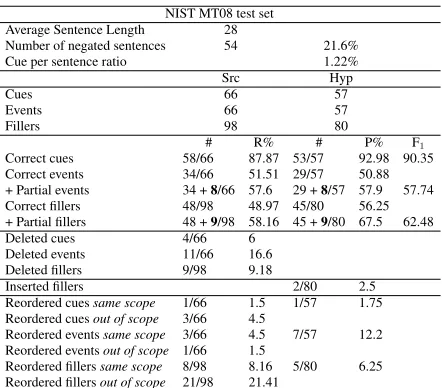
The results of the manual evaluation for the NIST MT08 test set are reported in Table 1. It can be easily seen that getting the cue right is easier than translating event and scope correctly. The cue is in fact usually a one-word unit and related errors con-cern almost entirely whether the system has deleted it during translation or not. Event and scope instead are usually multi-word units whose correctness also depends on whether they interact correctly with the other negation elements.
In those cases where the cues were deleted during translation, the trace shows that they were all caused by a rule application that doesnotcontain negation on the English right hand side. Also worth
notic-ing is that, in these cases, the negation cue in the source side is lexically linked to the event (‘b `ush˘ao’ , ‘not few, many’) or lexically embedded in it (e.g. ‘d´e b `udao, ‘cannot obtain’). No cases of cues be-ing deleted were found where the cue is a distinct unit. Also, no cases of cues were found of cues be-ing deleted because of not bebe-ing seen durbe-ing trainbe-ing (out-of-vocabulary items).
Other cue-related errors involve the cue being ordered with respect to scope. In one case, cue re-ordering happens within the same scope, where the cue is moved from the main clause to the subordi-nate. In three other cases, the cue is instead trans-lated outside its source scope and attached to a dif-ferent event. The two cases are exemplified in (2) and (3) respectively.
(2) [t¯a]f iller She
c´ongb`ucue never
[y¯ınw`ei
because
w˘o
I
g˘ei
to
t¯a
him
t´ı
raise
gu`o
ASP
y`ıj`ıan]f iller opinion
´er
so [d`ui
to
w˘o]f iller I
hu`ai y˘ouevent have
[p`ıanj`ıan]f iller bias
[...]
Ref: He never showed any bias against me [because i ’d complained to him]sub[...]
Hyp: he never mentioned to him because my opinions and i have bias against china [...]
(3) [...] [...]
ji`u
then
hu`ı
can
r`enw´ei
think
b`u
not
c´unz`ai
exist
Ref: [...] people would think [that [they do]scopenot [exist]scope]sub
Hyp:[...] donotthink [there is a]sub
source becoming events in the machine output, as shown in (4).
(4) zh`e
This
y¯ıge
one
ji¯edu`an
stage
de
of
bi˘axi`an
show
sh`ı
is
[du˘anq¯ı
short-term
xi¯aogu¯o]f iller result
b`ud`acue+event not big
[...] [...]
Ref:what this stage brings forward is : mod-est success in the short-term [...]
Hyp: this is a stage performance are notcue [short-term effect]event
The fact that most of reordering errors are filler-related is connected to the lack of semantic-filler-related information during the translation process, a com-mon problem in machine translation systems. Since there is no explicit guidance as to which events the fillers should be attached to and in what order, in-scopeandout-of-scopeproblems are to be expected. Around 10% of filler-related errors were caused by deletion. An investigation of the trace shows that in all 9 cases, the system has knowledge of the source words in the rule table but has applied a rule that does not contain the filler on the target side.
Finally, in the case of fillers, we notice that 2 of the incorrect fillers in the hypothesis were due to the
insertion in the scope of fillers not present in the source side. The trace shows that this kind of error is generated by rules that contain on the right hand side extra material not related to the source side. We hypothesised that these rules might have been cre-ated during training where English words that did not correspond to any Chinese source words were arbitrarily added to neighbouring phrases. For in-stance, in (5) a rule that translates y˘izh`ıy´u (‘to the extent of’) into ‘to the extent ofthey’ is used, adding a filler to following negation scope.
(5) [...] [...]
y˘ızh`ıy´u
to the extent
w´uf˘a
not possible
y´u
with
o¯u zhou
Europe
m´enggu´o
union
zh`engch´ang
normally
zh˘ank¯ai
open
h´ezu`o
cooperation
Ref:[...] even made it is impossible to carry out cooperation with their European allies as normal .
Hyp: [...] to the extent that [they]f iller are unable to conduct normal with its european allies cooperation
NIST MT08 test set Average Sentence Length 28
Number of negated sentences 54 21.6%
Cue per sentence ratio 1.22%
Src Hyp
Cues 66 57
Events 66 57
Fillers 98 80
# R% # P% F1
Correct cues 58/66 87.87 53/57 92.98 90.35
Correct events 34/66 51.51 29/57 50.88
+ Partial events 34 +8/66 57.6 29 +8/57 57.9 57.74
Correct fillers 48/98 48.97 45/80 56.25
+ Partial fillers 48 +9/98 58.16 45 +9/80 67.5 62.48
Deleted cues 4/66 6
Deleted events 11/66 16.6
Deleted fillers 9/98 9.18
Inserted fillers 2/80 2.5
Reordered cuessame scope 1/66 1.5 1/57 1.75 Reordered cuesout of scope 3/66 4.5
Reordered eventssame scope 3/66 4.5 7/57 12.2 Reordered eventsout of scope 1/66 1.5
[image:6.612.316.537.69.263.2]Reordered fillerssame scope 8/98 8.16 5/80 6.25 Reordered fillersout of scope 21/98 21.41
Table 1: Results from the error analysis of the 250 sen-tences randomly extracted from the NIST MT08 test set.
5.1.2 IWSLT ’14 Tst2012 TED Talks
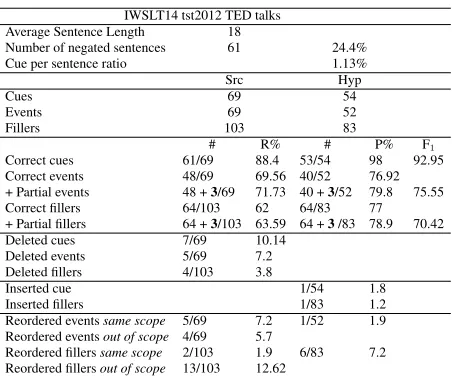
Results for the TED talks test set are reported in Table 2. It can be observed that results on all three categories are better than the NIST08 test set, in particular for the F1 measure of correct events and scope. A reduction in the percentage of reordered fillers on the overall number translation errors might be connected to the fact that on average sentences in the TED talk, also given their domain, are shorter than the sentences in the NIST08 test set and thefore there is less chance of operating long range re-ordering.
We can also observe that genre has an effect on the number of negation cues; despite sentences be-ing shorter, we found more negative instances in the TED talks.
As for the errors in the NIST08 test set, we anal-ysed the trace output after the completion of the translation process to see whether deletions were caused by incorrect rule application or by the pres-ence of OOV items not seen during training. Out of 7 cases of cue deletion, 3 of event deletion and 5 of filler deletion, only one was caused by the presence of an OOV vocabulary item in the source. However, as shown in (6), the OOV error is generated by a wrong segmentation of two elements in the source,
(6) b`uzh¯ız˘enme
do not know how
y`ong
use
w˘omen
we
b`u
not
n´eng
be able
w´anqu´an
completely
l˘ıji˘e
understand
de
of
f¯angshi
method [...] [...]
Ref: ways we cannot fully understand that we don’t know how to use [...]
Hyp: was converted to the way we cannot fully understand [..]
This seem to exclude OOV items as a problem in translating negation for the present system and what we are left with is a problem of negative elements not correctly reproduced on the target side of the rules.
Finally, we have found two cases of insertion, one cue and the other event related. Overall, cases of insertion are rare and do not constitute a real prob-lem for the system here considered. In general, as foreventandscope, a rule application that does not contain one of these two elements on the Chinese left hand side but inserts it in the English right hand side might be just fortuitous. As in the case of (5), it might have been that a rule containing extra material was preferred because a better fit in that specific con-text (a LM score is in fact part of the scoring func-tion of a SMT system). Inserfunc-tion of thecuedeserves instead a better investigation. The results shows that deletion is sometimes associated with rules whose Chinese (left-hand) side contains a cue whilst the English side does not. This is most certainly caused by the training process where rules are extracted ac-cording to what portion of the source Chinese sen-tence is aligned to what portion in the target English sentence. If an Chinese sentence contains negation but the English does not, a rule learnt from that pair might learn that a negation cue corresponds to some-thing positive. This should theoretically happen the other way around and if so, the application of these rules should lead to insertion. Further analysis of the rule table and the sentences used in training might clarify this point.
6 Towards An Automatic Error Analysis
This manual error analysis assesses the quality of the 1-best translation output by the system. More can be done: (i) we can determine which component of the system is responsible for each error so as to know where to intervene and (ii) we can automate
IWSLT14 tst2012 TED talks
Average Sentence Length 18
Number of negated sentences 61 24.4%
Cue per sentence ratio 1.13%
Src Hyp
Cues 69 54
Events 69 52
Fillers 103 83
# R% # P% F1
Correct cues 61/69 88.4 53/54 98 92.95
Correct events 48/69 69.56 40/52 76.92
+ Partial events 48 +3/69 71.73 40 +3/52 79.8 75.55
Correct fillers 64/103 62 64/83 77
+ Partial fillers 64 +3/103 63.59 64 +3/83 78.9 70.42
Deleted cues 7/69 10.14
Deleted events 5/69 7.2
Deleted fillers 4/103 3.8
Inserted cue 1/54 1.8
Inserted fillers 1/83 1.2
Reordered eventssame scope 5/69 7.2 1/52 1.9 Reordered eventsout of scope 4/69 5.7
[image:7.612.314.540.69.257.2]Reordered fillerssame scope 2/103 1.9 6/83 7.2 Reordered fillersout of scope 13/103 12.62
Table 2: Results from the error analysis of the 250 sen-tences randomly extracted from the IWSLT2014 test set.
the whole process of error finding. Both actions can be referred to asautomatic error analysis, given that they rely on (semi-)automatic method to analyse er-rors in translating negation, although they differ in the scope of their analysis: (i) represents an exten-sion of the manual error analysis, whilst (ii) aims at automating it.
Although out of the scope of the present work, we briefly sketch our current work on (i) whilst leaving (ii) for future work. The reason for this is because the assumption behind this as many other manual analysis, i.e. that a small set of string-based error categories can be used to characterise different kind of translation errors (here semantic), can be easily projected in the automatic error analysis. Moreover, the importance and indispensability of a manual er-ror analysis is highlighted when devising an auto-matic error analysis. This is obvious in the case of (i), where, in order to find the causes of the errors, we need to know what these are. However, even we succeed in (ii) and we are able to spot errors auto-matically, we still need a manual error analysis as a benchmark to assess the quality of any automatic method.
er-ror category and the set of negation sub-constituents used in this manual error analysis:
1. Thecuehas to be translated correctly; no cue
deletionorinsertionshould occur.
2. The event has to be translated correctly; no eventdeletionorinsertionshould occur.
3. Thecuehas to be connected to rightevent; no cue or eventreorderingshould occur.
4. The semantic argumentsin the source scope should be translated and reproduced in line with the target language semantics; no dele-tion, insertionor reorderingof the semantic fillers should occur.
An ideal system would meet all the above conditions in translating negation in each cell of the decoding chart1; if not, we have to inspect the decoding chart trace and classify the errors occurred. The goal here is to find which part of the translation system is re-sponsible for each error category. There are three main type of errors, each one connected to one com-ponent of the translation pipeline:
• Induction errors, where the correct translation for a given element is absent from the search space. These errors depends on how many tar-get translations are fetched from the rule table when a given source span is translated (default is 20). The more we consider, the more likely is for the correct translation to be inserted in the search space. The system component related to this category is therule table.
• Search errors, where the correct translation fetched from the rule table disappears from the search space before making it to the final cell, due to pruning or other optimisation heuristics. The system component responsible for this er-ror is thesearch space.
• Model errors, where the system ranks bad translations better than better translations. The component responsible is thescoring function.
1Hierarchical phrase-based decoder uses a variant of
bottom-up CKY chart algorithm
Induction errors occur when no negation element is found in any hypothesis built in any of the chart cell; search errors occur when, by enlarging the search space, hypotheses meeting the expected conditions that were previously absent from the chart are now present; finally, model errors occur where hypothe-sis meeting one or more expectation are present but rank lower than the ones that do not.
Since these expectations are based on source side elements we need a way to project source side nega-tion elements into a target language; for expectanega-tion (1) and (2), we are experimenting with two differ-ent methods: (i) via an automatically extracted list of potential cues and a bilingual dictionary enriched with paraphrases; (ii) by extracting cues and events from the multiple reference translations set. To en-sure that expectation (3) and (4) are met we instead use a dependency parse.
Preliminary results on the translation of the cue alone (expectation (1)) in the NIST08 MT test set shows that it is uniquely a problem of model er-ror, where good hypotheses are ranked lower than bad ones. A comparison between the scores of good and bad hypotheses show, when the former are not ranked properly, shows that it is the translation model the main responsible for such bad ranking.
7 Conclusion
The present paper presents an analysis of the errors involved in translating negation. We showed that it is possible to build a clear and robust error analysis using (1) the set of semantic elements involved in the meaning of negation (cue,eventandscope) and (2) a sub-set of string-based operations traditionally used in SMT error analysis (deletion,insertionand
reordering).
prefers positive translations over negative and are therefore not caused by OOV items not seen during training.
Using the assumptions and the results of the man-ual error analysis, we also introduced an automatic way to inspect the causes of the errors in the de-coding chart trace. Preliminary results show that the scoring function is the main responsible for cue deletion errors observed.
We hope that the methodology and the results of the present work can guide future work on improv-ing the translation of negative sentences.
8 Future Work
In the present paper, we have successfully applied the manual error analysis to the output of a Chinese-to-English Hierarchical Phrase-based system. Fu-ture work will extend this method to other language pairs and different SMT systems. We in fact ex-pect these two variables to impact the kind of er-rors found in translation. Chinese and English are in fact very similar in the way they express nega-tion: adverbial negation is the most frequent way of expressing negation (Blanco and Moldovan, 2011; Fancellu and Webber, 2012); morphological nega-tion (or affixal) or lexically embedded negation is present in both languages and affect mainly adjec-tives; events can be both nominal, verbal and ad-jectival. If we however extend this analysis to a language pair where negation is expressed through different means (e.g. English and Czech), it is un-likely we will find the same error distribution. More-over, hierarchical phrase-based models are in fact non-purely syntax driven methods that are able to deal with high levels of reordering. That however also means that (a) there is no concept of syntac-tic constituent boundaries and (b) when reordering is performed incorrectly there is a high degree of el-ement scrambling. For this reason phrase-based sys-tems (where reordering is limited) and syntax-based systems (where an explicit knowledge of constituent boundaries is present) are likely to yield different re-sults.
Finally, this paper has only discussed manual detection of translation errors involving negation. Other ongoing work tries instead to automate this process.
9 Acknowledgements
This work was supported by the Accept, MosesCore and GRAM+ grant. The authors would like to thank Adam Lopez for his comments and suggestions and the three anonymous reviewers for their feedback.
References
Baker, Kathryn and Bloodgood, Michael and Dorr, Bonnie J and Callison-Burch, Chris and Filardo, Nathaniel W and Piatko, Christine and Levin, Lori and Miller, Scott (2012). Modality and nega-tion in SIMT use of modality and neganega-tion in semantically-informed syntactic MT. Computa-tional Linguistics, 38(2):411–438.
Blanco, Eduardo and Moldovan, Dan (2011). Some Issues on Detecting Negation from Text. In Pro-ceedings of the 24th Florida Artificial Intelligence Research Society Conference (FLAIRS-24), pages 228–233, Palm Beach, FL, USA.
Chiang, David (2007). Hierarchical phrase-based translation. Computational Linguistics, 33(2):201–228.
Chowdhury, Md and Mahbub, Faisal (2012). FBK: Exploiting phrasal and contextual clues for nega-tion scope detecnega-tion. InProceedings of the First Joint Conference on Lexical and Computational Semantics-Volume 1: Proceedings of the main conference and the shared task, and Volume 2: Proceedings of the Sixth International Workshop on Semantic Evaluation, pages 340–346.
Collins, Michael and Koehn, Philipp and Kuˇcerov´a, Ivona (2005). Clause restructuring for statisti-cal machine translation. In Proceedings of the 43rd Annual Meeting on Association for Compu-tational Linguistics, pages 531–540.
Fancellu, Federico and Webber, Bonnie (2012). Im-proving the performance of chinese-to-english Hierarchical phrase-based models (HPBM) on negative data using n-best list re-ranking. Mas-ter’s thesis, School of Informatics, University of Edinburgh.
Gao, Qin and Vogel, Stephan (2008). Parallel imple-mentations of word alignment tool. In Software Engineering, Testing, and Quality Assurance for Natural Language Processing, pages 49–57.
Hao-Min, Li and Li, Ying and Duan, Hui-Long and Lv, Xu-Dong (2008). Term extraction and nega-tion detecnega-tion method in chinese clinical docu-ment. Chinese Journal of Biomedical Engineer-ing, 27(5).
Hardmeier, Christian and Tiedemann, J¨org and Nivre, Joakim (2014). Translating pronouns with latent anaphora resolution. In NIPS 2014 Work-shop on Modern Machine Learning and Natural Language Processing.
Li, Jin-Ji and Kim, Jungi and Kim, Dong-Il and Lee, Jong-Hyeok (2009). Chinese syntactic reordering for adequate generation of Korean verbal phrases in Chinese-to-Korean SMT. InProceedings of the Fourth Workshop on Statistical Machine Transla-tion, pages 190–196.
Lo, Chi-kiu and Wu, Dekai (2010). Evaluating ma-chine translation utility via semantic role labels. InSeventh International Conference on Language Resources and Evaluation (LREC-2010), pages 2873–2877.
Lo, Chi-kiu and Wu, Dekai (2011). MEANT: an inexpensive, high-accuracy, semi-automatic met-ric for evaluating translation utility via semantic frames. InProceedings of the 49th Annual Meet-ing of the Association for Computational LMeet-inguis- Linguis-tics: Human Language Technologies-Volume 1, pages 220–229.
Morante, Roser and Blanco, Eduardo (2012). *SEM 2012 shared task: Resolving the scope and focus of negation. InProceedings of the First Joint Con-ference on Lexical and Computational Semantics, pages 265–274.
Morante, Roser and Schrauwen, Sarah and Daele-mans, Walter (2011). Annotation of negation cues and their scope, Guidelines v1.0. Computational linguistics and psycholinguistics technical report series, CTRS-003.
Och, Franz Josef (2003). Minimum error rate train-ing in Statistical Machine Translation. In Pro-ceedings of the 41st Annual Meeting on
Asso-ciation for Computational Linguistics-Volume 1, pages 160–167.
Papineni, Kishore and Roukos, Salim and Ward, Todd and Zhu, Wei-Jing (2002). BLEU: a method for automatic evaluation of machine translation. In Proceedings of the 40th annual meeting on association for computational linguistics, pages 311–318.
Read, Jonathon and Velldal, Erik and Øvrelid, Lilja and Oepen, Stephan (2012). Uio 1: constituent-based discriminative ranking for negation resolu-tion. InProceedings of the First Joint Conference on Lexical and Computational Semantics-Volume 1: Proceedings of the main conference and the shared task, and Volume 2: Proceedings of the Sixth International Workshop on Semantic Evalu-ation, pages 310–318.
Snover, Matthew G and Madnani, Nitin and Dorr, Bonnie and Schwartz, Richard (2009). TER-Plus: paraphrase, semantic, and alignment en-hancements to Translation Edit Rate. Machine Translation, 23(2-3):117–127.
Szarvas, Gy¨orgy and Vincze, Veronika and Farkas, Rich´ard and Csirik, J´anos (2008). The bioscope corpus: annotation for negation, uncertainty and their scope in biomedical texts. In Proceedings of the Workshop on Current Trends in Biomedical Natural Language Processing, pages 38–45.
Vilar, David and Xu, Jia and Haro, Luis Fernando and Ney, Hermann (2006). Error analysis of sta-tistical machine translation output. In Proceed-ings of LREC, pages 697–702.
Wetzel, Dominikus and Bond, Francis (2012). En-riching parallel corpora for statistical machine translation with semantic negation rephrasing. In
Proceedings of the Sixth Workshop on Syntax, Se-mantics and Structure in Statistical Translation, pages 20–29.