Building a Large Annotated Corpus of Learner English:
The NUS Corpus of Learner English
Daniel Dahlmeier1,2 and Hwee Tou Ng2,3 and Siew Mei Wu4
1SAP Technology and Innovation Platform, SAP Singapore
2NUS Graduate School for Integrative Sciences and Engineering 3Department of Computer Science, National University of Singapore
{danielhe,nght}@comp.nus.edu.sg
4Centre for English Language Communication, National University of Singapore
Abstract
We describe the NUS Corpus of Learner En-glish (NUCLE), a large, fully annotated cor-pus of learner English that is freely available for research purposes. The goal of the cor-pus is to provide a large data resource for the development and evaluation of grammatical error correction systems. Although NUCLE has been available for almost two years, there has been no reference paper that describes the corpus in detail. In this paper, we address this need. We describe the annotation schema and the data collection and annotation process of NUCLE. Most importantly, we report on an unpublished study of annotator agreement for grammatical error correction. Finally, we present statistics on the distribution of gram-matical errors in the NUCLE corpus.
1 Introduction
Grammatical error correction for language learners has recently attracted increasing interest in the natu-ral language processing (NLP) community. Gram-matical error correction has the potential to cre-ate commercially viable software tools for the large number of students around the world who are studying a foreign language, in particular the large number of students of English as a Foreign Lan-guage (EFL).
The success of statistical methods in NLP over the last two decades can largely be attributed to advances in machine learning and the availability of large, annotated corpora that can be used to train and evaluate statistical models for various NLP
tasks. The biggest obstacle for grammatical error correction has been that until recently, there was no large, annotated corpus of learner text that could have served as a standard resource for empirical ap-proaches to grammatical error correction (Leacock et al., 2010). The existing annotated learner corpora were all either too small or proprietary and not avail-able to the research community. That is why we decided to create the NUS Corpus of Learner En-glish (NUCLE), a large, annotated corpus of learner texts that is freely available for research purposes. The corpus was built in collaboration with the Cen-tre for English Language Communication (CELC) at NUS. NUCLE consists of about 1,400 student es-says from undergraduate university students at NUS with a total of over one million words which are completely annotated with error tags and correc-tions. All annotations and corrections have been per-formed by professional English instructors. To the best of our knowledge, NUCLE is the first annotated learner corpus of this size that is freely available for research purposes. However, although the NUCLE corpus has been available for almost two years now, there has been no reference paper that describes the details of the corpus. That makes it harder for other researchers to start working with the NUCLE cor-pus. In this paper, we address this need by giving a detailed description of the NUCLE corpus, includ-ing a description of the annotation schema, the data collection and annotation process, and various statis-tics on the distribution of grammatical errors in the corpus. Most importantly, we report on an unpub-lished study of annotator agreement for grammatical error correction that was conducted prior to creating
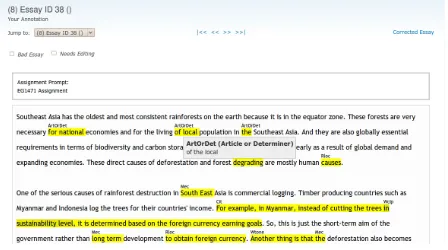
Figure 1: The WAMP annotation interface
the NUCLE corpus. The study gives some insights regarding the difficulty of the annotation task.
The remainder of this paper is organized as
fol-lows. The next section explains the annotation
schema that was used for labeling grammatical
er-rors. Section 3 reports the results of the
inter-annotator agreement study. Section 4 describes the data collection and annotation process. Section 5 contains the error statistics. Section 6 gives the re-lated work, and Section 7 concludes the paper.
2 Annotation Schema
Before starting the corpus creation, we had to de-velop a set of annotation guidelines. This was done in a pilot study before the actual corpus was cre-ated. Three instructors from CELC participated in the pilot study. The instructors annotated a small set of student essays that had been collected by CELC previously. The annotation was performed using an in-house, online annotation tool, called Writing, An-notation, and Marking Platform (WAMP), that was developed by the NUS NLP group specially for cre-ating the NUCLE corpus. The annotation tool al-lows the annotators to work over the Internet using a web browser. Figure 1 shows a screen shot of the WAMP interface. Annotators can browse through a batch of essays that has been assigned to them and perform the following tasks:
• Selectarbitrary, contiguous text spans using the cursor to identify grammatical errors.
• Classifyerrors by choosing an error tag from a drop-down menu.
• Correcterrors by typing the correction into a text box.
• Comment to give additional explanations if necessary.
We wanted to impose as few constraints as possi-ble on the annotators and to give them an experience that would closely resemble their usual marking us-ing pen and paper. Therefore, the WAMP annotation tool allows annotators to select arbitrary text spans, including overlapping text spans.
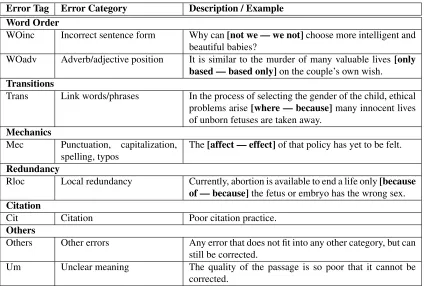
After some annotation trials, we decided to use a tag set which had been developed by CELC in a previous study. Some minor modifications were made to the original tag set based on the feedback of the annotators. The result of the pilot study was a tag set of 27 error categories which are grouped into 13 categories. The tag set is listed in Table 1. It is important to note that our annotation schema not only labels each grammatical error with an error category, but also requires an annotator to provide a suitable correction for the error as well. The anno-tators were asked to provide a correction that would fix the grammatical error if the selected text span containing the grammatical error is replaced with the correction. If multiple alternative text spans could be selected, the annotators were asked to select the min-imal text span so that minmin-imal changes were made to arrive at the corrected text.
We chose to use the tag set in Table 1 since this tag set was developed and used in a previous study at CELC and was found to be a suitable tag set. Fur-thermore, the tag set offers a reasonable compro-mise in terms of its complexity. With 27 error cate-gories, it is sufficiently fine-grained to enable mean-ingful statistics for different error categories, yet not as complex as other tag sets that are much larger in size.
3 Annotator Agreement
Error Tag Error Category Description / Example Verbs
Vt Verb Tense A university[had conducted — conducted]the survey last year.
Vm Verb modal No one[will — would]bother to consider a natural bal-ance.
V0 Missing verb This[may — may be]due to a traditional notion that boys would be the main labor force in a farm family. Vform Verb form Will the child blame the parents after he [growing —
grows]up?
Subject-verb agreement
SVA Subject-verb-agreement The boy[play — plays]soccer.
Articles/determiners
ArtOrDet Article or Determiner From the ethical aspect, sex selection technology should not be used in[non-medical — a non-medical] situa-tion.
Nouns
Nn Noun Number Sex selection should therefore be used for medical [rea-son — rea[rea-sons]and nothing else.
Npos Noun possessive The education of[mother’s — mothers]is a significant factor in reducing son preference.
Pronouns
Pform Pronoun form 90% of couples seek treatment for family balancing rea-sons and 80% of[those — them]want girls.
Pref Pronoun reference Moreover, children may find it hard to communicate with
[his/her — their]parents.
Word choice
Wcip Wrong
colloca-tion/idiom/preposition
Singapore, for example, has invested heavily[on — in]
the establishment of Biopolis
Wa Acronyms Using acronyms without explaining what they stand for. Wform Word form Sex-selection may also result in[addition — additional]
stress for the family.
Wtone Tone [Isn’t it — Is it not]what you always dreamed for?
Sentence Structure
Srun Runons, comma splice [Do spare some thought and time, we can make a dif-ference! — Do spare some thought and time. We can make a difference!](Should be split into two sentences) Smod Dangling modifier [Faced — When we are faced ]with the unprecedented energy crisis, finding an alternative energy resource has naturally become the top priority issue.
Spar Parallelism The use of sex selection would prevent rather than [con-tributing — contribute]to a distorted sex ratio. Sfrag Fragment Although he is a student from the Arts faculty.
[image:3.612.70.497.88.644.2]Ssub Subordinate clause It is the wrong mindset of people that boys are more su-perior than girls[should — that should]be corrected.
Table 1: NUCLE error categories. Grammatical errors in the examples are printed in bold face in the form
Error Tag Error Category Description / Example Word Order
WOinc Incorrect sentence form Why can[not we — we not]choose more intelligent and beautiful babies?
WOadv Adverb/adjective position It is similar to the murder of many valuable lives[only based — based only]on the couple’s own wish.
Transitions
Trans Link words/phrases In the process of selecting the gender of the child, ethical problems arise[where — because]many innocent lives of unborn fetuses are taken away.
Mechanics
Mec Punctuation, capitalization, spelling, typos
The[affect — effect]of that policy has yet to be felt.
Redundancy
Rloc Local redundancy Currently, abortion is available to end a life only[because of — because]the fetus or embryo has the wrong sex.
Citation
Cit Citation Poor citation practice.
Others
Others Other errors Any error that does not fit into any other category, but can still be corrected.
[image:4.612.72.496.58.344.2]Um Unclear meaning The quality of the passage is so poor that it cannot be corrected.
Table 1: NUCLE error categories (continued)
data set and are not included in the official NUCLE corpus. The essays were then annotated by our three annotators in a way that each essay was annotated independently by two annotators. Four essays had to be discarded as they were of very poor quality and did not allow for any meaningful correction. This left us with 96 essays with double annotation.
Comparing two sets of annotation is complicated by the fact that the set of annotations that corrects an input text to a corrected output text is ambigu-ous (Dahlmeier and Ng, 2012). In other words, it is possible that two different sets of annotations pro-duce the same correction. For example, one anno-tator could choose to select a whole phrase as one error, while the other annotator selects each word individually. Our annotation guidelines ask annota-tors to select the minimum span that is necessary to correct the error, but we do not enforce any hard con-straints and different annotators can have a different perception of where an error starts or ends.
An especially difficult case is the annotation of omission errors, for example missing articles. Se-lecting a range of whitespace characters is difficult for annotators, especially if the annotation tool is
web-based (as whitespace is variable in web pages). We asked annotators to select the previous or next word and include them into the suggested
correc-tion. To change conduct survey to conduct a
sur-vey, the annotator could changeconducttoconduct
a, or change survey to a survey. If we only
com-pare the exact text spans selected by the annotators when measuring agreement, these different ways to select the context could easily cause us to conclude that the annotators disagree when they in fact agree on the corrected phrase. This would lead to an un-derestimation of annotator agreement. To address this problem, we perform a simple text span nor-malization. First, we “grow” the selected context to align with whitespace boundaries. For example,
if an annotator just selected the last charactere of
the word use and provided ed as a correction, we
grow this annotation so that the whole worduseis
selected andusedis the correction. Second, we
to-Source : This phenomenon opposes the real .
Annotator A : This phenomenon opposes (the→(ArtOrDet)) (real→reality (Wform)) .
Annotator B : This phenomenon opposes the (real→reality (Wform)) .
Table 2: Example of a sentence from the annotator agreement study with annotations from two different annotators.
kens is broken up into multiple token-level annota-tions. We align the tokens in the original text span and the tokenized correction string using minimum edit distance. Now, we can compare two annotations in a more meaningful way at the token level. Table 2 shows a tokenized example sentence from the anno-tator agreement study with annotations from two dif-ferent annotators. Annotator A and B agree that the
first three wordsThis, phenomenon, andopposesand
the final period are correct and do not need any
cor-rection. The annotators also agree that the wordreal
is part of a word form (Wform) error and should be
replaced withreality. However, they disagree with
respect to the articlethe: annotator A believes there
is an article error (ArtOrDet) and that the article has to be deleted while annotator B believes that the ar-ticle is acceptable in this position.
The example shows that annotator agreement can be measured with respect to three different criteria: whether there is an error, what type of error it is, and how the error should be corrected. Accordingly, we analyze annotator agreement under three differ-ent conditions:
• IdentificationAgreement of tagged tokens re-gardless of error category or correction.
• Classification Agreement of error category, given identification.
• ExactAgreement of error category and correc-tion, given identification.
In the identification task, we are interested to see how well annotators agree on whether something is a grammatical error or not. In the example above, annotators A and B agree on 5 out of 6 tokens and
disagree on one token (the). That results in an
identi-fication agreement of5/6 = 83%. In the
classifica-tion task, we investigate how well annotators agree on the type of error, given that both have tagged the token as an error. In the example, the classification agreement is 100% as both annotator A and B tagged
the wordrealas a word form (Wform) error. Finally,
for the exact task, annotators are considered to agree if they agree on the error category and the correction given that they both have tagged the token as an er-ror. In the example, the exact agreement is 100% as both annotators give the same error category Wform
and the same correctionrealityfor the wordreal. We
use the popular Cohen’s Kappa coefficient (Cohen, 1960) to measure annotator agreement between an-notators. Cohen’s Kappa is defined as
κ= P r(a)−P r(e)
1−P r(e) (1)
where P r(a) is the probability of agreement and
P r(e) is the probability of chance agreement. We
can estimateP r(a) andP r(e)from the double
an-notated essays through maximum likelihood estima-tion. For two annotators A and B, the probability of agreement is
P r(a) = #agreed tokens
#total tokens (2)
where the number of agreed tokens is counted as de-scribed above, and the total number of tokens is the total token count of the subset of jointly annotated documents. The probability of chance agreement is computed as
P r(e) = P r(A= 1, B= 1) +P r(A= 0, B= 0)
= P r(A= 1)×P r(B = 1)
+P r(A= 0)×P r(B= 0)
whereP r(A = 1) andP r(A = 0) symbolize the
events of annotatorA tagging a token as “error” or
“no error” respectively. We make use of the fact that both annotators perform the task independently.
P r(A = 1) and P r(A = 0) can be computed through maximum likelihood estimation.
P r(A= 1) = # annotated tokens of annotator A
# total tokens
P r(A= 0) = # unannotated tokens of annotator A
Annotators Kappa-iden Kappa-class Kappa-exact
A – B 0.4775 0.6206 0.5313
A – C 0.3627 0.5352 0.4956
B – C 0.3230 0.4894 0.4246
[image:6.612.75.305.61.120.2]Average 0.3877 0.5484 0.4838
Table 3: Cohen’s Kappa for annotator agreement.
The probabilitiesP r(B = 1) andP r(B = 0)are
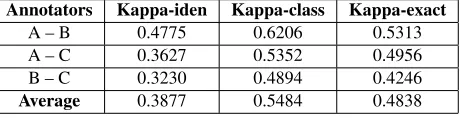
computed analogously. The chance agreement for this task is quite high, as the number of un-annotated tokens is much higher than the number of annotated tokens. Cohen’s Kappa coefficients for the three an-notators and the average Kappa coefficient are listed in Table 3. We observe that the Kappa scores are relatively low and that there is a substantial amount of variability in the Kappa coefficients; annotator A and B show a higher agreement with each other than they do with annotator C. According to Landis and Koch (1977), Kappa scores between 0.21 and 0.40 are considered fair, and scores between 0.41 and 0.60 are considered moderate. The average Kappa score for identification can therefore only be consid-ered fair and the Kappa scores for classification and exact agreement are moderate. Thus, an interesting result of the pilot study was that annotators find it harder to agree on whether a word is grammatically correct than agreeing on the type of error or how it should be corrected. The annotator agreement study shows that grammatical error correction, especially grammatical error identification, is a difficult prob-lem.
Our findings support previous research on an-notator agreement that has shown that grammati-cal error correction is a challenging task (Tetreault and Chodorow, 2008; Lee et al., 2009). Tetreault and Chodorow (2008) report a Kappa score of 0.63 which in their words “shows the difficulty of this task and also show how two highly trained raters can produce very different judgments.” An interest-ing related work is (Lee et al., 2009) which investi-gates the annotation of article and noun number er-rors. The annotation is performed with either a sin-gle sentence context only or the five preceding sen-tences. The agreement between annotators increases when more context is given, from a Kappa score of
0.55 to a Kappa score of 0.60. Madnaniet al.(2011)
and Tetreaultet al.(2010) propose crowdsourcing to
overcome the problem of annotator variability.
4 Data Collection and Annotation
The main data collection for the NUCLE corpus took place between August and December 2009. We collected a total of 2,249 student essays from 6 En-glish courses at CELC. The courses are designed for students who need language support for their aca-demic studies. The essays were written as course assignments on a wide range of topics, like technol-ogy innovation or health care. Some example ques-tion prompts are shown in Table 4. All students are at a similar academic level, as they are all undergrad-uate students at NUS. Students would typically have to write two essay assignments during a course. The length of each essay was supposed to be around 500 words, although most essays were longer than the re-quired length. From this data set, a team of 10 CELC English instructors annotated 1,414 essays with over 1.2 million words between October 2009 and April 2010. Due to budget constraints, we were unfortu-nately not able to perform double annotations for the main corpus. Annotators were allowed to label an error multiple times if the error could be assigned to more than one error tag, although we observed that annotators did not make much use of this option. Minimal post-processing was done after the annota-tion process. Annotators were asked to review some corrections that appeared to contain annotation mis-takes, for example redundancy errors that did not re-move the annotated word. The final results of the annotation exercise were a total of 46,597 error tags. The essays and the annotations were released as the NUCLE corpus through the NUS Enterprise R2M portal in June 2011. The link to the corpus can be
found on the NUS NLP group’s website1.
5 NUCLE Corpus Statistics
This section provides basic statistics about the NU-CLE corpus and the collected annotations. These statistics already reveal some interesting insights about the nature of grammatical errors in learner text. In particular, we are interested in the follow-ing questions: how frequent are errors in the NU-CLE corpus and what are the most frequent error
“Public spending on the aged should be limited so that money can be diverted to other areas of the country’s develop-ment.” Do you agree?
Surveillance technology such as RFID (radio-frequency identification) should not be used to track people (e.g., human implants and RFID tags on people or products). Do you agree? Support your argument with concrete examples. Choose a concept or prototype currently in research and development and not widely available in the market. Present an argument on how the design can be improved to enhance safety. Remember to consider influential factors such as cost or performance when you summarize and rebut opposing views. You will need to include very recently published sources in your references.
Table 4: Example question prompts from the NUCLE corpus.
NUS Corpus of Learner English
Documents 1,414
Sentences 59,871
Word tokens 1,220,257
Word types 30,492
Error annotations 46,597
[image:7.612.323.537.198.354.2]# of sentences per document 42.34 # of word tokens per document 862.98 # of word tokens per sentence 20.38 # of error annotations per document 32.95 # of error annotations per 100 word tokens 3.82
Table 5: Overview of the NUCLE corpus
categories? The basic statistics of the NUCLE cor-pus are shown in Table 5. In these statistics, we treat multiple alternative annotations for the same error as separate errors, although it could be argued that these should be merged into a single error with multiple alternative corrections. Fortunately, only about 1% of the errors are labeled with more than one annotation. We can see that grammatical errors
are very sparse, even in learner text. In the
NU-CLE corpus, there are 46,597 annotated errors for 1,220,257 word tokens. That makes an error density of 3.82 errors per hundred words. In other words, most of the word tokens in the corpus are grammat-ically correct. This shows that the students whose essays were used for the corpus already have a rel-ative high proficiency of English. When we look at the distribution of errors across documents, we can make another interesting observation. Figure 2 shows a histogram of the number of error annota-tions per document. The distribution appears non-Gaussian and is heavily skewed to the left with most documents having less than 30 errors while some documents have significantly more errors than the average document. That means that although
gram-matical errors are rarein general, there are also
0 5 10 15 20 25 30 35 40
0 20 40 60 80 100 120 140 160 180 200
Number of documents
Number of error annotations Histogram: error annotation per document
Figure 2: Histogram of error annotations per document in NUCLE.
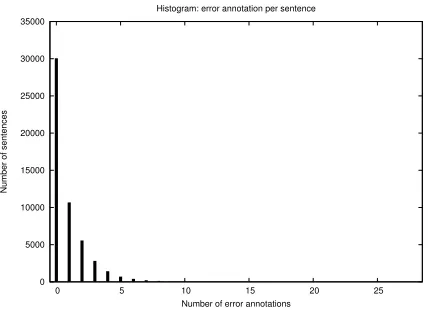
uments with many error annotations. 32 documents have more than 100 error annotations and the highest number of error annotations in a document is 194. The mode, i.e., the most frequent value in the his-togram, is 15 which is to the left of the average of 32.95. A similar pattern can be observed when we look at the distribution of errors per sentence. Fig-ure 3 shows a histogram of the number of error anno-tations per sentence in the NUCLE corpus. For this histogram, only the error annotations which start and end within sentence boundaries are considered (this accounts for 98.6% of all error annotations). Sen-tence boundaries are determined automatically using
the NLTK Punkt sentence splitter2. The histogram
shows that 57.64% of all sentences have zero errors, 20.48% have exactly one error, and 10.66% have ex-actly two errors, and 11.21% of all sentences have more than two errors. Although the frequency de-creases quickly for higher error counts, the highest observed number of error annotations for a sentence is 28.
2
0 5000 10000 15000 20000 25000 30000 35000
0 5 10 15 20 25
Number of sentences
[image:8.612.320.535.62.217.2]Number of error annotations Histogram: error annotation per sentence
Figure 3: Histogram of error annotations per sentence in NUCLE.
The skewed distribution of errors in the NUCLE corpus is an interesting observation. A possible ex-planation for the long tail of the distribution could be a “rich-get-richer” type of dynamics: if a learner has made a lot of mistakes in her essay so far, the chance of her making more errors in the remainder of the essay increases, for example because she makes sys-tematic errors which are likely to be repeated. Ex-plaining the cognitive processes that produce the ob-served error distribution is beyond the scope of this paper, but it would certainly be an interesting ques-tion to investigate.
So far, we have only been concerned with how many errors learners make overall. But it is also important to understand what types of errors lan-guage learners make. Error categories that appear more frequently should be addressed with higher priority when creating an automatic error correction system. Figure 4 shows a histogram of error cate-gories. Again, we can observe a skewed distribu-tion with a few error categories being very frequent and many error categories being comparatively in-frequent. The top five error categories are wrong collocation/idiom/preposition (Wcip) with 7,312 in-stances or 15.69% of all annotations, local redun-dancies (Rloc) (6,390 instances, 13.71%), article or determiner (ArtOrDet) (6,004 instances, 12.88%), noun number (Nn) (3,955 instances, 8.49%), and mechanics (Mec) (3,290 instances, 7.06%). These top five error categories account for 57.83% of all er-ror annotations. The next 5 categories are verb tense (Vt) (3,288 instances, 7.06%) word form (Wform)
0 1000 2000 3000 4000 5000 6000 7000 8000
Wcip Rloc ArtOrDet Nn Mec Vt Wform SVA Others Vform Trans Um Pref Srun Cit WOinc Wtone Spar Vm V0 Ssub WOadv Npos Sfrag Pform Smod Wa
Number of annotations
Error categories Error categories
Figure 4: Error categories histogram for the NUCLE cor-pus.
(2,241 instances, 4.81%), subject-verb agreement (SVA) (1,578 instances, 3.38%), other errors that could not be grouped into any of the error categories (1,532 instances, 3.29%), and Verb form (Vform)
(1,531, 3.29%). Together, the top 10 error
cate-gories account for 79.66% of all annotated errors. A manual inspection showed that a large percentage of the local redundancy errors involve articles that are deemed redundant by the annotator and should be deleted. These errors could also be considered article or determiner errors. For the Wcip errors, we observed that most Wcip errors are preposition errors. This confirms that articles and prepositions are the two most frequent error categories for EFL learners (Leacock et al., 2010).
6 Related Work
In this section, we compare NUCLE with other learner corpora. While there were almost no an-notated learner corpora available for research pur-poses until recently, non-annotated learner corpora have been available for a while. Two examples are the International Corpus of Learner English (ICLE) (Granger et al., 2002) and the Chinese Learner
En-glish Corpus (Gui and Yang., 2003)3. Rozovskaya
and Roth (2010) annotated a portion of each of these two learner corpora with error categories and correc-tions. However, with 63,000 words, the annotated data is small compared to NUCLE.
3The Chinese Learner English Corpus contains annotations
[image:8.612.80.295.63.218.2]The Cambridge Learner Corpus (CLC) (Nicholls, 2003) is possibly the largest annotated English learner corpus. Unfortunately, to our knowledge, the corpus is not freely available for research pur-poses. A subset of the CLC was released in 2011
by Yannakoudakiset al.(2011). The released data
set contains short essays written by students taking the First Certificate in English (FCE) examination. The data set was also used in the recent HOO 2012 shared task on preposition and determiner correction (Dale et al., 2012). Comparing the essays in the FCE data set and NUCLE, we observe that the essays in the FCE data set are shorter than the essays in NU-CLE and show a higher density of grammatical er-rors. One reason for the higher number of errors (in particular spelling errors) is most likely that the FCE data was not collected from take-home assignments where students have the chance to spell check their writing before submission. But it could also mean that the essays in FCE are from students with a lower proficiency in English compared to NUCLE. With regards to the annotation schema, the CLC annota-tions include both the type of error (missing, unnec-essary, replacement, form) and the part of speech. As a result, the CLC tag set is large with 88 differ-ent error categories, far more than the 27 error cate-gories in NUCLE.
Finally, the HOO 2011 shared task (Dale and Kil-garriff, 2011) released an annotated corpus of frag-ments from academic papers written by non-native speakers and published in a conference or work-shop of the Association for Computational Linguis-tics. The corpus uses the annotation schema from the CLC. Comparing the data set with NUCLE, the HOO 2011 data set is much smaller (about 20,000 words for training and testing, respectively) and rep-resents a specific writing genre (NLP papers). The NUCLE corpus is much larger and covers a broader range of topics.
7 Conclusion
We have presented the NUS Corpus of Learner En-glish (NUCLE), a large, annotated corpus of learner
English. The corpus contains over one million
words which are completely annotated with gram-matical errors and corrections. The NUCLE corpus is freely available for research purposes. We have
also reported an inter-annotator agreement study for grammatical error correction. The study shows that grammatical error correction is a difficult task, even for humans. The error statistics from the NUCLE corpus show that learner errors are generally sparse and have a long-tail distribution.
Acknowledgments
This research is supported by the Singapore Na-tional Research Foundation under its InternaNa-tional Research Centre @ Singapore Funding Initiative and administered by the IDM Programme Office.
References
J. Cohen. 1960. A coefficient of agreement for nominal scales. Educational and Psychological Measurement, 20(1):37–46.
D. Dahlmeier and H.T. Ng. 2012. Better evaluation for grammatical error correction. InProceedings of HLT-NAACL, pages 568–572.
R. Dale and A. Kilgarriff. 2011. Helping Our Own: The HOO 2011 pilot shared task. InProceedings of the Generation Challenges Session at the 13th Eu-ropean Workshop on Natural Language Generation, pages 242–249.
R. Dale, I. Anisimoff, and G. Narroway. 2012. HOO 2012: A report on the preposition and determiner error correction shared task. InProceedings of the Seventh Workshop on Innovative Use of NLP for Building Ed-ucational Applications, pages 54–62.
S. Granger, F. Dagneaux, E. Meunier, and M. Paquot. 2002. The International Corpus of Learner English. Presses Universitaires de Louvain, Louvain-la-Neuve, Belgium.
S. Gui and H. Yang. 2003. Zhongguo Xuexizhe Yingyu Yuliaohu (Chinese Learner English Corpus). Shang-hai Waiyu Jiaoyu Chubanshe. In Chinese.
J.R. Landis and G.G Koch. 1977. The measurement of observer agreement for categorical data. Biometrics, 33(1):159–174.
C. Leacock, M. Chodorow, M. Gamon, and J. Tetreault. 2010. Automated Grammatical Error Detection for Language Learners. Morgan & Claypool Publishers. J. Lee, J. Tetreault, and M. Chodorow. 2009. Human
N. Madnani, J. Tetreault, M. Chodorow, and R. Ro-zovskaya. 2011. They can help: using crowdsourc-ing to improve the evaluation of grammatical error de-tection systems. In Proceedings of ACL:HLT, pages 508–513.
D. Nicholls. 2003. The Cambridge learner corpus: Error coding and analysis for lexicography and ELT. In Pro-ceedings of the Corpus Linguistics 2003 Conference, pages 572–581.
A. Rozovskaya and D. Roth. 2010. Annotating ESL er-rors: Challenges and rewards. InProceedings of the Fifth Workshop on Innovative Use of NLP for Building Educational Applications, pages 28–36.
J. Tetreault and M. Chodorow. 2008. Native judgments of non-native usage: Experiments in preposition error detection. InProceedings of the Workshop on Human Judgements in Computational Linguistics, pages 24– 32.
J. Tetreault, E. Filatova, and M. Chodorow. 2010. Re-thinking grammatical error annotation and evaluation with the Amazon Mechanical Turk. In Proceedings of the Fifth Workshop on Innovative Use of NLP for Building Educational Applications, pages 45–48. H. Yannakoudakis, T. Briscoe, and B. Medlock. 2011.
![Table 1: NUCLE error categories. Grammatical errors in the examples are printed in bold face in the form<[ mistake> — < correction> ].](https://thumb-us.123doks.com/thumbv2/123dok_us/1513304.693269/3.612.70.497.88.644/table-nucle-categories-grammatical-examples-printed-mistake-correction.webp)