Tools for non-native readers: the case for translation and simplification
Maxine Eskenazi
Yibin Lin
Language Technologies Institute Language Technologies Institute Carnegie Mellon University Carnegie Mellon University
Pittsburgh PA 15213 Pittsburgh PA 15213
[email protected] [email protected]
Oscar Saz
Language Technologies Institute Carnegie Mellon University
Pittsburgh PA 15213 [email protected]
Abstract
One of the populations that often needs some form of help to read everyday documents is non-native speakers. This paper discusses aid at the word and word string levels and focuses on the possibility of using translation and simplification. Seen from the perspective of the non-native as an ever-learning reader, we show how translation may be of more harm than help in understanding and retaining the meaning of a word while simplification holds promise. We conclude that if reading every-day documents can be considered as a learn-ing activity as well as a practical necessity, then our study reinforces the arguments that defend the use of simplification to make docu-ments that non-natives need to read more ac-cessible.
1
Introduction
There are many tools that natural language processing (NLP) can offer disadvantaged readers to aid them in understanding a document. Readers may be at a disadvantage due to poor sight, to cog-nitive disabilities, or simply to reading in a lan-guage other than their native one (L1). This paper addresses that last case. For non-native readers, there are a number of aids that could be made available to them. Some aids help on the word level, assuming that the understanding of a specific
word is what is impeding comprehension. Others address a more global level, presuming that the understanding blockage is due lack of comprehen-sion of the meaning of a group of words. Our work addresses learning English vocabulary, for which we have conducted studies on both word-level and higher-level aids. We argue that our findings can inform what can be done to make documents more understandable in general for non-natives.
In the past, we have studied the effect of aids such as ordered definitions (Dela Rosa and Eskenazi, 2011) and synthesized speech (Dela Rosa et al., 2010) on learning vocabulary from web documents. These aids have been aimed at the word level and have been shown to help learning. We explored the wider context around an unknown word in an effort to give the non-native reader an understanding of the several-word context around an unknown word in order to help understanding of the meaning of the text.
Reading documents to learn a language is a very different activity from reading an everyday document (like a rental agreement) out of neces-sity. Yet we find that there are similarities between the two activities. We believe that, unlike for some other categories of disadvantaged readers, each document that a non-native reads is a learning moment and that they learn the target language more with each encounter. These incremental addi-tions to the readers’ knowledge enable them to be increasingly capable of tackling future unknown documents. It also reflects on the manner with
which readers tackle a document since some un-derstanding of the words has to take place in order for the document to be understood. We believe that these similarities warrant using learning findings to guide the choice of NLP tools used in document processing for non-native readers. The learning environment is used in this paper to measure document understanding.
2
Background
Using learning as a means of estimating the usefulness of NLP techniques in making texts more accessible, we can examine the positions that the learning community has taken on the educa-tional value of several of these techniques.
Translation (the use of L1 in second lan-guage (L2) vocabulary acquisition) is the area in which we find the greatest controversy. Models of L2 lexical acquisition represent acquisition of new L2 words as an assimilation through an L1 lemma that is generalized and applied to concepts in L2 (Jiang, 2000; Kroll and Sunderman, 2003). Exces-sive use of L1 is believed to reduce L2 fluency and to fossilize errors. Context, dictionary definitions and examples of other sentences in which a word could be used are commonly considered to be the most effective tools since students can interiorize the concept of the new word without reliance on L1. This implies that the use of such techniques can lead to better learning and improved fluency than direct use of L1 translation. This claim has been challenged by Grace (1998), showing that that when translation is provided, there are higher scores on vocabulary tests both in the short-term and long-term use of the new words. Prince (1996) also claimed that the more proficient students benefit more from translation on short-term lexical recall tasks, since it is easier for them to get rid of the L1 scaffolding. These studies and others have been hampered by the ability to accurately measure the extent of the subjects’ use of translation. The REAP software described below has afforded a more precise estimate of use and of retention of vocabulary items.
Simplification has had more widespread acceptance. Simplified texts have often been pro-vided to language learners either along with the original text or alone (Burstein et al, 2007, Peter-sen and Ostendorf, 2007). These texts have been used as reading comprehension exercises or
text-book reading materials (Crossley, et al. 2007). Ac-cording to Oh (2008), simplification typically uses shorter sentences, simpler grammar and controlled vocabulary. The use of simplified texts has been shown to significantly help students’ reading com-prehension (Yano, et al. 1994, Oh 2008). However, there has not been any research specifically about whether reading the simplified texts, rather than the original ones, will affect the students’ vocabu-lary acquisition. There are a few disadvantages related to simplifying texts for ESL students. Yano et al. (1994) note that simplified texts may appear unnatural, giving them a lack of flow, thus making them difficult to read. They may also lack the complex grammar structures that commonly exist in the real world (that students should be exposed to). The simplified texts used in these studies were created by hand and are usually written with the express intention of featuring certain vocabulary and/or syntactic elements for the purpose of being used by a non-native learner.
To address the link between vocabulary and comprehension of a text, the literature often reveals mastery of vocabulary as the key. Perfetti (2010) emphasized the vocabulary-comprehension link. Increased vocabulary has been shown to in-crease comprehension. Thus text comprehension for non-natives could depend on either presenting only words that they can understand or offering an aid for understanding any challenging words that they may encounter.
2.1 NLP techniques
are presented in an ordered list, according to the best fit in the context, students learned words bet-ter. Another word-level aid is the use of speech synthesis to speak the word to the reader (Dela Rosa 2010). Non-natives know some words au-rally, but have never seen them in written form. This aid is especially helpful when the orthography of an unknown word makes it difficult to deduce the pronunciation (as in “thought”). Another aid presents a word in other contexts. Giving the stu-dent the ability to compare several contexts with their contrasting meanings is helpful for learning. These contexts can be found by searching for sen-tences with a target word and a set of commonly co-occurring context words.
While research in vocabulary acquisition over the years has shown positive results for many word-centric learning aids, it is interesting to ex-pand the offerings to context-level aids. We were also curious to see if the use of the REAP platform (Brown and Eskenazi, 2005) could help add to the knowledge of the role of translation in L2 vocabu-lary learning. This is what brought us to examine the effect of translation and simplification on learning. These two techniques, thanks to the use of NLP, could be totally automated in the future. Research in machine translation (MT) goes back several decades and many types of statistical mod-els have been employed (Koehn, 2010). If all of the documents to be translated are in one given domain, then sufficiently good automatically trans-lations can be obtained.
Automated simplification is a newer do-main. There has been significant progress in sim-plifying documents for use by specific disadvantaged populations (Alusio et al 2010, Bach et al, 2011, Chandrasekar and Srinivas, 1997, Inui et al, 2003, Medero and Ostendorf, 2011, Yaskar et al 2010). Like Alusio and colleagues, who work with low-literacy populations, and a few other authors, we are concerned not only about the quality of the simplification, but also about whether the simplified documents actually help disadvantaged readers.
We could have also looked at summariza-tion, which uses some of the same techniques that are used for simplification. In some early unpub-lished studies, we found that students experienced difficulty when asked to summarize a passage. They usually responded by simply cutting and pasting the first sentence of that passage. This
could have meant that students just could not pro-duce a well-structured sentence and thus avoided doing so. But non-natives, who are asked to iden-tify the appropriate summary out of four possibili-ties in a multiple choice question, also had much difficulty. Thus, rather than giving a very high-level overview of a passage through summariza-tion, we chose to look at the intermediate level aids that would also contribute to vocabulary under-standing: translation and simplification of local contexts.
Translation and simplification can both be characterized as relating to overall context, operat-ing effectively on a stroperat-ing of several words rather than on only one word. They both aid in under-standing the meaning of the whole string as op-posed to just one target word, and their help for unknown words is through making the context of the word clear enough to surmise the meaning of the word. Besides its controversial status, transla-tion had also attracted our interest when we ob-served the students’ efforts to get translations for tasks in class. We wanted to find out if translation had different properties from all other aids. Trans-lation is different from the aids that we had used in the past in two ways:
it uses L1
it covers several-word contexts, rather than just one word.
To tease apart these two characteristics, we became interested in simplification, which shares the sec-ond characteristic, but not the first.
3
The REAP tutor
The studies in this paper used the CMU REAP intelligent tutor. That tutor provides curricu-lum for vocabulary acquisition for non-native stu-dents while serving as a platform for research studies (Brown and Eskenazi, 2005). REAP gives students texts retrieved from the Internet that are matched to their reading level and their preferences (Heilman et al., 2008) and helps them acquire new words from context (Juffs et al., 2006). REAP in-corporates several features like pop-up word defi-nitions, examples of the word in other contexts, text-to-speech synthesis of words and translation of words to the student’s native language.
clicking on a word brings up a pop-up window showing the definition and examples of use of that word and a button for hearing the pronunciation of the word. Focus words, the words that the teacher has chosen for the students to learn, are highlighted in the text.
From the beginning, REAP has shown that it can improve students’ acquisition of new vo-cabulary in English (Heilman et al., 2006). Fea-tures embedded in REAP have been validated in several experimental studies which showed the learning outcomes achieved by the students. REAP has been used to study motivation as well as learn-ing gains.
Figure 1. REAP interface and features for a student whose native language is Mandarin.
4
The translation study
REAP was used to study whether transla-tion helped students to learn vocabulary (Lin, Saz and Eskenazi, in review). These studies explored whether the students both learned more and be-came more fluent when they use translation. It is challenging to measure fluency. While it is impos-sible to record everything that the student says in her everyday conversations and then measure the average rapidity of response, one can measure the increase in the rapidity of response from the mo-ment an item (post-test question) appears on the screen to when the student clicks on the answer and can compare results for that student as well as across groups of students. The documents used in this study were gathered from a crawl of the inter-net for documents containing certain focus words that students were to learn. The documents were
filtered to be at the level of the students and the topics were varied, from sports to current events, for example. The translation (bilingual dictionary) of the words in this study was provided by WordReference.com and the Bing Translator (http://www.microsofttranslator.com/) for the documents (contexts) in the study. The translations of all of the focus words in all of the students’ L1s were manually checked by native speakers to make sure that the translated word corresponded with the specific context in which it appeared. If necessary, a change in the translation was made to make it context-appropriate.
All studies described in this paper were included as regular curricula at the English Lan-guage Institute of the University of Pittsburgh. The first study involved 27 students taking the Level 5 Reading course (high-intermediate learners); 25 were native speakers of Arabic, 1 spoke Spanish and 1 spoke Turkish. The second study involved 26 students in Level 5: 22 of them were native Arabic speakers, 2 were Mandarin Chinese speak-ers and 2 were Korean speakspeak-ers. There were two studies to determine whether the way that the stu-dents requested translations had an effect on the amount of translations they asked for.
For both studies, the first session consisted of a pre-test which measured knowledge of a set of focus words in multiple-choice cloze questions (Taylor 1953), where the target word was removed from a full, meaningful sentence. There were 2 questions per focus word. Post-reading (immedi-ately after reading a document) and post-test (after all the training sessions were over) questions had the same form as the pre-test and involved com-pletely different sentences.
In each training session, students had one 400-500 word reading. After each reading, they took the post-reading test where they answered 2 previously unseen cloze questions per focus word. The students were shown their results along with the correct answers to the cloze questions at the end of each post reading test. In the last session, the students took a post-test with content similar to the pre-test, 2 new unseen questions per focus word.
study took place for 6 weeks in the spring of 2012. There were also 24 focus words in this study.
The main difference in the setup of both studies was how the students accessed a transla-tion. For the fall 2011 study students had to type or copy and paste one or more words into a box at the bottom of the screen to get the translation. In the spring 2012 study they used a left mouseclick to get the translation. In both studies, the students could click (left mouseclick in fall 2011 and right mouseclick in spring 2012) to obtain the definition from the Cambridge Advanced Learners’ Diction-ary (CALD, Walter, 2005) and to listen to text-to-speech synthesis of the word (Cepstral, 2012).
The accuracy of each student at the pre-test, post-reading and post-test was calculated as the percentage of correct answers over the total number of questions in the test. The fluency was calculated as the median response time of a given student to answer each question. To measure flu-ency, we used the median and not the mean of the response times since the mean was distorted by a few instances of very long response duration for a few questions (possibly due to distractions). We also used comparative measures, such as gain and normalized gain in accuracy between two different assessment tasks (for instance, from pre-test to post-test) (Hake, 1998). A positive value of the gain and the normalized gain means that the stu-dent achieved higher scores in the post-test.
We note that only 14 (17%) of the transla-tions are for focus words.
The results show that students used transla-tion when it was easier (clicking instead of typing), in detriment to using dictionary definitions. Stu-dents did not request definitions or translations for all of the focus words. This may indicate that they are not indiscriminately clicking on words, as has sometimes been seen in the past. Rather they may be making an effort to click on words they felt they did not know well.
Dictionary Translation All
words
Focus words
All words
Focus words Fall’11 5.29 2.35 2.31 0.64 Spring’12 1.78 0.84 8.15 2.35
Table 1. Use of dictionary and translation (4 focus words/reading in Fall’11, 3 focus words/reading in Spring’12). Average is per student and per reading.
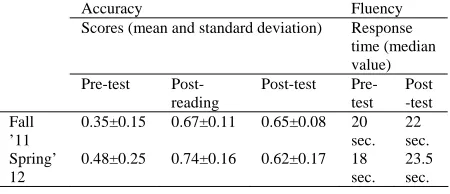
We then examined the accuracy of the stu-dents for just the words that they chose to translate. Table 2 shows that accuracy increases in post-reading tests and post-tests with respect to the pre-test for both studies. But there is a drop in the post-test scores with respect to the post-reading post-tests in spring 2012. Furthermore, there is an increase in response time in the post-test, which is more pro-nounced for spring 2012. These are the first indica-tions of possible differences in student performance related to their patterns in the use of translations.
Accuracy Fluency
Scores (mean and standard deviation) Response time (median value) Pre-test
Post-reading
Post-test Pre-test
Post -test Fall
’11
0.35±0.15 0.67±0.11 0.65±0.08 20 sec.
22 sec. Spring’
12
0.48±0.25 0.74±0.16 0.62±0.17 18 sec.
[image:5.612.314.539.222.319.2]23.5 sec.
Table 2. Accuracy and fluency results for translated words.
To find whether the amount of translation actually affected this result, spring 2012 students were separated into 2 groups: the 13 students who used the least number of translations overall and the 13 students who used the most translations. Figure 2 shows the normalized gains in post-reading tests and post-tests over the pre-test for these 2 groups. Both groups present a similar gain in post-reading (approximately 0.35) and, while this gain was lower for groups on the post-test, the students who used translation the most had a larger loss. Although not significant (p = 0.48), this dif-ference, which is approximately 0.07 in normalized gain, indicates that these students are having more difficulty transferring the knowledge they may have acquired in the longer term. The low signifi-cance is mainly due to the relatively small number of participants in the study.
5
The simplification study
sev-eral words at a time. The number of questions on focus words (24 words this time), over the pretest, post-reading test and the post-test remained the same. There were 20 students in this study. There were 11 speakers of Arabic, 3 of Japanese, 2 each of Korean and Chinese and one each of Spanish and Serbo-Croatian.
FIGURE 2. Gains in post-reading and post-test de-pending on the amount of translation used
Again, the translations were carried out automatically as described above, with a human verification pass. The simplifications were created by one of the authors by replacing less frequent words with appropriate more frequent ones (Leroy and Endicott, 2011) and splitting complex sen-tences into shorter ones. An example of a simplifi-cation:
for: “ They began immigrating in large numbers in the 1960s for economic reasons and now make up a third of the population—but there are also Africans, West Indi-ans, Pakistanis, IndiIndi-ans, Turks, Chinese, and Eastern Europeans.”
the simplified form was: “They began immigrating in large numbers in the 1960s for economic reasons. These people now make up a third of the population. There are also Africans, West Indians, Pakistanis, Indians, Turks, Chinese, and Eastern Europeans.”
Overall, they requested 218 simplifications, 82 translations and 79 dictionary lookups. This was surprising to us. Given the large number of transla-tion requests in the past two studies, we were pre-pared to see overwhelmingly more clicks for translations than for simplifications. This result is important in deciding what aids can be given to non-native readers. While we thought that a reader would prefer an aid that involved translation, this result shows an acceptance of the L2 aid.
Non-natives probably realize the educational value of the L2 tool and voluntarily choose to use it.
Only 14 (17%) of the translations con-tained focus words while 102 (47%) of the simpli-fications did. Given the small number of focus word translations, results cannot be significant. REAP significantly helps students to learn focus words in general ( p<0 . 05 ). Post-reading tests show lower accuracy than the post-test. The t-test shows that the difference here is not statistically significant ( p=0 . 2 6 ).
[image:6.612.312.524.265.358.2]To control for the quality of the study, we compared overall learning gains from this study with that of the two translation studies above on Table 3 and found them to be similar
Normalized Gain
Pre-test to Post-reading
Pre-test to post-test
Fall’12 0.10± 0.24 0.17± 0.28
Fall’11
0.31 ± 0.33 0.31± 0.28 Spring’12 0.35± 0.28 0.22± 0.21
Table 3. Learning Outcome: Gains (gain + deviation)
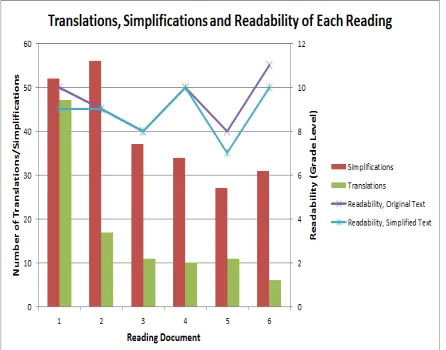
[image:6.612.313.536.481.656.2]Figure 3 shows the number of requests for simplification and translation for each of the six documents in the study compared to their readabil-ity level (Heilman 2008). We note that the hardest document (#6) was not the one for which the most aid was requested. This could simply be due to the decreasing number of requests for aid over time.
To control for any outlier document, we also looked at whether any one of the six docu-ments required more translation than simplifica-tion. Figure 3 also shows that the trend to request more simplification held true for all of the docu-ments. We note that this can only be called a trend due to the significant standard deviation which, in turn, is due to the low number of participants. The first document was where the requests for the two were almost equal. This could be due to the stu-dents trying out both possibilities to see what they liked or to the fact that over a short time they real-ized the greater value of the L2 aid.
Table 4 shows the normalized gains for focus words that were translated or simplified. The low number of translation requests lead to results that are not significant. We note that for simplifica-tion there is a trend implying learning gains at both the post-reading test and, in long term retention, for the post-test.
Normalized gain
Aid pre-test to post-reading
pre-test to post-test
No. items Translation
-0.07± 0.15 0.22± 0.13 14
Simplification
0.27± 0.17 0.28± 0.18 98
Table 4: Normalized Gain (average and standard deviation) for focus words that were translated or simplified and number of clicks on focus words
Normalized Gain
Pre-test to post-reading
Pre-test to post-test
no. of questions Focus words
not translated
0.06±0.26 0.17±0.30 946 Focus words
not simplified
0.06±0.26 0.18±0.31 862
Table 5: Normalized Gain (average and standard deviation) for focus words that were not translated or simplified and number of questions
In the case of non-translated and non-simplified focus words, although there was also some room for improvement (and at first, it would seem that the learning gains are larger), there are some vari-ables that have not been taken into account here. One is that a subject could have often requested definitions. Some subjects may benefit more from the use of the definitions than from other types of help. We will test this hypothesis in the future, when we have more data, to see if the benefits
from each type of help are greater for some sub-jects than for others. While we are not convinced that this is the cause for the differences we see here, we do believe that hearing the words when working through the documents may be a factor. Since the students only have the written form of the word at pre-test time, they may know the word to hear it, but not by sight. In past years in our use of REAP in the classroom, we have noticed many students suddenly recognizing a word after hearing it (from clicking on the synthesis option). Again due to lack of sufficient data, we cannot explore this further for this dataset, but plan to look at this and any other possible variables in the near future.
6
Conclusions and further directions
We have argued that exploring the learning results of non-natives when using various aids for learning vocabulary through context may guide our choices of reading aids for this population.
We have specifically explored the use of translation and of simplification. Both simplifica-tion and translasimplifica-tion are voluntarily used by stu-dents and when both are available, stustu-dents tend to prefer simplification. This should make the use of simplified documents in real life reading situations very acceptable to non-natives.
The overuse of translation contributes to a decline in long term retention of new vocabulary while the use of simplification appears to aid in retention. This could mean that reading any simpli-fied document may benefit the ever-learning non-native when encountering future documents.
com-munity as a whole as it develops novel and robust simplification tools.
ACKNOWLEDGEMENTS
This work is supported through the Re-finement and Fluency Thrust of the Pittsburgh Sci-ence of Learning Center which is funded by the US National Science Foundation under grant number SBE-0836012. Any opinions, findings, and conclu-sions or recommendations expressed in this mate-rial are those of the authors and do not necessarily reflect the views of the NSF. Oscar Saz was sup-ported with a Fulbright/MEX fellowship.
References
Alusio, S., Specia, L., Gasperin, C., Scarton, C., 2010, Readability Assessment for Text Simplification, Proc NAACL HLT Fifth Workshop on Innovative Use of NLP for Building Educational Applications, p. 1-9.
Bach, N., Gao, Q.,Vogel, S., Waibel A., 2011, TriS: A Statistical Sentence Simplifier with Log-linear Mod-els and Margin-based Discriminative Training In Proceedings of the 5th International Joint Conference on Natural Language Processing (IJCNLP 2011), Chiang Mai, Thailand.
Brown, J., Eskenazi, M., 2005, Student, text and cur-riculum modeling for reader-specific document re-trieval, In Hamza, M.-H. (Ed.) Proceedings of the IASTED International Conference on Human-Computer Interaction (pp. 44-47). Anaheim, CA: Acta Press.
Burstein, J., Shore, J., Sabatini, J., Lee, Y., Ventura, M., 2007, The automated text adaptation tool, in Demo proceedings of NAACL-HLT, Rochester.
Cepstral Text-to-Speech, 2000, Retrieved Sep. 8, 2012, from http://www.cepstral.com/.
Chandrasekar, R. and Srinivas, B., 1997, Automatic induction of rules for text simplification. Knowledge-Based Systems, 10(3):183--190.
Coxhead, A., 2000, A New Academic Word List. TESOL Quarterly, 34(2), pp. 213-238. doi:10.2307/3587951
Crossley, S. A., Louwerse, M. M., McCarthy, P. M., & McNamara, D. S., 2007, A linguistic analysis of sim-plified and authentic texts. The Modern Language Journal, 91(1), 15-30.
Dela Rosa, K., Eskenazi, M., 2011, Impact of Word Sense Disambiguation on Ordering Dictionary Defi-nitions in Vocabulary Learning Tutors, Proceedings of the 24th International FLAIRS Conference.
Dela Rosa, K., Parent, G.,Eskenazi, M., 2010,
Multimo-dal learning of words: A study on the use of speech synthesis to reinforce written text in L2 language learning, Proceedings of the ISCA Workshop on Speech and Language Technology in Education (SLaTE 2010).
Geer, P., 2011, GRE Verbal Workbook. Hauppauge, NY: Barron’s Educational Series.
Grace, C. A., 1998, Retention of Word Meanings In-ferred from Context and Sentence-Level Transla-tions: Implications for the Design of Beginning-Level CALL Software. The Modern Language
Jour-nal, 82, 533–544. doi:
10.1111/j.1540-4781.1998.tb05541.x
Hake, R., 1998, Interactive-engagement versus tradi-tional methods: a six-thousand- student survey of mechanics test data for introductory physics courses. American Journal of Physics, 66, 64 – 74.
Heilman, M., Collins-Thompson, K., Callan, J. and Es-kenazi, M., 2006, Classroom success of an Intelligent Tutoring System for lexical practice and reading comprehension. Proceedings of the Ninth Interna-tional Conference on Spoken Language Processing (pp. 829-832). Pittsburgh, PA.
Heilman, M., Zhao, L., Pino, J., and Eskenazi, M., 2008, In Tetreault, T., Burstein, J. and De Felice, R. (Ed.) Retrieval of Reading Materials for Vocabulary and Reading Practice. Proceedings of the 3rd Workshop on Innovative Use of NLP for Building Educational Applications (pp.80-88), Columbus, OH: Association
for Computational Linguistics. doi:10.3115/1631836.1631846
Inui, K., A. Fujita, T. Takahashi, R. Iida and T. Iwakura, 2003, Text simplification for reading assistance: a project note, Proceedings of the second international workshop on paraphrasing-volume 16, pages 9--16. Association for Computational Linguistics.
Jiang, N., 2000, Lexical representation and development in a second language. Applied Linguistics, 21(1), 47-77. doi: 10.1093/applin/21.1.47
Juffs, A., Wilson, L., Eskenazi, M., Callan, J., Brown, J., Collins-Thompson, K., Heilman, M., Pelletreau, T. and Sanders, J., 2006, Robust learning of vocabu-lary: investigating the relationship between learner behaviour and the acquisition of vocabulary. Paper presented at the 40th Annual TESOL Convention and Exhibit (TESOL 2006), Tampa Bay, FL.
Koehn, P., 2010, Statistical machine translation. Cam-bridge University Press.
The Development of Lexical and Conceptual Repre-sentations. In C.J. Doughty and M. H. Long (Ed.), The Handbook of Second Language Acquisition. Ox-ford, UK: Blackwell Publishing Ltd,. doi: 10.1002/9780470756492.ch5
Leroy, G., Endicott, J.E., 2011, Term familiarity to indi-cate perceived and actual difficulty of text in medical digital libraries (ICADL 2011), Beijing.
Lin, Y., Saz, O., Eskenazi, M. (in review) Measuring the impact of translation on the accuracy and fluency of vocabulary acquisition of English
Medero, J., Ostendorf, M., 2011, Identifying Targets for Syntactic Simplification," Proc. ISCA SLaTE ITRW Workshop.
Oh, S-Y, 2008, Two types of input modification and EFL reading comprehension: simplification versus elaboration, TQD 2008, vol.35-1.
Perfetti, C.C., 2010, Decoding, vocabulary and compre-hension: the golden triangle of reading skill, in M.G. McKeown and L. Kucan (Eds), Bringing reading re-searchers to life: essays in honor of Isabel Beck, pp. 291-303, New York: Guilford.
Petersen, S., Ostendorf, 2007, Text simplification for language learners: a corpus analysis, Proc ISCA SLaTE2007, Farmington PA
Prince, P., 1996, Second Language Vocabulary Learn-ing: The Role of Context versus Translations as a Function of Proficiency. Modern Language Journal, 80(4), 478-493. doi:10.2307/329727
Taylor, W.L., 1953, Cloze procedure: a new tool for measuring readability, Journalism Quarterly, vol.30, pp. 415-433.
Walter, E., 2005, Cambridge Advanced Learner's Dic-tionary, 2nd Edition. Cambridge, UK: Cambridge University
Yano, Y., Long, M. H., & Ross, S., 1994, The effects of simplified and elaborated texts on foreign language reading comprehension, Language Learning, 44(2), 189-219.