This
paper
is
the
final
draft
version
of
the
published
article.
Readers
wishing
to
cite
from
this
work
for
scholarly
purposes
are
advised
to
consult
the
definitive,
published
version
(below).
Kensicki,
L.J.
(2003)
Building
credibility
for
non
‐
profit
organizations
through
Building credibility for non-profit organizations
through webpage interface design
Kensicki, L. J. (2003). Building credibility for non-profit organizations through webpage
Abstract
Limited research has examined the impact of visual communication on the web and none has
explored how wired visual constructions influence an organization’s credibility. This research
tested a model of visual credibility through simulated web pages for two types of non-profit
organizations. Contrary to previous work, a structured, symmetrical design was not uniformly
seen as more credible than an organic, asymmetrical design. Further, regardless of the issue,
photographs and bright, warm colors were found to confer credibility to an organization.
Credibility gained through visual representations was found to engender intended participation
in the non-profit organization – particularly among those who had already received positive
information about the organization.
Key Words:
BUILDING CREDIBILITY FOR NON-PROFIT ORGANIZATIONS
THROUGH WEBPAGE INTERFACE DESIGN
The Internet has been heralded as a powerful communication tool for several reasons,
not the least of which is its fundamental integration of visual and textual information. Despite
this strength, little research has examined the visual implications of having a web presence. This
research examines this area for those organizations that may have much to gain with a wired
presence – non-profit, social change organizations.
The proliferation of non-profit organizations on the web has created a level of
expectation from possible constituents and clients. It has been suggested that today’s non-profit
enjoys a certain level of credibility from the public merely for having a website in the first place.
Yet, the public appears to be becoming more and more skeptical. So, what of the well-organized
organization with a disorganized website? Can having a poorly designed website actually do a
non-profit damage? Since visual constructions are the primary and immediate force involved in
cognitive recognition, are there certain design techniques, photographic uses, and color palettes
that are intrinsically more credible? And, does this credibility gained from visual constructions
translate to intended participation?
To better answer these questions, this research first examines the issue of credibility.
Second, this research attempts to construct a model of visual credibility that will be tested on
two hypothetical types of non-profit organizations.
Credibility
Previous studies have found that messages are more likely to be ignored if they are
perceived as less credible (e. g. Johnson & Kaye, 1998). For non-profits, the risk of this lack of
awareness (Gitlin, 1980; van Zoonen, 1992), generate status (Barker-Plummer, 1995), recruit new
members and offer psychological support to already present members of the movement
(Molotch, 1979). The importance of credibility for non-profit sites in particular is reflected in a
recent survey of journalists that found they relied more on non-profit Web sites than business
sites for credible information (Dollarhide, 1999).
Research has consistently found that highly credible sources are more effective in
causing positive attitude changes and behavioral intentions (Gotlieb & Sarel, 1991; Homer &
Kahle, 1990; Ward & McGinnies, 1974). Fogg, a leader in credibility research and head of the
Stanford University Persuasive Technology Lab, writes that “credibility can be defined as
believability” (Fogg et. al., 2001). Adding two additional points, credibility is a perceived
quality (Fogg & Tseng, 1999) that results from evaluating trustworthiness and expertise
simultaneously (Buller & Burgoon, 1996; Gatignon & Robertson, 1991; Petty & Cacioppo, 1981;
Self, 1996; Stiff, 1994).
Whether messages are through interpersonal contact, at the organizational level or
through mass-mediated communication, credibility research has traditionally examined how
receivers of information process messages contingent upon various characteristics (e.g. Hovland
& Weiss, 1951; Mulac & Sherman, 1975; O’Keefe, 1990). Throughout the past fifty years of
credibility research, source credibility has generally been found to derive principally from three
areas: audience’s perceptions of the source (Srull, Lichtenstein & Rothbart, 1985), their
influencing opinions about the medium (Schweiger, 2000) and/or qualities of the message itself
(Kaplowitz et. al., 1991).
Credibility based on audience’s perceptions of the source has proven to be multifaceted,
source itself has been shown to have a strong impact on resulting source credibility levels (e.g.
Srull, Lichtenstein & Rothbart, 1985), but audience perceptions of credibility have also been
inferred from source credentials (e.g. Austin & Dong, 1994). Safety, qualifications, and
dynamism (Berlo, Lemert, & Mertz, 1970); competency and objectivity (Whitehead, 1968); as
well as expertise, trustworthiness and attractiveness (Yoon, Kim, & Kim, 1998) within the source
have all been suggested to enhance source credibility.
More recently, with the development of new technologies, research has examined the
medium itself as a predictor of credibility (Schweiger, 2000). Early medium credibility studies
generally compared television content to that of newspapers (Carter & Greenberg, 1965;
Rimmer & Weaver, 1987). With the advent of the Internet, several studies have examined the
credibility of online news in relation to television and print (Brady, 1996; Flanagin & Metzger,
2000; Kiousis, 2001). The majority of medium credibility studies have found that television is the
most credible medium (Johnson & Kaye, 1998). Given that the Internet is such a vast medium
with a seemingly infinite number of inputs, critics have begun to wonder that, “taken to the
extreme, Web-based content could come to be regarded as the follow-on to the cable-TV
infomercial or the supermarket tabloid – and the hardware that enables the Web could be
viewed as the next-generation idiot box” (Mokhoff, 1999, 61).
Finally, qualities intrinsic to the message itself influence credibility (e.g. Kaplowitz, Fink,
Mulcrone, Atkin, & Dabil, 1991). Qualities within the content, such as high levels of evidentiary
message support (Luchok & McCroskey, 1978) and the quantity of information provided
(Lashbrook, Snavely, & Sullivan, 1977) have been found to boost source credibility. Further, the
quality of writing (Slater & Rouner, 1996), the apparent reality of a message (Austin & Dong,
as well. Audience evaluation of messages has been so overwhelmingly correlated with source
credibility judgments that “although source credibility is supposed to influence perceptions
about the message, in fact, messages also influence perceptions concerning the credibility of the
source” (Slater & Rouner, 1996, 975).
While the research completed to date has been extensive, studies have paid little
attention to the visual components of messages. Rather, the preponderance of research has
relied heavily on textual communication (e.g., Chartprasert, 1993). The importance of visual
communication is inherently recognized by the scholarly community, but often only vaguely
referred to in credibility studies. In an examination of non-profit organizations’ presence on the
web, Spencer (2002), writes “quality design and content can only add to perceptions of
organizational credibility.” The credibility studies that have dealt with the visual aspect of
communication have largely dealt with interpersonal communication issues such as dress
(Chaiken, 1979; Gorham, Cohen, & Morris, 1999) and body language (Woodall, Burgoon &
Markel, 1980). These threads of research do little to explain how visual components of messages
influence source credibility within a mediated context.
Approaching A Model for Visual Credibility
Visual imagery reproduces informational cues that individuals use to construct their
perception of social reality (Messaris, 1994). This reliance on available visual information to
construct reality, calls for a thorough examination of imagery used in mediated contexts.
Gattegno (1969) noted that sight itself is simultaneous, comprehensive and synthetic in its
analysis. Indeed, visual imagery instantaneously affects how we perceive the message and the
messenger. Visual images are central to how we “represent, make meaning, and communicate
a culture that has become increasingly visual (Fetveit, 1999; Sturken & Cartwright, 2001) and
within a medium, such as the Internet, that relies heavily on the synergy between visual and
textual messages (Dyson, 1997).
Very little research has examined the link between visual imagery and credibility. One
early study found only that information must be attractive to be seen as credible (Chaiken,
1979). However, defining what is ‘attractive’ has proven to be a difficult task for credibility
scholars. One notable exception is work done by Kim & Moon (1997) who found that in
laboratory settings, cool color tones and a balanced layout enhanced user’s perceptions of
trustworthiness within a commercially-oriented web interface. Another study found that sites
with a ‘professional appearance’ that is visually appropriate to the subject matter are more
believable (Fogg, et. al., 2002).
While not directly related to credibility, several scholars have explained elemental visual
imagery in descriptive terms. These broad categorizations of visual communication components
help provide a framework for building several hypotheses. For example, it has been found that
structured, aligned designs within a strong grid formation denote a level of seriousness and
professionalism (Williams, 1994) and that alignment on a page creates a strong cohesive unit
(Williams, 1994). When elements are aligned, there is an invisible line that connects items and
indicates their relationship. Without any alignment, a design can appear haphazard,
unstructured and unconnected. These factors may have implications for credibility. For the
purposes of this research, the term structure is operationalized as arranged elements that
mutually connect through parallel or perpendicular alignment whereas organic is
operationalized as elements that are free-form and do not necessarily have perpendicular or
Balanced designs have been found to translate strength (Lauer & Pentak, 2002). In this
research, balance is operationalized as an equalization of weight between the x and y axes.
Traditionally, practitioners and scholars have categorized symmetrical designs as balanced and
asymmetrical designs as unbalanced. However, as Lauer and Pentak (2002) note, both
asymmetrical and symmetrical designs are balanced in relation to visual weight. Symmetrical
balance is operationalized as similar elements that have equal visual weight or equal eye
attraction and create a mirror image across the design. Asymmetrical balance, on the other
hand, is operationalized as dissimilar elements that have equal visual weight or equal eye
attraction. Whereby a symmetric design denotes formality, tradition and conservatism, an
asymmetrical design proves to have a dynamic tension (Lauer & Pentak, 2002). This finding
leads to the research assumption that any perceived visual seriousness would translate to
credibility for an organization. Finally, for this research, in accordance with Fogg et. al. (2001),
credibility itself is operationalized as believability.
Hypothesis 1: The non-profit organization with a structured, symmetrical website interface design will be judged as more credible than the non-profit organization with an organic, asymmetrical website interface design.
The news industry has accepted much, well-publicized, criticism over recent years for
digitally manipulating photographs (Foss, 1992; Hundertmark, 1991). In recent years,
knowledge of photographic manipulation in general has become rather widespread (Fetveit,
1999; Huang, 2001). At the outset, this may appear to have interesting implications for
credibility. However, there is evidence to suggest that visual imagery – photographs in
particular – provide more credibility than text alone (Huxford, 2001). In reference to news
our culture has resulted in an atmosphere where the image itself remains unchallenged. Indeed,
photographs have historically been construed as solidifying the objectivity of the messenger
(Hall, 1973). Thus, due to the constant inundation of photographic imagery in this culture, it is
suggested that while viewers may have the cognitive understanding that photographs can be
manipulated, they only bring this knowledge to bear on a photograph if the content is
overwhelmingly confrontational or from an unbelievable source. It is suggested that in all other
cases, viewers find images to be inherently believable.
Hypothesis 2: The non-profit organization that has a website with photography will be judged as more credible than the non-profit organization that has a website that does not use photography.
On a color wheel, greens and blues are seen as far more psychologically cool because
they contract and recede while reds and oranges are seen as more psychologically warm due to
their ability to expand and advance (Lester, 2000). Colors indeed evoke emotions and have an
impact on mood (García, 1993; Poynter Organization, 2002). In particular, bright, warm colors
have been found to denote youthfulness (Lauer & Pentak, 2002; Lester, 2000;). This conclusion
could have some relationship to credibility given the common conception that with age comes
psychological maturity and professionalism (Sheldon & Kasser, 2001). Thus, cool, mute colors
may be more appropriate in building credibility. Indeed, an earlier study found that muted,
cool colors in a commercially-based web interface can denote trustworthiness (Kim & Moon,
1997) – a fundamental component to credibility.
Research has consistently found that highly credible sources are more effective in
causing positive attitude changes and behavioral intentions (e.g. Gotlieb & Sarel, 1991; Homer &
Kahle, 1990; Ward & McGinnies, 1974) — the goal of any activist organization. However, none
of these studies examined visual elements in a mediated context. Therefore, the following
hypothesis is suggested:
Hypothesis 4: The non-profit organization’s website interface design that is viewed as more credible will be more likely to engender intended participation than the non-profit
organization’s website interface design that is viewed as less credible.
Given these hypotheses, a tentative model for non-profits to build credibility that could
translate into an increased level of intended participation for the organization includes the
following: the webpage interface design must be structured and symmetrical, utilizing
photography and cool, muted colors.
Methodology
Participants
Younger users still dominate those who use the Internet (Birdsell, Muzzio, Taylor &
Krane, 1996; Stempel & Hargrove, 1996). Therefore, 266 college students were selected for this
study as they fall within the core demographic component of Internet users. Respondents were
selected exclusively from their membership within an Introduction to Mass Communication
course. Their presence in this course indicated a certain level of interest in media issues,
suggesting they had some conceptions of why and how often they engaged the Internet. But,
perhaps more importantly, these students were only beginning their college career in mass
communications, which indicated they had not yet learned the principles and influences of
Design
As the review of literature elucidated, source credibility has generally been found to
derive principally from three areas: audience’s perceptions of the source, their influencing
opinions about the medium and/or qualities of the message itself. The first two components of
source credibility (audience’s perceptions of the source and the medium) were accounted for in
this study in order to better ascertain the impact of the actual message qualities on perceived
credibility.
To help account for source credibility, students were divided into two groups. One
group was shown mock pro/con abortion web pages and the other group was shown mock
pro/con death penalty web pages. Respondents were asked which side of the specific issue they
most agreed with and then asked to view the upcoming generic subject-specific sites from that
perspective. For example, in regards to the abortion issue, respondents were first asked if they
were in support of abortion or against abortion. If they stated they were against abortion, then
they were told to examine the generic abortion-oriented website as if it was an organization’s
website that was against abortion. If they stated the opposite, then they examined different
visual treatments of a generic website that they viewed as in support of abortion. This ensured
that the audience’s perceptions of the specific source did not play a role in determining the
credibility of the media messages.
Controversial topics of abortion and the death penalty were chosen in this study in an
effort to ensure that respondents would give clear opinions that were not confounded by
lackluster emotions about the issue itself. Presumably, most individuals have an opinion about
both of these contentious issues, suggesting that responses, after dividing the subject into a pro
In regards to medium credibility, participants were asked:
1. In general, how much information on the World Wide Web do you think
is reliable and accurate?
2. How often do you use the World Wide Web?
3. If you were interested in finding more information out about a
political/non-profit organization, how likely would you be to check the World Wide Web in general for information about that organization?
4. If you were interested in finding more information out about a
political/non-profit organization, how likely would you be to rely on information from that political organization’s website?
5. If you were interested in becoming a member of a political/non-profit
organization, how likely would you be to rely on information from that political organization’s website in making your decision to become a member?
Respondents’ usage of the web was an integral question because although respondents
were examining screen captures and not engaging actual web sties, they were told that they
were evaluating content from the Internet and presumably recognized the standard formatting
of the web browser. This level of questioning is additionally important as previous studies have
suggested a correlation between how often one uses a medium and the perceived credibility
(Wanta & Hu, 1994; Westley & Severin, 1964). Further, past research has shown a correlation
between an individuals preferred medium and high levels of perceived credibility (Rimmer &
Weaver, 1987).
Credibility of the visual message itself was found through several direct questions
pertaining to the web design interface. These questions were asked of every pair of sites
presented and then for all eight website interfaces presented simultaneously.
1. Which website do you ‘believe’ the most for this cause?
[For the following questions, participants gave responses for both the more and less believed web page, when asked in pairs.]
2. If you felt strongly about this issue, how credible would you view this
organization, based on this website alone?
3. If you did not feel strongly about this issue, but supported its cause, how
4. If you already had positive information about this organization, and were inclined to join, would this website change your view?
5. If you already had negative information about this organization, and
were not inclined to join, would this website change your view?
Stimuli
The images were first created in QuarkXPress and then transferred to Adobe Photoshop
for the creation of a TIFF file. This enabled the graphics to be placed within a screen capture of
the Microsoft Internet Explorer browser. By combining these two images, the final result was a
simulated web page that was captured from the Internet (see Appendix I for complete pro/con
abortion web pages and Appendix II for death penalty web pages). A total of eight images were
used for each topic. These were generalized so that the viewer could decide if the website
represented an anti-abortion or pro-abortion organization, for example. Additionally, the sites
were generalized so that the viewer could decide if the website represented an anti-death
penalty or pro-death penalty organization. The entirety of the text throughout all of the
screen-captures was jumbled to ensure the text had no impact on their decisions.
There were four designs used for this study. The four design types for this research
were photo/organic/asymmetrical, photo/structured/symmetrical, photo/structured/
asymmetrical, and text only/structured/asymmetrical.
Each of the four design types was presented in both warm, bright color tones and cool,
muted color tones. Colors are often examined along the primary color spectrum of the red,
green, and blue whereby colors with more red are seen as bright and warm and colors with
more blue are seen as more muted and cool. All of the bright, warm colors used for this study
had at least 60 percent of its value in the red/green spectrum while all of the muted, cool colors
Procedures
Students within two large lecture classes were used for this study. In total, 266 students
were used with 133 examining pro/con death penalty sites and 133 examining pro/con
abortion sites. Each student was given a scantron sheet and a questionnaire and asked to view
pairs of web pages that displayed either two pro/con death penalty sites or two pro/con
abortion sites. After viewing all pairs separately, participants viewed all eight options together
and evaluated the one site they found to be most believable.
Analysis
The study utilized descriptive statistics to describe the variables of interest. Independent
sample t-tests, chi squares, phi, Cramer’s V, Eta, Kappa, simple percentages, and frequencies
were utilized to answer the stated hypotheses.
Results
The experimental survey was completed by 266 students who were principally
white/Anglo/Caucasian (85.7%) freshman and sophomores (accounting for 73.6%) that
considered themselves ‘generally liberal’ (57.9%). A majority, 63.9% of students said they were
not, and have never been, involved in a political/non-profit organization, and 58.6% of the total
sampled said they were generally ‘not politically active’ or ‘not politically active.’
In reference to medium credibility, just over half of those who answered the
questionnaire believed that ‘about half’ of the information on the World Wide Web is reliable
and accurate with another 27.8% that believed ‘most’ of the World Wide Web is reliable and
accurate. In addition, over 70% of these same respondents accessed the World Wide Web at
least several times a day and an overwhelming 84.2% said that if they were interested in finding
likely’ to check the World Wide Web for information about that organization. Only slightly less,
but still large 80.5 percent said they would be ‘very likely’ or ‘somewhat likely’ to rely on that
same information and almost half of the participants (44.4%) of respondents stated it would be
unlikely that they would seek out information about a non-profit organization through other
means than the Internet. Just over half of the respondents stated that it would be ‘somewhat
unlikely’ or ‘very unlikely’ that they would later join an organization they were interested in if
they did not locate them on the World Wide Web.
Given these findings, the participants were judged to give the Internet medium itself
strong credibility. Further, the overwhelming majority of participants agreed that the
information that derived from the Internet medium was found to be credible.
Structured, Symmetry vs. Organic, Asymmetry
Hypothesis 1: The non-profit organization with a structured, symmetrical website interface design will be judged as more credible than the non-profit organization with an organic, asymmetrical website interface design.
In the first group, sixty-eight percent of the respondents claimed to be extremely or
generally in support of abortion. Within the second group, fifty-seven percent of the
respondents claimed to be extremely or generally in support of the death penalty. Respondents
were first asked what website they ‘believed’ more, between two visual options appropriate to
their position and topic.
When comparing only design styles, there were differences between the death penalty
website and the abortion website. When abortion sites were shown in contrast to one another
along design styles, the organic asymmetrical website was consistently found to be was most
‘believability’ of the organic asymmetrical site when compared to other designs was 69.9
percent.
When death penalty sites were shown in contrast to one another along design styles, the
structured symmetrical website was consistently found to be was most ‘believable’ (73.7% when
compared against the organic site; 54.9% when compared to the text only site; and 57.9% when
compared to the asymmetrical site). Thus, the average ‘believability’ of the structured
symmetrical site when compared to other designs was 62.1 percent.
It is important to note that credibility of a webpage design depended upon what sites
were compared for the pro/con abortion sites. For example, the abortion structured
symmetrical site had the largest percentage of people finding the organization credible (71.4%).
Yet, the same organization had lower 68.4% credibility when it was compared to the structured
asymmetrical site for the same criteria. Conversely, the abortion organization with a structured,
asymmetrical site wasn’t chosen as credible when juxtaposed against the symmetrical site, but
was viewed as highly credible when compared to the text only site (64%). However, the
structured symmetric death penalty webpage interface design was found to be highly credible
(consistently in the mid to upper 60 percentile range) regardless of what design style it was
compared against.
The Eta test was used to test the proportion of the variability of the dependent variable
(credibility) that was explained by knowing the values of the independent variable (design
type) because these variables are both interval and nominal (SPSS, 1999). Using the
respondents’ preference for design type as an independent variable to predict their level of
perceived organization credibility accounted for anywhere between 58.1% to 80.9% of the
variability of the later item for the pro/con death penalty sites. If the roles of the independent
and dependent variables were reversed, the percentages uniformly rose. In all of the cases, the
Pearson chi-square was significant at p = .000 suggesting a strongly significant association
between credibility and design type.
The correlation between these design styles for the death penalty pages and for the
abortion pages was high (ranging from .985 to .945) and the associated p value was very small
(.000), indicating that the correlation differed significantly from 0 and that there was a strong
linear relationship between the variables. In comparing the organic, asymmetrical abortion site
to the structured symmetrical death penalty site, the former was found to be more credible than
the later. Therefore, based on the conclusions found here, hypothesis one was not supported.
Photography
Hypothesis 2: The non-profit organization that has a website with photography will be judged as more credible than the non-profit organization that has a website that does not use photography.
There was a strong and significant relationship between credibility and believability
found (p=.000). When compared to organic asymmetrical, structured asymmetrical and
structured symmetrical designs with photos, the text-only interface design was selected only
once as the most ‘believable’ for both abortion sites and death penalty sites. It was selected as
most ‘believable’ only when compared to an organic, asymmetrical website design for the death
penalty. Therefore, hypothesis two was supported.
Color
Bright colors were found to be more believable than cool colors in each of the four
design styles for abortion sites. The correlation between interface colors was fairly strong
(ranging from .838 to .439) and the associated p value was very small (p =.000), indicating that
the correlation differed significantly from 0. While the correlation found was substantial, the
paired samples test produced a very small p value (ranging from .000 to .001), indicating that a
mean paired difference ranging from –7.52 to .97 departs significantly from 0. Thus, the more
‘believable’ color was not chosen by chance alone.
The largest percentage that a cool, mute colored website received in relation to a warm,
bright colored website with the same design style was 20.3% when the paired symmetrical sites
were shown. Following these trends of ‘believability’, when all eight options were shown for
the general anti/pro-abortion sites, a bright site was chosen as the most ‘believable.’ Fifty five
percent of the 133 students sampled found that the bright organic site was their favorite anti or
pro abortion website.
The bright colors were also preferred for the pro/con death penalty sites. The largest
percentage that a cool, mute colored website received in relation to a bright colored website
with the same design style was 19.5% when the symmetrical sites were shown. Following this
pattern, the bright structured, symmetrical site was chosen as the most ‘believable’ overall (28
percent). Thus, the third hypothesis was found to be overwhelmingly rejected.
Credibility and Intended Participation
Hypothesis 4: The non-profit organization’s website interface design that is viewed as more credible will be more likely to engender intended participation than the non-profit
Overall, the credibility of the webpage interface design was found to be relatively high
(64.4% somewhat credible and 13% extremely credible for pro/con abortion and 63.3%
somewhat credible and 12% extremely credible for pro/con death penalty) among participants
who already supported the cause. These numbers dropped only slightly if the respondent did
not feel strongly about the issue: 61% viewed the organization as ‘somewhat credible’ and 7.5%
viewed the organization as ‘extremely credible’ under the same constraints for pro/con
abortion pages while 52% viewed the group as ‘somewhat credible’ and 7.9% viewed the
organization as ‘extremely credible’ under the same constraints for pro/con death penalty
pages.
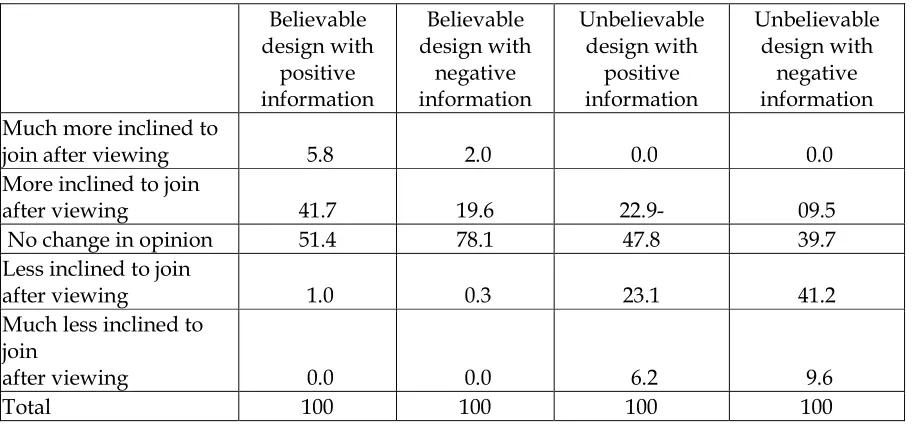
When asked, ‘If you already had positive information about this organization, and were
inclined to join, would the webpage that you found most believable change your view,’ 35.6%
of pro/con death penalty participants (Table 1), and 41.73 percent of pro/con abortion
respondents (Table 2) stated they would be ‘more inclined to join after viewing.’ A much
smaller 5.8% of abortion respondents and even smaller 3% of death penalty participants, said
that after viewing the same website that they believed they would be ‘much more inclined to
join after viewing.’ The overwhelming remainder of both pro/con abortion participants and
pro/con death penalty participants reported that there was no change in their opinion (only a
very small 1% of the abortion participants responded that they now were less inclined to join
after viewing and 2% of the death penalty participants responded the same). However, when
asked the same question, but applied to sites that respondents found less believable, the results
reveal a reduced willingness to participate (21.8 percent of death penalty participants and 23.1
It was also asked, ‘If you already had negative information about this organization, and
were not inclined to join, would the webpage that you found most believable change your
view?’ This resulted in an average of 19.6% of abortion respondents and a smaller 15.5% of
death respondents who stated that their view was changed positively and that they would be
‘more inclined to join after viewing’ and 2% of abortion respondents and 1.7% of death penalty
respondents said they would be ‘much more inclined to join after viewing’ followed by 4.7
percent of death penalty respondents and 6.4 percent of abortion respondents stating that they
would be less inclined to join. Of the remainder of participants, 78.1 and 72 percent, respectively
reported no change at all. Again, when asked the same question, but applied to sites that
respondents found less believable, the results reveal a strong reduction in willingness to
participate (33.3 percent of death penalty participants and 41.2 percent of abortion participants
report they would be less inclined to join after viewing).
Hypothesis four stated that the activist organization with a website that is viewed as
more credible will be more likely to engender participation. Of the nine webpage interface
designs that had a positive ‘somewhat credible’ rating over 65%, at least 40% of respondents
stated that they would be more inclined to join after viewing the websites for only four of the
nine organizations. Because these variables are both ordinal (containing ordered values),
Somers’ d, a modification of gamma that includes the number of pairs not tied on the
independent variable (SPSS, 199), was utilized. Somer’s d was used to test the proportion of the
variability of the dependent variable (participation) that was explained by knowing the values
of the independent variable (credibility) (SPSS, 1999). Using the respondents’ perceived
credibility of an organization via their website as an independent variable to predict their level
the later item when focused on generalized abortion websites. These numbers shifted slightly to
66.0% to 88.4% for generalized death penalty websites. In all of the cases, the Pearson chi-square
was significant at p = .000 suggesting a strongly significant association between perceived
credibility of the organization via the website and predicted participation within the
organization itself, therefore hypothesis four was accepted.
Discussion
Contrary to previous work in this area, structured websites with strong alignment and
symmetry were not found to be uniformly more credible. The symmetrical site was chosen as
most credible for death penalty non-profits but the organic site was chosen as most credible for
abortion non-profits. This may be a reflection of the issue itself. In this case, the death penalty
may have been seen as a more somber, stringent topic whereas abortion may have been
perceived as a more personalized, woman’s issue. Therefore, an organic site may have been
deemed more credible based on perceptions of femininity while a structured, symmetrical site
appeared much more credible to those connecting the death penalty with severe rules and
regulations. Therefore, this study appears to confirm what good designers have always
understood: content is integral in dictating design. Even though structure and symmetry may
denote professionalism, seriousness and cohesion, as other scholars have found, it may also be
found as unbelievable if the content does not support the design. This finding could be further
supported with research that examines respondents’ emotional perceptions of issues in addition
to the self-reported level of support for the cause that was measured for this study.
It is important to note that even when web pages were found to be credible, there was
some level of varying credibility for organizations whose websites were viewed in context with
the designs that surround it. Building credibility through an organizations’ interface design
appears to be dependent upon the design itself and competition from others. This suggests that
designers must be vigilant in keeping abreast of other interface designs on the web and be
ready to make modifications to their style.
As credibility was found to be dependent upon the context that the site was viewed, it
would be instructive to create a study that patterned vastly different visual sites in succession to
see distinctions in design patterns and resulting credibility ratings. This methodology has
already been done in other areas of study, mostly related to advertising, but it has not been
conceptualized with purely visual information.
Photographs and bright, warm colors were found to be credible regardless of the
organization’s focus. Thus, it appears that public fear of digital manipulation is not an
important factor in building credibility. Rather, in the context of a non-profit organization’s
interface design, the photograph itself appears to solidify the objectivity and credibility of the
messenger. Also, in contrast to earlier research that found cool, muted colors denoted
trustworthiness and professionalism, this research found that bright, warm colors translated
into increased credibility. The difference in results may be due to this research focus on
non-profits rather than the commercially-oriented banking industry, which was the background for
the previous study cited here. Thus, context may again be dictating credibility. It would be
helpful if future studies examine how various types of photography and a range of colors,
rather than one image throughout and only two opposing colors, can effect audience member’s
perception of source credibility.
Finally, participants who found a website credible stated they also had an intent to join
type of non-profit organization being discussed. Respondents were less willing to join a death
penalty organization than an abortion organization after viewing a site that they had already
received positive information about. This conclusion may be due to the nature of the
organization itself and the relative immediacy the participants may have felt with abortion as
opposed to the death penalty. In addition, the participants were much less polarized than they
were when answering their position on the abortion issue.
All respondents were uniformly more inclined to join an organization if positive
information already existed about the organization prior to viewing the site, but, this research
suggests that the design itself is an essential component to garnering participation. These two
factors appear to have a mutually contributing effect on credibility. If a respondent received
positive information and found the site believable, an average of 1.5 percent reported being less
inclined to join. However, those who were less inclined to join grew to an average of 22 percent
if they found the site design unbelievable. Thus, believability in the design itself appears to be
essential for participation in a non-profit organization. Further, while credibility ratings of those
who already had a positive impression of an organization were fairly high, the numbers were
lower from those who received negative information prior to viewing the site. This suggests
that first conceptions of the organization also play an important role in the credibility of a
website and that how people feel about an issue is an additional predictor of credibility.
Finally, when all eight options were presented for both types of organizations, the levels
of credibility and propensity to join were consistently higher than when only two options were
given. Thus, when respondents are given a broad variety of choices, it may be that they value
finding, however, could be better substantiated with future research that examines deeper
psychological processes of participant decision-making.
Given the results of this preliminary study, it is suggested that a model for building
visual credibility for non-profits should include utilizing photography and bright, warm colors.
However, this model must be flexible to allow for selection of an interface design that correlates
with the mood of the content and the clients that the non-profit serves. Without this flexibility,
interface designs that do not adhere to the content will be seen as less credible. If these design
approaches are taken, non-profits may see an increased propensity to join the organization from
web users – particularly those who have already received positive information about the
Table 1
Percentage intending to join a pro/con death penalty non-profit organization after viewing interface designs and receiving information
Believable design with positive information Believable design with negative information Unbelievable design with positive information Unbelievable design with negative information Much more inclined to
join after viewing 3.0 1.7 0.8 0.0
More inclined to join
after viewing 35.6 15.5 24.3 16.2
No change in opinion 59.4 72.0 52.4 43.7
Less inclined to join
after viewing 2.0 9.9 21.8 33.3
Much less inclined to join
after viewing 0.0 0.9 0.7 6.8
Table 2
Percentage intending to join a pro/con abortion non-profit organization after viewing interface designs and receiving information
Believable design with positive information Believable design with negative information Unbelievable design with positive information Unbelievable design with negative information Much more inclined to
join after viewing 5.8 2.0 0.0 0.0
More inclined to join
after viewing 41.7 19.6 22.9- 09.5
No change in opinion 51.4 78.1 47.8 39.7
Less inclined to join
after viewing 1.0 0.3 23.1 41.2
Much less inclined to join
after viewing 0.0 0.0 6.2 9.6
References
Austin, E. W. & Dong, Q. (1994). Source v. content effects on judgments of news believability.
Journalism Quarterly, 71, 973-983.
Barker-Plummer, Bernadette (1995). News as a Political resource: Media Strategies and Political
Identity in the U.S. Women’s Movement, 1966-1975. Critical Studies in Mass
Communication, 12, 306.
Berlo, D. K., Lemert, J. B. & Mertz, R. J. (1970). Dimensions for evaluating the acceptability of
message sources. Public Opinion Quarterly, 33, 563-576.
Birdsell, D., Muzzio, D., Taylor, H. & Krane, D. (1996). A new political marketplace: The web
snares voters. The Public Perspective, June/July, 33.
Brady, D. J. (1996). Cyberdemocracy and perceptions of politics: An experimental analysis of
political communication on the World Wide Web. Paper presented at the annual meeting of
the Midwest Association for Public Opinion Research. Chicago, IL:
Buller, D. B. & Burgoon, J. K. (1996). Interpersonal deception theory. Communication Theory, 6,
(3), 203-242.
Carter, R. & Greenberg, B. (1965). Newspapers or television: Which do you believe? Journalism
Quarterly, 42, 29-34.
Chaiken, S. (1979). Communicator physical attractiveness and persuasion. Journal of Personality
and Social Psychology, 37, 1387-1397.
Chartprasert, D. (1993). How bureaucratic writing style affects source credibility. Journalism
Dollarhide, M. (1999). Survey: Journalists find nonprofit Web sites more credible. Freedom Forum
Online, (March), http://www.freedomforum.org/technology/1999/3/2msc.asp.
Retrieved March 2002.
Dyson, E. (1997). Release 2.0: A design for living in the digital age. New York, NY: Broadway Books.
Fetveit, A. (1999). Reality TV in the digital era: A paradox in visual culture? Media, Culture &
Society, 21, 787-804.
Flanagin, A. J. & Metzger, M. J. (2000). Perceptions of Internet information credibility. Journalism
& Mass Communication Quarterly, 77, 515-540.
Fogg, B. J., Kameda, T., Boyd, J., Marshall, J., Sethi, R., Sockol, M. & Trowbridge, T. (2002).
Stanford-Makovsky web credibility study 2002: Investigating what makes web sties
credible today. A Research Report by the Stanford Persuasive Technology Lab & Makovsky &
Company. Stanford University. [Online: http://www.webcredibility.org]
Fogg, B. J., Marshall, J., Laraki, O., Osipovich, A., Varma, C., Fang, N., Paul, J., Rangnekar, A.,
Shon, J., Swani, P., & Treinen, M. (2001). What makes a web site credible? A report on a
large quantitative study. Proceedings of ACM CHI 2001 Conference on Human Factors in
Computing Systems, 1, 61-68. New York, NY: ACM Press. [Online
http://captology.stanford.edu/pdf/p61-fogg.pdf]
Fogg, B. J. & Tseng, H. (1999). The elements of computer credibility. Proceedings of the CH199
Conference on Human Factors and Computing Systems, 80-87. New York, NY: ACM Press.
Foss, K. (1992). Digital dilemma: Enhancement or manipulation? Photo Electronic Imaging, April,
21-23.
García, M. R. (1993). Contemporary Newspaper Design: A Structural Approach, 3rd edition.
Gatignon, H & Robertson, T. S. (1991). Innovative decision processes. In T. S. Robertson & h. H.
Kassarjian (Eds.), Handbook of Consumer Behavior. Englewood Cliffs, NY: Prentice-Hall.
Gattegno, C. (1969). Towards a visual culture: Educating through television. New York, NY:
Outerbridge & Dienstfrey.
Gitlin, T. (1980). The Whole World Is Watching: Mass Media in the Making and Unmaking of the New
Left. Berkley, CA: University of California Press.
Goldman, R. & Beeker, G. (1985). Decoding newsphotos: An analysis of embedded ideological
values. Humanity and Society, 9, 351-361.
Gorham, Joan, Cohen, Stanley H., and Morris, Tracy L. (1999). Fashion in the classroom III:
Effects of instructor attire and immediacy in natural classroom interactions.
Communication Quarterly, 47, 281-299.
Gotlieb, J. B. & Sarel, D. (1991). Comparative advertising effectiveness: The role of involvement
and source credibility. Journal of Advertising, 20, (1), 38-45.
Hall, S. (1973). The determinations of news photographs, in S. Cohen & J. Young (Eds.), The
manufacture of news: Deviance, social problems and the mass media, pp. 176-190. London,
United Kingdom: Constable.
Homer, P. M. & Kahle, L. R. (1990). Source expertise, time of source identification, and
involvement in persuasion: An elaborative processing perspective. Journal of Advertising,
19, (1), 30-39.
Hovland, C. I. & Weiss, W. (1951). The influence of source credibility on communication
effectiveness. Public Opinion Quarterly, 15, 633.650.
Huang, E. (2001). Readers’ perception of digital alteration in photojournalism. Journalism &
Hundertmark, J. (1991). When enhancement is deception: The ethics of photo manipulation.
Publish, October, 51-55.
Huxford, J. (2001). Beyond the referential: Uses of visual symbolism in the press. Journalism:
Theory, Practice and Criticism, 2, 45-71.
Johnson, T. J., & Kaye, B. K. (1998). Cruising is believing?: Comparing internet and traditional
sources on media credibility measures. Journalism and Mass Communication Quarterly, 75,
325-340.
Kaplowitz, S., Fink, E., Mulcrone, J., Atkin, D. & Dabil, S. (1991). Disentangling the effects of
discrepant and disconfirming information. Social Psychology Quarterly, 54, 191-207.
Kim, J. & Moon, J. Y. (1997). Designing towards emotional usability in customer interfaces:
Trustworthiness of cyber-banking system interfaces. Interacting with Computers, 10, 1-29.
Kiousis, S. (2001). Public trust or mistrust? Perceptions of media credibility in the information
age. Mass Communication & Society, 4, 381-403.
Lashbrook, W. B., Snavely, W. B., & Sullivan, S. L. (1977). The effects of source credibility and
message information quantity on the attitude change of apathetics. Communication
Monographs, 44, 252-262.
Lauer, D. & Pentak, S. (2002). Design Basics, 5th Edition. Belmont, CA: Wadsworth/Thomson
Learning.
Lester, P. (2000). Visual communication: Images with messages, 2nd edition. Belmont, CA:
Wadsorth/Thomson Learning.
Luchok, J. A., & McCroskey, J. C. (1978). The effect of quality of evidence on attitude change
and source credibility. Southern Speech Communication Journal, 43, 371-383.
McCroskey, J. & Mehrley, R. S. (1969). The effects of disorganization and nonfluency on attitude
change and source credibility. Speech Monographs, 36, 13-21.
Mokhoff, N. (1999). Computers must be credible by design. Electronic Engineering Times, June 7,
61.
Molotch, H. (1979). Media and Movements. In M. Zald & J.M. McCarthy (Eds.), The Dynamics of
Social Movements. 54-72,Cambridge, MA: Wintrop.
Mulac, A. & Sherman, A. R. (1975). Relationships among four parameters of speaker evaluation:
Speech skill, source credibility, subjective speech anxiety, and behavioral speech anxiety.
Speech Monographs, 42, 302-310.
O’Keefe, D. J. (1990). Persuasion theory and research. Newbury Park, CA: Sage.
Poynter Organization (2002). Color, Contrast & Dimension in News Design.
http://www.poynter.org/special/colorproject/colorproject/color.html. Retrieved
March of 2002.
Petty, R. & Cacioppo, J. (1981). Attitudes and Persuasion: Classic and Contemporary Approaches.
Dubuque, IA: Brown.
Rimmer, T. & Weaver, D. (1987). Different questions, different answers? Media use and media
credibility. Journalism Quarterly, 64, 28-36, 44.
Schweiger, Wolfgang. (2000). Media credibility - experience or image?: A survey on the
credibility of the World Wide Web in Germany in comparison to other media. European
Journal of Communication. 15 , 37-59.
Self, C. S. (1996). Credibility. In M. Salwen & D. Stacks (Eds.), An Integrated Approach to
Slater, M. D., and Rouner, D. (1996). How message evaluation and source attributes may
influence credibility assessment and belief change. Journalism & Mass Communication
Quarterly,. 73 (4, Winter), 974-991.
Sheldon, K. & Kasser, T. (2001). Getting older, getting better? Personal strivings and
psychological maturity across the life span. Developmental Psychology, 37, (4), 491.
SPSS Base 9.0 Applications Guide (1999). Chicago, IL: SPSS.
Stempel III, G. & Hargrove, T. (1996). Mass media audiences in a changing media environment.
Journalism & Mass Communication Quarterly, 73, 549-558.
Sturken, M. & Cartwright, L. (2001). Practices of looking: An introduction to visual culture. Oxford,
United Kingdom: Oxford University Press.
Srull, T., Lichtenstein, M. & Rothbart, M. (1985). Associative storage and retrieval processes in
person memory. Journal of Experimental Psychology: Learning, Memory & Cognition, 11,
316-345.
Stiff, J. (1994). Persuasive Communication. New York, NY: Guilford.
Wanta, W. & Hu, Yu-Wei (1994). The effects of credibility, reliance, and exposure on media
agenda-setting: A path analysis model. Journalism Quarterly, 71, 90-98.
Ward, D. C. & McGinnies, E. (1974). Persuasive effects of early and late mention of credible and
noncredible sources. Journal of Psychology, 86, (1), 17-23.
Westley, B. & Severin, W. (1964). Some correlates of media and credibility. Journalism Quarterly,
41, 325-335.
Whitehead, J. L. (1968). Factors of source credibility. Quarterly Journal of Speech, 54, 59-63.
Woodall, W., Burgoon, J., and Markel, N. (1980). The effects of facial-head cue combinations on
interpersonal evaluations. Communication Quarterly, 28, 47-55.
Yoon, K., Kim, C. H., and Kim, M. (1998). A cross-cultural comparison of the effects of source
credibility on attitudes and behavioral intentions. Mass Communication & Society, 1,
153-173.
van Zoonen, E. A. (1992). The Women’s Movement and the Media: Constructing a Public